

Have you ever written something in an earlier article, essay, book, interview, or email and wanted to use those exact words again? If so, you may have wondered: Do I need quotation marks when I quote myself? The short answer is yes, if you are reproducing your own earlier words exactly as a quotation. Your own words do not get a special exemption from normal quotation rules.
However, there’s an important distinction.
If you’re repeating your exact earlier wording, quotation marks can show readers that the words come directly from your previous statement. If you’re only explaining the same idea in your own new wording, quotation marks usually aren’t necessary. In academic writing, there’s another layer to consider: citation. Quotation marks show that the wording is being reproduced exactly. A citation tells readers where that wording or idea originally appeared.
So, self-quotation and self-citation can work together, but they are not the same thing.
Quick Answer
Yes. If you are quoting your own previous words word-for-word, use quotation marks just as you would when quoting someone else.
For example, imagine you wrote this sentence in an earlier article:
“Clear writing begins with clear thinking.”
Later, you want to reproduce that exact sentence in another article.
You could write:
As I wrote in my earlier article, “Clear writing begins with clear thinking.”
The quotation marks tell readers that the sentence is being presented as an exact quotation.
But suppose you don’t remember the original wording exactly. Instead, you write:
I previously argued that clear thinking helps produce clearer writing.
That’s a paraphrase, not a direct quotation. You have expressed the earlier idea in different words, so quotation marks aren’t normally needed.
The key question is simple:
Are you repeating your exact earlier words, or are you expressing the earlier idea in new words?
That distinction determines whether quotation marks are appropriate.
Understanding Self-Quotation: What Does It Mean to Quote Yourself?
Self-quotation means reproducing words that you previously wrote or said and presenting them as a quotation.
The word “self” simply identifies the original speaker or writer as you.
For example, suppose you wrote a book several years ago and included this sentence:
“Language becomes clearer when writers choose precise words.”
If you later use that exact sentence in a new book, article, presentation, or essay, you’re quoting yourself.
You might introduce it like this:
In my earlier book, I wrote, “Language becomes clearer when writers choose precise words.”
The quotation marks surround the exact words taken from the earlier source.
Self-quotation can happen in many settings.
You might quote yourself from:
- an earlier article
- a published book
- a research paper
- an academic thesis
- an interview
- a speech
- a personal essay
- a memoir
- an email
- a previous presentation
- an earlier social or professional statement
The punctuation principle remains essentially the same. If you reproduce the original wording as a direct quotation, quotation marks help distinguish those words from the surrounding text.
Why Would You Quote Yourself?
Writers quote themselves for several practical reasons.
Perhaps an earlier sentence expresses an idea particularly well. Maybe you made an important observation in a previous publication and want to revisit it. You might also want to compare your earlier position with your current thinking.
For example:
In my 2022 article, I wrote, “Good editing is not about making every sentence longer.” I still agree with that principle.
Here, the quotation serves a clear purpose. It lets readers see your original wording before you comment on it.
Self-quotation can also create a useful connection between different pieces of writing.
For example:
I described the problem in my earlier report as “a gap between policy and practice.”
The quotation gives readers the exact phrase you previously used.
Direct Quotation vs. Paraphrase
This is the most important distinction to understand.
A direct quotation reproduces the original wording.
A paraphrase communicates the original meaning using different wording.
Consider an original sentence:
“Effective communication depends on understanding your audience.”
If you use those exact words, you are quoting yourself:
I previously wrote, “Effective communication depends on understanding your audience.”
The quotation marks signal that the wording itself comes from the earlier text.
Now consider this version:
I previously explained that good communication requires writers to understand their readers.
The meaning is similar, but the wording has changed.
That is a paraphrase.
You don’t normally put quotation marks around it.
Direct Quotation
A direct quotation preserves the original wording.
In my earlier report, I wrote, “Effective communication depends on understanding your audience.”
Paraphrase
A paraphrase restates the earlier idea.
My earlier report emphasized the importance of understanding your audience when communicating.
The difference isn’t about whether the idea belongs to you.
It’s about whether the specific wording is being reproduced.
That’s an important point because writers sometimes assume quotation marks are unnecessary when the original speaker is themselves.
They aren’t.
Quotation marks identify reproduced wording, not the identity of the person who originally created it.
When Should You Use Quotation Marks for Your Own Words?
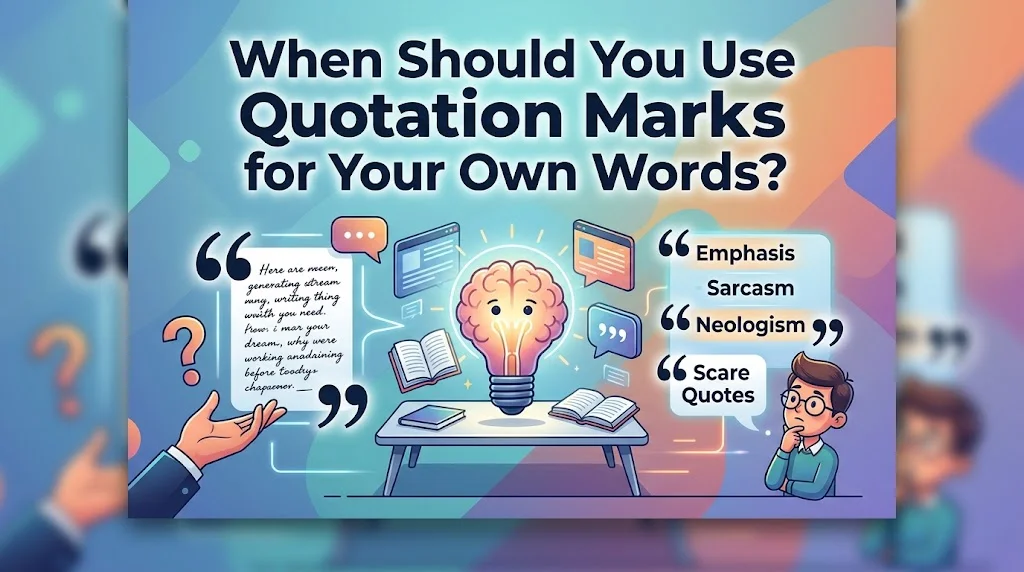
Use quotation marks when you’re presenting your earlier wording as a direct quotation.
This is especially useful when the precise language matters.
For example:
In my previous article, I described the situation as “a turning point for modern workplace communication.”
The quotation marks show that a turning point for modern workplace communication is the wording you used previously.
Without quotation marks, the sentence could suggest that you’re simply describing the situation in your current writing.
Compare these examples:
I previously described the change as “a turning point for modern workplace communication.”
and:
I previously described the change as a turning point for modern workplace communication.
The first version clearly presents the phrase as your earlier wording.
The second version can read more like a general description in the current text.
When Exact Wording Matters
Quotation marks become especially useful when you want readers to notice the precise language.
For example, imagine you’re discussing how your opinion changed over time:
In my earlier essay, I called the proposal “a promising but incomplete solution.” Today, I would describe it differently.
The exact phrase matters because you’re analyzing your earlier statement.
Without quotation marks, the reader may not know whether you’re reproducing your old words or simply summarizing your previous position.
Self-quotation can therefore be useful when you’re:
- examining your earlier argument
- comparing past and present views
- discussing an important phrase you coined
- analyzing your previous writing
- revisiting an earlier publication
- explaining how your position developed
- showing the exact language used in an earlier work
The more important the original wording is, the more useful direct quotation becomes.
Why Exact Wording Matters
A quotation is about more than an idea.
It preserves the language used to express that idea.
Suppose your original sentence was:
“Small changes can transform the way readers experience a sentence.”
You later write:
“Small changes can completely transform how readers experience a sentence.”
Those sentences are very similar, but they’re not identical.
If you present the second sentence as though it were your original quotation, you’ve changed the wording.
That may seem minor, especially when you’re quoting yourself. But the same basic principle still applies: a direct quotation should accurately represent the original wording.
If you need to make changes, you should make it clear that the wording has been altered when the relevant style or context requires it.
Don’t Quietly Rewrite a Quotation
Suppose your earlier sentence said:
“The results demonstrate a significant change in reader behavior.”
You remember the idea but write:
“The results show a major change in reader behavior.”
If you place the second version inside quotation marks and present it as your earlier sentence, you’re no longer giving an exact quotation.
Instead, you have created a paraphrase.
You could simply write:
I previously argued that the results showed a major change in reader behavior.
Now the wording belongs to your current writing rather than being presented as an exact reproduction.
This distinction becomes particularly important in academic and professional contexts.
When Don’t You Need Quotation Marks?
You generally don’t need quotation marks when you’re paraphrasing, summarizing, or referring to your earlier idea without reproducing its exact wording.
For example:
I discussed this issue in an earlier article.
No quotation is being presented.
You could also write:
My earlier research examined how readers respond to complex sentences.
Again, you’re referring to previous work without reproducing a specific sentence.
Or:
I previously argued that shorter sentences can improve readability.
This communicates an earlier idea but does not claim to reproduce your exact original words.
Quotation marks would therefore be unnecessary.
Referring to Your Own Ideas
Writers often use phrases such as:
As I discussed earlier…
In my previous article, I argued that…
I previously explained that…
My earlier research examined…
In an earlier essay, I suggested that…
These phrases usually introduce a reference or paraphrase, not a direct quotation.
For example:
In my previous article, I argued that consistency improves readability.
There’s no need for quotation marks because you’re not claiming that I argued that consistency improves readability was your exact earlier wording.
You’re simply describing the substance of your earlier argument.
Useful Phrases for Referring to Your Earlier Ideas
Sometimes you want to acknowledge your previous work without quoting it directly.
Several natural phrases can help.
“As I mentioned earlier”
As I mentioned earlier, clear headings help readers navigate long articles.
This is useful when referring to something earlier in the same piece of writing.
“In my previous article”
In my previous article, I discussed the difference between editing and proofreading.
This works well when referring to a separate article.
“In an earlier study”
In an earlier study, I examined how sentence length affects readability.
This is especially appropriate in academic or research contexts.
“I previously argued”
I previously argued that writers should prioritize clarity over unnecessary complexity.
This signals that you’re referring to your earlier position.
“As I wrote in…”
As I wrote in my earlier book, “Good writing should make difficult ideas easier to understand.”
This phrase works particularly well when followed by an actual direct quotation.
Notice the difference:
As I wrote in my earlier book, readers benefit from clear explanations.
This is a reference or paraphrase.
As I wrote in my earlier book, “Good writing should make difficult ideas easier to understand.”
This contains a direct quotation.
The quotation marks make the distinction visible.
One Important Academic Distinction
Academic writing adds an important layer to the question.
When you reuse your own earlier words, quotation marks and citation perform different jobs.
Quotation marks indicate that the wording is being reproduced directly.
A citation identifies the earlier source.
For example:
As I argued in an earlier article, “Clear definitions reduce confusion for readers” (Author, 2023).
Here, the quotation marks identify the exact wording, while the citation points readers toward the earlier publication.
If you paraphrase instead:
I previously argued that clear definitions reduce confusion for readers (Author, 2023).
There are no quotation marks because the wording has been changed, but the citation may still be necessary.
This distinction is crucial.
No quotation marks does not automatically mean no citation.
Likewise, quotation marks do not automatically provide enough information for readers to locate the original source.
In academic writing, you need to think separately about:
What words am I using?
and:
Where did those words or ideas originally appear?
Those are two different questions.
How Context Changes Self-Quotation
Whether quotation marks are helpful can also depend on context.
A sentence that clearly identifies an earlier quotation in one situation may be confusing in another.
For example:
I once wrote, “The problem is more complicated than it appears.”
The phrase I once wrote tells readers that the following words come from an earlier statement.
Now consider:
“The problem is more complicated than it appears.”
If the sentence appears without context, readers may not know who originally said or wrote it.
The quotation marks show that the words are being presented as a quotation, but they don’t tell readers whose words they are.
That’s why context matters.
Context Should Make the Source Clear
When quoting yourself, introduce the quotation in a way that makes its origin understandable.
You might write:
In my earlier essay, I wrote, “The problem is more complicated than it appears.”
Or:
I described the issue in my 2024 report as “more complicated than it appears.”
These versions give readers useful context.
The quotation marks identify the exact wording, while the surrounding sentence explains where it came from.
This becomes particularly important when your current audience has never seen your earlier work.
Don’t assume readers automatically know what you’re referring to.
Same Article, Different Article
Self-reference can happen within the same article or across different works.
If you’re quoting something you wrote earlier in the same article, the surrounding context may already make the source clear.
For example:
Earlier, I wrote, “Clear examples make difficult grammar easier to understand.”
The phrase earlier, I wrote clearly points readers to the previous wording.
If you’re quoting from a different article, book, study, or publication, more information may be useful:
In my earlier article on sentence structure, I wrote, “Clear examples make difficult grammar easier to understand.”
In academic writing, you may also need a formal citation.
The basic quotation principle doesn’t change simply because the earlier words belong to you.
If the wording is being reproduced exactly, treat it as a quotation.
If you’re merely referring to the earlier idea, paraphrase it without quotation marks.
That simple distinction will guide most self-quotation decisions.
Quoting Yourself in Academic Writing
Academic writing makes self-quotation a little more complicated because your previous work may be part of the scholarly record.
If you quote something you wrote in an earlier paper, thesis, dissertation, book, conference presentation, or published article, you should treat the wording as a direct quotation when you reproduce it exactly.
For example:
In my previous study, I described the pattern as “a gradual shift in reader expectations.”
The quotation marks show that the phrase comes directly from your earlier writing.
However, academic writing also requires you to consider self-citation.
Even though you wrote the original words, readers may need to know where those words appeared previously.
This is why the question isn’t simply:
“Do I need quotation marks?”
You may also need to ask:
“Do I need to cite my earlier work?”
In many academic situations, the answer can be yes.
Why Self-Citation Matters
A citation does more than give credit to another person.
It also helps readers trace the development of an idea or argument.
Suppose you published a study in 2023 and later write another paper that discusses the same research.
You might write:
My earlier study found that readers responded more positively to shorter explanations (Author, 2023).
This is a reference to your previous work.
If you reproduce an exact sentence, quotation marks may also be appropriate:
As I noted in my earlier study, “Readers responded more positively to shorter explanations” (Author, 2023).
The two sentences serve slightly different purposes.
The first paraphrases your earlier finding.
The second quotes your earlier wording.
In both cases, the previous work may need to be identified.
Quotation Marks and Citations Do Different Jobs
This distinction is worth remembering:
Quotation marks show exact wording.
Citations identify the source.
Neither replaces the other.
Consider this example:
I previously described the findings as “surprising but consistent.”
The quotation marks tell readers that the phrase is being reproduced exactly.
But if this is a reference to a previously published academic work, readers may also need a citation:
I previously described the findings as “surprising but consistent” (Author, 2023).
The citation tells readers where to find the original material.
Now consider a paraphrase:
My earlier research characterized the findings as unexpected but consistent (Author, 2023).
There are no quotation marks because the wording has changed.
The citation can still be necessary because the underlying material comes from the earlier source.
This is one of the most important principles in academic self-reference.
APA, MLA, and Chicago: How Self-Quotation Works
Different academic styles have their own rules for citations, quotation length, formatting, and repeated references.
APA, MLA, and Chicago all recognize the distinction between quoting and paraphrasing, but their citation systems differ.
The safest approach is to identify the required style before preparing your final paper.
Don’t assume that quotation marks alone satisfy the requirements of your institution.
Your professor, journal, publisher, or department may also have additional instructions.
MLA and Quoting Your Previous Work
MLA style commonly uses an author-page citation system.
If you quote from a work you previously published, the quotation can still require an appropriate citation.
For example:
I previously described the argument as “a major shift in literary interpretation” (Author 42).
The quotation marks identify the exact language.
The parenthetical citation points readers toward the source and relevant page.
If you paraphrase instead:
My earlier article described the argument as a major change in literary interpretation (Author 42).
The quotation marks disappear because you are no longer reproducing the exact wording.
The source can still require citation.
If your earlier work is being cited by your own current paper, follow the MLA guidance that applies to the specific source.
Chicago and Self-Reference
Chicago style offers different documentation systems, depending on the type of work and the preferences of the publisher or institution.
A quotation may appear with quotation marks in the text, while the source is documented through notes or another appropriate citation method.
For example:
I previously called the development “an unexpected consequence.”¹
A note can then identify the earlier publication.
The important principle remains unchanged.
Quotation marks indicate the reproduced wording. The citation system identifies the source.
When using Chicago style, check whether your assignment or publication uses the notes-bibliography system or author-date system.
APA Considerations
APA style distinguishes clearly between direct quotations and paraphrases.
If you reproduce your earlier wording directly, treat it as a quotation and provide the relevant citation information.
For example:
I previously described the process as “a gradual transformation” (Author, 2023, p. 15).
If you paraphrase:
I previously described the process as a gradual transformation (Author, 2023).
The quotation marks are not necessary in the second version because the wording is your new wording.
Page numbers may be required or recommended in particular APA quotation situations, while paraphrases follow different citation requirements.
Always check the current style guidance required by your institution or publication.
Self-Quotation vs. Self-Citation
These terms sound similar, but they describe different things.
Self-quotation means using your own earlier words as a direct quotation.
Self-citation means citing your previous work as a source.
You can do one without the other in some contexts.
For example, in an informal article, you might write:
As I said earlier, “Clear writing starts with clear thinking.”
That’s self-quotation, but it may not require a formal academic citation.
In academic writing, you might have:
As I argued in my earlier study, “Clear writing starts with clear thinking” (Author, 2023).
Here, you have both self-quotation and self-citation.
You can also cite your previous work without directly quoting it:
My earlier study examined the relationship between sentence length and readability (Author, 2023).
That’s self-citation without self-quotation.
Understanding this difference prevents a common mistake: assuming that quotation marks and citations are interchangeable.
The Difference at a Glance
| Situation | Quotation Marks? | Citation? |
| Exact earlier wording in casual writing | Usually yes | Not necessarily |
| Exact earlier wording in academic writing | Yes | Usually needed |
| Paraphrasing your earlier work | No | Often needed |
| Referring generally to your previous idea | No | Depends on context |
| Mentioning your earlier article by title | Usually no | Often appropriate in academic work |
| Reproducing a published passage | Yes if directly quoted | Usually needed in academic work |
The exact requirements can vary by style guide, institution, publication, and source type.
The table is therefore a practical guide rather than a substitute for the rules that apply to your specific project.
Quoting Something You Published Previously
Suppose you wrote a published article several years ago.
You now want to reuse one sentence in a new article.
For example, your earlier article says:
“Readers understand complex ideas more easily when writers introduce them gradually.”
Your new article says:
In my earlier article, I wrote, “Readers understand complex ideas more easily when writers introduce them gradually.”
This is a direct self-quotation.
The quotation marks are appropriate because you’re reproducing the earlier sentence.
But because the original article was published, you may also need to identify that earlier source, especially in academic or professional publishing.
What If You Change a Few Words?
Be careful.
Suppose the original sentence was:
“Readers understand complex ideas more easily when writers introduce them gradually.”
You change it to:
“Readers understand difficult ideas more easily when writers introduce them gradually.”
You’ve replaced complex with difficult.
That means the quotation is no longer an exact reproduction.
If you need to make a change inside a quotation, follow the relevant style rules for indicating alterations.
In many academic contexts, brackets can be used to show that a word has been changed or supplied.
For example:
“Readers understand [difficult] ideas more easily when writers introduce them gradually.”
The exact method depends on the style you’re following.
The larger lesson is simple:
Don’t silently change a direct quotation and continue presenting it as the original wording.
Copyright Is Separate From Punctuation
Quotation marks answer a punctuation question.
They do not automatically answer a copyright question.
This distinction matters when you’re reusing material from something you previously published.
You may own the copyright to your work, or you may have transferred or licensed some rights to a publisher, employer, organization, or other party.
So, being the original writer does not necessarily mean you can freely reproduce every previously published passage.
For example, imagine you wrote a book and later signed a publishing agreement.
You may still be the author, but the agreement could affect your rights to reuse substantial portions of the text.
That’s a copyright issue, not a quotation-mark issue.
Punctuation and Copyright Are Different Questions
When reusing previous writing, ask two separate questions:
Question one:
Do I need quotation marks because I’m reproducing the original wording?
Question two:
Do I have the right or permission to reuse this material?
The first question concerns writing and punctuation.
The second concerns copyright, licensing, publication agreements, and potentially institutional policies.
Don’t assume that quotation marks solve a copyright problem.
They don’t.
Likewise, obtaining permission to reuse text does not determine whether quotation marks are grammatically appropriate.
These are separate considerations.
Self-Quotation and Self-Plagiarism: What’s the Difference?
The phrase self-plagiarism can sound strange at first.
After all, how can you plagiarize yourself?
In academic and professional contexts, the issue isn’t simply ownership of words. It concerns the reuse or presentation of previously submitted or published work without appropriate disclosure, citation, or compliance with relevant rules.
For example, imagine a student submits the same paragraph in two different assignments without telling the instructor.
The student originally wrote the paragraph, but that doesn’t automatically mean the reuse is acceptable.
Similarly, a researcher may need to disclose that material or findings appeared in an earlier publication.
The exact rules vary by institution, discipline, publisher, and situation.
Why This Matters for Students
Students sometimes assume:
“I wrote it, so I can use it anywhere without quotation marks or citation.”
That’s not always correct.
An instructor may expect every assignment to contain original work produced for that particular task.
If you reuse material from an earlier paper, you may need permission, disclosure, citation, or substantial revision.
For example, you might have written:
“Social media has transformed how students communicate.”
in an earlier assignment.
If you submit the same sentence in another assignment, quotation marks alone may not resolve the issue.
The instructor’s policy may prohibit submitting previously graded work or recycled passages.
That’s why students should check the assignment instructions and academic integrity policy.
Why This Matters for Researchers
Researchers face a similar but more complex issue.
Academic publications often expect authors to distinguish new contributions from material that has appeared elsewhere.
Reusing your own wording may be acceptable in some circumstances, but extensive overlap can create problems.
For example, a researcher might reuse a methods description because the procedure remains unchanged.
A journal may permit some repetition, while another publication may have stricter requirements.
The important point is that self-quotation is not automatically the same thing as self-plagiarism.
Self-quotation describes how you present your earlier words.
Self-plagiarism concerns the broader practice and context of reusing previous work.
Quotation marks may help accurately identify reused wording, but they don’t automatically make every form of reuse acceptable.
Self-Quotation in Creative and Literary Writing
Self-quotation isn’t limited to academic work.
Authors use their own earlier language in creative writing too.
A novelist might repeat a phrase from an earlier chapter.
A poet might intentionally echo a line from an earlier poem.
A memoirist might revisit words used in a diary years earlier.
A playwright might have a character repeat something from an earlier scene.
In these situations, quotation marks depend on how the words function in the new work.
For example:
I remembered what I had written years earlier: “You cannot understand the road until you have traveled it.”
If the writer is presenting the earlier words as a direct quotation, quotation marks make sense.
But if the writer has simply incorporated the same idea into a new sentence, quotation marks may not be necessary.
Creative writing gives authors more stylistic freedom, but the basic distinction between direct quotation and paraphrase remains useful.
Why Writers Quote Earlier Language
A writer may quote earlier language to show:
- how their thinking has changed
- how a memory has remained important
- how a younger version of themselves viewed an event
- how a particular phrase influenced later work
- how language connects different parts of a story
- how an earlier statement gains a new meaning over time
For example:
In my old notebook, I had written, “Tomorrow will be different.”
Years later, the sentence might carry a completely different emotional meaning.
The quotation marks tell readers that the phrase belongs to the earlier writing.
The writer isn’t simply saying the same thing again.
They’re bringing the earlier words into the present narrative.
Quoting Yourself in Personal Narratives and Memoirs
Memoirs often contain self-quotation because writers may revisit journals, letters, notes, diaries, or other personal records.
Suppose a memoirist finds a sentence in an old journal:
“I want to leave this town and never look back.”
The memoir might reproduce it as:
My journal from that summer contained a single sentence: “I want to leave this town and never look back.”
The quotation marks show that the memoir reproduces the earlier journal entry.
This can make the narrative feel more immediate because readers see the writer’s earlier words rather than only a later summary.
A Practical Rule for Memoir
When writing memoir, ask:
Am I showing the reader the exact words I wrote or said at the time?
If yes, quotation marks can help identify them as direct quotations.
If you’re summarizing your earlier thoughts, you can paraphrase:
At the time, I desperately wanted to leave town and start over.
The meaning remains, but the wording belongs to the present narrator.
This distinction can also help memoir writers show the difference between their past voice and present perspective.
What If You Quote Yourself From an Interview?
Interviews create another interesting situation.
Suppose you gave an interview several years ago and now want to reproduce something you said.
If you’re presenting your exact words, quotation marks can be appropriate:
In a 2021 interview, I said, “The project taught me to value patience.”
The quotation marks indicate that the sentence represents your earlier spoken words.
If you’re only summarizing what you said, quotation marks aren’t necessary:
In the interview, I explained that the project taught me to value patience.
The second version communicates the idea without claiming to reproduce the exact wording.
Spoken Words Can Be Quoted Too
Quotation marks aren’t limited to written material.
You can quote your own:
- interview responses
- speeches
- presentations
- recorded statements
- public remarks
- conversations, depending on the context
The same basic principle applies.
If you reproduce the exact wording, you’re dealing with a direct quotation.
If you summarize the meaning, you’re paraphrasing.
What If You Quote Yourself From an Email or Message?
You may also want to reuse something you wrote in an email, text message, or professional communication.
For example:
In my email to the team, I wrote, “We need to review the proposal before Friday.”
If those are the exact words from the email, quotation marks make sense.
If you’re simply explaining what you told the team, you could write:
I told the team that we needed to review the proposal before Friday.
No quotation marks are needed because you’ve changed the wording.
One Extra Consideration
Emails and private messages can contain information about other people, confidential business information, personal data, or sensitive discussions.
Even if you wrote the original message, that doesn’t automatically mean you should reproduce it publicly.
Before reusing an old email or message, consider:
- who received it
- whether it contains confidential information
- whether other people’s words appear inside it
- whether publication could reveal private information
- whether your workplace has communication policies
- whether permission is appropriate
The punctuation question is only one part of the decision.
If you are reproducing your own exact words, quotation marks may be appropriate. But the broader context determines whether sharing those words is appropriate in the first place.
A Practical Self-Quotation Case Study
The easiest way to understand self-quotation is to look at one situation from several angles.
Imagine that you wrote this sentence in an earlier article:
“Good writing respects the reader’s time.”
You now want to discuss that idea in a new article about clear communication.
You have several options.
The best choice depends on what you want your new sentence to accomplish.
Direct Quotation
If you want to reproduce your original wording exactly, use quotation marks.
In my earlier article, I wrote, “Good writing respects the reader’s time.”
This is a direct quotation because the words inside quotation marks are presented as your exact earlier wording.
If the earlier article is a published source and you’re writing in an academic setting, you may also need an appropriate citation.
The quotation marks and citation perform separate functions.
The quotation marks show the wording.
The citation identifies the source.
Paraphrase
Maybe the exact wording isn’t important.
Perhaps you simply want to communicate the idea again.
In that case, paraphrasing may be more natural:
In my earlier article, I argued that writers should consider their readers’ time.
This sentence conveys the same general idea, but it uses different wording.
Because you’re not presenting the sentence as an exact quotation, quotation marks aren’t needed.
In academic writing, however, a citation may still be appropriate.
That’s because a paraphrase can still be based on a previous published source.
Brief Reference
You may not even need to restate the idea.
Sometimes a brief reference is enough:
I discussed this principle in an earlier article.
Or:
My previous work examined the importance of reader-focused writing.
These statements simply point readers toward your earlier work.
There is no direct quotation, so quotation marks aren’t necessary.
If the context is academic, a citation may still be required.
Which One Should You Choose?
Ask yourself what you want the reader to understand.
If the exact wording matters, use a direct quotation.
If the idea matters but the original wording doesn’t, paraphrase it.
If you only need to remind readers that you’ve discussed the topic before, a brief reference may be enough.
For example:
| Your purpose | Best approach |
| Show your exact earlier wording | Direct quotation |
| Explain the same idea differently | Paraphrase |
| Mention previous work briefly | Reference |
| Analyze a phrase you previously used | Direct quotation |
| Summarize your previous argument | Paraphrase |
| Point readers toward an earlier publication | Reference or citation |
This simple distinction can prevent most confusion about self-quotation.
A Simple Test: Do I Need Quotation Marks?
When you’re unsure whether to use quotation marks around your own words, work through a few questions.
Are These My Exact Earlier Words?
Start with the most important question.
Are you reproducing the exact wording you used before?
If yes, quotation marks are generally appropriate when you’re presenting those words as a direct quotation.
For example:
I previously wrote, “Clarity should guide every editing decision.”
If that’s exactly what you wrote before, the quotation marks make the status of those words clear.
If you aren’t sure whether the wording is exact, don’t automatically put it inside quotation marks.
Check the original source if possible.
This is especially important when the quotation is being used in academic, legal, professional, or published writing.
Am I Simply Referring to an Earlier Idea?
If you’re expressing the earlier idea in new language, you’re paraphrasing.
For example, your original sentence might have been:
“Clarity should guide every editing decision.”
Your new sentence could be:
My earlier work emphasized the importance of clarity during editing.
This is not a direct quotation.
The wording has changed.
Therefore, quotation marks aren’t needed.
If you’re working academically, remember that a paraphrase can still require a citation.
Is the Earlier Work Published?
This question matters because publication can introduce additional considerations.
If your earlier words appeared in a published article, book, research paper, website, or other public work, readers may benefit from knowing where they came from.
In academic writing, the source may need to be cited.
In commercial publishing, copyright or licensing agreements may also matter.
Don’t assume that being the original author eliminates these concerns.
You can be the original writer and still need to identify the previous publication or check your reuse rights.
Is This Academic Writing?
If you’re writing a university paper, thesis, dissertation, journal article, conference paper, or research report, be especially careful.
Academic writing generally requires clear source documentation.
If you quote your previous work directly, you may need both:
Quotation marks + citation
If you paraphrase your earlier work, you may need:
Citation without quotation marks
The exact requirements depend on the style guide and institutional rules.
Always check whether your school, department, journal, or publisher has additional requirements.
Am I Using Quotation Marks Only for Emphasis?
This is another common problem.
Quotation marks are not normally used simply to make a word or phrase stand out.
For example, avoid writing:
My “own” research showed a different result.
unless the quotation marks have a specific linguistic purpose.
If you want emphasis, formatting such as italics or bold may be more appropriate, depending on the style and context.
Likewise, don’t put quotation marks around a phrase simply because it belongs to you.
Quotation marks aren’t a badge that means:
“These are my words.”
They indicate that the enclosed wording is being treated as quoted language.
The Decision Table
Here’s a practical way to make the decision quickly.
| Situation | Quotation Marks | Citation |
| You reproduce your exact earlier words | Yes | May be needed |
| You paraphrase your earlier work | No | Often needed in academic writing |
| You summarize your previous argument | No | Often needed |
| You mention an earlier article generally | No | Often appropriate academically |
| You quote an earlier interview response | Yes | Depends on context |
| You quote a private email you wrote | Usually yes | Depends on context |
| You reuse a phrase as a creative device | Depends on context | Depends on context |
| You simply emphasize your own words | No | No |
The most important distinction is between quotation marks and source attribution.
Don’t let one replace the other.
Common Self-Quotation Mistakes
Self-quotation seems straightforward, but several mistakes appear frequently.
Putting Quotation Marks Around a Paraphrase
One of the most common errors is placing quotation marks around words that aren’t actually the original wording.
Suppose your original sentence was:
“Clear writing reduces unnecessary confusion.”
You later write:
I previously said that “clear communication helps eliminate confusion.”
The idea is similar, but the wording has changed.
If you present it as an exact quotation, you’re implying that those were your original words.
They weren’t.
Instead, remove the quotation marks:
I previously said that clear communication helps eliminate confusion.
Now the sentence is clearly a paraphrase.
If exact wording matters, return to the original source and quote it accurately.
Assuming Your Own Words Never Need Quotation Marks
Another mistake is thinking:
“They’re my words, so I don’t need quotation marks.”
This confuses ownership with quotation.
Quotation marks aren’t used because someone else owns the words.
They’re used to indicate that particular wording is being presented as a quotation.
If you wrote:
“Readers need examples before they can understand complex grammar.”
and later reproduce that exact sentence, quotation marks can still be appropriate:
In my earlier article, I wrote, “Readers need examples before they can understand complex grammar.”
The fact that you wrote the sentence originally doesn’t change its status as a direct quotation.
Assuming Quotation Marks Replace Citations
Quotation marks do not tell readers where the quotation came from.
They only show that the wording is being quoted.
For example:
“Readers need examples before they can understand complex grammar.”
A reader still doesn’t know when or where you wrote that sentence.
In academic writing, you may need to add a citation.
For example:
“Readers need examples before they can understand complex grammar” (Author, 2023).
The exact format depends on the citation style you’re using.
Remember:
Quotation marks identify quoted wording.
Citations identify sources.
Changing Words Inside a Quotation
Another mistake is changing a quotation while leaving it inside quotation marks without indicating the change where the applicable style requires it.
Suppose the original was:
“The results were difficult to interpret.”
You later write:
“The results were hard to interpret.”
Those aren’t the same words.
If you need to preserve the quotation as a direct quote, use the original wording.
If you want to express the idea differently, paraphrase it:
I previously explained that the results were difficult to interpret.
In formal writing, if a change inside a quotation is genuinely necessary, use the appropriate editorial notation required by your style guide.
Reusing Large Passages Without Checking the Rules
Another issue arises when writers reuse substantial portions of their earlier work.
A single sentence and several pages of previous text are not necessarily treated the same way.
For example, a researcher might want to reuse an entire literature review from an earlier paper.
Simply placing quotation marks around the whole section doesn’t automatically make the reuse appropriate.
There may be concerns involving:
- academic integrity
- publisher policies
- copyright
- licensing agreements
- journal requirements
- assignment rules
- reader expectations
- disclosure of previous publication
If you’re reusing a large amount of previously published material, investigate the relevant rules before proceeding.
Using Quotation Marks Simply Because an Idea Is Yours
Quotation marks aren’t needed merely because a sentence expresses your personal idea.
For example:
I believe that clear writing improves communication.
There is no reason to put quotation marks around clear writing improves communication simply because the idea belongs to you.
Likewise:
My view is that writers should avoid unnecessary complexity.
No quotation marks are required.
The words are being written directly in the current text.
Quotation marks become relevant when you’re presenting earlier wording as a quotation.
A Better Way to Think About Self-Quotation
If you’re still unsure, stop thinking about whether the words are “mine” or “someone else’s.”
Instead, ask:
Am I reproducing earlier wording?
That’s the question that matters most.
Imagine that you wrote the following sentence yesterday:
“Good examples make difficult concepts easier to understand.”
Today, you write the same sentence again.
Even though you’re the original writer, you’re reproducing earlier wording.
That makes it a quotation if you’re presenting it as coming from that earlier text.
But if you write:
Good examples can help readers understand difficult concepts.
you’ve created a new sentence.
The idea may be the same, but the wording is different.
That’s a paraphrase or restatement, not a direct quotation.
What Counts as “Exact” Wording?
Writers sometimes wonder how exact a quotation must be.
The safest approach is simple: check the original whenever possible.
Don’t rely on memory.
For example, you might remember writing:
“Good writing respects the reader’s time.”
But the original might actually say:
“Effective writing respects the reader’s time.”
Those sentences communicate nearly the same idea, but they’re not identical.
If you put the second version in quotation marks while claiming it’s your earlier wording, you’ve created an inaccurate quotation.
This is why checking the original source matters.
What About Small Changes in Punctuation?
Minor punctuation differences can sometimes occur because a quotation is incorporated into a new sentence.
For example, the original sentence might end with a period, while the quotation is integrated into a sentence that uses different punctuation.
Citation styles provide rules for handling these situations.
The important point is to avoid changing substantive wording while pretending that the quotation remains exactly the same.
If you’re unsure, consult the style guide you’re required to follow.
What If You Can’t Find Your Original Words?
Sometimes you remember the general idea but can’t locate the original text.
In that situation, don’t invent a quotation from memory.
Instead, paraphrase the idea.
For example:
I previously discussed how clear examples can improve understanding.
This is safer than writing:
I previously wrote, “Clear examples always improve understanding.”
when you aren’t sure those were your exact words.
A direct quotation requires confidence in the original wording.
A paraphrase gives you more flexibility because you’re expressing the idea in your current language.
Why Self-Quotation Can Improve Your Writing
Quoting yourself isn’t merely a punctuation exercise.
Used carefully, it can make your writing more connected and purposeful.
It can show readers how an idea developed.
It can remind them of an earlier argument.
It can create continuity between publications.
It can also let you examine your own language critically.
For example:
In my earlier work, I wrote, “Technology always improves communication.” I would now qualify that statement because technology can also create new communication barriers.
Here, the quotation serves an important purpose.
You’re not repeating your old sentence just because you can.
You’re examining it.
The exact wording allows readers to see what your earlier position actually was.
That makes the comparison between past and present much clearer.
The Practical Rule to Remember
When you quote yourself, follow the same basic principle you would use when quoting anyone else:
Exact earlier wording = quotation marks.
New wording of an earlier idea = no quotation marks.
Then ask a second question:
Does the earlier source need to be identified?
In academic writing, the answer is often yes.
In informal writing, the answer depends on the context.
Finally, consider whether the reuse itself is permitted.
Quotation marks address how you present the words. They don’t automatically settle citation, copyright, academic integrity, or publication-policy questions.
Once you separate these issues, self-quotation becomes much easier to handle.
Self-Quotation Checklist
Before you reuse your own earlier words, take a moment to check how you’re using them. A short review can prevent punctuation errors, citation problems, and accidental misrepresentation of your previous writing.
The following checklist works for articles, essays, academic papers, books, presentations, interviews, and personal writing.
Accuracy
First, make sure the quotation actually matches your earlier words.
If you’re presenting something as a direct quotation, don’t rely on memory when the original source is available.
Go back to the original article, paper, email, transcript, book, or document.
Compare the wording carefully.
For example, suppose your earlier sentence was:
“Clear writing helps readers understand difficult ideas.”
You remember it as:
“Clear writing helps people understand difficult ideas.”
The difference may look small, but it means the second sentence isn’t the original wording.
If you want to quote yourself directly, use the actual original words.
This is particularly important in academic and professional writing, where readers may be able to check the earlier source.
Context
Next, make sure readers understand where the quotation came from.
A quotation that appears without context can leave readers wondering who originally said or wrote it.
Compare:
“Good writing respects the reader’s time.”
with:
In my earlier article, I wrote, “Good writing respects the reader’s time.”
The second version gives readers much more information.
They know that the quotation comes from your earlier work.
You can provide even more context when necessary:
In my 2024 article on editing, I wrote, “Good writing respects the reader’s time.”
The amount of context you need depends on the situation.
In an academic paper, you may need a formal citation. In an informal article, a simple introduction may be enough.
Citation
If your earlier work is a source that readers need to locate, determine whether it should be cited.
This is especially important in academic writing.
Suppose you’re writing a new research paper and want to reuse a sentence from your previous publication.
You might write:
As I explained in my earlier study, “Reader expectations change as communication platforms evolve” (Author, 2024).
The quotation marks show the exact wording.
The citation identifies the earlier source.
If you paraphrase instead:
My earlier study examined how communication platforms can influence reader expectations (Author, 2024).
There are no quotation marks, but the citation can still be necessary.
Don’t assume that changing the wording eliminates the need to identify the source.
Reuse
Think about how much of your earlier material you’re using.
Reusing one short sentence is different from reproducing several paragraphs, a complete section, or a large part of a previous publication.
If you’re using a substantial amount of previously published material, investigate the applicable rules before publishing it again.
You may need to consider:
- copyright ownership
- publication agreements
- licensing restrictions
- academic integrity policies
- journal requirements
- employer policies
- permission from a publisher
- disclosure of previous publication
Being the original author doesn’t automatically answer every question about reuse.
You may own the copyright, or you may have granted particular rights to someone else.
That’s why reuse deserves separate attention.
Style
Finally, make sure the quotation fits naturally into your current writing.
Don’t add quotation marks simply because you’re referring to something you once wrote.
For example:
I previously argued that “clear writing improves communication.”
This can be correct if clear writing improves communication is your exact earlier wording.
But if you’re simply summarizing your earlier position, you could write:
I previously argued that clear writing improves communication.
The second version is cleaner when exact wording isn’t important.
Good self-quotation should have a purpose.
Use it when the original language matters, not simply because the words appeared in your earlier work.
A Five-Question Self-Quotation Test
If you want an even faster method, ask yourself these five questions before adding quotation marks.
Did I Use These Exact Words Before?
If yes, a direct quotation may be appropriate.
If no, you’re probably paraphrasing or writing a new sentence.
Am I Trying to Preserve the Original Wording?
If the exact wording matters, quotation marks help show that you’re preserving it.
If the wording doesn’t matter, paraphrasing may be more natural.
Can I Verify the Original?
If the source is available, check it.
Avoid reconstructing a quotation from memory when accuracy matters.
Does the Earlier Source Need a Citation?
If you’re writing academically or referring to a published source, check the relevant citation requirements.
Remember that a quotation can require a citation, and a paraphrase can require a citation too.
Are There Rules About Reusing the Material?
Check relevant academic, publishing, copyright, workplace, or assignment policies when applicable.
This final question is especially important when you’re reusing substantial material.
Self-Quotation in the Same Article
Sometimes writers quote something they said earlier in the same article.
This is usually straightforward.
Imagine your article begins with:
Clear writing requires deliberate choices.
Later, you want to revisit that exact sentence.
You could write:
As I noted at the beginning of this article, “Clear writing requires deliberate choices.”
The quotation marks indicate that you’re reproducing the earlier sentence.
You don’t necessarily need a formal citation because you’re referring to the same document, but the context should make the reference clear.
If you’re writing an academic paper with formal cross-referencing requirements, follow the relevant style guidance.
Self-Quotation Across Different Articles
Quoting yourself from another article requires more context.
For example:
In my earlier article on sentence structure, I wrote, “Short sentences can make complex ideas easier to follow.”
This tells readers that the quotation originated in another piece of writing.
If the earlier article is part of an academic publication, you may need a formal citation.
If the earlier article is simply another page on your personal website, a natural reference may be enough depending on your purpose.
The important distinction is that the reader should not be misled about where the wording came from.
What If the Earlier Work Was Never Published?
You can still quote yourself.
Your earlier words don’t have to appear in a formally published book or article before they can be quoted.
For example, you might quote something from:
- an unpublished essay
- a personal journal
- a private speech
- an old presentation
- class notes
- a draft manuscript
- a personal email
You could write:
In my journal from that period, I wrote, “I wasn’t ready to make that decision.”
The quotation marks show that the sentence comes from the earlier writing.
However, unpublished and private material can raise additional questions about privacy, accessibility, and whether the material should be shared.
Again, punctuation is only one part of the decision.
What If Your Earlier Words Appear in a Public Video?
The same principle can apply to spoken words.
Suppose you gave a public presentation and later want to reproduce something you said.
You might write:
During my presentation, I said, “The future of communication depends on adaptability.”
If those are your exact words, quotation marks can be used.
If you’re simply summarizing the presentation:
During my presentation, I discussed the importance of adaptability in communication.
No quotation marks are needed.
The distinction remains the same even though the original source was spoken rather than written.
Can You Quote Yourself Without Saying “I”?
Yes.
You don’t always have to introduce a self-quotation with I wrote or I said.
For example:
My earlier article described the development as “a gradual change in reader expectations.”
The sentence makes the source clear without explicitly saying I.
In a formal academic context, you might instead identify the work through a standard citation.
The goal is clarity.
Readers should understand that the quoted language comes from an earlier source rather than from the surrounding sentence.
What If the Same Words Appear Naturally Again?
Not every repeated phrase requires quotation marks.
Some expressions are ordinary language rather than distinctive wording that you’re intentionally reproducing from a previous source.
For example, if you previously wrote:
Clear writing helps readers.
and later independently write:
Clear writing helps readers.
You don’t necessarily need to treat the second sentence as a formal quotation simply because you happened to use the same common wording.
Quotation becomes relevant when you are intentionally presenting the wording as something taken from the earlier source.
This distinction matters because ordinary language often repeats naturally.
The purpose and context of the reuse matter.
What If You Quote Yourself for Emphasis?
Sometimes writers put their own words in quotation marks because they want those words to stand out.
That’s usually unnecessary.
For example:
My “main point” is that writers should edit carefully.
The quotation marks around main point don’t indicate a quotation from an earlier source.
They may suggest irony, distance, uncertainty, or another special meaning.
If none of those meanings is intended, remove them.
Instead:
My main point is that writers should edit carefully.
Use quotation marks for actual quotations or other established uses, not simply as decorative emphasis.
A Useful Comparison
Consider these four sentences:
I previously wrote, “Readers need context.”
I previously explained that readers need context.
My earlier article discusses the importance of context.
As discussed earlier, readers need context.
These sentences may communicate related information, but they do different things.
The first is a direct quotation.
The second is a paraphrase.
The third is a general reference.
The fourth is a current statement that refers back to an earlier discussion.
Understanding these differences makes quotation decisions much easier.
When Quotation Marks Are Not the Main Issue
Sometimes writers focus so heavily on quotation marks that they overlook the more important question: Should this material be reused at all?
Imagine that you want to copy several paragraphs from a previous publication.
You may correctly place quotation marks around the material.
But that doesn’t automatically make the reuse appropriate.
You may still need to consider:
- whether the material should be cited
- whether the publisher allows reuse
- whether permission is required
- whether the assignment permits recycled work
- whether readers should be told about the previous publication
- whether the amount of reused material is reasonable
- whether the material contains information that has become outdated
Quotation marks solve only one part of the problem.
Self-Quotation and Changing Your Mind
One particularly useful reason to quote yourself is to show how your thinking has changed.
Suppose you wrote several years ago:
“Remote work will remain a temporary trend.”
Today, you might have a different view.
You could write:
In an earlier article, I predicted that “remote work will remain a temporary trend.” I now take a different view based on subsequent developments.
Here, the quotation is valuable because it preserves your original wording.
It lets readers distinguish your earlier position from your current one.
Without quotation marks, the reader might not know whether the prediction came from your earlier work or from your current article.
Self-Quotation Can Create Continuity
Quoting yourself can also connect separate pieces of writing.
A writer may revisit a phrase from an earlier article because it provides a useful foundation for a later discussion.
For example:
In my earlier essay, I called this problem “the hidden cost of convenience.” That phrase still captures the central issue.
The quotation creates a clear bridge between the two pieces.
This can be particularly effective in:
- personal essays
- memoirs
- long-form journalism
- research projects
- book-length writing
- serialized articles
- professional thought leadership
The quotation doesn’t have to be long.
A short, meaningful phrase can be enough.
A Practical Rule for Writers
When deciding whether to quote yourself, don’t make the process more complicated than necessary.
Start with the wording.
If the earlier wording is being reproduced exactly, use quotation marks.
If you’re expressing the earlier idea in new wording, don’t use quotation marks.
Then consider the source.
If the earlier work needs to be identified, provide the appropriate reference or citation.
Finally, consider reuse.
If the material was previously published, submitted, licensed, or shared privately, check any rules that apply.
This three-step approach separates the main issues:
Wording → Citation → Reuse
That makes self-quotation much easier to handle.
Final Rule
So, do you need quotation marks when you quote yourself?
Yes, when you’re directly quoting your own earlier words.
Your identity as the original writer doesn’t change the basic quotation principle. If the exact wording comes from an earlier statement, quotation marks can show readers that you’re reproducing those words rather than writing them for the first time.
If you’re only paraphrasing your earlier idea, quotation marks aren’t normally needed. You may still need a citation in academic or other formal contexts.
It’s also important to separate punctuation from other issues. Quotation marks, citations, copyright, academic integrity, and permission are not the same thing. Each addresses a different part of the reuse question.
When in doubt, check the original wording, identify the source when appropriate, and follow the rules that apply to your particular type of writing.
The simplest rule is one you’ll rarely forget:
Exact earlier words need quotation treatment. New wording of an earlier idea does not.
Once you keep that distinction in mind, quoting yourself becomes much less confusing.
Conclusion
When you quote yourself, the same basic quotation principle applies as when you quote anyone else. If you reproduce your exact earlier words, quotation marks help show readers that the wording comes from a previous statement. If you simply restate the same idea in your own new words, quotation marks usually aren’t necessary.
In academic writing, remember that quotation marks and citations serve different purposes. Quotation marks identify exact wording, while citations point readers to the earlier source. Your own previous work may still need a citation, even when you’re paraphrasing it.
It’s also worth checking copyright, publishing agreements, academic policies, and reuse requirements when you’re bringing older material into new writing. Ultimately, the easiest rule is simple: quote exact words, paraphrase ideas, and identify earlier sources when appropriate. Once you understand that distinction, self-quotation becomes much easier and more natural.
FAQs
Do I need quotation marks when I quote myself?
Yes, quotation marks are generally appropriate when you reproduce your own earlier words exactly as a direct quotation. Your previous words don’t become exempt from quotation rules simply because you originally wrote them. If you are only paraphrasing the earlier idea in new wording, quotation marks usually aren’t needed. Academic writing may also require a citation.
Can I quote my own previous writing?
Yes, you can quote your own previous writing when the context allows it. If you reproduce the original wording exactly, use quotation marks to identify it as a direct quotation. If the work was previously published, submitted, or licensed, also check applicable citation, copyright, academic, or publication rules before reusing substantial material.
Do I need to cite myself when I quote myself?
In academic writing, you may need to cite your previous work when you quote or paraphrase it. Quotation marks show that the wording is reproduced directly, while the citation identifies where the earlier material appeared. The exact requirements depend on the citation style, institution, publisher, and type of source you are using.
What if I paraphrase my own previous words?
If you paraphrase your own previous words, quotation marks are normally unnecessary because you are expressing the idea in new wording. However, academic writing may still require a citation to your earlier work. Paraphrasing changes the wording, but it doesn’t necessarily remove the need to acknowledge the source of the underlying idea or information.
Are quotation marks required for self-quotation in academic writing?
Yes, if you reproduce your earlier wording as a direct quotation, quotation marks are generally appropriate for shorter quotations, subject to the requirements of the relevant style guide. You may also need a citation. Longer quotations can have different formatting rules. Always follow the specific APA, MLA, Chicago, or institutional guidelines required for your work.
Is self-quotation the same as self-citation?
No. Self-quotation means reproducing your own earlier words as a direct quotation. Self-citation means referring readers to your previous work through an appropriate citation. You can paraphrase your earlier work and cite it without quoting it. You can also quote yourself in an informal context without using a formal academic citation.
Is quoting yourself considered self-plagiarism?
Self-quotation and self-plagiarism are not automatically the same thing. Self-plagiarism generally concerns inappropriate reuse or presentation of previously submitted or published work. Quoting your earlier words accurately may be appropriate, but academic and publishing rules can limit how much previous material you reuse. Always check the requirements that apply to your situation.
Do quotation marks replace a citation when quoting myself?
No. Quotation marks and citations have different functions. Quotation marks indicate that the enclosed wording is being presented as a direct quotation. A citation identifies the earlier source. In academic writing, you may need both when reproducing your previously published words. The correct format depends on the citation style and source involved.
Can I quote myself from an old email or interview?
Yes, you can quote your own words from an email, interview, speech, or other communication when appropriate. If you reproduce the exact wording, quotation marks can identify it as a direct quotation. However, consider confidentiality, privacy, workplace policies, and the presence of other people’s information before sharing material from private communications.
Can I reuse a large section of my own published work?
You may be able to reuse it, but quotation marks alone do not settle the issue. Large-scale reuse can involve copyright, licensing, publisher policies, academic integrity rules, or disclosure requirements. Check who controls the rights to the earlier work and whether your current publication or institution permits substantial reuse before copying the material.