

Understanding Non-finite Verbs do more than show actions. They can also help you express purpose, describe people or things, connect ideas, and turn actions into nouns. One important group that makes all of this possible is non-finite verbs.
If the term sounds complicated, don’t worry. The basic idea is easier than the name suggests.
A non-finite verb is a verb form that does not change to show tense or agree with a subject. Common examples include to read, reading, and written.
Consider these sentences:
Sarah reads every morning.
Sarah wants to read every morning.
Reading every morning improves her vocabulary.
The book Sarah wrote became popular.
The verb forms reads, to read, reading, and written are related, but they do different grammatical jobs. Reads is finite because it shows the present tense and agrees with the subject Sarah. The other forms are non-finite.
Once you understand how these forms work, many complicated English sentences become much easier to analyze.
What Are Non-finite Verbs?
Quick Definition
A non-finite verb is a verb form that does not show tense or change according to the subject.
Unlike a finite verb, a non-finite verb does not normally tell you whether an action happens in the past, present, or future by itself. It also does not change from singular to plural because of the subject.
The three main types are:
- Infinitives: to walk, to write, to learn
- Gerunds: walking, writing, learning
- Participles: walking, written, broken
These forms still come from verbs, so they can retain some verb-like features. For example, they can take objects or modifiers.
Reading books improves vocabulary.
Here, reading comes from the verb read, but the phrase reading books functions as the subject of the sentence.
Another example is:
She wants to read the book.
The infinitive to read has the object the book.
This flexibility is one reason non-finite verbs are so useful in English.
Examples
Look at the following sentences:
I want to travel.
Swimming is good exercise.
The boy running across the street is my brother.
She has finished her homework.
The highlighted forms are non-finite.
To travel is an infinitive.
Swimming is a gerund functioning as a noun.
Running is a present participle describing the boy.
Finished is a past participle used in the perfect construction has finished.
The same basic verb can appear in different non-finite forms:
| Verb | Infinitive | -ing form | Past participle |
| walk | to walk | walking | walked |
| write | to write | writing | written |
| eat | to eat | eating | eaten |
| break | to break | breaking | broken |
| choose | to choose | choosing | chosen |
The exact grammatical role depends on how the form is used in a sentence.
Why Non-finite Verbs Matter
Non-finite verbs matter because they allow you to build clear, flexible, and varied sentences.
Compare these sentences:
She went to the library because she wanted to study.
She went to the library to study.
The second version is shorter because the infinitive to study expresses the purpose.
Now compare:
He opened the door, and he smiled.
Opening the door, he smiled.
The second version uses a participial phrase to connect the two ideas.
Non-finite verbs also help you avoid repeating subjects and full clauses.
Instead of writing:
Because Maria was tired, Maria decided that Maria needed to rest.
You can write:
Being tired, Maria decided to rest.
The second sentence is more concise and natural.
Non-finite forms appear constantly in everyday conversation, academic writing, business communication, journalism, and literature. Understanding them gives you better control over sentence structure.
Why Are They Called?
The word finite comes from the idea of being limited or defined.
A finite verb is grammatically limited by features such as tense and subject agreement.
For example:
She works here.
They work here.
The verb changes from works to work because of the subject.
A finite verb can also show tense:
She worked here.
She works here.
The verb form tells you something about when the action occurs.
A non-finite verb does not behave this way.
Consider:
She wants to work here.
They want to work here.
The infinitive remains to work even though the subject changes.
You would not say:
They want to work here.
The infinitive does not agree with they.
Similarly:
She enjoys reading.
They enjoy reading.
The form reading stays the same.
This lack of tense and subject agreement explains the term non-finite.
Non-finite Verbs vs. Finite Verbs
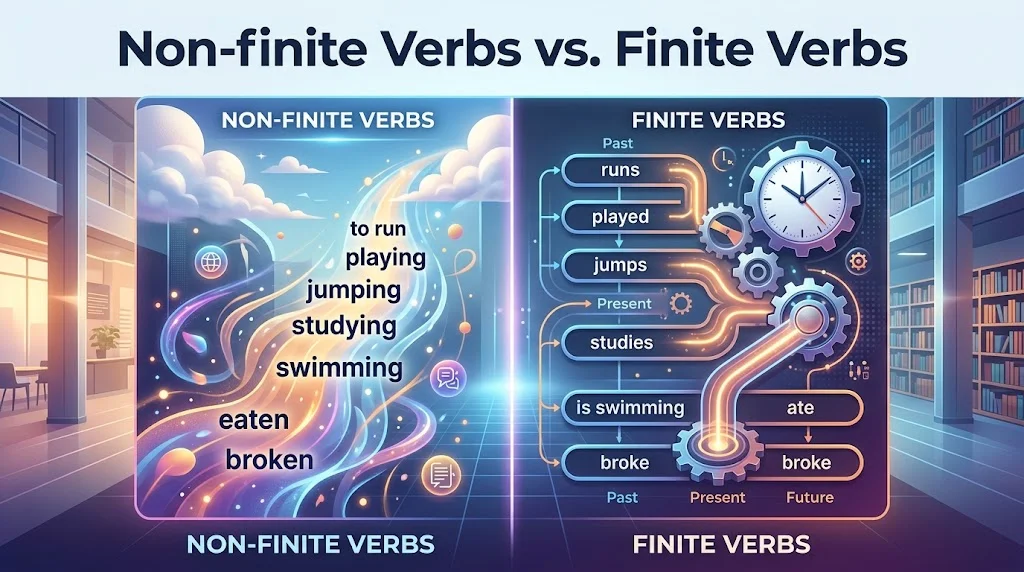
Understanding the difference between finite and non-finite verbs is one of the most important steps in learning this topic.
A finite verb can function as the main verb of a clause and normally carries tense or subject agreement.
A non-finite verb does not independently carry those features.
Consider:
She writes every day.
The verb writes is finite.
Now look at:
She wants to write every day.
The verb wants is finite. The infinitive to write is non-finite.
The same sentence can therefore contain both types.
Comparison Table
| Feature | Finite Verb | Non-finite Verb |
| Shows tense | Usually yes | No, not by itself |
| Changes for subject agreement | Sometimes | No |
| Can be the main verb of a clause | Yes | No, by itself |
| Can function as a noun | No | Yes, in forms such as gerunds |
| Can describe a noun | Not in the same way | Yes, especially participles |
| Common forms | works, worked, is | to work, working, worked |
A useful example is:
The students are studying to pass the exam.
Here, are is finite because it carries the present tense and agrees with the students. Studying is non-finite.
The infinitive to pass is also non-finite.
So one sentence can contain multiple verb forms with different grammatical functions.
Examples
Let’s examine a few examples more closely.
I like to swim.
Like is finite. It carries the present-tense structure of the clause.
To swim is non-finite.
Another example:
Running every morning keeps me healthy.
Keeps is finite.
Running is non-finite and functions as the subject.
Now consider:
The car parked outside belongs to my neighbor.
Belongs is finite.
Parked is a past participle functioning within a participial phrase that describes the car.
One more:
She has finished her assignment.
Has is finite.
Finished is a non-finite past participle.
This last example is especially important. A past participle can appear inside a verb phrase without being the finite verb itself.
A Simple Memory Trick
Use the tense test.
Ask:
Does this verb form itself show tense or subject agreement?
If yes, it is likely finite.
If no, it may be non-finite.
For example:
She walks to school.
Walks changes with the subject and belongs to the present-tense clause. It is finite.
She likes to walk to school.
To walk does not change when the subject changes. It is non-finite.
You can also use the subject test:
Does the verb form change because the subject changes?
If it does, you are likely looking at a finite verb.
If the form stays the same, it may be non-finite.
Key Characteristics
Non-finite verbs have several important characteristics. Knowing these features makes them easier to identify in real sentences.
They Do Not Show Tense
A non-finite verb does not independently show whether an action happens in the past, present, or future.
Compare:
She works at home.
She wants to work at home.
The finite verb works belongs to the present-tense clause. The infinitive to work does not itself mark present tense.
The same infinitive can appear in different time contexts:She wants to work at home.She wanted to work at home.She will want to work at home.
The infinitive remains to work, while the finite verbs wants, wanted, and will want carry the tense information.
Participles behave similarly.
She is working.
She was working.
The forms is and was carry the tense. Working remains non-finite.
They Do Not Agree With the Subject
Finite verbs can change according to the subject.
He runs every morning.
They run every morning.
The verb changes from runs to run.
Non-finite forms do not change like this.
He likes running.
They like running.
The form running remains unchanged.
Likewise:
She wants to leave.
They want to leave.
The infinitive remains to leave.
This consistency makes non-finite forms useful when building longer sentences.
They Cannot Stand Alone.
A non-finite verb generally cannot serve as the only verb of a complete independent clause.
For example:
To study.
This is not normally a complete sentence.
You need a finite verb:
I want to study.
Similarly:
Running down the street.
This is a fragment when used by itself.
You can make it part of a complete sentence:
The boy was running down the street.
Or:
Running down the street, the boy waved to us.
The finite verb provides the grammatical foundation that allows the sentence to stand independently.
There are special contexts where non-finite phrases can appear as standalone responses, headings, signs, or stylistic fragments. However, in ordinary clause structure, a complete independent clause needs a finite verb.
They Perform Different Grammatical Roles
Non-finite verbs are especially useful because they can perform different jobs.
An infinitive can function as a noun-like element:
To travel is exciting.
A gerund can function as a subject:
Reading helps you learn.
A participle can describe a noun:
The broken window needs repair.
A non-finite phrase can also express purpose:
She went outside to get some fresh air.
These different roles make non-finite verbs highly flexible.
They Make Writing More Concise
Non-finite constructions can combine ideas without repeating complete clauses.
Compare:
After she finished her work, she went home.
After finishing her work, she went home.
The second version is more compact.
Another example:
He opened the box because he wanted to see what was inside.
He opened the box to see what was inside.
The infinitive makes the purpose clear without using a longer clause.
However, concision should never come at the expense of clarity. A shortened construction must still make it clear who acts.
Key Takeaways
Keep these points in mind:
- Non-finite verbs do not independently show tense.
- They do not change to agree with the subject.
- They generally cannot form an independent clause by themselves.
- They can function as nouns, adjectives, or adverbial elements.
- The three major types are infinitives, gerunds, and participles.
- Non-finite forms often make sentences shorter and more flexible.
- A single sentence can contain both finite and non-finite verbs.
How Non-finite Verbs Work in English Sentences
Non-finite verbs are not just grammar terms found in textbooks. They perform practical jobs in everyday sentences.
You use them when you explain why someone does something, describe a person or object, name an activity, or connect related ideas.
They Explain Purpose
One of the most common uses of an infinitive is to explain purpose.
I went to the store to buy milk.
Why did the speaker go to the store?
To buy milk.
The infinitive phrase clearly answers the question why.
More examples include:
She called me to ask a question.
He saved money to buy a new computer.
We left early to avoid traffic.
They practiced every day to improve their skills.
This use is extremely common in American English.
They Can Act as the Subject
Some non-finite forms can occupy the subject position of a sentence.
Swimming is good exercise.
Here, swimming is the subject.
You can also use an infinitive:
To exercise regularly takes discipline.
Although grammatically correct, an -ing form often sounds more natural when discussing an activity generally:
Exercising regularly takes discipline.
Another example:
Learning a new language takes time.
The phrase learning a new language acts as a noun-like subject while retaining the verb learning.
They Describe Nouns
Participles can describe nouns.
The crying baby needs attention.
The present participle crying describes baby.
The broken window needs repair.
The past participle broken describes window.
The boiling water is dangerous.
The present participle boiling describes water.
These forms allow you to add information without creating a separate sentence.
Compare:
The dog was barking loudly. The dog woke the baby.
You could combine the ideas as:
The barking dog woke the baby.
The participle makes the sentence more compact.
They Connect Related Ideas
Participial phrases can connect actions or circumstances.
Walking home, I saw an old friend.
The phrase walking home provides background information about what was happening when the speaker saw the friend.
Another example:
Feeling tired, Maria went to bed early.
The participial phrase explains the circumstance surrounding Maria’s decision.
These structures can make writing smoother when the relationship between the actions is clear.
They Reduce Long Clauses
Non-finite constructions often allow writers to reduce longer clauses.
Consider:
The woman who is standing near the door is my teacher.
You can reduce this to:
The woman standing near the door is my teacher.
The phrase standing near the door replaces the longer relative clause who is standing near the door.
Another example:
Students who study regularly often perform better.
Can become:
Students studying regularly often perform better.
The reduced version is shorter while preserving the basic meaning.
They Improve Sentence Variety
Using only simple finite clauses can make writing repetitive
Non-finite forms can create a smoother version:
Opening the door, John looked outside and saw a package. Picking it up, he carried it inside.
This style should be used carefully. The reader should always be able to identify the person acting.
When used correctly, non-finite constructions can make writing more varied, efficient, and polished.
Where Do Non-finite Verbs Appear in a Sentence?
Non-finite verbs can appear in many positions.
They may occur at the beginning, middle, or end of a sentence.
At the beginning:
Walking to work, I called my friend.
In the middle:
The man standing by the window is my uncle.
At the end:
She went to the library to study.
They can also appear in larger verb phrases:
She is reading a novel.
They have finished the project.
Here, reading and finished are non-finite forms working with finite auxiliary verbs.
You may therefore encounter non-finite verbs almost anywhere in a sentence. The key is not their position. Their grammatical form and function matter more than where they appear.
The Three Types
English grammar traditionally groups non-finite verbs into three major categories:
Infinitives, gerunds, and participles.
Each has a different form and typical grammatical function.
Infinitives
An infinitive commonly uses to + base verb.
Examples include:to readto writeto learnto speakto understand
Infinitives can function in several ways. They can act like nouns, modify nouns, or express purpose.
To learn takes time.
I want to learn.
She has a book to read.
He went outside to exercise.
English also has bare infinitives, which use the base verb without to.
You must leave now.
Let him go.
I heard her sing.
Bare infinitives follow certain verbs and structures, which become especially important when studying infinitive patterns.
Gerunds
A gerund uses the -ing form of a verb but functions as a noun.
Reading is enjoyable.
I enjoy reading.
She is interested in learning.
The important point is that an -ing form is not automatically a gerund.
Compare:
Swimming is fun.
Here, swimming functions as a noun-like subject, so it is a gerund.
Now look at:
The children are swimming.
Here, swimming is part of the progressive verb phrase are swimming. It is not functioning as a noun.
Another example:
The swimming children waved at us.
Here, swimming describes children, so it functions as a participle.
The form is the same, but the grammatical role changes.
Participles
Participles are non-finite verb forms that commonly function as parts of verb phrases or as modifiers.
English has present participles, past participles, and perfect participles.
Present participles usually end in -ing:
running
laughing
sleeping
writing
Past participles can have -ed endings with regular verbs:
walked
cleaned
finished
But irregular verbs have different forms:
written
eaten
broken
gone
Perfect participles use:
having + past participle
For example:
Having finished the assignment, she went home.
Participles can describe nouns:
the broken chair
the smiling child
They can also form participial phrases:
Walking through the park, we saw a deer.
Understanding participles becomes especially important because the -ing form can also function as a gerund. Context and grammatical function tell you which role it has.
Infinitives: The Most Flexible Non-finite Verb
Infinitives are among the most versatile non-finite forms in English.
The most familiar structure is the to-infinitive:to readto writeto sleepto understandto communicate
An infinitive can function in several ways within a sentence.
What Is a To-Infinitive?
A to-infinitive consists of to followed by the base form of a verb.to walkto eatto studyto improveto explain
The verb after to does not change according to the subject.
I want to leave.
She wants to leave.
They want to leave.
Not:
She wants to leaves.
The form remains to leave.
To-infinitives can express purpose, intention, plans, results, or actions treated as concepts.
Infinitives as Nouns
An infinitive can perform a noun-like role in a sentence.As the SubjectTo travel is exciting.To learn another language takes patience.To exercise regularly can improve your fitness.
The infinitive phrase occupies the subject position.
In everyday American English, however, an -ing form can often sound more natural when the sentence discusses an activity in general.
Traveling is exciting.
Learning another language takes patience.
Exercising regularly can improve your fitness.
Both structures can be grammatical. The choice depends on context and style.
As the Object
Infinitives can also follow verbs and function as their complements.
I want to learn.
She decided to stay.
They hope to win.
We plan to leave early.
Here, the infinitive completes the meaning of the preceding verb.
Different verbs take different complements, so it is important to learn common patterns rather than assume that an infinitive can follow every verb.
Infinitives as Adjectives
An infinitive can modify a noun.
I have a report to finish.
The phrase to finish tells us which report or what needs to be done with it.
More examples:
She has a letter to write.
We need a place to stay.
He needs someone to help him.
I have several tasks to complete.
The infinitive often expresses what can, should, or needs to be done with the noun.
Infinitives as Adverbs
Infinitives can also function adverbially, especially when they express purpose.
She went to the store to buy groceries.
He called me to discuss the project.
We arrived early to get good seats.
In each case, the infinitive phrase explains why the action happened.
Ask “Why?”
Why did she go to the store?
To buy groceries.
Why did he call?
To discuss the project.
That makes purpose infinitives relatively easy to recognize.
Infinitives: The Most Flexible Non-finite Verb
Infinitives can do many jobs in English sentences. They can act like nouns, describe nouns, express purpose, and complete the meaning of certain verbs, adjectives, and nouns.
Common Verbs Followed by Infinitives
Many common verbs are followed by a to-infinitive. Learning these patterns can help you avoid awkward or incorrect constructions.
Common examples include:
| Verb | Example |
| want | I want to learn. |
| need | We need to leave. |
| decide | She decided to stay. |
| hope | They hope to win. |
| plan | He plans to travel. |
| agree | We agreed to help. |
| promise | She promised to call. |
| refuse | He refused to answer. |
| expect | I expect to finish soon. |
| learn | They learned to drive. |
Notice that the verb after to stays in its base form.
She decided to leave.
Not:
She decided to leaves.
The infinitive remains unchanged regardless of the subject.
Common Adjectives Followed by Infinitives
Many adjectives can be followed by a to-infinitive.
I am happy to help.
She was ready to leave.
He is eager to learn.
They were unable to attend.
We are excited to begin.
Common adjective patterns include:
- happy to
- glad to
- ready to
- willing to
- eager to
- able to
- unable to
- likely to
- unlikely to
- surprised to
- pleased to
- sorry to
These constructions are especially common in conversation and professional writing.
Compare:
We are pleased to announce the results.
The infinitive phrase completes the meaning of the adjective pleased.
Common Nouns Followed by Infinitives
Some nouns are commonly followed by infinitives.
I have a chance to improve.
She decided to leave.
He has a reason to complain.
We need a plan to solve the problem.
They have an opportunity to grow.
The infinitive often tells you what action is connected with the noun.
For example:
We need a plan to reduce costs.
The phrase to reduce costs explains the purpose of the plan.
Usage Tip: Infinitive or Gerund?
One of the most common challenges is deciding between a to-infinitive and a gerund.
Some verbs normally take infinitives:
She decided to go.
I hope to see you soon.
Some normally take gerunds:
She enjoys reading.
I avoid driving at night.
Some verbs can take either form with little or no change in meaning:
I like reading.
I like to read.
Both can be correct, although the choice may depend on context or style.
Other verbs can take both forms but change meaning.
I remembered locking the door.
I remembered to lock the door.
In the first sentence, the speaker remembers a past action.
In the second, the speaker remembered that the action needed to happen.
So don’t assume that to + verb and verb-ing are always interchangeable. The verb before the complement matters.
Bare Infinitives
A bare infinitive is the base form of a verb without to.
Examples include:
go
eat
sleep
write
leave
Compare:
I want to leave.
You must leave.
The first example contains a to-infinitive. The second contains a bare infinitive.
Bare infinitives occur after specific verbs and structures.
When Do We Use Bare Infinitives?
After Modal Verbs
Modal verbs are normally followed by the base form of another verb.
You must leave.
She can swim.
They should wait.
We might go.
He will call later.
Do not add to after a modal verb.
Incorrect:
She can to swim.
Correct:
She can swim.
This pattern applies to common modals such as can, could, may, might, must, shall, should, will, and would.
After Let
The verb let is followed by an object and a bare infinitive.
Let me help.
She let him go.
They let us enter.
The structure is:
let + object + base verb
Not:
Let me to help.
The correct form is:
Let me help.
After Make
In active constructions, make can be followed by an object and a bare infinitive.
The teacher made us rewrite the sentence.
The movie made me laugh.
His joke made everyone smile.
The structure is:
make + object + base verb
However, the passive construction is different:
We were made to rewrite the sentence.
The to returns in the passive.
This is a useful pattern to remember.
After Verbs of Perception
Certain perception verbs can be followed by an object plus a bare infinitive.
Common examples include see, hear, watch, feel, and notice.
I saw him cross the street.
We heard her sing.
She watched the children play.
I felt the ground shake.
These constructions often present the action as a complete event.
The same perception verbs can also take an -ing form:
I saw him crossing the street.
The meaning can differ slightly. The bare infinitive often emphasizes the action as a whole, while the -ing form focuses more on an action in progress.
After Help
The verb help can be followed by either a bare infinitive or a to-infinitive.
She helped me carry the boxes.
She helped me to carry the boxes.
Both forms are grammatical.
The version without to is especially common in American English, but both patterns are accepted.
Split Infinitives: Are They Really Wrong?
A split infinitive occurs when a word, often an adverb, comes between to and the base verb.
For example:
She decided to carefully review the report.
The word carefully splits to review.
Traditional grammar advice sometimes treated split infinitives as errors. Modern English usage does not generally consider them automatically wrong.
The important question is whether the sentence is clear and natural.
Compare:
She decided to carefully review the report.
She decided carefully to review the report.
The first sentence often sounds more natural in everyday American English.
Sometimes avoiding the split creates an awkward sentence:
He promised to completely finish the project.
Moving completely may produce:
He promised completely to finish the project.
The second version can sound stiff.
So a split infinitive is not automatically a grammatical mistake.
When Should You Avoid a Split Infinitive?
You may want to avoid one when the placement makes the sentence difficult to read or creates ambiguity.
For example:
The company plans to gradually reduce prices.
This is perfectly understandable.
But if moving the adverb improves clarity without making the sentence awkward, you can do so:
The company plans to reduce prices gradually.
In formal writing, consider the overall rhythm of the sentence. Don’t change a clear sentence simply because an adverb appears between to and the verb.
Clarity matters more than an old rule against splitting infinitives.
Common Mistakes with Infinitives
Infinitive patterns can be confusing because different verbs require different structures.
Mistake: Using an Infinitive After Enjoy
The verb enjoy is normally followed by an -ing form, not a to-infinitive.
Incorrect:
I enjoy to read.
Correct:
I enjoy reading.
You can say:
I enjoy reading mystery novels.
Remember the pattern:
enjoy + gerund
Mistake: Using To After Make
In active constructions, make + object takes a bare infinitive.
Incorrect:
The teacher made us to stay.
Correct:
The teacher made us stay.
However:
We were made to stay.
The passive structure uses to.
Mistake: Using To After a Modal Verb
Modal verbs take the base form.
Incorrect:
You should to study more.
Correct:
You should study more.
Incorrect:
She can to drive.
Correct:
She can drive.
Mistake: Using a Gerund After Decide
The verb decide normally takes a to-infinitive.
Incorrect:
She decided going home.
Correct:
She decided to go home.
The standard pattern is:
decide + to-infinitive
Mistake: Forgetting the Infinitive After Certain Verbs
Some verbs require a to-infinitive to complete their meaning.
Incorrect:
They hope win the game.
Correct:
They hope to win the game.
Other common examples include:
want to
plan to
agree to
promise to
refuse to
expect to
Learning these combinations as patterns can make your writing more accurate.
Quick Reference: Bare Infinitive vs. To-Infinitive
| Structure | Example |
| to-infinitive | I want to leave. |
| modal + bare infinitive | She can leave. |
| let + object + bare infinitive | Let him leave. |
| make + object + bare infinitive | They made him leave. |
| perception verb + object + bare infinitive | I saw him leave. |
| help + object + bare/to-infinitive | She helped me leave. |
The main lesson is simple: don’t add or remove randomly. The word or structure before the verb usually determines which form you need.
Gerunds: Verbs That Function as Nouns
A gerund is an -ing form of a verb that functions as a noun in a sentence.
For example:
Reading is relaxing.
The word reading comes from the verb read, but it acts as the subject of the sentence.
Another example:
I enjoy reading.
Here, reading functions as the object of enjoy.
Gerunds are useful because they allow you to talk about activities as things or concepts.
Quick Definition
A gerund is traditionally defined as a verb ending in -ing that performs a noun-like function.
Examples include:
Swimming is fun.
She enjoys cooking.
Learning takes practice.
He is interested in writing.
Although gerunds behave like nouns in certain positions, they retain important verb-like qualities.
For example:
Reading interesting books improves vocabulary.
The gerund reading has the adjective interesting modifying books, and books is its object.
That combination shows why gerunds are still closely connected to verbs.
How to Recognize a Gerund
Don’t identify a gerund simply because a word ends in -ing.
Instead, ask:
What grammatical job is the -ing form doing?
If it functions as a noun-like element, it is traditionally called a gerund.
Compare:
Swimming is excellent exercise.
Here, swimming is the subject. It is a gerund.
Now look at:
The children are swimming.
Here, swimming is part of the finite verb phrase are swimming. It is not functioning as a noun.
Now consider:
The swimming children waved.
Here, swimming describes the children. It is a present participle.
The spelling is identical, but the grammatical function is different.
Gerunds as Subjects
Gerunds can serve as sentence subjects.
Reading improves concentration.
Walking is good for you.
Cooking can be relaxing.
Learning new skills takes time.
The gerund phrase can be quite long:
Reading books about history can deepen your understanding of the past.
The entire phrase functions as the subject.
Gerunds are especially natural when discussing activities in a general sense.
Compare:
Running is difficult.
To run is difficult.
Both can be grammatical, but the gerund often sounds more natural in everyday American English when referring to an activity.
Gerunds as Objects
Gerunds can also function as objects after certain verbs.
I enjoy reading.
She avoids driving at night.
They finished cleaning the room.
He suggested taking a break.
We discussed moving the meeting.
Common verbs followed by gerunds include:
- enjoy
- avoid
- finish
- suggest
- consider
- recommend
- mind
- keep
- practice
- miss
- postpone
- admit
- deny
Examples:
She avoids eating late at night.
We finished preparing the presentation.
He suggested taking the train.
The verb pattern matters. A sentence can become incorrect if you replace the gerund with an infinitive when the verb does not allow that structure.
Gerunds After Prepositions
After a preposition, English normally uses an -ing form when the complement is a verb.
She is interested in learning Spanish.
He left without saying goodbye.
They talked about moving to another city.
Before leaving, check the lights.
A common mistake is to use to + verb after a preposition.
Incorrect:
She is interested in learning Spanish.
Correct:
She is interested in learning Spanish.
The key pattern is:
preposition + -ing form
This includes prepositions such as in, on, at, by, for, about, without, and before.
Be careful with to, because to can be either a preposition or part of an infinitive.
Compare:
I want to learn.
Here, to introduces an infinitive.
But:
I look forward to learning.
Here, to is a preposition, so the following verb uses an -ing form.
That distinction causes many common errors.
Common Verbs Followed by Gerunds
Some verbs strongly prefer or require a gerund.
| Verb | Correct Pattern | Example |
| enjoy | enjoy + -ing | I enjoy reading. |
| avoid | avoid + -ing | She avoids driving at night. |
| finish | finish + -ing | We finished cleaning. |
| suggest | suggest + -ing | He suggested waiting. |
| consider | consider + -ing | They considered moving. |
| recommend | recommend + -ing | I recommend trying it. |
| practice | practice + -ing | She practices speaking English. |
| postpone | postpone + -ing | They postponed meeting us. |
Learning these patterns can prevent many errors.
Instead of memorizing isolated grammar rules, learn the complete expression:
enjoy reading
avoid making
finish doing
suggest going
consider changing
This makes correct usage easier to recall when writing or speaking.
Gerunds After Certain Expressions
Gerunds also appear in several common expressions.
It is worth trying.
I look forward to meeting you.
She has trouble understanding the instructions.
He is busy preparing dinner.
They spent the afternoon cleaning the house.
Some expressions naturally require an -ing form.
For example:
There is no point in arguing.
The word in is a preposition, so arguing follows it.
Similarly:
It’s worth considering.
Here, worth is followed by an -ing form.
These patterns are common in natural English, so learning them as complete phrases is useful.
Common Mistakes with Gerunds
Mistake: Using a To-Infinitive After Enjoy
Incorrect:
I enjoy to swim.
Correct:
I enjoy swimming.
Mistake: Using an Infinitive After a Preposition
Incorrect:
She left without saying goodbye.
Correct:
She left without saying goodbye.
Mistake: Using the Wrong Form After Suggest
Incorrect:
He suggested to take a taxi.
Correct:
He suggested taking a taxi.
Mistake: Confusing “To” as a Preposition
Incorrect:
I look forward to see you.
Correct:
I look forward to seeing you.
Here, to is a preposition, not an infinitive marker.
Mistake: Assuming Every -ing Form Is a Gerund
Incorrect analysis:
The children are playing, so playing must be a gerund.
In this sentence, playing is part of the verb phrase are playing. It is a present participle used with the finite auxiliary are.
The form alone does not determine its grammatical label. Function and context matter.
Gerund or Present Participle?
The distinction between gerunds and present participles can be confusing because both traditionally use the same -ing form.
The easiest approach is to focus on the job the form performs.
Swimming is enjoyable.
Here, swimming acts like a noun. It is traditionally called a gerund.
The children are swimming.
Here, swimming is part of the progressive verb phrase. It is a present participle.
The swimming children waved.
Here, swimming describes children. It is a present participle.
So:
Gerund = noun-like function
Present participle = descriptive or verb-phrase function
Modern grammatical descriptions sometimes treat these as different uses of the same -ing form rather than completely separate verb forms. For practical grammar learning, however, the traditional distinction remains useful.
Participles: Verb Forms That Add Description
A participle is a non-finite verb form that can function within verb phrases or modify nouns and phrases.
Participles are especially useful when you want to describe an action, condition, or state.
Consider:
The crying baby woke everyone.
The present participle crying describes the baby.
Now:
The broken chair was removed.
The past participle broken describes the chair.
Participles can also create longer phrases:
Walking through the park, I noticed a small café.
These structures add information without requiring another full independent clause.
Quick Definition
The major participle forms include:
- Present participles: walking, smiling, running
- Past participles: walked, smiled, written, broken
- Perfect participles: having walked, having written, having finished
Their forms and functions vary, but all are non-finite.
Present Participles
Present participles are formed with the -ing form.
Examples:
running
laughing
talking
studying
working
They can appear in progressive constructions:
She is studying.
They can also describe nouns:
The studying students were quiet.
And they can appear in participial phrases:
Studying for the exam, Maria turned off her phone.
The present participle does not mean that an action is necessarily happening in the present. The term present participle refers to its grammatical form, not simply the time of the action.
Examples
The barking dog woke me.
Smiling, she entered the room.
The man standing near the entrance is my teacher.
They are waiting outside.
In each example, barking, smiling, standing, and waiting are -ing forms. Their functions differ according to context.
In Sentences
Consider the sentence:
The woman carrying the blue bag is my neighbor.
The phrase carrying the blue bag describes the woman.
Now compare:
The woman is carrying the blue bag.
Here, carrying works with the finite auxiliary is to form the progressive verb phrase.
The same form appears in both sentences, but the grammatical structure differs.
Gerund or Present Participle?
When you see an -ing word, don’t label it immediately.
Use the job test.
Ask:
Is it functioning like a noun?
If yes, it is traditionally a gerund.
Running is healthy.
Ask:
Is it describing a noun or helping form a verb phrase?
If yes, it is a present participle.
The running water was cold.
She is running late.
This simple test works well for most everyday examples.
Past Participles
Past participles are another major type of non-finite verb form.
With regular verbs, they commonly end in -ed:
walked
cleaned
opened
finished
Irregular verbs can have completely different forms:
written
eaten
seen
broken
taken
gone
Past participles can appear in perfect verb phrases:
She has finished.
They have gone home.
They can also appear in passive constructions:
The window was broken.
The letter was written yesterday.
And they can modify nouns:
the broken window
the written instructions
Regular Past Participles
Regular verbs generally form their past participles with -ed.
| Base Verb | Past Participle |
| walk | walked |
| clean | cleaned |
| open | opened |
| work | worked |
| finish | finished |
Examples:
She has worked hard.
The room was cleaned yesterday.
We have finished the project.
Irregular Past Participles
Irregular verbs don’t follow the standard -ed pattern.
| Base Verb | Past Participle |
| write | written |
| eat | eaten |
| break | broken |
| choose | chosen |
| take | taken |
| see | seen |
| speak | spoken |
| drive | driven |
Examples:
She has written three emails.
They have chosen a new leader.
The glass was broken during the move.
He has driven across the country.
These forms must often be learned individually because there is no single rule that predicts every irregular past participle.
In Sentences
Past participles commonly appear in several structures:
She has written the report.
The report was written yesterday.
The written report is on my desk.
The form written remains the same, but its grammatical function changes.In the first sentence, it works with has in a perfect construction.In the second, it works with was in a passive construction.In the third, it modifies report.
This flexibility is a key feature of participles.
Perfect Participles
A perfect participle uses:
having + past participle
Examples:Having finished the assignment, she went home.Having eaten dinner, they went for a walk.Having completed the project, the team celebrated.
The perfect participle shows that one action happened before another action.
Compare:
Having finished the report, Sarah went home.
First, Sarah finished the report.
Then, she went home.
This structure can make the sequence of events clear without using two full clauses.
Structure
The basic structure is:
having + past participle
Examples:having finishedhaving writtenhaving eatenhaving seenhaving completed
A negative perfect participle can use not:
Not having finished the work, he stayed late.
This means he stayed late because he had not finished the work.
ExamplesHaving studied all night, the students felt exhausted.Having missed the bus, I decided to walk.Having completed the training, she started her new position.Having seen the movie before, he knew what would happen.
The perfect participle is especially useful when you want to emphasize that one event happened before another.
In Sentences
Consider:
Having finished her presentation, Maya answered questions from the audience.
The phrase having finished her presentation describes an earlier action.
The main clause contains the finite verb answered.
This is an important pattern:
Non-finite phrase + finite main clause
The non-finite phrase adds information, while the finite verb anchors the sentence as a complete clause.
Participles as Adjectives
Participles can function as adjectives because they can describe nouns.
Present participles often describe something that causes a feeling or displays an action.
an interesting book
an exciting movie
a confusing explanation
Past participles often describe someone or something that experiences a state or feeling.
an interested student
an excited audience
a confused customer
This distinction is important.
Compare:
The movie was boring.
The movie causes boredom.
I was bored.
I experienced boredom.
Similarly:
The lesson was interesting.
The students were interested.
The -ing adjective often describes the source of a feeling. The -ed adjective often describes the person or thing experiencing it.
Examples
The broken phone was expensive to replace.
The excited children ran outside.
We watched an interesting documentary.
The confused customer asked for help.
The rising sun appeared above the mountains.
Participles can make descriptions more precise without requiring additional clauses.
Participial Phrases
A participial phrase contains a participle and additional words that complete or modify it.
For example:
Walking through the park, I saw a deer.
The phrase includes the participle walking and the additional words through the park.
Another example:
The man wearing a black jacket is my brother.
The phrase wearing a black jacket describes the man.
Participial phrases can appear in several positions.
Examples
Tired after the long journey, we went straight to bed.
The students, excited about the trip, talked throughout lunch.
She walked home, singing softly.
Each phrase adds information while keeping the sentence relatively compact.
Where Can Participial Phrases Appear?
Participial phrases can appear at the beginning, middle, or end of a sentence.
Beginning
Feeling nervous, Daniel checked his notes.
The opening phrase describes Daniel’s condition.
Middle
Daniel, feeling nervous, checked his notes.
The phrase interrupts the main clause and adds extra information.
End
Daniel checked his notes, feeling nervous.
The phrase comes after the main clause and provides additional description.
Punctuation depends on how the phrase relates to the main clause and whether the information is essential or supplementary.
Dangling Participles: A Common Mistake
A dangling participle occurs when a participial phrase seems to modify the wrong noun because the intended subject is missing or unclear.
Incorrect:
Walking down the street, the trees looked beautiful.
The trees are grammatically positioned as the subject, so the sentence appears to say that the trees were walking.
Trees cannot logically perform that action.
A clearer version is:
Walking down the street, I thought the trees looked beautiful.
Now I am the person walking.
Incorrect
Driving to work, the traffic became heavy.
The sentence makes it sound as though the traffic was driving.
Correct
Driving to work, I noticed that the traffic became heavy.
Now the person performing the driving is clearly identified.
Another Example
Incorrect:
After reading the book, the movie seemed disappointing.
The movie did not read the book.
Correct:
After reading the book, I found the movie disappointing.
The understood subject of reading is now clearly connected to I.
The main rule is simple:
Make sure the person or thing performing the participial action is clearly connected to the main clause.
Misplaced Participles
A misplaced participle is positioned so close to another noun that the reader may misunderstand what it describes.
Incorrect
She handed the student a note covered in red ink.
This may suggest that the student was covered in red ink.
The intended meaning is probably that the note was covered in red ink.
Correct
She handed the student a note covered in red ink.
The phrase now sits directly beside the noun it describes.
Clear placement prevents unnecessary confusion.
Present vs. Past Participles
Present and past participles can both function as non-finite verb forms, but they often communicate different ideas.
A present participle normally uses the -ing form:
smiling
running
laughing
growing
changing
A past participle may end in -ed with regular verbs, while irregular verbs can have forms such as written, broken, or taken.
cleaned
finished
written
broken
taken
The difference becomes especially clear when participles describe nouns.
Meaning Difference
Present participles often describe an action, process, or quality that something causes or displays.
an exciting game
The game causes excitement.
a confusing question
The question confuses.
Past participles often describe a state or feeling that someone or something experiences.
an excited player
The player experiences excitement.
a confused student
The student experiences confusion.
This gives you a useful comparison:
| Present Participle | Past Participle |
| exciting | excited |
| boring | bored |
| confusing | confused |
| surprising | surprised |
| tiring | tired |
| frightening | frightened |
Compare:
The lecture was boring.
The students were bored.
The lecture caused the feeling. The students experienced it.
This distinction is especially useful with adjectives formed from participles.
Finite Verbs vs. Non-finite Verbs
A sentence can contain both finite and non-finite verbs.
Consider:
She has finished her assignment.
The word has is finite. It carries the present-tense information and agrees with the subject she.
Finished is a past participle and is non-finite.
Another example is:
She is reading a novel.
It is finite.
Reading is a present participle.
This shows why you should not assume that every verb-like word in a sentence is finite.
Example
Consider:
The students were preparing to leave.
There are three verb forms:
- were — finite auxiliary
- preparing — present participle
- to leave — infinitive
Only were carries the tense of the clause.
If you change the sentence to:
The students are preparing to leave.
The non-finite forms remain unchanged. The finite auxiliary changes from were to are.
This is one of the easiest ways to see the difference.
Verbs That Change Meaning with Gerunds and Infinitives
Some verbs can be followed by either a gerund or an infinitive, but the meaning changes.
This is one of the most important areas of non-finite verb usage because a small change in form can change the entire message.
Remember
Compare:
I remembered locking the door.
I remembered to lock the door.
Remember + gerund refers to remembering a past action.
The speaker remembers that they actually locked the door.
Remember + infinitive refers to remembering that an action needed to happen.
The speaker did not forget to act.
For example:
I remembered locking the door before leaving.
I remembered to lock the door before leaving.
The first sentence focuses on the memory of a completed action.
The second focuses on successfully remembering to act.
Stop
The verb stop also changes meaning depending on the form that follows it.
She stopped smoking.
This means she quit smoking.
But:
She stopped to smoke.
This means she paused another activity to smoke.
The difference is significant.
stop + gerund = end an activity
stop + infinitive = pause one activity to do another
Try
Consider:
Try restarting the computer.
This suggests experimenting with or using a possible solution.
Now:
Try to restart the computer.
This emphasizes making an effort to restart it.
The two sentences are related, but they do not communicate the same idea.
Forget
Compare:
I forgot meeting him.
This means the speaker does not remember the past meeting.
Now:
I forgot to meet him.
This means the speaker failed to remember a planned action.
The first looks backward at a past event. The second concerns an action that should have happened.
Regret
Regret + gerund generally refers to something that happened in the past.
I regret leaving so early.
The speaker feels sorry about leaving.
Regret + infinitive is often used when announcing or reporting something unpleasant.
We regret to inform you that your application was unsuccessful.
This pattern is common in formal notices and business communication.
Common Mistakes and How to Fix Them
Non-finite verbs become easier when you focus on the structure surrounding them.
After a Preposition
Use an -ing form after a preposition when the complement is a verb.
Incorrect:
She left without saying goodbye.
Correct:
She left without saying goodbye.
More examples:
He is interested in learning more.
They talked about moving.
Before leaving, turn off the lights.
Remember that to can be either an infinitive marker or a preposition.
I want to learn.
Here, to introduces an infinitive.
I look forward to learning.
Here, to is a preposition.
After Certain Verbs
Different verbs take different non-finite patterns.
enjoy reading
avoid driving
decide to leave
hope to win
suggest waiting
plan to travel
A common error is assuming that all verbs work with the same pattern.
Incorrect:
She suggested to go by train.
Correct:
She suggested going by train.
Incorrect:
He decided going home.
Correct:
He decided to go home.
Learning common verb patterns is more useful than trying to create one universal rule.
After Modal Verbs
Modal verbs normally take the bare infinitive.
Incorrect:
You should to call her.
Correct:
You should call her.
Incorrect:
They might to arrive late.
Correct:
They might arrive late.
This applies to common modals such as can, could, may, might, must, shall, should, will, and would.
Dangling Participle
Make sure the subject of the main clause can logically act the participial phrase.
Incorrect:
Walking into the room, the lights suddenly went out.
The lights cannot walk into the room.
Correct:
Walking into the room, I noticed that the lights suddenly went out.
Now the subject clearly acts.
Misplaced Participle
Place a participial phrase near the noun it describes.
Unclear:
She saw a dog walking through the park with a red collar.
The sentence may be understandable, but a more precise version is:
She saw a dog with a red collar walking through the park.
Clear positioning helps readers process the sentence without stopping to reinterpret it.
Quick Error Checklist
Before using a non-finite construction, ask:
- Is the verb form correct?
- Does the preceding verb require an infinitive or gerund?
- Is there a preposition before the verb?
- Does a modal require a bare infinitive?
- Is the intended subject clear?
- Does the participial phrase modify the correct noun?
- Does the sentence remain complete?
- Does the chosen form express the intended meaning?
These questions can catch many common grammar problems.
Quick Practice
Identify the non-finite verb or verb phrase in each sentence.
A. She hopes to finish the project today.
B. Reading before bed helps me relax.
C. The broken chair needs repair.
D. They watched the children playing outside.
E. Having completed the assignment, Maya went home.
Answers
A. to finish — infinitive
B. Reading — gerund
C. broken — past participle
D. playing — present participle
E. Having completed — perfect participle
Notice that identifying the form is only part of the task. You should also consider its grammatical function.
Non-finite Clauses Explained
A non-finite clause is a clause built around a non-finite verb form.
Unlike a typical finite clause, its main verb does not carry tense or subject agreement.
Examples include:
To finish the work on time was difficult.
Reading the instructions carefully can prevent mistakes.
Having completed the project, the team celebrated.
These structures can contain other elements such as objects, complements, and modifiers.
For example:
To complete the assignment before Friday requires careful planning.
The non-finite verb is to complete. The phrase the assignment is its object, while before Friday adds time information.
Quick Definition
A non-finite clause contains a non-finite verb as its central verb form.
Common types include:
- Infinitive clauses
- Gerund clauses
- Participial clauses
These clauses are useful because they can express ideas without creating another fully tensed clause.
Example
Compare:
Because she wanted to save money, she cooked at home.
With:
Wanting to save money, she cooked at home.
The second version uses a non-finite participial clause.
Another example:
She went to the library because she wanted to study.
Can become:
She went to the library to study.
The infinitive clause expresses the purpose more concisely.
Non-finite clauses can therefore help you combine closely related ideas while avoiding unnecessary repetition.
Types of Non-finite Clauses
Infinitive Clauses
An infinitive clause is centered on an infinitive.
To learn another language takes time.
She wants to learn another language.
He went outside to get some fresh air.
The infinitive clause can perform different functions depending on where it appears.
It may function as a subject:
To exercise regularly is beneficial.
It may complement a verb:
She wants to exercise regularly.
It may express purpose:
She walks every morning to exercise regularly.
The same basic form can therefore serve different grammatical roles.
Gerund Clauses
A gerund clause is traditionally built around an -ing form functioning in a noun-like way.
Reading books regularly improves vocabulary.
I enjoy reading books regularly.
She is interested in learning new skills.
The phrase can contain an object:
Reading difficult books requires patience.
Here, books function as the object of reading.
Modern grammar descriptions sometimes call these -ing clauses rather than treating every -ing clause as a separate gerund category. For practical learning, the traditional term gerund clause remains useful.
Participial Clauses
Participial clauses use participles to add information about an action, condition, cause, time, or circumstance.
Walking through the city, we found a quiet café.
Exhausted after the journey, the travelers went to bed.
Having finished the meeting, the manager returned to her office.
Participial clauses often function as supplementary or adverbial elements.
The relationship between the participial clause and the main clause should be clear.
Compare:
Feeling tired, John went home.
The relationship is logical because John is the person who felt tired.
A dangling version would be:
Feeling tired, the long meeting ended.
The meeting cannot feel tired, so the intended meaning is unclear.
Why Writers Use Non-finite Clauses
Non-finite clauses are valuable because they can make writing shorter, smoother, and more varied.
Compare:
After she finished the report, she sent it to her manager.
With:
After finishing the report, she sent it to her manager.
The second version removes the repeated subject and makes the sentence more concise.
Another example:
Because he wanted to improve his writing, he read every day.
Can become:
Wanting to improve his writing, he read every day.
These reductions work best when the subject of the non-finite clause is clearly understood.
Longer Version
The students who were waiting outside the classroom became impatient.
This sentence contains a full relative clause:
who were waiting outside the classroom
It clearly identifies the students.
Improved Version
The students waiting outside the classroom became impatient.
The relative clause has been reduced to a participial phrase.
The meaning remains essentially the same, but the sentence is more concise.
Reduced Relative Clauses
A reduced relative clause removes certain words while retaining the essential descriptive information.
Consider:
The woman who is standing near the door is my teacher.
A reduced version is:
The woman standing near the door is my teacher.
The relative pronoun who and the finite auxiliary disappear, leaving the present participle standing.
Another example:
The documents that were submitted yesterday are being reviewed.
Reduced:
The documents submitted yesterday are being reviewed.
The passive relative clause becomes a past-participle phrase.
Full Sentence
The man who lives next door works at the hospital.
Reduced Version
The man living next door works at the hospital.
The reduced phrase living next door describes the man.
Full Sentence
The package that was delivered this morning is on the table.
Reduced Version
The package delivered this morning is on the table.
The phrase delivered this morning describes the package.
Reduced relative clauses are common in both everyday and formal English. They can make descriptions more compact when the meaning is clear.
Reduced Adverbial Clauses
Non-finite forms can also reduce some adverbial clauses.
For example:
Because she was feeling tired, Maria went home.
Can become:
Feeling tired, Maria went home.
The reduced version removes the finite clause structure while keeping the relationship between the ideas.
Another example:
After he finished the meeting, he called his assistant.
Can become:
After finishing the meeting, he called his assistant.
These structures work well when the understood subject of the reduced clause matches the subject of the main clause.
Full Sentence
While she was walking home, Lisa called her mother.
Reduced Version
While walking home, Lisa called her mother.
The subject of walking is understood to be Lisa.
Full Sentence
Because they wanted to save time, they took a taxi.
Reduced Version
Wanting to save time, they took a taxi.
The reduced construction is shorter and more fluid.
However, not every clause should be reduced. If reducing it creates ambiguity, keep the full clause.
Clear communication should always come before unnecessary brevity.
Real-life Examples of Non-finite Verbs
Non-finite verbs appear throughout ordinary English. You don’t need a formal setting to encounter them.
Everyday Conversation
I need to get some groceries.
Cooking at home saves money.
I’m tired of waiting.
She went out to buy coffee.
These examples show infinitives and gerunds working naturally in everyday speech.
Academic Writing
Academic writing often uses non-finite structures to make explanations more concise.
Analyzing the data reveals several important patterns.
The researchers conducted the study to examine consumer behavior.
Having collected the responses, the researchers reviewed the results.
These constructions reduce repetition and allow several related ideas to fit into a sentence.
Business Communication
Non-finite forms are also common in workplace writing.
We are pleased to announce the new policy.
Thank you for taking the time to respond.
We look forward to working with you.
Following the meeting, the team reviewed the proposal.
These patterns help business communication sound professional without becoming unnecessarily wordy.
News Headlines
News writing frequently favors compact language.
Government plans to reduce taxes.
Company launching new service next month.
Officials working to improve public safety.
Headlines may also omit words that would normally appear in complete sentences. The goal is usually brevity and immediate communication.
Literature and Storytelling
Writers use participles and infinitives to create movement and description.
Running through the rain, he searched for shelter.
She stopped to listen.
Having reached the hilltop, they looked across the valley.
These structures allow several actions or details to be connected without a string of short sentences.
Used thoughtfully, non-finite verbs can make prose feel more fluid and descriptive.
Quick Comparison Tables
Gerunds vs. Infinitives
| Feature | Gerund | Infinitive |
| Typical form | verb + -ing | to + base verb |
| Common role | Noun-like | Noun-like, adjective-like, or adverbial |
| Example | Reading helps. | To read helps. |
| After enjoy | Yes | No |
| After decide | No | Yes |
| After a preposition | Yes | No |
Examples:
I enjoy reading.
I decided to read.
She is interested in learning.
She wants to learn.
Gerunds vs. Present Participles
| Feature | Gerund | Present Participle |
| Form | -ing | -ing |
| Typical function | Noun-like | Descriptive or part of a verb phrase |
| Example | Swimming is fun. | The children are swimming. |
| Can modify a noun | Usually no | Yes |
| Can appear with an auxiliary | No, not in the gerund role | Yes |
The most important difference is function, not spelling.
Present Participles vs. Past Participles
| Feature | Present Participle | Past Participle |
| Common form | -ing | -ed or irregular |
| Example | running | broken |
| Can form progressive constructions | Yes | No |
| Can form perfect constructions | No | Yes |
| Can modify nouns | Yes | Yes |
| Example adjective | exciting | excited |
Examples:
The running water was cold.
The broken pipe caused a leak.
She is running.
She has broken the glass.
Finite Verbs vs. Non-finite Verbs
| Feature | Finite | Non-finite |
| Carries tense | Yes | No, not independently |
| Subject agreement | Yes, where applicable | No |
| Main verb of an independent clause | Yes | No |
| Common examples | works, worked, is | to work, working, worked |
| Can appear with auxiliaries | Yes | Yes |
For example:
She is writing a report.
It is finite.
Writing is non-finite.
The combination creates a complete finite verb phrase.
Memory Tricks for Learning Non-finite Verbs
Non-finite verbs become easier when you stop trying to memorize every sentence and start recognizing patterns.
Remember the Three Types
Think:
Infinitive → to do
Gerund → doing
Participle → describing or helping
For example:
to study
studying
studied
Then ask what each form is doing in the sentence.
The “Job Test”
When you see an -ing form, ask what job it performs.
If it behaves like a noun:
Reading is useful.
Think gerund.
If it describes a noun:
The reading student looked tired.
Think present participle.
If it helps form a progressive verb phrase:
She is reading.
Think present participle.
This job-based approach is more reliable than identifying a word from its spelling alone.
The Three-question Rule
When you encounter a possible non-finite verb, ask:
Does it show tense?
If yes, it is likely finite.
Does it change for the subject?
If yes, it is likely finite.
What grammatical job does it perform?
If it functions as a noun, modifier, purpose phrase, or part of a larger verb construction, you may be looking at a non-finite form.
These three questions provide a quick way to analyze unfamiliar sentences.
Practice Exercises
Understanding non-finite verbs becomes much easier when you practice identifying their forms and functions in complete sentences. The goal isn’t simply to recognize words such as reading or writing. You should also understand why that form is being used.
Exercise 1: Identify the Non-finite Verb
Find the non-finite verb or verb phrase in each sentence.
A. She wants to improve her writing.
B. Swimming every morning helps him stay active.
C. The broken window was replaced yesterday.
D. Walking through the park, we saw a family of ducks.
E. They have finished preparing the presentation.
F. I went to the store to buy some bread.
G. Having completed the course, she applied for the position.
H. The children are playing outside.
Answers
A. to improve — infinitive
B. Swimming — gerund
C. broken — past participle
D. Walking — present participle
E. finished and preparing — past participle and -ing form
F. to buy — infinitive
G. Having completed — perfect participle
H. playing — present participle
Notice that a sentence can contain more than one non-finite form. In sentence E, have is finite, while finished is a past participle and preparing is an -ing form.
Exercise 2: Identify the Type
Identify whether the bolded non-finite form is an infinitive, gerund, present participle, past participle, or perfect participle.
A. To learn a language takes patience.
B. She enjoys painting.
C. The damaged computer needs repair.
D. Running down the street, he waved at us.
E. Having finished dinner, they went outside.
F. The students are studying for the exam.
G. We have written the report.
H. He went outside to exercise.
Answers
A. To learn — infinitive
B. Painting — gerund
C. Damaged — past participle
D. Running — present participle
E. Having finished — perfect participle
F. Studying — present participle
G. Written — past participle
H. To exercise — infinitive
The most important lesson is that the same spelling does not always mean the same grammatical function.
For example:
Swimming is relaxing.
Here, swimming is traditionally called a gerund.
The children are swimming.
Here, swimming is a present participle in a progressive construction.
Exercise 3: Fill in the Blanks
Choose the correct form of the verb in parentheses.
A. I enjoy ________ books. (read)
B. She decided ________ home early. (go)
C. You should ________ more carefully. (listen)
D. They avoided ________ about the problem. (talk)
E. We hope ________ you soon. (see)
F. He made me ________ the sentence again. (write)
G. She is interested in ________ Spanish. (learn)
H. I look forward to ________ with you. (work)
I. They went outside ________ some fresh air. (get)
J. He stopped ________ when the teacher entered. (talk)
Answers
A. reading
I enjoy reading books.
B. to go
She decided to go home early.
C. listen
You should listen more carefully.
D. talking
They avoided talking about the problem.
E. to see
We hope to see you soon.
F. write
He made me write the sentence again.
G. learning
She is interested in learning Spanish.
H. working
I look forward to working with you.
I. to get
They went outside to get some fresh air.
J. talking
He stopped talking when the teacher entered.
The patterns are easier to remember when you learn the words together:
enjoy + -ing
decide + to-infinitive
modal + bare infinitive
preposition + -ing
make + object + bare infinitive
purpose + to-infinitive
Exercise 4: Correct the Errors
Correct each sentence.
A. She enjoys cooking for her family.
B. He decided to go home early.
C. You must finish this today.
D. They made us wait outside.
E. I look forward to meeting you.
F. Walking through the park, the trees looked beautiful.
G. After finishing the report, she went home.
H. He suggested taking the train.
Answers
A.
Incorrect:
She enjoys to cook for her family.
Correct:
She enjoys cooking for her family.
B.
Incorrect:
He decided going home early.
Correct:
He decided to go home early.
C.
Incorrect:
You must tinish this today.
Correct:
You must finish this today.
D.
Incorrect:
They made us wait outside.
Correct:
They made us wait outside.
E.
Incorrect:
I look forward to meet you.
Correct:
I look forward to meeting you.
F.
Incorrect:
Walking through the park, the trees looked beautiful.
Correct:
Walking through the park, I thought the trees looked beautiful.
The original creates a dangling participle because the trees cannot logically be walking.
G.
Incorrect:
After to finish the report, she went home.
Correct:
After finishing the report, she went home.
H.
Incorrect:
He suggested takingthe train.
Correct:
He suggested taking the train.
Exercise 5: Rewrite the Sentences
Rewrite each sentence using a non-finite construction where appropriate.
A. She went to the library because she wanted to study.
B. The man who is standing near the door is my teacher.
C. After he finished the project, he celebrated.
D. Because she wanted to save money, she cooked at home.
E. The documents that were submitted yesterday are being reviewed.
Possible Answers
A.
She went to the library to study.
The infinitive expresses purpose.
B.
The man standing near the door is my teacher.
The relative clause has been reduced to a participial phrase.
C.
Having finished the project, he celebrated.
The perfect participle emphasizes that the project was completed before the celebration.
D.
Wanting to save money, she cooked at home.
The participial phrase gives the reason for her action.
E.
The documents submitted yesterday are being reviewed.
The passive relative clause has been reduced to a past-participle phrase.
Challenge Quiz
Test your understanding of non-finite verbs with these questions. Try answering them before checking the explanations.
Which sentence contains a gerund?
A. She is reading a novel.
B. Reading novels improves vocabulary.
C. The girl reading a novel is my sister.
D. She wants to read a novel.
Answer: B
In Reading novels improves vocabulary, reading functions as the subject of the sentence. Traditionally, this makes it a gerund.
Which sentence contains a participle?
A. Swimming is good exercise.
B. I enjoy swimming.
C. The smiling child waved at me.
D. To swim is difficult.
Answer: C
In the smiling child, smiling describes the noun child. It is functioning as a present participle.
The other examples use swimming as a noun-like form or use an infinitive.
Which sentence contains a bare infinitive?
A. She wants to leave.
B. She can leave.
C. She decided to leave.
D. She hopes to leave.
Answer: B
After the modal can, English uses the base verb without to:
She can leave.
This is a bare infinitive.
Which sentence contains a perfect participle?
A. Having finished the work, she went home.
B. She finished the work.
C. She is finishing the work.
D. She wants to finish the work.
Answer: A
Having finished is a perfect participle.
Its structure is:
having + past participle
It shows that finishing the work happened before the main action.
Why Non-finite Verbs Are Important in English Grammar
Non-finite verbs are among the most useful tools for building flexible English sentences.
They allow you to express an activity as a concept:
Learning takes time.
They can express purpose:
She studied hard to pass the exam.
They can describe nouns:
The broken chair was replaced.
They can connect related actions:
Walking home, I called my friend.
They can reduce lengthy clauses:
The woman standing by the door is my teacher.
They can also help you avoid repetitive sentence structures.
Without non-finite forms, many sentences would require additional finite clauses. That could make writing longer and less varied.
Choosing the Right Non-finite Form
When deciding which form to use, start with the grammar pattern around the verb.
If a verb normally takes an infinitive, use the infinitive:
She decided to leave.
If a verb normally takes a gerund, use the -ing form:
She enjoys reading.
After a preposition, use an -ing form when the complement is a verb:
He left without saying goodbye.
After a modal, use the bare infinitive:
You should wait.
For purpose, the to-infinitive is often the most direct choice:
We went outside to get some fresh air.
For descriptions, participles can provide concise information:
The broken window needs repair.
The woman standing outside is my neighbor.
The correct choice depends on both form and function.
A Practical Way to Learn Non-finite Verbs
You don’t need to memorize every grammar rule at once.
Start with the three major categories:
Infinitives: to read, to write, to learn
Gerunds: reading, writing, learning when used as noun-like elements
Participles: reading, written, having finished when used in descriptive or verb-phrase constructions
Then learn the common patterns.
Remember:
enjoy + -ing
decide + to-infinitive
modal + bare infinitive
preposition + -ing
make + object + bare infinitive
purpose + to-infinitive
Finally, pay attention to meaning.
I stopped smoking.
means something different from:
I stopped to smoke.
Likewise:
I remembered locking the door.
differs from:
I remembered to lock the door.
These small differences can significantly change the message.
Final Review of Non-finite Verbs
A non-finite verb is a verb form that does not independently express tense or subject agreement.
The main forms discussed in English grammar are infinitives, gerunds, and participles.
Infinitives commonly appear with to:
to learn
Gerunds use the -ing form in a noun-like role:
Learning is useful.
Participles can describe nouns or participate in larger verb constructions:
the broken chair
She is learning.
Non-finite forms can express purpose, describe nouns, act as subjects or objects, reduce clauses, and connect related ideas.
The most important point is to focus on function and context, not just spelling.
An -ing form can be a gerund in one sentence and a present participle in another. A past participle can work with an auxiliary or describe a noun. An infinitive can express purpose or complete the meaning of another word.
Once these patterns become familiar, long English sentences become much easier to understand. You can identify the finite verb, recognize the non-finite forms, and see exactly how each part contributes to the sentence.
Conclusion
Understanding non-finite verbs can make English grammar much easier to manage. These verb forms do not carry tense or change to match the subject, yet they perform many important jobs in sentences. Infinitives, gerunds, and participles can act as nouns, adjectives, or adverbs, while non-finite clauses help connect ideas smoothly and keep writing concise.
Once you learn to recognize these forms by their function, complicated sentences become easier to understand. You can also avoid common errors involving infinitives, gerunds, participles, and dangling modifiers. The key is to focus on how each verb form works within its sentence. With regular practice, non-finite verbs will become a natural part of your English grammar skills. Whether you are writing an email, completing an assignment, or improving everyday communication, mastering these forms can help you write with greater clarity, variety, and confidence.
FAQs
What is a non-finite verb in English grammar?
A non-finite verb is a verb form that does not show tense or agree with the subject. It cannot normally serve as the only verb of an independent clause. Common non-finite forms include infinitives, gerunds, and participles. For example, in “She enjoys reading,” reading is a non-finite verb functioning as the object of enjoys.
What are the three main types of non-finite verbs?
The three main types are infinitives, gerunds, and participles. Infinitives usually appear as to + base verb, such as to learn. Gerunds use the -ing form as a noun, such as Swimming is fun. Participles can describe nouns or form part of verb phrases, such as the running water or has finished.
What is the difference between finite and non-finite verbs?
A finite verb shows tense and can agree with its subject. For example, She works uses the finite verb works. A non-finite verb does not show these features by itself. In She wants to work, wants is finite, while to work is non-finite. Both forms can occur together in the same sentence.
Is an infinitive a non-finite verb?
Yes. An infinitive is one of the most common types of non-finite verb. A to-infinitive consists of to plus the base form, as in to read, to write, or to understand. Infinitives can function as nouns, adjectives, or adverbs. Bare infinitives also occur after certain verbs, modal verbs, and other structures.
Is a gerund a non-finite verb?
Yes. A gerund is a non-finite -ing form that functions as a noun. In “Reading improves vocabulary,” reading acts as the subject. In “She enjoys reading,” it acts as the object. Although gerunds look like present participles, their grammatical function differs. The same -ing form can perform different roles depending on how it is used.
What is the difference between a gerund and a present participle?
Both gerunds and present participles use the -ing form, but they perform different grammatical jobs. A gerund functions like a noun, as in “I enjoy painting.” A present participle usually acts as an adjective or helps form a verb phrase, as in “The painting student smiled” or “She is painting.” Context determines the function.
Can a non-finite verb show tense?
A non-finite verb does not independently show tense in the way a finite verb does. However, non-finite constructions can express time relationships through forms such as perfect infinitives and perfect participles. For example, to have finished can indicate an earlier action. The tense of the main clause is still carried by a finite verb.
What is a bare infinitive?
A bare infinitive is the base form of a verb without to. It commonly follows modal verbs such as can, should, and must. It also appears after verbs such as let and make. For example, “She can swim” and “They made him apologize” both contain bare infinitives.
Why are non-finite verbs important in English?
Non-finite verbs help you build clearer, shorter, and more varied sentences. They allow you to express purpose, describe nouns, name activities, and connect related ideas without creating unnecessary full clauses. They are especially useful in academic, professional, and everyday writing. Understanding them also helps you identify and correct common grammar mistakes.
How can I identify a non-finite verb in a sentence?
Start by looking for common forms such as to + base verb, -ing forms, and participles. Then ask what grammatical job the form performs. Does it act like a noun, describe something, or provide additional information? Also check whether it carries tense and agrees with the subject. These clues can help you distinguish non-finite forms from finite verbs.