

The Quick Answer
If you’ve ever wondered whether to say “one die” or “one dice,” the traditional rule is simple: die is the singular noun, while dice is the plural. When you have one gaming cube, you have a die. When you have two or more, you have dice. Major English dictionaries still recognize this distinction. Cambridge lists dice as the plural of die, while Oxford gives the gaming sense of die with the plural dice.
| Number of gaming cubes | Traditional form | Example |
| One | die | Roll one die. |
| Two | dice | Roll two dice. |
| Three | dice | Roll three dice. |
| Several | dice | The box contains several dice. |
This makes die vs. dice an example of an irregular plural in English. You don’t form the plural by adding -s to die. Instead, the word changes to dice, much like mouse changes to mice. Cambridge’s grammar materials specifically list die → dice among irregular singular and plural noun pairs.
There is one wrinkle worth knowing. Modern dictionaries also record dice more broadly. In particular, Cambridge notes that die can occur in American English and older usage, while dice remains the common plural form. Oxford likewise lists die as the singular form and dice as its plural for the gaming sense.
So, for clear standard writing, remember this short rule:
One die. Two dice.
That rule will take you far.
What Does “Die” Mean?
In the context of games, a die is one small cube used to generate a random result. A traditional die has six equal square faces, with different numbers of spots or pips on its sides. You might see one in a board game, tabletop game, casino setting, classroom probability exercise, or family game night. Oxford defines this gaming die as a small cube made from materials such as wood or plastic, with different numbers of spots on its sides.
The word becomes especially useful when you want to talk about one specific object.
For example:
- Roll the die.
- The die landed on four.
- Pick up the die.
- The blue die is missing.
- One die has a cracked corner.
- The player rolled the die again.
Notice how naturally the singular article a fits before die. You can also use one, this, that, or another singular determiner.One die = one gaming cube
Describe
That relationship matters because English grammar usually requires the noun to match the quantity being discussed. If you describe one object, use the singular noun. If you describe several, use the plural.The word die, however, has other meanings. This is where context becomes important.In manufacturing, for example, a die can refer to a shaped tool used to cut, form, or stamp material. Oxford lists this as another noun meaning, separate from the gaming sense.
There is also the familiar verb die, meaning to stop living. These meanings have different grammatical roles and different contexts.
Compare:
- Roll the die. — noun, gaming object
- The metal die shapes the part. — noun, manufacturing tool
- Plants die without water. — verb, stop living
The spelling alone doesn’t tell you which meaning applies. The surrounding words do.
For an article about die vs. dice, though, the gaming noun is the key meaning. When the subject involves rolling, throwing, board games, probability, pips, numbers, or chance, die usually refers to one gaming cube.
What Does “Dice” Mean?
Dice traditionally functions as the plural of die when you discuss gaming cubes. If one cube is a die, two or more cubes are dice.
For example:
- two dice
- three dice
- four dice
- a pair of dice
- a set of dice
- several dice
Cambridge defines gaming dice as small cubes used in games involving chance. Oxford similarly gives dice as the plural gaming noun and provides common combinations such as a pair of dice, roll the dice, and throw the dice.
That gives you another useful pattern:
One die → multiple dice
The change looks unusual because English doesn’t simply add -s. You don’t normally say two dies when you mean two gaming cubes. The established plural is dice.
Consider these examples:
Correct:
- We need two dice for this game.
- She rolled three dice at once.
- The player shook the dice in his hand.
- Put the dice back in the box.
- Each player receives a pair of dice.
Not the traditional standard form:
- We need two dies for this game.
- She rolled three dies at once.
- Put the dies back in the box.
The distinction becomes even easier when you attach a number to the noun. If the number is one, choose die. If the number is greater than one, choose dice.
Singular and Plural Grammar Explained
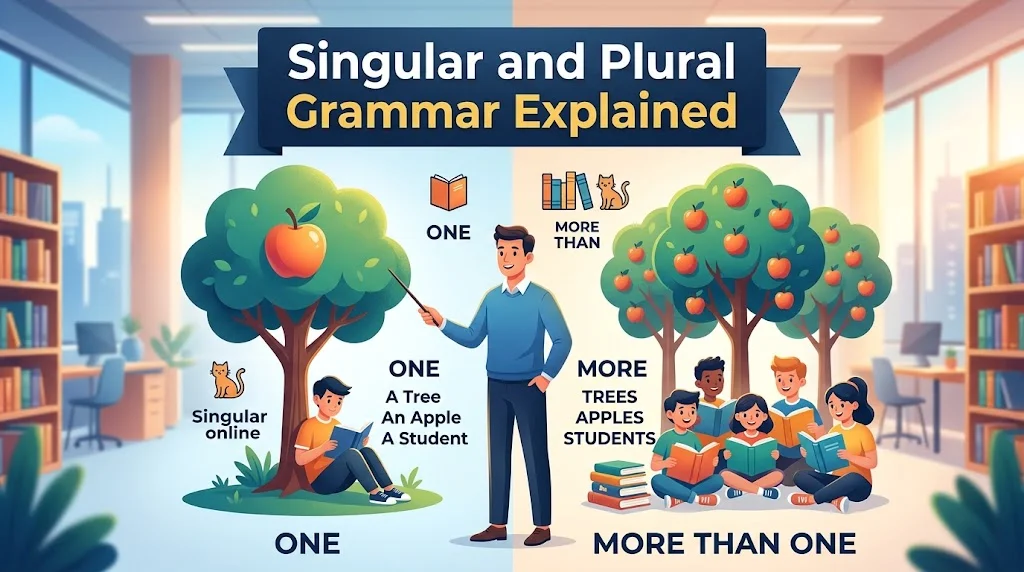
The central grammar point behind die vs. dice is quantity.
Die is singular.
Dice is plural.
That makes the basic structure straightforward:
| Singular | Plural |
| one die | two dice |
| a die | several dice |
| this die | these dice |
| that die | those dice |
You can use the same logic in complete sentences.
- This die is heavier than the others.
- These dice are made of wood.
- That die landed on six.
- Those dice belong to the game.
- One die rolled under the table.
- Two dice stopped near the board.
The grammar becomes almost automatic once you connect each form with quantity.
English has many irregular plurals that work this way. A singular noun can change internally rather than simply taking an ending. Consider:
- one man → two men
- one woman → two women
- one child → two children
- one mouse → two mice
- one tooth → two teeth
- one die → two dice
The exact historical reasons differ from word to word, but the grammatical principle remains familiar: some English plurals have special forms.
Cambridge’s grammar reference includes die → dice in its list of irregular noun pairs.
Why “Dies” Causes Confusion
The spelling dies looks like it should be the plural of die. In some contexts, it actually is a legitimate plural form. The problem comes from assuming that every meaning of die takes the same plural.
For gaming cubes, traditional standard English uses dice.
But dies can refer to more than one manufacturing tool called a die. Oxford, for example, defines another kind of die as a shaped metal block used to form materials such as coins or other objects.
So context changes the answer.
Compare:
- The player rolled two dice.
- The factory uses several dies.
The first sentence concerns gaming cubes. The second concerns manufacturing tools.
That difference is important because it prevents a common mistake: assuming that dies is always wrong. It isn’t. It simply isn’t the traditional plural you want when discussing gaming cubes.
Is “Dice” Singular or Plural?
In traditional grammar, dice is plural when it refers to multiple gaming cubes.
For example:
The dice are on the table.
The plural verb are fits because the sentence treats dice as more than one object.
You can also say:
The dice were loaded.
Again, the plural verb agrees with the plural noun.
However, real-world English has become more flexible around dice. Modern dictionaries recognize usage patterns that don’t always fit the older rule as neatly as traditional grammar guides do. Cambridge identifies dice as a plural noun while also noting die as a US or older form. Merriam-Webster likewise defines dice as a plural noun meaning die, while separately recording other senses of dice.
This distinction matters when you encounter different forms in books, games, online discussions, or casual speech.
If your goal is clear, conventional American English, the safest pattern remains:
Use die for one gaming cube and dice for more than one.
That choice avoids ambiguity and aligns with major dictionary references.
Is “Die” Singular or Plural?
For the gaming sense, die is singular.
That means you can correctly write:
- The die is red.
- The die landed on five.
- A die has six faces.
- One die rolled off the table.
- This die belongs to Sarah.
Notice the verb is in “The die is red.” A singular subject takes a singular verb.
Now compare it with:
- The dice are red.
- The dice landed on five and two.
- Two dice have six faces each.
- These dice belong to Sarah.
Here, dice takes plural agreement.
This simple subject-verb pattern gives you a useful editing test. If you can replace the noun with one cube, use die. If you mean multiple cubes, use dice.
A Fast Substitution Test
Ask yourself:
Could I say “one cube”?
If yes, use die.
Could I say “two or more cubes”?
If yes, use dice.
For example:
Roll one cube.
Becomes:
Roll one die.
And:
Roll two cubes.
Becomes:
Roll two dice.
This technique works particularly well when you’re proofreading a sentence and don’t immediately remember the rule.
Why Is the Plural?
The unusual plural has a long history. The gaming noun die traces back through Middle English to Old French de, ultimately connected with Latin datum, meaning something given or played. Oxford gives this word origin for the gaming sense.
The plural dice developed from an older French plural form. Oxford lists its origin through Middle English and Old French des, the plural of de, with the same Latin source. Merriam-Webster also traces modern dice to Middle English forms such as dyce and dees.
So the modern pair reflects an older singular-plural relationship rather than a simple English -s ending.
You can think of the development like this:
Latin → Old French → Middle English → Modern English
The important takeaway isn’t memorizing the entire history. It’s understanding why die/dice doesn’t behave like a regular noun such as book/books.
English inherited many irregular forms from earlier stages of the language. Some survived because speakers continued using them often enough to keep them recognizable.
Gaming vocabulary is especially resistant to replacement because these terms have remained useful for centuries. Players need short, familiar words to describe individual pieces and groups of pieces. Die and dice filled those roles effectively.
There is also a famous expression that preserves the singular die:
The die is cast.
This idiom means that a decision or event has passed the point of reversal. Oxford lists the expression with the sense that something has happened or a decision has been made that cannot be changed.
Interestingly, the phrase often feels more formal or literary than everyday gaming language. You might say “roll the die” while playing a board game, but “the die is cast” usually describes an irreversible decision.
The same word appears in both cases, yet context gives it a very different flavor.
In Real Sentences
The easiest way to master the distinction is to see it operating naturally in sentences.
When You Mean One Die
Use die when only one gaming cube exists in the situation.
- Roll the die and move your piece.
- The die landed on three.
- I found one die beneath the table.
- That die has rounded corners.
- The player picked up the die.
- One die is enough for this part of the game.
Each sentence describes a single object.
When You Mean Multiple Dice
Use dice when the sentence refers to two or more gaming cubes.
- Roll the dice and add the numbers.
- The dice landed beside the board.
- She bought a new set of dice.
- The player rolled two dice.
- Three dice were scattered across the table.
- The game requires a pair of dice.
Oxford specifically records common combinations such as a pair of dice, roll the dice, throw the dice, and shake the dice.
The Same Action With Different Quantities
One of the clearest ways to understand the difference is to keep everything else unchanged.
| One gaming cube | Multiple gaming cubes |
| Roll the die. | Roll the dice. |
| Pick up the die. | Pick up the dice. |
| The die landed here. | The dice landed here. |
| The die shows six. | The dice show different numbers. |
| Move after rolling the die. | Move after rolling the dice. |
The action doesn’t determine the noun. Quantity does.
That’s an important point. People sometimes memorize phrases such as roll the dice and then use dice automatically whenever a game involves rolling. However, if you specifically mean one cube, roll the die remains the precise traditional form.
In Board Games and Tabletop Games
Game instructions provide some of the clearest examples of the distinction.
Imagine a game that gives each player one six-sided cube. The instructions might say:
Roll the die to determine who goes first.
Now imagine a different game that gives each player two six-sided cubes:
Roll the dice and add the numbers together.
Nothing mysterious happens here. The noun simply reflects the number of objects.
Many tabletop games use more than one type of die as well. A player might have a six-sided die, an eight-sided die, and a twenty-sided die. In that situation, you can talk about three dice as a group while referring to each individual object as a die.
For example:
The player rolls three dice: one six-sided die, one eight-sided die, and one twenty-sided die.
This sentence demonstrates the relationship perfectly.
Dice identifies the group.
Die identifies each individual cube.
That distinction becomes especially useful in detailed game rules. A sentence such as “Roll the dice” may be perfectly clear when the rules already specify two or three cubes. But if the player must choose one particular cube from several types, die provides greater precision.
In Probability and Mathematics
The singular-plural distinction also appears in probability.
A standard six-sided die usually has six possible face values:
1, 2, 3, 4, 5, 6
If you roll one die, each face represents one possible result under the usual fair-die model. Assuming every face has an equal chance, each result has a probability of 1/6, or about 16.67%.
That gives you a natural mathematical sentence:
The probability of rolling a six on one fair die is 1/6.
When you roll two dice, the number of possible ordered outcomes becomes 36, because each die can independently produce one of six results:
6 × 6 = 36
For example, rolling a 2 on the first die and a 5 on the second creates the ordered outcome (2, 5).
The grammar changes with the mathematics:
- One die has six possible face results.
- Two dice have 36 ordered outcomes.
- Three dice have 216 ordered outcomes.
The underlying calculation follows:
6 × 6 × 6 = 216
This is a useful example because it shows how grammar and technical language work together. The noun die identifies one randomizing object. The noun dice identifies multiple objects used together.
One Die vs. Two Dice in Probability
| Situation | Correct term | Number of equally likely ordered outcomes |
| One six-sided cube | one die | 6 |
| Two six-sided cubes | two dice | 36 |
| Three six-sided cubes | three dice | 216 |
| Four six-sided cubes | four dice | 1,296 |
These figures assume ordinary independent six-sided dice with equally likely faces.
That assumption matters. Real physical dice can vary slightly because of material, manufacturing, balance, surface wear, or other physical factors. In elementary probability, however, the standard model treats each face as equally likely.
Is “Dice” Singular or Plural?
The word dice traditionally works as the plural of die when you talk about gaming cubes. If you have one cube, you have a die. If you have two or more, you have dice. That distinction may look unusual at first, but it follows a long-established pattern in English.
For example:
- The die is on the table.
- The dice are on the table.
- One die rolled under the chair.
- Two dice rolled across the board.
- This die has sharp edges.
- These dice have rounded edges.
The verbs also reveal the difference. Die takes a singular verb such as is or has, while dice normally takes plural verbs such as are or have.
| Singular | Plural |
| The die is ready. | The dice are ready. |
| The die has six faces. | The dice have six faces each. |
| This die was rolled. | These dice were rolled. |
This agreement becomes particularly helpful when you’re unsure which form belongs in a sentence. Look at the quantity first. Then choose the noun.
Modern English does introduce some variation. In casual speech, gaming discussions, and some modern usage, dice sometimes appears as a singular form. Merriam-Webster records dice as a noun with both plural and singular-related usage, while traditional dictionaries continue to identify die as the singular gaming noun.
For formal writing, educational material, edited content, and careful American English, the traditional distinction offers the clearest choice:
One die, two dice.
That short rule avoids confusion without requiring you to memorize complicated grammar terminology.
Is “Die” Singular or Plural?
When die means a gaming cube, it is singular. You use it when the situation involves one individual cube.
Consider these examples:
- The die landed on six.
- Roll the die again.
- A die has six faces.
- One die is missing from the set.
- This die belongs to the red player.
Each sentence focuses on one object.
The plural version changes the noun:
- The dice landed on six and two.
- Roll the dice again.
- Two dice have six faces each.
- Several dice are missing from the set.
- These dice belong to the red player.
The difference isn’t about the game itself. It’s about number.
If you’re talking about one cube, use die. If you’re talking about multiple cubes, use dice.
A useful editing trick is to replace the noun mentally with cube or cubes. If the sentence means one cube, choose die. If it means several cubes, choose dice.
For instance:
Roll one cube.
That becomes:
Roll one die.
Now change the quantity:
Roll two cubes.
That becomes:
Roll two dice.
This substitution test works because it removes the unusual spelling from the equation. You first identify the quantity, then select the appropriate form.
What About “Dies”?
This is where things get interesting. Dies isn’t simply an incorrect word. It can be a legitimate plural of die in other contexts.
For example, manufacturing uses die as a technical noun for a tool that shapes, cuts, presses, or forms material. The plural can be dies.
So you could write:
The factory uses several metal dies.
Here, dies doesn’t refer to gaming cubes. It refers to manufacturing tools.
That gives you three forms worth keeping separate:
| Word | Meaning | Example |
| die | One gaming cube | Roll the die. |
| dice | Multiple gaming cubes | Roll the dice. |
| dies | Plural of certain other meanings of die | The factory uses several dies. |
Context does the heavy lifting.
When you see roll, game, board, pips, faces, or probability, the gaming meaning becomes obvious. In manufacturing, words such as metal, press, stamp, cut, and tool point toward the technical meaning.
So don’t memorize dies = wrong. Instead, remember:
Dies is not the traditional plural for gaming dice.
That distinction is much more accurate.
Why Is the Plural?
The unusual plural comes from the history of the word. English didn’t create dice by simply adding a regular plural ending. The modern forms developed through earlier French and Middle English forms.
Oxford traces the gaming noun die through Middle English to Old French de, ultimately connecting it with Latin datum, while dice developed from the corresponding plural forms.
That history explains why die → dice doesn’t resemble ordinary pairs such as:
- book → books
- table → tables
- game → games
- player → players
Instead, it resembles other irregular English patterns where the noun changes form.
Compare:
- one mouse → two mice
- one tooth → two teeth
- one foot → two feet
- one child → two children
- one die → two dice
You don’t need to know the historical details to use the words correctly. Still, understanding their origin helps explain why the plural seems unusual.
The form dice has also survived because gaming has remained a common activity across centuries. Players, game designers, mathematicians, and writers have continued using the word in everyday language.
The result is a compact and familiar pair:
die = singular
dice = plural
“The Die Is Cast”
One famous expression also preserves the singular form:
The die is cast.
The expression describes a decision or action that has become irreversible. Once the “die” has been cast, the outcome can no longer be changed.
The phrase has a long historical association with Julius Caesar crossing the Rubicon. The Latin expression traditionally connected with the event is alea iacta est, commonly translated as “the die is cast.” The English expression later became a fixed idiom.
Today, you may encounter it in journalism, literature, speeches, or discussions about major decisions.
For example:
The contract has been signed, and the die is cast.
Here, die remains singular even though the phrase isn’t describing an ordinary board-game move.
That example also shows why context matters so much. The word may appear in a gaming discussion, a historical reference, or a figurative expression. Its meaning depends on the surrounding language.
In Real Sentences
Real sentences make the distinction easier to remember than isolated definitions. Once you see the words working naturally, the pattern becomes almost automatic.
Examples With One Die
Use die when only one gaming cube appears in the situation.
- Roll the die and move three spaces.
- The die landed on four.
- A die rolled beneath the sofa.
- The player picked up the die.
- One die is enough for this round.
- This die has unusually deep pips.
- The red die belongs to Mia.
- The die bounced twice before stopping.
Each example points to a single object.
You can also place descriptive words before die:
- a six-sided die
- a red die
- a wooden die
- a weighted die
- a standard die
- a single die
For example:
The player rolled a standard six-sided die.
The noun remains singular because the sentence describes one gaming cube.
Examples With Multiple Dice
Use dice when two or more gaming cubes are involved.
- Roll the dice before choosing a card.
- The dice stopped beside the board.
- She rolled two dice.
- Three dice were scattered across the table.
- The player collected the dice.
- These dice have different colors.
- The game requires a pair of dice.
- He keeps his dice in a small container.
Again, quantity controls the choice.
The phrase a pair of dice deserves special attention. A pair means two things considered together, so the plural noun naturally follows it.
a pair of dice
You wouldn’t normally say:
a pair of die
because the phrase describes two gaming cubes.
In Board Games and Tabletop Games
Board games provide some of the clearest real-world examples of die vs. dice. Game instructions often need to tell players exactly how many objects to roll.
Suppose a game uses one six-sided cube. Its rules might say:
Roll the die and move your token according to the number shown.
Now imagine a game that uses two six-sided cubes:
Roll the dice and add the results together.
The verb roll stays the same. The noun changes because the number changes.
This distinction becomes even more useful in tabletop games that use different types of dice. Modern role-playing games, for example, commonly use polyhedral dice with different numbers of faces.
You might encounter:
- d4 — four-sided die
- d6 — six-sided die
- d8 — eight-sided die
- d10 — ten-sided die
- d12 — twelve-sided die
- d20 — twenty-sided die
The notation d20, for instance, normally refers to a twenty-sided die.
If a player owns several d20s, you can correctly say:
The player has four d20 dice.
Or more naturally:
The player has four d20s.
When discussing one, you can say:
Roll one d20.
This demonstrates the same underlying relationship. One physical object is a die, while several are dice.
A Practical Gaming Example
Imagine a tabletop game that requires three dice. The rules could state:
Roll three dice and add their face values.
A player might roll a 2, 5, and 6.
The total is:
2 + 5 + 6 = 13
If the next instruction asks the player to reroll only the cube showing 2, the language changes:
Reroll that die.
The group is dice.
The individual cube is die.
That is the distinction in action.
In Probability and Mathematics
The words die and dice appear frequently in probability because dice provide a simple model for random outcomes.
A standard six-sided die has six numbered faces:
1, 2, 3, 4, 5, 6
Under the standard assumption of a fair die, each face has an equal probability of appearing.
Therefore:
P(rolling a 6) = 1/6 ≈ 16.67%
The noun remains singular because the experiment involves one cube:
The probability of rolling a six on one die is 1/6.
When two dice are involved, the mathematical structure changes.
Each die has six possible outcomes. Two dice therefore create:
6 × 6 = 36
possible ordered outcomes.
For example:
- (1, 1)
- (1, 2)
- (1, 3)
- (2, 1)
- (2, 2)
- (6, 6)
These represent combinations of results from two dice.
The language follows the mathematics:
Roll two dice and calculate the sum.
If you roll two standard six-sided dice, the possible sums range from 2 through 12.
The probability distribution isn’t uniform. A sum of 7 occurs more often than a sum of 2 because more combinations produce 7.
For example:
| Sum | Number of combinations |
| 2 | 1 |
| 3 | 2 |
| 4 | 3 |
| 5 | 4 |
| 6 | 5 |
| 7 | 6 |
| 8 | 5 |
| 9 | 4 |
| 10 | 3 |
| 11 | 2 |
| 12 | 1 |
There are 36 total ordered outcomes, and six of them produce a sum of 7.
So:
P(sum of 7) = 6/36 = 1/6 ≈ 16.67%
This mathematical example makes the singular-plural relationship especially clear. A probability problem might begin with one die, then move to two dice, and the grammar changes with the number of physical objects.
Three Dice and Beyond
The same principle continues as the number of dice increases.
For three standard six-sided dice:
6 × 6 × 6 = 216
ordered outcomes exist.
For four:
6 × 6 × 6 × 6 = 1,296
possible ordered outcomes exist.
| Number of dice | Possible ordered outcomes |
| 1 die | 6 |
| 2 dice | 36 |
| 3 dice | 216 |
| 4 dice | 1,296 |
| 5 dice | 7,776 |
These calculations assume independent rolls and six equally likely outcomes for each die.
That assumption matters in mathematics. Physical dice aren’t guaranteed to produce perfectly equal probabilities. Their shape, weight distribution, manufacturing quality, surface condition, and rolling method can influence real-world behavior. Elementary probability problems generally ignore those small physical effects and use the ideal fair-die model.
The grammar, however, doesn’t change:
one die, two dice, three dice, four dice.
Which Is Correct?
For traditional standard English, one die is the correct choice when you mean one gaming cube.
The reason is straightforward. One identifies a singular quantity, so the singular noun die follows it.
Correct examples include:
- one die
- a die
- this die
- that die
- one six-sided die
- one red die
By contrast, one dice conflicts with the traditional singular-plural distinction.
You may encounter one dice in casual conversation or online gaming communities. Language changes through everyday use, and some speakers now use dice more broadly. Still, that doesn’t make it the best choice for formal or carefully edited writing.
If you’re writing a school assignment, game rules, instructional guide, professional article, or other polished text, choose:
one die
rather than:
one dice
The same principle applies to phrases such as a single die and each die.
For example:
Each die has six faces.
Not:
Each dice has six faces.
The determiner each always points to individual items, so the singular noun fits naturally.
“Two Dice” vs. “Two Dies”: Which Is Correct?
When you mean two gaming cubes, the correct traditional form is two dice.
For example:
The player rolled two dice.
Not:
The player rolled two dies.
The word dies belongs to other meanings of die, particularly contexts involving tools or devices used to shape materials.
Compare:
The player rolled two dice.
with:
The manufacturer replaced two metal dies.
The first sentence concerns gaming objects.
The second concerns industrial tools.
This is why context matters more than spelling alone.
The easiest rule remains:
Gaming: one die → two dice
Other technical meanings: one die → multiple dies
Once you separate those meanings, the apparent contradiction disappears.
Common Mistakes
Even after learning the basic rule, die vs. dice can still cause confusion. The problem usually appears when a sentence contains numbers, game instructions, or technical terms. The good news is that the core distinction stays simple.
For gaming objects, die refers to one cube. Dice refers traditionally to two or more cubes.
The following mistakes are especially common:
| Incorrect | Correct | Why |
| Roll one dice. | Roll one die. | Die is singular. |
| I have two dies. | I have two dice. | Dice is the traditional gaming plural. |
| She rolled three die. | She rolled three dice. | A number greater than one requires the plural. |
| Pick up one dice. | Pick up one die. | One signals a singular noun. |
| The player rolled a dice. | The player rolled a die. | The article a normally takes a singular count noun. |
Mistake: Using “Dice” After “One”
The phrase one dice appears in casual speech and informal writing. However, traditional standard usage calls for one die.
Think about the number before the noun.
If the quantity is exactly one, use die:
- one die
- a die
- this die
- that die
- each die
- another die
If the quantity is more than one, use dice:
- two dice
- three dice
- several dice
- many dice
- these dice
- those dice
This pattern makes editing much easier. Instead of asking whether dice sounds familiar, look at the quantity first.
Mistake: Assuming Every Plural “Die” Becomes “Dice”
The word die has several meanings in English. Its plural depends on which meaning you have in mind.
When die means a gaming cube, its traditional plural is dice.
When die refers to a tool used in manufacturing, the plural can be dies.
For example:
The factory replaced two worn dies.
Here, dies does not mean gaming cubes. It refers to manufacturing tools.
That distinction matters because the same spelling can represent different nouns. Context determines which plural makes sense.
Mistake: Treating “Dies” as the Gaming Plural
A common assumption is that dies must be the regular plural of die. Grammatically, that looks reasonable.
English, however, contains many irregular plurals.
Consider:
- one mouse, two mice
- one child, two children
- one person, two people
- one tooth, two teeth
- one die, two dice
So two dies isn’t the traditional form when you’re talking about gaming cubes.
Mistake: Using “Die” for Multiple Dice
The opposite error also occurs.
A sentence such as:
The player rolled three die.
is incorrect in traditional standard English.
The number three tells you that the noun must refer to multiple objects. Therefore, the standard form is:
The player rolled three dice.
This is one of the easiest errors to catch during proofreading. Search for a number before die and check whether the quantity is actually one.
Mistake: Confusing “Dice” the Noun With “Dice” the Verb
The word dice has another common role in English. It can function as a verb meaning to cut food into small cubes.
For example:
Dice the onions before adding them to the pan.
Here, dice isn’t a plural noun at all. It’s a verb.
The same spelling can therefore appear in two completely different grammatical roles:
| Word | Part of speech | Meaning | Example |
| die | noun | One gaming cube | Roll one die. |
| dice | noun | Two or more gaming cubes | Roll two dice. |
| dice | verb | Cut into small cubes | Dice the carrots. |
| die | verb | Stop living | Plants can die without water. |
| die | noun | Manufacturing tool | The machine uses a metal die. |
| dies | noun | More than one manufacturing tool | Several dies were replaced. |
Context usually removes the ambiguity.
If you see dice after a verb such as roll, it probably functions as a gaming noun. If you see it after an instruction such as dice the tomatoes, it functions as a verb.
In American English
American English generally follows the traditional distinction one die, two dice when referring to gaming cubes. This remains the safest choice for formal, edited, academic, educational, and instructional writing.
At the same time, language changes through everyday use. Dice is sometimes treated as a singular noun in modern informal English, especially when speakers are thinking of dice as a general game object rather than as individual cubes.
This creates an important difference between traditional grammar and actual usage.
Dictionaries document this variation. Traditional usage identifies die as the singular gaming noun and dice as its plural. Some modern usage also recognizes dice as a singular form, particularly in North American English.
Traditional American English
For careful writing, these forms are straightforward:
Roll one die.
Roll two dice.
The game uses five dice.
Each player receives one die.
This approach keeps the singular and plural forms clearly separated.
Modern Informal Usage
You may encounter sentences such as:
Roll a dice.
or:
Pick up that dice.
These forms occur in real-world English. They don’t necessarily prevent readers from understanding the sentence.
Still, one die is the better choice when you’re writing for a broad audience or following traditional grammatical conventions.
This is especially true in:
- school assignments
- grammar guides
- textbooks
- game instructions
- formal reports
- edited articles
- professional writing
- educational materials
A simple rule works well:
Use “die” for one gaming cube and “dice” for two or more.
That rule is clear, familiar, and unlikely to confuse your readers.
Why Usage Can Vary
The shift toward singular dice makes sense from a language-change perspective. Speakers often regularize unusual forms.
For many people, dice feels like the name of the object itself. They may not consciously think about die as its singular form.
This is similar to how some irregular forms become less prominent in everyday speech. Frequent exposure can gradually change how speakers analyze a word.
That doesn’t make the traditional form useless. Quite the opposite.
If your goal is precision, die remains the clearest singular choice for a gaming cube.
Formal vs Informal Use
Register matters when choosing between traditional and newer forms.
Imagine two different situations.
A group of friends is playing a board game. Someone says:
Grab a dice.
Everyone understands the instruction immediately.
Now imagine a textbook explaining probability:
Roll one dice six times and record the results.
The sentence feels less polished because a formal educational context normally favors:
Roll one die six times and record the results.
The difference isn’t about whether the reader can understand the sentence. It’s about standardized usage and precision.
For Academic Writing
Use:
A fair die has six equally likely outcomes.
Not:
A fair dice has six equally likely outcomes.
When discussing multiple cubes, write:
Two dice are rolled simultaneously.
This distinction is especially useful in mathematics because singular and plural quantities affect the underlying calculation.
For Game Instructions
Clear terminology makes rules easier to follow:
Roll one die and move your token three spaces.
Roll two dice and add the numbers together.
A player shouldn’t have to guess whether dice means one object or several.
For Casual Conversation
Informal speech may be more flexible.
You might hear:
Can you hand me a dice?
Most listeners will understand the intended meaning.
However, if you’re unsure which form to use, the traditional version is the safest:
Can you hand me a die?
This choice is particularly useful when writing rather than speaking.
“A Pair of Dice” and Other Useful Expressions
English has many expressions built around die and dice. Learning these phrases can make the distinction easier because they show how native usage works in context.
A Pair of Dice
A pair of dice means two gaming cubes considered together.
For example:
He picked up a pair of dice and shook them in his hand.
The expression is especially common when two standard six-sided dice are used together.
Notice the grammar:
- a pair = singular noun phrase
- of dice = two gaming cubes
You wouldn’t normally say a pair of die in this context.
A Set of Dice
A set of dice refers to a collection of dice.
For example:
She bought a new set of dice for her tabletop game.
A set might contain several dice of different sizes.
In role-playing games, a typical set can include different polyhedral forms, such as a d4, d6, d8, d10, d12, and d20.
A Handful of Dice
This phrase describes several dice held together or considered as a group.
He grabbed a handful of dice from the box.
The exact number isn’t important. The phrase simply suggests more than one.
Roll the Dice
Roll the dice is one of the most familiar expressions involving the word.
Literally, it means to throw dice so they tumble across a surface and produce random results.
It can also have a figurative meaning:
Starting a new business felt like rolling the dice.
In this figurative use, the phrase suggests taking a risk when the outcome is uncertain.
Roll of the Dice
A roll of the dice can refer literally to one instance of rolling dice.
For example:
The winner was determined by a roll of the dice.
It can also describe an unpredictable event:
Choosing that investment was a roll of the dice.
The phrase emphasizes uncertainty and chance.
No Dice
No dice is an informal expression meaning no success, no agreement, or no possibility.
For example:
We asked for a discount, but no dice.
It can also mean that an attempt failed:
I tried to fix the old printer, but no dice.
The expression is idiomatic. It doesn’t literally mean that there are no dice present.
Load the Dice
To load the dice means to arrange circumstances so that a particular result becomes more likely.
Literally, loaded dice have been altered to favor certain outcomes.
The expression is also commonly figurative:
The rules were loaded against the smaller team.
The phrase often suggests that a situation isn’t fair or neutral.
The Die Is Cast
The die is cast is a well-known idiom meaning that an important decision has been made and cannot easily be reversed.
The phrase uses the singular die because its traditional wording refers to a single die.
For example:
Once the contract was signed, the die was cast.
The expression is associated with Julius Caesar in traditional accounts, although the famous wording comes through later literary tradition.
Dice With Death
The expression dice with death means to take an extremely dangerous risk.
For example:
Driving that fast on an icy road is like dicing with death.
This expression uses dice as a verb rather than as the plural noun for gaming cubes.
That difference is easy to miss.
Here:
Roll the dice.
Dice is a noun.
But here:
They diced with death.
Diced is a verb.
Die vs Dice vs Dies: A Clear Comparison
The three forms can look deceptively similar. Their meanings become much clearer when placed side by side.
| Form | Typical role | Meaning | Example |
| die | gaming noun | One gaming cube | Roll one die. |
| dice | gaming noun | Two or more gaming cubes | Roll two dice. |
| dies | manufacturing noun | More than one manufacturing die | The factory uses several dies. |
| die | verb | Stop living | Plants die without water. |
| dice | verb | Cut into small cubes | Dice the potatoes. |
| diced | past-tense verb | Cut into small cubes | She diced the tomatoes. |
| dies | verb | Third-person singular of die | The plant dies without sunlight. |
This table highlights an important point: grammar alone doesn’t determine the meaning.
You must also consider the surrounding words.
Gaming Context
The player rolled two dice.
The word dice is a plural noun.
Manufacturing Context
The company ordered two new dies.
The word dies is a plural noun referring to tools.
Cooking Context
Dice the peppers finely.
The word dice is an imperative verb.
Biological Context
Without water, the plant may die.
The word die is a verb.
Third-Person Verb
The plant dies without enough water.
Here, dies is not a plural noun. It’s the third-person singular form of the verb die.
These distinctions prevent a lot of unnecessary confusion.
In Game Instructions
Game instructions benefit from precise singular and plural nouns because players need to know exactly how many objects to use.
Compare these instructions:
Roll a die.
This tells you to use one gaming cube.
Now compare:
Roll two dice.
This tells you to use two gaming cubes.
The quantity changes the noun form.
A longer instruction might say:
Roll one die first. Then roll two dice and add the results together.
The wording makes the sequence obvious.
Why Precision Matters in Games
Suppose a game rule says:
Roll a dice and move according to the result.
A player may understand the intended meaning. However, traditional grammar would make the instruction:
Roll a die and move according to the result.
Now consider:
Roll dice and move according to the total.
This can refer generally to multiple dice. If the exact number matters, specify it:
Roll three dice and add their values.
Precise quantities eliminate ambiguity.
Tabletop Role-Playing Games
Tabletop role-playing games make the distinction especially visible because players often use different types of dice.
A rule might say:
Roll one d20.
That means one 20-sided die.
Another instruction might say:
Roll two d6s.
That means two six-sided dice.
The notation 2d6 also commonly means two six-sided dice. Similarly:
- 1d4 = one four-sided die
- 1d6 = one six-sided die
- 2d6 = two six-sided dice
- 3d8 = three eight-sided dice
- 1d20 = one twenty-sided die
The number before the d tells you how many dice to roll. The number after it tells you how many sides each die has.
This system gives players a compact way to express both quantity and type.
In Probability
The singular-plural distinction also matters in probability problems.
A problem might ask:
What is the probability of rolling a 6 on a fair die?
Because the problem concerns one cube, die is appropriate.
There are six equally likely outcomes:
1, 2, 3, 4, 5, 6
Therefore:
P(6) = 1/6 ≈ 16.67%
Now consider two dice.
What is the probability of rolling a total of 7 with two fair dice?
There are 36 equally likely ordered outcomes.
Six combinations produce a total of 7:
- 1 + 6
- 2 + 5
- 3 + 4
- 4 + 3
- 5 + 2
- 6 + 1
So:
P(total of 7) = 6/36 = 1/6 ≈ 16.67%
The mathematics depends on the number of dice, while the grammar reflects that number.
One Die
For one standard six-sided die:
6 possible outcomes
Two Dice
For two standard six-sided dice:
6 × 6 = 36 ordered outcomes
Three Dice
For three standard six-sided dice:
6 × 6 × 6 = 216 ordered outcomes
Four Dice
For four standard six-sided dice:
6⁴ = 1,296 ordered outcomes
This illustrates why accurate wording matters in mathematical explanations. One die and two dice don’t merely differ grammatically. They describe different probability spaces.
When “Dice” Acts Like a Singular Noun
One of the more interesting parts of modern English is the use of dice as a singular noun.
Traditional grammar treats:
one die
and:
two dice
as the standard pair.
However, some dictionaries recognize dice as a singular form in modern usage, particularly in North American English.
This means you may encounter:
a dice
in contemporary writing.
That usage is understandable, but it can still sound less traditional to readers who learned the older distinction.
Should You Use “A Dice”?
For most formal situations, no.
Use:
a die
instead.
This is the clearest option for:
- academic writing
- professional content
- grammar explanations
- educational resources
- formal game rules
- edited publications
If you’re writing casually, a dice may appear in everyday usage. Still, choosing a die avoids the issue altogether.
Why “A Die” Is the Safer Choice
The traditional form gives readers an immediate quantity signal.
A die means one.
Dice means multiple.
That distinction requires no extra explanation.
When writing instructional content, clarity usually beats novelty.
A Practical Editing Test for Die and Dice
When proofreading a sentence, ask one simple question:
How many gaming cubes are being discussed?
If the answer is one, choose die.
If the answer is two or more, choose dice.
For example:
The player has one ___.
Answer: die
The player has four ___.
Answer: dice
Each player receives a ___.
Answer: die
Each player receives two ___.
Answer: dice
This test works in most ordinary gaming contexts.
It also helps you avoid being distracted by the unusual spelling.
Instead of memorizing a complicated grammatical explanation, connect the word directly to quantity:
1 → die
2+ → dice
That small mental shortcut handles most cases.
A Closer Look at “Dies”
Because dies resembles the expected regular plural of die, it deserves special attention.
In manufacturing and mechanical contexts, a die can be a tool used to shape, cut, stamp, or form material.
The plural is commonly dies.
For example:
The manufacturer replaced the damaged dies.
Here, dies is completely correct.
The same form also appears as a verb:
The battery dies quickly in cold weather.
In this sentence, dies means that the battery stops functioning.
So dies can represent two different grammatical ideas:
plural noun
Several manufacturing dies were stored in the workshop.
third-person singular verb
The machine dies when it overheats.
Neither example refers to multiple gaming cubes.
For gaming objects, traditional usage gives you:
one die
two dice
This distinction is worth remembering because the spelling alone doesn’t tell you the meaning.
A Simple Usage Guide
When you’re writing about games, probability, or tabletop play, this compact guide covers the most important cases.
| If you mean… | Use… | Example |
| One gaming cube | die | Roll one die. |
| Two gaming cubes | dice | Roll two dice. |
| Several gaming cubes | dice | Gather the dice. |
| A manufacturing tool | die | The die shapes the metal. |
| Several manufacturing tools | dies | The dies need replacement. |
| Cutting food into cubes | dice | Dice the onions. |
| Stopping to live or function | die | The plant may die. |
| Third-person form of die | dies | The plant dies quickly. |
The most important distinction remains simple:
Gaming: one die, two or more dice.
Once you separate the gaming noun from the other meanings of die, the spelling becomes much easier to control.
Common Real-World Examples
Here are several natural examples that show how the forms work in everyday contexts.
Example: Board Game
Maria rolled one die and moved her piece four spaces.
Only one gaming cube is involved, so die is correct.
Example: Two Dice
The player rolled two dice and added the numbers together.
Two cubes require the plural dice.
Example: Multiple Dice
Several dice were scattered across the table.
The exact number isn’t stated, but the sentence clearly refers to more than one.
Example: Probability Class
A fair die has six equally likely faces.
The sentence describes one standard gaming cube.
Example: Manufacturing
The factory keeps several metal dies in storage.
These are tools, not gaming cubes.
Example: Cooking
Dice the carrots into small pieces.
Here, dice is a verb.
Example: Figurative Expression
Accepting that risky offer was a roll of the dice.
The phrase uses dice in its familiar figurative sense of uncertainty and chance.
These examples show why surrounding context matters just as much as the word itself.
A Quick Rule for Writers and Editors
If you’re editing an article, game manual, lesson, or probability problem, use this sequence:
Check the meaning.
Is die being used as a gaming noun, manufacturing noun, or verb?
Check the quantity.
If it’s a gaming noun, is there one cube or more than one?
Check the grammar.
Use die for one gaming cube and dice for two or more.
Check the register.
If the writing is formal or educational, favor the traditional distinction.
Check the surrounding words.
Words such as one, a, and each usually point toward singular die. Numbers such as two, three, and several point toward plural dice.
This five-step check takes only a few seconds. It can prevent one of the most persistent little grammar mistakes in gaming vocabulary.
How to Remember the Difference
The easiest way to remember die vs. dice is to connect each word with a number.
One die.
Two dice.
That is the core rule.
You don’t need to memorize a long grammar explanation every time you write the words. Instead, picture a single gaming cube in your hand. That’s a die. Put another cube beside it, and now you have dice.
This simple visual trick works surprisingly well.
Use the “One or More?” Test
Whenever you’re unsure, ask:
Am I talking about one gaming cube or more than one?
If it’s one, write die.
I rolled one die.
If it’s more than one, write dice.
I rolled three dice.
This method is especially useful when you’re proofreading quickly.
Remember the Irregular Plural
Think about familiar irregular plurals:
- one mouse → two mice
- one goose → two geese
- one tooth → two teeth
- one die → two dice
The spelling changes instead of simply adding -s.
That makes die → dice unusual, but not completely unique in English.
A Visual Memory Trick
Imagine a game table.
There is one die in the center.
Then another die joins it.
Now there are two dice.
The picture itself reinforces the grammar:
1 = die
2+ = dice
If you remember only that relationship, you’ll handle most ordinary uses correctly.
Quick Grammar Rules
The following rules provide a fast reference for writers, students, editors, and gamers.
Rule One: Use “Die” for One Gaming Cube
When you mean exactly one numbered cube used in a game, use die.
Roll one die.
The die landed on six.
Pick up the die from the floor.
Each player gets a die.
The singular form works naturally with a, one, each, this, and that.
Rule Two: Use “Dice” for Two or More Gaming Cubes
When you mean multiple gaming cubes, use dice.
Roll two dice.
The dice landed near the board.
She bought six new dice.
Put the dice back in the box.
The traditional plural form remains the safest choice in formal and edited English.
Rule Three: Don’t Use “Dies” for Multiple Gaming Cubes
In traditional standard usage:
one die → two dice
not:
one die → two dies
However, dies can be correct when die has another meaning, especially a manufacturing tool.
The factory replaced three dies.
So don’t memorize “dies is always wrong.” Instead, identify the meaning first.
Rule Four: Watch the Word “Dice” as a Verb
Dice can also be a verb meaning to cut something into small cubes.
Dice the potatoes.
Here, it has nothing to do with the plural noun dice.
This distinction becomes even clearer when you change the tense:
She diced the onions.
The chef is dicing the carrots.
The surrounding sentence tells you which grammatical role the word has.
Rule Five: Formal Writing Favors the Traditional Distinction
Although modern usage sometimes treats dice as singular, one die remains the clearest traditional choice.
For formal writing, use:
one die
rather than:
one dice
This recommendation is particularly useful when you’re writing for students, teachers, editors, or a general professional audience.
Correct and Incorrect Usage
Seeing the forms side by side makes the difference much easier to recognize.
| Incorrect or nontraditional | Standard/traditional | Explanation |
| Roll one dice. | Roll one die. | One requires the singular form. |
| I bought two dies. | I bought two dice. | Gaming plural is dice. |
| She rolled three die. | She rolled three dice. | Three indicates more than one. |
| Pick up a dice. | Pick up a die. | A introduces a singular count noun. |
| The dice is red. | The die is red. | One gaming cube takes singular die. |
| The die are on the table. | The dice are on the table. | Multiple cubes require plural dice. |
| Each player gets two die. | Each player gets two dice. | Two requires the plural. |
| He rolled four dies. | He rolled four dice. | Dies isn’t the traditional gaming plural. |
| Roll the die. | Roll the die. | Correct when one cube is intended. |
| Roll the dice. | Roll the dice. | Correct when multiple cubes are intended. |
The first five examples are especially useful for learners because they cover the most common patterns.
“The Die Is” vs. “The Dice Are”
Subject-verb agreement provides another useful clue.
When referring to one gaming cube:
The die is on the table.
When referring to multiple gaming cubes:
The dice are on the table.
This makes the singular-plural distinction visible through the verb as well.
Compare:
One die is missing.
Two dice are missing.
Several dice are scattered across the floor.
The verb helps confirm the noun form.
In Questions
Questions follow the same basic pattern.
When asking about one gaming cube:
Where is the die?
Did you roll a die?
Which number did the die show?
When asking about multiple cubes:
Where are the dice?
Did you roll two dice?
Which numbers did the dice show?
Notice how the verb changes too:
Where is the die?
Where are the dice?
The difference is grammatical, but it also reflects the number of physical objects involved.
Articles and Determiners
Articles can provide a useful clue when choosing between die and dice.
With “A”
Use a die for one gaming cube:
I need a die.
She rolled a die.
The phrase a dice occurs in modern informal usage, but a die is the traditional standard choice.
With “One”
Use one die:
Roll one die.
The game requires one die.
The combination one dice conflicts with the traditional singular-plural distinction.
With “Two or More”
Use two dice, three dice, four dice, and so on.
Roll two dice.
He owns three dice.
They used four dice during the experiment.
With “Several”
Use several dice:
Several dice were lying beside the board.
With “Each”
When each individual object is considered separately, die can follow each:
Each player receives one die.
You could also say:
Each die has six numbered faces.
Although the group may contain many dice, each die refers to the individual cubes one at a time.
In Possessive Sentences
Possessive constructions follow the same quantity rule.
For one gaming cube:
The die’s edge was chipped.
For multiple gaming cubes:
The dice’s results were recorded.
However, in natural English, writers often restructure the second example because a plural possessive can sound awkward.
A clearer alternative is:
The results of the dice were recorded.
Or:
The dice results were recorded.
The important point is that possession doesn’t change the basic singular-plural distinction.
In Different Types of Games
The words appear across many kinds of games.
Board Games
Board games commonly use one or more standard six-sided dice.
Roll the die and move your token.
Roll two dice and follow the higher number.
Role-Playing Games
Role-playing games often use multiple polyhedral dice.
Roll one d20 to determine whether the attack succeeds.
Roll two d6s for damage.
The notation makes quantity particularly clear.
Gambling Games
Dice also appear in gambling contexts.
The player threw the dice across the table.
When one physical cube is specifically being discussed, die remains the traditional singular form.
Educational Games
Teachers may use dice to teach arithmetic, probability, or counting.
Roll one die and write down the result.
Roll two dice and calculate the sum.
This type of instruction benefits from precise grammar because the number of dice affects the activity itself.
In Probability Experiments
Probability exercises often provide excellent examples of the distinction.
Imagine a classroom experiment involving one standard six-sided die.
Students might be asked to roll the die 50 times.
The experiment uses one physical object, so die is singular.
Now imagine a second experiment involving two standard dice.
Students could roll the dice 50 times and record the total from each roll.
The plural is necessary because two cubes are involved.
One Die Experiment
A student rolls one fair die 100 times.
Each face has an ideal probability of:
1/6 ≈ 16.67%
The experimental results may not match that percentage exactly. Random variation is expected.
Two Dice Experiment
A student rolls two fair dice 100 times.
Each pair has an individual probability of:
1/36 ≈ 2.78%
The possible totals range from 2 through 12.
The distribution isn’t uniform because some totals can be produced in more ways than others.
For example:
7 has six combinations.
2 has only one combination.
That makes 7 more likely than 2 when rolling two fair six-sided dice.
The terminology and mathematics work together:
Roll one die.
Roll two dice.
A small grammatical distinction can therefore communicate an important mathematical difference.
In Technical and Manufacturing Contexts
One reason die vs. dice can be confusing is that die isn’t limited to games.
In manufacturing, a die can be a specialized tool used to shape or process material. Its plural is commonly dies. Oxford dictionaries also distinguish this manufacturing noun from the gaming noun.
For example:
The metal was pressed through a die.
More than one:
The manufacturer tested several dies.
This creates three forms that can appear in related sentences:
- one gaming die
- multiple gaming dice
- multiple manufacturing dies
The meaning comes from context.
If you’re discussing a casino, board game, probability experiment, or tabletop game, dice is probably the plural you’re looking for.
If you’re discussing metalworking, stamping, extrusion, or industrial production, dies may be the correct plural.
In Food and Cooking
The word dice also has a completely different culinary meaning.
As a verb, to dice means to cut food into small pieces, usually roughly cube-shaped.
For example:Dice the tomatoes.Dice the onions finely.Dice the potatoes before boiling them.
Here, dice isn’t the plural of die.
The verb can also appear in different forms:
- dice — present or base form
- dices — third-person singular
- diced — past tense
- dicing — present participle
Examples:
She dices the vegetables every morning.
He diced the carrots.
They are dicing the potatoes.
This distinction is particularly important when searching for the word in a sentence. The grammatical environment can reveal its meaning immediately.
A Mini Case Study: Editing a Game Rule
Consider this sentence:
Each player should roll one dice, then roll two die for the bonus.
At first glance, the rule seems understandable. However, it contains two traditional grammar errors.
The corrected version is:
Each player should roll one die, then roll two dice for the bonus.
Why?
One die = one gaming cube.
Two dice = two gaming cubes.
Now consider a different sentence:
The manufacturer produced two dies for the machine.
That sentence can be correct because dies refers to manufacturing tools.
The lesson is simple: don’t correct a word based only on its spelling. Check its meaning and context first.
A Mini Case Study: Editing a Probability Lesson
Suppose a worksheet contains this instruction:
Roll a dice six times and record each result.
For traditional standard English, revise it to:
Roll a die six times and record each result.
Now consider another instruction:
Roll two die and calculate the total.
The corrected version is:
Roll two dice and calculate the total.
The mathematics becomes easier to understand when the grammar clearly identifies the number of objects.
A Mini Case Study: Editing Informal Conversation
Imagine a friend says:
Can you pass me a dice?
The intended meaning is obvious. In everyday conversation, such usage can occur.
If the sentence is being edited for a formal article, however, use:
Can you pass me a die?
This illustrates an important principle in English:
Common usage and formal standard usage aren’t always identical.
Modern English can accommodate variation. Yet when precision matters, the traditional singular die remains the safer choice.
A Practical Checklist for Choosing Die or Dice
Before publishing a sentence, run through this quick checklist.
Identify the Meaning
Ask whether die refers to:
- a gaming cube
- a manufacturing tool
- the verb meaning to stop living
If it refers to something other than a gaming cube, don’t automatically apply the gaming plural.
Count the Gaming Cubes
If you’re discussing gaming cubes, determine the quantity.
One → die
Two or more → dice
Check the Determiner
Look for words such as:
- a
- one
- each
- another
- this
- that
- two
- three
- several
- many
- these
- those
They often reveal whether the noun should be singular or plural.
Check Subject-Verb Agreement
Look at the verb.
The die is…
The dice are…
Agreement can help expose an incorrect noun form.
Check the Writing Context
For formal or educational writing, prefer the traditional distinction:
one die
two dice
This approach is clear, established, and easy for readers to follow.
The Fastest Reference Table
| Situation | Correct form |
| One gaming cube | one die |
| A single gaming cube | a die |
| Two gaming cubes | two dice |
| Three gaming cubes | three dice |
| Several gaming cubes | several dice |
| Multiple gaming cubes | dice |
| One manufacturing tool | a die |
| Multiple manufacturing tools | dies |
| Cut food into cubes | dice |
| Stop living | die |
| Third-person singular of die | dies |
For most readers, the first five rows answer the central question.
Final Grammar Takeaway
The mystery behind die vs. dice becomes much smaller once quantity enters the picture.
For traditional standard English, especially in American English writing:One die.dice.Three dice.Several dice.
The unusual plural dice comes from the history of the word rather than from the regular -s pattern. Dictionaries continue to recognize the traditional distinction, while modern usage sometimes treats dice as singular in informal or regional contexts.
The word dies belongs to other grammatical or semantic contexts. It can be the plural of a manufacturing die, or it can be the third-person singular form of the verb die.
The safest writing habit is therefore simple:
Check the meaning. Check the quantity. Then choose the form.
If you’re talking about one gaming cube, write die.
If you’re talking about two or more, write dice.
That small distinction keeps your grammar clear and your meaning unmistakable.
Conclusion
Understanding die vs. dice is much easier once you connect each word to quantity. In traditional English, die is the singular form for one gaming cube, while dice is the plural form for two or more. So, you roll one die but roll two dice. The word dies has other uses, especially as the plural of a manufacturing tool, while dice can also function as a verb meaning to cut something into small cubes. Although modern informal English sometimes uses dice as a singular noun, one die remains the safest choice for formal and educational writing. Once you remember the simple pattern, the distinction becomes second nature. Whether you’re writing game instructions, explaining probability, or polishing an English sentence, choosing between die and dice becomes clear when you check the meaning and quantity first.
FAQs
Is die singular or plural?
Die is the singular form when you mean one gaming cube. For example, you can say, “Roll one die.” Its traditional plural is dice, as in “Roll two dice.” However, die can have other meanings, such as a manufacturing tool or a verb meaning to stop living. Always consider the context before choosing the plural form.
Is dice singular or plural?
Traditionally, dice is the plural of die when referring to gaming cubes. For example, “She rolled two dice” is standard usage. Modern English sometimes uses dice as a singular noun, particularly in informal North American usage. However, one die remains the clearest and safest choice for formal, academic, and educational writing.
Is it correct to say one dice?
In traditional standard English, one die is preferred over one dice. The word die refers to a single gaming cube, while dice traditionally refers to multiple cubes. Although “one dice” appears in modern informal usage, using one die is the better choice for formal writing, educational content, professional communication, and careful grammar.
Is it two dice or two dies?
For gaming cubes, the correct traditional expression is two dice. The word dies has a different use and can refer to multiple manufacturing tools. Therefore, you should write, “The player rolled two dice,” rather than “The player rolled two dies.” The distinction depends on the meaning of die in the sentence.
Why is the plural of die dice?
The plural dice comes from the historical development of the word rather than the regular English plural pattern. The gaming noun developed through Middle English and Old French forms related to Latin. Over time, dice became established as the traditional plural of die. It is therefore an irregular plural, similar to forms such as mouse/mice.
Can dice be singular in American English?
Yes. Modern American English sometimes uses dice as a singular noun, especially in informal contexts. However, the traditional distinction remains widely recognized: one die, two dice. If you’re writing an academic paper, grammar article, textbook, game instruction, or other formal material, one die is generally the clearer and more conventional choice.
What is the difference between die and dice?
The main difference is number. Die traditionally means one gaming cube, while dice means two or more gaming cubes. For example, “Roll one die” refers to a single cube, whereas “Roll three dice” refers to three cubes. Both words can have other meanings, so the surrounding context can also affect their interpretation.
Is dies ever a correct plural of die?
Yes. Dies can be the plural of die when the word refers to a manufacturing tool used for shaping, cutting, stamping, or forming materials. For example, “The factory replaced several dies.” It is not the traditional plural for gaming cubes. When discussing games, use die for one cube and dice for multiple cubes.
What does dice mean besides a gaming noun?
Dice can also function as a verb meaning to cut food or another substance into small cube-shaped pieces. For example, “Dice the onions before cooking them.” In this use, dice has nothing to do with the plural noun for gaming cubes. The surrounding grammar makes its meaning clear in most sentences.
How can I easily remember die vs. dice?
Use the simple pattern one die, two dice. Think of one gaming cube sitting on a table as a die. Add another cube, and you have dice. If you’re unsure while writing, check the quantity first. One gaming cube takes die, while two or more traditionally take dice.