
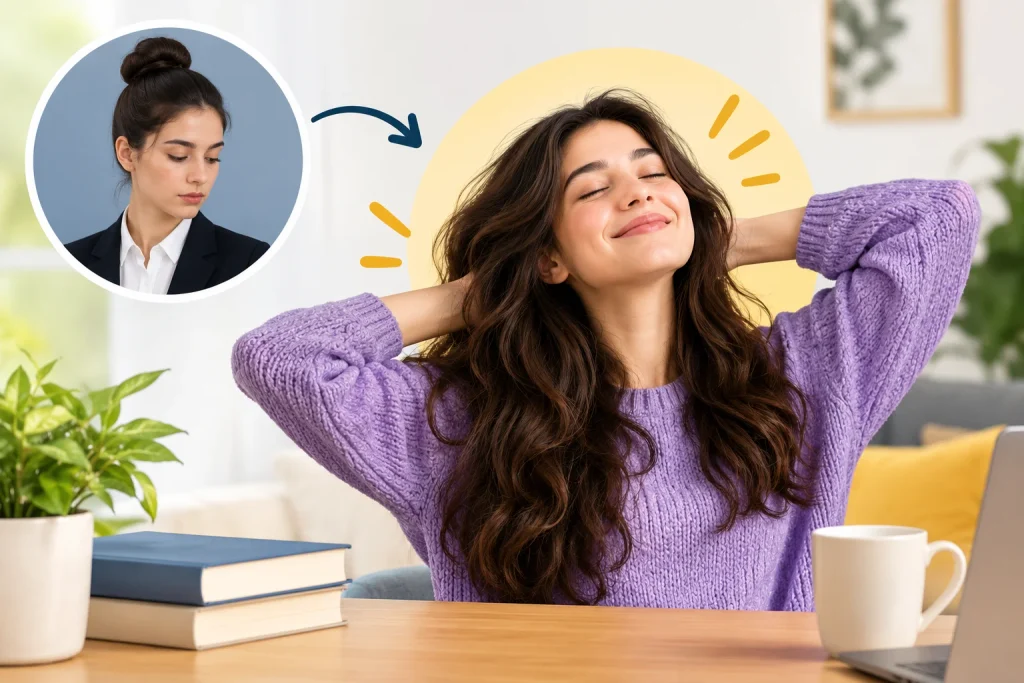
What Does “Let One’s Hair Down” Mean?
The idiom “let one’s hair down” means to relax, behave informally, and stop holding yourself back. It often describes a person who moves away from a formal, serious, or restrained manner and feels free to act naturally. Collins gives the American English sense as being “very informal, relaxed, and free in behavior,” while also noting that the expression can mean relaxing or speaking candidly.
In everyday English, you might use this expression after a stressful week, a formal event, or a demanding period at work. For example, someone might finish a major project and decide to let their hair down with friends that evening. The person isn’t necessarily behaving wildly. They may simply stop worrying about rules, expectations, or appearances for a while.
The phrase can also carry a sense of being yourself. When someone normally acts reserved in public but becomes relaxed around close friends, you could say that they have finally let their hair down. Dictionary.com defines the expression in terms of dropping one’s reserve or inhibitions and behaving casually or informally.
Simple Definition of “Let One’s Hair Down”
In simple English, let one’s hair down = relax and feel free to be yourself.
It can involve:
- relaxing after work
- spending time with friends
- enjoying a vacation
- joking in a normally serious setting
- speaking more openly
- taking a break from social pressure
- enjoying yourself without worrying too much about appearances
Consider this example:
After weeks of studying for her exams, Maya finally let her hair down at the weekend party.
Here, the phrase doesn’t mean Maya literally changed her hairstyle. It means she stopped focusing on her studies for a while and enjoyed herself.
Another example is more subtle:
Daniel is usually quiet at meetings, but he really lets his hair down around his college friends.
This sentence focuses less on partying and more on comfort and openness. Daniel feels safe enough to show a different side of his personality.
That distinction matters because letting your hair down doesn’t always mean having a wild time. Sometimes it simply means dropping your usual reserve.
“Let One’s Hair Down” Meaning in Everyday English
Native speakers commonly use the expression in relaxed, conversational situations. It works especially well when someone has spent time being serious, careful, professional, or restrained and now wants a change of pace.
For example:
I need to let my hair down after this exhausting week.
The speaker probably wants some downtime. They might go to dinner, watch a movie, meet friends, play a game, or simply enjoy an evening without work.
The expression can also describe a change in someone’s social behavior:
Once the guests left, everyone let their hair down.
The meaning here depends on the context. Perhaps everyone started joking, talking openly, playing music, or behaving more casually. The phrase tells you that the atmosphere became less formal.
Collins specifically includes the sense of speaking candidly or frankly. That makes the idiom broader than the simple word “relax.”
Compare these two sentences:
- I relaxed after work.
- I let my hair down after work.
The first sentence simply describes rest or reduced tension. The second adds a social or emotional shade. It suggests that the speaker escaped routine, loosened up, or stopped worrying about being so restrained.
Literal vs. Figurative Meaning
The expression has both a literal and a figurative possibility.
In a literal sentence, someone can physically let their hair down:
She let her hair down after removing the clip.
Here, let means allow, hair refers to actual hair, and down describes its new position. There is no hidden meaning.
In the idiomatic expression, however, the entire phrase takes on a different meaning:
She finally let her hair down at the reunion.
The sentence usually means she became more relaxed and informal.
This is one reason idioms can confuse English learners. Looking at every word separately doesn’t always reveal the intended meaning. A person who learns only the literal meanings of let, hair, and down might expect the expression to describe a hairstyle. Context provides the missing key.
The figurative meaning is well established in English dictionaries. Collins lists meanings connected with informal, relaxed behavior and reduced restraint.
What Does the Idiom Suggest About Someone’s Behavior?
“Let one’s hair down” often suggests a noticeable behavior change.
Someone may normally be:
- serious
- reserved
- cautious
- formal
- highly focused
- concerned about appearances
After letting their hair down, that person may become:
- relaxed
- playful
- talkative
- open
- spontaneous
- informal
- more expressive
However, the change doesn’t have to be dramatic.
Imagine a manager who usually leads formal meetings. At a company picnic, she starts telling funny stories and joining casual games with her team. Someone might say:
She really let her hair down at the company picnic.
The sentence doesn’t accuse her of behaving irresponsibly. Instead, it highlights the contrast between her usual professional manner and her relaxed behavior.
Why “Let One’s Hair Down” Means Relaxing
The expression works as a metaphor. Letting hair down creates an image of releasing something that has been held in place.
That image naturally connects with the idea of releasing restraint. Instead of keeping everything controlled, a person allows themselves greater freedom.
The metaphor remains understandable even for people who don’t regularly wear formal hairstyles. The phrase has become a familiar fixed expression whose meaning goes beyond its physical imagery.
Dictionary.com dates the idiomatic expression to around 1900 and connects it with the practice of taking down pinned-up long hair in private.

Definition and Meaning
A useful way to understand this idiom is to separate its core meaning from the different situations in which people use it.
| Expression | Basic meaning | Common emphasis |
| Let one’s hair down | Relax and behave freely | Reduced restraint |
| Relax | Become less tense | Rest or reduced stress |
| Unwind | Recover from pressure | Rest after effort |
| Loosen up | Become less tense or serious | Social behavior |
| Have a good time | Enjoy an experience | Fun and enjoyment |
| Be yourself | Act naturally | Authentic behavior |
These expressions overlap, but they aren’t interchangeable in every sentence.
For instance, you can unwind by reading quietly at home. You can also let your hair down while reading with friends, but the second expression usually adds an idea of dropping your normal reserve.
Meaning of “Let Your Hair Down”
“Let your hair down” is simply the second-person form of the idiom.
You should let your hair down this weekend.
The speaker is encouraging someone to relax and enjoy themselves.
The possessive changes when the subject changes:
- I let my hair down.
- You let your hair down.
- He let his hair down.
- She let her hair down.
- We let our hair down.
- They let their hair down.
The basic idiomatic meaning stays the same.
Meaning of “Let His or Her Hair Down”
With a third-person subject, the possessive pronoun must agree with that person.
James let his hair down after the tournament.
Sarah let her hair down at the family gathering.
The expression doesn’t require the person to have long hair. Its modern meaning is figurative.
This point is useful because the phrase’s imagery can sometimes distract readers from its grammar. The possessive word belongs to the person whose behavior is changing.
Is “Let One’s Hair Down” Always About Having Fun?
No. Fun is common, but it isn’t required.
Someone can let their hair down by:
- talking honestly with a trusted friend
- laughing after a stressful day
- spending a quiet afternoon without obligations
- behaving casually around family
- taking a break from professional responsibilities
- enjoying a vacation without following a strict schedule
Collins includes a sense of candid or frank conversation, which shows that the expression can involve openness as well as recreation.
For example:
After everyone left the office, Maria let her hair down and talked honestly about the challenges she had faced.
Maria isn’t necessarily partying. She’s simply dropping her professional reserve.
Origin and History
The exact historical path of this idiom deserves some care because popular explanations often sound more certain than the evidence allows.
Where Did “Let One’s Hair Down” Come From?
The expression is commonly explained through the image of a person taking down hair that had been arranged or pinned up.
Formal hairstyles could require considerable effort and restraint. Allowing the hair to fall freely creates a strong physical image of moving from controlled appearance toward comfort.
Dictionary.com connects the idiom with the practice of women taking down pinned-up long hair in private and dates the expression to around 1900.
However, historical evidence suggests that the figurative expression is older than that particular date. Etymonline records “to let one’s hair down” meaning “become familiar” from 1850.
That distinction matters. Idioms often develop gradually. A phrase can appear in related forms before a modern dictionary definition becomes standardized.
Historical Meaning Behind the Expression
Earlier uses connected the phrase with becoming familiar, friendly, or at ease. That fits closely with its modern meaning.
The expression eventually developed broader associations with:
- informality
- relaxation
- openness
- freedom from restraint
- enjoyment
- candid behavior
The basic metaphor remained stable even as social customs changed.
Modern dictionaries reflect that wider meaning. Collins describes the American English expression as informal and relaxed behavior and also recognizes the idea of reducing restraints.
How Hairstyles May Have Inspired the Idiom
The hairstyle explanation is intuitive because hair that has been tightly arranged can represent order and formality. Letting it fall freely creates an immediate visual contrast.
Imagine two scenes.
In the first, someone attends a formal gathering with carefully arranged hair and controlled behavior. In the second, that same person returns home, releases the hairstyle, changes into comfortable clothes, and relaxes.
The physical action creates a natural metaphor for the emotional shift.
Still, the historical record doesn’t justify presenting every popular origin story as proven fact. Some explanations connect the phrase with women relaxing privately, while others suggest dancing or other informal settings.
The safest conclusion is that the idiom’s imagery clearly depends on the contrast between arranged hair and freer hair, while the precise route by which that imagery became an established idiom is less certain.
How the Idiom Developed Its Figurative Meaning
The figurative development follows a familiar pattern in English.
A physical action becomes associated with a social or emotional state. Over time, speakers stop interpreting the phrase literally and begin using it as a conventional expression.
The progression can be understood like this:
physical release → reduced restraint → informality → relaxation → carefree behavior
That progression explains why the phrase now works in many situations that have nothing to do with hairstyles.
A modern speaker can say:
The team finally let their hair down after finishing the project.
Nobody needs to imagine everyone undoing a hairstyle. The phrase instantly communicates a change in mood.
How to Use Correctly
Using the idiom correctly isn’t difficult once you understand its central idea: someone temporarily drops their usual reserve and relaxes.
When to Use “Let One’s Hair Down”
The phrase fits particularly well when there is a clear contrast between pressure and freedom.
Good contexts include:
- after a busy work period
- after exams
- during vacations
- at informal gatherings
- with close friends
- after a formal event
- during weekends
- during celebrations
- in relaxed family settings
For example:
After completing the final report, the entire team went out to let their hair down.
The sentence establishes a clear before-and-after contrast. First came concentrated work. Then came relaxation.
Common Situations for Using the Idiom
The expression works naturally when someone has spent time following expectations and now wants more freedom.
After work
I just want to let my hair down after this exhausting week.
With friends
She always lets her hair down when she’s with her childhood friends.
During vacation
We decided to let our hair down and explore the city without a schedule.
After a formal event
Once the ceremony ended, everyone let their hair down.
After exams
The students let their hair down after finishing their final exam.
These examples show why the phrase is flexible. The activity can be energetic or quiet. The central idea remains the same.
Using the Idiom After Work or Stress
This is one of the most natural contexts.
Work often requires people to maintain a certain level of focus, professionalism, and self-control. After that pressure ends, they may want to switch into a more relaxed mode.
After twelve hours at the office, Kevin wanted to let his hair down.
The expression works because the sentence establishes a clear emotional contrast.
However, “let your hair down” doesn’t automatically mean forgetting all responsibility. A person can relax responsibly.
For example:
After finishing her assignments, Nina let her hair down by watching a movie with her roommates.
Nothing reckless happens. She simply permits herself to enjoy some downtime.
Using the Idiom With Friends and Family
People often feel less pressure around people they trust.
That makes friends and family natural settings for this expression.
Marcus is very serious at work, but he lets his hair down around his brothers.
Here, the phrase emphasizes familiarity and comfort.
The same idea appears in Dictionary.com’s example involving people who become more open and informal when they are together.
Using the Idiom During Vacations and Free Time
Vacation creates another natural contrast.
A person may spend months following schedules, meeting deadlines, and managing obligations. A vacation offers room to loosen that routine.
During the beach trip, we finally let our hair down.
This doesn’t tell us exactly what the group did. That is one advantage of idioms: the expression communicates the overall mood without listing every activity.
Using the Idiom in Social Situations
The phrase can describe a change in atmosphere.
The dinner started formally, but everyone let their hair down after dessert.
The first part establishes restraint. The second shows that the group became more relaxed.
This kind of contrast makes the idiom especially effective in storytelling.
Grammar and Sentence Structure
The grammar behind the expression is straightforward, but learners sometimes make mistakes because they treat the idiom as a fixed phrase that never changes.
It actually changes its possessive pronoun according to the subject.
Is “Let One’s Hair Down” an Idiom or a Phrase?
“Let one’s hair down” is an idiom.
Its overall meaning cannot be understood simply by combining the ordinary meanings of every word.
The literal words describe allowing someone’s hair to fall. The idiomatic meaning refers to relaxing, behaving informally, or dropping restraint.
That fixed figurative meaning is what makes it an idiom.
The Verb Pattern in “Let One’s Hair Down”
The basic pattern is:
subject + let + possessive adjective + hair + down
Examples:
I let my hair down.
She lets her hair down.
They let their hair down.
The verb let is unusual because its simple past form is also let.
| Tense or form | Example |
| Present | I let my hair down. |
| Third-person present | She lets her hair down. |
| Past | We let our hair down. |
| Present participle | He is letting his hair down. |
| Infinitive | They want to let their hair down. |
Wiktionary also records let as the simple present form and lets for third-person singular, with letting as the present participle and let as both simple past and past participle.
Why “Let” Does Not Become “Letted” in Every Form
A common learner mistake is letted.
That form isn’t correct for the standard verb.
Say:
She let her hair down after the ceremony.
Not:
She letted her hair down after the ceremony.
The same rule applies when the phrase is used idiomatically.
Possessive Forms: My, Your, His, Her, Our, and Their
The possessive must match the subject.
| Subject | Correct expression |
| I | let my hair down |
| You | let your hair down |
| He | let his hair down |
| She | let her hair down |
| We | let our hair down |
| They | let their hair down |
The dictionary form “let one’s hair down” uses one’s because dictionaries need a neutral possessive form.
In normal writing, you generally replace one’s with the appropriate possessive.
“Let One’s Hair Down” in Different Tenses
The idiom can appear naturally in several grammatical structures.
Present simple:
I usually let my hair down on Saturday evenings.
Past simple:
We let our hair down after the conference.
Present continuous:
They are letting their hair down at the celebration.
Present perfect:
She has finally let her hair down around her new colleagues.
Future:
We’ll let our hair down once the exams are over.
The idiomatic meaning remains stable even though the grammatical form changes.
Common Sentence Patterns With the Idiom
Some patterns occur naturally in everyday English:
Let + possessive + hair + down
I let my hair down.
Finally let + possessive + hair + down
We finally let our hair down.
Go out to let + possessive + hair + down
They went out to let their hair down.
Need to let + possessive + hair + down
I need to let my hair down tonight.
Never really let + possessive + hair + down
He never really lets his hair down at work.
These patterns help learners produce natural sentences instead of forcing the idiom into awkward structures.
Formal or Informal?
“Let one’s hair down” is informal. It belongs comfortably in conversation, casual writing, personal storytelling, and relaxed workplace discussions.
Collins labels the American English expression as informal and also identifies a slang sense involving very relaxed or free behavior.
That doesn’t make it incorrect in professional communication. It simply means you should consider the audience and tone.
For example, this sounds natural:
We worked hard all week, so let’s let our hair down tonight.
A formal report might instead say:
The team took time to relax after completing the project.
The second sentence sounds more neutral and businesslike.
“Let One’s Hair Down” in Spoken English
The expression works particularly well in speech because idioms can communicate an entire idea quickly.
Come on, you’ve been working all day. Let your hair down!
That sounds friendly and conversational.
It can also appear in casual messages:
This weekend, we’re finally letting our hair down!
The phrase immediately creates a relaxed tone.
“Let One’s Hair Down” in Written English
The idiom can work well in:
- blogs
- personal essays
- magazine articles
- dialogue
- informal emails
- social media posts
- lifestyle writing
- fictional narratives
In highly technical or formal writing, a direct term such as relax, rest, or reduce stress may communicate the point more precisely.
Using the Idiom in Professional Settings
You can use it with coworkers when the atmosphere is informal.
We’ve finished the audit, so let’s let our hair down over dinner.
That sounds natural among colleagues who already have a relaxed relationship.
However, consider the audience before using it in formal business communication. An executive report, legal document, or academic paper generally benefits from more precise wording.
The issue isn’t correctness. It’s register.
Using the Idiom in Casual Conversation
Casual conversation is where the expression feels most at home.
You work too much. You need to let your hair down sometimes.
Here, the phrase conveys both relaxation and a gentle suggestion that the person should stop being so serious for a while.
American English vs. British English Usage
The expression is understood in both American and British English.
Collins provides separate American and British English entries. Its British English definition centers on behaving without reserve, while its American English entry includes being very informal, relaxed, and free in behavior.
The difference is therefore more about usage and register than a major difference in meaning.
In both varieties, the phrase can describe someone becoming less restrained or more relaxed.
She really let her hair down at the reunion.
An American speaker and a British speaker would generally understand the intended meaning.
The expression is therefore safe for learners who want a widely understood English idiom.
Example Sentences
Seeing the idiom in different situations makes its meaning much easier to understand. The expression usually suggests relaxation, freedom, informality, or reduced restraint. Cambridge defines let your hair down as allowing yourself to behave much more freely than usual and enjoy yourself.
Simple Example Sentences
These short examples show the basic pattern:
- I need to let my hair down tonight.
- She finally let her hair down at the party.
- We let our hair down after the exams.
- He rarely lets his hair down at work.
- They decided to let their hair down for the weekend.
- You should let your hair down sometimes.
- Maria always lets her hair down around close friends.
- After dinner, everyone let their hair down.
- The vacation gave us a chance to let our hair down.
- Jake wants to let his hair down after finishing the project.
Notice that the possessive changes with the subject. The core expression remains the same.
Examples About Work and Stress
Work is one of the most natural contexts for this idiom because professional life often requires focus and restraint.
After working late all week, I just want to let my hair down tonight.
The speaker isn’t necessarily planning anything dramatic. They simply want to escape the pressure of work.
The employees went out for dinner to let their hair down after completing the project.
Here, the completed project creates a natural transition from pressure to relaxation.
Sarah usually stays serious at the office, but she lets her hair down after work.
This example highlights a change in personality. Sarah behaves professionally at work but becomes more relaxed afterward.
Collins gives similar examples involving people relaxing after periods of hard work.
Examples About Friends and Social Events
The idiom frequently appears when people spend time with friends.
I always let my hair down when I visit my college friends.
The group let their hair down and spent the evening telling funny stories.
She is reserved around strangers, but she really lets her hair down with her best friends.
After the formal dinner ended, everyone let their hair down.
The important idea is not the specific activity. The focus is on becoming less restrained.
Someone could dance, joke, sing, talk openly, play games, or simply enjoy a relaxed conversation.
Examples About Vacations and Holidays
Vacations often create a break from normal responsibilities.
We’re going to the coast this weekend and plan to let our hair down.
During the holiday, David finally let his hair down and forgot about work.
After months of studying, the students let their hair down during spring break.
The family decided to let their hair down and enjoy the trip without following a strict schedule.
The idiom works particularly well when the sentence establishes a contrast between routine and freedom.
Examples About Family and Celebrations
Family gatherings can also provide opportunities to behave more casually.
Everyone let their hair down during Grandma’s birthday celebration.
My parents usually act formally around guests, but they let their hair down with family.
After the wedding ceremony, the newlyweds let their hair down at the reception.
Once the relatives arrived, the house became lively, and everyone let their hair down.
These examples show that the expression isn’t limited to nightlife or parties.
Examples About School and College
Students can use the idiom when talking about relaxation after demanding academic periods.
After the final exam, we went out to let our hair down.
Emma studied all semester and finally let her hair down during the weekend.
The students let their hair down after submitting their final projects.
Once the presentation was over, the class let their hair down and joked together.
The expression is especially useful when there is a clear before-and-after contrast.
Examples About Workplace Situations
The idiom can appear in workplace conversations when the tone is relaxed.
Our team went bowling to let our hair down after the product launch.
The manager encouraged everyone to let their hair down at the annual picnic.
We worked under intense pressure for three months, so the celebration gave everyone a chance to let their hair down.
However, register still matters. The expression sounds natural in conversation, but a highly formal report might use relax, celebrate, or take a break instead.
Examples From Everyday Conversation
Friend: You look exhausted.
Alex: I am. I just want to let my hair down tonight.
Friend: Are you coming to the party?
Mia: Absolutely. I need to let my hair down after this week.
Tom: You seem much more relaxed today.
James: I finally finished the project, so I can let my hair down a little.
Lisa: Sarah is so quiet at work.
Anna: She’s completely different when she lets her hair down with friends.
These dialogues demonstrate how naturally the idiom fits informal conversation.
In Different Contexts
The meaning stays consistent, but the reason for letting your hair down can change considerably.
Personal Life
In personal life, letting your hair down often means taking a break from obligations and expectations.
You might:
- spend an evening with friends
- watch a favorite movie
- play games
- take a spontaneous trip
- laugh with family
- enjoy a hobby
- have a long conversation
- simply do nothing demanding
For example:
After a difficult week, I stayed home and let my hair down with a good movie and some takeout.
This sentence proves that the idiom doesn’t require a loud party. Relaxation can be quiet.
Professional Life
In professional contexts, the phrase often describes what happens after work or after completing an important task.
The staff went out for dinner after the conference to let their hair down.
The workplace itself may remain formal. The informal behavior happens during a social event connected to work.
A useful distinction is:
Professional responsibility: stay focused, respectful, and appropriate.
After-work relaxation: let your hair down and enjoy the company of others.
The idiom therefore often marks a shift between two social roles.
School and College
Students frequently move between highly structured academic environments and informal social settings.
After three days of exams, everyone was ready to let their hair down.
The phrase captures the emotional release that follows a demanding period.
It can also describe a student’s behavior around friends:
Priya is quiet in class, but she lets her hair down in the dorm with her roommates.
Again, the emphasis is on reduced restraint, not necessarily extreme behavior.
Travel and Leisure
Travel provides plenty of opportunities to use the expression.
We left our schedules behind and let our hair down during the road trip.
The group let their hair down after checking into the resort.
I want one vacation where I can completely let my hair down.
The idiom works particularly well when someone wants freedom from routines.
Parties and Social Gatherings
Parties are perhaps the most obvious setting.
Everyone really let their hair down at the reunion.
The guests started letting their hair down once the formal speeches ended.
We danced until midnight and finally let our hair down.
Still, letting your hair down isn’t synonymous with partying. A party is simply one setting where relaxed behavior can occur.
Cambridge specifically connects the expression with behaving more freely than usual and enjoying yourself.
Sports and Entertainment
The phrase can describe athletes, performers, fans, or audiences when they move away from a serious competitive mindset.
After winning the championship, the players finally let their hair down.
The actors let their hair down during the cast celebration.
The fans let their hair down after the final whistle.
In these examples, the phrase emphasizes the release of tension following an important event.
Family Events and Celebrations
Family celebrations often combine formal and informal behavior.
The wedding began formally, but everyone let their hair down during the reception.
After the anniversary dinner, the family let their hair down and shared old stories.
The children helped everyone let their hair down by turning the gathering into a game night.
The idiom works because the atmosphere becomes less controlled and more spontaneous.
“Let One’s Hair Down” vs. Similar Expressions
Several English expressions overlap with let one’s hair down, but each has its own shade of meaning.
| Expression | Main idea | Typical tone | Example |
| Let one’s hair down | Relax and behave freely | Informal | We let our hair down after work. |
| Relax | Become less tense | Neutral | I need to relax tonight. |
| Unwind | Recover from stress | Neutral | I unwind by reading. |
| Loosen up | Become less serious or tense | Informal | You need to loosen up. |
| Chill out | Relax and calm down | Very informal | Just chill out for a while. |
| Take it easy | Avoid stress or effort | Informal | Take it easy this weekend. |
| Have a good time | Enjoy yourself | Neutral/informal | We had a good time at dinner. |
| Blow off steam | Release frustration | Informal | I went running to blow off steam. |
| Paint the town red | Go out and celebrate energetically | Informal | They painted the town red after graduation. |
The expressions are related, but their emphasis differs.
Let One’s Hair Down vs. Relax
Relax is broader and more neutral.
I relaxed after work.
This could mean sleeping, reading, meditating, or sitting quietly.
I let my hair down after work.
This suggests greater informality or freedom. It may involve friends, conversation, entertainment, or simply dropping one’s usual reserve.
Let One’s Hair Down vs. Unwind
Unwind focuses strongly on recovering from tension.
I like to unwind with a book.
Let one’s hair down has a stronger social or behavioral dimension.
I like to let my hair down with friends.
Someone can unwind alone, while letting their hair down often suggests freedom from normal restraint.
Let One’s Hair Down vs. Loosen Up
Loosen up means becoming less tense, rigid, serious, or nervous.
You need to loosen up before the presentation.
It can describe a temporary emotional adjustment.
Let one’s hair down often suggests a broader change in behavior.
After the presentation, everyone let their hair down.
The first phrase may encourage someone to become less tense. The second usually describes what happens after the restraint has already been dropped.
Let One’s Hair Down vs. Take It Easy
Take it easy can mean relaxing or avoiding excessive effort.
Take it easy this weekend.
It can also mean be careful or don’t become upset, depending on context.
Let one’s hair down is more specifically connected with enjoying freedom and behaving less formally.
Let One’s Hair Down vs. Chill Out
Chill out is highly informal.
We just chilled out at home.
It usually emphasizes relaxation or calming down.
Let one’s hair down can carry more personality. It suggests someone is showing a less restrained side of themselves.
Collins lists chill out among synonyms of let your hair down, while also listing expressions such as let yourself go and let off steam.
Let One’s Hair Down vs. Have a Good Time
These expressions overlap, but have a good time simply means enjoy yourself.
We had a good time at the party.
There is no necessary suggestion that anyone changed their behavior.
We really let our hair down at the party.
This suggests that people became especially relaxed, informal, or uninhibited.
Let One’s Hair Down vs. Blow Off Steam
Blow off steam usually involves releasing frustration, anger, or pent-up energy.
He went for a run to blow off steam.
Let one’s hair down is broader and more positive.
He went out with friends to let his hair down.
A person may blow off steam because they’re angry. They let their hair down because they want freedom or enjoyment.
Let One’s Hair Down vs. Paint the Town Red
Paint the town red is much more energetic.
It traditionally suggests going out and enjoying a lively night, often involving several social activities.
They painted the town red after graduation.
By contrast:
They let their hair down after graduation.
This could mean anything from a party to a relaxed dinner.
Therefore, let one’s hair down has a wider range of intensity.
Comparison of Similar Expressions
A useful way to remember the differences is to focus on the central idea:
- Relax → reduce tension.
- Unwind → recover from stress.
- Loosen up → become less tense or serious.
- Chill out → relax informally.
- Blow off steam → release frustration.
- Have a good time → enjoy yourself.
- Paint the town red → celebrate energetically.
- Let one’s hair down → relax and behave more freely than usual.
Synonyms and Related Words
There isn’t one perfect synonym for every use of the idiom. The best alternative depends on what you want to emphasize.
Direct Synonyms
Some close alternatives include:
- relax
- unwind
- loosen up
- let loose
- let yourself go
- chill out
- take it easy
- be carefree
- enjoy yourself
Let loose is especially close when the emphasis is on freedom from restraint.
The team let loose after winning the final.
However, let loose can sometimes suggest stronger or wilder behavior than let one’s hair down.
Near Synonyms
Near synonyms share part of the meaning without matching it completely.
Decompress emphasizes recovering from mental pressure.
I need to decompress after that meeting.
Unwind emphasizes gradual relaxation.
She unwinds by listening to music.
Relax is the broadest option.
He relaxed after dinner.
Loosen up focuses on becoming less serious or tense.
The guests loosened up after a few conversations.
Contextual Alternatives
The most natural replacement depends on the situation.
| If you mean… | Consider using… |
| Reduce stress | unwind |
| Stop being tense | relax |
| Become less serious | loosen up |
| Enjoy yourself | have a good time |
| Release frustration | blow off steam |
| Act freely | let loose |
| Relax casually | chill out |
| Enjoy a lively celebration | paint the town red |
This is why blindly replacing idioms with synonyms can produce awkward writing. Meaning and context must match.
Words Related to Relaxation
Words connected with the idiom include:
relaxation, rest, leisure, comfort, recreation, enjoyment, pleasure, downtime, relief, calm, ease, recreation, unwinding
These words share the broader concept of moving away from pressure.
Words Related to Freedom and Informality
The idiom also connects with:
freedom, spontaneity, openness, informality, authenticity, self-expression, confidence, comfort, independence, natural behavior
These terms help explain why the phrase means more than simply sit down and rest.
When Each Alternative Sounds Most Natural
Consider this comparison:
I need to unwind after work.
Best when stress relief is the focus.
I need to let my hair down after work.
Best when informal enjoyment or freedom is the focus.
I need to blow off steam after work.
Best when frustration has built up.
I need to chill out after work.
Best in very casual conversation.
I need to take it easy after work.
Best when avoiding effort or pressure is the focus.
Choosing the right expression makes your English sound more precise and natural.
Opposite Expressions
The opposite of letting your hair down is not one single fixed idiom. Several expressions describe maintaining restraint, seriousness, or professionalism.
Keep a Straight Face
Keep a straight face means avoid showing amusement, especially when something is funny.
I tried to keep a straight face during the serious meeting.
This contrasts with the relaxed, playful behavior that can accompany letting your hair down.
Stay Professional
Stay professional means maintain appropriate workplace behavior.
Even when the meeting became difficult, she stayed professional.
A person can let their hair down after work while still staying professional during working hours.
Keep Your Guard Up
Keep your guard up means remain cautious and avoid becoming emotionally or socially vulnerable.
He keeps his guard up around strangers.
By contrast, someone who lets their hair down may feel comfortable enough to become more open.
Be on Your Best Behavior
Be on your best behavior means behave especially politely, appropriately, or carefully.
We need to be on our best behavior at the formal dinner.
This is almost the reverse of the relaxed freedom suggested by let your hair down.
Stay Serious or Formal
Sometimes the simplest opposite is a direct description:
During the ceremony, everyone stayed serious and formal.
Later:
At the reception, everyone let their hair down.
This contrast demonstrates the idiom especially clearly.
Quick Comparison of Opposite Expressions
| Expression | Main idea |
| Let one’s hair down | Relax and behave freely |
| Keep a straight face | Avoid showing amusement |
| Stay professional | Maintain professional conduct |
| Keep your guard up | Remain cautious |
| Be on your best behavior | Behave especially appropriately |
| Stay formal | Maintain a formal manner |
The important distinction is that letting your hair down doesn’t mean abandoning all standards. It simply means becoming less restrained in an appropriate setting.
Common Collocations
Collocations are words that commonly appear together. Learning them can help you use an idiom more naturally.
Words and Phrases Commonly Used Before the Idiom
Common introductory phrases include:
- finally let your hair down
- really let your hair down
- completely let your hair down
- decide to let your hair down
- want to let your hair down
- need to let your hair down
- go out to let your hair down
- get a chance to let your hair down
Examples:
We finally let our hair down after the deadline.
She really let her hair down at the reunion.
They decided to let their hair down after the ceremony.
Words and Phrases Commonly Used After the Idiom
The expression often connects with activities through and or by.
We let our hair down and danced.
She let her hair down with her friends.
He let his hair down after work.
They let their hair down for the weekend.
I let my hair down by taking a long walk.
These structures make the intended activity clear.
“Let Your Hair Down After Work”
This is a particularly natural combination.
Let’s let our hair down after work.
The phrase establishes a transition from professional responsibilities to personal relaxation.
“Let Your Hair Down With Friends”
This combination emphasizes comfort and familiarity.
I always let my hair down with my oldest friends.
It suggests that the speaker feels less concerned about judgment around those people.
“Let Your Hair Down on Vacation”
This phrase highlights freedom from routine.
We went to the mountains to let our hair down on vacation.
The vacation itself doesn’t automatically mean someone is carefree. The idiom emphasizes the person’s attitude toward the break.
“Let Your Hair Down for the Weekend”
This construction is common when someone has had a demanding week.
You’ve worked hard all week. It’s time to let your hair down for the weekend.
The expression sounds particularly natural in friendly conversation.
Natural Sentence Combinations
Here are several useful patterns worth remembering:finally let my hair downlet her hair down with friendslet his hair down after worklet our hair down for the weekendlet their hair down on vacationlet your hair down and have funlet one’s hair down in a relaxed setting
These combinations can make your English sound more natural because they reflect common ways the idiom functions in actual sentences.
Common Mistakes and Misunderstandings
Although “let one’s hair down” is a familiar English idiom, learners can still misuse it. Most mistakes happen when people interpret the expression too literally or overlook its informal tone.
Understanding these errors will help you use the phrase naturally and confidently.
Confusing the Literal and Idiomatic Meanings
The most obvious mistake is assuming the expression always refers to actual hair.
She let her hair down before going to bed.
This can have a literal meaning. She physically released her hairstyle.
But:
She let her hair down at the office party.
This almost certainly has the idiomatic meaning. She became more relaxed, informal, or uninhibited.
Context determines which interpretation makes sense.
| Sentence | Likely meaning |
| She let her hair down before sleeping. | Literal |
| She let her hair down at the party. | Idiomatic |
| He let his hair down with his friends. | Idiomatic |
| She let her hair down after removing the ribbon. | Potentially literal |
| We let our hair down after the project ended. | Idiomatic |
When an expression has both literal and figurative meanings, surrounding words usually provide the necessary clue.
Assuming It Always Means Partying
Another common misunderstanding is thinking letting your hair down always means partying or drinking.
It doesn’t.
Someone can let their hair down by:
- watching a movie
- chatting with friends
- taking a relaxed walk
- enjoying a hobby
- laughing with family
- taking a break from work
- having an informal conversation
For example:
After finishing her report, she let her hair down with a cup of tea and a good book.
Nothing about this sentence suggests a party. The person simply moved away from work and into a relaxed state.
Using the Wrong Possessive Form
The dictionary form is “let one’s hair down,” but ordinary sentences normally use a possessive that matches the subject.
Incorrect:
She let his hair down.
Correct:
She let her hair down.
Incorrect:
They let our hair down.
Correct:
They let their hair down.
A quick check helps: ask whose hair?
| Subject | Possessive |
| I | my |
| you | your |
| he | his |
| she | her |
| we | our |
| they | their |
The possessive isn’t optional because it identifies the person associated with the expression.
Misusing the Verb “Let”
Because let is an irregular verb, learners sometimes create incorrect past forms.
Incorrect:
We letted our hair down after dinner.
Correct:
We let our hair down after dinner.
The simple past of let is let.
In the present tense, third-person singular uses lets:
She lets her hair down around close friends.
With continuous forms, use letting:
They are letting their hair down after the ceremony.
Using the Idiom in an Inappropriate Context
The expression is informal, so it may sound out of place in highly formal situations.
For example, a legal document might say:
The participants relaxed following the proceedings.
It would sound unusual to write:
The participants let their hair down following the proceedings.
The second version isn’t grammatically wrong. The issue is register.
Formal writing often favors direct, precise language. Casual conversation allows more expressive idioms.
Forgetting the Importance of Context
The same phrase can communicate slightly different shades of meaning.
John let his hair down at the party.
This could mean he danced, joked, became talkative, or simply stopped acting formally.
Now consider:
John finally let his hair down and told us what he really thought.
Here, the expression suggests greater openness or candor, not necessarily entertainment.
Context supplies the specific interpretation.
Overusing the Expression
Even a correct idiom can become awkward when repeated too often.
Instead of writing:
We let our hair down after work. Then we let our hair down at dinner. Later, we let our hair down at the club.
Use related expressions naturally:
We relaxed after work, enjoyed dinner together, and later had a carefree night out.
Variety makes writing sound more natural.
Can Have a Negative Meaning?
Usually, “let one’s hair down” has a positive or neutral meaning, but context can give it a less favorable shade.
The expression itself does not automatically imply irresponsible behavior.
Positive and Neutral Uses
Most uses suggest healthy relaxation or greater freedom.
After months of hard work, the team finally let their hair down.
This is positive because the team earned a chance to relax.
She lets her hair down whenever she’s with her family.
This is neutral or positive. It suggests comfort and familiarity.
We let our hair down during the vacation.
Again, the phrase simply describes a break from routine.
When the Idiom Suggests Excessive Behavior
Sometimes the surrounding words make the behavior sound excessive.
The group really let their hair down and stayed out until sunrise.
The idiom itself remains positive or playful, but the additional details can make the behavior seem extreme.
Another example:
He let his hair down a little too much at the celebration.
The phrase “a little too much” changes the tone. It suggests that the person’s behavior went beyond what was appropriate.
This illustrates an important principle:
The idiom carries the basic idea of freedom, while context determines whether that freedom seems sensible or excessive.
How Context Changes the Meaning
Compare these examples:
Maria let her hair down by singing karaoke with her friends.
This sounds harmless and fun.
Maria let her hair down by telling her closest friends about her worries.
This suggests openness and emotional comfort.
Maria let her hair down and ignored every rule at the event.
This sounds more negative because the surrounding action suggests inappropriate behavior.
The idiom hasn’t fundamentally changed. The context around it has.
Examples of Different Interpretations
| Sentence | Likely interpretation |
| She let her hair down with old friends. | Comfortable and informal |
| We let our hair down after exams. | Relaxed after pressure |
| He let his hair down at the party. | More playful or carefree |
| She let her hair down and spoke honestly. | Open and candid |
| They let their hair down too much. | Possibly excessive |
| He never lets his hair down at work. | Remains formal or reserved |
This flexibility makes the expression useful in both everyday speech and descriptive writing.
In American English
“Let your hair down” is well established in American English. It commonly appears in informal conversations about relaxation, social life, vacations, work, and personal relationships.
Cambridge describes the expression as allowing yourself to behave much more freely than usual and enjoy yourself.
How Americans Use the Expression
In American English, the phrase often appears when someone wants a break from pressure.
I just want to let my hair down this weekend.
We should go somewhere and let our hair down.
She really lets her hair down around her cousins.
These sentences sound natural because the idiom fits informal conversation.
It can also appear in American lifestyle writing, entertainment coverage, personal blogs, and casual workplace discussions.
Common Conversational Situations
You may hear the expression when people discuss:
- weekends
- vacations
- parties
- celebrations
- friendships
- family gatherings
- work stress
- school pressure
- holidays
- social events
A person might say:
After this deadline, I need to let my hair down.
The sentence is short, but it communicates a recognizable emotional transition from pressure to freedom.
The Idiom in Modern American Speech
The phrase remains understandable because its figurative meaning is now firmly established.
Modern speakers don’t normally need to know anything about historical hairstyles to understand:
You need to let your hair down.
They hear the expression as an invitation to relax and stop being so restrained.
That makes it different from some older idioms whose meanings have become obscure. The imagery remains easy to visualize, while the figurative meaning remains relevant to modern life.
Why the Expression Remains Familiar
The phrase continues to work because the underlying experience is universal: people often move between situations where they must behave carefully and situations where they can relax.
Consider the contrast:
At work: deadlines, meetings, professionalism, concentration.
After work: friends, hobbies, conversation, entertainment.
During exams: study, pressure, schedules, concentration.
After exams: rest, socializing, recreation.
The expression gives that transition a memorable image.
Mini Dialogues
Short conversations reveal how native speakers can use the idiom naturally.
Friends Talking After Work
Emma: You look exhausted.
Rachel: I am. This week has been brutal.
Emma: Then forget about work tonight. Let’s go somewhere and let our hair down.
Rachel: That sounds perfect.
Here, the phrase means relaxing and enjoying time together after a stressful week.
Coworkers Relaxing After a Busy Week
Mike: Are you coming to dinner after the meeting?
James: I wasn’t planning to.
Mike: Come on. We’ve worked nonstop all week. We deserve to let our hair down.
James: All right. I’m in.
The expression works because the coworkers are moving from a professional environment into a more casual social setting.
Family Members Planning a Weekend
Mom: What should we do this weekend?
Lisa: Nothing complicated. Let’s stay home and let our hair down.
Mom: I’m happy with that.
Here, the idiom doesn’t imply a party. It simply means taking a break from obligations.
Students Finishing Exams
Ava: How did your last exam go?
Noah: Better than expected. I’m just glad it’s over.
Ava: Same here. Let’s go out tonight and let our hair down.
Noah: Absolutely.
The phrase captures the relief that follows an intense academic period.
Friends Discussing a Vacation
Ben: Are you making an itinerary for every day?
Chris: Not this time.
Ben: Good. We should let our hair down and see where the trip takes us.
This use emphasizes spontaneity and freedom from rigid planning.
Practice Using
Practice helps turn passive understanding into active vocabulary. Try these exercises without checking the answers immediately.
Fill in the Blanks
Complete each sentence with the correct form of let one’s hair down.
- After finishing the project, we finally ________.
- She always ________ when she’s around her closest friends.
- I need to ________ after this stressful week.
- They decided to ________ during their vacation.
- He rarely ________ at formal events.
- You should ________ and enjoy your weekend.
- After the exams ended, the students ________.
- Maria wanted to ________ with her family.
The correct answers depend on the subject and tense.
Choose the Correct Meaning
“After months of preparation, the performers let their hair down at the celebration.”
What does the expression most likely mean?
A. They changed their hairstyles.
B. They became more relaxed and informal.
C. They prepared for another performance.
D. They left the celebration early.
Correct answer: B.
The surrounding context indicates a shift from serious preparation to relaxed celebration.
Match the Idiom to the Situation
Match each situation with the most suitable interpretation.
| Situation | Meaning |
| After a difficult work week | Relax after pressure |
| Around trusted friends | Behave naturally |
| At a celebration | Enjoy yourself |
| During a vacation | Escape routine |
| During an honest conversation | Become more open |
The same idiom can fit all five situations because its central meaning involves reduced restraint.
Rewrite Sentences Using the Idiom
Replace the bold phrase with an appropriate form of let one’s hair down.
She relaxed with her friends after completing the exam.
Possible rewrite:
She let her hair down with her friends after completing the exam.
The team became informal after finishing the presentation.
Possible rewrite:
The team let their hair down after finishing the presentation.
I want to relax this weekend.
Possible rewrite:
I want to let my hair down this weekend.
The goal isn’t simply to substitute words. The sentence should still sound natural in its context.
Check Your Answers
For the fill-in-the-blank exercise, suitable answers include:
- let our hair down
- lets her hair down
- let my hair down
- let their hair down
- lets his hair down
- let your hair down
- let their hair down
- let her hair down
Remember the most important grammatical rule: change the possessive pronoun to match the subject.\
In Different Contexts
The meaning of let one’s hair down remains consistent, but the situation around it can change its exact shade. Sometimes the phrase highlights relaxation after pressure. In other cases, it emphasizes friendship, openness, celebration, or freedom from routine.
Understanding those differences helps you choose the idiom naturally rather than treating it as a simple replacement for relax.
Personal Life
In personal life, let one’s hair down often describes stepping away from everyday responsibilities.
You might spend the evening with friends, enjoy a hobby, watch a movie, or simply stop worrying about your schedule.
After a long week of errands and responsibilities, I finally let my hair down.
The sentence doesn’t explain exactly what happened. Instead, the idiom communicates the broader change in mood.
It suggests that the person stopped focusing on obligations and allowed themselves some freedom.
The expression can also describe emotional openness.
Daniel rarely talks about his problems, but he lets his hair down when he’s with his sister.
Here, the phrase means Daniel feels comfortable enough to lower his usual emotional guard.
That interpretation is especially useful because relaxation isn’t always physical. A person can relax emotionally by becoming more open and authentic.
Professional Life
Professional settings require more attention to tone.
At work, people often need to remain focused, polite, and professional. Outside working hours, those same people may behave more casually.
After completing the merger, the executives went out to let their hair down.
The idiom works because the formal responsibility has ended.
You might also hear it during workplace social events:
The staff really let their hair down at the annual celebration.
This sentence suggests that employees behaved more casually than they normally would at work.
However, the expression shouldn’t be interpreted as permission to ignore professional standards. Letting your hair down is context-dependent.
A good workplace use might describe:
- a team dinner
- a company picnic
- an informal celebration
- an after-work gathering
- a holiday party
- a successful project celebration
A formal business document would usually choose clearer language such as relax, celebrate, or take a break.
School and College
Students can use the idiom when talking about breaks from academic pressure.
After submitting my final paper, I let my hair down for the weekend.
The sentence establishes a clear contrast between intense academic work and free time.
It can also describe social behavior:
Nina is very serious in class, but she lets her hair down with her roommates.
This doesn’t mean Nina behaves badly. It means she feels comfortable enough to act naturally.
The expression is particularly effective when describing the emotional relief that follows:
- exams
- assignments
- presentations
- research projects
- major deadlines
- graduation preparations
For example:
After months of preparation, the graduating class finally let their hair down.
The phrase captures the sense of release after sustained effort.
Travel and Leisure
Travel often gives people a temporary escape from ordinary routines.
We decided to let our hair down and explore the city without a fixed schedule.
Here, the idiom suggests spontaneity.
Another example:
During our vacation, we let our hair down and stopped checking our work emails.
The activity itself isn’t necessarily exciting. The important point is that the travelers have stepped away from their usual responsibilities.
You can also combine the expression with specific leisure activities:
We let our hair down by spending the afternoon at the beach.
They let their hair down with music, food, and a long evening walk.
I wanted to let my hair down without planning every hour of the trip.
These examples show how the idiom can describe freedom from structure, not just entertainment.
Parties and Social Gatherings
Parties provide one of the clearest settings for the expression.
Everyone let their hair down once the formal dinner ended.
The phrase suggests that people moved from controlled behavior toward more relaxed interaction.
They might have started dancing, telling jokes, singing, playing games, or simply talking more freely.
Still, the phrase doesn’t require a large party.
We had a small dinner at home and really let our hair down.
The gathering is small, but the people feel relaxed and comfortable.
Sports and Entertainment
Competitive events can create significant pressure. Once the event ends, participants may finally relax.
The players let their hair down after winning the championship.
The performers let their hair down after the final show.
The production crew finally let their hair down after months of preparation.
These examples emphasize relief following intense concentration.
The idiom can also describe spectators:
The fans let their hair down after their team secured the victory.
Here, the phrase means they celebrated and behaved more freely than they might have before the result was known.
Family Events and Celebrations
Family celebrations can move between formal and informal moods.
The wedding ceremony was formal, but everyone let their hair down at the reception.
This sentence gives the idiom a clear contrast.
During the ceremony, guests follow expected social behavior. Later, the atmosphere becomes more relaxed.
The same idea works with birthdays, anniversaries, reunions, graduations, and holiday gatherings.
After the anniversary dinner, the family let their hair down and shared embarrassing childhood stories.
The phrase works especially well when a celebration encourages people to reveal a more playful side.
“Let One’s Hair Down” vs. Similar Expressions
English has many expressions for relaxation, but they aren’t identical. Choosing the right phrase depends on the feeling you want to communicate.
Let One’s Hair Down vs. Relax
Relax is the broadest term.
I need to relax after work.
This sentence doesn’t specify how or why the person will relax.
I need to let my hair down after work.
This version suggests a stronger shift away from seriousness, restraint, or routine.
Relax can describe physical rest. Let one’s hair down often adds a social or behavioral element.
Let One’s Hair Down vs. Unwind
Unwind usually emphasizes recovering from stress.
I like to unwind by reading before bed.
It often suggests a gradual return to a calmer state.
We went out to let our hair down after finishing the project.
This sentence focuses more on freedom and informal enjoyment.
A person can unwind alone, while letting your hair down often carries a stronger sense of social freedom.
Let One’s Hair Down vs. Loosen Up
Loosen up often means becoming less tense, nervous, rigid, or serious.
You need to loosen up and enjoy the evening.
Let one’s hair down has a related meaning, but it can suggest a fuller release from one’s normal behavior.
Compare:
The speaker loosened up after the first few minutes.
The team let their hair down after the presentation.
The first describes a gradual reduction in nervousness. The second describes a shift into relaxed social behavior.
Let One’s Hair Down vs. Take It Easy
Take it easy can mean relax, avoid stress, or avoid excessive effort.
Take it easy this weekend.
The phrase can also be used as advice to calm down.
Take it easy! There’s no need to get angry.
Let one’s hair down doesn’t normally carry that warning or calming sense. It focuses more on freedom and enjoyment.
Let One’s Hair Down vs. Chill Out
Chill out is strongly informal.
We just chilled out at home.
It often means becoming calm or relaxing.
Let one’s hair down can sound slightly more expressive because it suggests a person is releasing their usual restraint.
She finally let her hair down around her new friends.
That sentence suggests increased comfort and openness.
Let One’s Hair Down vs. Have a Good Time
Have a good time simply means enjoy yourself.
We had a good time at the concert.
It doesn’t necessarily suggest a change in behavior.
We really let our hair down at the concert.
This suggests the group became especially relaxed, carefree, or informal.
Let One’s Hair Down vs. Blow Off Steam
Blow off steam is usually connected with frustration or pent-up emotion.
I went for a long run to blow off steam.
The person needs an outlet for accumulated tension.
By contrast:
I went out with friends to let my hair down.
The motivation is more about relaxation and enjoyment.
Someone can blow off steam without having fun, while letting their hair down usually carries a more positive emotional tone.
Comparison of Similar Expressions
| Expression | Core meaning | Emotional emphasis |
| Let one’s hair down | Relax and behave freely | Freedom and informality |
| Relax | Become less tense | Calm |
| Unwind | Recover from pressure | Stress relief |
| Loosen up | Become less serious or tense | Reduced rigidity |
| Chill out | Relax or calm down | Casual calm |
| Take it easy | Avoid stress or effort | Rest and moderation |
| Have a good time | Enjoy yourself | Pleasure |
| Blow off steam | Release frustration | Emotional release |
Synonyms and Related Words
Learning related vocabulary gives you more flexibility. However, a synonym should match the exact meaning you want.
Direct Synonyms
The closest alternatives include:
- relax
- unwind
- loosen up
- let loose
- chill out
- take it easy
- have a good time
- enjoy yourself
- be carefree
Among these, let loose is often especially close.
The students let loose after their final exam.
However, let loose can sometimes imply more energetic or uninhibited behavior.
Near Synonyms
Some words overlap with the idiom without matching it completely.
Decompress emphasizes recovering from mental pressure.
I need some time to decompress after the meeting.
Unwind emphasizes gradually becoming relaxed.
She unwinds by listening to jazz.
Loosen up focuses on becoming less tense or serious.
Everyone loosened up after dinner.
De-stress directly emphasizes reducing stress.
I exercise to de-stress after work.
These alternatives can make writing more precise when the idiom isn’t the best choice.
Contextual Alternatives
Consider these choices:
| Intended meaning | Natural alternative |
| Recover from stress | Unwind |
| Become calm | Relax |
| Become less serious | Loosen up |
| Release frustration | Blow off steam |
| Enjoy yourself | Have a good time |
| Behave freely | Let loose |
| Take a quiet break | Take it easy |
| Become mentally calmer | Decompress |
The best word depends on the specific situation, not simply on dictionary similarity.
Words Related to Relaxation
Related vocabulary includes:
relaxation, rest, leisure, downtime, comfort, calm, ease, recreation, enjoyment, pleasure, relief, unwinding
These words describe the broader concept behind the idiom.
Words Related to Freedom and Informality
The expression also connects with:
freedom, spontaneity, openness, informality, authenticity, self-expression, confidence, comfort, natural behavior, carefree behavior
These terms are particularly useful when explaining why the idiom doesn’t simply mean sit down and rest.
When Each Alternative Sounds Most Natural
Compare these sentences:
I need to unwind after work.
This sounds natural when stress recovery is the main concern.
I need to let my hair down after work.
This sounds natural when the speaker wants freedom from professional restraint.
I need to blow off steam after work.
This works when the speaker feels frustrated.
I need to chill out after work.
This fits very casual conversation.
I need to take it easy after work.
This suggests avoiding effort or pressure.
Choosing based on meaning creates much stronger English than replacing every idiom with the same synonym.
Opposite Expressions
There isn’t a single perfect antonym for this idiom. Instead, several expressions describe restraint, seriousness, caution, or formality.
Keep a Straight Face
Keep a straight face means avoid laughing or showing amusement.
I tried to keep a straight face during the serious discussion.
This contrasts with the playful behavior often associated with letting your hair down.
Stay Professional
Stay professional means maintain appropriate workplace conduct.
Even though everyone was tired, we stayed professional during the meeting.
After the meeting, the same people might relax together.
Keep Your Guard Up
Keep your guard up means remain cautious or emotionally protected.
She keeps her guard up around people she doesn’t know.
Someone who lets their hair down may feel safe enough to lower that guard.
Be on Your Best Behavior
Be on your best behavior means behave especially politely or appropriately.
We need to be on our best behavior at the formal reception.
The phrase creates almost the opposite image of letting your hair down.
Stay Serious or Formal
A simple descriptive phrase can also provide the contrast.
Everyone stayed serious during the ceremony.
Later:
Everyone let their hair down at the reception.
This before-and-after structure makes the meaning particularly clear.
Quick Comparison of Opposite Expressions
| Expression | Meaning |
| Let one’s hair down | Relax and behave freely |
| Keep a straight face | Avoid showing amusement |
| Stay professional | Maintain professional conduct |
| Keep your guard up | Remain cautious |
| Be on your best behavior | Behave especially appropriately |
| Stay formal | Maintain a formal manner |
The important point is that letting your hair down doesn’t mean abandoning good judgment. It means becoming less restrained in a suitable situation.
Common Collocations
Natural collocations make idiomatic English easier to recognize and produce.
Words and Phrases Commonly Used Before the Idiom
Common patterns include:
- finally let your hair down
- really let your hair down
- completely let your hair down
- decide to let your hair down
- want to let your hair down
- need to let your hair down
- get a chance to let your hair down
- go out to let your hair down
Examples:
We finally let our hair down after the deadline.
She really let her hair down at the reunion.
They decided to let their hair down after graduation.
These combinations sound natural because they frame the idiom as a change in behavior.
Words and Phrases Commonly Used After the Idiom
The phrase often connects to an activity or setting.
We let our hair down after work.
She let her hair down with her friends.
They let their hair down during vacation.
He let his hair down at the party.
We let our hair down and danced.
She let her hair down by spending the afternoon outdoors.
These structures help readers understand what the speaker means by relaxation.
“Let Your Hair Down After Work”
This is a highly natural context because work often represents responsibility and restraint.
We should let our hair down after work.
The sentence suggests moving from professional obligations into personal time.
“Let Your Hair Down With Friends”
This combination emphasizes trust and familiarity.
I can really let my hair down with my oldest friends.
The speaker feels comfortable enough to behave naturally.
“Let Your Hair Down on Vacation”
This phrase emphasizes freedom from routine.
We went on vacation to let our hair down and forget about deadlines.
The vacation provides the setting, while the idiom describes the change in attitude.
“Let Your Hair Down for the Weekend”
This construction is common when someone has had a demanding week.
You’ve worked hard all week. It’s time to let your hair down for the weekend.
The expression creates a natural contrast between weekday responsibilities and weekend freedom.
Natural Sentence Combinations
Keep these patterns in mind:
finally let my hair downlet her hair down with friendslet his hair down after worklet our hair down for the weekendlet their hair down on vacationlet your hair down and have funlet one’s hair down in a relaxed setting
These patterns provide a practical foundation for everyday usage.
Common Mistakes and Misunderstandings
Even familiar idioms can cause problems when learners translate them word for word.
Confusing the Literal and Idiomatic Meanings
Consider:
She let her hair down before going to bed.
This can describe a physical action.
Now compare:
She let her hair down at the reunion.
The second sentence most likely means she became relaxed and informal.
The surrounding context determines whether hair has its literal meaning or participates in the idiom.
Assuming It Always Means Partying
Letting your hair down doesn’t require a party.
A quiet evening can qualify:
I let my hair down by reading a novel after work.
So can an honest conversation:
He let his hair down and told his friends how he really felt.
The common thread is reduced restraint, not a particular activity.
Using the Wrong Possessive Form
Always match the possessive with the subject:
I let my hair down.
She let her hair down.
He let his hair down.
We let our hair down.
They let their hair down.
A useful question is: Whose hair?
The answer tells you which possessive to use.
Misusing the Verb “Let”
Don’t use letted as the simple past form.
Incorrect:
We letted our hair down.
Correct:
We let our hair down.
The present third-person form is different:
She lets her hair down.
The continuous form is:
She is letting her hair down.
Using the Idiom in an Inappropriate Context
The phrase is informal.
It fits:
- casual conversation
- personal writing
- dialogue
- lifestyle content
- informal workplace conversation
- social situations
It may sound less suitable in:
- legal documents
- highly technical reports
- formal academic writing
- official policies
For formal contexts, relax, take a break, or celebrate may be more suitable.
Forgetting the Importance of Context
The idiom can suggest different shades of meaning.
She let her hair down at the party.
This probably suggests carefree behavior.
She let her hair down and spoke honestly.
This suggests openness.
He let his hair down around his family.
This suggests comfort and familiarity.
Context determines the precise interpretation.
Overusing the Expression
A strong idiom becomes less effective when repeated constantly.
Instead of:
We let our hair down after work and let our hair down at dinner.
Use varied language:
We relaxed after work and enjoyed a carefree dinner together.
Good writing uses idioms strategically rather than mechanically.
Can Have a Negative Meaning?
The expression is usually positive or neutral, but surrounding context can give it a negative shade.
Positive and Neutral Uses
The team let their hair down after completing the project.
Positive.
She lets her hair down around her closest friends.
Neutral or positive.
We let our hair down during the vacation.
Positive.
These examples focus on relaxation and comfort.
When the Idiom Suggests Excessive Behavior
Context can imply that someone became too uninhibited.
He let his hair down a little too much at the celebration.
The phrase “a little too much” tells the reader that the behavior may have crossed a line.
Likewise:
They let their hair down and ignored every rule.
The negative meaning comes from ignored every rule, not from the idiom itself.
How Context Changes the Meaning
| Example | Likely tone |
| She let her hair down with friends. | Positive |
| We let our hair down after exams. | Positive |
| He let his hair down at the party. | Neutral/positive |
| She let her hair down and spoke honestly. | Open and candid |
| They let their hair down too much. | Potentially negative |
| He let his hair down and behaved irresponsibly. | Negative because of context |
This distinction is important for accurate interpretation.
In American English
Let your hair down remains a familiar informal expression in American English. It appears naturally in conversations about work, friendships, vacations, celebrations, and personal relaxation.
How Americans Use the Expression
Common American-style examples include:
I need to let my hair down this weekend.
Let’s go out and let our hair down.
She really lets her hair down around her cousins.
After the deadline, the whole team let their hair down.
The expression is especially natural when describing a transition from pressure to freedom.
Common Conversational Situations
You may encounter the idiom when Americans discuss:
- weekends
- vacations
- parties
- holidays
- work stress
- school pressure
- friendships
- family gatherings
- celebrations
- entertainment
Its informal character makes it particularly useful in everyday conversation.
The Idiom in Modern American Speech
The phrase remains easy to understand even though most modern speakers don’t think about its historical hairstyle imagery.
When someone says:
You need to let your hair down.
The listener usually understands the intended message immediately: relax, stop worrying so much, and enjoy yourself.
The idiom’s usefulness comes from its memorable metaphor and broad application.
Why the Expression Remains Familiar
People still move between formal and informal environments every day.
A person might be:
Professional at work → relaxed with friends
Serious during exams → carefree afterward
Structured during a project → celebratory after completion
Reserved around strangers → open with family
That repeated human experience keeps the metaphor meaningful.
Mini Dialogues
Friends Talking After Work
Emma: You look exhausted.
Rachel: This week has been terrible.
Emma: Forget about work tonight. Let’s go somewhere and let our hair down.
Rachel: I’m definitely ready for that.
Coworkers Relaxing After a Busy Week
Mike: Are you joining us for dinner?
James: I might skip it.
Mike: We’ve worked nonstop all week. We deserve to let our hair down.
James: Fair enough. I’ll come.
Family Members Planning a Weekend
Mom: Do you have plans this weekend?
Lisa: Nothing serious. I just want to let my hair down.
Mom: Then let’s have a relaxed family dinner.
Students Finishing Exams
Ava: How did your final exam go?
Noah: Better than expected. I’m just glad it’s finished.
Ava: Great. Let’s go out tonight and let our hair down.
Noah: Absolutely.
Friends Discussing a Vacation
Ben: Have you planned every day of the trip?
Chris: Not this time.
Ben: Good. Let’s let our hair down and see where the trip takes us.
Chris: That’s exactly what I wanted.
Practice Using
Practice can help you move from recognizing the idiom to using it naturally.
Fill in the Blanks
Complete each sentence with the correct form.
- After the project ended, we finally ________.
- She always ________ around her closest friends.
- I need to ________ after this exhausting week.
- They decided to ________ during their vacation.
- He rarely ________ at formal events.
- You should ________ and enjoy your weekend.
- The students ________ after their final exam.
- Maria wanted to ________ with her family.
Choose the Correct Meaning
After months of preparation, the performers let their hair down at the celebration.
What does let their hair down mean?
A. They changed their hairstyles.
B. They became more relaxed and informal.
C. They prepared for another performance.
D. They left the celebration.
Correct answer: B.
The context indicates a transition from intense preparation to relaxed celebration.
Match the Idiom to the Situation
| Situation | Best interpretation |
| After a stressful work week | Relax after pressure |
| Around trusted friends | Behave naturally |
| At a celebration | Enjoy yourself |
| During vacation | Escape routine |
| During an honest conversation | Become more open |
All five situations can use the idiom because they involve some form of reduced restraint.
Rewrite the Sentences Using the Idiom
She relaxed with her friends after the exam.
She let her hair down with her friends after the exam.
The team became informal after completing the presentation.
The team let their hair down after completing the presentation.
I want to relax this weekend.
I want to let my hair down this weekend.
The goal is to preserve the original meaning while making the idiom fit naturally.
Check Your Answers
Suitable answers include:
- let our hair down
- lets her hair down
- let my hair down
- let their hair down
- lets his hair down
- let your hair down
- let their hair down
- let her hair down
The most important grammar point is simple: the possessive pronoun must agree with the subject.
Key Takeaways
Definition and Core Meaning
“Let one’s hair down” means to relax, behave informally, and become less restrained.
It can describe enjoying yourself, becoming more open, escaping routine, or showing a more natural side of your personality.
Correct Grammar and Usage
Use the correct possessive:
- my hair
- your hair
- his hair
- her hair
- our hair
- their hair
Remember that let stays let in the simple past.
I let my hair down yesterday.
Not:
I letted my hair down yesterday.
Common Contexts
The idiom works naturally after:
- work
- exams
- major projects
- stressful periods
- formal events
- busy schedules
It also fits:
- vacations
- parties
- family gatherings
- social events
- time with close friends
Similar and Opposite Expressions
Close alternatives include relax, unwind, loosen up, chill out, take it easy, and let loose.
Opposite ideas include stay professional, keep your guard up, keep a straight face, and be on your best behavior.
Most Important Usage Tip
Don’t assume letting your hair down means partying.
The deeper idea is releasing restraint.
You can let your hair down at a party, but you can also do it during a quiet evening with friends. You can become more playful, more open, or simply less formal.
Once you understand that central meaning, the idiom becomes much easier to recognize and use naturally.
Conclusion
Understanding the let one’s hair down idiom definition makes this common expression much easier to use naturally. The phrase means to relax, loosen up, and behave more freely than usual. It often describes stepping away from stress, formality, responsibilities, or social pressure so you can enjoy yourself. You might let your hair down after a long workday, during a weekend with friends, or while enjoying a vacation. Although the expression can suggest having fun, it doesn’t always mean partying or behaving wildly. Context determines the exact feeling. In everyday American English, let your hair down sounds friendly, familiar, and conversational. Once you understand its meaning, grammar, and common situations, you can use this idiom confidently in both casual speech and appropriate informal writing.
FAQs
What does “let one’s hair down” mean?
“Let one’s hair down” means to relax and enjoy yourself without worrying too much about being formal, serious, or restrained. It often describes behaving naturally after dealing with stress or responsibilities. For example, someone might let their hair down by spending a quiet evening with friends, watching a movie, or enjoying a fun weekend.
Is “let your hair down” an idiom?
Yes, let your hair down is an established English idiom. Its meaning is figurative rather than literal. Instead of referring to physically releasing your hair, it means relaxing and becoming less formal or reserved. The expression commonly appears in casual conversations about social activities, free time, vacations, celebrations, and other situations where people can feel comfortable.
What is another way to say “let your hair down”?
Several expressions can replace let your hair down, depending on the context. You could say relax, unwind, loosen up, chill out, take it easy, or blow off some steam. However, these alternatives have slightly different shades of meaning. “Let your hair down” especially emphasizes becoming less restrained and enjoying yourself naturally.
Is “let one’s hair down” formal or informal?
“Let one’s hair down” is generally an informal expression. It works especially well in everyday conversations, friendly messages, personal writing, and relaxed social situations. It may sound too casual for highly formal documents or professional reports. In formal writing, alternatives such as “relax,” “take a break,” or “enjoy some leisure time” may sound more appropriate.
What is the origin of “let one’s hair down”?
The expression is commonly connected with the older practice of wearing long hair pinned or arranged up and letting it down while relaxing in private. Historical evidence shows related uses of the expression well before modern everyday speech. Over time, the physical image developed a figurative sense, suggesting that someone was dropping social restraints and behaving more freely.
Does “let your hair down” mean relax?
Yes. Let your hair down commonly means to relax and enjoy yourself. However, the expression can convey more than simply resting. It often suggests becoming less serious, formal, reserved, or self-conscious. For instance, someone may let their hair down at a party by laughing, talking freely, and enjoying time with friends after a demanding week.
How do you use “let your hair down” in a sentence?
Use the expression when describing someone relaxing or behaving more freely than usual. For example, you could say, “After finishing the project, we finally let our hair down.” You can change the possessive according to the subject: my hair, your hair, his hair, her hair, our hair, or their hair.
What is the difference between “let your hair down” and “loosen up”?
Both expressions can mean becoming more relaxed, but they aren’t identical. Let your hair down usually emphasizes enjoying yourself and dropping normal social restraints. Loosen up can mean becoming less tense, nervous, strict, or serious. You might tell a nervous person to loosen up, while you might invite a friend to let their hair down.
Can “let one’s hair down” have a negative meaning?
Usually, let one’s hair down has a positive or neutral meaning. It suggests relaxation, freedom, and enjoyment. However, context can sometimes make it imply excessive or inappropriate behavior. The phrase itself doesn’t automatically suggest anything negative. The surrounding words and situation determine whether the speaker means healthy relaxation or behavior that has gone too far.
Is “let your hair down” common in American English?
Yes, let your hair down is familiar in American English, particularly in casual conversations. People commonly use it when discussing weekends, vacations, parties, friendships, celebrations, or recovering from stressful periods. The expression sounds natural when someone wants to describe taking a break from responsibilities and enjoying a more relaxed, informal side of life.