
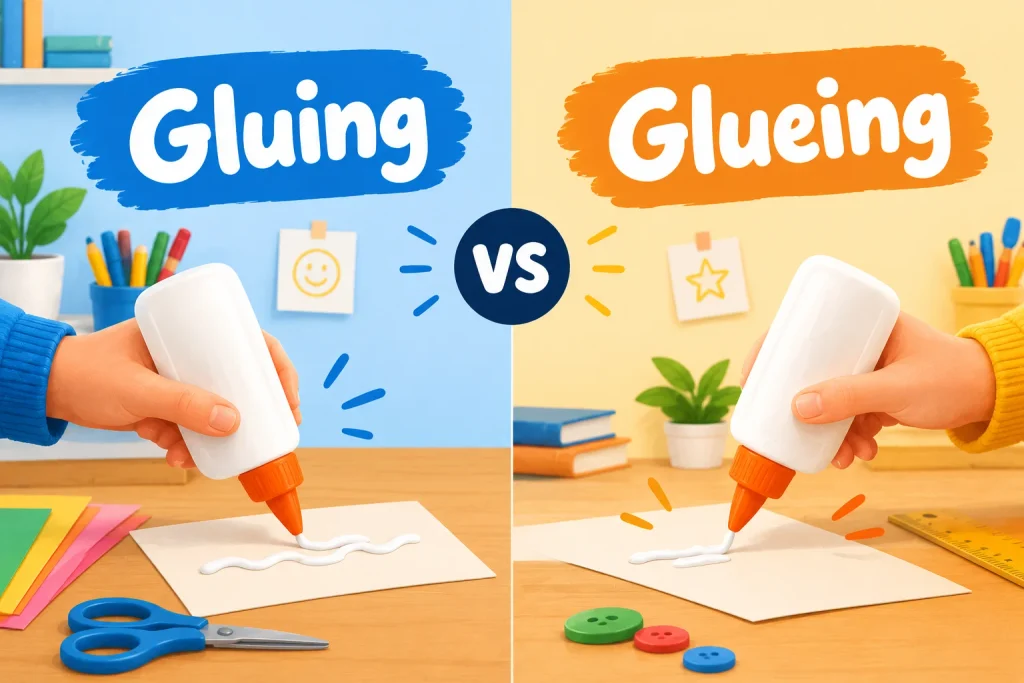
If you’ve ever paused while typing “gluing” because “glueing” looked more natural, you’re not alone. The two spellings look almost identical, sound the same, and come from the same verb: glue. That small spelling difference can make the word surprisingly confusing.
So, is it gluing or glueing?
The answer depends partly on the variety of English you’re using. Gluing is the standard and widely preferred spelling, particularly in American English. However, glueing is not simply a meaningless typo. Major dictionaries, including Cambridge, Oxford, and Merriam-Webster, recognize glueing as a legitimate variant.
That distinction matters when you’re writing an essay, editing professional content, completing schoolwork, or trying to maintain a consistent style.
The good news is that the difference is easy to understand once you look at how English handles verbs ending in silent e.
Quick Answer: Is It Gluing or Glueing?
Gluing is the spelling you’ll generally want to use, especially in American English.
Glueing is also found in standard dictionaries as an alternative form. Cambridge lists the present participle as “glueing or gluing,” while Oxford lists both forms for the verb glue. Merriam-Webster likewise gives “gluing” and “glueing” as forms of the verb.
Here’s the practical distinction:
| Spelling | Status | Best use |
| gluing | Standard and widely preferred | General and American English writing |
| glueing | Recognized variant | Some British and other English usage |
| glue | Base verb | Present or infinitive forms |
| glued | Past tense and past participle | Completed actions |
For example:
- I am gluing the pieces together.
- She is gluing a label onto the box.
- They spent the afternoon gluing paper shapes to cardboard.
- He glued the broken handle back onto the cup.
If you’re writing for an American audience and want the safest choice, use gluing.
That doesn’t mean you should automatically label glueing as an error. English spelling has developed through different regional conventions, dictionary traditions, and historical patterns. A careful writer should recognize that variation instead of treating every alternative spelling as a mistake.
What’s the Difference?
At the most basic level, gluing and glueing represent the same verb form.
Both come from glue, meaning to join something to another thing with an adhesive substance. Cambridge defines glue as a substance used for joining things together and also defines the verb as joining things together using glue.
The important difference is spelling preference, not meaning.
Gluing
Gluing is the shorter and more common form in contemporary writing. It removes the final e from glue before adding -ing:
glue → gluing
This follows a familiar spelling pattern in English. When many verbs end in a silent e, the final e disappears before -ing is added.
Consider these examples:
- make → making
- take → taking
- bake → baking
- write → writing
- use → using
- give → giving
By that pattern, glue → gluing makes intuitive sense.
Glueing
Glueing keeps the final e before adding -ing:
glue → glueing
At first glance, this may look unusual because English commonly removes a silent e before -ing. Yet glueing has remained in use and is recognized by major dictionaries.
Oxford, for example, gives both gluing and glueing as the -ing forms of glue. Both are pronounced /ˈɡluːɪŋ/.
That means the distinction is not:
gluing = correct
glueing = completely incorrect
A more accurate explanation is:
Gluing is the preferred form in many contexts, while glueing is an accepted variant.
This is an important point because spelling advice often becomes too absolute. English contains many regional and historical variations that dictionaries continue to recognize.
What Does Gluing Mean?

Gluing is the present participle and gerund form of the verb glue.
The verb glue means to join or attach something using glue or another adhesive substance. Cambridge gives the verb the meaning “to join things together using glue,” while Merriam-Webster defines it as causing something to stick tightly with or as if with glue.
So, when you use gluing, you’re describing an action that involves applying glue or attaching something with glue.
For example:
- Maria is gluing the photographs into her scrapbook.
- The students are gluing colored paper onto the poster.
- He spent an hour gluing the broken pieces together.
- We’re gluing the wooden panels before painting them.
The word can describe a very literal physical action, but English also uses glued in figurative expressions.
For instance:
- The children were glued to the television.
- Her eyes were glued to the screen.
- He was glued to his phone during the entire trip.
Here, glued doesn’t mean someone has literally been attached with adhesive. Instead, it suggests intense attention or an inability to move away.
Oxford recognizes this figurative construction in expressions such as “be glued to something,” meaning to give something your full attention or remain very close to it.
Gluing as an Ongoing Action
One of the easiest ways to understand gluing is to think of it as an action in progress.
Compare these sentences:
- I glue the pieces together.
- I am gluing the pieces together.
- I glued the pieces together.
The first sentence uses the base verb glue.
The second uses gluing to show an ongoing action.
The third uses glued as the past form.
This distinction becomes especially useful when choosing the correct verb form in a sentence.
| Verb form | Example | Function |
| glue | I glue the pieces together. | Base/present form |
| glues | She glues the pieces together. | Third-person singular |
| gluing | She is gluing the pieces together. | Present participle/gerund |
| glued | She glued the pieces together. | Past tense/past participle |
Oxford lists glue, glues, glued, gluing, and glueing among the forms associated with the verb.
What Does Glueing Mean?
Glueing has the same basic meaning as gluing.
It refers to the action of joining things with glue. The difference lies in the spelling rather than the underlying definition.
For example:
- She is gluing the paper onto the card.
- He spent the morning glueing the model pieces together.
- They were glueing decorations to the classroom wall.
These sentences communicate essentially the same meaning as their versions with gluing.
Cambridge explicitly lists “glueing or gluing” as the present participle of glue.
Oxford also lists both gluing and glueing as the -ing forms of the verb.
Merriam-Webster follows the same pattern by listing “glued; gluing also glueing.”
So if you encounter glueing in a book, website, article, or British English text, the word itself is not evidence of a spelling error.
Why Does Glueing Look Strange?
The confusion comes from the final e.
The base word is:
glue
When English adds -ing, writers often expect the silent e to disappear:
glue + ing → gluing
But glue is slightly awkward compared with verbs such as make or write.
Look at the difference:
- make + ing → making
- write + ing → writing
- bake + ing → baking
- glue + ing → gluing
The spelling gluing follows the usual deletion pattern.
Yet glueing has also survived as a variant. That spelling makes the relationship with the base word glue visually obvious:
glue + ing → glueing
This is one reason some writers naturally produce glueing even when they are familiar with standard English spelling rules.
Why Is It “Gluing” Instead of “Glueing”?
The main reason gluing feels more natural in modern standard spelling is the general rule involving the final silent e.
When a verb ends in a silent e, English commonly drops that e before adding -ing.
For example:
hope → hoping
drive → driving
come → coming
dance → dancing
move → moving
The same pattern gives us:
glue → gluing
This spelling keeps the pronunciation intact while avoiding an unnecessary letter.
However, English spelling rules contain plenty of exceptions and historical variations. The rule is therefore useful, but it doesn’t explain every form found in real-world English.
That’s particularly important with glueing.
Rather than treating the spelling as impossible, it’s more accurate to say that gluing is the preferred modern form in wide varieties of English, while glueing remains an established variant.
The Silent “E” Rule
The final e in glue does not normally need to remain when -ing is added.
Compare:
| Base verb | + -ing | Result |
| make | make + ing | making |
| take | take + ing | taking |
| write | write + ing | writing |
| drive | drive + ing | driving |
| use | use + ing | using |
| glue | glue + ing | gluing |
The pattern is straightforward.
However, you should avoid turning it into a rigid rule that explains every English verb. English spelling contains exceptions because its vocabulary developed through many languages and historical stages.
For glue, the important practical point is simple:
If you need the most widely accepted modern spelling, choose “gluing.”
Is Glueing Wrong?
This question deserves a careful answer because many spelling guides oversimplify it.
Glueing is not universally treated as wrong.
Several major dictionaries recognize it as a variant of gluing. Cambridge lists both spellings, Oxford lists both -ing forms, and Merriam-Webster identifies glueing as an alternative alongside gluing.
That gives us a useful distinction between incorrect, less preferred, and regionally accepted spelling.
A Better Way to Think About It
Instead of asking:
“Is glueing wrong?”
Ask:
“Which spelling is preferred for the English variety and context I’m writing for?”
That question leads to much better writing decisions.
If you’re writing standard American English, gluing is the safer and more natural choice.
If you’re reading British or international English, you may encounter glueing without it being treated as an error.
For formal writing, consistency also matters. If your publication follows a particular dictionary or style guide, follow that authority rather than switching randomly between forms.
Why Some Writers Call Gluing Incorrect
There’s a straightforward reason for the disagreement.
Many English spelling lessons teach the rule:
Drop the final silent e before adding -ing.
Students then learn:
- bake → baking
- hope → hoping
- smile → smiling
- use → using
From that perspective, glueing appears to violate the pattern.
A teacher following a strict classroom spelling rule may therefore prefer gluing.
That preference can be perfectly reasonable for teaching purposes. It doesn’t necessarily mean that every dictionary recognizes glueing as an error.
This difference between prescriptive rules and actual dictionary usage is important.
A prescriptive rule tells you what form you should normally use.
A dictionary can also tell you which forms speakers and writers actually use and recognize.
Good spelling advice considers both.
In American English
For American English, gluing is the best default choice.
If you’re writing an American English essay, article, report, email, instruction manual, or website, gluing will usually look more familiar to readers.
Consider these examples:
- The children are gluing shapes onto the poster.
- She is gluing the broken pieces back together.
- The technician is gluing the material to the frame.
- He learned how to make the model by cutting and gluing cardboard.
The spelling gluing also appears in Merriam-Webster’s entry for glue. The dictionary lists glued; gluing; also glueing, which places gluing first while still recognizing the alternative.
That ordering is useful when you’re deciding which spelling to use in American writing.
Why Gluing Is the Safer American Choice
American English tends to favor the shorter form gluing.
It follows the familiar silent-e pattern, looks cleaner on the page, and avoids an extra letter that many readers may perceive as unnecessary.
For SEO content, educational material, business writing, and general web copy, gluing is therefore the practical choice when the intended audience primarily uses American English.
For example, this headline is natural:
“How to Start Gluing Wood Pieces Together”
The alternative:
“How to Start Glueing Wood Pieces Together”
is understandable, but it may look less familiar to many American readers.
That difference is subtle. It doesn’t change the meaning.
Gluing or Glueing in British English
British English requires a little more nuance.
You may encounter both gluing and glueing, and major British-oriented dictionaries recognize both forms. Cambridge lists glueing or gluing as the present participle, while Oxford gives both forms in its verb entry.
This means you shouldn’t assume that adding the e automatically makes a British spelling wrong.
Regional spelling differences often involve more than famous pairs such as:
- color/colour
- center/centre
- organize/organise
Some differences are much less obvious. Gluing/glueing is one of those cases.
What Should British Writers Choose?
If you’re writing for a British audience, the best choice is to follow the style guide or dictionary preferred by your publication, school, employer, or client.
If no specific style guide applies, gluing is still a perfectly recognized form.
The presence of glueing in dictionaries simply means that readers may encounter it and understand it as a legitimate variant.
That’s why a good editor shouldn’t automatically “correct” every instance of glueing without considering context.
What Major Dictionaries Say About
Dictionary evidence is especially useful when two spellings create disagreement.
Here’s what several major sources show:
| Dictionary | Gluing | Glueing | What this tells us |
| Cambridge Dictionary | Recognized | Recognized | Both are listed as present participles |
| Oxford Learner’s Dictionaries | Recognized | Recognized | Both are listed as -ing forms |
| Merriam-Webster | Listed first | Listed as an alternative | Gluing is the primary listed form |
Cambridge gives “glueing or gluing” as the present participle of glue.
Oxford gives both gluing and glueing, with the same pronunciation.
Merriam-Webster lists “glued; gluing also glueing.”
The evidence leads to a useful conclusion:
Gluing is the safest general-purpose spelling, but glueing is not automatically an error.
That distinction should guide the rest of the discussion.
The Grammar Behind Gluing
Understanding the grammar makes the spelling much easier to remember.
Gluing can function as a present participle or a gerund, depending on how it behaves in a sentence.
These two grammatical uses look identical because they use the same -ing form.
Gluing as a Present Participle
A present participle often works with a form of be to create a progressive verb phrase.
For example:
She is gluing the pieces together.
Here, is gluing describes an action happening around the relevant time.
Other examples include:
- I am gluing the pages into the notebook.
- They are gluing the decorations onto the wall.
- He was gluing the model together when the phone rang.
- We have been gluing the pieces together all morning.
In these sentences, gluing helps form a verb phrase that expresses an ongoing action.
Gluing as a Gerund
An -ing form can also function as a noun.
For example:
Gluing requires patience.
Here, gluing names an activity. It isn’t describing what someone is currently doing.
Compare:
She is gluing the pieces together.
In this sentence, gluing forms part of the verb phrase.
Gluing the pieces together takes patience.
Here, gluing the pieces together acts as the subject of the sentence.
That grammatical distinction is useful because it shows how flexible gluing can be.
Examples of Gluing as a Gerund
- Gluing paper can become messy.
- Gluing small pieces requires steady hands.
- Gluing the edges together took several minutes.
- Gluing wood requires the right adhesive.
- Careful gluing can improve the final result.
The word remains spelled gluing in each example.
What Is the Pronunciation of Gluing?
Another reason gluing and glueing can confuse is that they have essentially the same pronunciation.
Oxford gives both gluing and glueing the pronunciation /ˈɡluːɪŋ/.
In simple terms, the word sounds roughly like:
GLOO-ing
The spelling difference therefore doesn’t create a meaningful pronunciation difference in ordinary use.
That creates an interesting spelling trap.
You hear one sound, but you can encounter two written forms.
This is common in English. Pronunciation alone doesn’t always tell you which spelling a word requires.
For example, English contains many words where letters appear to promise one pronunciation but behave differently. In the case of gluing, the challenge is almost the opposite: two spellings can represent the same spoken form.
Why Is Often Preferred
There are several practical reasons gluing tends to be the preferred form.
It Follows a Familiar Spelling Pattern
The final e disappears before -ing, just as it does in:
- making
- taking
- using
- writing
- moving
That makes gluing easier to teach and remember.
It Looks Cleaner
Compare:
gluing
and
glueing
The first version is shorter and visually simpler.
That doesn’t make the second version meaningless or invalid. It simply explains why many editors and writers prefer the shorter form.
It Matches Major Dictionary Usage
Merriam-Webster lists gluing first and gives glueing as an alternative.
Oxford recognizes both, while Cambridge does the same.
This combination of spelling convention and dictionary support makes gluing a strong default choice.
A Simple Rule to Remember
If you want one practical rule, use this:
When you need the standard modern form, write “gluing.”
Then remember the important qualification:
“Glueing” is also recognized as a variant in major dictionaries.
This approach keeps your writing accurate without pretending that English spelling has no regional or historical variation.
For most American English writing, gluing should be your first choice.
For British or international material, check the relevant style guide if consistency matters.
And when you’re reading, don’t assume glueing is automatically a spelling mistake. Context matters.
The Key Difference at a Glance
Before moving into more detailed usage examples and common mistakes, the central distinction can be summarized simply:
| Feature | Gluing | Glueing |
| Meaning | Joining with glue | Joining with glue |
| Base verb | Glue | Glue |
| Grammatical form | -ing form | -ing form |
| Pronunciation | /ˈɡluːɪŋ/ | /ˈɡluːɪŋ/ |
| American English | Preferred | Recognized variant |
| British English | Used | Recognized variant |
| Dictionary status | Standard | Accepted variant |
| Best general choice | Yes | Usually secondary |
The most important takeaway is that meaning does not separate these two spellings.
They refer to the same action.
The real issue is which spelling best fits your audience, style, and purpose.
For everyday American English, gluing is the clear practical winner.
For dictionary awareness, however, glueing deserves recognition as a legitimate variant rather than an automatic red mark.
The Spelling Rule Behind Gluing
The spelling of gluing becomes much easier once you understand what happens when English adds -ing to a verb ending in a silent e.
In many cases, the final e disappears before -ing is added. This gives us familiar forms such as:
- make → making
- bake → baking
- take → taking
- write → writing
- drive → driving
- use → using
- move → moving
- hope → hoping
The same pattern produces:
glue → gluing
This is the main reason gluing looks more natural to many English speakers. It follows a spelling pattern that readers encounter constantly.
However, spelling rules describe common patterns rather than every historical detail of English. The continued existence of glueing demonstrates that real English usage can be more flexible than a simple classroom rule suggests.
Cambridge, Oxford, and Merriam-Webster all recognize glueing alongside gluing, although Oxford’s American English entry lists gluing as the -ing form.
Why the Final E Usually Disappears
The silent e often helps establish the pronunciation of a base word.
Consider:
- hope
- hoping
The e in hope isn’t pronounced. When -ing is attached, it isn’t needed, so English removes it.
The same principle applies to:
- write → writing
- ride → riding
- love → loving
- name → naming
With glue, the final e is also silent:
glue → gluing
The pronunciation remains essentially the same while the spelling becomes shorter.
Why “Glueing” Still Exists
If the spelling rule is so familiar, why does glueing exist at all?
The answer lies in the complexity of English spelling.
English developed through centuries of contact among different languages and writing traditions. Not every spelling follows one perfectly consistent modern rule. Some forms survive because speakers have used them for a long time, because they make the connection to the base word visually obvious, or because regional writing traditions preserve them.
Glueing therefore survives as a recognized variant rather than disappearing completely.
That is why dictionary evidence matters more than intuition alone. If a word looks unusual, its appearance isn’t enough to determine whether it’s actually acceptable.
When Should You Use Gluing?
For most modern writing, gluing is the best default.
This is especially true when you’re writing:
- School assignments
- College papers
- Business documents
- Blog posts
- Website content
- Product instructions
- DIY tutorials
- Craft guides
- General American English
- Professional communication
Using gluing gives readers the spelling they’re most likely to expect.
For example:
The students are gluing colored paper onto the poster.
The sentence sounds natural, and the spelling follows the standard pattern for many verbs ending in silent e.
Another example:
She is gluing the broken pieces together before painting them.
Again, gluing clearly describes an action happening at the time being discussed.
When Might Glueing Appear?
You may encounter glueing in British English, international English, older material, or writing that follows a dictionary or style tradition that accepts the variant.
That doesn’t automatically mean the writer made a mistake.
For example:
The children were glueing pictures onto the cardboard.
The sentence remains understandable, grammatical, and semantically identical to:
The children were gluing pictures onto the cardboard.
The spelling changes. The action doesn’t.
This distinction is particularly useful for editors. Correcting glueing to gluing may improve consistency with a particular style guide, but calling the original spelling universally incorrect would be too strong.
In American English
If your audience uses American English, choose gluing.
Oxford’s American English dictionary gives gluing as the -ing form of glue. Merriam-Webster also lists gluing first and identifies glueing as an alternative.
That makes the practical choice straightforward.
Common American English Examples
Crafting
Mia is gluing the beads onto the picture frame.
Schoolwork
The students are gluing their research images onto the display board.
DIY
He is gluing the loose trim back onto the cabinet.
Model building
The hobbyist spent several hours gluing the tiny parts together.
Repair work
She is gluing the cracked wooden ornament back together.
In each sentence, gluing functions naturally as the present participle.
Why American Writers Usually Prefer Gluing
American English writing generally favors gluing because it is concise and matches the familiar silent-e spelling pattern.
There is also a practical editorial advantage.
If you write:
The company is gluing the layers together.
Most American readers will process the spelling immediately.
If you write:
The company is glueing the layers together.
Readers will still understand it, but some may stop briefly because the spelling looks less familiar.
That moment of hesitation is one reason gluing makes the better default for American-facing content.
In British English
British English requires a slightly more flexible approach.
Both gluing and glueing appear in major dictionaries. Cambridge lists “glueing or gluing” as the present participle, while Oxford’s general learner’s dictionary lists both forms with the same pronunciation.
Therefore, British usage doesn’t justify a simple statement such as:
“Glueing is wrong in British English.”
That claim would be too broad.
A better explanation is:
Both forms are recognized, but the preferred form can depend on the dictionary, publication, or style convention being followed.
Regional Variation Doesn’t Change the Meaning
Regional spelling differences can make English confusing because readers sometimes assume that a different spelling means a different word.
That isn’t the case here.
Whether you write:
- gluing
- glueing
the basic meaning remains joining or attaching something with glue.
Cambridge defines the verb glue as joining things together using glue and lists both glueing and gluing as its present participles.
So the variation is orthographic rather than semantic.
In other words, you’re dealing with two spellings of the same grammatical form, not two different actions.
Gluing as a Verb Form
The word gluing comes directly from the verb glue.
The complete pattern looks like this:
| Form | Example |
| Base form | I glue the pieces together. |
| Third-person singular | She glues the pieces together. |
| Past tense | She glued the pieces together. |
| Past participle | The pieces were glued together. |
| Present participle | She is gluing the pieces together. |
| Gerund | Gluing takes patience. |
Oxford gives the same core verb forms, including glue, glues, glued, gluing, and glueing.
Understanding this pattern helps prevent another common mistake: trying to use gluing in places where the base verb or past form belongs.
Gluing vs. Glue
Consider:
I glue the pieces together every weekend.
This sentence describes a repeated or habitual action.
Now compare:
I am gluing the pieces together right now.
The second sentence describes an action currently in progress.
The difference isn’t about the object being attached. It comes from the grammatical construction.
Gluing vs. Glued
Now compare:
I am gluing the pieces together.
with:
I glued the pieces together.
The first describes an ongoing action.
The second describes an action that has already happened.
This distinction matters because writers sometimes focus so heavily on the spelling of gluing that they overlook the larger verb structure.
Gluing as a Present Participle
A present participle is an -ing form that can help form progressive verb constructions.
For example:
The worker is gluing the panels together.
The structure is:
is + gluing
Another example:
The children were gluing shapes onto the paper.
Here the structure is:
were + gluing
You can also combine it with perfect progressive constructions:
They have been gluing the pieces together for an hour.
The word gluing remains unchanged even though the larger verb phrase becomes more complex.
More Present-Participle Examples
- She is gluing the envelope shut.
- They are gluing labels onto the containers.
- He was gluing the model when the power went out.
- We were gluing the photographs into the album.
- The technician has been gluing the layers together.
These examples show that gluing naturally fits many different tense and aspect structures.
Gluing as a Gerund
The same -ing form can function as a noun-like element.
For example:
Gluing can be difficult when the pieces are tiny.
Here, gluing refers to the activity itself.
It isn’t describing what a particular person is doing at that exact moment.
Compare the following:
She is gluing the pieces together.
Here, gluing is part of the verb phrase.
Gluing the pieces together requires patience.
Here, gluing the pieces together acts as the subject of the sentence.
That is the basic distinction between the two grammatical uses.
Gerund Examples
- Gluing paper is easy once you learn the technique.
- Gluing small objects requires precision.
- Gluing wood can take longer in cold conditions.
- Careful gluing produces a cleaner finish.
- Gluing the edges first makes assembly easier.
The spelling doesn’t change based on whether the -ing form functions as a participle or gerund.
Common Sentence Patterns With Gluing
Learning a few sentence structures can make the word much easier to use correctly.
Gluing + Object
She is gluing the photographs into the scrapbook.
The structure is:
subject + be + gluing + object
Gluing + Object + Preposition
He is gluing the label onto the package.
Common prepositions include:
- to
- onto
- together
- down
- in place
Oxford gives examples such as “glue the label onto the box” and “glue the two pieces of cardboard together.”
Gluing + Adverb
She is carefully gluing the delicate pieces together.
Adverbs can explain how the action happens.
Common choices include:
- carefully
- firmly
- neatly
- securely
- slowly
- evenly
For example:
The artist is carefully gluing each piece into place.
The adverb carefully tells the reader how the action is performed.
Gluing in DIY and Craft Writing
The word gluing appears frequently in instructions because many craft and construction tasks involve attaching materials.
For example:
Begin by gluing the two cardboard panels together.
Or:
After cutting the fabric, apply adhesive before gluing it to the frame.
In instructional writing, clarity matters more than stylistic complexity. Readers need to know what to attach, where to attach it, and when to act.
Useful instructional phrases include:
- Start by gluing…
- Continue gluing…
- Avoid gluing…
- Allow the adhesive to dry before gluing…
- Apply a thin layer before gluing…
- Hold the pieces together while gluing…
Example of a Clear Instruction
Apply a thin layer of adhesive to both surfaces before gluing the pieces together. Hold them firmly for several seconds while the adhesive begins to set.
Notice how gluing identifies the attachment stage of the process.
This kind of precise wording is particularly useful in tutorials, manuals, classroom activities, and DIY guides.
Gluing in Academic and Professional Writing
Although gluing often appears in craft contexts, it isn’t limited to children’s projects or household repairs.
It can describe processes in manufacturing, engineering, packaging, product development, and laboratory work.
For example:
The researchers used an adhesive layer for gluing the components together.
Or:
The manufacturing process includes cutting, positioning, and gluing the material.
In professional writing, the key issue isn’t whether the action sounds informal. The word gluing is perfectly appropriate whenever the process genuinely involves adhesive bonding.
Technical Contexts
Depending on the field, writers may use more specialized terms such as:
- bonding
- adhesion
- adhesive application
- joining
- lamination
- attachment
- cementing
These words aren’t always exact synonyms.
For example, bonding can describe a broader technical process, while gluing is often more straightforward and accessible.
A technical writer should therefore choose the term that accurately describes the actual process.
Gluing vs. Bonding
The words gluing and bonding sometimes overlap, but they aren’t always interchangeable.
Gluing usually emphasizes the use of glue or an adhesive to attach things.
Bonding can describe the broader process by which two materials become attached, including methods that don’t involve conventional glue.
For a general audience:
The technician is gluing the panels together.
is clear and direct.
For a specialized engineering audience:
The panels are bonded using a structural adhesive.
may be more precise.
This illustrates an important writing principle: the simplest word isn’t always the least professional. Good technical writing uses the most accurate term for its audience and context.
The Figurative Meaning of Glued
The related word glued has an important figurative use.
When someone is glued to something, they are giving it intense attention or staying fixed in one place.
For example:
The children were glued to the television.
Nobody is suggesting that actual adhesive was involved.
The expression means the children were so absorbed in the television that they remained focused on it.
Oxford lists “be glued to something” as an idiom meaning to give something your full attention or stay very close to it.
Merriam-Webster similarly gives a figurative sense of glue meaning to cause someone or something to remain continuously fixed, with examples involving people being glued to their seats or screens.
Common Figurative Examples
- She was glued to her phone all afternoon.
- His eyes were glued to the screen.
- The audience remained glued to their seats.
- The children were glued to the movie.
- Everyone was glued to the news during the announcement.
These expressions are common in conversational English.
However, don’t confuse glued with gluing.
Gluing describes the act of attaching something.
Glued can describe something that has been attached, but it also appears in figurative expressions.
The Difference Between Gluing and Glueing Is Mostly Orthographic
The term orthography refers to the conventional system used to write a language.
In this case, the central difference between gluing and glueing is orthographic.Both spellings represent the same underlying verb form.They don’t create different definitions.They don’t describe different kinds of glue.They don’t indicate different pronunciation.They simply represent different spelling conventions.This is why dictionary evidence is so important.
Cambridge explicitly lists glueing or gluing, and Oxford lists both forms with the same pronunciation.
Merriam-Webster also identifies glueing as an alternative form of gluing.
A Practical Decision Guide
When you’re unsure which spelling to use, you don’t need to overthink it.
Use this quick guide:
| Your situation | Recommended choice |
| American English | Gluing |
| General web writing | Gluing |
| School assignment | Gluing |
| Professional writing | Gluing |
| SEO content | Gluing |
| British English with no style requirement | Gluing is a safe choice |
| British source that uses glueing | Preserve the established style when appropriate |
| Quoting a source | Keep the source’s original spelling |
| Dictionary discussion | Mention both forms |
The safest general strategy is simple:
Use gluing unless you have a specific reason to use glueing.
That approach gives your writing a familiar appearance while still recognizing the legitimate variant.
What Not to Do With Gluing and Glueing
A few habits can make spelling discussions unnecessarily complicated.
Don’t Treat Every Variant as a Typo
Seeing glueing doesn’t automatically prove that someone made a spelling mistake.
Major dictionaries recognize the form.
Don’t Switch Forms Randomly
If your article begins with gluing, suddenly changing to glueing can make the writing look inconsistent.
Choose a primary form and stick with it.
Don’t Invent a Meaning Difference
There is no basic semantic difference between gluing and glueing.
Both describe the same action.
Don’t Assume British English Uses Completely Different Rules
British English has many spelling differences from American English, but not every unusual spelling follows a simple regional rule.
Check the relevant dictionary or style guide when precision matters.
Don’t Let Spell Check Decide Everything
A spell checker can flag a word because of a dictionary setting, regional language preference, or software configuration.
That doesn’t necessarily prove the word is incorrect.
Human judgment still matters.
A Useful Editing Test
If you’re editing a sentence and see gluing, ask three questions:
What variety of English am I using?
If you’re writing American English, gluing is generally the better choice.
Does my style guide specify a preferred spelling?
If it does, follow that guidance consistently.
Am I correcting an actual error or simply changing a recognized variant?
This last question is particularly important.
An editor’s job isn’t to make every sentence conform to personal preference. The goal is to make the text accurate, consistent, clear, and appropriate for its intended audience.
A More Accurate Rule
A simple rule such as “always write gluing” is practical, but it’s not the whole story.
A more accurate rule is:
Use “gluing” as the standard default, especially in American English, while recognizing “glueing” as an accepted variant in major dictionaries.
That rule gives you both practical guidance and linguistic accuracy.
It also explains why different sources may appear to disagree.
One source may recommend gluing because it follows the standard silent-e pattern.
Another may accept glueing because its dictionary records the variant.
These statements aren’t necessarily contradictory.
They’re answering slightly different questions.
One asks:
Which spelling should I prefer?
The other asks:
Which spellings are recognized in English?
Those are not the same question.
Why Dictionary Evidence Matters
Dictionaries are particularly valuable when ordinary spelling rules don’t tell the whole story.
For gluing, dictionary evidence confirms three important facts:
- Gluing is a recognized form of glue.
- Glueing is also recognized by major dictionaries.
- The two forms share the same basic meaning and pronunciation.
Cambridge lists both forms directly in its verb entry.
Oxford provides both forms and gives them the same pronunciation.
Merriam-Webster lists gluing first and glueing as an alternative.
That evidence gives writers a much stronger foundation than simply saying, “This spelling looks right.”
The Best Default
If you want one answer that works in most situations, choose gluing.
It is concise, familiar, grammatically correct, and supported by major dictionaries.
For example:
She is gluing the pieces together.
The children are gluing pictures onto the poster.
Gluing the edges carefully creates a cleaner result.
He spent the afternoon gluing the model together.
These sentences work naturally in everyday, academic, professional, and instructional contexts.
At the same time, remember that glueing isn’t simply nonsense or an invented spelling.
It is a documented variant.
That distinction becomes especially important when you’re proofreading someone else’s work, comparing regional English, or reading older or international material.
A Quick Memory Trick for Gluing
Here’s an easy way to remember the preferred spelling:
Think: “Glue loses the E before -ing.”
So:
GLUE → GLUING
You can compare it with:
MAKE → MAKING
TAKE → TAKING
WRITE → WRITING
USE → USING
The pattern becomes easier to remember when you group the words rather than memorizing gluing in isolation.
However, keep one qualification in mind:
The existence of the variant “glueing” doesn’t mean the spelling rule is useless.
It simply means English has preserved an alternative form alongside the more widely preferred spelling.
How to Use Gluing in a Sentence
Once you understand the spelling, using gluing correctly is straightforward. The word describes the action of attaching, joining, or securing something with glue.
You can use gluing in everyday conversation, instructions, academic writing, craft descriptions, technical explanations, and figurative contexts.
The exact sentence structure depends on how gluing functions grammatically.
For example:
She is gluing the photographs into her scrapbook.
Here, gluing is part of the present progressive verb phrase.
Now consider:
Gluing photographs into a scrapbook requires patience.
In this sentence, gluing refers to the activity itself and functions as a gerund.
The spelling remains the same in both cases.
Gluing With “Is,” “Am,” or “Are”
One of the most common structures is:
subject + is/am/are + gluing
For example:
- I am gluing the pieces together.
- She is gluing the decorations onto the card.
- He is gluing the broken handle back into place.
- They are gluing paper shapes onto the poster.
- We are gluing the model parts together.
This construction shows that the action is happening now or around the current time.
The auxiliary verb changes according to the subject, but gluing remains unchanged.
| Subject | Correct structure | Example |
| I | am gluing | I am gluing the pieces. |
| You | are gluing | You are gluing the label. |
| He | is gluing | He is gluing the frame. |
| She | is gluing | She is gluing the card. |
| It | is gluing | The machine is gluing the layers. |
| We | are gluing | We are gluing the panels. |
| They | are gluing | They are gluing the decorations. |
This pattern makes gluing easy to recognize in ordinary sentences.
Gluing With Past Progressive Forms
You can also use gluing with was and were.
For example:
She was gluing the pieces together when the phone rang.
The action was already in progress when another event occurred.
Other examples include:
- I was gluing the cardboard when the adhesive spilled.
- He was gluing the model when his friend arrived.
- They were gluing the decorations when the teacher entered.
- We were gluing the labels onto the boxes all afternoon.
The important point is that the spelling doesn’t change.
You don’t write glueding.
You write:
glue → glued
for the simple past, but:
glue → gluing
for the -ing form.
That distinction prevents a surprisingly common spelling error.
Gluing vs. Glued
The forms gluing and glued serve different grammatical purposes.
Gluing describes an ongoing activity or can name the activity itself.
Glued generally describes a completed action or something that has been attached.
Compare:
She is gluing the pieces together.
The action is happening now.
She glued the pieces together.
The action happened in the past.
The pieces are glued together.
The sentence describes their current state.
These differences become clearer in a comparison table.
| Form | Typical function | Example |
| glue | Base verb | I glue the pieces together. |
| glues | Present tense, third-person singular | She glues the pieces together. |
| gluing | Present participle/gerund | She is gluing the pieces. |
| glued | Past tense/past participle | She glued the pieces together. |
A strong understanding of these forms helps you avoid forcing gluing into every sentence simply because the article is discussing the word.
Gluing in Everyday Conversation
You don’t need a technical context to use gluing correctly.
People naturally use the word when discussing crafts, repairs, school projects, decorations, packaging, and household tasks.
For example:
I’m gluing the last piece onto the model.
Are you gluing that back together?
She’s gluing pictures into her notebook.
We’re gluing the decorations to the poster.
These sentences are casual, direct, and completely natural.
Everyday Examples
Here are several common situations where gluing fits naturally:
Crafting
I’m gluing the beads around the edge of the frame.
School projects
The students are gluing pictures onto their science posters.
Home repairs
Dad is gluing the loose trim back onto the cabinet.
Model building
He’s gluing the tiny pieces together before painting them.
Scrapbooking
She spent the evening gluing photographs into her album.
Decorating
We’re gluing paper stars to the classroom wall.
The word works naturally across all these contexts because the underlying action remains the same.
Gluing in School and Academic Writing
Students often encounter gluing while describing art projects, experiments, models, posters, and practical activities.
In school writing, the main goal should be clarity.
For example:
After cutting the shapes, the students began gluing them onto the poster.
This sentence clearly establishes the sequence:
cutting → gluing → completing the poster
Another example:
The final step involved gluing the paper strips around the outside of the model.
Here, gluing appears after involved, where the -ing form functions naturally as part of the sentence structure.
Academic Examples
- The students practiced gluing the components together.
- The activity involved cutting, folding, and gluing paper.
- After measuring the material, the class began gluing the pieces together.
- Careful gluing helped the students create a stable model.
- The project required accurate cutting and precise gluing.
Notice how the final example uses gluing as a noun-like activity:
The project required accurate cutting and precise gluing.
This construction is common in instructional and academic writing.
Gluing in DIY, Crafts, and Construction
Gluing is especially common in instructional content because adhesive-based assembly requires clear descriptions.
A DIY guide might say:
Start by gluing the two wooden pieces together.
A craft tutorial might say:
Apply a small amount of adhesive before gluing the paper to the frame.
A model-building guide could say:
Allow the first section to dry before gluing the remaining pieces.
These instructions use gluing because the writer is describing a process.
Common Instructional Patterns
You may see phrases such as:
- Start by gluing…
- Begin gluing…
- Continue gluing…
- Avoid gluing…
- After gluing…
- Before gluing…
- While gluing…
- When gluing…
- Carefully glue…
For example:
Before gluing the pieces together, make sure their edges line up correctly.
This sentence is especially useful because it shows the difference between gluing and glue.
After before, the -ing form works naturally:
before gluing
But in a direct command, the base form works:
Glue the pieces together.
Gluing and Prepositions
Certain prepositions commonly appear with gluing because they explain where one material is being attached.
Common combinations include:
- gluing to
- gluing onto
- gluing together
- gluing down
- gluing in place
For example:
She is gluing the photograph to the page.
He is gluing the label onto the container.
They are gluing the two pieces together.
The worker is gluing the material down.
We are gluing the loose section in place.
Choosing the right preposition makes the sentence more precise.
“Gluing To” vs. “Gluing Onto”
Both constructions can be correct, but they can emphasize slightly different relationships.
Gluing to often describes attachment to a surface or object:
She is gluing the fabric to the board.
Gluing onto emphasizes movement or placement onto a surface:
She is gluing the fabric onto the board.
In everyday writing, the two can overlap significantly.
The best choice depends on the exact action and the style of the sentence.
Gluing Together
The phrase gluing together is extremely common.
It emphasizes that two or more separate pieces are being joined.
Examples include:
- She is gluing the pieces together.
- The children are gluing the cardboard sections together.
- He spent the morning gluing the model together.
- The technician is gluing the layers together.
The phrase is especially useful when the result involves turning separate parts into one connected object.
Gluing Down
Gluing down means attaching something firmly to a surface.
For example:
She is gluing down the loose edge of the wallpaper.
The artist is gluing down the paper before painting over it.
He is gluing down the fabric so it doesn’t move.
This phrase is common in crafts, upholstery, paper projects, flooring, and other practical contexts.
Gluing in Place
The phrase gluing in place emphasizes securing something at a particular position.
For example:
Hold the piece steady while gluing it in place.
The technician secured the component by gluing it in place.
After positioning the decoration, begin gluing it in place.
This wording is useful when precise placement matters.
Common Mistakes With Gluing and Glueing
The spelling issue creates several predictable mistakes.
Some writers add an unnecessary e. Others remove the e but accidentally change another part of the word. Still others use glueing and assume it must be wrong because a spell checker flags it.
Understanding the source of these mistakes makes them easier to avoid.
Mistake: Writing Glueing Automatically
The most obvious problem is choosing glueing simply because the base word is glue.
A writer may think:
glue + ing = glueing
That calculation looks logical.
English spelling, however, commonly drops the final silent e before -ing.
So the preferred form is:
glue + ing = gluing
At the same time, remember that glueing is recognized as a variant.
Therefore, the issue isn’t that the writer has created a meaningless word. The issue is that gluing is generally the better default.
Mistake: Writing Glueding
This error occurs when someone tries to build the -ing form from the past-tense form:
glued + ing = glueding
That is incorrect.
The correct forms are:
glue → glued
and:
glue → gluing
For example:
❌ She is glueding the pieces together.
✅ She is gluing the pieces together.
This mistake is worth remembering because it can occur when writers focus on the word glued rather than the base verb glue.
Mistake: Writing Gluying
Another possible error is changing the spelling incorrectly while trying to remove the final e.
The correct form is:
gluing
Not:
gluying
The base spelling glu- remains intact.
Mistake: Changing the Meaning
Some writers assume that gluing and glueing describe different processes.
They don’t.
Both forms refer to the action of joining something with glue.
The difference is primarily one of spelling preference and usage convention.
Common Spelling Errors at a Glance
| Incorrect or questionable form | Better form | Explanation |
| glueding | gluing | Don’t add -ing to glued |
| gluying | gluing | The spelling doesn’t change to gluy- |
| glue-ing | gluing | Hyphen isn’t normally needed |
| glueing | gluing in most general writing | Recognized variant, but usually secondary |
| gluing | gluing | Standard preferred form |
The most important correction is glueding → gluing.
The relationship between gluing and glueing is different because both have dictionary support.
Why Spell Checkers Can Be Confusing
Digital spell checkers don’t always provide a universal verdict on English spelling.
Their suggestions can depend on:
- Language settings
- Regional dictionaries
- Software dictionaries
- House style
- Custom dictionaries
- Application settings
For example, software configured for American English may strongly prefer gluing.
Another system may recognize glueing without offering a correction.
Therefore, a red underline isn’t always proof that a word is objectively wrong.
The better approach is to combine spell-checking with a reliable dictionary and the style requirements of your intended audience.
Human Editing Still Matters
Automated tools are useful, but context determines whether a particular form is appropriate.
Suppose an editor sees:
The British source uses “glueing” throughout the article.
Changing every occurrence to gluing might make the text conform better to an American style guide.
However, if the goal is to reproduce the source faithfully, changing its spelling could be inappropriate.
The right decision depends on the purpose of the document.
Mixing
Using both spellings in the same document can make your writing appear inconsistent.
For example:
The children are gluing paper to the board. Later, they continue glueing decorations onto the edges.
There is no meaningful reason to switch forms halfway through the passage.
If your chosen style uses gluing, maintain it consistently:
The children are gluing paper to the board. Later, they continue gluing decorations onto the edges.
Consistency improves readability and gives your writing a more polished appearance.
When Keeping Both Forms Makes Sense
There are situations where both forms may legitimately appear.
For example, an article discussing the spelling difference may need to use both forms.
Likewise, a linguistics paper might compare regional variants.
A quotation may also preserve the spelling used in the source.
In those cases, the variation is intentional rather than careless.
In Formal Writing
For formal writing, gluing is usually the safest choice.
This includes:
- Reports
- Essays
- Research assignments
- Business documents
- Educational resources
- Professional websites
- Technical instructions
- Editing projects
Formal writing benefits from familiar, standardized forms.
Using gluing reduces the chance that readers will pause over the spelling.
However, formal writing doesn’t require pretending that recognized variants don’t exist.
If your discussion is specifically about English spelling, mentioning glueing can actually make the explanation more accurate.
In SEO Content
When writing SEO content around gluing, natural usage matters more than mechanically repeating the keyword.
A strong article can naturally incorporate related terms such as:
- gluing definition
- gluing meaning
- gluing spelling
- gluing vs. glueing
- correct spelling of gluing
- glueing or gluing
- gluing in American English
- gluing in British English
- how to spell gluing
- gluing example sentences
- gluing as a verb
- gluing as a gerund
- gluing present participle
These related phrases help cover the topic comprehensively without stuffing the exact keyword into every sentence.
For example, instead of repeatedly writing:Gluing is correct. Gluing is the spelling. Gluing means…a stronger paragraph might explain the spelling rule, dictionary evidence, grammatical function, and regional usage naturally.
That creates useful topical depth while keeping the prose readable.
Semantic Relationships Around Gluing
Search engines don’t understand a grammar article only through one repeated keyword.
A comprehensive explanation naturally connects gluing with related concepts such as:
Spelling
- spelling
- variant
- standard form
- preferred form
- orthography
- regional variation
Grammar
- verb
- present participle
- gerund
- progressive tense
- base form
- past tense
Meaning
- glue
- adhesive
- attach
- join
- bond
- secure
- stick
Usage
- American English
- British English
- formal writing
- everyday speech
- instructional writing
- academic writing
These relationships help explain the subject thoroughly instead of treating it as a one-word spelling quiz.
A Mini Case Study: Choosing the Right Form
Imagine that an American educational website is preparing a craft tutorial.
The original draft says:
Begin by gluing the cardboard pieces together.
The editor has two choices.
The first is to leave the sentence unchanged because glueing is recognized as a variant.
The second is to change it to:
Begin by gluing the cardboard pieces together.
For an American audience, the second option is generally preferable because gluing is the familiar standard form.
Now imagine a British publication whose established editorial style already uses glueing.
In that situation, changing every occurrence simply because an American dictionary prefers gluing could create unnecessary inconsistency.
The lesson is simple:
Correct editing depends on audience, style, and purpose—not spelling preference alone.
Another Case Study: A Student Essay
Consider this sentence in a student assignment:
The experiment involved cutting the material and gluing the pieces together.
Would the sentence be understandable?
Absolutely.
Would gluing be the safer choice for a general American English assignment?
Yes.
A polished version would read:
The experiment involved cutting the material and gluing the pieces together.
The improvement isn’t about changing the meaning.
It simply uses the more widely preferred form.
In Editing
Editors should distinguish between error correction and style normalization.
An actual spelling error such as glueding should be corrected.
A recognized variant such as glueing may or may not need changing.
That decision depends on the publication’s style.
A professional editor might therefore classify the forms like this:
| Form | Editorial treatment |
| gluing | Preferred general form |
| glueing | Recognized variant; change only if style requires it |
| glueding | Incorrect; correct it |
| gluying | Incorrect; correct it |
| glue-ing | Normally unnecessary; revise according to context |
This approach avoids overcorrecting legitimate language variation.
In Digital Communication
Text messages, social posts, emails, and online discussions generally don’t require complicated spelling analysis.
If you’re writing quickly and want the most familiar form, use:
gluing
For example:
I’m gluing the last few pieces together now.
That’s clear and natural.
If someone writes glueing, most readers will still understand it immediately.
The spelling difference rarely causes a communication problem.
However, when you’re publishing polished content, consistency becomes more important.
Clarity Matters
When gluing appears in instructions, the writer should make the action unmistakable.
Compare:
Start gluing.
with:
Start gluing the two panels together along the marked edge.
The second instruction gives the reader much more useful information.
Good instructional writing should answer practical questions such as:
- What should you glue?
- Where should you apply the adhesive?
- What should the pieces be attached to?
- In what order should you work?
- How should the pieces be positioned?
- What should happen before or after gluing?
The word gluing is only one part of that larger explanation.
A Useful Sentence-Building Formula
If you’re struggling to write a sentence with gluing, use this simple formula:
Subject + be + gluing + object + location/result
For example:
The student is gluing the photographs onto the display board.
Break it down:
- Subject: The student
- Verb: is
- Action: gluing
- Object: the photographs
- Location: onto the display board
Another example:
The technician is gluing the protective layer to the surface.
This formula works across casual, academic, and professional writing.
More Example Sentences With Gluing
Here are examples across different contexts:
Everyday Use
- I’m gluing the broken ornament back together.
- She is gluing a label onto the jar.
- We’re gluing the decorations to the wall.
School
- The students are gluing colored shapes onto the poster.
- Gluing the pieces together was the final step of the project.
- The teacher demonstrated gluing before the students began.
Crafts
- She spent the afternoon gluing beads onto the frame.
- Careful gluing gave the project a cleaner finish.
- Avoid moving the pieces while gluing them together.
DIY
- He is gluing the loose trim back onto the cabinet.
- The instructions recommend gluing the joints before painting.
- Make sure the surfaces are clean before gluing them together.
Professional
- The process includes cutting, shaping, and gluing the material.
- The technician is gluing the layers together with adhesive.
- Accurate positioning is important when gluing the components.
Figurative
The exact word gluing is less common in figurative expressions, but its related form glued is widely used:
- She was glued to her phone.
- His eyes were glued to the screen.
- The audience remained glued to their seats.
These examples show how the literal concept of adhesive attachment has developed into a metaphor for intense attention or immobility.
Gluing and the Meaning of “Stick”
The verb stick overlaps with glue in some contexts, but the words aren’t always interchangeable.
If you say:
The pieces are sticking together.
you’re describing the result or behavior of the materials.
If you say:
She is gluing the pieces together.
you’re emphasizing the action of applying adhesive to create that attachment.
This distinction can make technical and instructional writing more precise.
For example:
Apply adhesive before gluing the pieces together.
is more specific than:
Make the pieces stick together.
The first tells the reader how the attachment is being created.
Gluing and Adhesion
In scientific and technical contexts, adhesion refers to the attraction between different materials or surfaces.
Glue works by creating adhesive interactions that help surfaces remain attached.
However, the exact mechanism varies depending on the adhesive and materials involved.For general writing, you usually don’t need to explain the chemistry behind the adhesive.For technical content, however, distinguishing gluing, adhesion, and bonding can improve precision.For example:
- Gluing emphasizes the practical action.
- Adhesion emphasizes the interaction between surfaces.
- Bonding often emphasizes the resulting connection or joining process.
This broader vocabulary helps writers avoid using gluing as a catch-all term in specialized contexts.
The Most Important Spelling Insight
The central spelling lesson can be reduced to one line:
glue + -ing → gluing
The final e normally disappears.
But there is a second lesson that matters just as much:
Glueing is a recognized variant, so don’t automatically treat it as an absolute spelling error.
That combination gives you a more accurate understanding of the word.
If you’re unsure what to type, gluing is the safest choice.
If you’re reading glueing, don’t assume the writer doesn’t know English spelling.
Context and regional convention can explain the difference.
Gluing vs. Glueing Comparison Table
When you need a quick answer, a side-by-side comparison makes the distinction much easier to remember.
| Feature | Gluing | Glueing |
| Base word | Glue | Glue |
| Form | Present participle/gerund | Present participle/gerund |
| Basic meaning | Joining with glue | Joining with glue |
| Pronunciation | Essentially the same | Essentially the same |
| Final e | Removed | Retained |
| Common modern preference | Yes | Less preferred |
| American English | Preferred | Recognized variant |
| British English | Used | Recognized variant |
| Suitable for formal writing | Yes | Depends on style |
| Suitable for everyday writing | Yes | Yes |
| Automatically incorrect? | No | No |
| Safest general choice | Gluing | Secondary choice |
The most useful distinction is therefore preference rather than meaning.
If you’re choosing one form for general-purpose writing, gluing is the stronger choice.
If you’re analyzing English spelling, editing a regional text, or discussing dictionary variants, glueing may deserve to remain.
Words That Follow the Same Spelling Pattern
One of the easiest ways to remember gluing is to connect it with other verbs that lose their final silent e before -ing.
The pattern appears throughout English.
Common Examples
| Base verb | -ing form |
| bake | baking |
| close | closing |
| drive | driving |
| give | giving |
| hope | hoping |
| make | making |
| move | moving |
| save | saving |
| smile | smiling |
| take | taking |
| use | using |
| write | writing |
| glue | gluing |
Once you recognize this pattern, gluing becomes less mysterious.
Think of the final e as a letter that normally steps aside when -ing arrives.
So:
glue + ing
becomes:
gluing
rather than:
glueing
That mental image can make the spelling easier to recall.
Not Every Verb Follows the Same Pattern
It’s important not to treat the silent-e rule as an absolute formula for every English verb.
Some verbs behave differently.
For example:
- see → seeing
- agree → agreeing
- flee → fleeing
- free → freeing
These forms retain the final e because removing it would create a different or awkward spelling pattern.
This is another reason English spelling cannot always be mastered through one simple rule.
The useful takeaway is narrower:
For “glue,” the standard preferred -ing form is “gluing.”
The existence of glueing as a recognized variant adds an extra layer, but it doesn’t change the practical recommendation.
Why “Gluing” Looks Different From “Glue”
At first, gluing can look strange because the spelling seems to lose part of the original word.
Compare:
glue
gluing
The sequence glu remains, but the final e disappears.
Some learners therefore wonder whether gluing should contain another vowel.
It shouldn’t.
The spelling isn’t:
- gluying
- glueing, when following the preferred form
- glueding
- gluingg
It is simply:
gluing
The pronunciation helps here. The word begins with the familiar sound “gloo”, followed by the -ing ending.
A Visual Way to Remember the Spelling
Try breaking the word into two parts:
GLU + ING
That gives:
GLUING
The final e from glue is removed before -ing is attached.
You can also remember the sequence through a simple comparison:
glue → glued → gluing
Notice that the forms don’t develop by repeatedly adding letters to the previous form.
Instead, each grammatical form follows its own spelling pattern.
This is why:
glue + ed = glued
but:
glue + ing = gluing
Understanding that difference can prevent several common errors at once.
Which One Should You Use?
If you want a straightforward recommendation, use gluing.
It’s the most practical choice for:
- American English
- General web content
- School writing
- Business communication
- Professional documents
- Educational material
- Instructional content
- Most modern general-purpose writing
The alternative spelling is still useful to recognize because dictionaries document it as a variant.
So the rule of thumb is:
Write “gluing” by default, but recognize “glueing” when you encounter it.
That approach gives you confidence without oversimplifying the language.
When “Glueing” May Be Kept
There are several circumstances in which changing glueing to gluing may not be necessary.
In a Quotation
If you’re quoting someone directly, preserving the original wording can be important.
For example:
The original document says, “The process involves glueing the pieces together.”
If the spelling is part of the source, changing it could alter the quotation.
In a Historical Text
Older texts can contain spelling conventions that differ from modern preferences.
If you’re reproducing or analyzing such material, preserving the original spelling may be appropriate.
In a Regional Publication
A publication may have an established house style that permits or prefers glueing.
Consistency with that publication’s conventions can matter more than imposing another style.
In a Linguistic Discussion
If you’re writing specifically about spelling variation, you may intentionally use both forms.
For example:
The forms gluing and glueing illustrate variation in the spelling of the present participle.
In that context, using both forms is not an inconsistency. It’s the subject of the discussion.
Why Consistency Matters More Than You Might Think
Suppose an article uses gluing fifteen times and glueing twice.
A reader might wonder whether the two spellings have different meanings.
They don’t.
The inconsistency simply creates unnecessary uncertainty.
A polished article should therefore establish its preferred form early and use it consistently unless there’s a specific reason to show the alternative.
For most general English content, that preferred form should be:
gluing
This is especially important for long-form content where the same concept appears repeatedly.
How Editors Can Handle Gluing and Glueing
Editors often need to make decisions that go beyond identifying something as simply right or wrong.
A useful editorial framework is:
Accuracy → Audience → Style → Consistency
First, determine whether the form is recognized.
Second, consider who will read the content.
Third, check the publication’s style guide.
Finally, make sure the chosen spelling remains consistent throughout the document.
Using this framework prevents unnecessary corrections.
For example, changing:
The students are glueing paper onto the board.
to:
The students are gluing paper onto the board.
may be sensible in American educational content.
But if the text is specifically documenting a source that uses glueing, preserving the original spelling may be better.
The correct editorial choice depends on the purpose of the document.
Gluing in Different Writing Contexts
The preferred spelling remains useful across many forms of writing.
Blog Writing
Learn how to avoid common mistakes when gluing wood pieces together.
This sounds natural and direct.
Product Instructions
Allow the surface to dry completely before gluing the component in place.
The wording is concise and action-oriented.
Academic Writing
The final stage involved cutting, positioning, and gluing the samples together.
The -ing form fits naturally into a parallel list.
Technical Writing
The assembly process includes cleaning, aligning, and gluing the components.
Here, the three -ing forms create a balanced grammatical structure.
Casual Conversation
I’m gluing this back together before it falls apart again.
The word works just as naturally in everyday speech.
Parallel Structure With Gluing
One particularly useful grammatical pattern involves lists of activities.
When several actions appear together, keeping them in the same grammatical form makes the sentence easier to read.
For example:
The project involved cutting, folding, and gluing the material.
Each action uses an -ing form:
- cutting
- folding
- gluing
Another example:
The process requires measuring, trimming, positioning, and gluing the pieces.
This parallel structure creates rhythm and makes the sequence easier to follow.
Compare that with an inconsistent version:
The process requires measuring, trimming, positioning, and gluing the pieces.
The final item breaks the pattern.
A better version is:
The process requires measuring, trimming, positioning, and gluing the pieces.
This is a small grammatical detail, but it makes professional writing noticeably cleaner.
Gluing After Certain Verbs
Some verbs naturally take an -ing form after them.
For example:
She enjoys gluing paper models.
Here, gluing functions as the complement of enjoys.
Other examples include:
- They practiced gluing the pieces together.
- He avoided gluing the parts too early.
- She considered gluing the edges first.
- We discussed gluing the panels before assembly.
- The students finished gluing their projects.
These patterns are useful because they show that gluing isn’t restricted to progressive constructions such as is gluing.
Gluing After Prepositions
An -ing form commonly follows a preposition.
Examples include:
- before gluing
- after gluing
- without gluing
- by gluing
- instead of gluing
- while gluing
Consider these sentences:
Wash the surface before gluing the pieces together.
The pieces became stronger after gluing.
You can improve the result by gluing the edges carefully.
Avoid touching the surface while gluing.
This is a useful grammatical pattern because it gives you several natural ways to describe a process.
Gluing and the Word “Adhesive”
The noun adhesive is closely related to glue, but the terms aren’t always identical in tone.
Glue is the familiar everyday word.
Adhesive is broader and often sounds more technical.
For example:
Apply glue before gluing the pieces together.
is perfectly natural for a craft project.
In a technical manual, you might instead see:
Apply the adhesive evenly before bonding the components.
The second sentence uses more specialized terminology.
This distinction matters when writing for different audiences.
A beginner may benefit from glue and gluing because they’re immediately understandable.
A specialist may expect more precise terminology such as adhesive bonding.
Gluing vs. Sticking
The word sticking can sometimes replace gluing, but the meanings aren’t identical.
Consider:
The label is sticking to the box.
This sentence describes the label’s ability to remain attached.
Now compare:
She is gluing the label to the box.
This sentence describes the action that creates the attachment.
The distinction is subtle but useful:
- gluing focuses on the act of applying adhesive.
- Sticking focuses more broadly on attachment or remaining attached.
This difference becomes especially important in technical or instructional writing.
In Technical Contexts
In manufacturing and engineering, bonding can refer to a broad category of joining methods.
An adhesive may create a bond between two surfaces, but not every bonding process involves ordinary craft glue.
Therefore, replacing bonding with gluing isn’t always accurate.
For example:
The manufacturer uses adhesive bonding to join the components.
This sounds more technically precise than:
The manufacturer uses gluing to join the components.
The second sentence isn’t necessarily incomprehensible, but it may sound too informal or imprecise for a specialist audience.
The best word depends on what process you’re describing.
How to Proofread Gluing and Glueing
When proofreading an article, scan specifically for the following forms:
Preferred:
- gluing
- glued
- glue
- glues
Recognized variant:
- glueing
Forms to correct:
- glueding
- gluying
- glue-ing, when no hyphen is justified
Then check whether the document uses its chosen spelling consistently.
A quick proofreading pass can prevent the same spelling from appearing in several different forms.
A Five-Second Spelling Check
When you’re in a hurry, use this simple process:
Step one: Find the base word.
glue
Step two: Add the -ing ending mentally.
glue + ing
Step three: Remove the final silent e.
gluing
Step four: Read the complete word.
gluing
Step five: Check your style.
If you’re following American English or a style guide that prefers the standard form, you’re ready to go.
This takes only a few seconds once the pattern becomes familiar.
Memory Trick: “The E Steps Away”
A memorable way to think about gluing is:
The E in glue steps away when -ing arrives.
Picture it like this:
GLUE
↓
-ING arrives
↓
E steps away
↓
GLUING
It’s a simple mental image, but it works because it connects the spelling rule directly to the word.
You can use the same idea with:
- make → making
- take → taking
- drive → driving
- write → writing
The final silent e disappears in the standard -ing form.
Memory Trick: Group It With Similar Words
Another effective method is to memorize gluing alongside familiar words.
Think:
make → making
take → taking
use → using
glue → gluing
The shared pattern reinforces the spelling.
This is usually more effective than memorizing the word as a completely isolated item.
Memory Trick: Focus on the Middle
If you often accidentally write glueing, focus on the middle of the word:
GLU-ING
Not:
GLUE-ING
The correct preferred form has the sequence:
GLU + ING
That visual cue can help you catch the extra e before you finish typing.
Memory Trick: Compare the Forms
Remember the three most useful forms together:
glue
glued
gluing
This helps separate the past-tense ending from the -ing ending.
Never build the progressive form from glued.
Instead, return to the base verb:
glue → gluing
That single habit eliminates the common error glueding.
In Search Queries
People searching for spelling answers may type the question in several ways:
- gluing or glueing
- glueing or gluing
- is glueing correct
- is gluing correct
- correct spelling of gluing
- how do you spell gluing
- gluing meaning
- glueing meaning
- gluing definition
- glueing definition
- gluing in American English
- glueing in British English
Although these queries look different, they usually reflect the same underlying intent.
The searcher wants to know:
Which spelling should I use?
A comprehensive explanation should answer that question quickly and then provide enough detail to explain why.
That is more useful than simply declaring one form right and the other wrong.
Search Intent Behind “Gluing or Glueing”
The question usually falls into several related categories.
Spelling Intent
The reader wants to know which form is spelled correctly.
Grammar Intent
The reader wants to understand why gluing is formed from glue.
Regional Intent
The reader wants to know whether British and American English treat the forms differently.
Usage Intent
The reader wants examples showing how to use gluing naturally.
Editing Intent
The reader has encountered glueing and wants to know whether it needs correction.
A strong explanation addresses all five without losing sight of the central question.
Frequently Confused Forms
Several words can create similar spelling questions because they involve final e plus -ing.
Consider:
- argue → arguing
- continue → continuing
- pursue → pursuing
- queue → queuing
- glue → gluing
These words demonstrate that English spelling can behave differently even when words appear similar.
For instance, queueing is a recognized spelling because the final e is part of the established spelling pattern of queue. Similarly, arguing drops the final e from argue.
The important lesson is not to apply one spelling rule mechanically to every word.
Instead, learn the standard form of each word while understanding the broader pattern.
What Writers Should Remember
The entire spelling issue can be reduced to a few practical principles.
First, gluing is the preferred general spelling.
Second, the word comes from glue and normally loses its final silent e before -ing.
Third, glueing is recognized as a variant by major dictionaries.
Fourth, both forms have the same basic meaning.
Fifth, the pronunciation is essentially the same.
Sixth, American English writers should generally choose gluing.
Seventh, regional and editorial conventions can influence whether glueing is retained.
Eighth, consistency matters when you’re writing a long document.
These principles provide a reliable way to handle the word in almost any writing situation.
A Final Practical Checklist Before Publishing
Before publishing content that uses gluing or glueing, check the following:
- Have you chosen a primary spelling?
- Does that spelling fit your target variety of English?
- Have you avoided the incorrect form “glueding”?
- Have you avoided accidentally writing “gluying”?
- Have you used the same form consistently?
- Does your style guide specify a preferred spelling?
- If you retained “glueing,” is there a reason for doing so?
- Have you distinguished spelling preference from meaning?
- Have your examples used the word grammatically?
- Have you checked the surrounding sentence rather than the word alone?
This checklist is especially useful for editors, teachers, content writers, and students.
The Clear Practical Choice
When you encounter the question “Gluing or glueing?”, don’t let the extra e throw you off.
For most modern general writing, especially American English, gluing is the form to choose.
The spelling follows the familiar pattern of dropping the final silent e before adding -ing:
glue → gluing
At the same time, accurate language guidance should acknowledge that glueing exists as a recognized variant. Its presence in major dictionaries means it shouldn’t automatically be treated as an outright spelling error.
The distinction is therefore straightforward:
Use “gluing” as your default. Recognize “glueing” as an accepted variant.
That gives you a practical answer without oversimplifying how English actually works.
Key Takeaways
The essential points are easy to review:
| Key point | Answer |
| Which spelling should you normally use? | Gluing |
| What is the base verb? | Glue |
| Why does the e disappear? | English commonly drops a final silent e before -ing |
| Is glueing a real word? | Yes, it is a recognized variant |
| Does glueing have a different meaning? | No |
| Is the pronunciation different? | Generally, no |
| Which form is best for American English? | Gluing |
| Can British English use glueing? | Yes, it is recognized as a variant |
| Should you mix both spellings randomly? | No |
| What form should most writers remember? | Gluing |
The spelling may look like a tiny detail, but understanding it teaches a broader lesson about English.
Spelling rules provide useful patterns, yet real language also preserves variants, regional preferences, and historical forms. That’s why the most reliable approach combines grammar, dictionary evidence, audience awareness, and consistency.
When in doubt, remember the simple version:
Glue becomes gluing when -ing is added.
And if you encounter glueing, recognize what it is: an accepted spelling variant rather than a completely different word.
Conclusion
Choosing between gluing and glueing can seem surprisingly tricky, especially because both forms look reasonable at first glance. The key takeaway is simple: gluing is the preferred form in American English and the most practical choice for modern everyday writing. However, glueing is also recognized as a variant by major dictionaries, particularly in British and international usage.
Understanding the spelling pattern makes the choice easier. The final e in glue is usually dropped before adding -ing, which gives you gluing. If you’re writing for an American audience, sticking with gluing will generally give your writing the clearest and most familiar form.
Whether you’re discussing crafts, construction, schoolwork, or everyday activities, using the right spelling helps your writing look polished. Once you remember the pattern, gluing vs. glueing becomes much less confusing.
FAQs
Is gluing or glueing the correct spelling?
Gluing is the preferred spelling in American English and is widely used in modern English. Glueing is also recognized as a variant by several major dictionaries, particularly in British and international contexts. Both forms refer to the act of joining something with glue. For general American writing, however, gluing is the safest and most familiar choice.
Is glueing considered wrong?
No, glueing isn’t universally considered wrong. Major dictionaries recognize it as a variant spelling of gluing. That said, usage varies by region, and American English strongly favors gluing. If you’re writing for an American audience, choosing gluing will usually provide the most conventional and widely accepted form.
Why is it spelled gluing instead of glueing?
The spelling gluing follows the common English pattern of dropping a final silent e before adding -ing. The base word is glue, but the final e disappears in gluing. This spelling pattern also appears in words such as making and using. English spelling has exceptions, but gluing follows this familiar rule.
Do gluing and glueing have the same meaning?
Yes. Gluing and glueing have essentially the same meaning. Both describe joining or attaching something with glue. The difference lies primarily in spelling and regional usage rather than meaning. For example, She is gluing the pieces together and She is glueing the pieces together communicate the same basic idea.
Which spelling should I use in American English?
Use gluing in American English. It is the standard and more commonly preferred form in American dictionaries and contemporary writing. Whether you’re writing an essay, website article, instruction manual, email, or social media post, gluing is generally the best choice for an American audience.
Is glueing used in British English?
Yes, glueing can be found in British English and broader international usage. British dictionaries may list both gluing and glueing as acceptable forms. Usage can vary between writers and publications. If you’re following a particular style guide or publication’s house style, follow its preferred spelling for consistency.
How do you pronounce gluing?
Gluing is pronounced essentially like glue-ing, with the vowel sound of glue followed by the sound in ing. The pronunciation doesn’t change simply because the final e disappears from the spelling. Glueing generally has the same pronunciation, so the main difference between the forms is visual rather than phonetic.
Is gluing a verb or a noun?
Gluing can function as both a verb form and a gerund. As a verb, it describes an ongoing action, as in He is gluing the pieces together. As a gerund, it can function like a noun, as in Gluing requires patience. The sentence determines its grammatical role.
What are some examples of gluing in a sentence?
Examples include “She is gluing the paper to the cardboard,” “They spent the afternoon gluing decorations together,” and “Gluing small pieces requires careful handling.” These examples show how gluing can describe an ongoing action or act as a gerund. In each case, gluing is the preferred American English spelling.
How can I remember whether to write gluing or glueing?
A simple memory trick is to remember the common silent-e + ing pattern. When glue takes -ing, the final e usually drops, producing gluing. Think of the spelling as glue + ing → gluing. If you’re writing in American English, remembering this pattern will help you choose the preferred form quickly.