
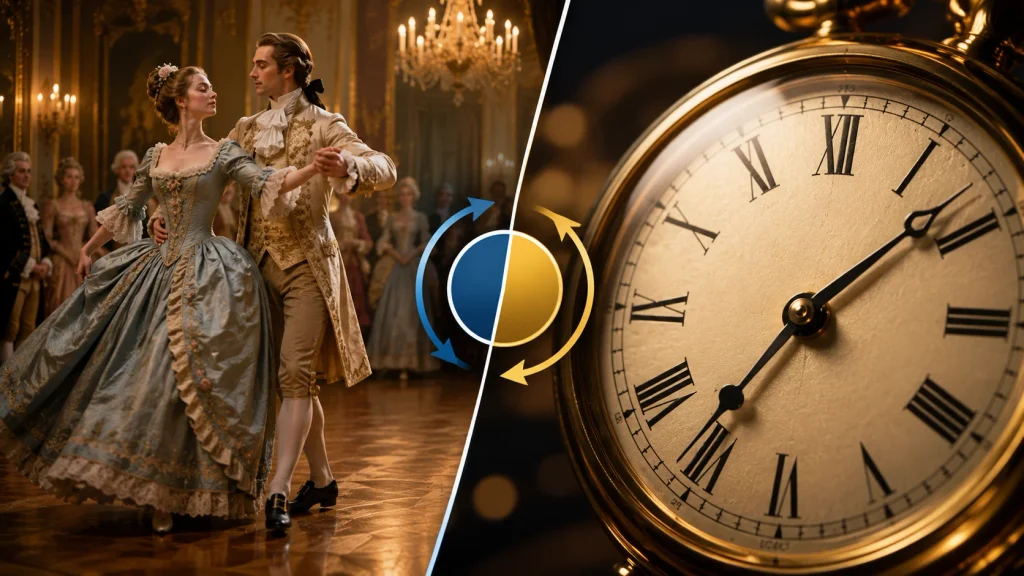
Have you ever seen minuet and minute and wondered whether they mean the same thing? Their spelling looks surprisingly similar, and their pronunciation can sound close in some contexts. However, these two words belong to completely different areas of English.
A minuet is a formal historical dance and also a type of musical composition associated with that dance. A minute, on the other hand, usually refers to a unit of time equal to 60 seconds. It can also be an adjective meaning extremely small or very precise in detail.
The confusion becomes even more interesting because minute has two distinct pronunciations. The time-related noun is pronounced roughly MIN-it, while the adjective meaning “extremely small” is pronounced roughly my-NOOT.
Understanding the distinction is useful because replacing one word with the other can completely change your sentence. If you say, “The orchestra played a minute,” you don’t mean that the musicians performed for sixty seconds. If you write, “Wait a minuet,” you’re not talking about time at all.
This guide explains the minuet vs. minute difference in meaning, pronunciation, grammar, history, usage, and context, with clear examples that make the distinction easy to remember.
What’s the Difference?
The simplest way to distinguish these words is to connect each one with its main idea:
- Minuet → a formal dance or a piece of music based on that dance.
- Minute → a unit of time equal to 60 seconds.
- Minute → when pronounced differently, an adjective meaning extremely small or very detailed.
So, although minuet and minute look alike, they don’t function as interchangeable words.
Quick Examples
The musicians performed a graceful minuet.
Here, minuet refers to the musical work or dance.
The meeting lasted twenty minutes.
Here, minutes refers to units of time.
The scientist detected a minute amount of material.
Here, minute means extremely small.
The context usually tells you which meaning applies. The spelling also provides an important clue, but pronunciation becomes especially important when you’re dealing with the two meanings of minute.
Minuet vs. Minute at a Glance
| Word | Main Meaning | Part of Speech | Typical Pronunciation | Example |
| minuet | A formal dance or music for that dance | Noun | roughly min-yoo-ET | They learned a traditional minuet. |
| minute | 60 seconds | Noun | roughly MIN-it | Give me a minute. |
| minute | Extremely small | Adjective | roughly my-NOOT | The instrument detected a minute change. |
The important point is that minuet has a specialized cultural and musical meaning, while minute has several everyday meanings.
Merriam-Webster defines a minute as the 60th part of an hour, or 60 seconds, while its adjective form means “very small” or “infinitesimal.”
Oxford defines minuet as a slow formal dance popular in the 17th and 18th centuries and also as a piece of music written for that dance.
What Does “Minuet” Mean?
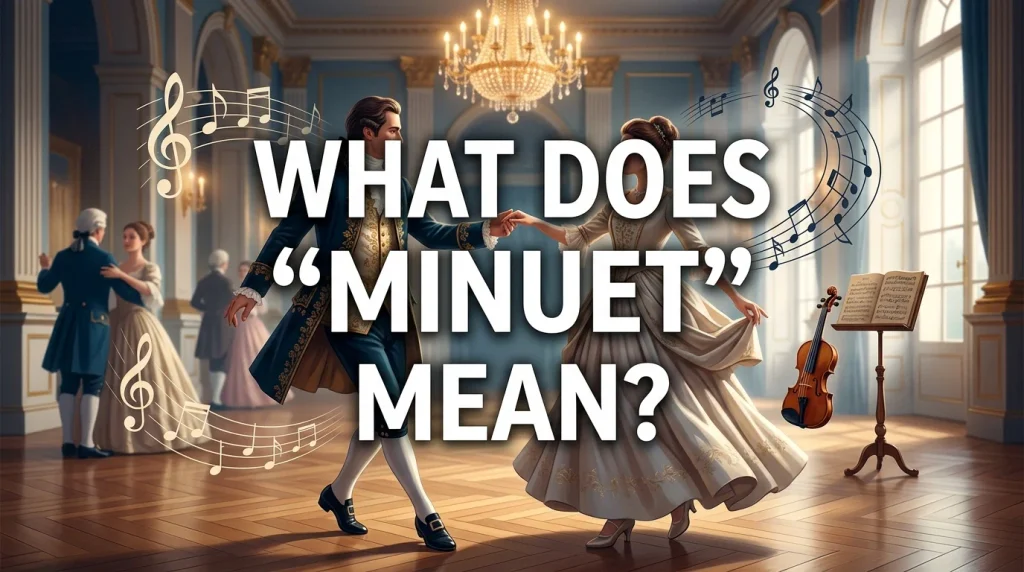
Minuet is a noun associated with European dance and classical music. Historically, it referred to a graceful, formal social dance that became especially prominent in France and later spread throughout European court culture.
The word also came to describe music written for the dance. As composers developed the form, the minuet moved beyond its original role as dance music and became an important instrumental movement.
In simple terms:
Minuet = a formal historical dance + music associated with that dance.
For example:
- The dancers performed a minuet at the historical festival.
- The composer included a minuet in the suite.
- The orchestra played a graceful minuet.
- Students studied the rhythm of the minuet.
Unlike minute, the word minuet has nothing to do with measuring time.
Minuet as a Dance
The traditional minuet was a courtly social dance for couples, characterized by controlled, graceful movements. It became strongly associated with French court culture during the 17th and 18th centuries.
The Library of Congress describes the minuet as a couple dance in triple time and notes that it was documented extensively in 18th-century dance manuals. Those sources describe specific figures and steps used by dancers.
The dance was not simply about moving to music. It also emphasized:
- elegance
- posture
- controlled steps
- formal gestures
- social etiquette
- coordination between partners
- rhythmic precision
This explains why the minuet is often associated with images of royal courts, formal balls, elaborate clothing, and highly disciplined dancing.
The minuet’s character also changed over time. What began as a social dance became increasingly stylized as composers and performers adapted it for formal musical settings.
A Useful Historical Picture
Imagine a grand European ballroom rather than a modern dance floor. Instead of improvising freely, dancers follow established patterns and move with deliberate precision. Their posture, gestures, and interaction with their partners matter almost as much as the steps themselves.
That atmosphere captures the traditional character of the minuet.
The Library of Congress notes that the minuet was considered less technically complicated than some other dances of its period, yet its performance depended heavily on the dancers’ quality, confidence, and bearing.
Minuet as a Musical Composition
Minuet doesn’t refer only to the dance itself. It can also mean a piece of music written for the dance or modeled on its rhythm and character.
This musical meaning became particularly important during the Baroque and Classical periods.
Composers including Johann Sebastian Bach, George Frideric Handel, Joseph Haydn, and Wolfgang Amadeus Mozart wrote minuets or incorporated minuet movements into larger works.
The form became especially important in instrumental music. A minuet might appear within a:
- suite
- sonata
- symphony
- chamber work
- other multi-movement composition
In later Classical music, the minuet and trio became a familiar structural pairing. A principal minuet section is followed by a contrasting trio section, after which the opening minuet returns.
This development shows why the word minuet cannot be reduced simply to “an old dance.” It also describes a significant musical form.
What Does a Minuet Sound Like?
A traditional minuet is generally associated with triple meter, meaning the rhythmic organization groups beats in threes. The familiar 3/4 meter is strongly associated with the form.
However, it’s better to say that a traditional minuet is characterized by triple meter rather than claiming that every work labeled “minuet” must follow one rigid formula.
Historically, dance practice and musical composition changed as composers adapted the form for concert performance.
The Library of Congress notes that each traditional minuet step required two measures of 3/4-time music, illustrating the close relationship between the dance’s movements and its rhythmic structure.
Minuet Examples in Music
The minuet appears across several important stages of Western classical music.
Johann Sebastian Bach used minuets in suites and other works. George Frideric Handel also composed minuets, while Joseph Haydn helped establish the minuet as an important movement within the Classical-era symphony. Wolfgang Amadeus Mozart likewise used the form in instrumental compositions.
The minuet therefore occupies an interesting position in music history. It began as a dance form, but composers transformed it into sophisticated concert music.
A useful distinction is:
| Context | Meaning of “minuet” |
| Dance history | A formal European social dance |
| Music history | Music written for or based on the dance |
| Classical composition | A movement or musical form |
| Everyday modern English | Usually a historical or classical-music reference |
What Does “Minute” Mean?
Unlike minuet, minute has several common meanings in modern English.
The most familiar meaning is a unit of time equal to 60 seconds.
For example:
- I’ll be there in a minute.
- The lesson lasted forty minutes.
- Wait one minute.
- The train leaves in five minutes.
Merriam-Webster also lists other noun uses of minute, including a short period of time, a brief note or memorandum, and the official record of a meeting when used in the plural as minutes.
Minute as a Unit of Time
A minute represents 60 seconds and 1/60 of an hour.
That gives you a straightforward conversion:
| Unit | Equivalent |
| 1 minute | 60 seconds |
| 2 minutes | 120 seconds |
| 5 minutes | 300 seconds |
| 10 minutes | 600 seconds |
| 30 minutes | 1,800 seconds |
| 60 minutes | 1 hour |
The word appears constantly in everyday communication.
You might say:
- “Give me a minute.”
- “I’ll call you in ten minutes.”
- “The movie starts in five minutes.”
- “We waited for thirty minutes.”
- “She finished the task in a minute.”
In these examples, minute is a noun referring to time.
Common Expressions With “Minute”
English uses minute in many fixed expressions.
At the last minute means just before something is due to happen.
She submitted the application at the last minute.
In a minute can mean after a short period.
I’ll be ready in a minute.
For a minute can refer to a short period of time.
I thought about it for a minute.
The minute can mean “as soon as.”
Call me the minute you arrive.
Every minute emphasizes each individual period of sixty seconds or, depending on context, every moment.
Every minute of the trip was memorable.
These expressions demonstrate why minute is far more common in everyday conversation than minuet.
Minute as an Adjective Meaning “Very Small”
Here’s where the word becomes especially interesting.
Minute can also function as an adjective meaning extremely small, tiny, slight, or infinitesimal.
This meaning has a different pronunciation from the time-related noun.
Compare:
The machine detected a minute amount of dust.
Here, minute means extremely small.
The machine ran for one minute.
Here, minute means 60 seconds.
The spelling stays the same, but the pronunciation and meaning change.
Merriam-Webster gives “very small” and “infinitesimal” as meanings of the adjective minute. It also notes that the adjective can describe something involving close attention to details.
Examples of “Minute” Meaning “Very Small”
- The microscope revealed minute organisms.
- There was a minute crack in the glass.
- The test detected a minute quantity of the substance.
- Even a minute change in temperature affected the result.
- The artist included minute details in the painting.
In these sentences, replacing minute with minuet would make the sentence nonsensical.
For instance:
The microscope revealed a minuet organism.
That would suggest that the organism is somehow a dance or musical composition, which clearly isn’t the intended meaning.
Minute Can Also Mean Extremely Detailed
The adjective has another useful connection. Something described as minute can involve very close attention to small details.
For example:
The researcher conducted a minute examination of the evidence.
Here, minute doesn’t mean that the examination lasted sixty seconds. It means the examination was extremely careful and detailed.
This sense explains expressions such as:
- minute examination
- minute analysis
- minute details
- minute differences
- minute observations
The word therefore carries a stronger sense of precision than ordinary words such as small.
The Key Distinction So Far
If you’re trying to decide between minuet and minute, ask yourself what you’re talking about.
Are you talking about music or a historical dance?
Use minuet.
Are you talking about 60 seconds or a period of time?
Use minute.
Are you describing something extremely small or exceptionally detailed?
Use minute, but pronounce it differently.
| If you mean… | Use… |
| A formal historical dance | minuet |
| Music associated with that dance | minuet |
| 60 seconds | minute |
| A short period | minute |
| Something extremely small | minute |
| Something examined in very fine detail | minute |
That simple distinction provides the foundation for understanding the entire minuet vs. minute comparison. The next part will examine where these words came from, why their histories are surprisingly connected, and how their pronunciations differ.
History and Etymology of “Minuet”
The history of minuet helps explain why the word looks somewhat like minute. The connection is not accidental. Both words ultimately have roots associated with the idea of smallness, although they developed into different words with different meanings and uses.
The English word minuet came from French menuet, which meant something like “fine” or “delicate” and developed from menu, meaning “small.” Oxford dates the English word to the late 17th century.
The Online Etymology Dictionary traces minuet through French menuet and ultimately to Latin minutus, meaning “small.” One traditional explanation connects the name with the dance’s short, carefully controlled steps.
That history gives you an interesting linguistic connection:
minuet → French menuet → menu (“small”) → Latin minutus (“small”)
This doesn’t mean minuet and the modern time-related minute are interchangeable. Instead, they have historical connections through older words associated with the concept of smallness.
Why Is It Called a Minuet?
One widely cited explanation is that the name relates to the dance’s small steps.
The French menu meant “small,” “fine,” or “delicate,” and the dance was characterized by controlled, measured movements. The traditional explanation therefore connects the name with the idea of taking small steps.
However, historical word origins can be more complicated than a neat one-line explanation. Etymologists and music historians have discussed alternative possibilities, so it is safer to describe the “small steps” explanation as a traditional etymological account rather than an unquestionable fact.
The important point for modern English is simpler: minuet developed as the name of a particular formal dance and then became the name of music associated with that dance.
The Minuet’s French Background
The minuet became especially prominent in France during the 17th century. It eventually became closely associated with courtly life and formal European dancing.
Historical accounts describe the minuet as a dance for two people performed with a controlled, graceful character. Its popularity expanded dramatically during the 17th and 18th centuries.
The dance’s social role matters because it wasn’t merely entertainment. Court dancing could communicate status, manners, control, and refinement.
A dancer was expected to maintain an appropriate posture, perform movements accurately, and interact with a partner according to established conventions.
In that sense, the minuet was almost a social language.
From Social Dance to Concert Music
The minuet eventually moved beyond the ballroom.
Composers began incorporating minuet movements into larger musical works. The form became particularly important during the Baroque and Classical periods, when instrumental dance movements played a major role in suites, chamber music, and orchestral compositions.
The transition is significant because the word minuet eventually referred to music that might never actually accompany dancing.
That is why a music teacher might say:
“Listen to the minuet in this movement.”
The teacher isn’t necessarily asking you to dance. The word can identify a musical form or movement that originated in dance culture.
Minuet in Baroque and Classical Music
The minuet became one of the most recognizable dance forms in European art music.
During the Baroque period, composers used dance movements extensively. Suites could contain several different dances, each with its own rhythmic identity and character.
The minuet became one of the important options in this musical vocabulary.
According to Oxford Academic, many Baroque instrumental works included different dance movements, but the minuet was the major dance type that successfully survived the stylistic transition into the Classical period.
That survival is important.
Other dances remained historically significant, but the minuet became firmly established as a movement within the developing Classical instrumental cycle.
The Minuet and Trio
One of the most important developments in classical music is the minuet and trio structure.
A simplified version looks like this:
Minuet → Trio → Minuet
The opening minuet establishes the main musical material. The trio then provides a contrasting section. After the trio finishes, the first minuet returns.
This creates a satisfying pattern of:
statement → contrast → return
Oxford Academic’s discussion of Classical form identifies the minuet/trio as a major structural pattern in the instrumental music of Haydn, Mozart, and Beethoven. The trio typically contrasts with the first minuet through elements such as melody, rhythm, texture, or tonality.
Why Is It Called a “Trio” If More Than Three People Can Play It?
This is a common point of confusion.
The word trio can make modern readers assume that exactly three performers must play the section. In the minuet-and-trio form, however, the label refers to the contrasting section of the composition rather than simply counting performers.
So a full orchestra can perform a trio section.
The structure is about musical contrast, not necessarily the number of musicians.
Minuet and 3/4 Time
The minuet is strongly associated with triple meter, especially 3/4 time.
That means the music organizes its beats in groups of three. You can often feel the pattern as:
ONE-two-three | ONE-two-three
This rhythmic organization supported the graceful movement of the historical dance.
However, it is better to avoid treating “3/4 time” as an absolute definition that covers every historical or later use of the term. Musical practice varied across periods and composers.
The essential idea is that the traditional minuet is strongly connected with triple meter and a measured, courtly character.
Famous Composers Associated With the Minuet
The minuet appears in the work of many major composers.
Johann Sebastian Bach
Johann Sebastian Bach incorporated dance forms extensively into his music. Minuets appear among the dance movements associated with his suites and other works.
Bach’s use of the minuet demonstrates how a form rooted in social dancing could become part of sophisticated instrumental composition.
Rather than existing only in a ballroom, the minuet became part of a composer’s larger musical architecture.
George Frideric Handel
George Frideric Handel also used minuets in his music.
His works reflect the broader Baroque tradition of incorporating dances into instrumental and theatrical compositions.
The minuet’s elegant character made it particularly useful when a composer wanted music with a formal, graceful quality.
Joseph Haydn
Joseph Haydn played a particularly important role in the development of the minuet in Classical instrumental music.
He frequently used minuets in symphonies and chamber works, helping establish the movement as a regular part of the Classical musical cycle.
Oxford Academic identifies the minuet as the principal dance type of the Classical period and discusses its role in the works of Haydn, Mozart, and Beethoven.
Haydn’s minuets could be more energetic than the image of a slow court dance might suggest.
That is an important historical detail: the musical minuet did not always sound exactly like the original social dance.
Wolfgang Amadeus Mozart
Wolfgang Amadeus Mozart used the minuet extensively, both within larger instrumental works and in other musical contexts.
Mozart’s music demonstrates how composers could preserve the formal identity of a dance while adapting its musical character for concert performance.
The minuet in Mozart’s works may sound polished and elegant, but its function is often structural as much as social.
Ludwig van Beethoven
Ludwig van Beethoven inherited the Classical minuet tradition but also helped transform it.
As musical style changed, composers increasingly favored the more energetic scherzo as a replacement for the traditional minuet in many large instrumental works.
This doesn’t mean Beethoven simply abandoned the minuet. Rather, his music helps illustrate a broader stylistic shift in which composers pushed beyond the older dance form.
The transition from minuet to scherzo is one of the clearest signs that musical language was changing around the turn of the 19th century. Historical Britannica material notes that Beethoven transformed the character of the traditional minuet into the scherzo.
Minuet Timeline
| Period | Development |
| 17th century | Minuet emerges and gains prominence as a formal European dance |
| Late 17th century | The term enters English from French |
| Baroque period | Composers incorporate minuets into instrumental and theatrical music |
| 18th century | Minuet becomes strongly associated with courtly and formal culture |
| Classical period | Minuet becomes a major instrumental movement |
| Haydn and Mozart | Minuet-and-trio form becomes highly developed |
| Beethoven’s era | The scherzo increasingly replaces the traditional minuet in major instrumental works |
The evolution shows that minuet is both a dance word and a music-history word.
Why the Minuet Still Matters Today
You may wonder why a centuries-old dance deserves attention in modern English.
There are several reasons.
First, the word remains part of the vocabulary of music history, classical performance, dance history, literature, and cultural studies.
Second, the minuet influenced the structure of instrumental music. Understanding the term helps you understand how composers organized larger works.
Third, the word provides a useful example of how language preserves historical culture.
When you encounter minuet in a book, museum description, music program, or history lesson, the word carries information about a particular artistic tradition.
You don’t need to be a classical musician to understand it.
You simply need to remember:
Minuet = formal dance or music connected with that dance.
Why “Minute” Has Two Pronunciations
Now the word minute creates a completely different kind of problem.
Unlike minuet, which has one standard pronunciation in ordinary English, minute has two common pronunciations because the spelling represents two distinct lexical meanings.
The time-related noun is pronounced approximately:
MIN-it
The adjective meaning “extremely small” is pronounced approximately:
my-NOOT
Merriam-Webster gives the noun pronunciation as ˈmi-nət, and the adjective pronunciation as mī-ˈnüt, with variant forms also recorded.
So these two sentences use identical spelling but different sounds:
I waited one minute.
There was a minute difference between the samples.
In the first sentence, minute means 60 seconds.
In the second, minute means extremely small or slight.
Why Do Identical Spellings Have Different Sounds?
The answer lies partly in the words’ historical development.
The noun minute, referring to a small division of time, came into English through Middle French from Late Latin minuta. Merriam-Webster traces it to Latin minutus, meaning “small,” from minuere, meaning “to lessen.”
The adjective also comes from Latin minutus, meaning “small.”
So the two meanings have an interesting historical relationship.
The basic idea was originally connected with smallness or a small division. A minute was a small division of an hour, while the adjective minute described something small in size or degree.
Over centuries, the meanings developed into distinct uses, and English retained the same spelling.
How the Time Meaning Developed
The time-related sense is especially interesting.
The word came from the concept of a small division. A minute represents one-sixtieth of an hour.
The same historical idea was used for angular measurement. A minute can also mean one-sixtieth of a degree.
Merriam-Webster lists both meanings:
- 1 minute of time = 60 seconds
- 1 minute of arc = 1/60 of a degree
This historical meaning becomes even clearer through medieval terminology. The Online Etymology Dictionary traces the noun to Latin minuta, meaning a small portion or piece, and explains how the concept developed into a one-sixtieth division of a circle and later an hour.
So the word’s history contains a logical progression:
small portion → small division → division of an hour → 60 seconds
That is why the word minute has such a specific numerical meaning today.
A Different Historical Development
The adjective minute retained the more direct meaning of small.
Its development began with Latin minutus, meaning “small” or “lessened.”
Over time, the adjective came to mean not merely small, but extremely small, fine, or difficult to perceive.
Later, it also developed a meaning associated with close attention to detail.
Merriam-Webster lists these meanings for the adjective:
- very small
- infinitesimal
- of small importance
- marked by close attention to details
This explains sentences such as:
The scientist observed a minute change.
The change isn’t related to time.
It is very small.
Or:
The report provides a minute description of the process.
Here, the word suggests an exceptionally detailed description.
How to Pronounce “Minuet”
The standard pronunciation of minuet is approximately:
min-yoo-ET
Oxford gives the pronunciation as:
/ˌmɪnjuˈet/
The strongest stress falls near the end:
min-yoo-ET
The final syllable is particularly important because it distinguishes minuet from the common pronunciation of the time-related minute.
Try saying these aloud:
- minuet
- minute
- minute
The first should sound like a word with three syllables:
min-yoo-ET
The second has two syllables:
MIN-it
The third also has two syllables:
my-NOOT
That difference is extremely useful when speaking.
How to Pronounce “Minute”
The pronunciation depends entirely on which meaning you intend.
“Minute” Meaning 60 Seconds
When minute means a unit of time, pronounce it approximately:
MIN-it
Examples:
Wait a minute.
The class lasted forty minutes.
I’ll call you in a minute.
“Minute” Meaning Extremely Small
When minute means extremely small, pronounce it approximately:
my-NOOT
Examples:
The instrument detected a minute variation.
There was a minute crack in the surface.
The researcher noticed a minute difference.
This pronunciation can initially surprise English learners because the spelling doesn’t provide an obvious visual clue.
Minuet vs. Minute Pronunciation Comparison
| Word | Meaning | Approximate pronunciation |
| minuet | Dance or musical composition | min-yoo-ET |
| minute | Unit of time | MIN-it |
| minute | Extremely small | my-NOOT |
The easiest pronunciation shortcut is:
minuet has the sound “yoo-ET.”
minute for time sounds like “MIN-it.”
minute meaning tiny sounds like “my-NOOT.”
Why “Minuet” and “Minute” Are So Easy to Confuse
Several factors work together to create this confusion.
Their Spellings Look Almost Identical
Compare:
minuet
minute
Both begin with minu- and contain similar letters.
That visual similarity encourages readers to assume that the words have similar meanings.
But English contains many words whose spellings look similar while their meanings differ sharply.
Both Have Historical Connections to “Small”
This is the more fascinating reason.
The etymology of minuet connects it to French menu, “small,” while minute traces back to Latin minutus, also meaning “small.”
So although they are not simply two spellings of the same modern word, they have a deeper historical relationship through the idea of smallness.
That makes their resemblance less of a coincidence than it first appears.
Their Pronunciations Can Mislead You
A person who has mostly encountered minute in writing might not immediately know that the adjective has a completely different pronunciation.
Meanwhile, someone hearing minuet without seeing it written may have difficulty connecting the sound to the spelling.
This is especially common for English learners because English spelling does not always map neatly onto pronunciation.
“Minute” Has Multiple Meanings
There are actually three especially useful meanings to keep in mind:minute = 60 secondsminute = a short periodminute = extremely small or highly detailed
The first two normally use the MIN-it pronunciation, while the adjective meaning “very small” uses my-NOOT.
That gives minute much greater everyday flexibility than minuet.
A Simple Pronunciation Test
When you see minute, stop and ask:
Is this sentence talking about time?
If yes, use:
MIN-it
Give me a minute.
Is it describing something tiny or extremely detailed?
If yes, use:
my-NOOT
We observed a minute change.
When you see minuet, think:
dance or classical music
and pronounce it:
min-yoo-ET
This three-way distinction solves most pronunciation problems immediately.
A Useful Etymological Connection
The relationship among these words becomes easier to visualize like this:
| Word | Historical connection | Modern meaning |
| minuet | French menuet, related to “small/fine” | Formal dance or music |
| minute | Latin minutus, “small” | 60 seconds or a short period |
| minute | Latin minutus, “small” | Extremely small or detailed |
The shared historical idea of smallness is a fascinating linguistic detail, but it shouldn’t cause you to confuse the modern meanings.
Think of it this way:
History explains why the words resemble each other. Context tells you which word and meaning you need.
That distinction becomes especially important in writing because a single misplaced letter can turn a perfectly normal sentence about time into an accidental reference to classical dance.
The Fastest Way to Tell Them Apart
If you need an instant decision, use this rule:
Music or dance? → minuet.
Time? → minute.
Extremely small? → minute.
For example:
- The orchestra performed a minuet. → Music
- The meeting lasted ten minutes. → Time
- The scientist observed a minute change. → Very small
The words may look like linguistic twins, but their modern jobs are completely different.
The next section will put these distinctions side by side and show exactly how minuet vs. minute differs in grammar, meaning, context, sentence structure, and everyday usage. It will also cover the most common mistakes writers and English learners make with these easily confused words.
Meaning, Grammar, and Usage Compared
The clearest way to master minuet vs. minute is to compare how each word behaves in an actual sentence. Their spellings are similar, but their meanings, parts of speech, pronunciations, and contexts are noticeably different.
The biggest trap is that minute itself has more than one meaning. You therefore need to identify both the word and the intended sense before choosing the correct pronunciation.
Difference in Meaning
The fundamental difference is straightforward:
- Minuet refers to a historical formal dance or a piece of music associated with that dance.
- Minute can refer to a unit of time.
- Minute can also describe something extremely small or highly detailed.
Consider these three examples:The dancers performed a minuet.The dancers performed for five minutes.The dancers made a minute adjustment to their positions.Each sentence uses a different meaning.The first refers to a dance.The second refers to time.The third describes an extremely small adjustment.That is why context matters so much when dealing with these words.
Difference in Part of Speech
Minuet is primarily a noun.
It names a thing: specifically, a dance or a musical composition.
Examples:
- a minuet
- the minuet
- several minuets
- Bach’s minuet
- a traditional minuet
Minute has more grammatical flexibility.
As a noun, it can refer to:
- a unit of time
- a short period
- a written record, usually in the plural minutes, of a meeting
As an adjective, minute can mean:
- extremely small
- slight
- infinitesimal
- very detailed or precise
This difference in grammatical function is an important clue.
| Word | Grammatical role | Example |
| minuet | Noun | The orchestra played a minuet. |
| minute | Noun | The meeting lasted a minute. |
| minute | Adjective | We noticed a minute difference. |
| minutes | Plural noun | The secretary recorded the meeting minutes. |
Difference in Pronunciation
Pronunciation provides another powerful distinction.
Minuet is pronounced approximately:
min-yoo-ET
Minute meaning time is pronounced approximately:
MIN-it
Minute meaning extremely small is pronounced approximately:
my-NOOT
This means you cannot always determine the meaning of minute simply by looking at it.
You have to listen to the pronunciation or examine the sentence.
Compare:
I’ll be there in a minute.
and:
There was a minute difference in the measurements.
The spelling is identical.
The meaning isn’t.
The pronunciation isn’t either.
Difference in Context
Context is usually the quickest way to determine which word belongs in a sentence.If the sentence involves music, dancing, composers, orchestras, court culture, or classical compositions, minuet is likely the correct word.If the sentence involves seconds, hours, waiting, schedules, appointments, duration, or deadlines, use minute.If the sentence describes something tiny, slight, barely noticeable, or extremely detailed, use minute with its adjective pronunciation.
Context clues for “minuet”
Look for words such as:
- dance
- ballroom
- orchestra
- composer
- classical music
- Baroque
- Classical period
- movement
- trio
- melody
- rhythm
- court
- dancers
Context clues for “minute”
For the time meaning, look for:
- seconds
- hour
- wait
- duration
- schedule
- clock
- late
- early
- appointment
- meeting
- time
For the “very small” meaning, look for:
- tiny
- slight
- detail
- difference
- amount
- variation
- change
- crack
- particle
- measurement
- examination
These clues won’t work in every sentence, but they provide a useful shortcut when you’re unsure.
Minuet vs. Minute in Sentences
Seeing the words in complete sentences makes the distinction much easier to remember.
Examples Using “Minuet”
The following sentences use minuet correctly:
The musicians performed a graceful minuet.
The dance instructor explained the traditional steps of the minuet.
Mozart included a minuet in several of his instrumental works.
The orchestra rehearsed the minuet and trio movement.
The historical dance group demonstrated a French minuet.
The students listened to a Baroque minuet during their music-history lesson.
The composer wrote a short minuet for the chamber ensemble.
The dancers practiced their posture before performing the minuet.
Notice that all these examples connect the word with dance or music.
The sentence doesn’t need to describe actual dancing. A minuet can refer to the musical composition itself.
Examples Using “Minute” for Time
Now compare those examples with the time-related meaning of minute:
Please wait a minute.
The train arrives in ten minutes.
The presentation lasted thirty minutes.
She finished the assignment in fifteen minutes.
Give me one minute to check the schedule.
The doctor will see you in a few minutes.
We arrived one minute before the doors closed.
The timer has only two minutes left.
Here, minute always relates to time.
The plural form minutes is especially common because people frequently discuss durations.
Examples Using “Minute” to Mean “Very Small”
The adjective minute creates another group of examples:
The scientist detected a minute quantity of the chemical.
There was a minute crack along the edge of the glass.
The camera captured minute details that weren’t visible to the naked eye.
The two samples showed a minute difference.
Even a minute change in pressure affected the experiment.
The engineer discovered a minute flaw in the design.
The microscope revealed minute organisms.
The artist painted every minute detail of the landscape.
In these examples, minute means something like extremely small, slight, or highly detailed.
It does not mean “sixty seconds.”
Side-by-Side Sentence Comparison
A direct comparison can make the distinction stick.
| Meaning | Correct sentence | What the word means |
| Dance | The couple performed a minuet. | A formal historical dance |
| Music | The orchestra played a minuet. | A musical composition/form |
| Time | The orchestra played for five minutes. | Five units of 60 seconds |
| Very small | The orchestra made a minute adjustment. | An extremely small adjustment |
| Time | Wait a minute. | Wait for a short period |
| Very small | A minute error changed the result. | A tiny/slight error |
The most important observation is that minuet never means time.
Likewise, ordinary minute does not mean a historical dance.
Common Mistakes With Minuet and Minute
Because the spellings are so similar, mistakes are easy to make. Fortunately, most errors disappear once you identify the intended meaning before writing.
Using “Minute” When You Mean “Minuet”
This mistake usually happens in writing about classical music or historical dance.
Incorrect:
The orchestra performed a beautiful minute.
Correct:
The orchestra performed a beautiful minuet.
Why?
Because the orchestra performed a musical composition, not a unit of time.
Another example:
Incorrect:
The dancers learned the traditional minute.
Correct:
The dancers learned the traditional minuet.
The word minuet identifies the dance.
Using “Minuet” When You Mean “Minute”
The reverse mistake is just as clear.
Incorrect:
I’ll be there in one minuet.
Correct:
I’ll be there in one minute.
The sentence refers to a unit of time, so minute is required.
Another example:
Incorrect:
The class lasted forty minuets.
Correct:
The class lasted forty minutes.
A minuet can be pluralized as minuets, but it doesn’t measure duration.
Confusing the Two Pronunciations of “Minute”
This error is more subtle.
Consider:
The researchers found a minute difference.
If minute means “extremely small,” it is pronounced approximately my-NOOT.
But:
The researchers waited one minute.
Here, it is pronounced approximately MIN-it.
The spelling remains unchanged.
A useful rule is:
MIN-it = time
my-NOOT = extremely small
You can use the surrounding words as a clue.
If the sentence contains numbers, clocks, waiting, hours, schedules, or duration, MIN-it is probably correct.
If the sentence contains words such as tiny, slight, detail, difference, or variation, my-NOOT is probably correct.
Assuming Similar Spelling Means Similar Meaning
This is perhaps the biggest underlying mistake.
English has many words that look or sound alike but carry unrelated meanings. Similar spelling is not enough to establish a semantic relationship.
For example:
- minuet → dance/music
- minute → time/small
The safest approach is to focus on meaning first, spelling second.
Ask:
“What am I trying to say?”
Then select the word that expresses that meaning.
Why “Minuet” Is Not a Synonym for “Minute”
It may seem tempting to treat minuet as an unusual spelling of minute, especially if you’re unfamiliar with classical music.
That assumption is incorrect.
A minuet is a specific noun referring to a historical dance or related musical form.
A minute can be a noun or adjective with several meanings.
They are not interchangeable synonyms.
Consider:
The meeting lasted a minute.
You cannot replace minute with minuet.
The orchestra played a minuet.
You cannot replace minuet with minute.
The resulting sentence would change meaning or become incorrect.
How to Remember the Difference Between Minuet and Minute
A good memory trick doesn’t require memorizing a dictionary definition. Instead, connect each word with a strong mental image.
Easy Memory Trick for “Minuet”
Think:
Minuet = music
Both words don’t begin with the same sound, but the concept is easy to connect.
Picture:
🎻 Orchestra → formal dance → minuet
When you see minuet, imagine an elegant historical dance accompanied by an orchestra.
You can also remember:
Minuet has “music” energy.
It belongs to the world of dance, composers, orchestras, and classical music.
Easy Memory Trick for “Minute”
For the time-related noun, imagine a clock:
⏰ Clock → 60 seconds → minute
One minute equals 60 seconds.
So when you’re talking about waiting, duration, or a clock, think:
Minute = time.
For the adjective, connect the pronunciation my-NOOT with something tiny.
Imagine a scientist examining a microscopic object through a microscope:
🔬 Microscope → tiny detail → minute
That gives you three quick mental associations:
| Word/meaning | Memory image |
| minuet | Orchestra and dancers |
| minute = time | Clock |
| minute = very small | Microscope |
A Simple Context Test
When you’re unsure, ask yourself three questions.
Is it about a dance or music?
→ minuet
Is it about 60 seconds or a period of time?
→ minute
Is it about something extremely small or highly detailed?
→ minute
This works because the meanings occupy very different semantic fields.
The “Three-Box” Method
You can make the distinction even easier by placing the words into three mental boxes:
BOX 1: MUSIC
MINUET
A historical dance or musical composition.
BOX 2: CLOCK
MINUTE
A unit of time.
BOX 3: MICROSCOPE
MINUTE
Extremely small or detailed.
Whenever you encounter the word in a sentence, determine which box the context belongs to.
A Practical Usage Guide
The following guide can help you choose the correct word quickly while writing.
| If you’re writing about… | Choose | Example |
| A historical dance | minuet | They performed a minuet. |
| Classical dance music | minuet | The composer wrote a minuet. |
| A musical movement | minuet | The symphony includes a minuet and trio. |
| 60 seconds | minute | Wait one minute. |
| Duration | minute | It took ten minutes. |
| A short period | minute | I’ll return in a minute. |
| Something tiny | minute | A minute particle was detected. |
| A slight difference | minute | There was a minute difference. |
| Fine detail | minute | She examined every minute detail. |
This table captures the central rule of the entire minute vs. minute debate.
When “Minute” Means More Than Sixty Seconds
One small detail deserves attention.
Although a minute is precisely defined as 60 seconds, everyday expressions don’t always use the word to describe an exact duration.
For example:
I’ll be back in a minute.
In casual conversation, this may mean soon, rather than exactly 60 seconds from now.
Likewise:
Wait a minute!
can function as an expression meaning “hold on” or “stop for a moment.”
So minute has both a precise measurement meaning and broader conversational uses.
This distinction is useful because it prevents you from interpreting every occurrence of minute as a literal measurement.
“Minute” in Meeting Language
Another meaning of minutes appears in professional and organizational contexts.
The plural noun minutes can refer to the official written record of what happened during a meeting.
For example:
The secretary distributed the meeting minutes.
Here, minutes does not mean several 60-second periods.
It refers to a written record of the meeting.
This creates yet another context for minute:
| Expression | Meaning |
| one minute | 60 seconds |
| a few minutes | a short period |
| last-minute decision | decision made shortly before a deadline |
| meeting minutes | official written record |
| minute detail | extremely small/fine detail |
The context therefore remains essential.
“At the Last Minute” and Other Common Expressions
The word minute also appears in common idioms and phrases.
At the Last Minute
This means very close to the deadline or just before something happens.
He changed his plans at the last minute.
Last-Minute
Used as an adjective, last-minute describes something done shortly before a deadline or event.
We made a last-minute reservation.
The Minute
This expression can mean as soon as.
Call me the minute you arrive.
Here, it doesn’t literally mean that you must call exactly 60 seconds after arriving.
In a Minute
This usually means soon or after a short time.
I’ll help you in a minute.
These expressions demonstrate how flexible minute is in everyday English.
Why Context Matters More Than Spelling
When two words look similar, spelling can become a distraction.
Instead, identify the semantic field first.
A semantic field is a group of words connected by meaning. For example:
Minuet semantic field:
dance → music → orchestra → composer → ballroom → court → movement → trio
Minute semantic field:
time → clock → second → hour → duration → waiting → schedule
And for the adjective:
Minute semantic field:
tiny → slight → microscopic → detail → fine → infinitesimal → small
If the surrounding vocabulary belongs to one of these groups, the intended meaning becomes much easier to recognize.
A Quick Test
Fill in the blank mentally:
The orchestra performed a ______.
If the sentence is about a classical musical work, the answer is minuet.
Now try:
The orchestra performed for five ______.
The answer is minutes.
Finally:
The orchestra made a ______ adjustment to the tempo.
The answer is minute if you mean a very small adjustment.
The sentence structure and surrounding meaning do most of the work.
What Should You Use?
Here’s the practical answer to keep in mind:Use “minuet” when you’re talking about a formal historical dance or a musical composition associated with it.Use “minute” when you’re talking about time.Use “minute” with the different pronunciation when you’re describing something extremely small, slight, or highly detailed.The distinction can be summarized in one line:
Minuet = dance/music. Minute = time/tiny.
Once you attach those meanings to the words, the spelling becomes much less confusing.
Quick Practice Quiz
Now that the differences between minuet and minute are clear, test yourself. Choose the word that best completes each sentence.
Practice Questions
The orchestra performed a beautiful ______ during the concert.
- A. minute
- B. minuet
Answer: minuet
The sentence refers to a musical composition, so minuet is correct.
Please give me a ______ to finish this email.
- A. minuet
- B. minute
Answer: minute
The sentence refers to a short period of time.
The microscope revealed a ______ organism that was almost impossible to see.
- A. minuet
- B. minute
Answer: minute
Here, minute means extremely small.
The dancers practiced the traditional ______ before the performance.
- A. minute
- B. minuet
Answer: minuet
The sentence concerns a historical dance.
The meeting lasted nearly ninety ______.
- A. minuets
- B. minutes
Answer: minutes
The sentence describes duration.
The researcher noticed a ______ difference between the two samples.
- A. minuet
- B. minute
Answer: minute
Here, minute means very small or slight.
The composer included a ______ and trio in the work.
- A. minute
- B. minuet
Answer: minuet
The expression minuet and trio refers to a well-known musical structure associated with Classical-era instrumental music.
Quick Score Guide
| Score | What It Means |
| 7/7 | You have mastered the distinction. |
| 5–6/7 | You understand the difference but may need more practice with context. |
| 3–4/7 | Review the three main meanings carefully. |
| 0–2/7 | Focus first on the basic rule: minuet = dance/music; minute = time/tiny. |
The most useful lesson isn’t simply memorizing the answers. It’s recognizing the context that points to each meaning.
Frequently Confused Word Pairs Related to Minuet vs. Minute
English contains many pairs that create the same kind of problem as minuet vs. minute.Sometimes the words look similar. Sometimes they sound alike. Sometimes only one letter separates them. Learning how these pairs work can make your writing more precise.
Affect vs. Effect
Affect is commonly used as a verb meaning to influence something.
Lack of sleep can affect your concentration.
Effect is commonly used as a noun meaning a result.
Lack of sleep can have a negative effect on concentration.
There are additional grammatical uses, but this basic distinction helps in everyday writing.
Complement vs. Compliment
Complement refers to something that completes, enhances, or goes well with something else.
The sauce is a perfect complement to the dish.
Compliment means a positive remark or expression of praise.
She complimented the chef.
One letter changes the meaning.
Stationary vs. Stationery
Stationary means not moving.
The vehicle remained stationary.
Stationery refers to writing materials such as paper and envelopes.
She ordered personalized stationery.
The spelling difference is small, but the meanings are unrelated.
Breath vs. Breathe
Breath is a noun.
Take a deep breath.
Breathe is a verb.
Remember to breathe slowly.
The pronunciation changes along with the extra e.
Minuet vs. Minute
The same principle applies here:
Minuet → historical dance or musical composition
Minute → unit of time, short period, or something extremely small
These pairs demonstrate a broader lesson in English:
Never choose a word based on spelling alone. Check its meaning, grammatical role, and context.
Key Takeaways
If you remember only a few points from this guide, remember these:
- Minuet is a noun.
- A minuet is a formal historical dance.
- Minuet can also refer to music based on that dance.
- The minuet became especially important in Baroque and Classical music.
- Minute can be a noun meaning 60 seconds.
- Minute can also refer informally to a short period.
- Minute can function as an adjective meaning extremely small or very slight.
- The time-related minute is pronounced approximately MIN-it.
- The adjective minute meaning “very small” is pronounced approximately my-NOOT.
- Minuet is pronounced approximately min-yoo-ET.
- The quickest memory rule is minuet = dance/music; minute = time/tiny.
- Context usually tells you which meaning of minute is intended.
A final three-word association makes the distinction particularly easy:
Minuet → music
Minute → clock
Minute → tiny
Once those associations become automatic, the two words are much harder to confuse.
Conclusion
Understanding minuet vs. minute becomes much easier when you focus on meaning and context rather than their similar spelling. A minuet is a graceful historical dance or a musical composition connected with that dance, especially in Baroque and Classical music. A minute usually refers to a unit of time, while the adjective minute can describe something extremely small, slight, or detailed. Pronunciation also helps separate them. Minuet sounds roughly like min-yoo-ET. The time-related minute sounds like MIN-it, while the adjective meaning very small sounds like my-NOOT.When you’re unsure, use a simple mental shortcut: minuet means music or dance; minute means time or tiny. With that distinction in mind, you’ll be able to recognize, pronounce, and use these commonly confused words correctly in everyday writing and conversation.
FAQs
What is the main difference between minuet and minute?
Minuet refers to a formal historical dance or a musical composition based on that dance. Minute usually means a unit of time equal to sixty seconds. It can also be an adjective meaning extremely small or detailed. The correct word depends entirely on context, so music and dance call for minuet, while time or tiny details call for minute.
How do you pronounce minuet?
Minuet is generally pronounced approximately min-yoo-ET, with the main stress on the final syllable. The word has three syllables and refers to a historical dance or its associated musical form. Its pronunciation differs clearly from the time-related minute, which sounds like MIN-it. Hearing the final “-ET” sound can help you identify minuet.
What does minute mean in English?
Minute has several meanings in English. As a noun, it commonly means a period of sixty seconds or, more generally, a short period. As an adjective, pronounced differently, it means extremely small, slight, or very detailed. Context determines which meaning applies. For example, “one minute” refers to time, while “a minute difference” means a very small difference.
Why does minute have two pronunciations?
Minute has two pronunciations because the spelling represents different meanings that developed historically. The time-related noun is pronounced approximately MIN-it. The adjective meaning extremely small is pronounced approximately my-NOOT. Although the spelling remains identical, the meanings, grammatical functions, and pronunciations differ. The surrounding words usually make the intended meaning clear.
Is a minuet a type of music?
Yes. Minuet can refer to both a historical dance and a musical composition associated with that dance. Composers used minuets extensively during the Baroque and Classical periods. The minuet later became an important instrumental movement, particularly in the familiar minuet-and-trio structure. Therefore, a minuet can describe either the dance itself or the music connected with it.
Does minuet have anything to do with time?
No. Minuet does not mean a period of time and cannot replace minute when discussing duration. For example, “Wait one minute” is correct, while “Wait one minuet” is incorrect. A minuet belongs to the world of historical dance and music. A minute belongs to the world of time when used with its common noun meaning.
Can minute mean something very small?
Yes. Minute can function as an adjective meaning extremely small, slight, or infinitesimal. For example, “The scientist detected a minute change” means the change was very small. This meaning has a different pronunciation from the noun referring to time. The adjective sounds approximately like my-NOOT, while the time-related noun sounds like MIN-it.
Is a minuet always written in three-four time?
Traditional minuets are strongly associated with triple meter, particularly three-four time. However, it is too restrictive to treat three-four as an absolute requirement for every composition called a minuet. The historical dance and its musical form developed over time. The most useful generalization is that traditional minuets have a strong connection with triple meter and graceful, measured movement.
Which composers are famous for writing minuets?
Several major composers used the minuet, including Johann Sebastian Bach, George Frideric Handel, Joseph Haydn, Wolfgang Amadeus Mozart, and Ludwig van Beethoven. Haydn and Mozart were especially important in developing the minuet-and-trio form within Classical instrumental music. Beethoven continued the tradition while also helping popularize the more energetic scherzo, which increasingly replaced the minuet in major works.
How can I remember the difference between minuet and minute?
Use the simple rule “minuet means music or dance; minute means time or tiny.” Picture an orchestra and dancers when you see minuet. Picture a clock when minute means time, and a microscope when it means extremely small. This mental association makes the spelling and meaning easier to recall whenever you encounter these commonly confused words.