
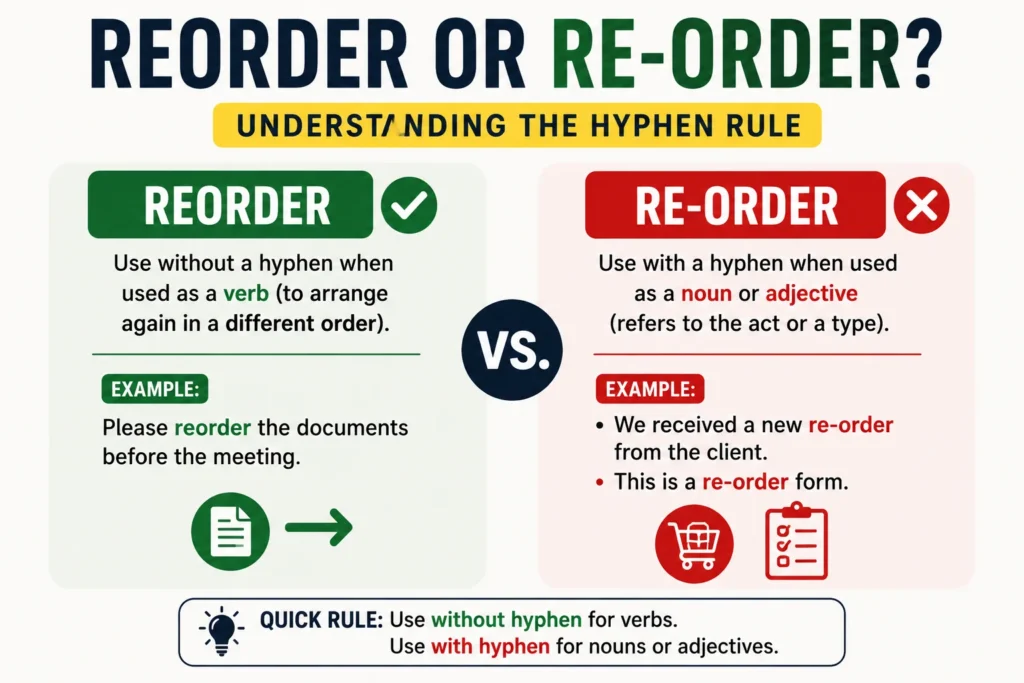
Choosing between reorder and re-order looks like a tiny spelling decision, but the hyphen can make writers pause. In modern American English, the straightforward answer is usually reorder. Major style guidance has moved toward closing up the prefix re- in ordinary words, while dictionaries recognize reorder as an established word with several related uses. The Associated Press changed its guidance in 2024 and said it generally no longer uses a hyphen with the prefix re-. Chicago also explains that prefixed compounds are usually closed, although hyphens can still help when they prevent confusion or an awkward reading.
Reorder or re-order? Choosing between these two forms can make writers pause, but in modern American English, reorder is usually the preferred spelling.
The Short Answer: Is It “Reorder” or “Re-Order”?
For standard American English, reorder is generally the form to choose. Merriam-Webster lists reorder as both a verb and a noun. As a verb, it can mean to arrange something differently, place another order, or request another supply. As a noun, it refers to an order similar to a previous order from the same supplier.
So, if you’re writing a sentence such as “Please reorder the paragraphs,” the closed form is the natural choice. The same applies to “We need to reorder printer paper.” One sentence deals with sequence; the other deals with purchasing. Neither normally needs a hyphen.
| Form | Typical status in American English | Example |
| reorder | Preferred standard form | Please reorder the list. |
| re-order | Less common variant or editorial choice | Please re-order the list. |
| reorder as a verb | Standard | We need to reorder the supplies. |
| reorder as a noun | Standard | The customer placed a reorder. |
The safest practical rule is simple: write “reorder” as one word unless a specific style guide, dictionary entry, or unusual context gives you a reason to do otherwise.
That rule also fits current editorial practice. AP announced in 2024 that it had changed its prefix guidance and would no longer generally use hyphens with re-, along with out-, post-, and pre-. The change was made for consistency and brought AP’s approach closer to Merriam-Webster.
However, don’t turn this into a rigid “never use a hyphen after re-” rule. English has exceptions. A hyphen can sometimes prevent a reader from interpreting a word incorrectly. That’s why re-cover and recover don’t always mean the same thing. Chicago specifically points to meaning-based distinctions such as re-create versus recreate as cases where a hyphen can matter.
What Does “Reorder” Mean?
The word reorder combines re- with order. In this combination, re- carries the familiar idea of doing something again or changing something that already exists. Order, meanwhile, can refer either to an arrangement or to a request for goods or services.
That gives reorder two especially useful meanings:
- Arrange again or differently: Change the sequence or organization of something.
- Order again: Request or purchase something that was ordered before.
Merriam-Webster records both senses. Its definition includes arranging something in a different way and placing another order. Collins likewise recognizes the meanings “put in order again” and “order goods again.”
This dual meaning explains why reorder appears in such different types of writing. An editor might reorder paragraphs. A retailer might reorder inventory. A customer might reorder a favorite product. A manager might reorder priorities.
The word stays unchanged in each case.
Reorder Means “Arrange Again”
When reorder means “arrange again,” the focus is on sequence, position, structure, or priority. You already have something organized in one way, but you decide that another arrangement works better.
For example:
- Reorder the steps so the instructions are easier to follow.
- The editor decided to reorder the paragraphs.
- Please reorder the items alphabetically.
- The teacher asked students to reorder the sentences.
- The designer reordered the sections to improve the page flow.
- The manager reordered the priorities after the deadline changed.
Notice what these examples have in common: something already exists, and its order changes.
That distinction makes reorder slightly different from organize. If you organize a collection for the first time, you’re creating a structure. If you reorder an existing collection, you’re changing the structure or sequence that is already there.
The difference can be subtle, but it matters in precise writing.
Consider a report containing five sections. If the writer creates a logical structure from scratch, organize may be the better verb. If the report already has five sections and the writer moves Section 4 ahead of Section 2, reorder describes the action more precisely.
The same idea applies to a simple grocery list. You might organize the list by food category. Once that structure exists, you could reorder the items so vegetables appear before dairy products.
Reorder Means “Order Again”
The second major meaning appears in shopping, business, manufacturing, retail, and inventory management.
When someone reorders something, they request it again because they previously bought or requested it. Merriam-Webster gives examples involving customers and stores placing another order.
For example:
The store sold out of the notebooks, so it reordered 500 more.
Here, nobody is rearranging notebooks. The store is purchasing another batch.
You could also say:
The customer liked the product and decided to reorder it.
Again, the meaning is “order again.”
This sense has become especially common in e-commerce. Online stores often let customers reorder products they bought previously. Subscription services may offer a one-click reorder option. Restaurants can allow customers to reorder a previous meal. Businesses can use automated systems to identify when inventory needs replenishment.
That makes reorder a particularly useful word in modern commercial English.
Reorder as a Noun
Although people often notice reorder as a verb, it can also function as a noun.
A reorder is another order placed for goods similar to a previous order. Merriam-Webster specifically defines the noun as an order like a previous order placed with the same supplier.
For example:
- The supplier received a reorder for 2,000 units.
- The company expects a reorder next month.
- The retailer placed a reorder after the first shipment sold out.
- This customer has made three reorders this quarter.
The noun becomes particularly useful in inventory and sales discussions because it describes a repeat purchase as a distinct business event.
However, don’t confuse the noun reorder with the phrase reorder point. A reorder point is an inventory-management concept that identifies when stock has fallen to a level at which another purchase should be triggered. The phrase contains two separate words because reorder modifies point.
Reorder in Business and Retail Contexts
In business writing, reorder often appears alongside terms such as inventory, supplies, stock, supplier, quantity, and point.
A retailer might say:
We need to reorder the blue jackets before the weekend sale.
An inventory manager could write:
The system automatically alerts staff when an item reaches its reorder point.
A purchasing department might report:
The company placed a reorder after demand exceeded the forecast.
These examples show why understanding the word’s meaning matters more than memorizing a hyphen rule in isolation. Once you recognize reorder as an established word, its spelling becomes much easier to handle.
Why Is “Reorder” Usually Written as One Word?

The main reason is straightforward: re- commonly combines directly with another word to create a single established word.
English contains many familiar examples:
- redo
- rewrite
- reread
- rebuild
- reconsider
- reorganize
- rearrange
- reposition
- restructure
You don’t normally write “re-do,” “re-write,” or “re-build” in standard modern American prose. The same pattern supports reorder.
Merriam-Webster also lists related words such as reorganize, which means to organize again or anew.
This is important because writers sometimes treat the prefix re- as though it always needs a visual separator. It doesn’t. A prefix is not automatically followed by a hyphen simply because it has a clear meaning of its own.
The Prefix “Re-” Usually Joins the Base Word
A useful way to think about the pattern is to imagine re- as a small building block. In many established words, it attaches directly to the base word and becomes part of the spelling.
For example:
re- + write → rewrite
re- + read → reread
re- + build → rebuild
re- + organize → reorganize
re- + order → reorder
Once a combination becomes a familiar word, readers generally recognize it without needing a hyphen to explain the structure.
Chicago’s guidance reflects this broader principle. Its hyphenation guidance says compounds formed with prefixes are usually closed and recommends using hyphens sparingly when they are genuinely needed.
That doesn’t mean every prefix combination should automatically be closed. English spelling has accumulated exceptions over centuries. Still, the general direction is clear: established prefixed words usually don’t need a hyphen simply because they contain a prefix.
Why Modern English Often Drops the Hyphen
Hyphenation changes over time. Words that once appeared with punctuation can become established as single units as readers become familiar with them.
This happens because spelling conventions aren’t frozen in place. Dictionaries, publishers, style guides, and ordinary usage all influence how compounds develop.
Think of a hyphen as a small signpost. When readers already understand the word without that signpost, the punctuation may eventually disappear.
Chicago describes this tendency directly: prefixed compounds are more often closed than hyphenated, although editors may retain a hyphen when it improves legibility or prevents a possible misreading.
That is why it makes sense to treat reorder as a normal single word rather than constructing it from scratch every time you write it.
Reorder Has a Long History
The spelling isn’t a brand-new invention created by online shopping. Merriam-Webster records the first known use of reorder as a verb in 1579 and the noun from 1883.
That historical detail matters because it shows that reorder has been established in English for centuries. Its modern business meaning developed alongside the broader use of ordering goods, but the underlying word has much deeper roots.
The word also follows a productive English pattern: re- attaches to an existing verb to indicate repetition or renewed action.
For readers, that means reorder isn’t an awkward modern construction that needs a hyphen to make sense. It’s a well-established lexical item.
When Does “Re-” Need a Hyphen?
The useful question isn’t “Does re- ever take a hyphen?” It certainly does. The better question is why the hyphen is needed.
There are several situations worth watching.
When a Hyphen Prevents Confusion
Sometimes closing the word produces a form that readers could interpret in two ways.
The classic example is:
recover vs. re-cover
Recover has an established meaning related to regaining something or returning to a normal state.
Re-cover can mean “cover again.”
The hyphen separates the prefix from the base word and makes the intended structure immediately visible.
Chicago specifically identifies re-create and recreate as another example of a hyphen distinguishing meanings.
The same logic helps explain why the rule for reorder isn’t simply “never hyphenate re-.” Hyphenation is sometimes about meaning, not decoration.
When the Closed Form Looks Awkward
Some combinations can be difficult to read when several vowels or consonants meet. A hyphen may make the structure easier to recognize.
Chicago notes that hyphens can be retained to prevent doubled vowels such as a or i in certain prefixed formations.
However, this principle needs care with re- words. Modern American style doesn’t automatically hyphenate every double-vowel construction. AP’s current guidance specifically notes exceptions and allows established forms such as reelect and reenter without automatically inserting a hyphen.
So the appearance of two vowels doesn’t, by itself, prove that a hyphen belongs there.
Why “Reorder” Doesn’t Need That Exception
The spelling reorder is visually straightforward:
re + order = reorder
The reader can identify the word without stumbling over the construction. More importantly, reorder is already established as a dictionary word with clear meanings.
There isn’t a common competing word spelled reorder that forces readers to stop and reinterpret the sentence. Context handles the distinction between arranging something again and ordering something again.
That makes reorder a poor candidate for an unnecessary hyphen.
A Practical Rule for Writers
If you’re writing in American English and you’re unsure whether to type reorder or re-order, start with the closed form.
Use reorder when:
- you mean arrange again;
- you mean order again;
- you’re using the established noun reorder;
- you’re writing ordinary business, academic, technical, or general prose;
- your required style guide doesn’t call for a different treatment.
Consider a hyphen only when:
- closing the word could create a different established meaning;
- the construction becomes genuinely difficult to read;
- a recognized dictionary or house style specifically supports the hyphenated form;
- the hyphen serves a clear editorial purpose.
The key word is clarity. A hyphen should solve a problem, not create one.
In the case of reorder, the modern standard is refreshingly simple: write it as one word.
Reorder vs. Re-Order: Understanding the Difference
The biggest mistake writers make with reorder and re-order is assuming that the hyphen automatically creates a different word. In modern American English, it usually doesn’t. Reorder is the established form for both “arrange differently” and “order again,” and Merriam-Webster lists it as both a verb and a noun.
That means these two sentences can use the same spelling:
Please reorder the paragraphs before submitting the report.
Please reorder the printer cartridges before they run out.
In the first sentence, reorder means to change the sequence. In the second, it means to purchase or request another supply. The surrounding words do the interpretive work.
Why “Reorder” Is the Default Choice
Reorder has been an established English word for centuries. Merriam-Webster dates its first known use as a verb to 1579 and its noun use to 1883.
That’s useful context because it shows that reorder isn’t simply a modern abbreviation or an informal digital-era spelling. It’s a well-established word that has developed naturally within English.
The word also fits a much broader pattern:
| Prefix + base | Standard closed form |
| re + do | redo |
| re + write | rewrite |
| re + read | reread |
| re + build | rebuild |
| re + arrange | rearrange |
| re + organize | reorganize |
| re + order | reorder |
The pattern isn’t absolute, but it gives you a useful starting point. If a re- formation is already an established word and readers can understand it without difficulty, the closed form is often the better choice.
Merriam-Webster, for example, defines reorganize as “to organize again or anew,” showing the same closed-prefix pattern.
Does “Re-Order” Mean Something Different?
Usually, re-order doesn’t function as a separate standard word with an entirely different dictionary definition. Instead, writers may use the hyphen to make the “again” element more visible.
For example:
The editor decided to re-order the sections.
A reader will almost certainly understand this as “order the sections again” or “change their order.” Yet the hyphen isn’t necessary because reorder already communicates that meaning clearly.
This distinction matters. A hyphen can sometimes change or clarify meaning, but that doesn’t mean every hyphenated version of a word automatically receives a new definition.
Compare that with:
- recover — regain, return to a previous state, or become well again
- re-cover — cover something again
- recreate — engage in recreation
- re-create — create again
Here, the punctuation can perform useful semantic work.
Chicago’s guidance specifically recognizes rare cases where a hyphen distinguishes meanings, including recreate and re-create. It also advises using hyphens sparingly and generally closing prefixed compounds.
That’s the key difference: reorder doesn’t normally need the hyphen because its established meanings remain clear without it.
How the Hyphen Changes Interpretation
A hyphen acts like a small visual boundary. It tells the reader, “Treat these elements as separate parts of the word.”
That can be valuable when joining the prefix directly to the base creates an unexpected reading.
Consider:
Recover vs. Re-cover
Recover is a familiar English word with meanings such as regaining something or returning to health.
Re-cover can mean to cover something again.
For example:
The patient began to recover after surgery.
But:
The workers will re-cover the old sofa.
The hyphen prevents the reader from treating both forms as the same word.
Recreate vs. Re-create
The same principle applies to recreate and re-create.
Recreate commonly relates to recreation or leisure.
Re-create means to create something again.
For instance:
The museum tried to re-create the original room.
The hyphen makes the intended “create again” structure immediately apparent.
Chicago’s current online guidance describes this type of meaning-based distinction as one of the rare situations in which a prefix hyphen can genuinely help.
Why Reorder Is Different
Now compare those examples with reorder.
There isn’t a common competing word where adding a hyphen suddenly separates two established dictionary meanings. The context is enough:
The manager decided to reorder the priorities.
versus:
The company needs to reorder more supplies.
One concerns sequence. The other concerns purchasing. Neither sentence becomes confusing without a hyphen.
That’s why reorder normally stays closed.
Re-Order as “Arrange Again” Rather Than “Buy Again”
A useful way to understand the issue is to look at the two main meanings of reorder side by side.
| Meaning | What changes? | Example |
| Arrange again | Sequence, position, or priority | Reorder the paragraphs. |
| Order again | A purchase or request | Reorder the supplies. |
The verb itself doesn’t tell you which meaning is intended. The object does.
If you reorder paragraphs, you’re changing their sequence.
If you reorder printer paper, you’re requesting another supply.
If you reorder priorities, you’re changing what receives attention first.
If you reorder a product, you’re purchasing that product again.
Merriam-Webster’s examples reflect both uses, including reordering priorities, reordering a batting lineup, and ordering another quantity of a product.
This is an important point for SEO and professional writing, too. Search engines and readers can understand the word from its surrounding context. There’s no need to force a hyphen into the spelling simply because the word has more than one sense.
Reorder vs. Rearrange
Reorder and rearrange overlap, but they’re not always interchangeable.
Reorder emphasizes sequence. Rearrange has a broader sense and can refer to changing the position, layout, organization, or structure of something.
For example:
Please reorder the chapters.
This strongly suggests changing their sequence.
Now consider:
Please rearrange the furniture.
That doesn’t necessarily involve a sequence. It involves changing physical placement.
You could also say:
The editor rearranged the article.
That might mean changing the order of paragraphs, rewriting sections, moving examples, or changing the overall structure.
Merriam-Webster’s thesaurus connects reorder with words such as rearrange, shift, move, position, and place.
A simple distinction helps:
Reorder = change the order.
Rearrange = change the arrangement.
The difference is small, but choosing the more precise verb can make professional writing sharper.
Reorder vs. Repeat
Don’t confuse reorder with repeat either.
Repeat means doing, saying, or presenting something again. It doesn’t necessarily involve changing its sequence.
For example:
Please repeat the instructions.
This asks someone to give the same instructions again.
But:
Please reorder the instructions.
This asks someone to change their sequence.
Likewise:
The teacher asked the student to repeat the sentence.
means the sentence should be said again.
The teacher asked the student to reorder the sentence.
means the words should be placed into a different sequence.
That distinction becomes especially useful in editing, education, technical writing, and instructional content.
What Major Style Guides Say About “Re-”
Current style guidance strongly supports treating reorder as a closed form in ordinary American English.
Associated Press Style
The Associated Press made an important change to its prefix guidance in 2024. AP stated that it would no longer generally use a hyphen with the prefixes out-, post-, pre-, and re-. The change was part of a broader effort to consolidate prefix guidance and align its style more closely with its primary dictionary.
That matters for writers because AP style influences journalism, business communication, public relations, digital publishing, and other professional writing.
So if an editor asks for AP style, reorder is the natural choice.
Chicago Manual of Style
Chicago takes a similarly flexible but clarity-focused approach. Its guidance says compounds formed with prefixes are usually closed, while noting that hyphens can improve legibility or prevent confusion.
Chicago’s approach is more useful than memorizing a blanket rule because English contains many exceptions.
Its practical philosophy can be summarized this way:
Close the word when clarity remains intact; use a hyphen when it genuinely helps the reader.
That principle explains both reorder and re-create without requiring dozens of disconnected rules.
Merriam-Webster
Merriam-Webster lists reorder as an established verb and noun. Its verb definitions include arranging something differently and placing another order. Its noun definition refers to an order similar to a previous order with the same supplier.
This is strong evidence for treating reorder as the standard dictionary form rather than assuming that re-order is required.
It’s also worth remembering that dictionaries don’t merely reflect someone’s personal preference. They document established spelling, pronunciation, meanings, grammatical categories, and usage.
Why Dictionaries Matter More Than Personal Preference
English spelling often creates a trap: if a writer has seen a form repeatedly, that form can start to feel “correct.”
But frequency alone doesn’t settle a style question.
You might encounter re-order in an older publication, a company document, a website, or an individual’s writing. That doesn’t automatically mean the hyphenated version is the preferred modern form.
A better hierarchy is:
- Check the dictionary.
- Check the required style guide.
- Consider whether the context creates ambiguity.
- Follow the publication’s established house style.
- Stay consistent throughout the document.
This approach works especially well when you’re writing for a business, academic institution, newsroom, or website with editorial standards.
The National Association of Broadcasters’ style guidance also says its prefix preferences are largely based on Merriam-Webster and notes the 2024 move away from generally hyphenating re-.
So the evidence isn’t limited to one dictionary or one writer’s preference. Several current editorial resources point toward the same practical treatment.
When Double Vowels Create Ambiguity
One reason writers hesitate over re- is the appearance of two vowels.
Words such as these can look unusual at first:
- reenter
- reelect
- reissue
- reexamine
A writer may instinctively insert a hyphen:
- re-enter
- re-elect
- re-issue
- re-examine
But modern American usage doesn’t support a universal “double vowel = hyphen” rule.
AP’s updated prefix guidance specifically provides examples of forms such as reelect and reenter that don’t require automatic hyphenation.
This is a good reminder that appearance isn’t the same as grammar.
A word may look slightly odd because two vowels meet, yet the spelling can still be standard.
Reenter vs. Re-enter
Both forms can be encountered, but the closed form is increasingly favored in modern American editorial practice.
Employees must reenter their passwords.
The word is understandable because reenter is an established construction meaning “enter again.”
Reelect vs. Re-elect
The same idea applies to reelect:
Voters chose to reelect the mayor.
The double e may initially look awkward, but it doesn’t automatically require a hyphen.
Reissue vs. Re-issue
Reissue is another example:
The publisher plans to reissue the book next year.
The meaning is clear: issue again.
The absence of a hyphen doesn’t prevent comprehension.
Reexamine vs. Re-examine
Likewise:
The committee will reexamine the evidence.
The closed form is perfectly readable in context.
The lesson is straightforward: don’t insert a hyphen merely because the spelling looks unusual.
A Closer Look at “Re-” + Vowel
Historically, English editors have used hyphens in some prefix constructions to make pronunciation, structure, or meaning easier to understand. Older style manuals can therefore look quite different from current American practice.
For example, older Chicago material included forms such as re-enter, while also acknowledging that usage could favor closed forms such as reenter.
This history helps explain why writers encounter conflicting versions online.
A reader might find:
- re-enter
- reenter
- re-elect
- reelect
- re-create
- recreate
and assume that one source must be wrong.
Not necessarily.
English spelling conventions evolve, and different style systems may preserve different preferences. The important question is which standard applies to the document you’re writing now.
For contemporary general American English, the trend is strongly toward closing familiar re- formations unless a hyphen serves a specific purpose.
When a Style Guide Can Override Your Default
Suppose you’re writing a corporate report and your organization’s style guide says to use re-enter. In that environment, consistency with the house style may matter more than your personal preference.
The same principle applies to:
- newspapers,
- academic journals,
- government agencies,
- legal organizations,
- technical publications,
- publishing houses,
- corporate communications teams.
Style guides exist partly because multiple acceptable forms can create unnecessary inconsistency.
Imagine a 200-page manual that uses reenter on one page, re-enter on another, and re-enter again in a third section. Even if readers understand every instance, the inconsistency makes the document look less carefully edited.
A professional editor therefore asks two questions:
What form is standard?
What form does this publication consistently use?
For reorder, the first answer in modern American English is generally clear: reorder.
Real-World Examples of “Reorder”
The word becomes easier to understand when you see it doing actual work.
Business Examples
The purchasing team needs to reorder packaging materials before Friday.
Here, reorder means purchase again.
The manager asked the analyst to reorder the priorities.
Here, it means change the sequence of importance.
The warehouse automatically generates a notice when it’s time to reorder an item.
Again, the meaning is to purchase or request another supply.
Academic Examples
The editor decided to reorder the sections to improve the argument.
Here, the word refers to sequence.
Students were asked to reorder the sentences into a logical paragraph.
Again, the focus is arrangement.
Everyday Examples
I had to reorder the shoes because the first pair didn’t fit.
This is the purchasing sense.
Could you reorder these photos by date?
This is the arrangement sense.
Let’s reorder the menu items so the most popular dishes appear first.
This combines organization and sequence.
The same spelling handles all three situations naturally.
A Quick Comparison
| Question | Reorder | Re-order |
| Is it an established word? | Yes | Usually treated as a variant rather than the default |
| Does it mean arrange again? | Yes | Can express the same idea |
| Does it mean order again? | Yes | Can express the same idea |
| Is the hyphen normally needed? | No | Usually no |
| Preferred for general modern American English? | Yes | Less commonly preferred |
| Can a house style use the hyphen? | Yes, but unnecessary in most contexts | Yes |
| Can a hyphen ever clarify meaning with other re- words? | N/A | Yes |
The table reveals an important point: the question isn’t really whether re-order is understandable. It is. The question is whether the hyphen is necessary.
For ordinary uses of this word, it generally isn’t.
A Practical Editing Test
When you’re proofreading a sentence containing re-order, try this three-step test.
First, remove the hyphen.
Write:
Please reorder the files.
Second, read the sentence normally.
If the meaning remains obvious, the hyphen probably isn’t doing useful work.
Third, check your style guide if the document has one.
If the guide favors the closed form, keep reorder.
This simple test works because good punctuation should serve the reader. If removing a mark doesn’t reduce clarity, the mark may not be necessary.
For reorder, the result is usually obvious.
Reorder reads smoothly.
Re-order looks more marked.
Neither version prevents the reader from understanding the sentence, but the first aligns better with current mainstream American editorial practice.
The Core Rule to Remember
Here’s the rule worth keeping:
Use “reorder” as one word in ordinary American English. Use a hyphen with “re-” only when it serves a real purpose, such as preventing ambiguity or following a specific style.
That rule is broad enough to be useful without pretending that English has no exceptions.
When you encounter another re- word, don’t simply copy the treatment of reorder. Check whether the closed form has another established meaning.
That’s why:
- reorder is normally closed;
- re-create can use a hyphen to mean “create again”;
- re-cover can use a hyphen to mean “cover again”;
- reelect can appear without a hyphen;
- reenter can appear without a hyphen.
The goal isn’t to memorize every spelling separately. It’s to understand why the hyphen exists when it appears.
Once you see the pattern, the choice between reorder and re-order becomes much less mysterious.
Reorder in Business, Retail, and E-Commerce
In business writing, reorder appears constantly because companies often need to purchase, request, or replenish something they already have. Retailers reorder products when inventory falls, manufacturers reorder materials when supplies run low, and customers reorder items they have bought before. The meaning is usually obvious from the object that follows the verb.
For example, “The store needs to reorder printer cartridges” means the store needs another shipment. By contrast, “The editor needs to reorder the paragraphs” means the editor needs to change their sequence. The spelling doesn’t change between these meanings.
Reorder Products and Supplies
Online shopping has made the concept of reordering especially familiar. A customer might reorder coffee, office supplies, cleaning products, replacement parts, or other frequently purchased goods. Retail systems may even include a reorder button that lets customers repeat a previous purchase.
Businesses use the word in much the same way:
- Reorder products when stock reaches a certain level.
- Reorder supplies before they run out.
- Reorder popular items after a sudden increase in demand.
- Review previous purchases before placing a reorder.
- Use sales data to predict when customers may reorder.
These examples all use reorder as a closed word. There’s no need to write re-order merely because the action happens again.
Reorder Point and Reorder Level
Inventory management adds several useful terms built around reorder. A reorder point is the stock level at which a business should place another order. The goal is to replenish inventory before available stock reaches zero.
For example, imagine a retailer sells 20 units of a product each day. If the supplier normally takes five days to deliver another shipment, the retailer can’t safely wait until the shelves are empty. It needs enough stock to cover expected demand during that delivery period.
A simplified calculation might look like this:
Reorder point = expected demand during lead time + safety stock
If daily demand is 20 units, lead time is five days, and safety stock is 30 units:
20 × 5 + 30 = 130 units
The business might therefore set a reorder point around 130 units, although real inventory systems can use more detailed demand forecasts.
The important language point is that reorder point contains the established word reorder. You don’t normally write re-order point in standard American business English.
Reorder Quantity
Another common term is reorder quantity. This refers to how much inventory a company orders when replenishing its stock.
Suppose a retailer sells notebooks quickly and wants to maintain enough inventory without placing tiny orders every few days. Its purchasing team may establish a standard reorder quantity based on demand, supplier requirements, storage space, delivery schedules, and purchasing costs.
Again, reorder functions naturally as one word.
This is a useful distinction for writers because business terminology can make hyphenation look more complicated than it really is. Once reorder becomes an established word, it can comfortably modify another noun:
- reorder point
- reorder level
- reorder quantity
- reorder threshold
- reorder notice
No extra hyphen is needed between reorder and the following noun simply because the first word contains the prefix re-.
Reorder in Academic and Professional Writing
The meaning of reorder changes slightly depending on the writing task. In academic and professional documents, it most often refers to changing the sequence of information.
An editor might reorder paragraphs to improve an argument. A researcher might reorder sections so the methodology appears in a more logical position. A technical writer might reorder instructions so users complete each step safely and efficiently.
The word is especially useful because it describes a targeted change. You’re not necessarily rewriting the material. You’re changing where the material appears.
Reordering Sentences and Paragraphs
Consider a paragraph with four sentences. If the final sentence introduces the main idea, the paragraph may feel backward. Moving that sentence to the beginning can improve the structure.
The editor could say:
“Reorder the sentences so the main point appears first.”
That’s more precise than simply saying “rewrite the paragraph.”
The same principle applies to longer documents. A writer might reorder chapters, headings, sections, examples, or supporting evidence without changing the actual wording.
This distinction becomes particularly useful during revision:
| Action | Main purpose |
| Rewrite | Change the wording |
| Reorder | Change the sequence |
| Delete | Remove material |
| Add | Introduce new material |
| Rephrase | Express the same idea differently |
| Reorganize | Change the broader structure |
These actions can overlap, but reorder specifically points to sequence.
Reorder Steps and Instructions
Technical and instructional writing often depends heavily on sequence. If a reader must complete Step A before Step B, putting those instructions in the wrong order can confuse or even make the process fail.
For example:
Reorder the instructions so users create an account before they attempt to submit the form.
The writer isn’t necessarily asking for new instructions. The writer wants the existing instructions placed in a more logical sequence.
This is why reorder works well in editing notes, project feedback, instructional design, and documentation.
Reorder Priorities
You can also reorder priorities. Here, the word describes changing what receives attention first.
For example:
The team had to reorder its priorities after the deadline moved forward.
The team hasn’t necessarily changed its goals. Instead, it has changed its relative importance or sequence.
This sense is common in workplace communication:
- reorder priorities
- reorder tasks
- reorder objectives
- reorder projects
- reorder requirements
Again, the closed spelling remains standard.
Reorder vs. Re-Order in American English
The strongest practical distinction is not really semantic. It’s standard spelling versus a less common hyphenated variant.
In current American English, reorder is the form writers will generally want in ordinary prose. The hyphenated re-order can still appear, especially in older material, individual house styles, or writing that deliberately emphasizes the prefix.
That doesn’t make every appearance of re-order an error. It means the writer should have a reason for using it.
When “Re-Order” Might Appear
You may encounter re-order in:
- older books and publications;
- company-specific editorial styles;
- documents influenced by older spelling conventions;
- writing where the author wants to emphasize “again”;
- texts copied or adapted from sources using a different convention.
The presence of the hyphen doesn’t automatically make the sentence grammatically wrong. However, if you’re writing fresh content in standard American English, reorder is generally the cleaner choice.
Does the Hyphen Change the Meaning?
Usually, no.
Compare:
Please reorder the files.
and:
Please re-order the files.
Both sentences will normally be understood as telling someone to arrange the files again or differently.
Now compare:
The workers will re-cover the chairs.
with:
The patient will recover soon.
Here, the hyphen makes a meaningful distinction.
This is why the rule needs nuance. A hyphen can sometimes clarify meaning, but it doesn’t automatically create a new meaning every time a writer inserts one.
American English vs. British English
Writers sometimes assume that reorder is American while re-order is British. That’s too simple.
English spelling differences between the United States and the United Kingdom are real, but the treatment of re- doesn’t divide neatly along national borders. Dictionaries and publishers can make different choices, and editorial conventions can change over time.
Are There Meaningful Regional Differences?
Both American and British readers understand reorder. The closed form is widely recognizable, especially in contemporary digital, business, and commercial writing.
You shouldn’t therefore treat re-order as an exclusively British spelling or reorder as an exclusively American one.
Instead, consider the publication and its editorial standard.
If you’re writing for a US audience, reorder is the safest general choice. If you’re writing for a British publication, check its house style and the dictionaries it follows.
Which Form Is More Common Today?
Modern English increasingly favors closed forms for familiar prefixed words. This trend is particularly visible in digital publishing, business writing, dictionaries, and updated style guidance.
The Associated Press provides a strong current example. In 2024, AP changed its guidance so it would generally no longer hyphenate words with the prefix re-. (ap.org)
That doesn’t mean the hyphen has vanished from every re- construction. It means writers shouldn’t treat the hyphen as the default.
Similar Words That Follow the Same Hyphen Rule
The best way to understand reorder is to compare it with other words formed using re-. Some follow the same closed pattern. Others show why a hyphen can occasionally matter.
Reenter vs. Re-enter
Reenter means enter again.
Visitors must reenter the building through the main entrance.
The closed form is increasingly common in modern American English.
You may still see re-enter, particularly in older or differently edited material. However, don’t assume the hyphen is mandatory just because re- meets another vowel.
Reelect vs. Re-elect
Reelect means elect again.
Voters chose to reelect the incumbent.
The double e can look strange at first glance. That’s exactly why some writers instinctively add a hyphen.
Yet current AP guidance does not treat the repeated vowel as an automatic reason for inserting one.
The lesson is valuable: don’t use visual discomfort as your spelling rule.
Reissue vs. Re-issue
Reissue means issue again.
The publisher plans to reissue the classic title.
The closed form may look dense, but the meaning remains clear.
In formal writing, checking the relevant dictionary or house style is better than deciding from appearance alone.
Reexamine vs. Re-examine
Reexamine means examine again.
The committee agreed to reexamine the evidence.
Some publications may retain re-examine, but the closed form fits the broader modern tendency toward closing familiar prefix constructions.
Recreate vs. Re-create
This pair is more interesting because the hyphen can distinguish meanings.
Recreate commonly means to engage in recreation.
Re-create means to create again.
For example:
The team hopes to re-create the original experiment.
Here, the hyphen helps the reader see the intended “create again” structure.
Now consider:
The resort offers several ways to recreate outdoors.
The meaning is completely different.
This is precisely the kind of situation where a hyphen can earn its place.
Why “Reorder” Doesn’t Need the Same Treatment
The contrast with recreate is important.
If you write:
Please reorder the files.
The reader doesn’t normally encounter a competing established word that creates serious confusion.
The sentence could mean “arrange the files again” or “change the sequence of the files.” Either way, the context makes the action clear.
If you write:
The designer will re-create the logo.
The hyphen can help distinguish “create again” from recreate.
So the difference isn’t simply about how the prefix looks. It’s about what the reader might understand from the completed word.
Common Mistakes Writers Make
Hyphenation mistakes often happen because writers apply one rule too broadly.
Assuming Every “Re-” Word Needs a Hyphen
This is the most common misconception.
The prefix re- doesn’t automatically require a hyphen. Many familiar words use it without one:
- redo
- rewrite
- rebuild
- reorder
- reorganize
- reconsider
- rearrange
- reposition
Writing “re-order” simply because you can identify re- as a prefix adds punctuation without a clear purpose.
Using Hyphens Based on Appearance
A word can look strange and still be correct.
Reelect has two consecutive e letters. Reenter also contains a visually unusual vowel combination. That doesn’t mean the spelling needs a hyphen.
English spelling isn’t designed entirely around visual symmetry.
A useful proofreading habit is to ask:
Does a recognized source actually require this hyphen?
If not, don’t add it simply because the word looks unusual.
Assuming “Re-Order” Is Always More Precise
The hyphen can feel helpful because it visibly separates re- from order. But readers already understand reorder.
Adding punctuation doesn’t automatically increase precision.
In fact, unnecessary hyphenation can make your writing look inconsistent, especially when nearby words such as rewrite, reorganize, and rearrange appear without hyphens.
Consistency matters.
Confusing the Two Meanings of Reorder
Another mistake involves meaning rather than punctuation.
A reader may encounter:
The company will reorder the products.
This could mean the company will arrange the products differently, or it could mean the company will purchase them again.
The surrounding context should resolve the ambiguity.
If the meaning really matters, rewrite the sentence for clarity:
The company will reorder the products alphabetically.
or:
The company will order the products again.
This is a powerful writing principle: when context creates ambiguity, clearer wording can solve the problem better than punctuation alone.
A hyphen isn’t always the best fix.
A Better Way to Handle Ambiguous Sentences
Suppose a manager writes:
We need to reorder the products.
If the intended meaning is purchasing, the writer could say:
We need to order the products again.
If the intended meaning is sequence, the writer could say:
We need to change the order of the products.
Both alternatives remove any possible doubt.
Still, in most ordinary contexts, reorder is clear. Don’t rewrite a simple sentence unnecessarily just because a word has multiple dictionary senses.
Quick Comparison: Reorder, Re-Order, Rearrange, and Repeat
| Word or phrase | Core meaning | Example |
| reorder | Arrange again or order again | Reorder the list. |
| re-order | Hyphenated variant of reorder | Re-order the list. |
| rearrange | Change an arrangement or structure | Rearrange the furniture. |
| repeat | Do or say something again | Repeat the instructions. |
| rewrite | Write again or differently | Rewrite the paragraph. |
| reorganize | Organize again | Reorganize the files. |
These words overlap in meaning, but they aren’t interchangeable in every sentence.
If you’re changing sequence, reorder is often the most exact choice. If you’re changing the broader structure, reorganize or rearrange may fit better.
A Simple Decision Framework for “Reorder” vs. “Re-Order”
When proofreading, use this quick framework.
Start with the closed form:
reorder
Then ask:
Is “reorder” an established word for the intended meaning?
If yes, keep it closed.
Could the closed form create a different established meaning?
If yes, investigate whether a hyphen improves clarity.
Does your style guide specify a different treatment?
If yes, follow that style.
Are you adding the hyphen only because the word looks unusual?
If so, remove it unless another rule supports keeping it.
This approach avoids both extremes. You don’t need to hyphenate everything, and you don’t need to pretend that hyphens are never useful.
When Professional Editors Check a Dictionary
Editors don’t usually settle every spelling question by intuition. When a word has competing forms, they check authoritative references.
For reorder, Merriam-Webster provides a clear entry for the closed form and identifies both noun and verb uses.
For broader prefix questions, style guides such as AP and Chicago provide rules about when compounds should remain closed and when a hyphen can improve clarity.
A professional workflow therefore looks something like this:
- Identify the intended meaning.
- Check whether the word is established in a dictionary.
- Check the required style guide.
- Look for possible ambiguity.
- Choose the clearest accepted form.
- Apply that choice consistently throughout the document.
This method is more reliable than relying on how familiar a spelling feels.
Why Consistency Matters in Professional Writing
Imagine a company’s product guide uses reorder in one section and re-order in another. Neither spelling is likely to stop a reader from understanding the message, but the inconsistency suggests that the document wasn’t carefully edited.
Professional writing benefits from predictable conventions.
If the document follows AP style, use the AP approach consistently. If a company has a house style that retains certain hyphens, follow it throughout the document.
The goal isn’t to win an argument about punctuation. The goal is to give readers clean, predictable prose.
Practical Examples You Can Use
Here are examples showing the most common uses of reorder:
Please reorder the paragraphs so the introduction leads naturally into the main argument.
The warehouse will reorder the missing supplies tomorrow.
Customers can reorder items from their previous purchases.
The editor decided to reorder the chapters before publication.
The company set a reorder point for its fastest-selling products.
We need to review the reorder quantity before placing the next purchase.
The manager asked the team to reorder its priorities.
Students must reorder the sentences to form a logical paragraph.
Each example uses reorder without a hyphen because the established closed form communicates the intended meaning clearly.
The broader lesson is worth remembering: hyphenation should serve meaning and readability, not merely visual preference. In standard modern American English, that makes reorder the practical choice in most situations.
How to Choose Between Reorder and Re-Order
When you’re deciding between reorder and re-order, don’t start by asking whether the prefix looks like it needs punctuation. Start with meaning, established usage, and the style standard you’re expected to follow.
For ordinary American English, reorder should be your default. It’s an established dictionary word and works naturally when you mean either “arrange again” or “order again.” The hyphenated re-order may appear in some sources, but it generally isn’t necessary in contemporary general writing.
A practical decision process looks like this:
- Identify the meaning. Determine whether you mean arranging something again or placing another order.
- Check the established spelling. If the dictionary gives reorder as the standard entry, prefer it.
- Look for ambiguity. Ask whether closing re- creates a different established word or could mislead the reader.
- Check your style guide. Professional publications may have specific rules.
- Stay consistent. Don’t alternate between reorder and re-order without a clear reason.
This approach works because it treats hyphenation as a tool rather than a decoration.
A Simple Decision Framework for Reorder
When you see re-order during editing, try removing the hyphen:
Please re-order the files.
becomes:
Please reorder the files.
Now ask whether the sentence becomes harder to understand. Usually, it doesn’t.
If the meaning remains clear, the closed form is generally the better choice for modern American English.
Use “Reorder” When You Mean Arrange Again
Use reorder when something already has an arrangement, and you want to change its sequence.
Examples include:
- reorder paragraphs
- reorder sentences
- reorder chapters
- reorder steps
- reorder questions
- reorder priorities
- reorder items on a list
For example:
The editor decided to reorder the chapters so the historical background came first.
The action involves sequence. Nothing needs to be purchased.
Use “Reorder” When You Mean Order Again
Use the same spelling when someone requests another supply of something.
Examples include:
- reorder office supplies
- reorder inventory
- reorder replacement parts
- reorder products
- reorder materials
- reorder merchandise
For example:
The retailer will reorder the popular shoes when the current stock runs low.
Here, reorder means “order again.”
The two meanings are different, but the spelling is identical.
When to Check a Dictionary
A dictionary becomes especially useful when you encounter a word that looks unfamiliar or has competing spellings.
For reorder, the answer is relatively straightforward. Merriam-Webster lists reorder as a verb and noun and gives multiple meanings for the word. It dates the verb’s first known use to 1579 and the noun to 1883. (merriam-webster.com)
That historical record provides useful perspective. Reorder isn’t a newly invented digital term. It has been part of English for hundreds of years.
A dictionary check is particularly worthwhile when:
- two spellings compete;
- a prefix creates a potentially confusing word;
- the word has more than one established meaning;
- you’re writing for publication;
- the spelling looks unusual;
- a style guide and ordinary usage appear to disagree.
Don’t rely solely on a search engine’s number of results. A form can appear thousands of times online because people copy one another. Established dictionaries and professional style guides provide much stronger evidence.
How Professional Editors Handle Prefixes
Professional editors generally don’t make prefix decisions based on instinct alone. They consider the dictionary, the publication’s style guide, the intended meaning, and the reader’s experience.
For a word such as reorder, the process is uncomplicated because the closed form is already well established.
For a less familiar construction, an editor may ask:
Does closing the prefix create a recognized word?
If yes, the closed form is often preferred.
Then comes a second question:
Could the closed form create confusion?
If the answer is yes, a hyphen may be useful.
This is why professional editing requires judgment rather than a single mechanical rule.
The “Clarity First” Principle
A good hyphen should make reading easier.
A bad hyphen merely makes a word look more segmented.
Consider these examples:
- reorder — clear without a hyphen
- rewrite — clear without a hyphen
- rebuild — clear without a hyphen
- reorganize — clear without a hyphen
- re-create — sometimes useful because recreate has another established meaning
- re-cover — useful when the intended meaning is “cover again”
The distinction is subtle but important.
A hyphen isn’t automatically correct because it makes the prefix easier to spot. It should have a recognizable editorial purpose.
Real-World Case Study: Editing a Business Document
Imagine a company’s inventory manual contains this sentence:
Staff should re-order products when stock falls below the required level.
An editor working in current American English could change it to:
Staff should reorder products when stock falls below the required level.
Why?
The word reorder is established, the meaning is obvious, and no ambiguity exists. The hyphen doesn’t add useful information.
Now imagine another sentence:
The company will recover the chairs.
That sentence could mean the company will retrieve or regain the chairs. If the intended meaning is that workers will put new covering on them, the editor could write:
The company will re-cover the chairs.
Here, the hyphen helps distinguish the intended meaning from recover.
The two examples demonstrate the real principle:
Use a hyphen when it solves a reading problem. Don’t use one simply because you can see the prefix.
Real-World Case Study: Editing an Academic Paper
Suppose an academic paper contains this instruction:
The researcher should re-order the variables before running the analysis.
The editor could normally change this to:
The researcher should reorder the variables before running the analysis.
The meaning is clear. The variables already exist, and the researcher wants to change their sequence.
Now compare:
The researcher should re-examine the results.
Depending on the style guide, reexamine may be preferred in modern American English. However, a publication that uses re-examine consistently may retain the hyphen.
The difference illustrates an important editorial reality: accepted English forms can coexist with different style preferences.
A professional writer therefore needs to know both the language rule and the publication’s conventions.
Reorder in Digital Products and User Interfaces
The word reorder has become particularly visible in software and e-commerce interfaces.
You might see a button labeled:
Reorder
The user understands that clicking it will repeat a previous purchase.
Similarly, project-management software may offer an option to reorder tasks. A music application may let users reorder tracks in a playlist. A document editor may let users reorder sections.
These uses demonstrate the flexibility of the word:
| Context | Meaning of “reorder” |
| Online shopping | Purchase again |
| Inventory | Request more stock |
| Playlist | Change sequence |
| Task manager | Change priority or sequence |
| Document editor | Move sections or paragraphs |
| Restaurant | Request another item |
| Business planning | Change priorities |
The spelling remains consistent throughout.
That consistency is one reason the closed form is so practical.
Reorder Point: A Useful Business Example
The phrase reorder point deserves special attention because it’s common in inventory management and often appears in technical or business content.
A reorder point represents the inventory level at which a company should replenish stock.
A simplified formula is:
Reorder point = average demand × lead time + safety stock
Suppose a business sells an average of 40 units per day. Its supplier takes four days to deliver new stock, and the company keeps 50 units as safety stock.
The simplified calculation would be:
40 × 4 + 50 = 210 units
The business could therefore set a reorder point of approximately 210 units under those assumptions.
Real inventory systems can be more sophisticated. They may account for variable demand, supplier reliability, seasonal patterns, service levels, and changing lead times.
From a language perspective, though, the spelling remains uncomplicated: reorder point, not re-order point, unless a particular house style says otherwise.
Reorder Quantity and Inventory Planning
Another common term is reorder quantity.
The reorder quantity tells a business how much inventory to purchase when it replenishes its stock.
For example, a store may determine that every time its supply of a certain product reaches its reorder threshold, it should purchase 500 additional units.
The quantity might depend on:
- average demand;
- storage capacity;
- supplier minimums;
- delivery costs;
- purchasing costs;
- seasonal demand;
- expected sales growth;
- safety-stock requirements.
Again, the word reorder remains closed.
These technical uses demonstrate that the spelling isn’t merely a grammar-book issue. It appears in real operational language used by purchasing teams, warehouse managers, retailers, and supply-chain professionals.
Reorder vs. Re-Order: What Should You Write?
For most writers, the answer can now be reduced to a practical rule.
Choose “Reorder” in Ordinary American English
Write:
reorder
when you mean:
- arrange again;
- change the sequence;
- order again;
- purchase another supply;
- place another order.
This is the form that fits most general writing.
Use “Re-Order” Only for a Specific Reason
The hyphenated form may be defensible if:
- a house style requires it;
- an editor specifically prefers it;
- an older text preserves that spelling;
- the writer intentionally uses the hyphen for a particular clarity purpose.
Even then, don’t assume that the hyphen creates a completely separate word.
A Broader Lesson About Hyphens
The reorder question teaches a much bigger lesson about English punctuation.
Hyphens aren’t there to make every word’s internal structure visible. They’re mainly useful when they improve clarity, prevent misreading, or reflect an established spelling convention.
That’s why English contains both closed and hyphenated forms.
Consider:
| Closed form | Hyphenated form | Why the distinction matters |
| recover | re-cover | Different meanings |
| recreate | re-create | Different meanings |
| reform | re-form | Different meanings |
| resign | re-sign | Different meanings |
| reorder | re-order | Usually no important meaning distinction |
The final row is the one to remember.
Reorder doesn’t normally need the hyphen because the closed form already communicates the intended action clearly.
Why Writers Still Encounter “Re-Order”
If reorder is the standard choice, why does re-order continue to appear?
There are several practical reasons.
Older publications often followed different hyphenation conventions. Some writers retain habits learned from older dictionaries or style manuals. Businesses may also preserve legacy wording in templates, software interfaces, or internal documents.
Search results can reinforce the confusion. Once a particular spelling appears online, other writers may copy it without checking a dictionary.
There is also a natural psychological reason. The writer recognizes re- as meaning “again” and order as the base word, so inserting a hyphen feels logical.
But English doesn’t determine spelling solely by visible word parts.
Established words often become fixed as single units.
That’s why rewrite doesn’t normally become re-write, and reorder doesn’t normally need to become re-order.
A Useful Editing Checklist
Before publishing a sentence containing reorder, check these points:
- Meaning: Does the word mean “arrange again” or “order again”?
- Spelling: Is reorder the established dictionary form?
- Ambiguity: Could removing the hyphen create a genuinely different meaning?
- Style: Does the publication require AP, Chicago, or another house style?
- Consistency: Are related words treated consistently?
- Readability: Does the chosen form make the sentence easier for the reader?
If all six checks point toward the closed form, use reorder.
For ordinary American English, that’s exactly what you’ll usually find.
Common “Re-” Hyphenation Patterns Worth Remembering
Rather than memorizing dozens of isolated spellings, group them by function.
Established Closed Words
These commonly appear without a hyphen:
- redo
- rewrite
- rebuild
- reorder
- reorganize
- rearrange
- reconsider
- reposition
- restructure
- reenter
- reelect
Meaning-Based Hyphenation
These can use a hyphen when the punctuation distinguishes meanings:
- re-cover
- re-create
- re-sign
- re-form
This grouping is more useful than a simplistic rule such as “always hyphenate after re” or “never hyphenate after re.”
What Current American Style Means for Your Writing
For contemporary American English, the direction is clear. Current AP guidance generally closes re- formations rather than automatically inserting a hyphen. AP announced this prefix change in 2024, while Chicago continues to emphasize that prefixed compounds are generally closed and that hyphens should be used when they improve clarity.
Merriam-Webster’s dictionary entry reinforces the status of reorder as an established word with both verb and noun functions.
So, if you’re writing an article, report, email, instruction manual, business document, or general piece of American English prose, reorder is the sensible default.
The Most Important Takeaways
Keep these points in mind when the spelling question comes up:
- Reorder is generally the preferred modern American English spelling.
- Reorder can mean “arrange again” or “order again.”
- Reorder can function as both a verb and a noun.
- Re-order may appear as a variant, especially in older or house-style-driven writing.
- A hyphen after re- isn’t automatically required.
- Hyphens can help when they prevent a different meaning or misreading.
- Re-create and re-cover illustrate situations where a hyphen can matter.
- Double vowels don’t automatically require a hyphen.
- Reenter, reelect, and similar forms demonstrate the modern preference for closed constructions.
- Always follow a publication’s required style when one exists.
- When no special style applies, reorder is the safest choice for standard American English.
The underlying principle is simple: write for the reader, then use the smallest amount of punctuation needed to make the meaning clear. For reorder, that punctuation is normally none.
Conclusion
Choosing between reorder and re-order doesn’t have to be a head-scratcher. In modern American English, reorder is generally the preferred form for both “arrange again” and “order again.” The hyphenated re-order can still appear in older publications or specific house styles, but it usually isn’t necessary in everyday writing. The key is to focus on meaning, clarity, and the style guide you’re following. If the closed form is already well established and readers can understand it without difficulty, there’s little reason to add a hyphen. When you’re unsure about a related re- word, check a reliable dictionary and consider whether the hyphen prevents genuine confusion. Once you understand that hyphens serve clarity rather than appearance, choices like reorder, recreate, and re-cover become much easier to handle. When in doubt, reorder is the practical choice for standard American English.
FAQs
Is “reorder” or “re-order” correct?
Reorder is generally the preferred spelling in modern American English. It can mean arranging something again, changing its sequence, or ordering something again. Re-order may appear in older writing or publications that follow a particular house style. Unless a specific style guide requires the hyphen, reorder is the clearest and most standard choice for contemporary writing.
Does “reorder” mean to order something again?
Yes. Reorder can mean to place another order for something you’ve previously purchased or requested. For example, a business might reorder office supplies when its inventory runs low. The same spelling also means to arrange something differently or again. Context usually makes the intended meaning clear, so a hyphen isn’t normally necessary.
Does “reorder” mean arrange again?
Yes. Reorder can mean to change the sequence or arrangement of existing items. You might reorder paragraphs in an essay, reorder steps in instructions, or reorder tasks according to priority. This meaning doesn’t require a hyphen. If the context clearly describes changing an arrangement, reorder is the natural spelling in American English.
Is “re-order” grammatically wrong?
Not necessarily. Re-order can be found in some dictionaries, older publications, and house styles. However, the hyphenated spelling isn’t generally necessary in contemporary American English when the meaning is clear. Writers should normally use reorder unless their publication, employer, or style guide specifically prefers re-order or the punctuation serves a clear purpose.
Why does “reorder” not need a hyphen?
English commonly closes familiar words formed with prefixes. Because reorder is an established word with well-known meanings, readers can recognize it without seeing a hyphen between re- and order. Modern American usage generally favors the closed form. A hyphen becomes more useful when leaving it out could create confusion or produce a different established meaning.
Should I write “reorder” in American English?
Yes. Reorder is the best general choice for standard modern American English. Use it when you mean “order again” or “arrange again.” This spelling works naturally in academic writing, business documents, websites, instructions, and everyday communication. If you’re following a specific editorial style, however, check that guide before making a final spelling decision.
Is “reorder” one word or two words?
Reorder is one word. It isn’t written as “re order” in standard usage. The prefix re- combines with order to form the established word reorder. Although re-order may appear as a hyphenated variant in some sources, the closed form is generally preferred in contemporary American English.
When should “re-” have a hyphen?
The prefix re- doesn’t automatically require a hyphen. Writers usually close familiar words such as rewrite, rebuild, and reorder. A hyphen may be appropriate when it prevents confusion between different meanings, as with re-create versus recreate. Always consider the dictionary, relevant style guide, intended meaning, and reader clarity before adding the punctuation.
Is “reorder” the same in American and British English?
Both American and British readers understand reorder, and the difference isn’t as simple as American versus British spelling. Dictionary and editorial preferences can vary between publications. For American audiences, reorder is a strong standard choice. British writers should follow the preferred dictionary or house style for their publication rather than assuming that one spelling applies universally.
What is the easiest way to remember the reorder rule?
Think closed first, hyphen only when needed. If reorder clearly communicates “arrange again” or “order again,” keep it as one word. Don’t add a hyphen simply because re- is a recognizable prefix. If another word creates a possible meaning problem, check a reliable dictionary or style guide to determine whether a hyphen improves clarity.