
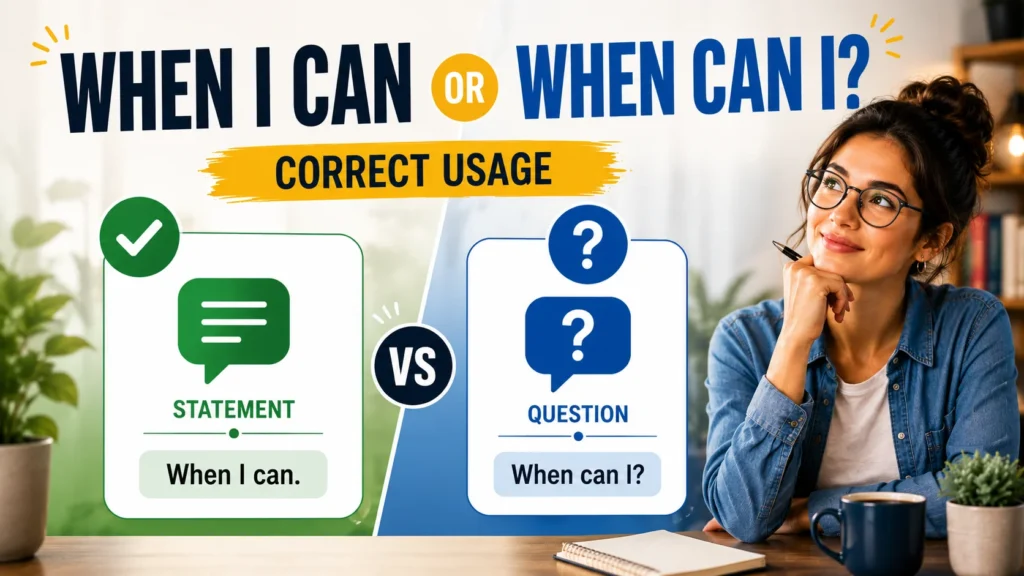
If you’ve ever paused over “when I can” and “when can I,” you’re not alone. These phrases contain the same words, yet their word order changes their grammatical role and meaning. The key is simple: “When can I…?” typically introduces a direct question, whereas “when I can…” usually appears within a statement or another clause. Once you see how can and I work together, this common English grammar problem becomes much easier to handle.
Quick Answer: “When Can I?” vs. “When I Can”
The easiest way to tell them apart is to look at what you’re trying to do. Use “when can I?” when you want to ask directly about a time, opportunity, permission, or possibility. For example, “When can I leave?” asks someone to tell you when leaving is possible or allowed. Use “when I can” when you’re describing a time or situation in which you have the ability or opportunity to do something: “I’ll leave when I can.” Here, you aren’t asking a question. You’re explaining when the action will happen.
| Expression | Main function | Example | Meaning |
| When can I…? | Direct question | “When can I leave?” | Asking about time, permission, or possibility |
| when I can… | Clause in a statement | “I’ll leave when I can.” | Referring to a time when you’re able or available |
The difference comes from English word order. In a normal statement, the subject generally comes before the modal verb: I can go. In a direct question, English usually places the modal before the subject: Can I go? Add when to the beginning, and you get When can I go?
The Simplest Rule
Think of the two forms this way:
- When can I…? → question
- when I can… → statement or clause
For example, imagine you’re waiting to leave work. You could ask your manager, “When can I leave?” You’re requesting information. If you later tell a friend, “I’ll leave when I can,” you’re describing your plan.
This small change in word order does a lot of work. It tells the reader or listener whether you’re asking something or stating something.
What Does “When Can I?” Mean in English Grammar?
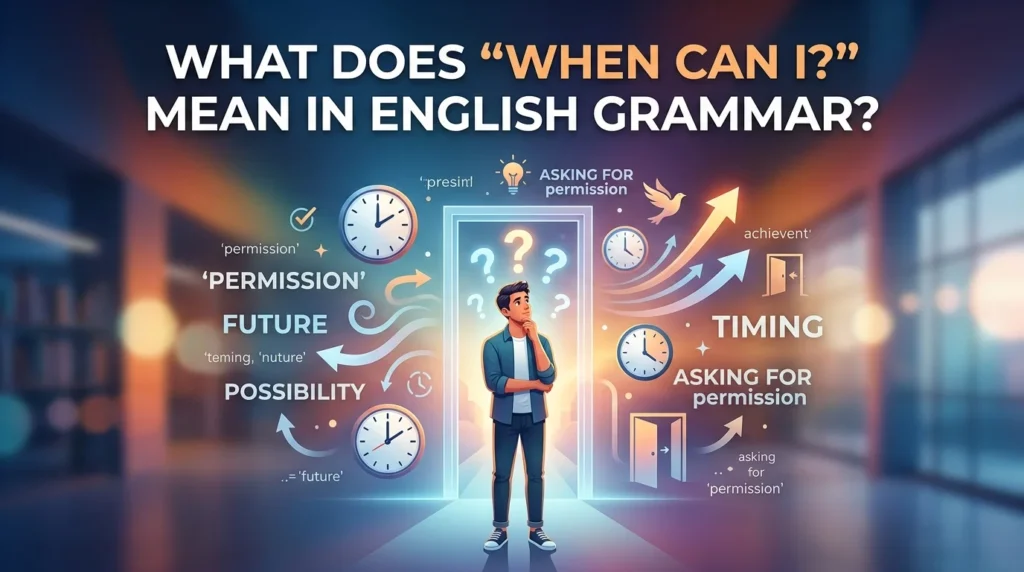
“When can I?” is a direct question. It usually asks when a person has the ability, permission, opportunity, or practical chance to act. The action may appear after the phrase, as in “When can I start?” However, speakers can sometimes leave the action unstated when the context already makes it obvious.
The basic structure looks like this:
When + can + I + base verb?
Consider these examples:
- When can I start?
- When can I call you?
- When can I apply?
- When can I leave?
- When can I see you?
In each case, when asks about time. Can adds the idea of ability, permission, possibility, or opportunity. I identifies the person who wants to perform the action.
Core Meaning
The exact meaning of can depends on the context.
If you ask, “When can I leave?” your question may concern permission. Perhaps you’re in a meeting and need your supervisor’s approval.
If you ask, “When can I meet you?” the question usually concerns availability or opportunity. You’re trying to find a suitable time.
If you ask, “When can I apply?” you’re asking when an application becomes possible or acceptable.
So, don’t assume can always means physical ability. In everyday English, it can also express permission or possibility.
Real-Life Examples
Picture a student who has finished an assignment but doesn’t know the submission schedule. The natural question is:
“When can I submit my assignment?”
At work, you might need to know when a colleague is available:
“When can I call you?”
At a doctor’s office, a patient might ask:
“When can I come in?”
During a trip, someone could ask:
“When can I check in?”
These examples all share the same structure. The speaker wants information about the time when an action can happen.
Structure Breakdown
Let’s break “When can I leave?” into its parts:
- When — question word asking about time
- can — modal verb expressing possibility or permission
- I — subject
- leave — base-form verb
The important detail is the position of can. It comes before I because this is a direct question.
Compare it with the statement:
I can leave.
The statement follows the ordinary subject-first pattern. Turn it into a direct question and the modal moves before the subject:
Can I leave?
Add when:
When can I leave?
That pattern applies to many other question words too.
What Does “When I Can” Mean?
“When I can” usually works as part of a larger sentence. It doesn’t normally ask a direct question. Instead, it describes a time when the speaker is able, available, or has an opportunity to do something.
For example:
“I’ll call you when I can.”
The speaker isn’t asking when to call. The speaker is saying that the call will happen when an opportunity becomes available.
You can expand the idea with a specific verb:
- “I’ll finish it when I can.”
- “I’ll visit when I can.”
- “I’ll help when I can.”
- “I’ll call when I can.”
- “I’ll respond when I can.”
Notice the word order: I can, not can I. That’s because when I can functions as part of a larger statement.
Core Meaning
The phrase can express several closely related ideas.
First, it can mean when I am able to do something:
“I’ll fix it when I can.”
Second, it can mean when I have enough time:
“I’ll read the report when I can.”
Third, it can mean when I have an opportunity:
“I’ll visit you when I can.”
The surrounding sentence supplies the exact meaning. That’s why context matters so much with this expression.
Real-Life Examples
Suppose a friend asks you to call later because you’re busy. You might say:
“I’ll call you when I can.”
At work, you could tell a colleague:
“I’ll review the document when I can.”
If you’re traveling and someone asks whether you’ll visit them, you might say:
“I’ll come by when I can.”
These aren’t questions. Each sentence explains when the speaker expects to perform an action.
Structure Breakdown
Look closely at:
“I’ll call you when I can.”
The sentence contains a main clause and a dependent clause:
- I’ll call you — main clause
- when I can — dependent clause
Inside the dependent clause, the normal statement order remains:
I + can
The phrase when introduces the clause. It doesn’t turn that clause into a direct question.
This is why these two forms behave differently:
When can I call you? → direct question
I’ll call you when I can. → statement containing a dependent clause
The difference may look tiny on the page. In actual English, however, that tiny shift changes the entire sentence function.
Direct Questions vs. Statements: The Real Difference
The most useful way to understand this grammar point is to stop looking at the words individually and examine the sentence function.
A direct question asks someone for information. A statement gives information. English uses different word-order patterns to signal that difference.
Direct Questions
A direct question with when normally follows this structure:
When + modal verb + subject + base verb?
For example:
- “When can I start?”
- “When can I leave?”
- “When can I call?”
- “When can I apply?”
The question mark also helps signal the function in writing.
Statements
A statement generally keeps the subject before the modal:
Subject + modal verb + base verb
For example:
- “I can start.”
- “I can leave.”
- “I can call.”
- “I can apply.”
When when introduces a dependent clause, the same subject-first order remains:
- “I’ll start when I can.”
- “I’ll leave when I can.”
- “I’ll call when I can.”
- “I’ll apply when I can.”
Key Takeaway
Here’s the practical shortcut: ask yourself whether you’re requesting information or describing a situation.
If you’re requesting information, use “when can I…?”
If you’re describing when you have the ability or opportunity to act, use “when I can…”
For example:
Question: “When can I speak with the manager?”
Statement: “I’ll speak with the manager when I can.”
The two sentences discuss a similar action. Their grammatical jobs differ.
Why Word Order Changes Meaning Completely
English relies heavily on word order. With modal verbs such as can, that order becomes especially noticeable.
Start with the statement:
I can help.
Now turn it into a direct question:
Can I help?
The modal verb can moves before the subject I.
Now add when:
When can I help?
That’s a direct question.
But if you place the phrase inside a larger statement, the order returns to normal:
I’ll help when I can.
This same pattern appears with other question words:
- What can I do? → “I know what I can do.”
- Where can I go? → “I know where I can go.”
- How can I help? → “She explained how I can help.”
The pattern is consistent. Direct questions use question word order. Clauses inside larger sentences generally use statement word order.
That distinction becomes even more important with embedded questions, which often cause learners to use the wrong structure. The next part will examine that issue closely and show how “when can I” changes to “when I can” when the question becomes part of a larger sentence.
Embedded Questions: Where Learners Often Make Mistakes
One of the easiest ways to confuse “when can I” with “when I can” is to put a question inside another sentence. English calls this an embedded question, and it follows a different word order from a direct question. For example, “When can I leave?” works as a direct question, while “Do you know when I can leave?” contains that question inside a larger sentence. The meaning stays related, but the structure changes. Once you recognize that shift, many common grammar mistakes become much easier to spot.
Correct Usage
A direct question uses can + I:
“When can I leave?”
An embedded question uses I + can:
“Do you know when I can leave?”
The second sentence still asks for information. However, when I can leave no longer stands as a direct question by itself. It sits inside the larger question “Do you know…?”
Here are a few natural examples:
- “Can you tell me when I can apply?”
- “Do you know when I can call?”
- “Could you explain when I can start?”
- “I’m not sure when I can leave.”
- “She asked when I can come.”
Notice the consistent pattern. After the introductory phrase, English normally uses subject + modal, not modal + subject.
Incorrect Usage
A common learner error is to keep direct-question order inside the larger sentence:
“Do you know when can I leave?”
In standard English, this isn’t the natural structure. The better version is:
“Do you know when I can leave?”
Why? Because when I can leave functions as an embedded question rather than a direct question.
The same principle applies elsewhere:
- ❌ “Can you tell me where can I park?”
- ✅ “Can you tell me where I can park?”
- ❌ “Do you know what can I do?”
- ✅ “Do you know what I can do?”
- ❌ “Could you explain how can I apply?”
- ✅ “Could you explain how I can apply?”
This isn’t an arbitrary rule. English uses the change in word order to distinguish a direct question from information embedded within another sentence.
Simple Rule
When the question stands alone, use:
Question word + can + subject
“When can I leave?”
When the question appears inside another sentence, use:
Question word + subject + can
“Do you know when I can leave?”
A useful mental check is to look at the words immediately after when. If can comes before I, you’re probably dealing with a direct question. If I comes before can, the phrase is probably part of a larger clause.
“When I Can” vs. “When I’m Able To”
Sometimes “when I can” and “when I’m able to” express nearly the same idea. Both can refer to a person’s ability or opportunity to perform an action. Still, they don’t always sound equally natural.
In everyday conversation, can is usually the shorter and more natural choice:
“I’ll finish the report when I can.”
You could say:
“I’ll finish the report when I’m able to.”
The second version is grammatical, but it can sound more formal or slightly heavier. In ordinary conversation, most speakers don’t need the extra words.
However, be able to can become useful when you need to emphasize actual ability or when another verb form makes can unavailable. For example:
“She wasn’t able to attend the meeting.”
Here, wasn’t able to works naturally because can doesn’t have the same range of tense forms.
For this particular grammar question, though, “when I can” is often the cleanest choice when you mean when I have the ability, time, or opportunity.
“When I Can” vs. “Whenever I Can”
The words when and whenever can both introduce time-related clauses, but they don’t always carry exactly the same emphasis.
“When I can” can refer to an opportunity or suitable time:
“I’ll visit you when I can.”
“Whenever I can” often emphasizes repeated opportunities:
“I visit my parents whenever I can.”
The second sentence suggests that the speaker visits every time a suitable opportunity arises. It has a stronger sense of repetition.
Consider another pair:
“I help when I can.”
“I help whenever I can.”
Both sentences communicate willingness and opportunity. The version with whenever places more emphasis on helping at every available opportunity.
This distinction matters when you’re choosing natural wording. You don’t need whenever simply because an action may happen more than once. Context usually tells you whether the stronger emphasis adds anything useful.
“When Can I?” vs. “When Should I?”
Another common source of confusion involves can and should. These modal verbs can appear in similar questions, but they ask for different information.
“When can I start?” asks when starting is possible, permitted, or available.
“When should I start?” asks when starting would be advisable or appropriate.
Imagine you’re beginning a new job. Your manager says the system becomes available on Monday. You might ask:
“When can I start using it?”
You’re asking about possibility or permission.
If the system is already available but you’re unsure about the best time, you might ask:
“When should I start using it?”
Now you’re asking for advice.
The distinction becomes clearer with another example:
- When can I submit the form? → What time or date allows submission?
- When should I submit the form? → What time or date is recommended?
So, don’t treat can and should as interchangeable. The first focuses on what is possible or allowed. The second focuses on what makes sense or is advisable.
“When Can I?” vs. “When May I?”
Can and may can both appear when someone asks for permission, although their tone and everyday usage differ.
“When can I leave?” sounds natural and common in ordinary American English.
“When may I leave?” sounds more formal and can feel somewhat traditional depending on the situation.
In a classroom, workplace, or everyday conversation, can is usually perfectly acceptable for permission:
“When can I submit this?”
In a formal setting, may can sound more respectful or ceremonious:
“When may I submit the application?”
There’s no need to assume that can is grammatically wrong whenever you ask for permission. Modern English commonly uses can for both ability and permission. The surrounding context tells the listener which meaning you intend.
Similar Patterns That Confuse Learners
The same word order issue appears with what, where, and how. Learning these patterns alongside when makes the underlying rule much easier to remember.
What Can I vs. What I Can
A direct question uses:
“What can I do?”
An embedded question uses:
“I know what I can do.”
The first asks for information. The second refers to information within a larger statement.
You can also combine the two:
“Can you tell me what I can do?”
Again, I can appears inside the embedded clause.
Where Can I vs. Where I Can
Consider:
“Where can I park?”
That’s a direct question.
Now place the same idea inside a larger sentence:
“Do you know where I can park?”
The structure changes because the question becomes embedded.
This pattern also works in statements:
“I know where I can park.”
The phrase where I can park doesn’t ask a direct question. It identifies the information the speaker knows.
How Can I vs. How I Can
The direct form is:
“How can I fix this?”
The embedded form is:
“Can you show me how I can fix this?”
The difference isn’t limited to when. Once you understand the pattern, you can apply it to many English questions.
Common Mistakes Learners Make
The biggest errors usually happen when speakers recognize the right words but place them in the wrong grammatical structure. That problem often appears when a learner translates directly from another language or remembers the direct-question pattern without considering the rest of the sentence.
Mixing Structures
One common mistake is combining parts of both patterns:
“When I can go?”
This has statement word order but question punctuation. In standard English, a direct question normally needs:
“When can I go?”
The reverse problem also occurs:
“I’ll go when can I.”
That incorrectly places the modal before the subject inside a dependent clause. The natural version is:
“I’ll go when I can.”
Using Question Order in Statements
Direct-question order doesn’t automatically belong in every sentence containing when.
Compare:
“When can I call you?”
with:
“I’ll call you when I can.”
The first asks for a suitable time. The second describes when the speaker will call.
The words look similar, but the sentence structures perform different jobs.
Forgetting Context
Context often determines the correct form before you even think about grammar terminology.
Suppose someone asks:
“Are you going to call Sarah?”
You could answer:
“Yes, I’ll call her when I can.”
Now imagine you’re trying to find out the best time to call Sarah. You might ask:
“When can I call Sarah?”
The situation changes the purpose of the phrase. Once you identify whether you’re asking or stating, the correct structure becomes much clearer.
Can “When I Can?” Ever Work?
In casual conversation, speakers sometimes shorten sentences when everyone already understands the missing information. This is called ellipsis, and everyday speech contains plenty of it.
For example, imagine someone says:
“You can call me later.”
You might respond:
“When can I?”
Here, the missing verb phrase is understood from the conversation.
A response such as “When I can?” can occasionally appear in informal speech when a speaker is repeating or questioning someone else’s wording. However, learners shouldn’t treat this as the normal direct-question structure.
For standard writing and clear professional communication, use the complete grammatical form:
“When can I?”
or, when the action needs to be stated:
“When can I call you?”
That small adjustment keeps the meaning clear and avoids making the reader reconstruct the missing information.
Modal Verbs: Can vs. Could
The choice between can and could adds another layer to questions about time. Both are modal verbs, but they can point to different meanings depending on context.
When to Use “Can”
Use can when you’re talking about present ability, current permission, present possibility, or available opportunities.
Examples include:
- “When can I start?”
- “When can I leave?”
- “When can I apply?”
- “When can I meet you?”
These questions usually concern something possible or available now or in the future.
When to Use “Could”
Could can refer to past ability, hypothetical situations, or a more tentative request.
Compare:
“When can I speak to the manager?”
with:
“When could I speak to the manager?”
The first sounds direct and focuses on current availability or possibility. The second can sound softer or more tentative, depending on the context.
For past ability, could has a different role:
“When could you swim?”
This asks about a person’s ability at some point in the past.
Context remains essential. Don’t assume that could always means “past can.” Its meaning depends on how the speaker uses it.
Quick Comparison Table
| Expression | Common use | Example |
| When can I…? | Present permission, possibility, ability, or availability | “When can I start?” |
| When could I…? | Past ability, tentative possibility, or a softer request | “When could I start?” |
| when I can… | A clause referring to ability or opportunity | “I’ll start when I can.” |
| when I could… | A clause referring to past or conditional possibility | “I would go when I could.” |
The most important point isn’t simply memorizing can versus could. You also need to recognize whether the phrase functions as a direct question or as part of a larger sentence.
Why These Patterns Matter in Real English
Correct word order does more than satisfy a grammar rule. It helps your listener understand your intention immediately. When you say “When can I leave?”, the listener knows you’re requesting information. When you say “I’ll leave when I can,” the listener understands that you’re explaining your circumstances.
That clarity becomes especially useful at work, in school, and during everyday conversations. A small word-order mistake can make a sentence sound unfinished or force the listener to guess what you mean. Once the distinction becomes familiar, however, choosing between “when can I” and “when I can” becomes almost automatic.
The next part will put these rules into realistic conversations, common learner examples, practical memory tricks, and focused practice so you can recognize the correct structure without stopping to analyze every sentence.
Real Conversation Examples
Grammar becomes much easier when you see how people actually use these forms. In real conversations, “when can I” usually appears when someone wants an answer about timing, permission, or availability. “when I can” usually appears when someone explains when they have an opportunity to act. The difference becomes obvious once you place both forms in realistic situations.
Workplace Situation
Imagine that you’ve finished your part of a project and want to know when you can send it to your manager. You might ask:
“When can I send you the report?”
Your manager could answer:
“You can send it this afternoon.”
Now suppose a coworker asks whether you’ll review another document. You might say:
“I’ll review it when I can.”
The first sentence requests information. The second explains your availability.
Here’s another useful contrast:
“When can I schedule the meeting?”
This question asks about an available time.
“I’ll schedule the meeting when I can.”
This statement means you’ll do it once you have the time or opportunity.
The context makes the distinction easy. When you need an answer, use the direct-question structure. When you’re explaining your own timing, use the clause structure.
School Situation
Students encounter this distinction often when asking about assignments, exams, and deadlines.
For example:
“When can I submit my assignment?”
This asks when submission is permitted or possible.
Now imagine you’ve already received the deadline:
“I’ll submit my assignment when I can.”
Here, you’re not asking your teacher for information. You’re explaining that you’ll submit the work once you have a suitable opportunity.
Embedded questions also appear naturally:
“Do you know when I can submit the assignment?”
Notice that I can follows when because the question sits inside the larger sentence.
A student might make the mistake of saying:
“Do you know when can I submit the assignment?”
Standard English normally requires:
“Do you know when I can submit the assignment?”
The difference looks small, but the second version follows the correct embedded-question pattern.
Everyday Life
Everyday conversations provide even more examples.
Suppose you’re planning to meet a friend:
“When can I see you?”
Your friend might answer:
“I’m free Saturday afternoon.”
Later, if your friend asks when you’ll visit, you could say:
“I’ll come when I can.”
You can also make the meaning more specific:
“I’ll come when I can get away from work.”
Another example involves a phone call:
“When can I call you?”
versus:
“I’ll call you when I can.”
The first asks about the other person’s availability. The second describes your own opportunity to make the call.
This contrast is worth remembering because both expressions can appear in the same conversation.
A Simple Way to Recognize the Difference
Instead of memorizing dozens of grammar rules, look at the job the phrase performs.
If you’re asking someone to give you information, start with:
“When can I…?”
If you’re explaining when you’ll be able to do something, use:
“when I can…”
For example:
Question: “When can I pick up the package?”
Statement: “I’ll pick up the package when I can.”
The first asks about a suitable time. The second gives a plan without requesting an answer.
There’s another useful clue. A direct question normally has a question mark:
“When can I leave?”
A dependent clause normally forms part of a larger sentence:
“I’ll leave when I can.”
That punctuation isn’t the main rule, but it can help you spot the difference when you’re writing.
How Context Changes the Meaning of “Can”
The word can has several meanings in English. That’s why translating it as one fixed word can sometimes cause trouble.
Can for Ability
Here, can means that someone has the ability to do something.
“When can I swim again?”
Depending on the context, the speaker may be asking when they will physically be able to swim.
Similarly:
“I’ll swim when I can.”
This means the speaker will swim once circumstances allow it.
Can for Permission
In everyday American English, can commonly expresses permission.
“When can I leave?”
A student might ask a teacher this question. An employee might ask a manager. A guest might ask a host.
The meaning comes from the situation.
Can for Opportunity
Sometimes can means that circumstances make an action possible.
“When can I meet you?”
The speaker may not be asking for formal permission. They may simply want to know when both people have an available opportunity.
Can for Possibility
Can can also describe something that may be possible under certain conditions.
For example:
“When can the machine operate safely?”
The question asks about the circumstances under which operation becomes possible.
In each case, when can I retains the same basic grammatical structure. The context determines the precise meaning of can.
“When I Can” in Longer Sentences
The phrase becomes easier to recognize when you see how it connects with a main clause.
Consider:
“I’ll finish the project when I can.”
The main clause is I’ll finish the project. The phrase when I can tells us when that action will happen.
You can move the dependent clause to the beginning:
“When I can, I’ll finish the project.”
The meaning remains essentially the same. The placement changes the emphasis.
Another example:
“I’ll call you when I can.”
becomes:
“When I can, I’ll call you.”
The second version puts more attention on the condition or opportunity.
This structure also works with different verbs:
- “I’ll visit when I can.”
- “I’ll respond when I can.”
- “I’ll help when I can.”
- “I’ll finish the work when I can.”
- “I’ll check the details when I can.”
The phrase remains I can because it functions inside a clause rather than as a direct question.
“When Can I?” With an Unstated Verb
Sometimes speakers say “When can I?” without naming the action. This can sound completely natural when the previous conversation already makes the action obvious.
For example:
“You can submit the form after your supervisor signs it.”
“When can I?”
The listener understands that the speaker means something like “When can I submit the form?”
This is an example of conversational ellipsis. English speakers often leave out information that everyone already understands.
However, context matters. If the listener doesn’t know what action you’re asking about, “When can I?” may sound incomplete.
Compare these situations:
Clear context:
“Your application is ready.”
“When can I?”
No context:
“When can I?”
The second example leaves too much unsaid. In writing, especially formal writing, naming the action usually makes the sentence clearer.
Why “When I Can?” Usually Causes Problems
Learners sometimes form “when I can?” because they remember the statement pattern I can and place a question mark after it. The problem is that standard direct questions with modal verbs normally require inversion.
Compare:
Statement: “I can leave.”
Question: “Can I leave?”
Add when:
Question: “When can I leave?”
The subject and modal don’t stay in statement order when you form a direct question.
However, I can remains correct when the phrase belongs to a larger clause:
“I’ll leave when I can.”
This gives you a useful three-step pattern:
I can leave.
When can I leave?
I’ll leave when I can.
Once these three forms become familiar, the distinction stops feeling like a memorization exercise.
Common Mistakes With Embedded Questions
Embedded questions deserve extra attention because even advanced learners sometimes carry direct-question word order into them.
Mistake: “Do You Know When Can I Go?”
This sentence combines two structures incorrectly.
The direct question is:
“When can I go?”
After adding Do you know, the question becomes embedded:
“Do you know when I can go?”
The word order inside the embedded clause changes from can I to I can.
Mistake: “Can You Tell Me When Can I Start?”
The natural version is:
“Can you tell me when I can start?”
The introductory phrase Can you tell me already forms the main question. The following clause provides the information being requested.
This distinction helps explain why the sentence can contain can twice:
“Can you tell me when I can start?”
The first can belongs to the main direct question. The second can belongs to the embedded clause.
Mistake: “I’ll Start When Can I”
The natural version is:
“I’ll start when I can.”
Here, when I can doesn’t ask anything. It identifies the point at which the speaker will start.
Memory Tricks That Actually Work
A good memory trick should help you make the right choice quickly. It shouldn’t replace understanding.
The Question Test
Ask yourself:
Am I directly asking someone when an action is possible?
If yes, use:
“When can I…?”
For example:
“When can I book the appointment?”
You’re waiting for an answer.
The Statement Test
Now ask:
Am I telling someone when I’ll have the ability or opportunity to act?
If yes, use:
“when I can…”
For example:
“I’ll book the appointment when I can.”
You’re giving information rather than asking for it.
The Quick Trick
Remember this simple contrast:
Question → can I
Clause → I can
So:
“When can I leave?”
but:
“I’ll leave when I can.”
That short pattern works surprisingly well because it focuses on the word order that causes the confusion.
Practice Examples
Try identifying whether each sentence needs when can I or when I can.
- “_____ submit the application?”
- “I’ll submit the application _____.”
- “Do you know _____ submit the application?”
- “_____ speak with the manager?”
- “I’ll speak with the manager _____.”
- “Can you tell me _____ speak with the manager?”
The correct forms are:
- When can I submit the application?
- I’ll submit the application when I can.
- Do you know when I can submit the application?
- When can I speak with the manager?
- I’ll speak with the manager when I can.
- Can you tell me when I can speak with the manager?
The examples reveal the core pattern again. Direct questions use can I. Embedded questions and dependent clauses use I can.
Why This Rule Matters in Real English
Correct word order makes your meaning easier to understand. You might know every word in a sentence yet still sound unnatural if you put those words into the wrong structure. That’s especially noticeable with modal verbs because English speakers expect a particular pattern in direct questions.
For learners, the practical benefit goes beyond grammar tests. You’ll use these structures when asking about appointments, deadlines, travel plans, workplace schedules, permission, and everyday arrangements.
Consider the difference in a workplace:
“When can I send the file?”
This clearly asks for a time.
“I’ll send the file when I can.”
This clearly communicates your availability.
Now add an embedded question:
“Could you tell me when I can send the file?”
All three sentences concern the same basic action. Their different structures tell the listener exactly what role the phrase plays.
A Simple Real-World Case Study
Imagine that Alex needs to submit a work report. Alex isn’t sure when the manager will accept it, so Alex asks:
“When can I submit the report?”
The manager explains that submissions open at noon.
Later, a coworker asks Alex whether the report is ready. Alex responds:
“I’ll submit it when I can.”
Then the coworker asks:
“Do you know when I can submit mine?”
Now the phrase appears inside an embedded question. The conversation contains all three patterns naturally:
When can I…? → direct question
when I can… → statement or dependent clause
when I can… → embedded question
The words don’t change much. Their grammatical role does.
A Practical Comparison of the Three Structures
| Structure | Sentence type | Word order | Example |
| When can I…? | Direct question | when + can + I | “When can I submit it?” |
| when I can… | Dependent clause | when + I + can | “I’ll submit it when I can.” |
| when I can… | Embedded question | when + I + can | “Do you know when I can submit it?” |
The second and third structures look identical because both use when I can. Their difference comes from their role in the larger sentence. One expresses a time condition or opportunity. The other carries the information being asked about inside an indirect question.
When “When I Can” Sounds More Natural
The phrase “when I can” often sounds more natural than longer alternatives when you’re talking about your own availability or opportunity. In everyday English, speakers usually prefer the shortest clear expression. For example, “I’ll call you when I can” sounds relaxed and natural. You could say “I’ll call you when I am able to”, but that version feels heavier unless you specifically need to emphasize ability. The same idea appears in sentences such as “I’ll help when I can,” “I’ll visit when I can,” and “I’ll finish it when I can.” The meaning comes from the surrounding context, so the phrase can refer to having enough time, finding an opportunity, or becoming able to complete an action.
When “When Can I?” Is the Better Choice
Choose “when can I” when you need another person to provide information. The question may concern a schedule, permission, availability, or a possible time. For example, “When can I start?” asks when starting is possible or allowed. “When can I call you?” asks about someone’s availability. “When can I apply?” asks when an application becomes possible. This structure works because English places the modal verb can before the subject I in a direct question. If you’re asking a complete question, this pattern is usually the natural choice.
Direct Questions and Embedded Questions Side by Side
The clearest way to master this distinction is to compare direct and embedded questions together. A direct question uses “When can I…?”: “When can I speak with the manager?” An embedded question changes the order: “Could you tell me when I can speak with the manager?” The first sentence directly asks for information. The second asks someone to provide information about a question contained inside the sentence. This same shift appears with other question words, too. “Where can I park?” becomes “Do you know where I can park?” Likewise, “How can I apply?” becomes “Can you explain how I can apply?” Once you understand this pattern, you can apply it far beyond the word when.
Can vs. Could in “When” Questions
The choice between can and could depends on the meaning and tone you want. “When can I leave?” normally asks about present or future permission, availability, or possibility. “When could I leave?” can sound more tentative, polite, hypothetical, or dependent on certain circumstances. For example, an employee might ask, “When can I leave?” when checking a current workplace rule. A more tentative version could be “When could I leave?” when discussing possible arrangements. Neither form automatically replaces the other. The context determines which modal verb fits.
| Expression | Main idea | Example |
| When can I…? | Current or future possibility, permission, or availability | “When can I start?” |
| When could I…? | Tentative possibility, hypothetical situation, or past ability | “When could I start?” |
| when I can… | A time when the speaker has an opportunity or ability | “I’ll start when I can.” |
| when I could… | A past or conditional situation | “I would help when I could.” |
When “Can” Means Permission, Ability, or Opportunity
One reason these sentences confuse learners is that can carries several meanings. In “When can I leave?”, it may ask about permission. In “When can I meet you?”, it usually concerns availability or opportunity. In “When can I swim again?”, it may concern physical ability. The grammar stays the same even though the meaning of can changes with the situation.
This makes context essential. You shouldn’t decide what can means by looking at the word alone. Look at the verb that follows it and consider the real-life situation. Someone asking “When can I enter?” may need permission. Someone asking “When can I get there?” may be asking about practical possibility. Someone saying “I’ll come when I can” is usually explaining that they’ll come when circumstances allow.
When “Whenever I Can” Works Better
Sometimes “whenever I can” expresses the idea more clearly than “when I can.” The word whenever can emphasize repeated opportunities rather than one particular time.
Compare:
“I visit my parents when I can.”
“I visit my parents whenever I can.”
Both are natural. The second places more emphasis on taking every available opportunity.
You might also say:
“I help whenever I can.”
That wording strongly suggests willingness to help each time an opportunity appears. By contrast, “I’ll help when I can” can simply refer to the next suitable opportunity.
The difference is subtle, so don’t treat when and whenever as completely interchangeable. Choose the one that matches the meaning you want.
When “Can” and “Should” Are Not Interchangeable
Learners sometimes confuse “When can I…?” with “When should I…?” because both questions ask about timing. However, they request different kinds of information.
“When can I start?” asks when starting is possible or permitted.
“When should I start?” asks when starting would be advisable.
For example, if a website opens registration on Monday, you might ask:
“When can I register?”
You’re asking about the first available opportunity.
If registration is already open and you’re deciding on the best time, you might ask:
“When should I register?”
You’re asking for advice.
That distinction matters in professional communication because can focuses on possibility or permission while should focuses on recommendation.
Common Mistakes to Avoid
Mistake 1: “When I Can Go?”
If you’re asking directly about the time you can leave or go, use:
“When can I go?”
The problem with “When I can go?” is the word order. A direct question needs the modal can before the subject I.
Mistake 2: “I’ll Go When Can I”
Use:
“I’ll go when I can.”
The phrase when I can forms part of a statement. It doesn’t ask a direct question.
Mistake 3: “Do You Know When Can I Go?”
Use:
“Do you know when I can go?”
The phrase is now an embedded question. English normally uses statement word order inside it.
Mistake 4: Treating “Can” as Only Ability
Can doesn’t always mean physical ability. It can also express permission, possibility, or opportunity.
For example:
“When can I leave?” may mean “When am I allowed to leave?”
Mistake 5: Adding “Can” Twice Without Understanding the Structure
Consider:
“Can you tell me when I can leave?”
Both uses of can are correct because they belong to different parts of the sentence. The first belongs to the direct question “Can you tell me…?” The second belongs to the embedded question “when I can leave.”
A Fast Memory Test
When you’re unsure which structure to choose, ask yourself one question:
Am I asking directly, or am I putting the idea inside another sentence?
If you’re asking directly:
When can I…?
If you’re describing a situation:
when I can…
If you’re embedding the question:
when I can…
For example:
Direct: “When can I start?”
Statement: “I’ll start when I can.”
Embedded: “Do you know when I can start?”
This three-part comparison captures most everyday uses of the two forms.
Practice: Choose the Correct Structure
Use the examples below to test whether you’ve understood the difference.
- _____ call you?
- I’ll call you _____.
- Do you know _____ call you?
- _____ submit the form?
- I’ll submit the form _____.
- Can you tell me _____ submit the form?
The correct answers are:
- When can I call you?
- I’ll call you when I can.
- Do you know when I can call you?
- When can I submit the form?
- I’ll submit the form when I can.
- Can you tell me when I can submit the form?
The pattern remains consistent. Direct questions use can I. Statements and embedded questions normally use I can.
A Final Practical Comparison
| Situation | Correct form | Example |
| Asking directly about a time | When can I…? | “When can I leave?” |
| Asking about permission | When can I…? | “When can I use this?” |
| Asking about availability | When can I…? | “When can I meet you?” |
| Explaining your opportunity | when I can… | “I’ll call when I can.” |
| Explaining when you’ll act | when I can… | “I’ll finish it when I can.” |
| Asking indirectly | when I can… | “Do you know when I can leave?” |
| Asking tentatively | When could I…? | “When could I start?” |
| Emphasizing repeated opportunities | whenever I can… | “I help whenever I can.” |
The safest habit is to focus on sentence structure, not just the individual words. When when begins a direct question, use can I: “When can I go?” When when I can belongs to a statement or embedded question, keep I can together: “I’ll go when I can” or “Do you know when I can go?” Once you recognize whether you’re asking directly, making a statement, or embedding a question, the correct form usually becomes clear.
Conclusion
Choosing between “when I can” and “when can I” becomes much easier once you focus on the sentence’s purpose. Use “when can I…?” when you ask directly about time, permission, availability, or possibility. Use “when I can…” when you describe when you’re able to do something or when the phrase appears inside an embedded question. The word order provides the biggest clue: direct questions place can before I, while statements and embedded questions normally keep I can together. For example, “When can I leave?” asks for information, while “I’ll leave when I can” describes an opportunity. Keep this simple distinction in mind and you’ll avoid one of the most common English grammar mistakes. With regular exposure to real examples, the correct structure will soon feel natural rather than something you have to stop and analyze.
FAQs
Is “When I Can” grammatically correct?
Yes, “when I can” is grammatically correct when it functions as part of a larger sentence or an embedded question. For example, “I’ll call you when I can” uses it as a dependent clause. Likewise, “Do you know when I can leave?” uses it inside an embedded question. The surrounding sentence determines its exact function and meaning.
Is “When Can I?” grammatically correct?
Yes, “When can I?” is correct as a direct question when the missing action is already clear from the conversation. For example, someone might say, “You can submit the form tomorrow,” and you could respond, “When can I?” If the context isn’t clear, saying “When can I submit it?” makes the meaning easier to understand.
What is the difference between “When Can I?” and “When I Can”?
“When can I?” normally asks a direct question about when something is possible, permitted, or available. “When I can” usually describes when someone has the ability or opportunity to do something. Compare “When can I leave?” with “I’ll leave when I can.” The word order changes because the grammatical function changes.
Why does “Can I” come before “I can” in questions?
English typically changes the position of a modal verb when forming a direct question. A statement says, “I can leave.” The corresponding question becomes, “Can I leave?” Adding when produces “When can I leave?” This subject-modal inversion helps listeners recognize that you’re asking for information rather than making a statement.
Can I say “When I Can?” as a question?
In standard English, “When I can?” isn’t normally the correct structure for a direct question. Casual conversation may sometimes use unusual or shortened phrasing when the context supplies missing information. For clear communication, especially in writing, use “When can I?” or include the action: “When can I leave?”
Why is “Do You Know When I Can?” correct?
“Do you know when I can?” contains an embedded question, so it follows statement word order inside the larger sentence. The direct question would be “When can I?” However, after “Do you know,” the natural structure becomes “when I can.” The same pattern appears in “Can you tell me when I can start?”
Should I use “When Can I?” or “When Should I?”
Use “When can I?” when you’re asking about possibility, permission, or availability. Use “When should I?” when you’re asking for advice about the best or recommended time. For example, “When can I apply?” asks when applying is possible, while “When should I apply?” asks when applying would be most appropriate.
What does “When I Can” mean?
“When I can” generally means when you’re able to do something, have enough time, or have a suitable opportunity. For example, “I’ll visit when I can” means you’ll visit when circumstances allow. Depending on the context, it can describe ability, availability, or opportunity without directly asking another person for information.
What is the difference between “When Can I?” and “When Could I?”
“When can I?” usually asks about present or future possibility, permission, or availability. “When could I?” can express a tentative possibility, hypothetical situation, past ability, or softer request. For example, “When can I start?” sounds direct, while “When could I start?” may sound more tentative depending on the surrounding context.
Does “When I Can” work in an embedded question?
Yes. In fact, “when I can” is the normal word order for many embedded questions. For example, “Do you know when I can start?” is correct. The direct question is “When can I start?” Once that question becomes part of a larger sentence, English normally changes the order to I can, creating the embedded structure.