
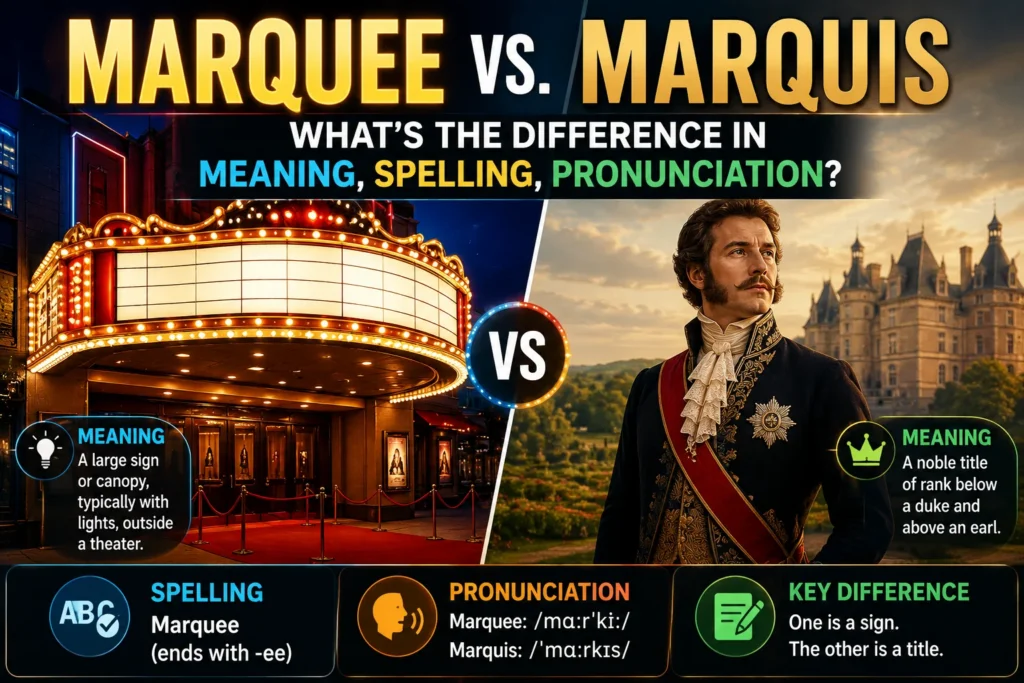
Quick Answer
Marquee and Marquis look remarkably similar, but they belong to different areas of English. Marquee can mean a large event tent, a covered entrance or sign outside a theater, or something considered especially important or popular. Marquis is a noun connected with European nobility. It refers to a man of high social rank and, in relevant historical contexts, the title he holds. Cambridge defines marquis as “a man of high social rank in Europe,” while dictionaries give marquee several distinct meanings.
The pronunciation makes the difference easier to hear. In US English, marquee is pronounced /mɑːrˈkiː/, with the stress on the second syllable and a long ee sound at the end. Marquis is pronounced /ˈmɑːr.kwɪs/, with the stress on the first syllable and a final sound closer to “kwiss.”
A simple way to remember the distinction is to connect the words with their most recognizable uses:
| Word | Main meaning | Typical context | US pronunciation |
| marquee | Large tent | Weddings, parties, outdoor events | /mɑːrˈkiː/ |
| marquee | Covered theater entrance or sign | Movies, theaters, entertainment | /mɑːrˈkiː/ |
| marquee | Prominent | Sports, entertainment, major events | /mɑːrˈkiː/ |
| marquis | Nobleman or noble title | History, aristocracy, literature | /ˈmɑːr.kwɪs/ |
So, if you’re describing a wedding tent, a theater sign, or a major sports attraction, choose marquee. If you’re describing a European nobleman or his title, choose marquis.
Why Do People Confuse Marquee and Marquis?
The confusion comes mainly from appearance. Both words begin with marqu-, and neither spelling gives an English learner an obvious clue about pronunciation. When you see them quickly, it is easy to assume that they are different spellings of the same word.
They aren’t.
Their similar forms do have a historical explanation. Oxford traces marquee to the late 17th century and notes that it came from marquise, with the form being treated as a plural and then reshaped with the -ee ending. That history helps explain why marquee and words associated with aristocratic titles look related even though their modern meanings differ.
Modern usage, however, gives each word a clear job.
When you read about an outdoor wedding, you might see a sentence such as, “The guests gathered under the marquee.” Here, the word refers to a large temporary tent.
When you read about a movie theater, you might see, “The film’s title appeared on the theater marquee.” In this context, marquee refers to the structure or sign associated with the entrance.
In sports writing, you might encounter a phrase such as marquee player. Here, the word no longer refers to a physical object. Instead, it means a prominent player who attracts attention.
Now compare that with marquis. A historical novel might say, “The marquis entered the estate.” The word identifies a nobleman. It has nothing to do with a tent, movie theater, or sports star.
The quickest test
When you’re unsure, ask yourself one question:
Am I talking about a structure, attraction, event, or prominent performer—or am I talking about nobility?
If the first group fits, marquee is probably correct.
If the second fits, marquis is the word to consider.
That context-based approach works better than trying to remember two nearly identical spellings in isolation.
What Is a Marquee?
Marquee is a versatile English word because it has developed several established meanings. Dictionaries recognize both noun and adjective uses, with some meanings especially associated with British English and others with North American English.
As a noun, marquee can refer to a large tent used at an outdoor social event. It can also refer to a roof-like structure or sign above the entrance of a public building, especially a theater.
As an adjective, particularly in North American English, marquee describes something that is among the most important, popular, or attention-grabbing examples in its field. Oxford specifically notes this use in areas such as sports.
That gives the word three useful meanings to remember:
- Marquee = a large event tent.
- Marquee = a theater or building entrance/sign.
- Marquee = a major or highly prominent person, event, or attraction.
The surrounding words usually make the intended meaning obvious.
Marquee as a Large Event Tent
In British English, marquee commonly means a large temporary tent used for social events. Weddings, receptions, parties, festivals, and other gatherings may take place inside one. Oxford describes this as a large tent used at social events and gives examples involving wedding receptions and guests sitting beneath one.
Imagine a country wedding held on a large lawn. Instead of moving guests into a permanent building, organizers erect a substantial temporary structure. Tables fill the interior. Lighting hangs from the ceiling. Caterers prepare food inside. Guests eat, talk, and dance beneath the covered space.
That structure is a marquee.
The word often appears with terms such as:
- large marquee
- wedding marquee
- event marquee
- giant marquee
- marquee tent
- inside the marquee
- under the marquee
- erect a marquee
These combinations show the word’s practical use in event planning and British English.
For example:
The wedding reception took place inside a large marquee on the estate.
Here, there is no connection to nobility. The sentence describes a physical temporary structure.
Another example:
The organizers erected a marquee beside the garden for the evening reception.
Again, marquee refers to a tent.
Cambridge similarly defines this British sense as a large tent used for eating and drinking at outdoor events involving many people.
Why the Tent Meaning Matters
This meaning can cause confusion for American readers because US English uses marquee differently in everyday entertainment contexts.
That doesn’t mean the tent meaning is wrong in American English. It means regional usage can affect which sense you encounter most often.
If you’re reading a British article about a wedding, horse show, garden party, or outdoor reception, marquee may appear repeatedly. In an American movie review, the same word may appear in connection with a theater.
The meaning comes from context.
Marquee as a Theater Entrance or Sign

In North American English, marquee commonly refers to a roof-like structure projecting over the entrance of a public building, especially a theater. A sign may appear on or above that structure and display the name of the theater, movie, play, or featured attraction. Cambridge and Oxford both recognize this North American sense.
Think about an old movie theater in a busy downtown area.
Above the entrance, a large horizontal structure extends toward the sidewalk. Lights outline its edges. The theater’s name appears across the front. Beneath it, the current movie title may be displayed.
That is a marquee.
You might read:
The new film was advertised on the theater’s bright marquee.
Or:
Her name appeared on theater marquees throughout the city.
In this use, marquee has a strong connection with public entertainment. It can evoke classic theaters, movie premieres, stage performances, and illuminated signs.
Marquee Does More Than Mean “Sign”
One small distinction matters here.
A marquee can refer to the projecting structure itself, the sign attached to it, or the covered entrance/sign arrangement depending on the context and dictionary definition. Cambridge specifically recognizes a US sense involving the sign on the roof-like structure as well as the structure itself.
That means you shouldn’t assume that marquee always means simply “sign.”
For example:
The theater installed a new digital marquee.
The sentence could refer to the entire display structure rather than merely the letters shown on it.
This distinction becomes useful when writing about architecture, theaters, historic buildings, or entertainment venues.
Marquee as an Adjective
The most important meaning that learners sometimes overlook is the adjective marquee.
In North American English, marquee can describe a person, event, or attraction that is especially important, popular, or likely to draw an audience. Oxford identifies this use as especially common in sports and gives examples involving marquee names and marquee events.
Consider a professional sports team that signs one of the league’s most recognizable players. A journalist might call that athlete a marquee player.
Why?
The player doesn’t literally stand beneath a theater sign. The word uses the idea of a marquee as a place where a major attraction gets displayed. In other words, the player is important enough to attract attention.
Common expressions include:
- marquee player
- marquee name
- marquee event
- marquee attraction
- marquee matchup
- marquee signing
- marquee performer
For example:
The championship game became the weekend’s marquee event.
Here, marquee means the main or most anticipated event.
Another example:
The club hopes its new marquee player will attract more fans.
The adjective emphasizes the player’s prominence.
Why “Marquee” Works as an Adjective
The adjective carries an idea of visibility and importance.
A marquee traditionally puts something where people can see it. A theater marquee advertises a movie or performer. A modern marquee event similarly stands out from the rest of a schedule.
That creates a useful conceptual link:
physical marquee → displayed attraction → prominent attraction
This explains why the adjective makes sense even when no physical structure exists.
It also explains why you may encounter marquee in sports journalism, entertainment reporting, business coverage, and event promotion.
Where Is the Word “Marquee” Commonly Used?
The word appears across several fields, but its meaning changes slightly depending on the subject.
| Context | Meaning of marquee | Example |
| Weddings | Large temporary tent | The reception was held in a marquee. |
| Outdoor events | Large event structure | Guests waited inside the marquee. |
| Theater | Covered entrance or display structure | The movie appeared on the marquee. |
| Entertainment | Main attraction | The singer became the marquee performer. |
| Sports | Major or highly popular | He is the team’s marquee player. |
| Events | Most important attraction | The final was the marquee event. |
This range is why context matters more than memorizing one definition.
Marquee in British English
British English strongly associates the noun marquee with the large tent used at social events. Oxford labels this sense as especially British.
You might see it in writing about:
- weddings
- village fairs
- garden parties
- charity events
- agricultural shows
- formal receptions
- outdoor celebrations
A British event planner could write:
We need a larger marquee because more than 200 guests are expected.
The word immediately suggests a temporary event structure.
Marquee in American English
American English commonly uses marquee for theaters and entertainment venues. It also uses the adjective for something highly prominent or popular. Cambridge identifies the covered theater entrance/sign sense as US usage and separately identifies the adjective meaning a main performer or sports figure.
For example:
The actor’s name appeared above the theater entrance.
A natural rewrite in American English might say:
The actor’s name appeared on the theater marquee.
Or in sports:
The team needs another marquee player.
The surrounding context makes the intended sense clear.
Definition of Marquee in Plain English
If a dictionary definition feels too abstract, reduce the word to three practical ideas.
A marquee can be something you stand under, something you look up at, or something that draws you in.You can stand under a marquee at an outdoor event.You can look up at a theater marquee before a movie.You can read about a marquee player whose reputation draws attention.
That simple framework covers the major modern meanings without forcing you to memorize long definitions.
Pronunciation of Marquee
Pronunciation is one of the easiest ways to separate marquee from marquis.
Cambridge gives the US pronunciation of marquee as /mɑːrˈkiː/ and the UK pronunciation as /mɑːˈkiː/. The main stress falls on the second syllable, and the word ends with the long ee sound.
The important sound pattern is:
mar-KEE
The final syllable carries the stress.
The ending sounds like the ee in words such as “see” or “tree.” That gives marquee a distinctly different ending from marquis.
A Simple Pronunciation Check
If you say marquee and hear the long ee ending, you’re using the expected pronunciation.
If you’re talking about a nobleman and your pronunciation ends in a short -iss sound, you’re likely thinking of marquis.
That distinction is especially useful when you hear these words before seeing them written.
Examples of “Marquee”
The best way to understand a flexible word is to see it work in several settings.
Example: Outdoor Event
The organizers placed the dinner tables inside the marquee.
Here, marquee means a large temporary tent.
Example: Wedding
Heavy rain forced the wedding guests into the marquee earlier than planned.
Again, the word describes the event structure.
Example: Theater
The film’s title glowed above the theater entrance on the marquee.
Here, the word describes the theater display or projecting structure.
Example: Sports
The club’s new marquee signing generated excitement among supporters.
Here, marquee works as an adjective meaning highly prominent or important.
Example: Entertainment
The festival saved its marquee performer for the final night.
The word signals that the performer is one of the event’s biggest attractions.
Example: Major Event
The championship match became the weekend’s marquee event.
Here, the event stands out as the most important or anticipated attraction.
These examples reveal an important pattern: marquee keeps a connection with prominence even when its literal meaning disappears. A physical marquee displays something people should notice. A figurative marquee person or event is likewise someone or something people are expected to notice.
Marquee: Common Collocations
Learning words in combinations often makes them easier to use naturally. With marquee, several combinations appear frequently in real English.
Noun combinations
- marquee tent
- wedding marquee
- event marquee
- theater marquee
- movie marquee
- marquee sign
- marquee entrance
Adjective combinations
- marquee player
- marquee event
- marquee name
- marquee attraction
- marquee performer
- marquee matchup
- marquee signing
These combinations also help you determine which meaning the writer intends.If you see wedding marquee, think about a tent.If you see theater marquee, think about an entrance or display.If you see marquee player, think about prominence.
That is much easier than trying to remember every dictionary definition separately.
Marquee and Context: The Most Reliable Clue
Context is your strongest tool when a word has multiple meanings.
Suppose you read:
The guests waited beneath the marquee.
The word beneath suggests a physical structure. A tent makes sense.
Now consider:
The player’s arrival became the marquee moment of the season.
This isn’t describing a physical roof or tent. Instead, marquee means something especially important or attention-grabbing.
Finally:
The movie’s title appeared on the marquee.
The reference to a movie points toward the theater sense.
The spelling never changes. The surrounding language changes the meaning.
This is a useful lesson beyond. English contains many words whose meanings depend heavily on context. Rather than memorizing isolated definitions, look at the nouns, verbs, adjectives, and situations around the target word.
A Practical Way to Remember Marquee
Use the final sound as your first memory cue.
Marquee → long “ee” sound → major attraction, theater display, or event tent.
You can also picture a theater sign shining above a busy street. The sign displays the name of the movie or performer everyone came to see. That image connects marquee with visibility and attraction.
Then remember the three core ideas:
tent → theater → attraction
If a sentence fits one of those ideas, marquee is likely the right spelling.
Why Marquee and Marquis Shouldn’t Be Treated as Interchangeable
The biggest mistake is assuming that these words are simply alternate spellings.
They aren’t.
Replacing one with the other can completely change the meaning of a sentence.
Consider:
The stadium signed a marquee player.
This means the stadium or team acquired a prominent player.
Now imagine replacing the word:
The stadium signed a marquis player.
That doesn’t produce the intended meaning. Marquis relates to nobility, not sporting prominence.
The reverse problem is even clearer:
The marquee attended the royal ceremony.
That would be incorrect if the writer meant a nobleman.
The correct word would be marquis.
The two spellings may look like close relatives, but their modern roles are distinct.
At a Glance
Before moving to the noble title itself, the core distinction can be reduced to this:
| Question | Correct word |
| Is it a large tent for an outdoor event? | marquee |
| Is it a theater entrance or display? | marquee |
| Is it a major sports player? | marquee |
| Is it a major entertainment attraction? | marquee |
| Is it a European nobleman? | marquis |
| Is it the noble title held by that man? | marquis |
| Does the word end with a long “ee” sound? | marquee |
| Does the word end with a “kwiss” sound? | marquis |
The spelling difference is small. The semantic difference is much larger.
Understanding that distinction now makes the next part of the comparison much easier: marquis belongs to the vocabulary of rank, title, and European aristocracy, while marquee has developed around structures, displays, and prominent attractions.
What Is a Marquis?
While marquee can describe a tent, theater structure, or major attraction, marquis belongs to a very different part of English vocabulary. A marquis is a nobleman of high rank in European systems of nobility. In the United Kingdom, the closely related form marquess is the standard term for a nobleman ranked below a duke and above an earl. Oxford also notes that marquis is used in some European countries for a rank between a count and a duke.
That distinction gives you an easy practical rule: if the sentence involves aristocracy, hereditary rank, estates, courts, or historical titles, you’re probably dealing with marquis, not marquee. The two words may look like twins on the page, but their meanings live in different neighborhoods.
Definition of Marquis
A marquis is a man who holds a particular high-ranking noble title. Cambridge gives the broader definition as a man of high social rank in Europe, while Oxford provides a more precise explanation of the title’s position within different European systems.
In a sentence such as:
The marquis welcomed his guests to the estate.
the word identifies a person. It doesn’t describe the estate, the building, or the gathering.
The word also appears in formal titles, historical accounts, biographies, novels, and discussions of European aristocracy. You may see constructions such as the Marquis of [place] or references to a marquis when the writer discusses the holder of the rank.
The grammatical difference matters too:
| Word | Part of speech | What it identifies |
| marquee | Noun or adjective | A structure, display, event, attraction, or prominent person |
| marquis | Noun | A nobleman or his title |
| marquess | Noun | The British form of the noble title |
So if you write, “The marquis arrived at the theater,” you’re describing a nobleman who arrived. If you write, “The marquee displayed his name,” you’re describing a theater display. One person can appear beside the other in the same sentence, but the words still perform completely different jobs.
What Rank Is a Marquis?
The exact rank depends on the national system you’re discussing. This is where overly simple definitions can create problems.
In some European countries, Oxford describes a marquis as a nobleman ranking between a count and a duke. In the UK, Oxford uses marquis as an alternative form of marquess, with the rank positioned between an earl and a duke.
That difference is worth remembering because count and earl aren’t interchangeable in every historical context. Earl is the traditional English title, while count is used in many continental European systems.
A simplified comparison looks like this:
| Context | Rank of marquis/marquess |
| Some European systems | Between a count and a duke |
| United Kingdom | Between an earl and a duke |
This is why a good definition shouldn’t simply say that a marquis is “always between a count and a duke.” The historical and national context matters.
Marquis vs. Marquess: What’s the Difference?
This is another spelling issue that often gets mixed into the question.
Marquis and marquess can refer to the same general noble rank, but their usage differs by region and tradition. Oxford lists marquess as the British form and identifies marquis as an alternative.
In British usage, you’ll normally encounter marquess when referring to the title. For example:
The Marquess of Bath attended the ceremony.
In other European contexts, marquis is the more familiar form.
Merriam-Webster likewise defines marquess as a nobleman of hereditary rank and specifically describes the British rank as below a duke and above an earl. Its etymology traces the word to Middle English marquis and Anglo-French forms connected with marche.
This creates three visually similar words worth keeping separate:
- marquee — tent, theater structure, or prominent attraction
- marquis — nobleman or noble title
- marquess — British form of the noble title
The final -ee in marquee is the biggest visual clue. The endings -quis and -quess belong to the vocabulary of the noble title.
Historical Background of Marquis
The history of marquis explains why the word has such a strong connection with borders and territory.
Oxford traces the word through Middle English to Old French marchis and marquis. Both forms connect with march, meaning an area of land along the border between countries or territories.
That original territorial idea is important.
A march was historically a frontier region. Because borderlands needed defense and administration, rulers appointed people to govern or oversee them. Over time, the title associated with such frontier authority developed into a recognized rank of nobility.
The Oxford Etymologist describes a marquis historically as a ruler associated with a march, or frontier district. It also connects the word with the Germanic concept behind mark, a term associated with a boundary or district.
Etymology Online gives a similar historical path, tracing marquis through Old French forms connected with marche, meaning a frontier or border territory. The original sense involved a ruler of border territory before the word developed into a hereditary or social title of rank.
So the historical development can be simplified like this:
frontier territory → ruler of a frontier → noble rank → marquis/marquess
That chain makes the word much easier to understand. It wasn’t created as an arbitrary label for an aristocrat. Its early meaning had a practical connection with territorial administration and border defense.
From Frontier Ruler to Noble Title
The title eventually moved away from its original job.
A person called a marquis was no longer necessarily governing an exposed border. Instead, marquis became a recognized title within systems of aristocratic rank.
This kind of semantic change happens often in language. A word can begin as the name of an occupation, responsibility, location, or social function and later become a hereditary title.
The same general pattern appears with other titles whose original functions became less important than their social status.
By the time readers encounter marquis in historical literature, the word usually tells them something about the character’s rank rather than describing his daily duties.
That distinction matters when reading older texts. A sentence might mention a marquis alongside a duke, earl, count, or other noble figure. The writer expects the reader to understand the character’s social position from the title alone.
How Marquis Is Used in Modern English
Today, marquis isn’t an everyday word for most American English speakers. You’ll encounter it more often in historical writing, European history, biographies, literature, genealogy, and discussions of aristocratic titles.
Typical contexts include:
- European history
- British history
- French history
- aristocracy
- genealogy
- historical fiction
- literary analysis
- royal and noble titles
- heritage and estates
The word can also appear in discussions of specific historical figures.
For example:
The marquis inherited the family estate after his father’s death.
The sentence uses the title to establish the man’s social position.
Another example:
The novel’s marquis controls a large country estate.
Again, the word identifies a noble character.
You wouldn’t use marquis simply because someone is wealthy or influential. A billionaire isn’t automatically a marquis. The word refers to a specific aristocratic title and its historical equivalents.
Pronunciation of Marquis
Pronunciation creates one of the clearest differences between marquee and marquis.
Cambridge gives marquis as /ˈmɑːr.kwɪs/ in US English and /ˈmɑː.kwɪs/ in UK English. The stress falls on the first syllable.
A useful approximation is:
MAR-kwiss
The first syllable receives the emphasis. The second syllable has a short i sound followed by s.
Compare that with:
marquee → mar-KEE
The difference becomes obvious when you say them aloud:
MAR-kwiss = marquis
mar-KEE = marquee
The spellings may look related, but the pronunciation tells a different story.
A Common Pronunciation Trap
People sometimes pronounce marquis as though it were spelled marquee. That’s understandable because the visual similarity is strong.
However, standard English pronunciation doesn’t treat them as rhyming words.
Marquee ends with a long ee sound.
Marquis ends with a short iss sound and includes the kw sound.
Cambridge’s pronunciation guides make this contrast particularly clear.
If you’re editing spoken content, a presentation, or a voice-over script, this distinction becomes especially useful. A listener won’t see the spelling, so pronunciation has to carry the meaning.
Examples of Marquis in Sentences
Seeing marquis in different sentence structures helps establish its real usage.
Historical example
The marquis governed the frontier territory on behalf of the crown.
Here, the sentence evokes the historical connection between the title and border regions.
Estate example
The marquis invited several distinguished guests to his country estate.
The word identifies the nobleman who owns or controls the estate.
Literary example
In the novel, the marquis is portrayed as proud but politically cautious.
Here, marquis functions as a character label.
Historical research example
The historian examined letters written by the marquis during the conflict.
The title identifies the historical figure without requiring the writer to repeat his full name.
Formal title example
The Marquess of Bath is an example of the British form of the title.
In this case, marquess follows British convention. Oxford specifically gives the Marquess of Bath as an example of the British form.
Marquis in Literature and Historical Writing
The word appears naturally in literary settings because older novels often use social titles to establish a character’s position.
A writer might introduce a marquis before giving the character’s personal name. Readers familiar with the period would immediately understand that the character belongs to the upper ranks of European society.
That makes titles such as duke, marquis, earl, count, and baron more than decorative labels. They can establish relationships, privileges, expectations, and social conflicts.
For example, if a novel describes a young woman marrying a marquis, the title immediately tells readers that the marriage involves a person from a high-ranking aristocratic family. The word carries historical and social information in a single term.
This is one reason marquis remains useful even though hereditary aristocratic titles aren’t part of ordinary everyday American life.
Marquis and Gender: A Related Term
Another related word is marchioness.
A marchioness is the feminine form associated with a marquess or marquis in British and European title systems. Oxford’s entry for marquess specifically points readers toward marchioness as the related feminine title.
This distinction can help when reading historical documents or fiction.
For example:
The marquess arrived with his wife, the marchioness.
The two words identify related aristocratic titles.
It’s useful to keep marchioness separate from marquee, too. The visual similarity doesn’t make them interchangeable.
A Real-World Context Test
Suppose you’re writing a sentence and hesitate between the two words.
Try replacing the word with a plain-English description.
If you mean “large tent”
The guests gathered beneath the large tent.
Replace tent with marquee.
If you mean “theater display”
The movie title appeared on the theater sign.
Replace the relevant term with marquee.
If you mean “major attraction”
The singer was the festival’s main attraction.
You can use marquee as an adjective:
The singer was the festival’s marquee attraction.
If you mean “nobleman”
The nobleman inherited the estate.
Replace nobleman with marquis if that specific title is intended.
This substitution test is surprisingly effective because it forces you to identify the meaning before choosing the spelling.
The Three-Word Family Worth Remembering
The easiest way to avoid future mistakes is to keep these three forms in separate mental boxes:
| Term | Meaning | Typical setting |
| Marquee | Tent | Weddings and outdoor events |
| Marquee | Theater structure/sign | Movies and entertainment |
| Marquee | Major or prominent | Sports and events |
| Marquis | Nobleman/title | European history |
| Marquess | British noble title | UK aristocracy |
| Marchioness | Feminine noble title | UK and European aristocracy |
The first word has a physical and figurative life. The other forms belong to the vocabulary of nobility.
Why the Spelling “Marquis” Makes Sense
At first glance, marquis can look like a strange English spelling. Its history explains why.
The word entered English through French-related forms rather than developing from ordinary modern English spelling patterns. Oxford traces it through Middle English and Old French marchis, with marquis reinforced by another Old French form.
That’s why trying to pronounce it strictly from the spelling can lead you astray.
English contains many words whose pronunciation reflects older linguistic layers. Marquis is one of them. Its spelling carries evidence of its French and medieval history, while its modern pronunciation has settled into the familiar MAR-kwiss pattern.
A Useful Case Study: One Sentence, Two Completely Different Meanings
Consider this sentence:
The marquis arrived beneath the marquee.
It sounds almost theatrical, but grammatically and semantically it’s perfectly possible.
Here, marquis identifies the nobleman.
Marquee identifies the structure.
The sentence demonstrates why the two words cannot substitute for one another.
Now reverse them:
The marquee arrived beneath the marquis.
The sentence becomes nonsensical if both words retain their ordinary meanings.
That’s a useful mental test. If replacing one word with the other changes a person into a structure or a structure into a person, you’re dealing with two distinct vocabulary items.
Marquis: What the Word Does Not Mean
A few boundaries are worth remembering.
Marquis does not mean:
- a large tent
- a theater sign
- a theater entrance
- a major sports player
- a famous performer
- a featured attraction
- a prominent event
Those meanings belong to marquee.
Likewise, marquee does not mean:
- European nobleman
- aristocratic title
- hereditary rank
- marquess
- marquisate
Those ideas belong to the noble-title family.
Keeping those semantic boundaries clear prevents most mistakes.
The Historical Link Between the Two Words
Although modern meanings differ, their historical forms help explain why marquee and marquis look so similar.
Marquis developed through French forms associated with a march, or frontier territory. Marquee also has a French historical connection, which explains part of the visual resemblance. Oxford’s dictionary entry for marquee traces it through marquise, while its entry for marquis traces the noble title through marchis and related Old French forms.
The important point is that modern English did not invent these spellings independently.
Language preserves old connections long after words develop separate meanings.
That is why can feel confusing today. Their modern definitions are far apart, but their historical forms still leave a recognizable family resemblance.
The Best Memory Rule
Don’t memorize the spelling alone. Memorize the meaning plus sound.
Marquee → mar-KEE → tent, theater, major attraction
Marquis → MAR-kwiss → nobleman or noble title
Then add one more association:
marquess → British noble title
That three-part system is enough for most everyday writing.If you’re writing about an outdoor wedding, theater, sports star, or major event, reach for marquee.If you’re writing about European aristocracy or a historical nobleman, consider marquis.If you’re specifically writing in a British context about the noble rank, marquess is often the form you’ll want.
The spelling becomes much easier once the meaning is clear.
Side-by-Side Comparison
The clearest way to understand is to compare what each word actually does in a sentence. Marquee can function as a noun or adjective, while marquis is a noun connected with European nobility. Oxford lists marquee as a large tent in especially British English, a covered entrance in North American English, and an adjective meaning especially important or popular. Marquis, meanwhile, refers to a nobleman, with the exact rank depending on the European system being discussed.
| Feature | Marquee | Marquis |
| Main word class | Noun and adjective | Noun |
| Core meaning | Tent, theater structure/sign, or major attraction | Nobleman or noble title |
| Common US context | Theater, entertainment, sports | European history and nobility |
| Common UK context | Large event tent | Noble title, often written marquess |
| US pronunciation | /mɑːrˈkiː/ | /ˈmɑːr.kwɪs/ |
| Stress | Second syllable | First syllable |
| Ending sound | Long ee | kwiss |
| Example | a marquee event | a marquis of high rank |
| Describes a physical structure? | Yes | No |
| Describes a nobleman? | No | Yes |
| Related British title | — | marquess |
Cambridge gives marquee the US pronunciation /mɑːrˈkiː/ and marquis /ˈmɑːr.kwɪs/, making the spoken distinction just as important as the spelling.
Meaning Is the Biggest Difference
Think about the kind of thing you’re naming.
Marquis works differently. It identifies a person who holds a noble rank. In some European countries, Oxford places the rank between a count and a duke. In Britain, the corresponding title is marquess, ranked above an earl and below a duke.That means the following distinction is reliable:
Marquee = structure, display, or major attraction.
Marquis = nobleman or noble title.
Once you understand that semantic split, the spelling becomes much easier.
Spelling Differences
The spelling difference looks small, but it carries a lot of information.
Marquee ends in -quee:
m-a-r-q-u-e-e
Marquis ends in -quis:
m-a-r-q-u-i-s
Both contain marqu, which creates the visual trap. The final letters, however, point toward completely different words.
A useful spelling pattern is:
marquee → -quee → “ee” sound
marquis → -quis → “kwiss” sound
The connection isn’t completely accidental. Oxford traces marquee to marquise, explaining that the late-17th-century English form came from marquise, which was interpreted as a plural and reshaped with an -ee ending.
Marquis, meanwhile, has a separate historical path through Middle English and Old French forms such as marchis and marquis. Oxford connects those forms with march, an area of land along a border between territories.
So although the words look related, modern English gives them separate meanings and pronunciations.
Why the Final Letters Matter
When spelling from memory, don’t focus only on the first five letters.
The ending tells you what you’re dealing with.
If the sentence says:
The wedding guests sat beneath the ______.
The meaning points to marquee.
If it says:
The ______ inherited the estate.
The context points to marquis if the writer means a nobleman.
This approach works because spelling follows meaning. You don’t have to remember an arbitrary sequence of letters when you already know what the word means.
Pronunciation Differences
Pronunciation creates an even sharper dividing line.
Marquee has the stress at the end:
mar-KEE
Marquis has the stress at the beginning:
MAR-kwiss
Cambridge lists the US pronunciation of marquee as /mɑːrˈkiː/ and marquis as /ˈmɑːr.kwɪs/.
The difference is easy to hear once you know what to listen for.
How to Pronounce “Marquee”
Say:
mar-KEE
The second syllable receives the main stress. The final sound is a long ee, similar to the ending in words such as coffee, degree, or employee.
Cambridge gives:
US: /mɑːrˈkiː/
UK: /mɑːˈkiː/
The transcriptions differ slightly because of regional pronunciation conventions, but the key feature remains the same: marquee ends with a clear long ee sound.
You can use the word naturally in sentences such as:
The guests waited inside the marquee.
Her name appeared on the theater marquee.
The tournament’s marquee event starts tonight.
The pronunciation stays the same even though the meaning changes.
How to Pronounce “Marquis”
Say:
MAR-kwiss
The first syllable receives the stress, followed by a kw sound and a short i sound.
Cambridge gives the US form as:
/ˈmɑːr.kwɪs/
The UK form is:
/ˈmɑː.kwɪs/
The difference becomes especially obvious when you put the two words together:
MAR-kwiss — marquis
mar-KEE — marqueeThey don’t rhyme.They don’t share the same stress pattern.They don’t have the same final sound.
That makes pronunciation a useful second check when spelling alone causes hesitation.
Common Pronunciation Mistakes With Marquee and Marquis
The most common mistake is to pronounce marquis as though it were marquee.
Someone sees the letters marqu- and assumes the words sound alike. That’s not how standard English pronunciation works.
Another mistake goes in the opposite direction: saying marquee with a final -kwiss sound because the speaker has encountered marquis first.
Neither pronunciation matches the standard dictionary forms.
A simple listening exercise helps:
| Word | Say it like | Stress |
| marquee | mar-KEE | Second syllable |
| marquis | MAR-kwiss | First syllable |
| marquess | MAR-kwiss | First syllable |
| marquise | mar-KEEZ | Second syllable |
The last two words are useful because marquess and marquise belong to the broader vocabulary of aristocratic titles. Oxford gives marquess the same basic pronunciation pattern as marquis, while marquise has a final zeez sound.
Marquee, Marquis, Marquess, and Marquise
Once you start researching aristocratic terminology, another layer of confusion appears. Marquis isn’t the only similar-looking word.
The four terms should be kept separate:
Marquee
A marquee can be:
- a large event tent
- a covered theater entrance
- a theater sign or display
- something especially prominent or popular
Oxford specifically identifies the adjective marquee as especially common in North American English, particularly in sports.
Marquis
A marquis is a nobleman or noble title. Oxford recognizes the word for certain European systems and also as an alternative to marquess in Britain.
Marquess
A marquess is the standard British form for the male noble title. Cambridge places a British marquess above an earl and below a duke.
Marquise
A marquise refers to the wife of a marquis or to a woman who holds that rank in her own right. Oxford gives the same basic distinction.
That produces a useful four-word map:
| Word | Meaning |
| marquee | Tent, theater structure/sign, or prominent attraction |
| marquis | Nobleman/title |
| marquess | British noble title |
| marquise | Wife or female holder of a marquis title |
This table is worth remembering because these words can appear close together in historical or literary writing.
When Should You Use “Marquee”?
Use marquee when the sentence involves one of its established modern meanings.
Use “marquee” for a large event tent
This is particularly common in British English.
The reception was held in a marquee beside the garden.
The word refers to the temporary structure where people gather.
Oxford lists this as a noun meaning a large tent used at social events and labels the sense especially British.
Use “marquee” for a theater entrance or display
In US English, this is a common meaning.
The movie title appeared on the theater marquee.
Cambridge describes the US sense as a sign on a roof-like structure projecting over a public building entrance, especially a theater.
Use “marquee” for something highly prominent
This is the adjective use.
The championship was the weekend’s marquee event.
Or:
The club needs a marquee player.
Oxford defines this adjective as meaning most important or most popular, especially in sports.
The three uses are different, but they share an underlying idea: marquee often points toward something that stands out.
When Should You Use “Marquis”?
Use marquis when you mean a nobleman or the corresponding title.
For example:
The marquis owned several estates.
The word identifies the nobleman.
You might also encounter:
The novel centers on a mysterious marquis.
Here, the word establishes the character’s aristocratic rank.
In a British context, however, marquess may be the preferred form:
The Marquess of Bath attended the ceremony.
Oxford explicitly gives marquess as the British title and marquis as an alternative.
Don’t Use Marquis for “Famous”
This is a subtle but important mistake.
Because marquee can mean “main” or “most popular,” writers sometimes associate the similar-looking marquis with fame or prominence.
That doesn’t work.
A marquee player is a prominent player.
A marquis is a nobleman.
The two concepts aren’t synonyms.
A Context Test for Choosing the Correct Word
When you’re unsure, look at the words surrounding the blank.
Sentence pattern: event
The wedding guests gathered under the ______.
The phrase under the suggests a physical structure.
Correct: marquee
Sentence pattern: theater
The movie title appeared on the ______.
The theater context suggests a display.
Correct: marquee
Sentence pattern: sports
The club signed a ______ player.
The adjective means highly prominent.
Correct: marquee
Sentence pattern: nobility
The ______ inherited the family estate.
The sentence refers to a person of aristocratic rank.
Correct: marquis
Sentence pattern: British title
The ______ of Bath attended the event.
The British title is normally Marquess of Bath.
Correct: marquess
This method turns a spelling problem into a meaning problem. Meaning is usually much easier to identify.
A Closer Look at “Marquee” as an Adjective
The adjective deserves extra attention because it has no direct equivalent in marquis.
Oxford marks the adjective as especially North American and gives examples involving prominent names and major events.
You might see:
- marquee athlete
- marquee player
- marquee name
- marquee event
- marquee matchup
- marquee attraction
- marquee performer
These phrases all describe something expected to attract attention.
For instance:
The festival’s marquee performer closed the show.
The performer is not physically standing beneath a marquee. The adjective is figurative.
The same applies to:
The final is the tournament’s marquee matchup.
The writer means that the matchup is one of the most important or anticipated.
This figurative meaning has become especially useful in sports and entertainment writing because it packs the idea of visibility, importance, and audience appeal into one adjective.
Why “Marquee” Can Describe a Person
At first, calling a person marquee may seem strange.
How can a person be a tent or theater structure?
The answer lies in semantic extension.
A theater marquee displays the name of the movie or performer that the public has come to see. Over time, marquee developed a figurative sense associated with the person or event that deserves top billing.
So:
marquee structure → advertised attraction → major attraction → prominent person or event
That evolution explains phrases such as marquee player and marquee name.
It’s not a random metaphor. The modern adjective preserves the word’s association with being prominently displayed.
Regional Usage: US English vs. UK English
Regional context can change which meaning you encounter first.
| Meaning | US English | UK English |
| Large event tent | Less central everyday sense | Common |
| Theater entrance/sign | Common | Used, but less central |
| Major/prominent | Common adjective | Less characteristic |
| Nobleman | marquis can occur | marquess is standard British form |
Cambridge identifies the large-tent meaning specifically as UK usage and the roof-like theater structure as US usage. It also identifies marquee as a US adjective meaning a main performer or sports person.
That doesn’t mean speakers never use the other senses. English usage overlaps across regions. The labels simply show where dictionaries consider particular meanings especially characteristic.
This distinction matters for editors and writers because a sentence can be grammatically correct while still sounding more natural in one variety of English than another.
Spelling, Sound, and Meaning: One Simple Framework
You can remember the entire distinction through three layers.
Look at the spelling
marquee → -quee
marquis → -quis
Listen to the sound
marquee → mar-KEE
marquis → MAR-kwiss
Identify the meaning
marquee → tent, theater, major attraction
marquis → nobleman or title
When all three clues point in the same direction, mistakes become unlikely.
A Practical Editing Example
Imagine an editor receives this sentence:
The team hopes to sign a marquis player before the new season.
The sentence looks plausible at first because marquis and marquee share the same opening letters.
But the context reveals the mistake.
A player can be prominent, famous, or highly sought after. The appropriate adjective is marquee.
The edited sentence becomes:
The team hopes to sign a marquee player before the new season.
Now consider:
The marquis arrived at the estate before sunset.
That sentence works if the writer means a nobleman.
This is exactly why context should come before spelling correction. An editor shouldn’t merely ask, “Which spelling looks right?” The better question is, “What does the writer mean here?”
Common Writing Mistakes
Several errors appear repeatedly when people confuse these words.
Mistake: Using “marquis” for a major player
Incorrect:
The club signed a marquis player.
Correct:
The club signed a marquee player.
Mistake: Using “marquee” for a nobleman
Incorrect:
The marquee inherited the estate.
Correct:
The marquis inherited the estate.
Mistake: Assuming “marquee” and “marquis” are alternate spellings
They aren’t interchangeable forms of the same modern English word.
Mistake: Ignoring British “marquess”
In British historical or aristocratic contexts, marquess is often the form you should expect.
Mistake: Pronouncing both words alike
Marquee ends in -kee.
Marquis ends in -kwiss.
Those sounds should remain separate.
A Compact Decision Guide
When you’re writing quickly, use this checklist:
Is it a tent? → marquee
Is it a theater entrance or display? → marquee
Is it a major attraction or prominent performer? → marquee
Is it a prominent sports person or event? → marquee
Is it a European nobleman? → marquis
Is it the British noble title? → marquess
Does it sound like mar-KEE? → marquee
Does it sound like MAR-kwiss? → marquis/marquess
This decision tree covers the most useful distinctions without requiring a dictionary every time.
The Core Difference in One Sentence
If you remember only one thing from, remember this:
A marquee is connected with a tent, theater display, or major attraction, while a marquis is connected with European nobility.
The similar spelling is historical. The modern meanings are distinct. The pronunciation is distinct. And once you connect each word with its proper context, choosing between marquee, marquis, and marquess becomes far less confusing.
Easy Memory Tricks
The fastest way to remember is to connect each spelling with the meaning it carries. The words look alike because of their historical development, but modern English uses them for very different purposes.
A useful memory system is:
Marquee = display, tent, or something major.
Marquis = nobleman.
That distinction is simple enough for everyday writing, yet it also works when you’re dealing with historical texts, sports articles, entertainment news, or formal descriptions.
Remember “Marquee”
Think of the final -ee in marquee as the sound you hear:
mar-KEE
Then connect the word with something that stands out.
A theater marquee stands above an entrance and displays information about a movie or show. A large event marquee provides a covered space for guests. A marquee player stands out from the rest of a sports team.
You can therefore associate marquee with three ideas:
- Structure
- Display
- Prominence
For example:
The guests gathered inside the marquee.
Here, marquee means a large tent.
Her name appeared on the theater marquee.
Here, it means a theater display.
The team signed a marquee player.
Here, it means a particularly prominent or important player.
The meaning changes with context, but the central idea of something being displayed or prominent remains useful.
Remember “Marquis”
For marquis, focus on the ending -quis.
Say it:
MAR-kwiss
Then associate it with rank.
A marquis is a nobleman or holder of a particular aristocratic title. In British English, the usual form is marquess.
A quick memory line is:
Marquis = a man with a noble rank.
For example:
The marquis owned a large estate.
The word refers to the person, not the property.
This distinction is particularly useful because marquee can describe a physical structure while marquis describes a person or title.
A Simple Memory Test
When you’re stuck between the two, ask one question:
Am I talking about a thing that attracts attention or a noble title?
If you’re describing a tent, theater display, major attraction, famous performer, or prominent sports figure, use marquee.
If you’re describing a nobleman or aristocratic rank, use marquis.
For British usage, remember marquess.
| Meaning | Correct word |
| Large event tent | marquee |
| Theater sign | marquee |
| Major attraction | marquee |
| Prominent athlete | marquee |
| Nobleman | marquis |
| British noble title | marquess |
This method works better than memorizing spelling in isolation because the meaning tells you which word you need.
When Should You Use “Marquee”?
Marquee has several established meanings, so context matters.
In British English, a marquee commonly refers to a large tent used for an outdoor gathering or event. Oxford identifies this as a major noun sense and notes that it is especially British.
In North American English, marquee commonly refers to a structure or sign outside a theater or other public building. It can also work as an adjective for something especially prominent or popular.
Marquee for a Tent
Use marquee when you mean a large temporary tent, particularly for events.
Examples include:
- wedding receptions
- garden parties
- exhibitions
- outdoor celebrations
- formal dinners
- festivals
Example:
The wedding reception took place in a decorated marquee.
The word identifies the physical structure where the event occurs.
Another example:
Workers assembled the marquee before the festival opened.
Here, the context clearly points to a temporary structure.
Marquee for a Theater Sign
In American English, marquee often refers to the sign or projecting structure outside a theater.
For example:
The film’s title appeared on the theater marquee.
The word can refer to the structure itself or the displayed information associated with it, depending on context.
That meaning developed from the practical function of the structure: it provides a prominent place to advertise what’s happening inside.
Marquee as an Adjective
The adjective marquee is especially useful in modern sports and entertainment writing.
Oxford defines the adjective as especially important or popular and notes its use in North American English. (oxfordlearnersdictionaries.com)
You might see:
- marquee player
- marquee signing
- marquee event
- marquee matchup
- marquee performer
- marquee attraction
- marquee name
For example:
The championship features two marquee players.
The adjective doesn’t mean that the players are associated with a physical theater sign. It means they’re prominent enough to attract attention.
Marquee in Sports Writing
Sports journalists use marquee frequently because major players and contests attract audiences.
Consider:
The league promoted the game as its marquee matchup of the season.
The word suggests that the matchup has exceptional appeal.
Another example:
The club hopes to add a marquee signing during the transfer window.
Here, marquee suggests a high-profile acquisition.
This figurative use is important because it can create confusion. Someone who knows only the tent definition may wonder why sports writers call a player a marquee player.
The answer is simple: the meaning has expanded from something prominently displayed to something prominent or attention-grabbing.
When Should You Use “Marquis”?
Use marquis when you’re talking about the noble title or the person who holds it.
The word is most likely to appear in historical, literary, genealogical, or European cultural contexts.
For example:
The marquis attended the royal ceremony.
The sentence identifies a nobleman.
Another example:
The marquis inherited the family estate.
Again, the word refers to the person.
It doesn’t describe the estate, ceremony, or building.
Marquis in Historical Writing
Historical writing frequently uses marquis when discussing European aristocracy.
A historian might write:
The marquis played an important role in regional politics.
The title helps establish the individual’s social position.
Because aristocratic systems varied across countries and periods, writers should avoid assuming that every marquis occupied exactly the same rank everywhere.
Oxford notes that the rank differs by system. In some European countries, a marquis ranks below a duke and above a count. In Britain, the corresponding marquess ranks below a duke and above an earl.
That small qualification makes historical explanations more accurate.
Marquis in Fiction
Historical novels often use marquis as a character title.
For example:
The mysterious marquis arrived at the estate just before midnight.
Here, the title immediately signals the character’s aristocratic background.
A novelist doesn’t need to explain his social position every time. The title itself carries that information.
This is one reason titles remain useful in literature. They can communicate social hierarchy without lengthy exposition.
In Everyday Sentences
Seeing the words in realistic sentences makes their distinction easier to remember.
| Sentence | Correct word | Why |
| The guests entered the wedding ____. | marquee | Large event tent |
| The actor’s name appeared on the theater ____. | marquee | Theater display |
| The team signed a ____ player. | marquee | Prominent player |
| The ____ inherited the estate. | marquis | Nobleman |
| The historian wrote about the French ____. | marquis | Noble title |
| The event featured a ____ matchup. | marquee | Major attraction |
| The British ____ attended the ceremony. | marquess | British noble title |
Notice how the surrounding words make the choice almost automatic.
Wedding, theater, player, and matchup point toward marquee.
Noble, estate, historian, and aristocratic titles point toward marquis or marquess.
Common Student Mistakes With Marquee and Marquis
Students often confuse these words because they share several letters and have related historical roots.
Using “marquis” when “marquee” is needed
Incorrect:
The actor’s name was displayed on the marquis.
Correct:
The actor’s name was displayed on the marquee.
The theater context makes marquee the correct choice.
Using “marquee” when “marquis” is needed
Incorrect:
The marquee inherited the ancestral estate.
Correct:
The marquis inherited the ancestral estate.
The subject is a nobleman, so marquis fits.
Confusing “marquee” with “marquess”
Incorrect:
The marquee of Bath attended the ceremony.
Correct:
The Marquess of Bath attended the ceremony.
The British aristocratic title is marquess.
Treating the words as spelling variants
They’re not simply alternative spellings.
You can’t replace marquee with marquis without changing the meaning.
That is the biggest point students should remember.
Why Learners Mix Up These Words
There are several reasons the confusion persists.
First, both words begin with marqu-. That visual similarity makes the brain group them together.
Second, both words have French connections. Their histories explain why they resemble one another.
Third, the pronunciation isn’t obvious from modern spelling.
Fourth, marquee has several meanings. A learner may know only one of them.
Finally, marquis, marquess, and marquise create an additional cluster of similar-looking words.
A learner who sees all four for the first time can easily assume they’re variations of the same word.
They’re not.
Writing Tips for Choosing the Correct Word
When editing your own sentence, don’t begin by checking the spelling.
Start with the meaning.
Ask:
What am I describing? If it’s a physical structure, attraction, or prominent person or event, consider marqueeIf it’s a nobleman, consider marquis.If it’s specifically the British noble title, consider marquess.
Then check pronunciation if you’re speaking the word aloud.
Finally, check the regional context. A British text may use marquee differently from an American text, while British aristocratic writing commonly uses marquess.
This three-step approach is fast:
Meaning → Context → Spelling
It works better than trying to memorize isolated dictionary definitions.
Memory Trick: Marquee Means “Main”
A helpful shortcut for the adjective is:
Marquee = main
If something is the main attraction, main event, or main player, marquee may be appropriate.
For example:
The concert’s marquee performer closed the festival.
You can mentally connect marquee with something placed prominently where everyone can see it.
The theater connection reinforces the idea. A marquee displays the names of the people or productions that deserve attention.
So:
marquee → display → attention → prominence
That chain explains several modern uses at once.
Memory Trick: Marquis Means “Man of Rank”
For marquis, use a different mental chain:
marquis → nobleman → title → aristocracy
This prevents the two words from competing in your memory.
If the sentence involves rank, nobility, estates, aristocracy, or European history, marquis becomes the likely candidate.
For British English, extend the chain:
marquess → British noble title
That small addition handles most of the confusion.
Multiple-Choice Practice
Choose the correct word in each sentence.
Question 1
The theater’s new film appeared on the ______.
A. marquis
B. marquee
C. marquess
Answer: B. marquee
The sentence refers to a theater display.
Question 2
The ______ inherited a large estate.
A. marquee
B. marquis
C. marquee
Answer: B. marquis
The sentence refers to a nobleman.
Question 3
The club’s new signing is expected to become a ______ player.
A. marquis
B. marquee
C. marquess
Answer: B. marquee
Here, marquee means prominent or high-profile.
Question 4
The ______ of Bath attended the formal ceremony.
A. marquee
B. marquis
C. marquess
Answer: C. marquess
The British title uses marquess.
Question 5
The reception was held under a large ______.
A. marquis
B. marquee
C. marquess
Answer: B. marquee
The word refers to a large event tent.
These examples reinforce the central rule: meaning determines the word.
Fill-in-the-Blank Practice
Try completing these without looking at the answers.
- The guests gathered inside the wedding ______.
- The movie’s title appeared on the theater ______.
- The team hopes to attract a ______ player.
- The ______ owned several estates.
- The historian studied the life of a French ______.
- The British ______ attended the ceremony.
Answers
- marquee
- marquee
- marquee
- marquis
- marquis
- marquess
The pattern is straightforward once the meaning becomes familiar.
Real-Life Usage Scenarios for “Marquee”
The word marquee appears across several areas of modern English.
Weddings and Events
The wedding reception was held in a spacious marquee.
Here, it means an event tent.
Theater
The actor’s name appeared above the theater entrance on the marquee.
Here, it means the theater display.
Sports
The league scheduled a marquee matchup for opening weekend.
Here, it means a particularly important or attractive contest.
Entertainment
The festival announced three marquee performers.
Here, it means major or high-profile performers.
Business
The company recruited a marquee executive to lead the new division.
Here, the adjective suggests that the executive has strong visibility or prestige.
These contexts may seem unrelated at first. They all share the idea of prominence or attention.
Real-Life Usage Scenarios for “Marquis”
The noun marquis appears in very different situations.
Historical Documents
The marquis signed the agreement with the crown.
The title identifies a nobleman.
Historical Biography
The biography examines the marquis’s political influence.
The possessive form identifies something belonging to the nobleman.
Historical Fiction
The marquis entered the ballroom as the guests fell silent.
The title establishes the character’s social rank.
Genealogy
The family records trace their connection to a nineteenth-century marquis.
The word identifies the aristocratic ancestor.
European History
The marquis controlled the territory during a period of political instability.
The title places the person within a historical system of nobility.
The contrast with marquee couldn’t be sharper.
A Quick “Which Word?” Chart
When you need an answer quickly, use this chart:
| If you’re talking about… | Use |
| A large event tent | marquee |
| A theater sign | marquee |
| A theater entrance structure | marquee |
| A major event | marquee |
| A prominent athlete | marquee |
| A famous performer | marquee |
| A major attraction | marquee |
| A European nobleman | marquis |
| A noble title | marquis |
| The British equivalent | marquess |
A Useful Rule for Editors and Students
When you encounter marquee or marquis during proofreading, replace the word temporarily with a simpler phrase.If tent, theater sign, main attraction, or prominent fits, choose marquee.If nobleman or aristocratic title fits, choose marquis.If you’re describing the British title, consider marquess.
This approach avoids guesswork.
It also helps when the sentence contains no obvious clue. Instead of staring at the spelling, identify the role the word plays.
For example:
The company’s ______ product will launch next month.
Could marquis fit? No. A nobleman can’t be a product.
Could marquee fit? Yes, if the writer means the company’s most prominent or important product.
That gives you:
The company’s marquee product will launch next month.
The same logic works in sports, entertainment, marketing, and event coverage.
The Difference Between Literal and Figurative Marquee
One final distinction makes marquee much easier to understand.
The word can be literal:
A large marquee stood beside the hotel.
It can also be figurative:
The actor was the festival’s marquee name.
In the first sentence, marquee identifies a structure.
In the second, it describes prominence.
The meanings aren’t unrelated. Both connect to the idea of something being noticeable and important.
Marquis, on the other hand, remains tied to the concept of a noble title.
That gives you a powerful semantic boundary:
marquee can move from physical structure to figurative prominence; marquis stays within the vocabulary of nobility.
Once that distinction becomes familiar, stops being a spelling trap and becomes a straightforward context question.
Real-Life Examples of Marquee
Understanding marquee becomes much easier when you see how people actually use it. The word has both literal and figurative meanings, so the surrounding context matters. In British English, it can describe a large tent used for an event. In American English, it commonly refers to a theater’s projecting sign or entrance structure. It can also work as an adjective for something especially important, popular, or high-profile.
Everyday Examples
At a wedding, for example, guests might sit inside a large marquee while dinner is served. The same word can describe a temporary structure used for a garden party, exhibition, festival, or formal gathering.
The organizers decorated the marquee with flowers and warm lighting.
In American English, you’ll often encounter a different meaning:
The movie’s title appeared brightly on the theater marquee.
Here, marquee refers to the prominent sign or structure outside the theater. The meaning becomes obvious from words such as movie, theater, and title.
The word can also describe something that attracts attention:
The championship was the weekend’s marquee event.
This figurative sense is especially common in sports and entertainment. A marquee event is one of the main attractions, while a marquee player is a highly prominent athlete.
Business and Corporate Examples
Modern business writing also uses marquee in a figurative way. A company might describe a well-known customer as a marquee client, or it might call a highly visible product a marquee product.
For example:
The software company landed a marquee client in the financial sector.
The client isn’t associated with a tent or theater sign. Instead, marquee suggests that the client is prestigious and likely to attract attention.
You might also see:
The company launched its marquee product at the annual conference.
This means the product is one of the company’s most important or high-profile offerings.
The same pattern appears in recruitment:
The firm hired a marquee executive to lead its expansion.
Again, the adjective highlights prominence.
Entertainment Examples
Entertainment provides some of the clearest modern examples of figurative marquee.
A festival might advertise a marquee performer, while a film studio might promote a marquee actor. A major concert can become the marquee event of a festival.
For example:
The singer became the festival’s marquee attraction.
The phrase tells the reader that the performer is expected to draw substantial attention.
The connection to the original theater meaning is easy to see. A theater marquee prominently displays the production or star people came to see. The adjective eventually developed the broader idea of something that deserves top billing.
Real-Life Examples of Marquis
Marquis belongs to a completely different semantic field. It refers to a nobleman or noble title associated with European aristocracy. The exact position of the rank has varied across countries and historical periods. In British usage, the corresponding title is normally marquess.
Historical Examples
A historical account might say:
The marquis controlled the territory during a period of political unrest.
The word identifies the nobleman rather than the territory itself.
Another example is:
The marquis attended the royal court with his family.
Here, the title establishes the person’s social rank.
The historical background of the word is particularly interesting. Marquis developed through French forms associated with a march, meaning a frontier or border territory. A ruler or official connected with such a territory eventually became associated with the noble title.
That history explains why the word is closely tied to aristocratic and territorial language.
Literature Examples
Historical fiction frequently uses marquis because the title quickly establishes a character’s position.
For example:
The marquis entered the ballroom as the orchestra began playing.
The reader immediately knows that the character belongs to the aristocracy.
Another sentence might read:
The young woman discovered that the mysterious marquis owned the neighboring estate.
Here, marquis describes the person who owns the estate. It does not describe the estate itself.
This distinction is important when reading older novels. Noble titles often communicate social relationships without requiring lengthy explanations.
Academic Examples
Academic writing may use marquis when discussing European political history, aristocratic institutions, genealogy, literature, or historical law.
For example:
The historian examined the political influence of the marquis during the eighteenth century.
Or:
The novel presents the marquis as a symbol of inherited social power.
In these examples, the word has nothing to do with a theater sign or event tent. The subject is historical or social rank.
In Real-Life Context
A useful way to see the difference is to place both words in situations that could occur in the same story.
Imagine a historical drama taking place at a large estate.
A marquis arrives at the property for an important gathering. Outside, workers have erected a marquee for the guests.
You could write:
The marquis arrived at the estate shortly before the reception began. Guests gathered beneath the decorated marquee as musicians prepared to perform.
Both words work naturally because they refer to completely different things.
The marquis is the person.
The marquee is the structure.
This simple contrast is one of the most effective ways to remember the distinction.
In American English
For American readers, marquee often appears in entertainment, sports, advertising, and event coverage.
Common expressions include:
- marquee player
- marquee matchup
- marquee event
- marquee attraction
- marquee name
- marquee performer
In contrast, marquis is much more likely to appear in historical or literary contexts.
This difference in frequency can help explain why American readers may recognize marquee immediately but hesitate over marquis.
American English also commonly uses marquee as an adjective meaning prominent or highly important. Oxford identifies this adjective as particularly associated with North American usage.
In British English
British English adds another useful distinction.
A marquee can commonly mean a large tent used for a social event. At the same time, the British form of the noble title is generally marquess rather than marquis.
For example:
The guests waited inside the marquee.
versus:
The Marquess attended the ceremony.
This makes regional context particularly useful.
If you’re reading British material about an aristocrat, marquess is likely to appear. If you’re reading about a wedding tent, marquee remains the appropriate word.
Why Marquee and Marquis Are So Easy to Confuse
The confusion isn’t surprising.
Both words:
- begin with marqu-
- contain similar letters
- have French historical connections
- appear relatively infrequently in everyday conversation
- have pronunciations that aren’t obvious from spelling alone
- can occur in formal or specialized writing
However, their meanings are now clearly separated.
Marquee belongs mainly to the vocabulary of structures, displays, prominence, entertainment, and events.
Marquis belongs to the vocabulary of nobility, aristocracy, history, and titles.
That’s the semantic divide to remember.
Pronunciation Quick Reference
Pronunciation provides another reliable way to keep them apart.
| Word | Approximate pronunciation | Stress |
| marquee | mar-KEE | Second syllable |
| marquis | MAR-kwiss | First syllable |
| marquess | MAR-kwiss | First syllable |
| marquise | mar-KEEZ | Second syllable |
Cambridge lists marquee with a final long ee sound and marquis with the stressed first syllable followed by a kwiss sound.
So if someone says mar-KEE, they’re referring to marquee.
If they say MAR-kwiss, they’re referring to marquis or marquess, depending on the spelling and context.
Spelling Quick Reference
The endings are equally useful.
Marquee
m-a-r-q-u-e-e
Marquis
m-a-r-q-u-i-s
Marquess
m-a-r-q-u-e-s-s
The shared marqu- beginning creates the visual similarity. The ending separates the words.
A quick spelling rule is:
-quee = marquee
-quis = marquis
-quess = marquess
Don’t rely on this rule alone, though. Always check the meaning too.
A Better Way to Remember the Difference
Instead of memorizing four dictionary definitions, create three mental pictures.
Picture One: A Tent
Imagine a large decorated event tent.
That’s a marquee.
Picture Two: A Theater
Imagine bright letters above a theater entrance.
That’s also a marquee.
Picture Three: A Nobleman
Imagine a historical aristocrat wearing formal clothing and holding a noble title.
That’s a marquis.
These visual associations work because they connect the spelling to a concrete idea rather than to an abstract definition.
A Practical Editing Checklist
Before publishing a sentence containing either word, check these points:
- Meaning: Does the word describe a structure, attraction, or nobleman?
- Spelling: Is the ending -quee, -quis, or -quess?
- Pronunciation: Does the intended word sound like mar-KEE or MAR-kwiss?
- Region: Is the text American or British English?
- Context: Is the subject entertainment, sports, events, history, or aristocracy?
- Grammar: Is marquee functioning as a noun or adjective?
- Title: If you’re discussing a British noble rank, should you use marquess?
This checklist catches most errors before they reach the final draft.
Frequently Confused Examples
Here are some common pairs that look tempting but aren’t interchangeable.
| Incorrect idea | Correct form | Reason |
| A noble marquee | A noble marquis | A marquis is a nobleman |
| A theater marquis | A theater marquee | A marquee can be a theater display |
| A marquis player | A marquee player | Marquee means prominent |
| A British marquis | A British marquess | Marquess is the standard British form |
| A wedding marquis | A wedding marquee | Marquee can mean event tent |
These mistakes usually happen because the writer remembers the beginning of the word but not its meaning.
The Core Rules
The entire distinction can be reduced to a few rules.Rule one: Use marquee for a large event tent.Rule two: Use marquee for a theater sign or entrance structure.Rule three: Use marquee as an adjective when you mean especially prominent, important, or popular.Rule four: Use marquis for the nobleman or noble title in contexts where that form is appropriate.Rule five: Use marquess for the standard British male title.Rule six: Pronounce marquee as mar-KEE.Rule seven: Pronounce marquis/marquess as MAR-kwiss.
These rules cover the overwhelming majority of situations in which writers encounter the words.
Final Usage Examples
Consider these examples side by side:
The guests entered the marquee after sunset.
Marquee means an event tent.
The film’s title appeared on the marquee.
Marquee means a theater display.
The tournament’s marquee match begins tonight.
Marquee means a major or highly anticipated event.
The team signed a marquee player.
Marquee means prominent or high-profile.
The marquis inherited the estate.
Marquis means a nobleman.
The historian studied the correspondence of the marquis.
Marquis refers to the holder of the title.
The Marquess of Bath attended the ceremony.
Marquess is the standard British form of the noble title.
Once these examples become familiar, the difference no longer depends on memorizing similar spellings.
Quick Reference
| Question | Answer |
| Does marquee describe a tent? | Yes |
| Can marquee refer to a theater sign? | Yes |
| Can marquee mean prominent? | Yes |
| Does marquis refer to a nobleman? | Yes |
| Is marquis the same modern word as marquee? | No |
| Do they have the same pronunciation? | No |
| Is marquess associated with British nobility? | Yes |
| Does marquee usually sound like “mar-KEE”? | Yes |
| Does marquis usually sound like “MAR-kwiss”? | Yes |
The most useful distinction remains simple: marquee is connected with a tent, theater display, or something prominent, while marquis refers to a nobleman or noble title. The British form marquess adds one more spelling to remember, but it belongs to the same aristocratic family rather than the modern meanings of marquee.
Conclusion
Understanding becomes much easier once you connect each word with its core meaning. Marquee can refer to a large event tent, a theater sign, or something especially prominent, such as a major player or attraction. Marquis, meanwhile, refers to a nobleman or aristocratic title, while marquess is the standard British form of that title.
Their similar spelling and shared historical background explain why they often cause confusion, but their modern uses are quite distinct. When you’re unsure, focus on context first: think marquee for tents, displays, entertainment, and prominence, and marquis for nobility and historical titles. Paying attention to pronunciation also helps. With these simple distinctions in mind, choosing the right spelling, meaning, and usage becomes much more natural.
FAQs
What is the main difference between marquee and marquis?
Marquee and marquis have different meanings despite their similar spelling. Marquee can mean a large event tent, a theater sign, or something prominent or high-profile. Marquis refers to a nobleman or an aristocratic title. The British form of the title is generally marquess. Context usually makes the correct choice clear.
How do you pronounce marquee?
Marquee is generally pronounced mar-KEE, with the stress on the second syllable. The ending sounds like the word “key.” This pronunciation differs from marquis, which sounds roughly like MAR-kwiss. Remembering the pronunciation can help you distinguish the two words when you’re speaking or listening to English.
How do you pronounce marquis?
Marquis is generally pronounced MAR-kwiss, with the emphasis on the first syllable. It does not sound like marquee, which is pronounced mar-KEE. The word refers to a nobleman or aristocratic title. In British English, marquess has essentially the same pronunciation as marquis, although the spelling differs.
What does marquee mean?
Marquee has several meanings. It can describe a large tent used for an event, particularly in British English. In American English, it can refer to a theater sign or entrance structure. As an adjective, marquee can mean especially prominent, important, or popular, as in “marquee player” or “marquee event.”
What does marquis mean?
Marquis refers to a nobleman who holds the rank of marquis. The title belongs to the traditional European aristocratic hierarchy. Historically, the exact rank and privileges associated with it varied by country. In British English, the equivalent male title is normally spelled marquess, while marquis remains common in other contexts.
Is a marquis the same as a marquess?
A marquis and a marquess refer to essentially the same type of aristocratic rank, but the spelling depends on the language and convention. Marquess is the standard form used for the British title. Marquis is common in French and in English references to certain foreign titles. Neither word means marquee.
Is marquee only used for tents?
No. Marquee has several established meanings. In British English, it commonly refers to a large temporary tent used for gatherings. In American English, it often describes a theater sign or structure. Modern English also uses marquee figuratively to describe something highly prominent, such as a major athlete, performer, event, or attraction.
Can marquee describe a person?
Yes. Marquee can describe a person when it functions as an adjective meaning prominent, important, or highly attractive to an audience. For example, a sports team might sign a marquee player, or a festival might announce a marquee performer. It doesn’t mean the person is a nobleman; that meaning belongs to marquis.
Why are marquee and marquis commonly confused?
The words are easy to confuse because they share similar letters and historical connections. Their pronunciations also differ from what their spelling might initially suggest. However, their meanings provide a reliable distinction. Marquee relates to structures, displays, prominence, and entertainment, while marquis relates to nobility and aristocratic titles.
Is marquee or marquis correct for a theater sign?
Marquee is correct when referring to a theater sign or the prominent structure displaying a movie or performance. For example, you can write, “The actor’s name appeared on the theater marquee.” Marquis would be incorrect in this context because it refers to an aristocratic title rather than a theater display.