
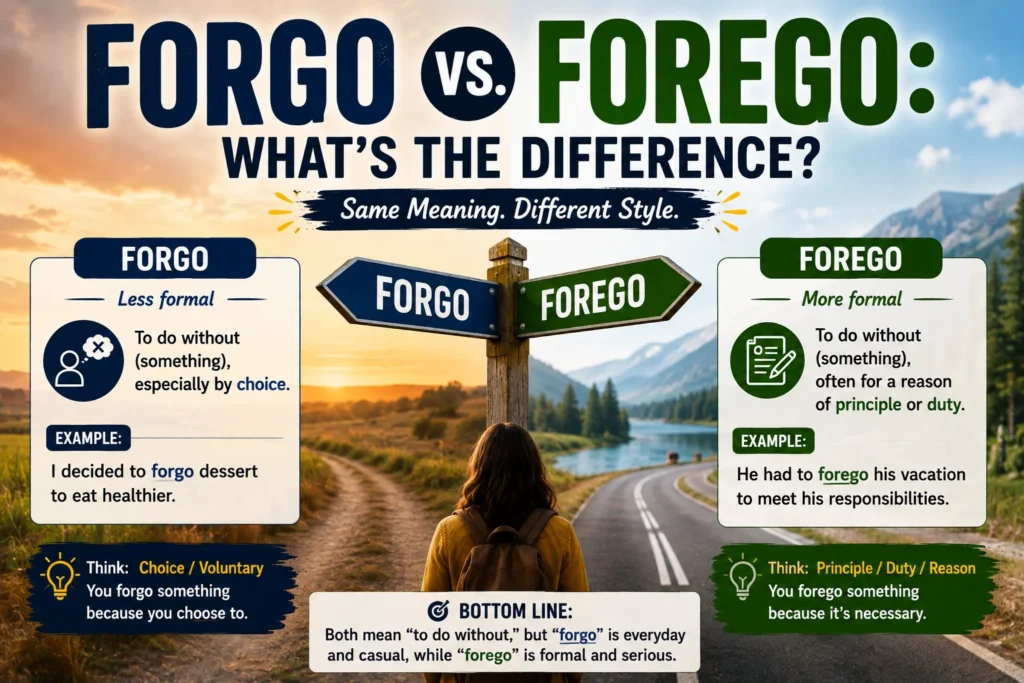
This is a common English spelling question because the two words look and sound very similar. The main difference is their meaning.
Forgo usually means to give up, skip, or do without something. Forego, in its traditional sense, means to go before or precede something. However, forego is also accepted as a variant spelling of forgo when it means “give up.”
For most modern writing, the easiest rule is:
Forgo = give up
Forego = go before
Understanding this distinction also makes related forms such as forgoing, foregoing, forgone, and foregone much easier to use correctly.
The Quick Difference
| Word | Meaning | Example |
| forgo | Give up, skip, or do without | She decided to forgo dessert. |
| forego | Go before or precede | The introduction foregoes the main discussion. |
| forego | Variant of forgo | They chose to forgo the expense. |
When you mean “give up,” forgo is generally the preferred spelling. It is clearer and more common in modern English.
When you mean “come before” or “precede,” forego is the traditional form.
What Does Forgo Mean?
Forgo is a verb meaning to deliberately give up, skip, or choose to do without something available.
For example:
She decided to forgo dessert.
This means she could have had dessert but chose not to.
The word can be used with many things, including:
- an opportunity
- a purchase
- a benefit
- a meal
- a luxury
- convenience
- additional features
- short-term profits
Examples of Forgo
He decided to forgo the expensive upgrade.
They chose to forgo the trip and save money.
The company may forgo short-term profits for long-term growth.
She was willing to forgo convenience for better quality.
We can forgo the extra features and keep the basic plan.
In each example, someone is choosing to do without something.
Forgo Does Not Mean Forget
Forgo and forget are completely different words.
Forget means to fail to remember something:
I forgot my umbrella.
Forgo means to deliberately give something up:
I decided to forgo the umbrella.
The first sentence is about memory. The second is about choice.
This difference is important because the words may look somewhat similar, but they have completely different meanings.
What Does Forego Mean?

In its traditional sense, forego means to go before, come before, or precede something.
For example:
The introduction foregoes the main discussion.
Here, the introduction comes before the main discussion.
The word forego is less common in everyday English with this meaning. In many situations, precede is a more natural alternative:
The introduction precedes the main discussion.
However, forego remains a legitimate word, especially when discussing its related forms.
Can Forego Also Mean “Give Up”?
Yes. This is an important detail.
Forego is also recognized as a variant spelling of forgo in the sense of “give up” or “do without.” Therefore, you may encounter a sentence such as:
They decided to forgo the additional expense.
This does not necessarily mean the writer made a spelling error.
However, if your intended meaning is “give up,” forgo is usually the clearer choice:
They decided to forgo the additional expense.
Using forgo helps avoid confusion with the separate forego = precede meaning.
Forgo or Forego: Which Should You Use?
Use this simple test:
If you mean “give up”
Use forgo.
She decided to forgo dessert.
The company chose to forgo immediate profits.
If you mean “come before”
Use forego in its traditional sense.
The introduction foregoes the main discussion.
However, in modern writing, precede may sound more natural than forego when you mean “come before.”
The Easy Rule
Remember:
Forgo = give up
Forego = go before
There is one exception to remember: forego can also be used as a variant spelling of forgo meaning “give up.” Even so, forgo is generally the safer choice for clear modern writing.
How to Use Forgo Correctly
Now that the basic difference between forgo and forego is clear, the next important step is learning how forgo changes form in a sentence.
Forgo is an irregular verb. Its past tense is not forgoed. Instead, the correct forms are:
forgo → forwent → forgone
Learning these forms will help you avoid some of the most common mistakes with this word.
Forgo, Forgoes, Forwent, Forgone, and Forgoing
Here are the main forms of forgo:
| Form | Use | Example |
| forgo | Base form | I will forgo dessert. |
| forgoes | Third-person singular | She forgoes unnecessary expenses. |
| forwent | Past tense | He forwent the opportunity. |
| forgone | Past participle | They have forgone the benefit. |
| forgoing | -ing form | She is forgoing the upgrade. |
The most important forms to remember are:
forgo → forwent → forgone
Not:
forgo → forgoed → forgoed
When to Use Forgo
Use forgo when the subject chooses not to have, use, or do something.
It commonly appears in situations involving choices, sacrifices, priorities, and trade-offs.
Forgo + Noun
The most common pattern is:
forgo + noun
For example:
She decided to forgo dessert.
He chose to forgo the upgrade.
They decided to forgo the vacation.
The company may forgo some short-term revenue.
In each sentence, the object is something the person or organization chooses to do without.
Choose to Forgo
Another common structure is:
choose to forgo + noun
For example:
She chose to forgo the expensive option.
The team chose to forgo its usual break.
The investor chose to forgo immediate returns.
This structure is especially useful when you want to emphasize that the decision was deliberate.
Decide to Forgo
You can also use:
decide to forgo + noun
For example:
We decided to forgo the extra features.
He decided to forgo the purchase.
They decided to forgo the trip this year.
The construction works naturally in both everyday and professional writing.
Forgo in Everyday English
Although forgo is a normal English word, it has a somewhat formal tone. In casual conversation, people often use phrases such as skip, give up, or go without instead.
For example:
I decided to skip dessert.
Sounds more conversational than:
I decided to forgo dessert.
Both sentences are correct. Forgo simply sounds more formal and precise.
This makes it particularly useful in articles, reports, business writing, academic writing, and professional communication.
Forgo in Business and Professional Writing
Forgo is especially useful when describing a trade-off.
For example:
The company chose to forgo short-term profits in favor of long-term growth.
The company is giving up one possible benefit to pursue another.
Other examples include:
The business decided to forgo immediate revenue to improve customer satisfaction.
The investor was willing to forgo short-term returns for greater long-term stability.
The organization may forgo certain benefits to reduce operating costs.
This is one reason forgo appears frequently in business and financial writing.
Forgo in Academic Writing
The word can also be useful when describing research decisions.
For example:
The researchers decided to forgo additional testing because the existing evidence was sufficient.
The study forwent a larger sample because of limited resources.
The researchers were willing to forgo some convenience to improve accuracy.
In these examples, forgo expresses a deliberate decision to leave one option aside.
The Past Tense of Forgo: Forwent
The simple past tense of forgo is forwent.
For example:
She forwent the opportunity.
He forwent dessert.
They forwent the expensive hotel.
The company forwent immediate profits.
Do not write:
She forgoed the opportunity.
The standard form is:
She forwent the opportunity.
This irregular past tense is one of the most important forms to memorize.
The Past Participle: Forgone
The past participle of forgo is forgone.
It is normally used with auxiliary verbs such as has, have, and had.
For example:
She has forgone several opportunities.
They have forgone the additional expense.
The company had forgone short-term revenue.
Compare the two forms:
She forwent the opportunity.
Simple past.
She has forgone the opportunity.
Past participle.
A useful pattern to remember is:
forwent = past tense
forgone = past participle
The -ing Form: Forgoing
The present participle and gerund form is forgoing.
It means giving something up or choosing to do without something.
For example:
Forgoing the purchase helped her save money.
He is forgoing the upgrade.
Forgoing convenience can sometimes reduce costs.
They are forgoing some benefits to keep the project affordable.
Notice the spelling:
forgoing
not:
foregoing
The two words have different meanings.
Forgoing = giving up
Foregoing = previously mentioned or coming before
We will look at this distinction in more detail in the next parts.
Forgo vs. Skip vs. Give Up
Sometimes you may wonder whether forgo is the best word for your sentence.
All three expressions can describe leaving something aside, but their tone is different.
| Expression | Typical tone | Example |
| skip | Casual | I decided to skip dessert. |
| give up | Neutral | I decided to give up dessert. |
| forgo | More formal | I decided to forgo dessert. |
Forgo is particularly useful when the decision involves a sacrifice or trade-off.
For example:
The company chose to forgo immediate profits.
This sounds more precise and professional than:
The company chose to skip immediate profits.
Common Forgo Mistakes
Mistake 1: Using “Forgoed”
Incorrect:
He forgoed the opportunity.
Correct:
He forwent the opportunity.
Mistake 2: Using “Forwent” After Has or Have
Incorrect:
She has forwent the opportunity.
Correct:
She has forgone the opportunity.
Remember:
forwent = simple past
forgone = past participle
Mistake 3: Confusing Forgoing and Foregoing
Incorrect when you mean “giving up”:
Foregoing the purchase saved money.
Preferred:
Forgoing the purchase saved money.
The first spelling can suggest a different meaning, so forgoing is the clearer choice when you mean “giving up.”
A Quick Forgo Practice Test
Choose the correct form in each sentence:
- She decided to ___ dessert.
- He ___ the opportunity last year.
- They have ___ several benefits.
- ___ the upgrade helped them save money.
The answers are:
- forgo
- forwent
- forgone
- Forgoing
The pattern is:
forgo → forwent → forgone → forgoing
Once you remember this sequence, using the word correctly becomes much easier.
Key Takeaway
Forgo means to give up, skip, or do without something. It is usually the preferred spelling when that is the intended meaning.
Its main forms are:
forgo — give up
forgoes — gives up
forwent — gave up
forgone — given up
forgoing — giving up
The most important rule is:
Never use “forgoed” as the standard past tense. Use “forwent.”
And when using has, have, or had, use forgone:
She has forgone the opportunity.
What Does Forego Mean?
Forego is more complicated than forgo because it has two recognized uses.
In its traditional sense, forego means to go before, come before, or precede something. The spelling reflects the prefix fore-, which often carries the idea of something being in front or happening earlier.
For example:
The introduction foregoes the main discussion.
Here, the introduction comes before the main discussion.
However, forego is also used as a variant spelling of forgo, meaning to give up or do without something.
That means context is important.
Forego Meaning “Precede”
When forego means “precede,” it describes something that happens, appears, or comes before something else.
For example:
The opening remarks forewent the formal presentation.
The remarks came before the presentation.
Another example:
A brief introduction foregoes the main argument.
The introduction comes first.
This meaning of forego is legitimate, but it is relatively uncommon in everyday English. In most modern contexts, precede is more familiar and natural.
For example:
The opening remarks preceded the formal presentation.
This is usually clearer than:
The opening remarks forewent the formal presentation.
Therefore, you don’t need to force yourself to use forego when precede communicates the idea more naturally.
Why the Spelling “Forego” Makes Sense
The prefix fore- often relates to something that is before, ahead, or in front.
You can see this idea in words such as:
- forehead
- forefront
- foreword
- foremost
- forefather
This gives you a useful memory trick:
fore- = before
Therefore:
forego = go before
This is a helpful way to distinguish the traditional meaning from forgo, which means “give up.”
Forego Can Also Mean “Give Up”
This is the part that makes confusing.
Forego can also be used as a variant spelling of forgo in the sense of give up or do without.
For example:
They decided to forego the additional expense.
Here, forego means the same thing as:
They decided to forgo the additional expense.
The spelling forego is not automatically wrong in this context.
However, forgo is generally the clearer and more common choice when you mean “give up.” If you are writing an article, essay, report, or professional document, using forgo can help avoid confusion.
That in a Sentence
Compare these two sentences:
She decided to forgo dessert.
Here, she chose not to have dessert.
Now compare:
The introduction foregoes the main discussion.
Here, the introduction comes before the discussion.
The meanings are completely different:
forgo = give up
forego = precede
Although forego can also mean “give up” as a variant, using forgo for that meaning is usually clearer.
Forego, Foregoes, Forewent, Foregone, and Foregoing
Like forgo, the verb forego has several forms.
| Form | Example |
| forego | The introduction may forego the main section. |
| foregoes | The opening section foregoes the main argument. |
| forewent | The introduction forewent the presentation. |
| foregone | The earlier event had foregone the later development. |
| foregoing | The foregoing discussion explains the issue. |
The forms can look very similar to the forgo family, which is why meaning should always guide your spelling.
Forgoing vs Foregoing
One of the biggest spelling problems occurs with forgoing and foregoing.
Forgoing
Forgoing means giving something up or doing without something.
For example:
Forgoing the purchase helped her save money.
The person decided not to make the purchase.
Other examples:
Forgoing dessert helped him stay within his diet.
Forgoing unnecessary features can reduce costs.
She is forgoing the upgrade to save money.
In each example, something is being given up.
Foregoing
Foregoing commonly means previously mentioned or coming before.
For example:
The foregoing discussion explains the problem.
This means:
The discussion mentioned above explains the problem.
Other examples include:
The foregoing information provides useful background.
Based on the foregoing analysis, the proposal should be revised.
The parties agreed to the terms described in the foregoing section.
This use is particularly common in formal, academic, legal, and business writing.
Forgoing vs Foregoing: The Easy Test
If you’re unsure which spelling to use, replace the word with a simpler phrase.
If it means:
giving up
use forgoing.
For example:
Forgoing the purchase saved money.
Replace it:
Giving up the purchase saved money.
The meaning works.
If it means:
mentioned above
use foregoing.
For example:
The foregoing discussion explains the issue.
Replace it:
The discussion mentioned above explains the issue.
Again, the meaning works.
This simple replacement test can prevent most mistakes.
Foregone vs Forgone
The same distinction appears with foregone and forgone.
Forgone
Forgone is the past participle of forgo and means given up.
The company had forgone the opportunity.
The company gave up the opportunity.
Foregone
Foregone is associated with forgo and commonly appears in the phrase foregone conclusion.
The result was a foregone conclusion.
A foregone conclusion is an outcome that seems certain or predetermined before the final result.
Other examples include:
Her victory seemed like a foregone conclusion.
The outcome appeared to be a foregone conclusion from the beginning.
The expression is firmly established in modern English.
Why “Foregone Conclusion” Uses Fore-
The phrase foregone conclusion is easy to remember because fore- carries the idea of something being determined beforehand.
A foregone conclusion is essentially a conclusion regarded as settled before all the events have finished.
Therefore, don’t write:
forgone conclusion
when you mean the established expression.
The standard phrase is:
foregone conclusion
Forego in Formal Writing
You may encounter forego and especially foregoing more often in formal writing than in everyday conversation.
For example:
The foregoing discussion provides sufficient evidence.
Based on the foregoing analysis, the proposal requires revision.
The terms described in the foregoing section remain unchanged.
These sentences are grammatically correct, but foregoing can sound formal or legalistic.
In less formal writing, you could often use simpler alternatives:
The discussion above provides sufficient evidence.
Based on the analysis above, the proposal requires revision.
The terms described in the previous section remain unchanged.
Using simpler alternatives can improve readability without changing the meaning.
Common Forego Mistakes
Mistake 1: Assuming Forego Is Always Wrong
It is not.
Forego is a legitimate word and can mean “precede.” It can also be used as a variant of forgo, meaning “give up.”
So this statement is too broad:
“Forego is always incorrect.”
A better rule is:
Use forgo when you mean “give up” for the clearest modern usage, and use forego when you mean “precede.”
Mistake 2: Writing Forgoing When You Mean “Mentioned Above”
Incorrect:
The forgoing discussion explains the issue.
If you mean the discussion presented earlier, the preferred form is:
The foregoing discussion explains the issue.
Mistake 3: Writing Forgone Conclusion
Incorrect:
It was a forgone conclusion.
The established expression is:
It was a foregone conclusion.
Mistake 4: Confusing Foregone With Forgone
Remember:
forgone = given up
foregone = predetermined / gone before
For example:
The opportunity was forgone.
The result was a foregone conclusion.
Key Takeaway
Forego has a traditional meaning of “go before” or “precede.” It is less common in everyday English, where precede is often a clearer alternative.
However, forego can also be used as a variant of forgo meaning “give up.” Because of this overlap, forgo is usually the better spelling when your intended meaning is “give up.”
The most important related forms are:
forgoing = giving up
foregoing = previously mentioned
forgone = given up
foregone = predetermined or settled beforehand
Once you connect each spelling with its meaning, the difference becomes much easier to remember.
Common Mistakes With Forgo and Forego
The difference between forgo and forego can be confusing because the words look and sound very similar. The easiest way to use them correctly is to focus on the meaning of the sentence.
Forgo usually means to give up, skip, or do without something. Forego traditionally means to come before or precede. However, forego is also accepted by some dictionaries as a variant spelling of forgo when it means “give up.”
Using Forego When You Mean Forgo
One of the most common mistakes is using forego when you mean give up.
For example:
She decided to forego dessert.
This spelling is not necessarily wrong because forego is recognized as a variant of forgo in this sense. However, forgo is generally the clearer and more widely preferred spelling:
She decided to forgo dessert.
The same applies in professional writing:
The company chose to forgo immediate profits.
He was willing to forgo the extra benefits.
They decided to forgo the expensive option.
When your intended meaning is give up, skip, or do without, forgo is usually the safest choice.
Confusing Forgoing With Foregoing
Forgoing and foregoing are especially easy to confuse.Forgoing means giving something up or choosing to do without it:Forgoing the expensive option helped the family save money.
Here, the family chose not to spend the extra money.
Foregoing, on the other hand, commonly means previously mentioned or coming before:
The foregoing discussion explains the main issue.
In this sentence, foregoing refers to the discussion that appeared earlier.
A simple replacement test can help:
- Forgoing = giving up
- Foregoing = mentioned above / previously stated
Confusing Forgone With Foregone
The same distinction applies to forgone and foregone.
Forgone is the past participle of forgo and means something was given up:
The company had forgone the opportunity.
The company chose not to take the opportunity.
Foregone belongs to the forego family and is especially common in the expression foregone conclusion:
The result was a foregone conclusion.
This means the result seemed certain or decided beforehand.
So remember:
Forgone = given up
Foregone = predetermined or decided beforehand
Don’t Use “Forgoed”
Another common mistake is treating forgo as a regular verb and writing forgoed.
The correct past tense is forwent:
She forwent the opportunity.
Not:
She forgoed the opportunity. ❌
The main forms are:
| Form | Correct Example |
| forgo | I will forgo dessert. |
| forgoes | She forgoes unnecessary expenses. |
| forwent | He forwent the opportunity. |
| forgone | They have forgone the benefit. |
| forgoing | She is forgoing the upgrade. |
Don’t Confuse “Forgone” and “Forwent”
Another frequent grammar mistake is using forwent after has, have, or had.
Use forwent as the simple past:
She forwent the opportunity.
Use forgone as the past participle:
She has forgone the opportunity.
They had forgone the additional benefits.
A quick rule is:
forwent = simple past
forgone = past participle
Choosing the Wrong Word Based on Sound
Pronunciation doesn’t always help because forgo and forego may sound the same or very similar.
Instead of choosing the spelling by sound, ask what the sentence means.
If you can replace the word with:
- give up
- skip
- do without
choose forgo.
If you can replace it with:
- precede
- come before
- happen earlier
forego may be the intended word.
For example:
We decided to ___ the extra expense.
“Give up the extra expense” makes sense, so:
We decided to forgo the extra expense.
Now consider:
The introduction ___ the main discussion.
“Came before the main discussion” makes sense, so forego fits the traditional “precede” meaning.
Common Sentence Corrections
| Common Mistake | Better Choice | Reason |
| She chose to forego dessert. | She chose to forgo dessert. | “Give up” meaning |
| Foregoing the purchase saved money. | Forgoing the purchase saved money. | Giving something up |
| The forgoing discussion explains the issue. | The foregoing discussion explains the issue. | Refers to earlier material |
| It was a forgone conclusion. | It was a foregone conclusion. | Established expression |
| He forgoed the opportunity. | He forwent the opportunity. | Correct past tense |
| She has forwent the opportunity. | She has forgone the opportunity. | Correct past participle |
A Simple Way to Avoid These Mistakes
Don’t memorize forgo and forego only as spellings. Remember them as meaning groups:
Giving something up:
forgo → forwent → forgone → forgoing
Going before or referring to earlier material:
forego → forewent → foregone → foregoing
There is one important exception: forego can also be used as a variant of forgo meaning “give up.” That’s why seeing forego in that sense doesn’t automatically mean the writer has made a spelling error.
For clear modern writing, however, the practical rule is simple:
If you mean “give up,” use forgo.If you mean “come before” or “precede,” use forego.If you mean “mentioned above,” use foregoing.If you mean “given up,” use forgone.
This approach will help you avoid the most common mistakes while keeping your writing clear and precise.
How to Remember
The difference between forgo and forego becomes much easier once you connect each spelling with its meaning. You don’t need to memorize complicated rules. A few simple memory tricks can help you choose the right word quickly.
The “Give Up” Rule
Remember:
FORGO = GIVE UP
Use forgo when someone chooses to give something up, skip something, or do without it.
For example:
She decided to forgo dessert.
He chose to forgo the extra expense.
The company may forgo short-term profits.
They decided to forgo the trip.
In each example, something is being given up or left aside.
The “Go Before” Rule
For the traditional meaning of forego, remember:
FOREGO = GO BEFORE
The prefix fore- often relates to something being in front, ahead, or earlier. You can see this idea in words such as forehead, forefront, and foreword.
So you can remember:
fore- → before → forego → go before
For example:
The introduction forewent the main presentation.
The introduction came before the presentation.
Remember “Foregoing” as “Mentioned Above”
One of the most useful memory tricks is:
FOREGOING = MENTIONED ABOVE
This is especially helpful in formal, academic, legal, and professional writing.
For example:
The foregoing discussion explains the main issue.
You can mentally replace this with:
The discussion mentioned above explains the main issue.
Another example:
Based on the foregoing analysis, the proposal should be revised.
Here, foregoing refers to the analysis presented earlier.
Remember “Forgoing” as “Giving Up”
In contrast:
FORGOING = GIVING UP
For example:
Forgoing the expensive option helped her save money.
This means she chose not to spend the additional money.
Compare:
Forgoing the purchase saved money.
with:
The foregoing discussion explains the issue.
The first means giving something up. The second means referring to something mentioned earlier.
Forgone vs. Foregone
The same memory pattern works with forgone and foregone.
FORGONE = GIVEN UP
FOREGONE = BEFORE / PREDETERMINED
For example:
The company had forgone the opportunity.
The company gave up the opportunity.
But:
The result was a foregone conclusion.
The result seemed certain beforehand.
The phrase foregone conclusion is one of the most common expressions containing foregone, so it’s worth memorizing as a complete phrase.
A Three-Second Test
When you’re unsure which spelling to use, ask yourself these questions:
1. Does it mean “give up” or “do without”?
→ Use forgo.
2. Does it mean “come before” or “precede”?
→ Use forego.
3. Does it refer to something mentioned earlier?
→ Use foregoing.
4. Does it mean something was given up?
→ Use forgone.
5. Is the phrase “___ conclusion”?
→ Use foregone conclusion.
This quick test can solve most questions.
A Simple Comparison
| Meaning | Correct Word | Example |
| Give up | forgo | She decided to forgo dessert. |
| Gave up | forwent | He forwent the opportunity. |
| Given up | forgone | They had forgone the benefit. |
| Giving up | forgoing | Forgoing the purchase saved money. |
| Go before | forego | The introduction foregoes the discussion. |
| Went before | forewent | The remarks forewent the announcement. |
| Predetermined | foregone | It was a foregone conclusion. |
| Mentioned earlier | foregoing | The foregoing discussion explains the issue. |
Final Takeaway
The most important rule is simple:
FORGO = GIVE UP
FOREGO = GO BEFORE
Although forego can also be used as a variant spelling of forgo meaning “give up,” forgo is usually the clearer and preferred choice when writing modern English.
So, if you’re unsure, ask what the sentence means rather than how the word sounds.
Give up? → forgo
Come before? → forego
Mentioned above? → foregoing
Given up? → forgone
Predetermined? → foregone
Once you remember these four associations, the difference between forgo and forego becomes much easier to use correctly.
Conclusion
Understanding becomes much easier when you focus on meaning instead of appearance. Forgo usually means to give something up, skip it, or choose to do without it. Forego traditionally means to go before or precede, although it can also appear as a variant spelling of forgo. The related forms matter too: forwent and forgone belong to forgo, while foregone and foregoing are commonly connected with forego. When you’re unsure, ask what the sentence actually means. If you’re talking about giving something up, forgo is generally the clearest choice. If you’re referring to something that came before, forego or foregoing may fit. Once you connect each spelling with its meaning, this easily confused pair becomes much simpler to use accurately in everyday, academic, and professional English.
FAQs
Is forgo or forego correct?
Both forgo and forego are legitimate English words, but they can have different meanings. Forgo generally means to give something up or do without it. Forego traditionally means to precede or go before. Dictionaries also recognize forego as a variant spelling meaning “give up,” but forgo is usually the clearer choice for that meaning.
What does forgo mean?
Forgo means to voluntarily give up, skip, or do without something. For example, “She decided to forgo dessert” means she chose not to have dessert. You can use the word for many situations, including giving up an opportunity, benefit, purchase, convenience, or activity. The central idea is choosing not to have or do something.
What does forego mean?
Forego traditionally means to go before or precede something else. For example, an introduction may forego a main discussion when it comes before it. However, forego is also recognized as a variant spelling of forgo meaning “give up.” In modern writing, using forgo for the “give up” meaning usually makes your intention clearer.
What is the past tense of forgo?
The past tense of forgo is forwent, not “forgoed.” For example, “She forwent the opportunity” means she chose not to take that opportunity. The main forms are forgo, forwent, and forgone. Because forgo is irregular, remembering these forms together can help you avoid common spelling and grammar mistakes.
Is it forgoing or foregoing?
Both forgoing and foregoing are correct, but their meanings differ. Forgoing means giving something up or doing without it. Foregoing commonly means something mentioned earlier or something that came before. For example, “Forgoing dessert saved money,” while “The foregoing discussion explains the issue.” Context tells you which form belongs.
Is it forgone or foregone?
Both forgone and foregone are correct forms used in different contexts. Forgone comes from forgo and means something has been given up. Foregone relates to forego and frequently appears in the phrase foregone conclusion, meaning an outcome that seems certain beforehand. Checking the intended meaning will usually reveal the correct spelling.
Is forego a misspelling of forgo?
No. Forego isn’t simply a misspelling of forgo. It traditionally means “to precede” or “to go before.” However, dictionaries also recognize forego as a variant spelling meaning “to give up.” Even though both spellings can occur with that meaning, forgo is generally the more direct and familiar choice.
What does foregone conclusion mean?
A foregone conclusion is an outcome that appears certain before the final result occurs. For example, if one team has dominated every game and faces a much weaker opponent, people might describe its victory as a foregone conclusion. The expression is firmly established in English and is one of the most common uses of foregone.
How can I remember the difference between forgo and forego?
A simple memory trick is FORGO = GIVE UP and FOREGO = GO BEFORE. When you mean choosing not to have or do something, think forgo. When you mean something comes first, think forego. For foregoing, remember “mentioned above,” while foregone commonly appears in “foregone conclusion.”
Why are forgo and forego so confusing?
Forgo and forego are confusing because they look and sound extremely similar while having overlapping historical and modern uses. Their related forms add another layer of difficulty. The best way to distinguish them is to identify the meaning first. If the sentence involves giving something up, forgo is normally the clearest choice.