Bilal

Input or Imput: Which Is Correct? Meaning, Spelling, and Usage

Input or Imput: Which Is Correct? Meaning, Spelling, and Usage

Quick Answer: Is It “Input” or “Imput”? The standard spelling is input. If you are writing an email, academic paper, website, report, technical document, or everyday sentence, input is the form you should normally use. The word imput is sometimes seen because it resembles the way input may sound in fast speech, and Merriam-Webster records

Input or Imput: Which Is Correct? Meaning, Spelling, and Usage Read More »

Understanding Non-finite Verbs in English Grammar: Types, Uses, Examples, and Rules

Understanding Non-finite Verbs in English Grammar: Types, Uses, Examples, and Rules

English grammar becomes much easier when you understand what each verb form actually does. One especially useful group is non-finite verbs. These forms appear everywhere in English, from everyday conversation to academic writing, news reports, and literature. Yet they often confuse learners because they look like ordinary verbs while behaving differently inside sentences.A non-finite verb

Understanding Non-finite Verbs in English Grammar: Types, Uses, Examples, and Rules Read More »

Day Off vs. Off Day: What’s the Difference? (+ Examples)

Day Off vs. Off Day: What’s the Difference? (+ Examples)

If you’ve ever wondered whether to say “day off” or “off day,” you’re not alone. These two expressions contain the same words, yet their meanings can change when the word order changes. That small difference matters in everyday American English, especially when you’re talking about work schedules, school, sports, performance, or how you feel. A

Day Off vs. Off Day: What’s the Difference? (+ Examples) Read More »

Some of Whom or Some of Who? Here’s the Correct Version

Some of Whom or Some of Who? Here’s the Correct Version

If you’ve ever paused over and , you’re not alone. The two phrases look almost identical, yet standard grammar gives them different treatment. In formal English, is the established construction when whom refers to people in a group already mentioned. Some of who is generally not the standard form for that same structure. The difference

Some of Whom or Some of Who? Here’s the Correct Version Read More »

Hi there meaning in English

What Does “Hi There” Mean and Should You Use It?

If you’ve ever wondered what “hi there” means, the short answer is simple: it’s a friendly, informal way to greet someone. The phrase usually feels a little warmer and more conversational than a plain “Hi.” The Cambridge Dictionary classifies “hi” as an informal greeting and even uses “Hi, there!” as an example. Oxford likewise defines

What Does “Hi There” Mean and Should You Use It? Read More »

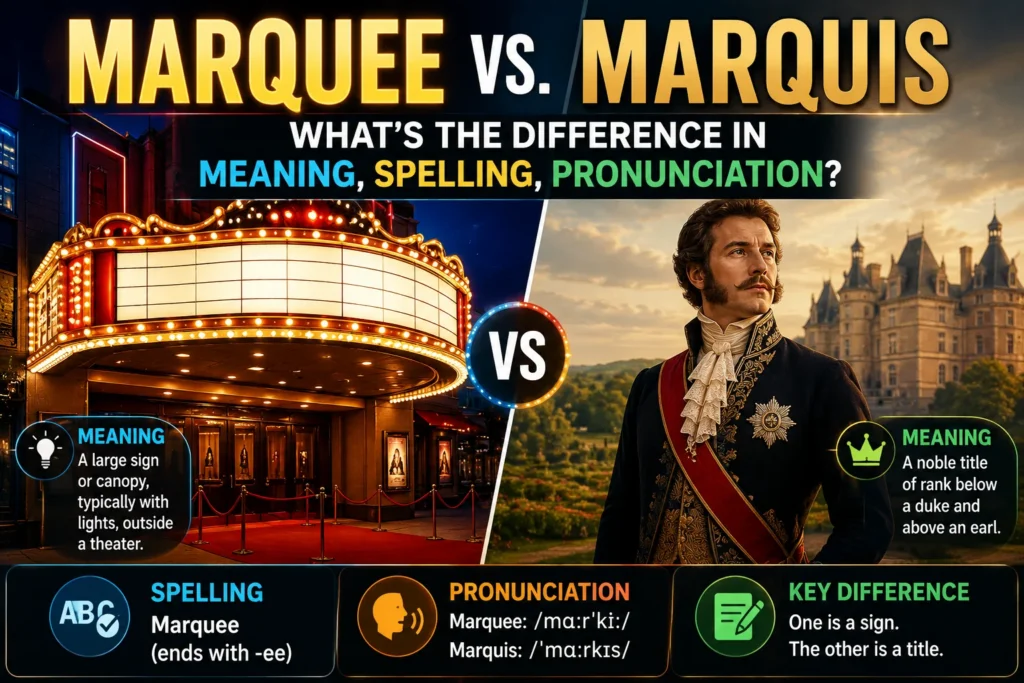
Marquee vs. Marquis: What’s the Difference in Meaning, Spelling, Pronunciation?

Marquee vs. Marquis: What’s the Difference in Meaning, Spelling, Pronunciation?

Quick Answer Marquee and Marquis look remarkably similar, but they belong to different areas of English. Marquee can mean a large event tent, a covered entrance or sign outside a theater, or something considered especially important or popular. Marquis is a noun connected with European nobility. It refers to a man of high social rank

Marquee vs. Marquis: What’s the Difference in Meaning, Spelling, Pronunciation? Read More »

What Does “Hi There” Mean and Should You Use It?

What Does “Hi There” Mean and Should You Use It?

If someone says “Hi there,” they’re usually doing something very simple: greeting you in a friendly way. The phrase sounds warm, approachable, and conversational without necessarily suggesting a close relationship. You might hear it from a stranger at a store, a coworker in a chat, a customer-service agent, or someone starting a casual email. The

What Does “Hi There” Mean and Should You Use It? Read More »

Some of Whom or Some of Who? Here’s the Correct Version With Clear Examples

Some of Whom or Some of Who? The Correct Version With Clear Examples

Some of Whom or Some off you’ve ever stopped while writing a sentence such as “The applicants, some of ___ had years of experience, were interviewed,” you’re not alone. The choice between some of whom and some of who looks small, but it involves an important distinction between subject and object forms of English pronouns.

Some of Whom or Some of Who? The Correct Version With Clear Examples Read More »