
Have you ever used “as a result” several times in the same paragraph? This phrase is useful for explaining consequences, connecting ideas, and showing how one event affects another. However, repeating it can make your writing sound predictable, especially in academic essays, professional emails, and long-form articles.
Fortunately, English offers plenty of alternatives. Expressions such as “therefore,” “consequently,” “because of this,” and “for this reason” can help you communicate cause and effect more naturally. Some sound formal and work well in reports, while others fit everyday conversations.
The key is choosing an expression that matches your meaning, tone, and sentence structure. Not every alternative works in exactly the same way, so understanding their differences will help you write with greater clarity.
What Does “As a Result” Mean?
“As a result” is a phrase used to introduce an outcome, consequence, or effect of something that happened earlier. It connects an action, event, or situation with what followed from it.
In simple terms, it answers the question: What happened because of this?
For example:
- The team prepared carefully. As a result, the presentation went smoothly.
- Heavy rain flooded the streets. As a result, several roads were closed.
- Maya practiced every day. As a result, she improved her speaking skills.
In each example, the phrase introduces an outcome connected to the preceding event. The preparation helped the presentation go smoothly, the rain contributed to road closures, and regular practice improved Maya’s skills.
How “As a Result” Works in a Sentence
“As a result” commonly appears at the beginning of a sentence or clause to connect it to an earlier idea.
At the beginning of a sentence:
The company improved its customer service. As a result, customer satisfaction increased.
After an introductory clause:
Because the shipment arrived late, the store ran out of stock. As a result, several customers placed their orders elsewhere.
Within a sentence:
The company changed its scheduling process and, as a result, reduced delays.
When “as a result” introduces a new independent clause at the beginning of a sentence, place a comma after it. When it appears in the middle of a sentence, punctuation depends on the sentence’s structure and how the phrase connects the clauses.
“As a Result” vs. “As a Consequence”
These expressions are similar because both introduce an outcome. However, “as a consequence” can place greater emphasis on the consequences of an action, particularly when those consequences are serious or undesirable.
For example:
- The company improved its training program. As a result, employees made fewer mistakes.
- The company ignored several safety warnings. As a consequence, it faced serious penalties.
The second example emphasizes the negative outcome of ignoring warnings. Still, either expression can describe positive or negative results, depending on context.
Common Situations Where “As a Result” Is Used
“As a result” is useful in many types of writing and speech. It helps readers understand the relationship between events without requiring a lengthy explanation.
Academic Writing
Students and researchers often use “as a result” to explain findings, connect evidence, or describe the effects of a process.
Example:
The researchers increased the sample size. As a result, the findings provided a clearer picture of the participants’ responses.
In academic writing, alternatives such as “therefore,” “thus,” and “consequently” can reduce repetition. However, choose them carefully. “Therefore” often introduces a logical conclusion, while “consequently” emphasizes an outcome.
Professional Emails and Business Reports
In workplace communication, “as a result” helps explain how a decision or action affected a project, customer, or business process.
Example:
We updated the inventory system last month. As a result, the team can now identify low-stock items more quickly.
For formal reports, “accordingly,” “consequently,” and “therefore” may also work well. In a friendly email, “so” or “because of this” may sound more natural.
Everyday Conversations
People use cause-and-effect expressions to explain everyday situations, from missed appointments to unexpected successes.
Example:
I left home earlier than usual. As a result, I arrived at work before the meeting started.
In conversation, “so” and “that’s why” often sound less formal.
For example:
- I left home earlier, so I arrived on time.
- I left home earlier. That’s why I arrived on time.
Both sentences communicate the connection clearly without sounding overly formal.
News Reports and Explanatory Articles
Writers often use “as a result” when explaining the effects of an event, policy, decision, or change.
Example:
The city introduced new recycling rules. As a result, more households began separating their waste.
Depending on the context, “leading to,” “resulting in,” or “which caused” may offer a more direct way to describe the relationship between an action and its outcome.
Is It Professional or Polite to Say “As a Result”?

Yes. “As a result” is a standard, professional expression that works well in reports, formal emails, academic assignments, presentations, and business communication.
It helps explain how one event or decision connects to another. Because the phrase is neutral, it can introduce positive, negative, or unexpected outcomes without sounding emotional or judgmental.
Professional example:
The department revised its approval process. As a result, requests are now processed more efficiently.
The phrase works because it clearly connects the department’s action with the reported improvement.
When to Use a More Formal Alternative
In formal writing, you can use “therefore,” “consequently,” “thus,” or “accordingly” when they accurately express your intended meaning.
For example:
The original delivery schedule was no longer practical. Therefore, the project manager revised the timeline.
However, these expressions aren’t interchangeable in every sentence. “Therefore” often emphasizes a conclusion drawn from previous information, while “accordingly” can suggest an action taken in response to a situation.
When a Simpler Alternative Is Better
Professional writing doesn’t need to sound complicated. In many emails and workplace conversations, “so,” “because of this,” or “that’s why” communicates the same basic relationship more naturally.
Example:
The client requested a few changes, so we updated the proposal.
This sentence is clear, concise, and appropriate for many professional situations. You don’t need a more formal phrase simply to make your writing sound businesslike.
Advantages and Disadvantages of Saying “As a Result”
“As a result” is a useful phrase, but like any expression, it has strengths and limitations. Understanding both can help you decide when to keep it and when to choose an alternative.
Advantages of “As a Result”
It makes cause and effect clear. The phrase tells readers that the next statement describes an outcome connected to the previous information.
Example: The company improved its website. As a result, customers found the checkout process easier to use.
It works in formal and informal writing. Although it often appears in professional and academic contexts, the phrase is also easy to understand in everyday communication.
Example: I forgot to set an alarm. As a result, I woke up late.
It creates smooth transitions. The phrase helps readers follow an explanation, especially when a paragraph describes several related events.
Example: The school introduced additional tutoring sessions. As a result, students had more opportunities to review difficult topics.
It is neutral in tone. Unlike expressions that emphasize blame or punishment, “as a result” can introduce an outcome without adding an unnecessarily emotional judgment.
Disadvantages of “As a Result”
It can become repetitive. Using the same transition in every paragraph may make an article or report sound monotonous.
Instead of repeating “as a result,” consider whether “therefore,” “consequently,” or “because of this” would fit the next sentence.
It may add unnecessary words. In a short sentence, a direct construction with “so” may be more efficient.
Wordy: The meeting ended late. As a result, we missed the bus.
Concise: The meeting ended late, so we missed the bus.
It can suggest a causal connection that hasn’t been established. The phrase signals that one event is connected to an outcome. If the evidence only shows that two events happened around the same time, claiming a cause-and-effect relationship may be misleading.
For example, if sales increased after a new advertisement launched, you shouldn’t automatically assume the advertisement caused the increase without considering other possible factors.
It may sound overly formal in casual conversation. Although the phrase is perfectly understandable, “so” or “that’s why” can feel more natural when speaking with friends.
How to Choose the Best Alternative
Before replacing “as a result,” consider three things:
- Meaning: Are you describing an outcome, drawing a conclusion, or explaining a reason?
- Tone: Does the sentence belong in an academic paper, business report, personal message, or casual conversation?
- Structure: Does the alternative fit grammatically into your sentence?
These checks help you vary your writing without changing the meaning or making a sentence unnecessarily complicated.
Synonyms for “As a Result”
Several expressions can replace “as a result,” but each has its own emphasis and grammatical pattern. Some introduce a complete clause, while others connect an action directly to its outcome.
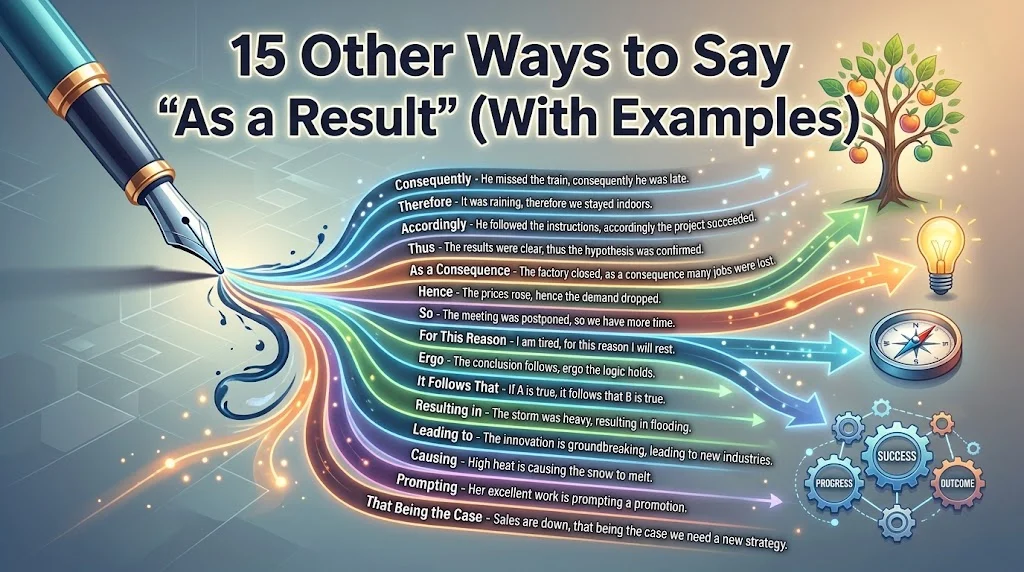
Here’s a quick overview of the 15 alternatives covered in this article:
| Alternative | Main Emphasis | Typical Tone |
| Consequently | An outcome that follows an event | Formal |
| Therefore | A logical conclusion or consequence | Formal or neutral |
| Thus | A result or conclusion | Formal or academic |
| Hence | A consequence or logical result | Formal |
| For this reason | An outcome linked to a stated reason | Neutral |
| Because of this | A consequence connected to the preceding situation | Neutral |
| Due to this | A result associated with a particular cause | Neutral or formal |
| Accordingly | A response or action appropriate to a situation | Formal |
| So | A straightforward result | Conversational |
| That’s why | An explanation of why something happened | Conversational |
| Resulting in | An outcome produced by an action or event | Neutral or formal |
| Leading to | An outcome or development that follows | Neutral |
| Which caused | A direct causal relationship | Neutral |
| As a consequence | An outcome, often emphasizing its significance | Formal or neutral |
| In consequence | A resulting effect or outcome | Formal and uncommon |
These expressions overlap in meaning, but they don’t all fit the same grammatical position. The following sections explain how to use each one, with examples to help you choose the right phrase for your writing.
1. Consequently
Meaning: “Consequently” means that something happens as a consequence of an earlier event, action, or situation. It introduces an outcome that follows from what has already been stated.
Why This Phrase Works: It offers a formal alternative to “as a result,” making it especially useful in academic writing, business reports, and professional explanations. It also helps connect related ideas without repeating the same transition throughout a document.
Real-World Usage Insight: “Consequently” is most effective when the relationship between the initial situation and the outcome is clear. It can introduce positive or negative consequences, depending on the context.
Best Use: Use it in research papers, formal reports, analytical articles, and professional communication when you want to emphasize an outcome.
Avoid When: You’re having a casual conversation or writing a short, friendly message. “So” may sound more natural in these situations.
Tone: Formal, analytical, and objective.
US vs. UK Usage: “Consequently” is standard in both American and British English, with no significant difference in meaning.
Example (Email / Message / Meeting): “The supplier failed to deliver the materials on schedule. Consequently, we had to postpone the product launch until the following week.”
2. Therefore
Meaning: “Therefore” introduces a conclusion or result that follows logically from the information presented earlier. It often signals that the next statement is supported by the preceding facts or reasoning.
Why This Phrase Works: It creates a clear connection between evidence and a conclusion. Although it can replace “as a result” in many sentences, “therefore” often emphasizes logical reasoning rather than simply describing what happened next.
Real-World Usage Insight: In academic writing, “therefore” is especially useful when explaining the implications of research, presenting an argument, or drawing a conclusion from established information. In business writing, it can also explain decisions based on specific circumstances.
Best Use: Use it in essays, reports, presentations, and professional explanations that require a clear logical connection.
Avoid When: You’re describing a sequence of events without drawing a conclusion. “Afterward” may be more appropriate if you only mean that something happened later.
Tone: Formal, logical, and confident.
US vs. UK Usage: “Therefore” is widely used in both American and British English and carries essentially the same meaning in both varieties.
Example (Email / Message / Meeting): “The latest figures show that operating costs have increased significantly. Therefore, we need to review the current budget and identify areas where we can reduce unnecessary spending.”
3. Thus
Meaning: “Thus” means “in this way” or “as a result,” depending on how it is used. When it introduces a consequence, it connects a preceding action, condition, or argument with its outcome.
Why This Phrase Works: It is concise and often suits formal, technical, and academic writing. It can help explain the outcome of a process without adding unnecessary words.
Real-World Usage Insight: “Thus” is common in research papers, scientific explanations, mathematical reasoning, and analytical discussions. However, it can sound stiff in everyday conversation, where a simpler expression may communicate the same idea more naturally.
Best Use: Use it when explaining a process, summarizing a logical outcome, or presenting a conclusion in a formal document.
Avoid When: You’re writing a casual message or speaking informally. “So” or “because of this” may be easier to follow.
Tone: Concise, formal, and analytical.
US vs. UK Usage: “Thus” is understood in both American and British English. Its formal tone is similar in both varieties.
Example (Email / Message / Meeting): “The revised process removes several unnecessary approval steps, thus allowing the team to complete routine requests more quickly.”
4. Hence
Meaning: “Hence” means “as a result,” “for this reason,” or “from this point.” When used to introduce a consequence, it indicates that the stated outcome follows from the circumstances or reasoning described earlier.
Why This Phrase Works: It provides a concise alternative to “as a result” and often fits formal explanations. In some contexts, it can make a sentence more direct by avoiding a longer transitional phrase.
Real-World Usage Insight: “Hence” is common in academic, technical, and analytical writing. It can also appear in business communication, although “therefore” or “because of this” may sound more natural in many everyday professional messages.
Best Use: Use it in formal explanations, technical discussions, and sentences that present a clear consequence.
Avoid When: You’re aiming for a relaxed conversational tone or when the relationship between the two ideas is unclear. A more explicit phrase may help readers understand your meaning.
Tone: Formal, concise, and analytical.
US vs. UK Usage: “Hence” is used in both American and British English. Neither variety gives it a fundamentally different meaning, although preferences may vary by context and writer.
Example (Email / Message / Meeting): “The team completed the initial testing ahead of schedule; hence, we can begin the next phase earlier than expected.”
5. For This Reason
Meaning: “For this reason” means that an action, decision, or outcome follows from a particular reason that has already been explained. It directly connects the stated circumstances to what happens next.
Why This Phrase Works: Unlike some shorter alternatives, this expression makes the relationship between the reason and the outcome easy to follow. It is especially useful when you want to emphasize why a decision was made.
Real-World Usage Insight: “For this reason” works in essays, business emails, explanations, and everyday writing. It is also helpful when you want a transition that sounds professional without being overly technical or formal.
Best Use: Use it when explaining a decision, justifying a recommendation, or connecting a specific problem with a practical response.
Avoid When: The reason has not been stated clearly. Readers may struggle to understand what “this reason” refers to if the preceding sentence contains several possible explanations.
Tone: Clear, neutral, and explanatory.
US vs. UK Usage: The phrase is standard in both American and British English and works in a wide range of contexts.
Example (Email / Message / Meeting): “Several customers reported difficulty navigating the old website. For this reason, we redesigned the main menu and simplified the checkout process.”
Quick Comparison: The First Five Alternatives
| Alternative | Main Emphasis | Best Context | Example |
| Consequently | An outcome that follows an event | Formal reports and analysis | The roads were flooded. Consequently, the event was canceled. |
| Therefore | A logical conclusion | Essays and professional reasoning | Costs increased. Therefore, we revised the budget. |
| Thus | A concise result or conclusion | Academic and technical writing | The process was simplified, thus reducing delays. |
| Hence | A consequence or inferred result | Formal explanations | Testing is complete; hence, we can proceed. |
| For this reason | A clearly stated justification | Emails, explanations, and recommendations | The route was unsafe. For this reason, we chose another road. |
The main difference is the emphasis each phrase creates. “Consequently” highlights an outcome, “therefore” often signals a logical conclusion, and “thus” provides a concise connection. “Hence” is brief and formal, while “for this reason” makes the justification particularly explicit.
Choose the phrase that best expresses the relationship between your ideas instead of replacing “as a result” mechanically.
6. Because of This
Meaning: “Because of this” explains that a particular event, action, or situation led to a specific outcome. It directly connects a cause with its consequence.
Why This Phrase Works: This expression is clear and natural, making it a useful alternative to “as a result” in everyday writing and professional communication. It also helps readers understand exactly which preceding situation caused the outcome.
Real-World Usage Insight: “Because of this” works especially well when the cause has just been explained. Unlike “therefore,” which can emphasize a logical conclusion, this phrase puts more emphasis on the reason behind what happened.
Best Use: Use it in emails, explanations, articles, and conversations when you want to make a cause-and-effect relationship easy to understand.
Avoid When: You want to express a conclusion based on several pieces of evidence rather than identify a particular cause. In that case, “therefore” may be more suitable.
Tone: Clear, natural, and explanatory.
US vs. UK Usage: The expression is common in both American and British English, with no significant difference in meaning.
Example (Email / Message / Meeting): “Several employees requested more flexible schedules. Because of this, management introduced a hybrid work policy that allows eligible team members to work remotely on certain days.”
7. Due to This
Meaning: “Due to this” means that something happened because of a particular circumstance or event. It identifies a cause that helps explain the outcome.
Why This Phrase Works: It provides a relatively formal way to connect a situation with its consequence. It can be useful in reports, workplace communication, and explanatory writing when the preceding cause is clear.
Real-World Usage Insight: Although “due to this” can introduce a consequence, it may sound less natural than “because of this” in some sentences. Writers should also distinguish between “due to this,” which identifies a cause, and “as a result,” which emphasizes the outcome.
Best Use: Use it in explanations, reports, and professional messages when referring directly to a previously mentioned circumstance.
Avoid When: The sentence becomes awkward or the cause is unclear. Consider rewriting the sentence with “because of this” or “as a result” instead.
Tone: Neutral, explanatory, and moderately formal.
US vs. UK Usage: “Due to this” is understood in both American and British English. Its suitability depends more on sentence structure and context than on regional differences.
Example (Email / Message / Meeting): “The original software experienced repeated technical issues. Due to this, the IT department recommended moving the project to a more reliable platform.”
8. Accordingly
Meaning: “Accordingly” can mean “as a result” or “in a way that is appropriate to the circumstances.” It often introduces an action, decision, or adjustment made in response to information or a situation.
Why This Phrase Works: The expression is particularly useful when a result involves a deliberate response. It can make professional writing sound precise without requiring a lengthy explanation.
Real-World Usage Insight: “Accordingly” is often found in business reports, formal notices, policies, and administrative communication. It is especially appropriate when someone changes a plan or takes action based on newly available information.
Best Use: Use it when describing an adjustment, decision, or action that follows from a stated situation.
Avoid When: You simply want to describe an ordinary consequence in casual conversation. “So” or “because of this” will usually sound more natural.
Tone: Formal, professional, and precise.
US vs. UK Usage: “Accordingly” is standard in both American and British English and carries a similar formal tone in both.
Example (Email / Message / Meeting): “The client has requested additional testing before approving the final version. Accordingly, we have adjusted the project timeline to include another review period.”
9. So
Meaning: “So” is a common word used to introduce a result, consequence, or conclusion. It connects two related ideas and often makes the relationship between them sound straightforward.
Why This Phrase Works: It is short, familiar, and natural in conversation. In many situations, it replaces “as a result” without changing the basic meaning, while making the sentence less formal.
Real-World Usage Insight: “So” is especially useful in spoken English, everyday messages, and friendly workplace communication. It can also appear in professional writing when the tone is conversational. In formal academic writing, however, “therefore” or “consequently” may be more appropriate.
Best Use: Use it in casual conversations, text messages, informal emails, and simple explanations.
Avoid When: You need a highly formal or carefully structured academic tone. Also, make sure the relationship between the clauses is clear so that the sentence doesn’t become confusing.
Tone: Conversational, simple, and direct.
US vs. UK Usage: “So” is common in both American and British English. Its basic cause-and-effect function is the same in both varieties.
Example (Email / Message / Meeting): “The meeting has been moved to Thursday, so I’ll send everyone an updated calendar invitation this afternoon.”
10. That’s Why
Meaning: “That’s why” means “that is the reason” and explains why a particular event or situation happened. It connects an outcome to the reason behind it.
Why This Phrase Works: This expression sounds natural and personal. It is particularly effective when explaining your actions, clarifying a situation, or helping someone understand the reason for a decision.
Real-World Usage Insight: “That’s why” often appears in conversations and informal writing. It can also work in friendly professional emails, especially when you want to explain a practical decision without sounding overly formal.
Best Use: Use it in everyday conversations, personal messages, and informal explanations.
Avoid When: You’re writing a formal research paper or a highly structured report. “Therefore,” “consequently,” or “for this reason” may fit better.
Tone: Conversational, explanatory, and friendly.
US vs. UK Usage: “That’s why” is widely understood in both American and British English, with no significant difference in meaning.
Example (Email / Message / Meeting): “The roads are expected to be icy early tomorrow morning. That’s why I’m planning to leave home earlier than usual.”
Quick Comparison: Alternatives 6–10
| Alternative | Main Emphasis | Best Context | Example |
| Because of this | A consequence linked to a specific cause | General and professional writing | The system failed. Because of this, we delayed the launch. |
| Due to this | A result associated with a circumstance | Reports and explanations | Due to this, the team revised its plan. |
| Accordingly | An action or adjustment based on circumstances | Formal business communication | The requirements changed. Accordingly, we updated the proposal. |
| So | A simple, direct consequence | Conversations and informal emails | It was raining, so we stayed inside. |
| That’s why | An explanation of why something happened | Everyday speech and messages | I was busy. That’s why I replied late. |
The distinction is mainly about tone and emphasis. “Because of this” identifies a cause, “accordingly” often signals a response, and “so” offers a concise conversational connection. “That’s why” explains the reason behind an outcome, while “due to this” can sound more formal.
11. Resulting In
Meaning: “Resulting in” describes an outcome produced by an action, event, or condition. Unlike “as a result,” it typically connects directly to the outcome within the same sentence.
Why This Phrase Works: It creates a compact cause-and-effect connection without requiring a separate sentence. This makes it useful when explaining the consequences of a process, decision, or change.
Real-World Usage Insight: “Resulting in” is common in academic writing, reports, and explanatory articles. It often follows a clause describing the cause, then introduces the effect.
Best Use: Use it when you want to describe an outcome concisely in the same sentence as its cause.
Avoid When: You need a complete sentence but have written only a fragment. “Resulting in” usually depends on a preceding clause to form a complete thought.
Tone: Neutral, explanatory, and often formal.
US vs. UK Usage: “Resulting in” is standard in both American and British English, with no major difference in meaning.
Example (Email / Message / Meeting): “The team automated several repetitive tasks, resulting in faster processing times and fewer manual errors.”
12. Leading To
Meaning: “Leading to” describes a situation or action that contributes to a later outcome or development. It emphasizes the connection between an event and what follows.
Why This Phrase Works: It can describe direct effects as well as developments that unfold over time. This makes it useful when the outcome is part of a longer process rather than an immediate consequence.
Real-World Usage Insight: “Leading to” is widely used in reports, articles, academic writing, and everyday explanations. It is particularly useful when discussing trends, decisions, behaviors, and their possible consequences.
Best Use: Use it when describing how one event contributes to another or sets a process in motion.
Avoid When: The relationship is purely chronological and no causal connection has been established. Something happening after an event doesn’t necessarily mean that the first event caused it.
Tone: Neutral, explanatory, and flexible.
US vs. UK Usage: “Leading to” is natural in both American and British English and has the same basic meaning.
Example (Email / Message / Meeting): “The team received unclear instructions at the beginning of the project, leading to repeated revisions and delays.”
13. Which Caused
Meaning: “Which caused” introduces an effect directly attributed to a previously mentioned event, action, or condition. It identifies the outcome as something the earlier situation brought about.
Why This Phrase Works: This expression makes the causal connection explicit. It can be especially useful when the reader needs to understand the direct impact of an event rather than simply recognize that two events are related.
Real-World Usage Insight: “Which caused” commonly appears in explanatory writing, reports, and narratives. Because it makes a direct claim about causation, use it only when the available information supports that connection.
Best Use: Use it when describing a specific consequence and when the sentence clearly identifies what caused that consequence.
Avoid When: You cannot establish that the earlier event actually caused the outcome. In that situation, “which may have contributed to” or “which was followed by” may communicate the relationship more accurately.
Tone: Direct, factual, and explanatory.
US vs. UK Usage: “Which caused” is used in both American and British English with the same basic meaning.
Example (Email / Message / Meeting): “A configuration error interrupted the payment service, which caused several transactions to fail during the morning.”
14. As a Consequence
Meaning: “As a consequence” means that something happened because of an earlier event or action. It is very similar to “as a result,” although it can place extra emphasis on the consequences of a particular choice or situation.
Why This Phrase Works: It offers a useful alternative when you want to highlight the significance of an outcome. It can be especially effective when explaining the effects of a decision, policy, or behavior.
Real-World Usage Insight: The expression appears in formal reports, essays, and explanatory writing. Although it often introduces negative outcomes, it can also describe neutral or positive consequences.
Best Use: Use it when discussing the effects of decisions, actions, or events that deserve particular attention.
Avoid When: You want a short, casual sentence. “So” or “because of this” may communicate the same idea more naturally.
Tone: Formal, explanatory, and sometimes serious.
US vs. UK Usage: “As a consequence” is standard in both American and British English, with similar meaning and usage.
Example (Email / Message / Meeting): “The organization failed to protect confidential customer information. As a consequence, it faced regulatory scrutiny and had to strengthen its data security procedures.”
15. In Consequence
Meaning: “In consequence” means “as a result” or “as a consequence of something.” It introduces an outcome linked to a preceding situation.
Why This Phrase Works: It provides a grammatically valid alternative that may suit certain formal or traditional styles of writing. However, it is less common in contemporary everyday English than “as a result” or “consequently.”
Real-World Usage Insight: Readers may encounter “in consequence” in older writing, formal prose, or particular regional and stylistic contexts. In most modern American English writing, more familiar alternatives will usually sound smoother and more direct.
Best Use: Use it when the surrounding writing already has a formal or traditional style and the expression fits naturally.
Avoid When: You want your writing to sound straightforward and contemporary. “Consequently,” “therefore,” or “as a result” will usually be clearer choices.
Tone: Formal, traditional, and uncommon.
US vs. UK Usage: The phrase is understandable in both American and British English, but it is not equally common in all contexts. In modern writing, “as a result” is generally the more familiar choice.
Example (Email / Message / Meeting): “The committee identified significant gaps in the original proposal and, in consequence, requested a revised submission before making its final decision.”
Comparison Table: The 15 Alternatives to “As a Result”
| Alternative | Best For | Tone | Example |
| Consequently | Explaining a clear outcome | Formal | The shipment was delayed. Consequently, the launch was postponed. |
| Therefore | Drawing a logical conclusion | Formal or neutral | The evidence is incomplete. Therefore, we need further testing. |
| Thus | Expressing a concise result | Academic or technical | The update simplified the process, thus reducing errors. |
| Hence | Introducing a consequence | Formal | The data is insufficient; hence, further research is needed. |
| For this reason | Explaining a decision | Neutral | The road was closed. For this reason, we took another route. |
| Because of this | Connecting a cause to an effect | Neutral | The system failed. Because of this, work stopped temporarily. |
| Due to this | Explaining an outcome’s cause | Neutral or formal | Due to this, the schedule was revised. |
| Accordingly | Describing an appropriate response | Formal | The requirements changed. Accordingly, we updated the plan. |
| So | Connecting ideas conversationally | Informal or neutral | It was late, so we went home. |
| That’s why | Explaining a reason | Conversational | I missed the call. That’s why I sent a message. |
| Resulting in | Connecting a cause and its outcome | Neutral or formal | The change reduced costs, resulting in greater savings. |
| Leading to | Describing a development or consequence | Neutral | The lack of planning led to delays. |
| Which caused | Identifying a direct cause | Neutral | A technical fault occurred, which caused the interruption. |
| As a consequence | Emphasizing an outcome | Formal | The policy changed. As a consequence, procedures were updated. |
| In consequence | A traditional or formal alternative | Formal and uncommon | The proposal was incomplete and, in consequence, was rejected. |
Common Mistakes When Replacing “As a Result”
Using alternatives helps improve your writing, but choosing a phrase based only on similarity can create awkward sentences or change the intended meaning.
Using “Therefore” When You Mean “Later”
“Therefore” usually introduces a conclusion or result, not merely the next event in a timeline.
Incorrect for a simple sequence: “I finished lunch; therefore, I watched television.”
This sentence suggests a logical relationship, but the intended meaning may simply be that television came afterward.
Better: “I finished lunch, and then I watched television.”
Use “therefore” when the second statement follows logically from the first, not merely because it happened later.
Confusing “Resulting In” With a Complete Sentence
“Resulting in” usually connects an outcome to a preceding clause. On its own, it often forms a sentence fragment.
Fragment: “Resulting in fewer mistakes.”
Complete sentence: “The team introduced a new checklist, resulting in fewer mistakes.”
Alternatively, you could write: “The team introduced a new checklist. As a result, employees made fewer mistakes.”
Using “Which Caused” Without Clear Evidence
“Which caused” makes a direct claim about causation. If you only know that one event occurred before another, the wording may be too strong.
Overstated: “The new website launched, which caused sales to increase.”
Unless you have evidence that the website caused the increase, this sentence may imply more certainty than you can support.
More cautious: “The new website launched, after which sales increased.”
This version establishes the sequence without claiming that the launch was necessarily responsible.
Making Casual Writing Too Formal
Expressions such as “hence,” “thus,” and “consequently” can sound stiff in friendly messages.
Overly formal for a casual text: “The bus was delayed; consequently, I arrived late.”
More natural: “The bus was delayed, so I arrived late.”
The goal is not to use the most sophisticated-sounding phrase. It is to communicate the relationship between events clearly.
Repeating Several Transitions in One Paragraph
Using “therefore,” “consequently,” “thus,” and “as a result” repeatedly can make writing feel mechanical. Vary your sentence structure rather than replacing every repeated phrase with another transition.
For example:
“The team reviewed the feedback and identified several problems. It then updated the design to address those concerns. As a result, the revised version was easier to use.”
This paragraph connects the ideas naturally without adding a transition to every sentence.
How to Choose the Right Alternative

Before choosing a replacement, identify what you want the reader to understand.
- For a formal consequence: Choose “consequently” or “as a consequence.”
- For a logical conclusion: Choose “therefore” or “thus.”
- For a clear explanation: Choose “for this reason” or “because of this.”
- For a response to new circumstances: Choose “accordingly.”
- For casual communication: Choose “so” or “that’s why.”
- For a result within the same sentence: Consider “resulting in” or “leading to.”
- For a direct causal claim: Use “which caused” when the evidence supports it.
- For a traditional formal style: Consider “in consequence,” although a more common alternative will often be preferable.
Always check grammar as well as meaning. For instance, “so” can connect independent clauses, while “resulting in” typically functions as a participial phrase. A phrase that expresses the right idea may still need a different sentence structure.
Conclusion
Learning other ways to say “as a result” helps you create clearer, more varied writing without sacrificing meaning. Expressions such as “consequently,” “therefore,” and “thus” work well in formal or analytical contexts, while “because of this,” “so,” and “that’s why” often sound more natural in everyday communication.
The most important distinction is the relationship you want to express. Some phrases emphasize a consequence, others introduce a logical conclusion, and a few describe how an action leads to a particular outcome. Choosing carefully helps readers follow your reasoning and understand how your ideas connect.
You don’t need to replace “as a result” every time you use it. The phrase remains clear and correct in many situations. Instead, vary your wording when another expression fits the context better. With practice, you’ll be able to explain cause and effect naturally in essays, professional emails, reports, and everyday conversations.
FAQs
What is another way to say “as a result”?
Common alternatives include “consequently,” “therefore,” “thus,” “because of this,” and “for this reason.” The best choice depends on the context. “Consequently” emphasizes an outcome, while “therefore” often introduces a logical conclusion. For casual conversations, “so” is usually a simple, natural replacement.
Is “therefore” the same as “as a result”?
The expressions are similar, but their emphasis can differ. “As a result” usually highlights an outcome that follows an event or situation. “Therefore” often introduces a conclusion drawn from the preceding information. Both can express cause and effect, but “therefore” is especially useful in logical arguments, academic writing, and formal explanations.
Can I use “consequently” in professional emails?
Yes. “Consequently” is appropriate in professional emails when you need to explain the outcome of an action, decision, or problem. For example, “The supplier missed the deadline. Consequently, we adjusted the delivery schedule.” If the email is friendly or conversational, “so” or “because of this” may sound more natural.
What is a casual alternative to “as a result”?
“So” and “that’s why” are common casual alternatives. For example, “The train was delayed, so I arrived late” sounds natural in everyday conversation. “That’s why I arrived late” works when you want to explain the reason behind your arrival. Both expressions are easy to understand and widely used.
Is “thus” formal or informal?
“Thus” is generally associated with formal, academic, technical, and analytical writing. It can introduce a result or conclusion concisely. For example, “The new process reduced unnecessary steps, thus improving efficiency.” Although the expression is grammatically correct, “so” or “as a result” may feel more natural in casual conversation.
What is the difference between “as a result” and “as a consequence”?
Both expressions introduce outcomes connected to earlier events. “As a consequence” can place extra emphasis on the significance of an outcome, especially when discussing the effects of a decision or action. However, either phrase can introduce positive or negative consequences. The best choice depends on the sentence and the emphasis you want.
Is “due to this” grammatically correct?
Yes, “due to this” is grammatically acceptable when it clearly refers to a previously mentioned cause or circumstance. For example, “The system experienced repeated failures. Due to this, the team changed platforms.” In some contexts, “because of this” or “as a result” may sound smoother, so consider the sentence’s overall flow.
Can I start a sentence with “as a result”?
Yes. You can begin a sentence with “as a result” when it introduces an outcome connected to the preceding context. For example, “The company improved its training program. As a result, employee performance increased.” When the phrase introduces the sentence’s main clause, a comma normally follows it.
What is the difference between “resulting in” and “leading to”?
Both expressions connect a cause with an outcome. “Resulting in” often presents an outcome directly produced by an action, while “leading to” can describe a development or consequence that unfolds over time. Their meanings overlap, and the best choice depends on the relationship you want to emphasize and the sentence structure.
Which alternative to “as a result” is best for academic writing?
“Therefore,” “consequently,” “thus,” and “hence” can work well in academic writing. Use “therefore” to present a logical conclusion, “consequently” to emphasize an outcome, and “thus” for a concise result. Choose the expression that accurately represents your reasoning rather than selecting a formal alternative simply to sound more academic.