

If you’ve ever hesitated between receiver and reciever, you’re not alone. The two spellings look remarkably similar, and the pronunciation doesn’t give you much help. One small vowel switch, however, makes the difference between the standard English spelling and a common spelling mistake.
The correct spelling is receiver.
The incorrect form is reciever.
The easiest way to remember the difference is to connect receiver with the verb receive. The spelling stays consistent when you move from the verb to the noun:
- receive
- received
- receiving
- receiver
Notice the cei sequence in receive and receiver. That pattern is the key.
But spelling is only part of the story. Receiver has several meanings in everyday English. It can describe a person who gets something, an electronic device that picks up signals, a football player, or a person appointed to manage certain financial or legal matters.
Let’s break down the difference carefully so you can recognize, spell, and use receiver with confidence.
Receiver or Reciever: Quick Answer
Receiver is the correct spelling.
Reciever is a common misspelling.
The correct form contains cei:
receiver
The incorrect form reverses the i and e:
reciever
This mistake often happens because English spelling rules can be confusing. Many people remember the familiar phrase “i before e,” then write reciever automatically. However, receiver follows the -ceive pattern found in words such as receive, deceive, conceive, and perceive.
Receiver Is the Correct Spelling
Use receiver whenever you mean a person or thing that receives something.
For example:
- The receiver signed for the package.
- The radio receiver stopped working.
- The quarterback threw the ball to the receiver.
- The legal receiver took control of the company’s assets.
In each sentence, receiver is spelled with cei.
Reciever Is a Common Spelling Mistake
Reciever is not the standard English spelling of the word.
You may see it in emails, online posts, documents, or informal writing, but its appearance does not make it an accepted spelling. If you are writing professionally, academically, or publicly, use receiver.
A useful correction is simple:
❌ reciever
✅ receiver
The difference is only one vowel position, but that small difference matters.
The Easy Rule to Remember
Instead of trying to memorize a complicated spelling rule, remember:
Receive + r = receiver
Start with the correctly spelled verb receive. Then add the noun-forming ending -r:
receive → receiver
That gives you the correct spelling naturally.
Another useful memory trick is to focus on CEI:
re + cei + ve + r
If you see reciever, check whether the i and e have switched places.
Why Is “Receiver” Correct?
The spelling receiver comes directly from the verb receive. The noun identifies someone or something that receives.
This relationship makes the spelling easier to understand.
Compare these forms:
| Word | Correct spelling |
| Verb | receive |
| Past tense | received |
| Present participle | receiving |
| Noun | receiver |
The important sequence remains connected to the base word.
For example:
The company will receive the shipment.
Then:
The receiver signed the delivery form.
The spelling changes slightly because of the grammatical form, but the core receiv- pattern remains visible.
The Important Letter Pattern
The most useful part of receiver to remember is cei.
Look closely:
r-e-c-e-i-v-e-r
The letters after c are e-i, not i-e.
That gives you:
receiver ✅
rather than:
reciever ❌
This is especially useful because the pronunciation does not clearly tell you which vowel comes first. When you hear the word in normal conversation, the spelling pattern is not obvious.
So instead of spelling the word from sound, connect it to receive.
Why “Reciever” Looks Plausible
The misspelling reciever looks reasonable at first glance because English contains many words in which ie appears together.
For example:
- field
- piece
- believe
- achieve
That familiar pattern can make reciever seem natural.
There is also the popular spelling guideline “i before e except after c.” Many learners remember the first half of that phrase but forget that English spelling has plenty of exceptions and limitations.
The word receive is a good example of why you shouldn’t rely on a short spelling rule without checking the actual word pattern.
Instead, treat receive and receiver as a connected word family.
What Does “Receiver” Mean?
The noun receiver has several meanings, but they all connect to the basic idea of receiving something.
In its broadest sense, a receiver is a person or thing that receives, accepts, collects, or picks up something.
The exact meaning depends on the context.
For example:
The receiver of the package had to show identification.
Here, receiver means the person who gets the package.
In another sentence:
The television receiver isn’t picking up the signal.
Here, receiver refers to equipment that receives an electronic signal.
In sports:
The receiver caught the football near the sideline.
Here, receiver refers to a player whose role includes catching passes.
So, although the spelling stays the same, the meaning can change considerably.
Receiver as a Person
The simplest meaning of receiver is a person who receives something.
This could be a package, payment, message, gift, document, or other item.
For example:
The receiver must sign the delivery form.
Here, the receiver is the person accepting the delivery.
You might also see the word in business or administrative contexts:
The receiver of the funds must provide valid identification.
The word is useful when the focus is on who receives something, especially when the identity of that person matters in a process.
However, everyday English often uses more specific words such as recipient when talking about people.
For example:
The recipient received the award yesterday.
That is why receiver and recipient are related but not always interchangeable.
Receiver as an Electronic Device
In technology, a receiver is a device that receives signals.
The signal might contain audio, video, data, or another form of information.
For example:
The wireless receiver connects the keyboard to the computer.
A radio also contains or uses receiving equipment:
The radio receiver picked up a weak signal.
In technical writing, receiver is often paired with transmitter.
A transmitter sends a signal.
A receiver receives it.
This distinction appears in radio communication, telecommunications, networking, electronics, and other technical fields.
For example:
The transmitter sends the signal, while the receiver detects it.
That sentence shows the basic relationship clearly.
Receiver in a Telephone
The word receiver also has a traditional telephone meaning.
On older telephones, the receiver was the part you lifted from its cradle to speak and listen.
For example:
She picked up the telephone receiver and called her office.
The term remains familiar even though many modern phones no longer have a separate physical receiver in the traditional sense.
You may also hear receiver used more generally when discussing the part of a communication system that handles incoming sound.
The meaning is therefore closely tied to the idea of receiving communication.
Receiver in American Football
In American football, a receiver is a player whose role commonly includes catching forward passes from the quarterback.
For example:
The quarterback threw the ball to the open receiver.
The word is especially common in terms such as wide receiver.
A wide receiver typically lines up away from the center of the offensive formation and runs routes intended to create opportunities to catch passes.
In sports writing, receiver has this specialized meaning, but the spelling remains exactly the same:
receiver
Not:
reciever
This is another useful example because it shows how widely the word appears in everyday American English.
Receiver in Legal and Financial English
In legal and financial contexts, receiver can have a more specialized meaning.
A receiver may be a person appointed to take control of property, assets, or business affairs in certain legal proceedings.
For example:
The court appointed a receiver to manage the company’s assets.
This usage is more formal than the everyday meaning of someone who receives a package.
The underlying idea remains connected to receiving or taking control of something, but the legal role has a specific technical meaning.
When reading legal or financial documents, it is therefore important to consider the context before assuming that receiver simply means “recipient.”
Receiver vs. Reciever: The Spelling Difference
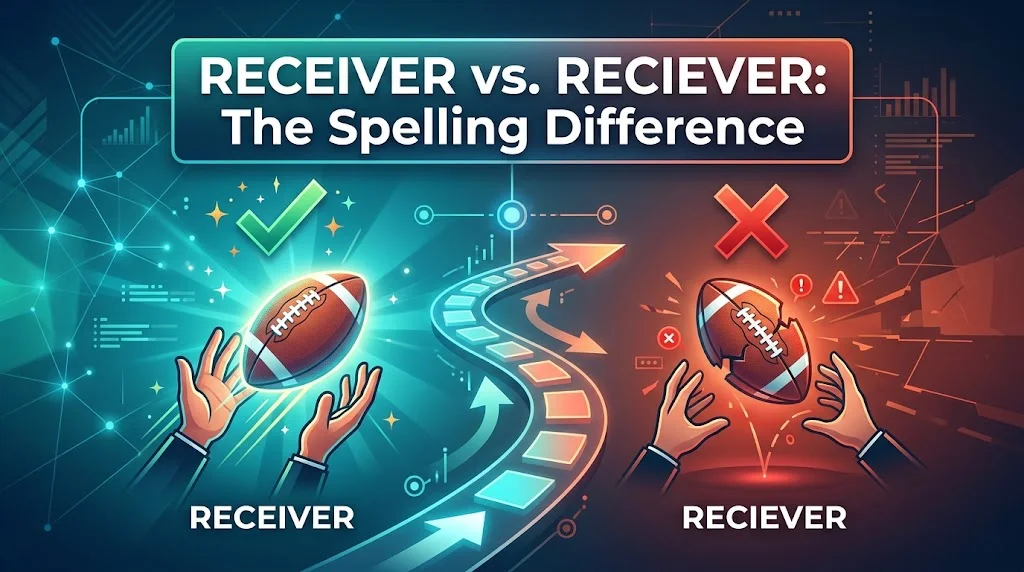
The difference between receiver and reciever is purely a spelling issue.
There is no standard meaning difference between the two forms because reciever is generally a misspelling rather than a separate English word.
Compare them carefully:
| Form | Status | Explanation |
| receiver | Correct | Standard English spelling |
| reciever | Incorrect | Common misspelling |
| receive | Correct | Base verb |
| recieve | Incorrect | Common misspelling of receive |
| received | Correct | Past tense and past participle |
| recieved | Incorrect | Common misspelling |
| receiving | Correct | Present participle/gerund |
| recieving | Incorrect | Common misspelling |
The same vowel-order problem appears throughout the word family.
That is why learning receiver alone isn’t enough. If you remember the spelling of receive, you can usually avoid several related mistakes at once.
Why Do People Spell “Receiver” as “Reciever”?
There isn’t one single reason people make this mistake. Several factors can contribute to it.
The most common is probably confusion about the spelling pattern ie/ei.
English learners are often taught simplified rules about these combinations. Those rules can help sometimes, but they don’t cover every word.
Pronunciation can also contribute to the problem. In ordinary speech, the vowels in receiver don’t clearly announce their written order.
Typing habits are another factor. If you type quickly, your fingers may reverse adjacent vowels without you noticing.
The good news is that the solution is straightforward: connect receiver to receive instead of trying to reconstruct the spelling from sound.
The “I Before E” Rule Can Cause Confusion
You may have learned:
“I before E except after C.”
This traditional spelling mnemonic is often introduced to help learners remember words containing ie and ei.
The problem is that English has many exceptions and complications. Treating the phrase as an absolute rule can create new spelling errors.
For receiver, the useful part is that the word contains cei:
receiver
The same pattern appears in receive:
receive
So the best practical strategy is not to force the word into a general mnemonic. Remember its relationship with receive.
Pronunciation Doesn’t Reveal the Spelling
When you hear receiver, you hear the word’s sounds, not its letters.
That means pronunciation alone won’t reliably tell you whether to write cei or cie.
This is common in English. Several words have spellings that aren’t completely predictable from pronunciation.
For that reason, learners should build a visual connection between related words.
If you already know receive, then receiver becomes much easier:
receive → receiver
The shared spelling pattern gives you a stronger memory cue than pronunciation alone.
Fast Typing Can Reverse the Vowels
Sometimes the problem is not a lack of vocabulary knowledge at all.
You may know perfectly well that receiver is correct, but type reciever because the two vowels are adjacent and easy to reverse.
This can happen when you’re writing quickly, especially in emails, messages, notes, or long documents.
A quick proofreading habit can catch the error.
Whenever you see recie-, pause and check the word. If you mean the noun related to receive, the correct sequence is recei-.
That tiny visual check can prevent a surprisingly common spelling mistake.
The “-Ceive” Pattern
One of the best ways to remember receiver is to recognize the broader -ceive spelling pattern.
Several common English words contain this sequence:
- receive
- deceive
- conceive
- perceive
Notice the shared cei sequence.
For example:
I receive emails every morning.
Some advertising can deceive consumers.
Scientists can conceive new solutions.
We perceive the situation differently.
These words don’t all have exactly the same meaning or grammatical structure, but their spelling pattern can help reinforce cei.
Once cei becomes familiar, receiver becomes easier to spell correctly.
Is “I Before E” a Reliable Rule for Receiver?
The “I before E” saying can be a useful memory aid, but it isn’t a complete description of English spelling.
English contains many words that don’t fit neatly into simplified spelling rules. That’s why memorizing the actual spelling of common words and their related forms is often more reliable.
For receiver, the safest approach is simple:
Remember receive first. Then add -r.
This gives you:
receive → receiver
You don’t need to calculate which vowel should come first every time you write the word.
You simply recognize the established word family.
Why the Rule Is Incomplete
Spelling rules often describe common patterns rather than absolute laws.
English has developed from several languages and spelling traditions, so exceptions are common. Pronunciation has also changed over time while many spellings have remained relatively stable.
As a result, a short rhyme may help you remember some words but won’t replace learning individual spellings.
With receiver, relying on the word’s established form is much safer than trying to apply a broad rule mechanically.
“Except After C” and Its Limitations
The phrase “except after c” points learners toward ei in words such as receive.
That part can be helpful, but the entire rhyme is not a universal spelling law.
A better learning strategy is to remember common word families.
For receiver, focus on:
receive → receiver
Once that connection becomes automatic, the spelling becomes much less likely to cause trouble.
Receive, Received, Receiving, and Receiver
The word receiver belongs to a familiar family built around the verb receive.
Learning the forms together can help you avoid several common errors.
Receive
Receive is the base verb.
It means to get, accept, or take something that is given, sent, or delivered.
Did you receive my email?
The correct spelling contains cei.
Received
Received is the past tense and past participle of receive.
We received the documents yesterday.
A common mistake is to write recieved. The correct form keeps the cei sequence before the v.
Receiving
Receiving is the present participle or gerund form.
The warehouse is receiving new shipments today.
Notice that the final e in receive is dropped before -ing:
receive → receiving
But the important internal spelling pattern remains.
Receiver
Receiver is the noun.
It can refer to a person or thing that receives something.
The receiver confirmed delivery.
Or:
The wireless receiver isn’t working.
The spelling connects directly to the base word:
receive → receiver
This word-family approach is one of the easiest ways to keep the spelling straight.
Receiver vs. Recipient
Receiver and recipient are closely related because both can refer to someone who gets something. However, they aren’t always the best choice in the same context.
A recipient is usually a person who receives something intentionally given, sent, awarded, or addressed to them.
For example:
She was the recipient of the scholarship.
The recipient received the package this morning.
Receiver has a broader range of uses. It can refer to a person, device, sports player, or specialized legal role.
For example:
The receiver signed the delivery form.
The wireless receiver stopped working.
The receiver caught the pass.
The surrounding context usually makes the intended meaning clear.
A Simple Decision Guide
Use recipient when you’re specifically talking about a person who receives something such as a gift, award, payment, message, or package.
Use receiver when the context involves a device, communication system, sports position, legal appointment, or the general act of receiving.
Compare these examples:
The recipient of the award thanked the committee.
The radio receiver needs a new battery.
The quarterback looked for an open receiver.
The receiver signed for the shipment.
The first sentence emphasizes the person receiving an award. The others use receiver in broader or specialized contexts.
Neither word is automatically better. The right choice depends on what you are describing.
Receiver vs. Reception
Receiver and reception come from the same general idea of receiving, but they serve different grammatical roles.
Receiver is a noun that identifies a person, device, player, or other entity that receives something.
Reception is a noun that refers to the act, process, or quality of receiving something.
For example:
The receiver picked up the signal.
The radio has poor reception.
Here, the receiver is the device, while reception describes how well the signal is received.
The same distinction appears in communication:
The receiver understood the message.
The message received a warm reception.
In the second sentence, reception describes the response to the message rather than the person receiving it.
Understanding this distinction helps prevent another common form of word confusion.
Receiver in Real-World Writing
The word receiver appears in many kinds of everyday and professional writing. Its meaning changes with the subject, but its spelling does not.
You may encounter it in emails, technical manuals, shipping records, sports articles, legal documents, and academic material.
The following examples show how naturally the word fits different contexts.
Email Example
In communication, a receiver can be the person who receives a message.
For example:
The email receiver should confirm the information before responding.
However, recipient is often more natural when referring specifically to the person an email was sent to:
Please check the email recipient before sending the message.
In technical discussions about communication systems, receiver can be more appropriate:
The receiver processes the incoming communication signal.
The important point is to consider the context rather than assuming the two words are always interchangeable.
Technical Example
In electronics and communication systems, receiver is a standard technical term.
For example:
The wireless receiver connects the keyboard to the computer.
Or:
The receiver detects the incoming radio signal.
In this context, recipient would not work because the receiver is a device rather than a person.
Technical writing often contrasts a receiver with a transmitter.
A transmitter sends information or signals.
A receiver accepts or detects them.
That distinction appears in many communication technologies.
Delivery Example
The word receiver can also describe the person who accepts a delivery.
For example:
The receiver must sign the delivery document.
This sentence may appear in shipping instructions or logistics paperwork.
However, recipient can sound more natural in ordinary customer-facing communication:
The recipient must provide an identification document.
The choice depends partly on the tone and purpose of the document.
In a formal process description, receiver may emphasize the role being performed. In everyday customer communication, recipient may be more familiar.
Sports Example
In American football, receiver is a standard sports term.
For example:
The receiver ran a deep route before catching the pass.
You can also use the more specific term wide receiver when appropriate.
In sports writing, this meaning is so well established that readers immediately understand what receiver refers to.
The spelling remains:
receiver
The incorrect reciever should not appear in edited sports writing.
Legal Example
In legal and financial writing, receiver can refer to a person appointed to manage property, assets, or business affairs under particular legal circumstances.
For example:
The court appointed a receiver to manage the company’s assets.
This is a specialized meaning, so the word may appear frequently in legal documents but less often in ordinary conversation.
If you’re reading a legal document and encounter receiver, don’t automatically interpret it as “recipient.” Its legal meaning may be much more specific.
Common Errors With Receiver
The spelling receiver causes several related errors because people often reverse the same vowels in other forms of the word.
The mistake isn’t limited to the noun.
Error: Reciever
The most direct spelling error is:
❌ reciever
The correct form is:
✅ receiver
The vowels e and i have been reversed in the incorrect spelling.
A quick way to catch the error is to compare it with receive.
If you can spell receive, you already have most of receiver correctly.
Error: Recieve
Another common error is:
❌ recieve
The correct spelling is:
✅ receive
This mistake is particularly important because receiver comes from receive.
If the base verb is spelled incorrectly in your memory, you are more likely to misspell its related noun too.
Error: Recieved
The past-tense form is often written incorrectly as:
❌ recieved
The correct spelling is:
✅ received
For example:
We received your application yesterday.
The ei sequence appears after the c, giving the familiar cei pattern.
Error: Recieving
The present participle is sometimes written:
❌ recieving
The correct spelling is:
✅ receiving
For example:
We are receiving new orders today.
The final e of receive is dropped before -ing, but the internal spelling remains based on receiv-.
Seeing the entire family together makes the pattern easier to remember:
receive → received → receiving → receiver
How to Remember the Spelling of Receiver
You don’t need to memorize a complicated spelling formula. A few practical memory strategies can make receiver much easier to spell.
The strongest strategy is to connect it directly to receive.
Think “Receive + R”
Break the word into a familiar base and ending:
receive + r = receiver
This is a useful memory shortcut because receive is already a common English word.
If you’re unsure how to spell receiver, mentally start with:
receive
Then add the final r.
That gives you:
receiver
This is usually easier than trying to remember whether ie or ei comes first from scratch.
Remember “CEI”
If you want a visual spelling cue, focus on CEI.
The beginning of the important section looks like this:
receive
And:
receiver
The same cei sequence appears in both words.
When you see reciever, look closely at the middle. The vowels are in the wrong order.
Learn the Word Family
Learning related words together is more effective than memorizing one isolated spelling.
Keep these forms together:
- receive
- receives
- received
- receiving
- receiver
- receivers
When you see the words repeatedly, the correct spelling becomes familiar.
This approach also helps you recognize mistakes such as recieve, recieved, and recieving more quickly.
Don’t Build the Word From Pronunciation
English pronunciation does not always provide enough information to determine spelling.
That’s especially true with receiver.
When you hear the word, you don’t hear the letters e and i separately in a way that reliably tells you their order.
Instead, remember the written form through its word family.
Think:
receive → receiver
This gives you a visual and grammatical connection rather than relying entirely on sound.
Use a Spelling Check
Spell-check tools can catch reciever, but they shouldn’t be your only strategy.
If you’re writing an important email, report, application, or academic paper, read the final text carefully.
Spell-check may identify an obvious misspelling, but it doesn’t always understand what you intended to say. A correctly spelled word can still be the wrong word for a particular context.
For receiver, however, a spelling check is a useful final safety net.
Receiver in Professional Communication
Receiver appears in professional communication whenever the focus is on someone or something that receives information, goods, signals, or responsibility.
For example:
The receiver must acknowledge delivery before the shipment can be closed.
In technical business communication, you may also encounter the word when discussing communication equipment:
The receiver is connected to the central monitoring system.
In logistics, receiver can identify the role of the person accepting goods.
In telecommunications, it can identify the equipment receiving a signal.
The word is therefore versatile, but professional writers should still choose between receiver and recipient carefully.
If you’re talking about a person who receives a specific email or award, recipient may be more natural.
If you’re describing a technical component or a defined receiving role, receiver is often the better fit.
Receiver in Academic Writing
Academic writers may use receiver in several fields, particularly when discussing communication, technology, linguistics, sports, or legal and financial systems.
For example:
The receiver interprets the signal transmitted by the source.
This kind of sentence could appear in communication studies or information theory.
In a technology paper, you might see:
The receiver converts the incoming signal into usable data.
In sports research:
The receiver’s position affects the team’s passing strategy.
The key is precision.
Academic writing often benefits from choosing a term that accurately describes the role being discussed. If the subject is a communication device, receiver is more precise than a general word such as recipient.
Receiver in Communication
In communication, the basic model often includes a source, message, channel, and receiver.
The receiver is the person, group, or system that receives and interprets the message.
For example:
The sender creates the message, while the receiver interprets it.
This use is common in communication studies and related academic fields.
The meaning can also extend to technical communication systems.
A radio transmitter sends a signal.
A receiver detects and processes that signal.
The same basic concept appears across many forms of communication: something sends information, and something else receives it.
That broad meaning helps explain why receiver is such a useful English noun.
Receiver vs. Reciever: A Practical Case Study
Imagine that a shipping company is preparing an email template for customers.
The original sentence says:
The reciever must sign the delivery form.
The writer knows exactly what the sentence means, but the spelling is incorrect.
The corrected version is:
The receiver must sign the delivery form.
The correction doesn’t change the meaning of the sentence. It simply changes the misspelled form to the standard English spelling.
Now consider another sentence:
The recipient must sign the delivery form.
This is also possible, depending on what the company means by the role.
If the document is focused on the person who receives the shipment, recipient may sound natural. If the company’s process specifically defines a receiver as the person responsible for accepting the delivery, then receiver may be the intended term.
The lesson is simple: first identify the meaning, then check the spelling.
The Lesson From the Case Study
A spelling correction should not happen in isolation.
When you see reciever, the first step is to recognize that the intended word is almost certainly receiver.
Then consider whether receiver is actually the right word for the sentence.
This two-step approach is useful in proofreading:
Meaning first. Spelling second.
That prevents you from correcting spelling while overlooking a possible word-choice issue.
Is “Reciever” Ever an Acceptable Variant?
In standard modern English, reciever is not an accepted alternative spelling of receiver.
If you encounter reciever in an article, email, document, or online post, it is normally a spelling error.
The same applies to related forms such as:
❌ recieve
❌ recieved
❌ recieving
The standard forms are:
✅ receive
✅ received
✅ receiving
There is no special American or British spelling that changes receiver to reciever.
If you’re writing for a professional or academic audience, always use receiver.
American English and British English
The spelling receiver is standard in both American English and British English.
There is no normal US-versus-UK spelling difference in this word.
You should therefore write:
receiver
regardless of whether you’re following American or British English conventions.
Other words do have spelling differences between the two varieties, but receiver is not one of them.
This makes the issue relatively straightforward. If you see reciever, changing it to receiver is not a matter of choosing an American or British preference. It’s simply correcting the spelling.
Receiver and Other “-Er” Nouns
Understanding how English forms nouns can also help you remember receiver.
Many English nouns ending in -er identify a person or thing that performs an action.
For example:
- teach → teacher
- write → writer
- drive → driver
- run → runner
- receive → receiver
The pattern isn’t always completely mechanical because English spelling changes can occur when suffixes are added. Still, recognizing the relationship between a verb and its corresponding noun can strengthen your spelling memory.
With receive, the connection is particularly useful:
receive → receiver
The noun identifies the person or thing doing the receiving.
This meaning-based connection makes the spelling easier to retain than memorizing random letters.
How to Proofread “Receiver” Quickly
When proofreading a document, you don’t need to stop every time you see receiver.
A quick visual check is enough.
Look at the middle of the word.
Does it contain:
cei
If yes, you probably have the correct spelling.
Does it contain:
cie
If you intended the standard word meaning a person or thing that receives, check it carefully.
The Receiver Checklist
Before submitting important writing, use this quick checklist:
- Is the word spelled receiver?
- Does it contain cei?
- Is it connected to the verb receive?
- Am I using receiver or recipient for the intended meaning?
- If the word is technical, does receiver describe the device or system accurately?
- Have I accidentally written reciever?
- Have I also checked related forms such as received and receiving?
This takes only a few seconds but can eliminate a common spelling mistake.
Practice: Receiver or Reciever?
Now test your understanding.
The radio ______ stopped working.
The correct answer is receiver.
The sentence refers to a device that receives a radio signal.
The radio receiver stopped working.
Did you ______ my email?
The correct answer is receive.
This sentence needs a verb, not the noun receiver.
Did you receive my email?
We ______ the documents yesterday.
The correct answer is received.
The sentence describes something that happened in the past.
We received the documents yesterday.
The wireless ______ isn’t connecting.
The correct answer is receiver.
Here, the word refers to a device that receives a wireless signal.
The wireless receiver isn’t connecting.
The quarterback threw the ball to the open ______.
The correct answer is receiver.
In American football, a receiver is a player who catches passes.
The quarterback threw the ball to the open receiver.
These examples show why context matters. The correct spelling isn’t enough by itself; you also need the correct grammatical form.
Correct These Common Mistakes
Here are several errors worth recognizing during proofreading.
Reciever
Incorrect:
❌ The reciever signed the form.
Correct:
✅ The receiver signed the form.
The vowels have been reversed.
Recieve
Incorrect:
❌ Did you recieve the package?
Correct:
✅ Did you receive the package?
The verb should contain cei.
Recieved
Incorrect:
❌ We recieved your application.
Correct:
✅ We received your application.
The past-tense form keeps the cei pattern.
Recieving
Incorrect:
❌ The office is recieving new applications.
Correct:
✅ The office is receiving new applications.
The e is dropped before -ing, but the internal cei pattern remains.
Correct Answers
The correct forms are:
receive
received
receiving
receiver
If you learn these as a single word family, you’re less likely to make the same vowel-order mistake repeatedly.
Receiver vs. Reciever: Quick Comparison
| Point | Receiver | Reciever |
| Standard spelling | Yes | No |
| Correct in formal writing | Yes | No |
| Related verb | Receive | — |
| Key spelling pattern | cei | Incorrect cie |
| Can describe a person? | Yes | — |
| Can describe a device? | Yes | — |
| Used in American football? | Yes | — |
| Used in legal contexts? | Yes | — |
| American/British spelling difference | None | None |
The central distinction is simple: receiver is the correct spelling, while reciever is a misspelling.
Quick Reference: Common Receiver Forms
The most useful forms to remember together are:
Receive — the base verb.
I receive several emails each day.
Receives — third-person singular present tense.
She receives the reports every Friday.
Received — past tense and past participle.
We received the documents yesterday.
Receiving — present participle or gerund.
The warehouse is receiving new shipments.
Receiver — noun for a person, device, player, or specialized role.
The receiver detected the incoming signal.
Receivers — plural noun.
The technicians tested several receivers.
Learning these forms as a connected group gives you a practical spelling advantage. Instead of wondering whether receiver contains ie or ei, you can connect it immediately to the familiar word receive.
And that brings the spelling question back to its simplest answer:
Receiver is correct.
Reciever is not.
Using Receiver Correctly in Different Contexts
The word receiver is easy to spell once you remember receive + r, but using it correctly also requires attention to context.
The word can describe a person, device, sports player, or specialized legal role. Its meaning depends on the words around it.
Consider these examples:
The receiver signed for the package.
Here, the receiver is a person accepting a delivery.
The satellite receiver lost its connection.
Here, the receiver is electronic equipment.
The quarterback passed to the receiver.
Here, the receiver is a football player.
The court appointed a receiver to manage the assets.
Here, the word has a specialized legal meaning.
The spelling never changes, but the meaning does. That’s why context matters whenever you encounter receiver in professional or technical writing.
Receiver as a General Noun
At its broadest, receiver can describe someone or something that receives.
The noun is formed from the verb receive, with the suffix -er identifying the person or thing associated with the action.
For example:
The receiver of the package signed the form.
The word can therefore work when you want to emphasize the role of receiving rather than simply identify someone as a recipient.
However, context determines whether receiver, recipient, or another noun sounds most natural.
Compare:
The recipient of the scholarship was announced yesterday.
The receiver of the radio signal detected interference.
The first sentence concerns a person receiving an award. The second concerns a technical device. The different nouns make sense because the contexts are different.
Receiver as a Technical Term
Technical writing uses receiver extensively.
A receiver is often part of a system that accepts signals, data, or information sent from another component.
For example:
The receiver converts the incoming signal into usable information.
You might see the word in discussions of:
- radio communication
- wireless devices
- telecommunications
- satellite systems
- audio equipment
- remote controls
- computer peripherals
- navigation systems
In many of these contexts, the opposite or complementary component is a transmitter.
A transmitter sends.
A receiver receives.
This relationship provides another useful way to understand the noun.
For example:
The transmitter sends the signal, and the receiver processes it.
The meaning is clear because the two roles are connected.
Receiver vs. Transmitter
Receiver and transmitter are often used together in technical English.
A transmitter sends a signal or information.
A receiver accepts, detects, or processes that incoming signal.
For example:
The transmitter sends the data to the receiver.
This distinction appears in many communication systems.
The terms can also describe different components within the same device or network.
Understanding the pair makes the meaning of receiver easier to remember. If something sends information, think transmitter. If something gets that information, think receiver.
This also reinforces the basic meaning of the word:
receive → receiver
The spelling and meaning work together.
Receiver in Audio and Home Technology
You may also encounter receiver when discussing home audio equipment.
An audio receiver can combine several functions, including receiving audio signals and routing them to speakers or other components.
For example:
The new audio receiver supports several input sources.
The word may also appear in product descriptions and technical manuals.
In this context, receiver doesn’t mean a person who receives something. It refers to equipment designed to receive and process signals.
That specialized meaning is one reason the word appears frequently in technology-related writing.
If you write about such equipment, receiver is the established spelling.
Writing reciever would simply be a spelling error.
Receiver in Wireless Devices
Small wireless receivers are common in everyday technology.
For example, a wireless keyboard or mouse may use a small USB receiver to communicate with a computer.
You might see instructions such as:
Insert the wireless receiver into an available USB port.
Here, the receiver is the component that accepts the wireless signal from the peripheral device.
This example is useful because it demonstrates how ordinary technology can make the word familiar.
You don’t need to memorize an abstract definition. You can connect the word to something you may actually use.
Again, the spelling is:
receiver
The middle contains cei, just as it does in receive.
Receiver in American Football
In American football, receiver has a specific and widely understood meaning.
A receiver is an offensive player whose responsibilities commonly include running routes and catching passes.
The phrase wide receiver is especially common.
For example:
The wide receiver caught the pass near the end zone.
You may also see:
The quarterback searched for an open receiver.
This specialized sports meaning is completely different from the technical meaning of an electronic receiver, but the underlying idea remains similar: the receiver is the one that receives the ball.
That connection can actually make the meaning easier to remember.
The spelling does not change:
receiver
Not:
reciever
Receiver in Legal and Financial Contexts
Legal English gives receiver another specialized meaning.
A receiver may be appointed by a court or another authorized body to take control of property, assets, or business operations under particular circumstances.
For example:
The court appointed a receiver to oversee the company’s assets.
This meaning often appears in discussions involving financial difficulty, disputes, insolvency, or asset management.
Because legal language can be highly specialized, readers shouldn’t assume that receiver simply means “the person who gets something.”
In a legal document, the surrounding terms usually clarify the role.
This is a good example of why vocabulary knowledge involves more than memorizing a dictionary definition. A familiar word can develop a specialized meaning within a particular field.
Receiver in Communication Theory
In communication studies, the receiver is the person, group, or system that receives and interprets a message.
A basic communication model might include:
sender → message → channel → receiver
For example:
The sender encodes the message, while the receiver interprets it.
Here, receiver refers to the destination of the communication process.
The term is especially useful when discussing how information moves between people or systems.
Depending on the academic framework, you may also encounter terms such as source, sender, encoder, decoder, channel, and recipient.
The exact terminology varies by field, but receiver remains a standard term in many communication contexts.
Receiver vs. Recipient in Communication
The difference between receiver and recipient becomes particularly interesting in communication.
Both words can refer to someone who gets a message.
However, recipient often focuses on the person for whom the message is intended.
Receiver can emphasize the role within a communication process.
Compare:
The recipient received an email from the bank.
This sounds natural in ordinary business communication.
Now consider:
The receiver interprets the message according to the communication model.
This sounds more academic and focuses on the communication role.
Neither word is automatically wrong. The intended meaning and context determine which term works better.
Common Collocations With Receiver
Learning common word combinations can make receiver easier to recognize and use naturally.
Some common collocations include:
- radio receiver
- wireless receiver
- audio receiver
- signal receiver
- satellite receiver
- television receiver
- receiver device
- receiver system
- receiver antenna
- wide receiver
- telephone receiver
- receiver of funds
- receiver of property
- appointed receiver
These combinations show how widely the word is used.
For example:
The radio receiver picked up the broadcast.
The wireless receiver needs to be replaced.
The wide receiver caught the pass.
The court appointed a receiver.
The meaning changes with the collocation, but the spelling remains consistent.
Common Phrases With Receive and Receiver
The connection between receive and receiver becomes especially useful when you encounter both words in the same passage.
For example:
The device receives the signal through its receiver.
Or:
The receiver receives data from the transmitter.
Although repetition may sound awkward in casual writing, technical writing may use these terms precisely.
Other useful combinations include:
receive a message
receive a payment
receive a package
receive a signal
receive information
receive an award
Then consider the corresponding noun:
message receiver
payment receiver
signal receiver
award recipient
The correct noun depends on the specific context.
Why “Reciever” Is Such a Persistent Mistake
Some spelling errors disappear when learners understand a word’s structure. Reciever can be more persistent because several factors reinforce the wrong version.
First, the pronunciation doesn’t clearly reveal the vowel order.
Second, the common “i before e” mnemonic can influence spelling.
Third, many English words contain ie, so reciever looks visually familiar.
Fourth, the mistake is easy to make while typing because the letters e and i are adjacent.
Finally, people often remember a word’s sound before they remember its written form.
The solution is not to memorize more rules. It is to build a stronger connection between related words:
receive → receiver
Once that connection becomes automatic, reciever begins to look visibly wrong.
A Simple Spelling Test
When you’re unsure about receiver, ask yourself:
What is the base verb?
The answer is:
receive
Now add the noun ending:
receive + r
That gives:
receiver
This method works because it uses a word you already know instead of asking you to remember a completely separate spelling.
You can use the same strategy when proofreading.
If you see:
reciever
compare it with:
receive
The mismatch becomes obvious.
Receiver in Workplace Documents
Workplace writing often uses receiver in logistics, technology, communication, and administrative processes.
For example:
The receiver must verify the shipment before signing the form.
Or:
The receiver should confirm that the wireless device is connected.
The word can identify a defined role within a process.
However, workplace writers should avoid choosing receiver merely because it sounds formal. If recipient is more precise, use recipient.
For example:
Please confirm the recipient’s email address.
This is usually clearer than:
Please confirm the receiver’s email address.
On the other hand:
The receiver must connect the device to the transmitter.
Here, receiver is clearly the right technical term.
Professional writing becomes clearer when the noun matches the actual role.
Receiver in Customer Service Writing
Customer service teams may encounter both receiver and recipient.
For deliveries, a company might write:
The recipient must be available to accept the package.
This is natural because the focus is on the person receiving the shipment.
A logistics system, however, may define a receiver as the employee or department responsible for accepting incoming goods.
For example:
The warehouse receiver inspected the shipment.
Here, receiver describes a role within the business.
The difference may seem small, but precise terminology can prevent confusion in workplace procedures.
Receiver in Shipping and Logistics
Shipping and logistics provide another useful context for the word.
A shipment usually has a sender and a person or organization that receives the goods.
Depending on the system, documents may refer to the receiving party as the receiver, recipient, consignee, or another specialized term.
These words aren’t always exact synonyms.
For example, consignee has a specific meaning in shipping and refers to the party to whom goods are consigned.
That means professional logistics writing should use the term required by the process or document.
If the intended word is receiver, make sure it is spelled correctly.
receiver
Not:
reciever
Receiver in Academic and Technical Terminology
Academic and technical writing often depends on precise distinctions.
A communication researcher might discuss the relationship between a sender and a receiver.
An engineer might describe a signal receiver.
A sports researcher might study the performance of a wide receiver.
A legal researcher might discuss the role of a court-appointed receiver.
These examples show why the word has more depth than a simple spelling exercise suggests.
When writing for a specialized audience, use the established terminology of the field. Don’t replace receiver with a more general word simply to avoid repetition if the technical term is necessary.
Does Receiver Always Mean a Person?
No.
One of the most important points about receiver is that it can refer to both people and things.
It can describe:
- a person receiving something
- an electronic device
- a communication component
- a telephone component
- a football player
- a legal or financial appointee
For example:
The receiver signed the document.
Here, the receiver is a person.
The receiver detected the signal.
Here, the receiver is equipment.
The receiver caught the pass.
Here, the receiver is a football player.
Context tells you which meaning applies.
Can Receiver Be Used for an Organization?
Yes, depending on the context.
An organization can be described as a receiver when it receives information, funds, goods, or another item, particularly when the sentence emphasizes its role in a process.
For example:
The receiving organization must verify the documents.
However, recipient, organization, institution, or another specific noun may be more natural depending on the context.
The best choice depends on what you’re trying to emphasize.
If you’re describing a formal role in a communication or transfer process, receiver may work well.
If you’re simply identifying an organization that received something, a more specific term may communicate the idea more naturally.
Receiver and the “-Er” Ending
The ending -er frequently forms nouns connected to actions.
Consider:
teach → teacher
drive → driver
write → writer
receive → receiver
The final noun often identifies someone or something associated with the action expressed by the verb.
This doesn’t mean every verb plus -er follows exactly the same spelling process, but the relationship is useful for vocabulary development.
When you understand that receiver comes from receive, the spelling becomes much easier to remember.
You aren’t memorizing a random sequence of letters.
You’re recognizing a word family.
How to Spot “Reciever” During Proofreading
When proofreading, don’t read only for meaning.
Train yourself to notice familiar spelling patterns.
If you see:
reciever
stop for a moment.
Ask:
Does this come from receive?
If yes, correct it to:
receiver
You can also search a document for reciever before submitting it. This is especially useful when editing a long report, website article, business document, or academic paper.
A quick search can identify every occurrence at once.
You can then check each one in context.
Why Spell-Check Isn’t Enough
Spell-check software is useful, but it shouldn’t replace knowledge of the word.
Most modern spell-checkers can identify reciever as a likely spelling error. However, spelling tools cannot always determine whether receiver or recipient is the better word.
For example:
The receiver of the award attended the ceremony.
The sentence may be understandable, but recipient may be the more natural choice.
A spell-checker may not flag that difference because both words are correctly spelled.
That’s why good proofreading involves two separate checks:
Is the word spelled correctly?
Is it the right word for this context?
Both questions matter.
A Practical Editing Method for Receiver
If you’re editing a document containing receiver, use this simple process.
Check the Spelling
Look for cei, not cie.
receiver ✅
reciever ❌
Check the Word Family
Compare the noun with receive.
receive → receiver
If the relationship makes sense, the spelling is probably correct.
Check the Meaning
Ask what the word refers to.
Is it a person?
A device?
A football player?
A legal role?
A communication role?
The answer should fit the surrounding sentence.
Check for a Better Noun
If you’re referring to someone who receives an award, message, or gift, consider whether recipient is more natural.
If you’re describing a technical device, receiver is usually the appropriate term.
This final check improves both accuracy and style.
Receiver in Everyday Sentences
Here are some natural examples showing the word in different contexts:
The package receiver signed the delivery form.
The television receiver isn’t working properly.
The wireless receiver needs a new battery.
The quarterback threw the ball to the receiver.
The receiver picked up the signal immediately.
The court appointed a receiver to manage the property.
The telephone receiver was resting on the desk.
The radio receiver detected a weak transmission.
Each sentence uses the same spelling but a different contextual meaning.
That versatility is one reason receiver appears in so many areas of English.
Receiver vs. Reciever: What Should You Write?
If you mean a person or thing that receives something, the standard spelling is:
receiver
If you write:
reciever
you have reversed the e and i.
The easiest correction is to connect the word to receive.
Remember:
receive → receiver
The cei sequence stays visible.
This simple connection is more reliable than trying to guess the spelling from pronunciation.
A Final Word-Family Review
Before moving on, review these forms together:
| Correct Form | Function |
| receive | Verb |
| receives | Present-tense verb |
| received | Past tense and past participle |
| receiving | Present participle or gerund |
| receiver | Noun |
| receivers | Plural noun |
The incorrect forms recieve, recieved, recieving, and reciever all share the same basic spelling problem.
Learning the family as a group gives you a much stronger memory than studying receiver by itself.
Once you recognize receive, the correct spelling of receiver becomes much easier to retrieve.
How to Choose Between Receiver and Recipient
One of the easiest ways to use receiver correctly is to ask what role you are describing.
If you mean a person who gets a gift, award, payment, or message, recipient may often sound more natural.
If you mean a device that receives a signal, receiver is the standard term.
If you mean a football player who catches passes, receiver is correct.
If you mean a person appointed to manage assets in a legal proceeding, receiver has a specialized meaning.
Consider these examples:
The recipient of the scholarship thanked the university.
The wireless receiver stopped responding.
The wide receiver caught the pass.
The court appointed a receiver to manage the property.
The key is not simply memorizing one definition. It is recognizing the role the word describes.
When “Receiver” Is the Better Choice
Use receiver when the word identifies something or someone functioning in a receiving role.
This is especially common when the receiving function is important to the sentence.
For example:
The receiver detected the incoming signal.
The device isn’t merely the destination of the signal. Its function is to receive and process it.
Likewise:
The receiver caught the football.
The player’s position involves receiving passes.
And:
The receiver managed the company’s assets.
The person’s legal role involves taking control of specified property or assets.
In each case, receiver describes a defined receiving function.
When “Recipient” Is More Natural
Recipient is often more natural when you are talking about a person who receives something that was given, awarded, sent, or intended for them.
For example:
She was the recipient of the annual award.
The recipient received an email confirmation.
The scholarship recipient thanked the committee.
These sentences focus on the person as the intended receiver of something.
Using receiver isn’t always impossible in such contexts, but it may sound less natural or less precise.
A good writer considers not only whether a word is technically understandable but also whether it is the most natural choice for the intended audience.
Receiver vs. Recipient: Side-by-Side Examples
| Context | Natural Choice | Example |
| Award | Recipient | The award recipient gave a speech. |
| Scholarship | Recipient | The scholarship recipient accepted the offer. |
| Recipient | Check the email recipient before sending. | |
| Radio equipment | Receiver | The receiver detected the signal. |
| Wireless mouse | Receiver | Plug in the wireless receiver. |
| American football | Receiver | The receiver caught the pass. |
| Legal asset management | Receiver | The court appointed a receiver. |
| Telephone | Receiver | He lifted the telephone receiver. |
This comparison shows why context matters more than memorizing a single synonym.
Receiver in Modern Technology
Although receiver has been used for decades in traditional communication systems, it remains common in modern technology.
Wireless devices, audio systems, radio equipment, remote controls, and communication networks may all contain or interact with receivers.
For example:
The wireless receiver connects the keyboard to the computer.
Or:
The satellite receiver processes the incoming signal.
In technical documentation, the word usually has a precise function.
A receiver receives information or signals from another source.
This makes receiver a useful technical term rather than simply a formal alternative to recipient.
Receiver and Wireless Communication
Wireless communication provides a particularly clear example of the sender-receiver relationship.
A device transmits information.
Another device receives it.
For example:
The transmitter sends the signal to the receiver.
The receiver may then decode, process, or convert the information into something useful.
This pattern appears in many systems.
The details differ, but the basic relationship remains:
transmitter → signal → receiver
This is also a helpful memory aid for the word itself.
If something receives a transmitted signal, it is a receiver.
Receiver in Digital Communication
Digital communication systems also use receivers.
A receiver may accept digital signals and process them so that the information can be used by another part of the system.
For example:
The receiver processes the incoming digital signal.
This kind of sentence is common in technical material.
The word’s meaning remains connected to the everyday verb receive, even when the technical process is much more complicated.
That’s an important vocabulary principle: specialized meanings often develop from ordinary words.
Receiver is a good example because its basic meaning remains visible across different fields.
Receiver in Business and Finance
Business writing may use receiver in several ways.
A company may have a person responsible for receiving shipments, funds, documents, or other materials.
Legal and financial documents may also use receiver as a formal title for someone appointed to manage assets.
For example:
The receiver reviewed the company’s financial records.
This use should not be confused with recipient.
A recipient is generally someone who receives something.
A legal receiver may have an official authority or responsibility beyond simply receiving an item.
The surrounding language will usually make the distinction clear.
Receiver in Sports Writing
Sports articles frequently use receiver, especially when discussing American football.
For example:
The receiver gained several yards after catching the pass.
You may also encounter phrases such as:
- wide receiver
- slot receiver
- receiver route
- receiver position
- receiver statistics
The spelling remains the same in every case.
This is another reason it’s useful to learn receiver as a complete word rather than trying to spell it from pronunciation.
Receiver in Historical Telephone Language
The traditional telephone receiver is the part of a telephone used to hear and speak.
For example:
He picked up the receiver and dialed the number.
Modern smartphones have changed the physical design of telephones, but the word remains familiar.
You may still encounter it in historical descriptions, technical discussions, literature, or references to traditional landline phones.
This meaning also helps explain why receiver can refer to a device component rather than a person.
The basic idea is always related to receiving communication.
Is Receiver Formal or Informal?
Receiver is a standard word that works in both everyday and formal contexts.
Its appropriateness depends on the meaning.
You can use it casually:
The receiver for my mouse isn’t working.
You can use it professionally:
The receiver must confirm the shipment before processing the order.
You can use it academically:
The receiver interprets the message within the communication process.
You can also use it technically:
The receiver converts the incoming signal into digital data.
The word itself isn’t inherently informal or overly formal.
The context determines the register.
Can You Use Receiver in Academic Papers?
Yes. Receiver is appropriate in academic writing when it accurately describes the subject.
For example:
The receiver interpreted the message based on the available context.
Or:
The receiver converts the incoming signal into a usable data stream.
The word appears naturally in fields such as communication studies, engineering, electronics, sports science, and legal research.
However, academic writing should always prioritize precision.
If you’re discussing a person who received a scholarship, recipient may be more precise.
If you’re discussing a communication role or technical device, receiver may be the better choice.
Receiver vs. Reciever in Professional Editing
Professional editing requires more than noticing obvious typos.
If you find reciever, correct it to receiver.
But don’t stop there.
Read the entire sentence and ask whether the noun fits the context.
For example:
The receiver of the award attended the ceremony.
This sentence is understandable, but an editor might consider:
The recipient of the award attended the ceremony.
The second version more naturally identifies the person who was awarded something.
Now compare:
The receiver detected the radio signal.
Here, receiver is exactly the right term.
This illustrates an important editing principle:
Correct spelling and correct word choice are separate checks.
How to Proofread Receiver in Seconds
If you’re reviewing a document quickly, use a three-step process.
Step One: Check the Vowels
Look for:
cei
The correct spelling is:
receiver
If you see:
reciever
the vowels have been reversed.
Step Two: Connect It to Receive
Ask:
Can I connect this word to receive?
If yes, the spelling should be:
receive → receiver
This is the fastest memory check.
Step Three: Check the Meaning
Ask what the word refers to.
Is it a person?
A device?
A football player?
A telephone component?
A legal role?
A communication role?
If the context supports the noun, you’re done.
This process takes only a few seconds.
A Useful Memory Trick for Receiver
The easiest memory trick is:
You receive before you become a receiver.
Think about the relationship:
receive = the action
receiver = the person or thing associated with receiving
The spelling naturally follows:
receive + r = receiver
You can also remember:
CEI belongs in receive and receiver.
This visual association is more dependable than trying to remember whether i comes before e in every English word.
Why “Receive + R” Works So Well
The memory trick works because it connects spelling, grammar, and meaning.
You’re not memorizing:
r-e-c-e-i-v-e-r
as an isolated sequence.
Instead, you’re remembering:
receive → receiver
That relationship gives your brain a familiar starting point.
The same strategy can work with other word families.
For example:
teach → teacher
drive → driver
write → writer
receive → receiver
Learning words in families can make spelling easier because related words reinforce one another.
Practice: Choose the Correct Word
Try these examples without looking at the answers first.
The ______ signed for the package.
The correct answer is receiver if the sentence is referring to the person designated to accept the delivery.
The receiver signed for the package.
Depending on the context, recipient could also work, but receiver is grammatically and semantically possible.
Did you ______ the confirmation email?
The correct answer is receive.
Did you receive the confirmation email?
The sentence needs a verb.
The company ______ the payment yesterday.
The correct answer is received.
The company received the payment yesterday.
The sentence describes a completed action.
The wireless ______ needs to be replaced.
The correct answer is receiver.
The wireless receiver needs to be replaced.
Here, the noun refers to a device.
The quarterback looked for the open ______.
The correct answer is receiver.
The quarterback looked for the open receiver.
Here, the word refers to an American football player.
Common Spelling Corrections
Here is a quick reference for the most common forms.
| Incorrect | Correct |
| reciever | receiver |
| recieve | receive |
| recieved | received |
| recieving | receiving |
Notice the same underlying problem in each incorrect form.
The e and i are reversed.
Learning one pattern can therefore help you correct several words.
Instead of memorizing each correction separately, remember the central spelling sequence:
cei
Then connect it to the base word:
receive
A Quick Proofreading Exercise
Suppose you are editing the following paragraph:
The reciever confirmed that the company had recieved the documents. The wireless reciever was also connected to the system.
There are multiple spelling errors.
The corrected version is:
The receiver confirmed that the company had received the documents. The wireless receiver was also connected to the system.
The same vowel-order mistake appeared in two different forms.
This is why recognizing word families is so useful. Once you identify the underlying pattern, several errors can be corrected at once.
Why Spelling Accuracy Matters
A single spelling error may seem minor, but repeated mistakes can affect how readers perceive a document.
In professional writing, spelling errors can distract readers from the message.
In academic writing, they can make otherwise strong work appear less carefully edited.
On a website, repeated misspellings can also reduce clarity and make readers question the quality of the content.
That’s why a simple distinction such as receiver vs. reciever is worth learning.
The correction is easy:
receiver is the standard spelling.
The real challenge is remembering the vowel order.
Receiver vs. Reciever: Quick Comparison
| Feature | Receiver | Reciever |
| Standard English spelling | Yes | No |
| Correct word | Yes | No |
| Related base word | Receive | — |
| Spelling pattern | cei | cie |
| Can describe a person | Yes | — |
| Can describe a device | Yes | — |
| Used in football | Yes | — |
| Used in technical English | Yes | — |
| Used in legal English | Yes | — |
| Standard in American English | Yes | No |
| Standard in British English | Yes | No |
The table makes the central point clear: there is no legitimate spelling choice between the two.
If you mean the standard noun, use receiver.
Quick Reference: Receiver Word Family
Keep these forms together when studying or proofreading:
Receive — to get, accept, or take something.
Receives — the third-person singular present form.
Received — the past tense and past participle.
Receiving — the present participle or gerund.
Receiver — a person, device, player, or other entity that receives.
Receivers — the plural form of receiver.
A useful visual chain is:
receive → receives → received → receiving → receiver → receivers
The exact grammatical form changes according to the sentence, but the core spelling pattern remains familiar.
Final Editing Checklist for Receiver
Before publishing or submitting your writing, run through this quick checklist:
- Write receiver, not reciever.
- Remember receive + r.
- Look for the cei sequence.
- Check related forms such as received and receiving.
- Don’t rely entirely on the “i before e” rule.
- Consider whether receiver or recipient better fits the context.
- Use receiver for technical devices that receive signals.
- Use receiver for American football players in the appropriate context.
- Use receiver when referring to a specialized legal role.
- Proofread important documents before sending or publishing them.
These checks are simple, but they cover most of the mistakes people make with this word.
Final Takeaway: Receiver or Reciever?
The correct spelling is receiver.
Reciever is a common misspelling caused mainly by reversing the e and i.
The easiest way to remember the correct form is to start with receive:
receive → receiver
The cei sequence is the key spelling pattern.
Remembering the entire word family also helps:
receive, received, receiving, receiver
Beyond spelling, receiver has several meanings. It can describe a person who receives something, an electronic device, a telephone component, an American football player, a communication role, or a specialized legal or financial appointee.
When you’re talking about a person receiving an award, gift, or message, recipient may sometimes be more natural. But when the context involves a technical device, football position, communication role, or legal appointment, receiver is the established term.
So when you pause over receiver vs. reciever, don’t guess from pronunciation. Think of the familiar verb receive, keep the cei pattern intact, and write receiver with confidence.
Conclusion
When it comes to Receiver vs Reciever, the correct spelling is straightforward: receiver is the standard English form, while reciever is a common spelling mistake. The easiest way to remember it is to connect the noun with the verb receive. The cei pattern stays in place when you form receiver. Once you recognize that connection, the spelling becomes much easier to remember. It also helps to understand that receiver has several meanings. It can describe a person who receives something, an electronic device, a football player, a telephone component, or a specialized legal role. Depending on the context, recipient may sometimes be a better word for a person who receives something. However, when the intended word is receiver, don’t reverse the vowels. Remember receive → receiver, and you’ll have a simple, reliable way to avoid this common spelling error.
FAQs
Is receiver or reciever correct?
Receiver is the correct spelling. Reciever is a common misspelling caused by reversing the e and i. The easiest way to remember the correct form is to connect it with the verb receive. Both words contain the important cei sequence. If you’re writing professionally, academically, or for publication, always use receiver.
Why is receiver spelled with ei?
Receiver follows the spelling pattern of the verb receive. The important sequence is cei, so the letters after c appear as e-i, not i-e. This pattern also appears in related words such as deceive, conceive, and perceive. Remembering the word family makes the spelling easier than relying entirely on a general spelling rule.
Is reciever an acceptable spelling?
No. Reciever is not the standard spelling of the English noun. It is generally treated as a spelling error rather than an accepted alternative. You should use receiver in formal writing, professional communication, academic work, websites, and other edited content. The same spelling pattern applies to related words such as receive, received, and receiving.
What does receiver mean?
Receiver generally refers to a person or thing that receives something. Depending on context, it can describe a person accepting a delivery, an electronic device receiving a signal, an American football player, a telephone component, or a person appointed to manage assets in a legal proceeding. The surrounding context determines the specific meaning.
What is the difference between receiver and recipient?
Both words can describe someone who receives something, but their typical uses differ. Recipient often refers to a person who receives an award, gift, message, payment, or other intended item. Receiver has broader uses and can describe people, devices, football players, communication components, and specialized legal roles. Context determines which word is more appropriate.
How can I remember how to spell receiver?
A simple memory trick is receive + r = receiver. Start with the familiar verb receive, then add the noun-forming ending. You can also remember the cei sequence. If you see reciever, check the middle of the word and compare it with receive. This quick connection can help prevent the vowel reversal.
Is receiver spelled the same in American and British English?
Yes. Receiver has the same standard spelling in both American and British English. There is no normal US-versus-UK spelling variation that changes receiver to reciever. Therefore, regardless of which variety of English you’re using, write receiver when you mean the standard noun.
Can receiver refer to an electronic device?
Yes. In technical English, a receiver is a device or component that receives signals, data, audio, or other information. Examples include radio receivers, wireless receivers, satellite receivers, and audio receivers. A receiver is often discussed alongside a transmitter, which sends the signal. This technical meaning is very common in modern technology and communication.
Is receiver used in American football?
Yes. In American football, a receiver is a player whose role commonly includes catching passes from the quarterback. Wide receiver is a particularly common term. For example, you might write, “The quarterback threw the ball to the open receiver.” The spelling remains receiver, never reciever, regardless of the sports context.
Is receiver a formal word?
Receiver is a standard English word that works in everyday, professional, academic, technical, and legal contexts. Its level of formality depends on how it is being used. For example, it can describe a wireless device in casual conversation or a court-appointed person in a legal document. The word itself isn’t limited to one writing style.