
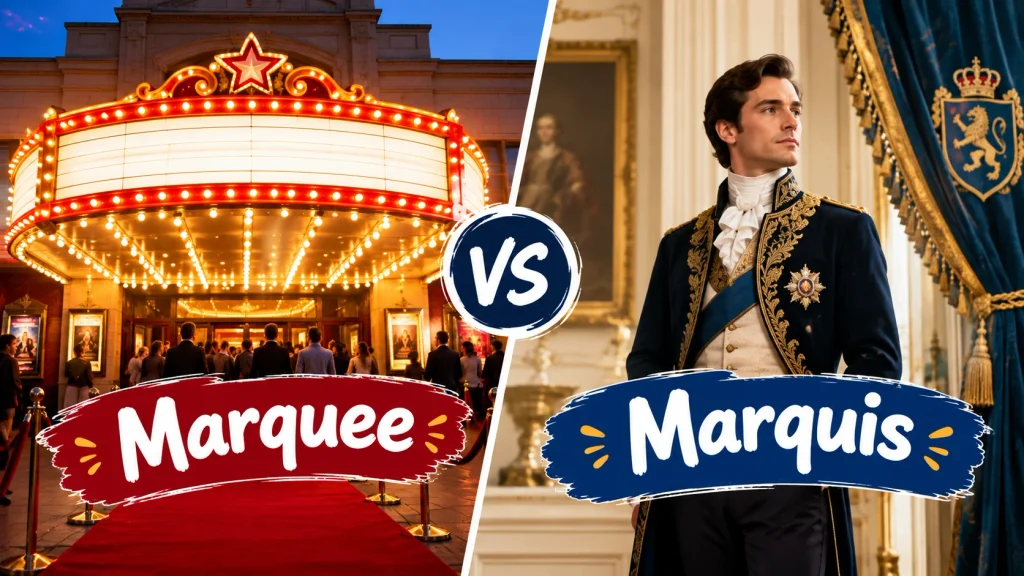
Have you ever seen the words marquee and marquis and wondered whether they mean the same thing? They look remarkably similar, yet they belong to completely different areas of English. One can describe a large event tent, a theater sign, or something highly prominent. The other refers to a traditional title of European nobility.
This difference becomes much easier once you connect each word with its core meaning. Marquee is associated with structures, signs, entertainment, and prominent attractions. Marquis is associated with aristocracy, noble rank, and European history.
The two words can cause trouble because they begin with the same letters, and both have French-related histories. Their pronunciations can also vary by region and dictionary tradition. However, they are not interchangeable.
In this guide, you’ll learn exactly when to use marquee and marquis, how to pronounce each word, how their spellings differ, where they came from, and how to remember the distinction.
Quick Answer: Marquee and Marquis
The simplest rule is this:
Marquee refers to a tent, a theater or venue sign, or something especially prominent. Marquis refers to a nobleman holding a particular aristocratic rank.
Here is the difference at a glance:
| Word | Main Meaning | Typical Context | Part of Speech | Example |
| marquee | Large tent or covered structure | Events, receptions, outdoor gatherings | Noun | We rented a marquee for the wedding. |
| marquee | Sign or canopy above a theater entrance | Movies, theaters, entertainment | Noun | The actor’s name appeared on the marquee. |
| marquee | Highly prominent or featured | Sports, entertainment, business | Adjective | She was the event’s marquee performer. |
| marquis | Male aristocrat of a particular rank | European history and nobility | Noun | The marquis owned a large estate. |
So, if you’re talking about a tent, theater sign, major attraction, or famous featured person, choose marquee.
If you’re talking about a nobleman or aristocratic title, choose marquis.
Dictionaries also recognize regional differences surrounding the related title marquess. Oxford describes marquis as a noble title used in some European countries and notes that it is also used for the British rank called marquess.
A Simple Context Test
When you’re unsure, don’t focus on the spelling first. Ask what the sentence is talking about.
- Is it an event tent? → marquee
- Is it a theater sign? → marquee
- Is it a major or high-profile attraction? → marquee
- Is it a famous player or performer? → marquee
- Is it a nobleman? → marquis
- Is it a European aristocratic title? → marquis
This context-based approach is much more reliable than trying to remember the spelling in isolation.
Why Do People Confuse?
The confusion starts with the visual appearance of the words.
Both begin with marq-:
- marquee
- marquis
That shared opening makes them look related. A reader who has encountered one word many times may unconsciously substitute it for the other.
The endings are different, however:
- marquee ends in -quee
- marquis ends in -quis
Those endings are important because the words have different meanings and grammatical roles.
Similar Spelling Does Not Mean Same Meaning
English contains many pairs of words that look or sound similar without being interchangeable. Marquee and marquis are a particularly noticeable example because both contain the unusual sequence marq-.
The confusion becomes stronger when someone has mostly encountered one word in writing.
For example, a person familiar with the phrase marquee event may recognize the spelling but have little experience with the historical title marquis. Another reader may know marquis from historical novels but have never seen marquee used to describe an event tent.
The result is a spelling substitution.
Consider these two sentences:
The wedding guests gathered beneath the marquee.
The marquis attended the royal reception.
Both sentences are grammatically correct. Replacing one bolded word with the other would completely change the meaning.
Their Meanings Belong to Different Fields
One of the easiest ways to understand the difference is to look at their semantic fields.
Marquee commonly belongs to fields such as:
- events
- hospitality
- theater
- cinema
- sports
- entertainment
- advertising
- business
- marketing
Marquis belongs primarily to fields such as:
- nobility
- aristocracy
- European history
- genealogy
- historical biography
- literature
- monarchies
- social rank
That distinction is powerful because it lets you identify the correct word before you even think about spelling.
If your sentence involves a wedding reception, marquee makes sense.
If your sentence discusses a European nobleman, marquis makes sense.
What Is a Marquee?
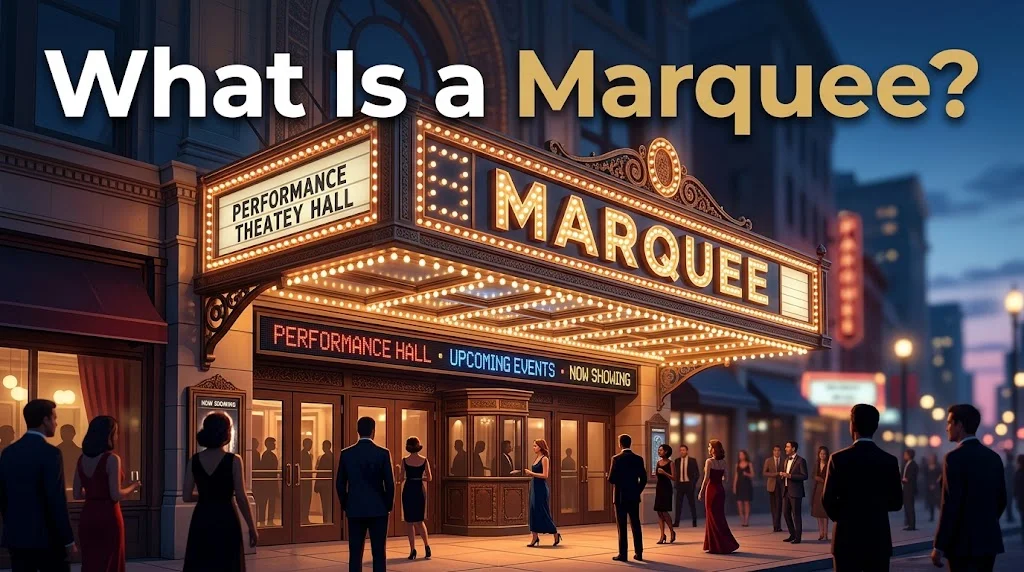
The word marquee has several related meanings in modern English.
In American English, it can refer to a projecting structure or sign over the entrance of a theater or other entertainment venue. It can also refer to a large tent or tent-likee shelter used for outdoor events. In addition, marquee has developed a figurative adjective meaning something highly prominent or likely to attract attention.
These meanings may seem unrelated at first. They actually connect through the idea of something prominent, noticeable, or set apart for an event or attraction.
Marquee as a Tent or Canopy
One traditional meaning of marquee is a large temporary tent or covered structure.
These structures are especially useful for outdoor gatherings where organizers need shelter without constructing a permanent building.
You might see a marquee at:
- weddings
- garden parties
- festivals
- fairs
- corporate events
- outdoor receptions
- exhibitions
- charity functions
- private celebrations
- community gatherings
A marquee can provide protection from sun, light rain, or changing weather while creating a defined space for guests.
For example:
The organizers installed a large marquee on the lawn for the reception.
Here, marquee refers to the physical structure.
The word is particularly useful when the structure is designed for an organized social or public event. Depending on the variety of English, other words such as tent, canopy, or temporary shelter may also work.
Marquee Does Not Simply Mean Any Tent
This distinction is worth remembering.
A small camping tent is not normally called a marquee in everyday American English.
You would usually say:
We bought a new camping tent.
You would be more likely to say:
The wedding guests gathered inside the marquee.
The second sentence describes a large event structure rather than ordinary camping equipment.
Dictionary definitions reflect this event-oriented meaning. Collins describes a marquee as a large tent used at fairs, garden parties, and other outdoor events.
Marquee as a Theater or Entertainment Sign
In American English, marquee has another extremely familiar meaning.
A marquee can be the structure or sign projecting above a theater entrance. It often displays information about the current or upcoming production.
A theater marquee might show:
- the movie title
- the name of a play
- featured performers
- screening information
- promotional messages
- the name of the theater
For example:
The new film’s title was displayed in bright letters on the marquee.
In this use, the word doesn’t refer to the entire theater.
The marquee is the prominent structure or sign associated with the entrance.
This distinction matters because writers sometimes use marquee loosely to mean the whole venue. More precisely, the word identifies the projecting sign or covered entrance structure.
Why Theater Marquees Became So Prominent
The theater marquee has an important visual function.
A theater needs to communicate its current attraction to people passing by. A large, elevated sign accomplishes that immediately.
Historically, many theater marquees became highly recognizable architectural features. Illuminated lettering and rows of lights helped attract attention after dark.
This physical visibility also helps explain the word’s later figurative meaning.
When something is described as marquee, it is often being presented as the main attraction.
That is why modern English can describe a famous performer as a marquee name or an important sports player as a marquee player.
The physical sign became associated with something displayed prominently to attract an audience.
Marquee as a Prominent or Featured Attraction
Modern American English frequently uses marquee in a figurative sense.
As an adjective, it can describe something high-profile, prominent, famous, or expected to attract a large audience. Collins gives examples such as a marquee player and a marquee event.
This use is especially common in sports, entertainment, media, and business writing.
Consider these examples:
The championship game is the weekend’s marquee event.
The club signed a marquee player during the offseason.
The festival announced a marquee performer for Saturday night.
In each sentence, marquee means that the person or event is especially important or attractive to an audience.
Marquee Event
A marquee event is a major or headline event.
For example:
The annual championship is the organization’s marquee event.
The phrase doesn’t mean that the event takes place inside a tent.
Instead, marquee is functioning figuratively. It suggests that the event is one of the most prominent attractions.
This is an important point for learners because the adjective use can initially seem surprising.
Marquee Player
The expression marquee player is common in sports writing.
It usually describes a prominent athlete whose fame, ability, or reputation can attract attention and audiences.
For example:
The team hopes its new marquee player will increase attendance.
Here, marquee has nothing to do with a theater structure. It means the player is a major attraction.
Marquee Name
You may also encounter marquee name in entertainment, business, and promotional writing.
A marquee name is a person, brand, or organization whose recognition gives an event, project, or product extra attention.
For example:
The conference added a marquee name to its speaker lineup.
The expression emphasizes reputation and visibility.
The Connection Between the Meanings
At first glance, these meanings seem separate:
- marquee = tent
- marquee = theater sign
- marquee = major attraction
There is, however, a useful conceptual connection.
A marquee is something associated with an event and designed to provide shelter, identify an attraction, or draw attention to something important.
The figurative sense grew naturally from the idea of a theater marquee displaying the main attraction.
That is why marquee can now describe a person, event, or product that serves as a major draw.
Definition of Marquee
For practical English usage, you can remember three major senses of marquee:
| Sense | Meaning | Example |
| Physical structure | Large temporary event tent | The reception was held under a marquee. |
| Theater structure | Sign or canopy above an entertainment venue | Her name appeared on the theater marquee. |
| Figurative adjective | Prominent or high-profile | He is the team’s marquee player. |
The third sense is particularly important in modern American English because it appears frequently in sports and entertainment coverage.
Is Marquee a Noun or an Adjective?
Marquee is commonly a noun when it refers to a structure or sign.
Examples:
The guests entered the marquee.
The theater replaced its old marquee.
It can also function as an adjective in expressions describing something prominent or high-profile.
Examples include:a marquee eventa marquee playera marquee performera marquee signing
This flexible grammatical use is one reason the word appears in many different contexts.
How Do You Pronounce “Marquee”?
In standard American English, marquee is generally pronounced approximately like:
mar-KEE
A common dictionary pronunciation is represented as /mɑːrˈkiː/ or with closely related American notation. Collins gives the American pronunciation as approximately mar-KEE.
The second syllable receives the main stress:
mar-KEE
The ending sounds like the -kee in words such as kiwi or the final sound in degree, although the full word should be learned as a unit.
Breaking “Marquee” Into Sounds
You can think of it in two parts:
mar + kee
The first part is relatively light.
The second part receives the emphasis.
mar-KEE
Avoid trying to pronounce every letter exactly as it appears. English spelling often preserves historical forms that don’t map neatly onto modern pronunciation.
Why the Spelling Looks Difficult
The spelling marquee contains several letters that can make learners hesitate.
The final -quee may look unusual, but the word is not pronounced with a separate sound for every letter.
The important point is:
marquee → mar-KEE
Once you associate the spelling with the sound, recognition becomes much easier.
What Is a Marquis?
A marquis is fundamentally different from a marquee.
A marquis is a nobleman who holds a particular rank in a system of European aristocracy. In broad terms, the title traditionally falls below a duke and above an earl or count, although exact systems and terminology vary between countries. Collins and Oxford both describe the title in relation to these ranks.
For example:
The marquis hosted a formal gathering at his estate.
Here, marquis identifies the man’s aristocratic rank.
It has nothing to do with a tent, theater, or entertainment sign.
Marquis as a Noble Title
The title belongs to the historical vocabulary of European nobility.
Traditional aristocratic systems included several ranks, and the precise hierarchy differed by country and historical period.
A simplified comparison is:
| Rank | General Position |
| Duke | Higher rank |
| Marquis / Marquess | Below duke |
| Earl / Count | Generally below marquis in systems using the title |
| Viscount | Lower rank |
| Baron | Lower rank |
This table is a broad guide rather than a universal rule for every European country and historical period.
The title marquis has been used in several European traditions. In Britain, the usual English title is marquess, while marquis is also recognized and used in broader European contexts. Oxford specifically notes marquis as the corresponding title in some European countries and gives marquess as the British form.
Marquis and Marquess
This distinction can create another layer of confusion.
Marquis and marquess refer to corresponding noble ranks, but their usage varies by country and tradition.
In British peerage, marquess is the standard form.
For example:
the Marquess of Bath
In other European contexts, particularly those influenced by French terminology, marquis is common.
Therefore, a reader shouldn’t assume that marquis and marquess represent two completely different ranks. They are closely related title forms.
How Do You Pronounce “Marquis”?
The pronunciation of marquis is more complicated than that of marquee because English dictionaries record more than one pronunciation.
In American English, marquis can be pronounced approximately:
MAR-kwiss
It can also occur with a French-influenced pronunciation closer to:
mar-KEE
Collins records both an American pronunciation corresponding to /ˈmɑrkwɪs/ and a French form.
Oxford gives the English pronunciation around /ˈmɑːkwɪs/ and identifies the title’s historical relationship to marquess.
For American English learners, the most useful everyday distinction is:
- marquee → mar-KEE
- marquis → commonly MAR-kwiss in English
That difference makes the two words easier to separate when spoken clearly.
Historical Background of Marquis
The history of marquis goes back to the medieval European concept of a march, meaning a border territory.
A nobleman responsible for a frontier or border region could hold a title connected with that territory. The word developed through forms in medieval French and Latin. Oxford traces marquis through Middle English and Old French forms associated with march, meaning an area along a border between territories.
Collins similarly traces the American English noun through Middle English and Old French forms connected with a frontier region or borderland.
This historical connection explains why the title originally had a political and territorial dimension.
What Was a “March”?
A march in this historical sense was not the same thing as a parade or organized walk.
It referred to a border region.
Medieval kingdoms often had vulnerable frontier areas that required strong military and administrative oversight. Titles connected with these regions developed as part of European systems of governance and nobility.
This background helps explain why marquis became associated with a high-ranking nobleman.
Marquis in Historical Writing
Today, marquis is most likely to appear in historical, literary, genealogical, or formal contexts.
For example:
The marquis controlled several estates near the border.
The historian examined the political influence of the marquis.
The novel introduces a wealthy marquis at the royal court.
These sentences all deal with aristocracy rather than modern entertainment.
The Core Difference
The most important distinction can now be reduced to one idea:
Marquee describes a structure, sign, or prominent attraction. Marquis describes an aristocratic title.
Compare:
The guests waited beneath the marquee.
The word refers to an event structure.
Now compare:
The marquis arrived at the estate.
The word refers to a nobleman.
The spelling difference is small, but the semantic difference is enormous.
| If you’re talking about… | Use |
| A wedding tent | marquee |
| A large event tent | marquee |
| A theater sign | marquee |
| A cinema entrance sign | marquee |
| A major sports attraction | marquee |
| A famous performer | marquee |
| A high-profile event | marquee |
| A European nobleman | marquis |
| An aristocratic title | marquis |
| Historical European nobility | marquis |
This is the foundation for everything that follows.
If you remember only one rule from this section, remember:
Marquee attracts an audience. Marquis holds a title.
Side-by-Side Comparison
The easiest way to keep marquee and marquis separate is to compare their meanings, grammatical roles, and typical contexts.
Although the words look similar, they perform very different jobs in a sentence. Marquee has several modern meanings, while marquis remains closely tied to a noble title.
| Feature | Marquee | Marquis |
| Main meaning | Tent, theater sign, or prominent attraction | European noble title |
| Common part of speech | Noun and adjective | Noun |
| Common modern context | Events, entertainment, sports, business | History, nobility, literature |
| Physical meaning | Large temporary event structure or sign | None |
| Figurative meaning | Important, prominent, high-profile | Generally none in standard usage |
| Related title | None | Marquess |
| Feminine form | None | Marchioness |
| Common phrase | marquee event | Marquis of ___ |
| Typical field | Entertainment and events | Aristocracy and history |
The difference becomes even clearer when you examine the words in complete sentences.
The festival hired a large marquee for the outdoor reception.
The marquis invited several aristocratic families to his estate.
The first sentence concerns an event structure. The second concerns a nobleman.
A Meaning-Based Choice Test
When you’re editing a sentence, ask one simple question:
What does the word describe?
If it describes a structure, sign, event, player, performer, or major attraction, you probably need marquee.
If it describes a nobleman or aristocratic rank, you need marquis.
This approach is especially useful because both words can be spelled correctly while still being wrong for the sentence.
For example:
The actor’s name appeared on the marquis.
The spelling is valid English, but the word is incorrect in this context.
The correct sentence is:
The actor’s name appeared on the marquee.
Likewise:
The marquee attended the royal ceremony.
That sentence makes no sense if you intend to identify a nobleman.
The correct word would be:
The marquis attended the royal ceremony.
Pronunciation Differences
Pronunciation creates another interesting difference between marquee and marquis.
The spelling of each word contains the unusual sequence marq-, so learners may expect them to sound nearly identical. In English, however, the pronunciation patterns are different in common usage.
How to Pronounce “Marquee”
Marquee is generally pronounced:
mar-KEE
The second syllable carries the main stress.
You can represent the pronunciation approximately as:
mar-KEE
The ending sounds like kee.
The word has two syllables:
- mar
- quee
The unusual spelling of quee shouldn’t cause you to pronounce the final letters separately. The ending produces a long ee sound.
Why “Marquee” Sounds Different From Its Spelling
English spelling often preserves historical patterns that don’t correspond perfectly to modern pronunciation.
In marquee, the letters qu do not create the sound that many learners might initially expect from words such as queen. Instead, the ending is pronounced with a simple long e sound.
That gives you:
marquee → mar-KEE
This pronunciation is consistent with the word’s common American English use for a theater sign or prominent attraction.
Example Sentences With the Pronunciation
Read these aloud:
The movie title appeared on the marquee.
We rented a marquee for the reception.
The quarterback became the team’s new marquee player.
In all three examples, the word is pronounced mar-KEE.
The meaning changes according to context, but the pronunciation remains the same.
How to Pronounce “Marquis”
The pronunciation of marquis requires a little more attention because English usage includes pronunciation variation.
A common American English pronunciation is approximately:
MAR-kwiss
The first syllable receives the main stress.
So, for many American English speakers:
marquis → MAR-kwiss
The final part sounds roughly like kwiss.
This is noticeably different from:
marquee → mar-KEE
That difference can help you distinguish the words during conversation.
Why “Marquis” Has Pronunciation Variation
The word marquis has a long connection with French and European aristocratic terminology.
As a result, pronunciation can vary according to language, region, historical context, and the speaker’s preferred pronunciation.
Some sources record a pronunciation closer to the French form, while English-language dictionaries also provide an anglicized pronunciation.
For American English learners, the practical point is simple:
Don’t assume that marquis is automatically pronounced exactly like marquee.
When you’re reading historical material aloud, you may encounter different pronunciations. Context still determines the meaning.
Are they homophones?
No, marquee and marquis are not normally treated as homophones in standard American English.
A homophone is a word that sounds the same as another word but has a different spelling and meaning.
For example:
- flower and flour
- right and write
- sea and see
Marquee and marquis generally don’t fit this pattern in American English because marquee is commonly pronounced mar-KEE, while marquis is commonly pronounced MAR-kwiss.
There can be pronunciation variation for marquis, particularly because of its French history. Even so, the two words should not be treated as interchangeable spellings.
Why Homophone Confusion Still Happens
People sometimes confuse words because they look similar rather than because they sound identical.
That’s exactly what can happen with marquee and marquis.
A learner might remember the shared marq- spelling and forget the ending. Someone who has encountered one word only occasionally may also guess the spelling from memory.
This is why learning the meaning + pronunciation + spelling together is more effective.
Common Pronunciation Mistakes
Several pronunciation errors are especially common among learners.
Pronouncing “Marquee” Letter by Letter
A reader may see marquee and try to give every letter a separate sound.
That produces an unnatural pronunciation.
Remember:
marquee → mar-KEE
The final -quee is not pronounced as separate q-u-e-e sounds.
Pronouncing “Marquis” Like “Marquee”
Another mistake is assuming:
marquis = mar-KEE
That pronunciation can occur in French-influenced contexts, but it isn’t the only English pronunciation. In American English, MAR-kwiss is a common pronunciation for the noble title.
Guessing Pronunciation From Spelling Alone
This is a broader English-learning problem.
Words borrowed from French and other languages often preserve historical spellings. Their modern English pronunciation may not be obvious from their letters.
For marquis, the safest strategy is to learn the word as a complete unit rather than applying a letter-by-letter rule.
Spelling Differences Between
The spelling difference is small but significant.
Marquee
M-A-R-Q-U-E-E
Marquis
M-A-R-Q-U-I-S
Both begin:
M-A-R-Q-U
The difference appears at the end:
- marquee → -ee
- marquis → -is
That final difference represents much more than spelling. It separates two completely different words.
| Spelling | Ending | Main Meaning |
| marquee | -quee | Tent, sign, prominent attraction |
| marquis | -quis | Noble title |
A Useful Spelling Memory
Think of the final letters as a warning sign.
When you see:
-quee
Think:
event, theater, attraction → marquee
When you see:
-quis
Think:
noble title → marquis
This won’t explain every historical detail, but it gives you a fast practical memory tool.
Why Do Learners Mix Them Up?
The two words create a perfect situation for spelling confusion.
They are:
- visually similar
- relatively uncommon compared with basic vocabulary
- historically connected to French
- used in very different contexts
- easy to mistype
- sometimes encountered primarily in writing
A learner may recognize marquee immediately because of phrases such as marquee event. However, marquis may appear mainly in history books or literature.
This uneven exposure can make one spelling feel more familiar than the other.
The Role of Context
Context is your strongest clue.
Consider this sentence:
The newspaper called the championship the city’s biggest ______ event.
The correct answer is marquee.
Why?
Because the sentence describes an important or high-profile event.
Now consider:
The novel’s main character was a wealthy ______.
The answer is marquis.
Why?
Because the sentence describes an aristocratic man.
You don’t need to memorize a complicated linguistic rule. You simply need to identify the meaning.
Easy Memory Trick
A good memory trick should connect the word to a clear mental picture.
For marquee, imagine a brightly lit theater entrance or a large white event tent.
For marquis, imagine a nobleman standing at a European royal court.
Those two images belong to completely different worlds.
Remember “Marquee”
Associate marquee with:
TENT + SIGN + STAR
A marquee can be:
- a large event tent
- a theater sign
- a prominent attraction
The phrase marquee event is particularly useful because it connects the word with something important or highly visible.
Think:
Marquee = something that gets attention.
A theater marquee attracts attention to a movie or show. A marquee event attracts attention to a major occasion. A marquee player attracts attention to a sports team.
Remember “Marquis”
Associate marquis with:
NOBLE + TITLE + HISTORY
Think of a European aristocrat.
The word belongs to the vocabulary of:
- noble titles
- aristocratic families
- historical estates
- European monarchies
- historical literature
Think:
Marquis = a noble title.
The Two-Word Mental Picture
You can make the distinction even easier with one imaginary scene.
Picture a large event marquee outside a historic estate.
Inside the estate is a marquis.
The marquee is the structure.
The marquis is the nobleman.
That simple contrast can make the spelling easier to recall.
When Should You Use “Marquee”?
Use marquee when your sentence involves a large temporary event structure, a theater sign, or something especially prominent.
The exact meaning depends on the context.
Marquee for an Event Structure
Use the noun marquee when describing a large temporary shelter for an organized event.
Examples:
The wedding reception was held inside a spacious marquee.
The organizers erected a marquee beside the garden.
Guests moved into the marquee when the rain began.
In each example, marquee means a temporary event structure.
Marquee for a Theater Sign
Use marquee when referring to the prominent sign or canopy above a theater entrance.
Examples:
The film’s title was displayed across the theater marquee.
Thousands of people gathered beneath the marquee.
The old cinema restored its historic marquee.
This is especially familiar in American English.
Marquee as a Figurative Adjective
Use marquee as an adjective when you want to emphasize importance, prominence, or audience appeal.
Examples:
The tournament’s marquee matchup attracted national attention.
The festival booked a marquee performer.
The company announced a marquee partnership.
Here, marquee means something like featured, major, high-profile, or headline.
It does not mean that a physical tent is present.
Examples of “Marquee” in Different Contexts
The word becomes much easier when you see it operating naturally across different fields.
| Context | Example | Meaning |
| Wedding | We decorated the marquee with flowers. | Event tent |
| Theater | Her name appeared on the marquee. | Theater sign |
| Sports | The game is a marquee matchup. | Major attraction |
| Entertainment | The actor is the film’s marquee star. | High-profile |
| Business | The company landed a marquee client. | Important/prominent |
| Festival | The concert is the festival’s marquee event. | Main attraction |
Marquee in Event Planning
Event planners often use marquee when discussing large outdoor functions.
For example:
The venue can accommodate a 300-person marquee.
The exact capacity depends on the structure, layout, seating arrangement, local regulations, and event requirements. A marquee is not defined by one universal size.
This is another reason not to treat marquee as simply a synonym for tent. The word often carries an event-specific or formal planning context.
Marquee in Sports
Sports writers use marquee extensively in phrases such as:
- marquee matchup
- marquee player
- marquee game
- marquee signing
- marquee event
These expressions highlight something that is expected to attract attention.
For example:
The two teams will meet in the season’s biggest marquee matchup.
The adjective emphasizes the importance and appeal of the contest.
Marquee in Business
Business writers sometimes describe important clients, brands, or partnerships as marquee.
For example:
The startup attracted several marquee clients during its first year.
The phrase suggests that these clients have strong reputations or provide significant credibility.
However, marquee is promotional language. In formal business writing, you should use it when the prominence is meaningful rather than simply using it as decoration.
When Should You Use “Marquis”?
Use marquis when referring to the historical or aristocratic title.
The word is most appropriate in contexts involving European nobility, historical figures, genealogy, biography, literature, or formal descriptions of aristocratic rank.
Marquis in Historical Writing
Historical writing frequently uses marquis when discussing noble families and European political systems.
For example:
The marquis controlled several properties in the region.
The king appointed the marquis to an important position.
The historian studied the political influence of the marquis.
Each sentence refers to an aristocratic figure.
Marquis Before a Name
A noble title can appear directly before a person’s name.
For example:
Marquis de Lafayette played an important role in the American Revolutionary era.
Here, Marquis forms part of the person’s recognized title and is capitalized.
This illustrates an important distinction between a generic title and a specific title used as part of a name.
Compare:
The marquis arrived at the palace.
Here, the word is a common noun and is lowercase.
Now compare:
Marquis de Lafayette arrived in America.
Here, Marquis is part of a specific title and name.
Capitalization can vary with the style guide and exact construction, so writers should follow the conventions required for their publication.
Examples of “Marquis” in Different Contexts
| Context | Example | Meaning |
| History | The marquis owned several estates. | Nobleman |
| Biography | The marquis became influential at court. | Aristocratic title |
| Literature | The novel features a mysterious marquis. | Noble character |
| Genealogy | The family descended from a marquis. | Noble ancestor |
| Formal title | Marquis de Lafayette | Specific title/name |
The common thread is always nobility.
If you can replace marquis with nobleman without changing the basic meaning, you’re probably using it correctly.
Marquis and European Nobility
The historical meaning of marquis becomes clearer when you understand the broader concept of European peerage.
A noble title was more than an honorific. In many historical societies, rank could affect political influence, landholding, military responsibility, inheritance, and access to royal courts.
The exact rights and privileges associated with a marquis varied greatly across countries and periods.
Therefore, it is misleading to treat every marquis as having exactly the same powers.
The safest description is that marquis identifies a particular aristocratic rank within several European systems of nobility.
In Modern American English
The two words have very different levels of everyday usefulness in American English.
Marquee appears regularly in modern media and business language.
You may encounter it in:
- sports coverage
- entertainment news
- event planning
- theater discussions
- advertising
- business reporting
- marketing
- hospitality
Marquis, by contrast, is much more specialized.
It tends to appear in:
- historical writing
- biographies
- literature
- genealogy
- discussions of European nobility
- historical fiction
- formal descriptions of aristocratic figures
This difference in frequency can explain why marquee may feel familiar while marquis seems unusual.
A Modern Usage Comparison
Consider the following examples:
The stadium is preparing for a marquee matchup.
Modern sports language makes this completely natural.
Now consider:
The marquis attended the royal banquet.
That sentence sounds historical or literary because the social rank itself belongs primarily to traditional aristocratic systems.
The words therefore differ not only in meaning but also in register and subject matter.
Common Uses of “Marquee” in Entertainment
Entertainment is one of the areas where marquee has developed a particularly strong figurative role.
A marquee can literally identify a theater.
From that physical meaning came the broader idea of something that deserves prominent attention.
That is why entertainment writers may describe:
- a marquee actor
- a marquee performer
- a marquee production
- a marquee release
- a marquee attraction
For example:
The festival’s marquee performer closed the evening with a sold-out concert.
The word tells the reader that the performer is a major draw.
Common Uses of “Marquee” in Sports and Media
Sports journalism often uses marquee because major games and athletes compete for audience attention.A marquee matchup is a highly anticipated contest.A marquee player is a prominent athlete.A marquee signing is a major acquisition.A marquee game is an especially important or attractive game.
For example:
The network scheduled the rivalry as its marquee game.
Here, the word signals importance and audience appeal.
This usage is common enough that many American readers recognize marquee as meaning featured or high-profile, even when no physical sign or tent is involved.
Common Uses of “Marquis” in Literature
Literature provides another setting where marquis appears naturally.
Historical novels, period dramas, and stories involving European aristocracy may feature characters identified by noble titles.
For example:
The marquis entered the ballroom shortly before midnight.
The title immediately gives the character a particular social position.
Writers can use titles like this to establish historical setting, class structure, family connections, and social expectations without lengthy explanation.
The word can therefore carry substantial cultural information in a single term.
A Practical Editing Strategy
If you encounter marquee or marquis while proofreading, don’t correct the spelling immediately.
First, identify the intended meaning.
Ask:
Is this about an attraction or an aristocrat?
If it’s about an attraction, event structure, theater sign, or prominent person:
marquee
If it’s about a nobleman:
marquis
Then check the spelling.
This two-step process is better than relying on visual familiarity.
A Quick Editing Checklist
Before publishing, check:
- Does the word refer to a tent?
- Does it refer to a theater sign?
- Does it describe something prominent?
- Does it describe a major event or player?
- Or does it refer to a noble title?
The first four point toward marquee.
The last points toward marquis.
That distinction eliminates most errors before they reach the final draft.
Common Student Mistakes
Because marquee and marquis look so similar, students often substitute one for the other. The mistake usually comes from spelling rather than grammar.
The good news is that the meanings are so different that context can usually reveal the correct choice.
Using “Marquis” for a Theater Sign
One of the most common errors is writing marquis when the sentence refers to a theater sign.
Incorrect:
The movie title appeared on the marquis.
Correct:
The movie title appeared on the marquee.
A theater marquee can display the title of a movie, play, concert, or other production.
The word marquis has no theater-sign meaning. It refers to a noble title.
Using “Marquee” for a Nobleman
The opposite mistake is equally important.
Incorrect:
The marquee arrived at the palace.
Correct:
The marquis arrived at the palace.
If the sentence describes a European nobleman, marquis is the appropriate word.
Assuming “Marquee” Only Means a Tent
Some learners memorize only the traditional physical meaning of marquee.
That can lead to another error.
For example:
The championship was the season’s marquee event.
This sentence is correct.
Here, marquee doesn’t mean a tent. It means prominent, featured, or highly important.
Modern English uses marquee figuratively in sports, entertainment, media, and business.
Assuming Similar Spelling Means Similar Meaning
English contains many words that look alike but have unrelated meanings.
Marquee and marquis are a good example.
The shared beginning should not become your main clue. Meaning and context are more reliable.
When you see either word, ask what the sentence is describing.
Confusing a Title With a Name
Another mistake occurs when writers treat marquis as though it were automatically a person’s name.
A marquis is a title or rank.
For example:
The marquis spoke with the ambassador.
Here, marquis identifies the man’s social rank.
When the title forms part of a specific name or formal title, capitalization may be appropriate:
Marquis de Lafayette became an important figure in the American Revolutionary era.
The exact capitalization can depend on the title’s established form and the style guide being followed.
Real-Life Examples of Marquee
Understanding marquee becomes much easier when you see how naturally it appears in different areas of modern life.
Everyday Examples
At an outdoor wedding, a large temporary structure may provide shelter for guests.
The guests ate dinner inside the marquee.
At a community festival, organizers may use a marquee for food, seating, or entertainment.
The children’s activities were held inside the main marquee.
At a theater, the same word can describe the prominent sign above the entrance.
The theater’s marquee displayed the evening’s performances.
These examples demonstrate why context matters. The physical object changes, but marquee remains the correct spelling.
Business and Corporate Examples
Business writers often use marquee in its figurative sense.
A company might describe an especially important customer as a marquee client.
For example:
The technology company attracted several marquee clients after launching its new platform.
The phrase means that the clients are prominent, prestigious, or valuable enough to attract attention.
Similarly:
The conference announced a marquee speaker for its opening session.
The speaker is a major attraction.
A business might also promote a:
- marquee partnership
- marquee product
- marquee customer
- marquee investor
- marquee event
- marquee brand
These expressions are generally promotional. They emphasize visibility, importance, reputation, or audience appeal.
Entertainment Examples
Entertainment provides some of the clearest modern examples.
The actor became the film’s marquee star.
The concert was promoted as the festival’s marquee attraction.
The theater replaced its old marquee before reopening.
Notice that the first two examples use marquee figuratively, while the third uses it as a noun for a physical theater feature.
Sports Examples
Sports journalism frequently uses marquee to describe highly anticipated competitions and athletes.
For example:
The rivalry game is the weekend’s marquee matchup.
The team signed a marquee player during the offseason.
The championship is the league’s marquee event.
In these sentences, marquee means something like major, featured, or high-profile.
This usage is especially important for American English because it appears regularly in sports reporting and promotional language.
Real-Life Examples of Marquis
Unlike marquee, marquis appears mainly in historical or aristocratic contexts.
Historical Examples
Historical writing may describe the activities, property, political influence, or family connections of a marquis.
For example:
The marquis maintained a large estate near the royal court.
The marquis supported the king during the political conflict.
Several members of the noble family held the title of marquis.
These sentences establish a historical or aristocratic setting.
Literature Examples
A marquis can also appear as a character in novels, plays, and other works involving European aristocratic society.
For example:
The mysterious marquis arrived at the estate just before the ball.
The title immediately suggests that the character belongs to a particular social class.
Authors can use aristocratic titles to establish:
- social status
- historical setting
- family relationships
- wealth
- political connections
- class distinctions
- courtly relationships
This is why marquis can appear frequently in historical fiction even though it isn’t common in ordinary modern conversation.
Academic Examples
Academic writing about European history may use marquis when discussing aristocratic institutions.
For example:
The study examines how the marquis influenced regional administration.
The historian compared the privileges of a marquis with those of other noble ranks.
In these sentences, the word has a precise historical meaning.
Academic writers should avoid using marquis merely as a synonym for wealthy person. A marquis is specifically connected with an aristocratic title.
In Real-Life Usage Scenarios
Sometimes the best way to learn a confusing word pair is to place both words into realistic situations.
Scenario: Planning a Wedding
Imagine an outdoor wedding reception.
The planner says:
We need a large marquee to accommodate the guests.
The word refers to the temporary event structure.
It would be incorrect to say:
We need a large marquis to accommodate the guests.
That would change the meaning completely and produce an inappropriate word choice.
Scenario: Visiting a Theater
Suppose you’re describing a historic movie theater.
You might write:
The theater’s marquee was restored to its original design.
Again, marquee refers to the theater sign or projecting structure.
The word marquis would be incorrect.
Scenario: Covering a Sports Event
Suppose a newspaper describes a major championship.
It might say:
The final is the tournament’s marquee event.
Here, marquee is an adjective.
It means the event is the main or most prominent attraction.
Scenario: Discussing a Famous Athlete
A sports reporter might write:
The team’s new marquee player is expected to draw larger crowds.
The player is not literally standing beneath a theater sign.
Instead, marquee is being used figuratively to describe someone highly prominent.
Scenario: Studying European History
Now imagine you’re reading about aristocratic families.
You might encounter:
The marquis played an influential role in regional politics.
This is clearly a noble title.
The word marquee would be completely wrong.
Scenario: Reading Historical Fiction
A novel might introduce a character like this:
The marquis entered the ballroom accompanied by several servants.
The social setting tells you immediately which word is required.
The sentence concerns aristocracy, not entertainment.
Grammar and Part of Speech
The two words also differ grammatically.
How “Marquee” Functions as a Noun
When marquee refers to a tent or theater sign, it functions as a countable noun.
Examples:
We rented a marquee.
The theater has two marquees.
The regular plural is:
marquees
For example:
Several marquees were installed across the festival grounds.
The word can also take possessive forms:
The theater’s marquee was damaged.
The marquee’s lights were replaced.
How “Marquee” Functions as an Adjective
In modern usage, marquee can also act as an adjective.
Examples include:
- marquee event
- marquee player
- marquee performer
- marquee matchup
- marquee client
- marquee attraction
In these phrases, marquee modifies another noun.
For example:
The championship is the season’s marquee event.
The word tells the reader that the event is especially prominent.
This adjective use is particularly common in American sports and entertainment writing.
How “Marquis” Functions as a Noun
Marquis is a noun referring to a man holding the relevant noble rank or to the title itself.
Examples:
The marquis owned several estates.
A marquis attended the ceremony.
The historian discussed the title of marquis.
The plural form is:
marquises
For example:
Several marquises attended the royal gathering.
The plural should not be confused with marquees, which is the plural of marquee.
Compare:
- one marquee → several marquees
- one marquis → several marquises
That single-letter difference can be easy to overlook during proofreading.
Possessive Forms
The possessive forms are also different.
For marquee:
The marquee’s lights were shining.
For marquis:
The marquis’s estate was located nearby.
Some historical or editorial contexts may use different possessive conventions for names and titles, but the ordinary singular possessive of the common noun is formed with ‘s.
Capitalization of Marquis
Capitalization requires attention because noble titles can function differently depending on context.
When the title is used generically, lowercase is usually appropriate:
The marquis arrived at the palace.
When a title is used as part of a specific formal name or title, capitalization may be required:
Marquis de Lafayette was a French aristocrat and military officer.
This follows the broader principle that titles used as part of proper names are often capitalized, while generic references are commonly lowercase.
Compare:
The duke addressed the crowd.
with:
Duke William addressed the crowd.
Style guides can differ in particular constructions, so writers should follow the conventions of their publication.
Related Words and Expressions
Learning related vocabulary can reinforce the distinction between marquee and marquis.
Words Related to “Marquee”
Common related terms include:
- tent
- canopy
- awning
- theater
- cinema
- sign
- attraction
- featured
- prominent
- headline
- event
- entertainment
These words cover both the physical and figurative senses.
For example, tent, canopy, and awning belong to the physical-structure field.
Attraction, featured, prominent, and headline connect more closely with the figurative sense.
Words Related to “Marquis”
Words associated with marquis include:
- noble
- nobility
- aristocrat
- aristocracy
- title
- peer
- duke
- earl
- viscount
- baron
- marchioness
- marquess
These words belong to the vocabulary of aristocratic rank and European history.
Marquis and Marquess
The related word marquess deserves special attention.
In British usage, marquess is the standard title for the rank corresponding to marquis.
The distinction is largely one of linguistic and national tradition rather than two entirely unrelated ranks.
For example, British peerage uses forms such as:
the Marquess of Salisbury
By contrast, marquis is common in French and several other European contexts.
This is why historical sources may use both spellings depending on the country, language, or title being discussed.
Context Is the Key
When vocabulary looks confusing, context can often solve the problem faster than memorization.
Look for the nouns surrounding the word.
If you see:
- event
- theater
- movie
- player
- performer
- attraction
- matchup
- tent
- reception
then marquee is likely the correct choice.
If you see:
- nobleman
- aristocrat
- estate
- royal court
- title
- peerage
- monarchy
- historical family
then marquis is likely the correct choice.
A Fast Decision Formula
You can remember the distinction with this formula:
Marquee = event, sign, or attraction
Marquis = noble title
That’s enough to solve most everyday usage questions.
Quick Grammar Rules
Keep these rules nearby when writing or proofreading:
- Use marquee for a large event tent or temporary structure.
- Use marquee for a theater or entertainment sign.
- Use marquee as an adjective for something prominent or high-profile.
- Use marquis for the relevant European noble title.
- Use marquess for the corresponding British peerage form when appropriate.
- Don’t use marquis to mean a theater sign.
- Don’t use marquee to mean a nobleman.
- Remember that marquees is the plural of marquee.
- Remember that marquises is the plural of marquis.
- Check capitalization when marquis forms part of a specific title or name.
These rules cover most practical situations.
Common Collocations With Marquee
A collocation is a combination of words that commonly occur together.
Learning collocations makes vocabulary easier to use naturally.
Common combinations with marquee include:
- marquee event
- marquee player
- marquee matchup
- marquee game
- marquee signing
- marquee performer
- marquee attraction
- marquee client
- marquee name
- marquee tent
- theater marquee
For example:
The championship is the league’s marquee event.
The team hopes its new marquee player will improve its chances.
The wedding reception took place under a large marquee tent.
These combinations demonstrate the word’s range.
Common Collocations With Marquis
The vocabulary surrounding marquis is much more closely connected to aristocracy.
Common expressions include:
- the marquis
- a marquis
- Marquis de Lafayette
- marquis title
- French marquis
- European marquis
- noble marquis
- marquis’s estate
- marquis and marchioness
- title of marquis
For example:
The marquis’s estate covered thousands of acres.
The historical novel introduces a French marquis.
These expressions immediately establish the word’s historical and social context.
Writing Tips Correctly
Correct usage becomes easier when you develop a simple proofreading routine.
Check the Meaning First
Don’t start by asking which spelling looks familiar.
Start by asking:
What does this word mean in my sentence?
If the meaning involves a tent, sign, or prominent attraction, choose marquee.
If it involves aristocracy, choose marquis.
Read the Entire Sentence
A single word may not provide enough information.
For example:
The ______ was the main attraction.
The blank alone doesn’t tell you enough.
But:
The championship ______ was the main attraction.
Now marquee is clearly appropriate.
Likewise:
The ______ arrived at court.
The historical context strongly suggests marquis.
Don’t Rely Only on Sound
Pronunciation can help, but it shouldn’t be your only test.
English contains many words whose pronunciation varies by region or historical influence.
Meaning is more stable.
Check Historical Context
If you’re writing about European history, don’t automatically assume that an unfamiliar word is marquee.
Look for clues such as:
- royal court
- aristocracy
- noble family
- estate
- peerage
- medieval politics
- French history
These strongly point toward marquis or a related noble title.
Use More Precise Alternatives When Appropriate
Although marquee can mean prominent or high-profile, it isn’t always the most precise choice.
Depending on your sentence, you might use:
- major
- featured
- headline
- leading
- prominent
- high-profile
- main attraction
For example:
The event’s featured performer opened the show.
This may be clearer than marquee performer for some audiences.
However, marquee is perfectly natural when the intended tone is promotional, journalistic, or entertainment-focused.
Formal and Informal Usage
The two words also differ in register.
Marquee is comfortable in everyday and professional English.
You can encounter it in ordinary conversation:
We need a bigger marquee for the reception.
You can also find it in formal business writing:
The conference’s marquee event will take place on Friday.
Marquis is more specialized.
It tends to sound historical, formal, literary, or aristocratic because the title itself belongs to a traditional social hierarchy.
For example:
The marquis inherited the family estate.
That sentence sounds natural in historical writing but unusual in ordinary modern conversation.
Journalism
Journalists commonly use marquee when discussing major events, sports contests, entertainment figures, or high-profile attractions.
For example:
The network promoted the rivalry as the night’s marquee matchup.
Marquis is more likely to appear in historical journalism or biographical reporting.
Academic Writing
In academic writing, marquis can be appropriate when the subject is European nobility.
Marquee may appear in research about:
- architecture
- theater history
- event management
- entertainment
- sports media
- advertising
The correct word depends entirely on the subject.
A Practical Comparison
Imagine that you’re reviewing six sentences.
| Sentence | Correct Word | Why |
| The wedding guests entered the large ___ . | marquee | Event structure |
| The film title appeared on the theater ___ . | marquee | Theater sign |
| The championship was the season’s ___ event. | marquee | Major attraction |
| The ___ inherited the estate. | marquis | Nobleman |
| The historian studied the ___ family’s political influence. | marquis | Aristocratic context |
| The novel’s mysterious ___ hosted the ball. | marquis | Noble character |
Notice how little you need to memorize.
The surrounding context practically tells you the answer.
A Useful Memory Framework
If spelling is your biggest problem, divide the words into two categories.
Marquee = Visibility
Think of something visible and attention-grabbing.
A theater marquee is visible from the street.A marquee event attracts public attention.A marquee player attracts fans.A marquee performer attracts an audience.
So:
Marquee = something prominently displayed or promoted.
Marquis = Nobility
Think of a noble title.
A marquis belongs to a historical aristocratic system.
So:
Marquis = noble rank.
The two concepts have almost nothing in common, which makes the distinction easier once you stop focusing on their similar spelling.
Teacher Tips for Teaching
Teaching marquee vs. marquis becomes easier when students connect each word with a clear mental image. The spellings look similar, but their meanings belong to very different areas of language. One usually points to a structure, theater sign, or featured attraction. The other refers to a noble title.
A good lesson should focus on meaning first, followed by pronunciation and spelling. Students are less likely to confuse the words when they understand why each word appears in a sentence.
Tip 1: Teach the Meaning Before the Spelling
Start with two simple images or descriptions.
A marquee can be a large tent used for an event. It can also refer to a theater sign or something especially prominent.
A marquis is a male nobleman with a specific aristocratic rank.
Ask students to complete these two sentences:
- The wedding guests gathered under the ______.
- The ______ attended the royal ceremony.
The first sentence calls for marquee. The second calls for marquis.
This approach helps students understand the words through context instead of memorizing isolated spellings.
Tip 2: Connect Marquee With Events and Entertainment
Students can remember marquee by connecting it with familiar settings such as theaters, concerts, weddings, sports, and major events.
For example:
The guests waited beneath the elegant marquee.
Another example is:
The movie’s title appeared on the theater marquee.
The word often feels natural when students associate it with something visible, public, or attention-grabbing.
The adjective marquee can also describe a major or highly prominent person, event, or attraction.
For example:
The team signed a marquee player during the offseason.
That meaning is especially useful in American sports and entertainment writing.
Tip 3: Connect Marquis With Nobility
Use marquis whenever the sentence concerns aristocracy, hereditary titles, European history, or a fictional noble character.
For example:
The marquis owned several estates.
Another example:
The novel introduces a mysterious marquis from France.
The surrounding words usually make the intended meaning obvious. Terms such as duke, earl, count, nobleman, estate, and aristocracy strongly suggest marquis.
Tip 4: Practice Pronunciation Separately
Pronunciation can reinforce the spelling difference.
In standard American English, marquee is commonly pronounced like mar-KEE. The final sound resembles the long ee sound.
Marquis is commonly pronounced like MAR-kwiss in American English.
Students should say both words aloud:
marquee — mar-KEE
marquis — MAR-kwiss
Hearing the difference makes it easier to choose the correct spelling during writing.
Writing Tips
Correct word choice depends on both meaning and context. A quick spelling check is not enough because the two words can look similar while functioning very differently.
Before using either term, ask what the sentence is describing.
If it describes a tent, theater sign, or prominent attraction, choose marquee.
If it describes a male aristocrat or noble title, choose marquis.
Compare these sentences:
The band performed beneath a large marquee.
The marquis arrived at the estate.
The first sentence concerns an event structure. The second concerns nobility.
Use Marquee Naturally in American English
American English frequently uses marquee in entertainment, sports, advertising, and event contexts.
Common combinations include:
- marquee sign
- theater marquee
- marquee attraction
- marquee event
- marquee player
- marquee name
- marquee performer
- marquee venue
- marquee guest
These combinations help show how the word works in modern writing.
For example:
The festival attracted several marquee performers.
The theater replaced its old marquee.
The championship game became the weekend’s marquee event.
Use Marquis in Historical or Aristocratic Contexts
Marquis is much narrower in meaning. It normally appears when the writer is discussing a nobleman or aristocratic title.
Natural combinations include:
- the marquis
- a French marquis
- the marquis of …
- the marquis’s estate
- a wealthy marquis
- the young marquis
- the elderly marquis
- the title of marquis
For example:
The young marquis inherited the family estate.
The historian examined the political influence of the marquis.
When the word appears before a specific title or name, capitalization depends on the naming convention and title usage. Generic references normally use lowercase marquis.
Memory Trick
A simple memory system can make marquee vs. marquis much easier.
Remember Marquee
Think:
Marquee = event, entertainment, attraction.
The final -kee sound can remind you of the word’s familiar pronunciation.
Picture a movie theater with bright letters above its entrance. That sign is a marquee.
Then picture a wedding reception beneath a large temporary structure. That can also be a marquee.
The central idea is something associated with a public event, venue, or prominent attraction.
Remember Marquis
Think:
Marquis = nobleman.
Picture a historical estate, royal court, or aristocratic family. The male nobleman can be called a marquis.
You can also connect marquis with other noble titles such as duke, earl, and count.
This creates a useful mental category:
marquee → events and entertainment
marquis → nobility and history
That distinction is much more reliable than trying to memorize every letter individually.
Practice Zone
The best way to master similar-looking words is to use them in complete sentences. Read each example carefully and identify the word that fits the meaning.
Multiple-Choice Questions
Which word refers to a theater sign?
A. Marquis
B. Marquee
C. Marquis
D. Neither
Answer: Marquee
A theater marquee displays information about a movie, show, or performance.
Which word refers to a male nobleman?
A. Marquee
B. Marquis
C. Marquee
D. Neither
Answer: Marquis
A marquis is an aristocratic title.
Which sentence uses the word correctly?
A. The marquis covered the outdoor reception area.
B. The marquee covered the outdoor reception area.
Answer: B
Here, marquee refers to the temporary event structure.
Which sentence uses the correct word?
A. The marquis inherited the family’s estate.
B. The marquee inherited the family’s estate.
Answer: A
The sentence describes a nobleman, so marquis is correct.
Which word works as an adjective meaning prominent or highly featured?
A. Marquis
B. Marquee
Answer: B
In American English, marquee can function as an adjective for something especially prominent or high-profile.
Fill in the Blanks
Complete each sentence with marquee or marquis.
The guests gathered beneath the large ______ before the ceremony.
Answer: marquee
The sentence describes an event structure.
The ______ was known for his extensive collection of paintings.
Answer: marquis
The sentence describes a nobleman.
The theater’s bright ______ attracted attention from across the street.
Answer: marquee
A theater sign is a marquee.
The newspaper published an article about a famous French ______.
Answer: marquis
The historical title identifies a nobleman.
The championship featured several ______ athletes.
Answer: marquee
Here, marquee functions as an adjective meaning prominent or high-profile.
The young ______ inherited an impressive country estate.
Answer: marquis
The context clearly concerns aristocracy and inheritance.
Correct the Mistake
Finding errors in complete sentences can help prevent the same mistake in your own writing.
Incorrect
The theater replaced its old marquis with a modern digital sign.
Correct
The theater replaced its old marquee with a modern digital sign.
The theater has a marquee, not a marquis.
Incorrect
The marquee inherited the family title.
Correct
The marquis inherited the family title.
A marquis can inherit a noble title. A marquee cannot.
Incorrect
The historical novel features a wealthy marquee.
Correct
The historical novel features a wealthy marquis.
The character is a nobleman, so marquis is the correct word.
Incorrect
The festival’s marquis attraction drew thousands of visitors.
Correct
The festival’s marquee attraction drew thousands of visitors.
The expression marquee attraction means a major or featured attraction.
A Simple Decision Test
When you’re unsure about marquee vs. marquis, don’t stare at the spelling. Look at the sentence.
Ask:
Is this about a structure or sign?
Use marquee.
Is this about an especially prominent attraction, person, or event?
Use marquee.
Is this about a nobleman or aristocratic title?
Use marquis.
This three-part test handles most everyday situations.
| If the sentence refers to… | Use |
| A theater sign | marquee |
| An event tent | marquee |
| A major attraction | marquee |
| A prominent player | marquee |
| A featured event | marquee |
| A male nobleman | marquis |
| European aristocracy | marquis |
| A historical noble title | marquis |
| An aristocratic character | marquis |
In Formal Writing
Formal writing requires especially careful word choice because a spelling mistake can change the meaning completely.
Suppose an academic paper discusses European aristocracy. Writing marquee instead of marquis would create a serious vocabulary error.
For example:
The marquis played an important role in regional politics.
Changing marquis to marquee would make the sentence nonsensical.
The same principle applies to journalism.
Consider:
The stadium’s marquee attraction was the championship match.
Here, marquee tells readers that the match was the main or most prominent attraction.
Using marquis would change the sentence into an error.
In professional writing, always consider the subject before choosing between similar spellings.
In Digital and Modern Writing
Modern American English uses marquee widely in entertainment, sports, marketing, and business language.
A writer might describe a:
- marquee event
- marquee client
- marquee brand
- marquee performer
- marquee athlete
- marquee matchup
- marquee attraction
These uses extend beyond the original physical sense of a tent or theater sign. The underlying idea remains prominence or visibility.
By contrast, marquis remains tied to nobility and historical or fictional aristocratic settings.
That difference makes the two words easier to separate in modern writing. One has broad contemporary applications. The other has a specialized historical and social meaning.
Choosing the Right Word in Everyday Sentences
Here are several quick comparisons.
The marquee outside the theater announced tonight’s performance.
The word refers to a theater sign.
The marquis attended the royal celebration.
The word refers to a nobleman.
The singer became the festival’s marquee performer.
The word means a featured or prominent performer.
The marquis invited several members of the aristocracy.
The context concerns nobility.
The reception was held beneath a white marquee.
The word describes an event structure.
The historical drama follows a young marquis.
The word identifies a noble character.
These examples show why context is more useful than visual similarity.
Quick Grammar Rules
Keep these rules handy when editing your writing.
Marquee is usually a noun or adjective.
As a noun:
The marquee was decorated with lights.
As an adjective:
The team signed a marquee player.
Marquis is a noun.
The marquis arrived at the palace.
It names a nobleman or refers to the aristocratic rank.
Marquee has a broader modern range of meanings.
It can describe a physical structure, a theater sign, or something prominent.
Marquis has a narrower meaning.
It relates primarily to nobility, history, and aristocratic titles.
The spellings should never be treated as interchangeable.
Even when pronunciation or appearance creates confusion, the meanings remain distinct.
A Final Comparison for Learners
The easiest way to keep these words separate is to place them into different mental categories.
Marquee belongs to the world of:
- theaters
- events
- tents
- signs
- entertainment
- sports
- advertising
- prominent attractions
Marquis belongs to the world of:
- nobility
- aristocracy
- European history
- noble titles
- estates
- royal courts
- historical fiction
Once these categories become familiar, the spelling becomes much easier to remember.
Key Takeaways
Marquee and marquis look alike, but they have different meanings and grammatical uses.
Marquee commonly refers to a theater sign or a large event structure. In American English, it can also describe something prominent, highly featured, or high-profile.
Marquis refers to a male nobleman or an aristocratic title used in European historical contexts.
Their common American pronunciations also differ. Marquee is generally pronounced mar-KEE, while marquis is commonly pronounced MAR-kwiss.
The safest memory trick is simple:
Marquee = events, entertainment, and prominence.
Marquis = nobility and aristocracy.
When you’re unsure, focus on the meaning of the sentence. If you’re talking about a theater sign, event structure, or major attraction, choose marquee. If you’re talking about a nobleman, choose marquis.
With that distinction in mind, marquee vs. marquis becomes a much easier pair to recognize, spell, pronounce, and use correctly.
Conclusion
Understanding marquee vs. marquis becomes much easier once you separate their meanings. Marquee commonly refers to a theater sign, an event tent, or something prominent and highly featured. Marquis, on the other hand, refers to a male nobleman or an aristocratic title. Their similar spelling can cause confusion, but their contexts are very different.
Pronunciation also helps you tell them apart in American English. Marquee usually has the familiar long “ee” ending, while marquis commonly has a different final sound. When writing, focus on the meaning of the sentence rather than the appearance of the words.
Remember the simple connection: marquee belongs to events, entertainment, and prominence; marquis belongs to nobility and history. With this distinction in mind, you can confidently choose the correct spelling, pronunciation, and usage whenever these two words appear.
FAQs
What is the main difference between marquee and marquis?
Marquee and marquis have completely different meanings. A marquee can be a theater sign, a large event structure, or something prominent or highly featured. A marquis is a male nobleman or an aristocratic title. Their spellings look similar, but they belong to different semantic categories and should not be used interchangeably.
Is marquee a noble title?
No, marquee is not a noble title. It generally refers to a theater sign, a temporary event structure, or something especially prominent. The noble title is marquis, which traditionally refers to a male member of the aristocracy. Keeping these meanings separate helps prevent one of the most common spelling and vocabulary mistakes involving these words.
What does marquis mean?
A marquis is a male nobleman who holds the rank of marquis. The title has been used in European aristocratic systems, with its exact position varying by country and historical period. In English, the word commonly appears in historical writing, biographies, literature, and discussions of European nobility.
How do you pronounce marquee?
In standard American English, marquee is commonly pronounced with stress on the second syllable and an “ee” sound at the end. The pronunciation is associated with both the physical theater sign or event structure and the adjective meaning prominent or highly featured. Saying the word aloud can make its spelling easier to remember.
How do you pronounce marquis?
In American English, marquis is commonly pronounced with the stress on the first syllable and a final sound similar to “wiss.” French pronunciation can differ. Because pronunciation varies somewhat by language and tradition, the surrounding context remains important when identifying the word in speech.
Are marquee and marquis homophones?
They are not normally homophones in standard American English. Marquee and marquis generally have different pronunciations as well as different meanings. However, pronunciation can vary across languages and accents, particularly because marquis has French historical connections. In ordinary American writing, their distinct meanings and spellings make the difference clear.
Can marquee be used as an adjective?
Yes. In American English, marquee can function as an adjective meaning prominent, highly featured, or likely to attract considerable attention. Expressions such as marquee player, marquee event, and marquee attraction are common examples. This adjective use is especially noticeable in sports, entertainment, business, and promotional writing.
What is a marquee at a theater?
A theater marquee is the sign or covered display associated with the entrance of a theater. It commonly presents information about a movie, performance, or show. The word can also refer to a large temporary structure used for events. The exact meaning becomes clear from the surrounding context.
What is the plural of marquis?
The plural of marquis is marquises. For example, a historical text might refer to several marquises who attended a royal gathering. The spelling changes from the singular form rather than simply adding an apostrophe. The word remains a noun because it refers to people who hold the aristocratic title.
What is an easy way to remember marquee vs. marquis?
Use the meanings as your memory trick. Think marquee = events, entertainment, signs, and prominence. Think marquis = nobility and aristocracy. If the sentence describes a theater sign, event structure, or major attraction, choose marquee. If it describes a nobleman or aristocratic title, choose marquis.