
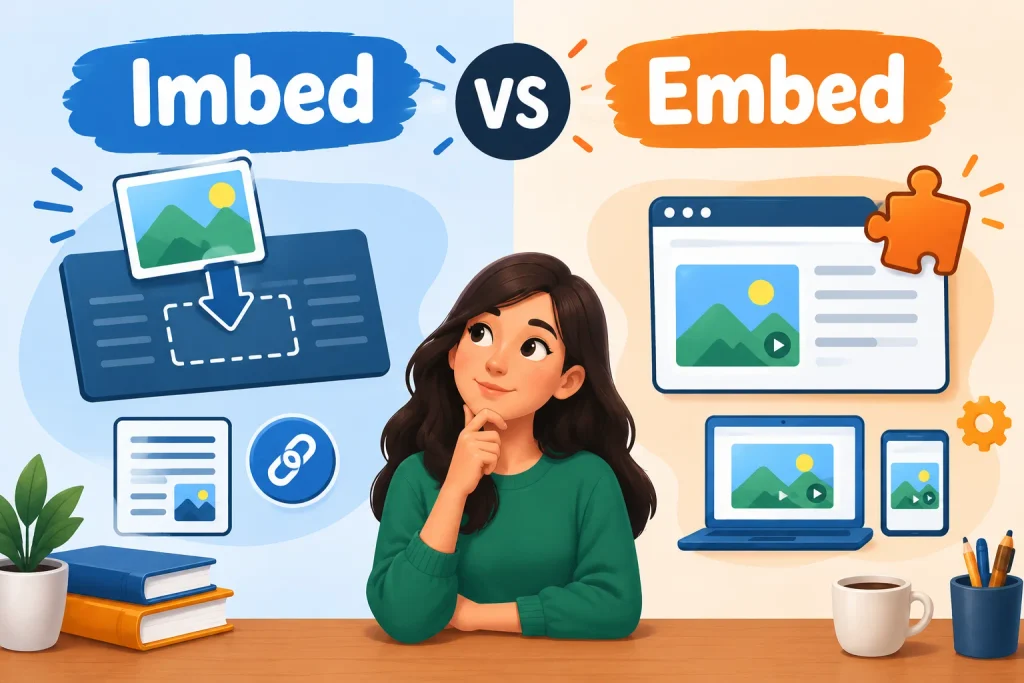
The good news is that the difference is much simpler than it first appears. Embed is the more common and generally preferred spelling, while imbed is a legitimate but less common variant. Major dictionaries treat imbed as a variant of embed, rather than as a completely different word. Merriam-Webster specifically describes imbed as the “less common spelling” of embed.
So, if you’re wondering whether “imbed” is wrong, the answer is no. If you’re wondering which spelling is usually the safer choice in modern writing, embed is the better choice.
Quick Comparison
| Feature | Embed | Imbed |
| Basic meaning | To fix, insert, or place something firmly within something else | Same meaning |
| Status | Main/common spelling | Less common variant |
| Pronunciation | /ɪmˈbed/ | /ɪmˈbed/ |
| Physical use | Yes | Yes |
| Figurative use | Yes | Yes |
| Technology | Very common | Much less common |
| Journalism | Common | Possible but uncommon |
| Linguistics | Yes | Yes |
| Past tense | embedded | imbedded |
| -ing form | embedding | imbedding |
| Best choice for most modern writing | Yes | Usually no |
Cambridge lists embed as the main entry and identifies imbed as a US variant. Oxford likewise lists embed with imbed” as an alternative form.
That distinction matters because both spellings are valid, but they don’t have equal frequency or stylistic weight.
What Do They Mean?
At their core, imbed and embed mean the same thing: to place something firmly inside, into, or as part of something else.
The idea can be physical.
For example:
- A stone can be embedded in concrete.
- A piece of glass can become embedded in a surface.
- A microchip can be embedded inside a device.
- A bullet can become embedded in a wall.
The idea can also be figurative.
For example:
- A tradition can become embedded in a culture.
- A belief can become embedded in someone’s thinking.
- A habit can become embedded in everyday behavior.
- An idea can become embedded in an organization’s values.
The word has also developed specialized meanings in areas such as technology, journalism, medicine, and linguistics. Merriam-Webster, for example, includes meanings involving digital media, microscopy specimens, journalists attached to military units, and something becoming an integral part of another thing.
Definition of Embed
Embed means to fix, insert, or place something deeply or firmly within another thing.
Cambridge defines it in its basic sense as fixing something firmly into a substance. In information technology, it also uses embed for placing text, sound, images, or video into a computer file, email, or website.
Consider these examples:
The workers embedded the metal supports into the concrete.
Here, the supports become physically fixed inside the concrete.
The website embeds a video directly on the article page.
Here, the video is integrated into the webpage rather than simply described by a link.
Her values are deeply embedded in her approach to teaching.
Here, embedded is figurative. The values aren’t physically inside anything. Instead, they have become a deep and established part of her approach.
This flexibility explains why embed appears across so many areas of modern English.
Examples of “Embed” in Different Contexts
Physical:
The jeweler embedded the stones into the ring.
Technology:
You can embed the video directly into the webpage.
Figurative:
The tradition is deeply embedded in the local culture.
Business:
The company embedded customer feedback into its product-development process.
Academic:
The researcher embedded the new findings within a broader theoretical framework.
Journalism:
The reporter was embedded with the military unit during the conflict.
Each sentence uses the same central idea: something becomes firmly placed within a larger context.
Definition of Imbed
Imbed has essentially the same meaning as embed.
It can describe something being physically placed inside another material, figuratively established within something, or used in specialized contexts.
Cambridge directs readers from imbed to embed, while Merriam-Webster explicitly defines imbed as the less common spelling of embed.
For example:
The technician imbedded the component inside the casing.
The meaning is clear, and the spelling is not inherently incorrect.
You could rewrite the same sentence as:
The technician embedded the component inside the casing.
The meaning remains the same.
This is the key point to remember:
Imbed is not a separate word with a separate definition. It is an accepted variant of embed.
Oxford also lists imbed as an alternative to embed and gives the same major uses, including physical placement, figurative meaning, journalism, and linguistics.
Do They Have Different Meanings?

No. In standard modern usage, imbed and embed have the same fundamental meaning.
The important difference is usage and frequency, not definition.
Think of them as two spellings for the same verb. One spelling has become much more dominant, while the other remains recognized.
This distinction is important because people sometimes assume that embed must describe one particular type of insertion and embed another. That isn’t how major dictionaries treat them.
For instance, embed can describe a physical object:
The nail was embedded in the wooden beam.
It can describe an abstract concept:
The belief became embedded in the community.
It can describe digital content:
The publisher embedded the video in the article.
And imbed can express the same ideas.
Oxford’s entries demonstrate this directly. Its embed entry covers physical, figurative, journalistic, and linguistic uses, while its imbed entry provides corresponding meanings.
Why Does “Embed” Look More Natural Today?
One reason embed feels more familiar is its overwhelming presence in modern technology and digital publishing.
You regularly encounter expressions such as:
- embedded video
- embedded image
- embedded content
- embedded system
- embedded software
- embedded link
- embedded code
- embed a post
- embed a video
- embed media
Technology has made embed part of everyday vocabulary.
When someone says, “Click here to get the embed code,” most readers immediately understand what that means.
By contrast, phrases such as “imbed code” or “imbedded video” look unusual to many contemporary readers, even though dictionaries recognize the forms.
That difference in familiarity is one reason embed is generally the safer spelling for new writing.
Literal vs. Figurative Meaning of Embed
Understanding the literal and figurative uses makes this word much easier to master.
Literal Meaning
A literal use involves something actually being placed inside another physical object or material.
For example:
The technician embedded the sensor in the wall.
The sensor is physically inside the wall.
Another example:
Small stones were embedded in the concrete.
The stones are physically surrounded by concrete.
A medical example might describe a foreign object that has become embedded in tissue.
Merriam-Webster also recognizes a specialized medical and microscopy sense in which a specimen is prepared for sectioning by enclosing it in a supporting substance.
So the literal concept is straightforward:
Something is firmly placed within something else.
Figurative Meaning
The figurative meaning extends the same idea to concepts, emotions, customs, beliefs, and behaviors.
For example:
The custom is deeply embedded in the community.
A custom cannot literally sit inside a community like a stone inside concrete. Instead, the sentence means that the custom has become a deeply established part of community life.
Consider another example:
Fear became embedded in his decision-making process.
Fear isn’t a physical object. The sentence means that fear became deeply integrated into the way he made decisions.
This figurative use is extremely common in formal and academic writing.
Common combinations include:
- deeply embedded
- firmly embedded
- culturally embedded
- socially embedded
- historically embedded
- structurally embedded
- deeply embedded beliefs
- embedded assumptions
- embedded values
- embedded practices
These expressions are useful because they communicate more than simple presence. They suggest that something has become deeply established and difficult to separate.
What Is the Actual Difference?
The simplest answer is this:
There is no meaningful difference in core meaning. The main difference is spelling, frequency, and preferred usage.
That distinction becomes clearer when you compare the dictionary treatment.
Merriam-Webster makes embed the primary entry and describes imbed as its less common spelling. It also lists embedded alongside imbedded and embedding alongside imbedding.
Oxford follows a similar pattern. Its primary embed entry lists imbed as an alternative form.
Cambridge goes a step further by labeling imbed as a US form while directing readers to embed.
The Practical Difference
For most writers, the distinction can be summarized like this:
Embed = standard, common, widely preferred
Imbed = correct variant, but less common
That means you generally won’t create a grammatical error by writing imbed. However, choosing embed will usually make your writing look more familiar and conventional.
Compare:
The developer embedded the video in the webpage.
and:
The developer imbedded the video in the webpage.
Both can be understood, and dictionaries recognize both forms. The first version is simply more natural for most modern readers.
Why Do Both Spellings Exist?
English contains many words with competing spellings. Some differences develop through pronunciation, historical spelling habits, regional preferences, or attempts to make spelling better reflect how a word sounds.
Imbed and embed are a good example of this broader pattern.
The modern dictionaries don’t treat the two forms as two unrelated vocabulary items. Instead, they recognize imbed as a variant of embed. Merriam-Webster dates the first known use of embed to around 1794, showing that the word has been established in English for more than two centuries.
The existence of imbed doesn’t mean that one spelling represents a completely different historical meaning. Instead, both forms have been used to express the same underlying concept.
Language often preserves variants long after one becomes more dominant.
You can see similar patterns elsewhere in English. Some alternative spellings survive because dictionaries record real usage, even when editors and modern writers strongly favor one version.
That’s essentially what happened with embed and imbed.
Why Is “Embed” Usually the Safer Choice?
If you’re writing something new and don’t have a specific style requirement, embed is usually the best choice.
There are several practical reasons.
It Is the More Familiar Form
Readers encounter embed frequently in websites, software documentation, academic material, business writing, and general journalism.
A familiar word creates less friction.
It Dominates Technology
Modern technology uses embeds constantly.
For example:
- Embed a YouTube video.
- Embed an image.
- Embed a social media post.
- Embed code.
- Embedded software.
- Embedded systems.
- Embedded content.
Cambridge specifically recognizes thtechnologicalgy meaning of embed for putting text, sound, images, or video into computer files, email messages, or websites.
It Fits Professional Writing
When a spelling has become overwhelmingly familiar in a particular field, following that convention usually improves readability.
Imagine reading technical documentation that repeatedly says:
“Copy the code and embed it into the page.”
The meaning is understandable. However, “embed it into the page” will look more conventional to most readers.
It Keeps Related Forms Consistent
Using embed gives you a familiar word family:
- embed
- embeds
- embedded
- embedding
If you choose imbed, the corresponding forms become:
- imbed
- imbeds
- imbedded
- imbedding
Both sets are recognized. The first set is generally more familiar in contemporary writing. Merriam-Webster explicitly lists both past and participle variants.
Is “Imbed” Still a Correct Word?
Yes.
This is one of the most important points in the entire imbed vs. embed debate.
Calling imbed “wrong” would be too strong because major dictionaries recognize it.
Merriam-Webster defines imbed as a less common spelling of embed.
Cambridge includes imbed as a US variant and directs readers to embed.
Oxford also lists imbed as an alternative form.
So you shouldn’t mark every occurrence of imbed as a spelling error.
Instead, ask a more useful question:
Is “imbed” the best choice for this particular piece of writing?
In most contemporary contexts, embed will be the stronger choice.
When “Imbed” Can Still Appear
You may encounter imbed in:
- Older publications
- Historical documents
- Quoted material
- American English sources
- Personal writing styles
- Specialized publications that retain the variant
- Existing text that consistently uses imbed
For example, if you’re quoting an old scientific paper that uses imbedded, changing the spelling inside a direct quotation could alter the original wording.
In that situation, preserving the original spelling can be appropriate.
Is Imbed Outdated?
Calling imbed completely outdated would be inaccurate.
It is better described as less common.
That distinction matters.
An outdated spelling may be strongly associated with an earlier period and rarely appear in current standard usage. A less common variant, by contrast, can still be legitimate and understandable.
Imbed falls into the second category.
Cambridge continues to list it, and Oxford continues to recognize it.
However, less common does not mean equally recommended.
If your goal is clear, contemporary, broadly accepted writing, embed usually wins.
Think of it this way:
Imbed is acceptable. Embed is conventional.
That one sentence captures the practical difference.
Should You Ever Use “Imbed”?
Yes, but use it intentionally.
If you’re writing a completely new article, business report, website, technical guide, or academic assignment, embed is generally the safer option.
There is rarely a practical advantage to choosing imbed unless a particular style, source, or publication calls for it.
Use “Imbed” When:
- A source you’re discussing consistently uses it.
- You’re preserving historical wording.
- A quotation contains imbed or imbedded.
- Your publication has a house style that prefers it.
- You’re working within a specialized tradition that regularly uses the form.
- You need to reproduce an original document accurately.
Prefer “Embed” When:
- You’re writing for a general audience.
- You’re writing web content.
- You’re writing software documentation.
- You’re describing digital media.
- You’re writing business content.
- You’re writing academic content from scratch.
- You’re unsure which spelling to choose.
This isn’t because imbed suddenly becomes grammatically incorrect in those situations. It’s because embed is more recognizable and widely established.
A Simple Case Study: Choosing the Right Spelling
Imagine that you’re writing a software tutorial.
Your sentence is:
You can imbed the video directly into your webpage.
Technically, readers can understand it, and the spelling is recognized.
But compare it with:
You can embed the video directly into your webpage.
The second version is more familiar because embed is deeply associated with digital content.
Now imagine you’re editing a historical quotation:
The original report stated that the device was “imbedded within the casing.”
If you’re reproducing the quotation exactly, changing imbedded to embedded would no longer preserve the original wording.
So the best choice depends on the purpose of the text.
| Situation | Better choice |
| New blog post | Embed |
| Website instructions | Embed |
| Software documentation | Embed |
| Academic paper | Embed |
| Business report | Embed |
| Historical quotation | Preserve the original spelling |
| Existing source using “imbed” | Usually preserve it when discussing or quoting it |
| House style requiring “imbed” | Follow the house style |
The lesson is simple: don’t confuse “less common” with “incorrect.”
Why “Embed” Became the Preferred Spelling
There isn’t a single rule that suddenly made embed correct and imbed incorrect. Instead, usage gradually favored one variant.
English often keeps multiple spellings alive for centuries. Over time, however, one form may become more common because dictionaries, publishers, professional communities, educators, and everyday speakers repeatedly use it.
That is the situation with embed.
Merriam-Webster currently makes embed the primary dictionary entry and lists imbed as a variant or less common spelling. It also records embedded and imbedded as variants, along with embedding and imbedding.
The practical result is straightforward:
Embed is the default spelling most writers should choose today.
Modern Dictionary Preference
Dictionary treatment is useful because it shows how established forms are presented to readers.
Merriam-Webster’s entry begins with embed and identifies imbed as a less common variant. Cambridge takes a similar approach by listing embed as the main verb and marking imbed as a US form.
That doesn’t make imbed invalid.
Instead, it creates a hierarchy of preference:
- Embed: common and preferred
- Imbed: recognized but less common
- Embedded: common past tense and participle
- Imbedded: recognized alternative
- Embedding: common -ing form
- Imbedding: recognized alternative
This is an important distinction for anyone writing professionally.
Digital and Technical Usage
Technology has given embed an enormous amount of everyday exposure.
You probably encounter the word when dealing with:
- YouTube videos
- images
- websites
- HTML
- social media posts
- audio players
- maps
- widgets
- software
- embedded devices
- embedded systems
- external content
Cambridge specifically defines embed in information technology as including text, sound, images, or video in a computer file, email, or website. It also uses the word for electronic equipment placed inside products.
That means modern readers see embed in both technical and ordinary digital environments.
Consider these familiar phrases:
Embed this video on your website.
Copy the embed code below.
The article contains embedded content.
The device uses an embedded processor.
The spelling embed feels natural in each sentence because technology has reinforced it repeatedly.
Professional Writing Favors Familiar Forms
Professional writing has a simple, practical goal: communicate clearly without creating unnecessary obstacles for the reader.
If two spellings have the same meaning, the more familiar form often makes the better choice.
For example:
The researcher embedded the data visualization in the report.
Most readers will process embedded immediately.
Now compare:
The researcher imbedded the data visualization in the report.
The second sentence isn’t necessarily wrong. However, embedded may make some readers stop and wonder whether they’ve encountered a typo.
That brief hesitation is avoidable.
For this reason, embed is usually the stronger editorial choice.
Comparison Table
The following table gives you a practical reference for the two spellings and their related forms.
| Word or form | Status | Meaning | Recommended for new writing? |
| embed | Main/common form | Place firmly within or incorporate into something | Yes |
| imbed | Less common variant | Same basic meaning as embed | Usually not |
| embedded | Common form | Past tense, past participle, or adjective | Yes |
| imbedded | Less common variant | Same basic meaning as embedded | Usually not |
| embedding | Common form | Present participle/gerund of embed | Yes |
| imbedding | Less common variant | Present participle/gerund of imbed | Usually not |
| embeds | Common form | Third-person singular of embed | Yes |
| imbeds | Less common variant | Third-person singular of imbed | Usually not |
Merriam-Webster explicitly records these relationships, listing embed with imbed as a variant and recognizing both embedded/imbedded and embedding/imbedding.
The Easiest Rule to Remember
If you’re writing something new and you’re unsure which form to choose, use:
embed → embedded → embedding
That sequence will look natural in almost every modern context.
You don’t need to worry that choosing embed somehow changes the meaning. It doesn’t.
You’re simply choosing the more familiar spelling.
When to Use “Embed”
The verb embed has a surprisingly broad range of uses.It can describe something physically placed inside another material. It can describe an idea becoming deeply established.It can describe digital content appearing within another document. It can even describe a journalist joining a military unit or another organization.Understanding these different uses helps you recognize the word beyond simple spelling questions.
Embedding Digital Content
One of the most common modern meanings of embed involves digital content.
When you embed something, you place or integrate it into another digital environment so that it can appear there rather than requiring the user to visit a completely separate page.
For example:
The editor embedded a video in the article.
The developer embedded an interactive map on the homepage.
The teacher embedded a presentation in the online lesson.
The website automatically embeds social media posts.
Cambridge specifically describes this technological use as including text, sound, images, and video placed into computer files, emails, or websites.
Merriam-Webster similarly defines embedding a media file as inserting a graphic, video, or audio clip into a computer document, including a website or email.
Example: Embedding a Video
Imagine that you’re publishing an article about home gardening.
You could simply write:
Watch our gardening video on YouTube.
Or you could embed the video directly into the article.
The reader sees the video within the webpage instead of having to navigate away from the article.
That is why phrases such as embedded video and embed code are now common parts of digital publishing vocabulary.
Common Types of Embedded Content
You can embed many different kinds of material.
Common examples include:
- Videos
- Images
- Audio
- Maps
- Social media posts
- Charts
- Presentations
- Forms
- Interactive tools
- Widgets
- External documents
- Code demonstrations
The exact technical mechanism varies by platform, but the basic language remains the same.
Something is being incorporated into another digital environment.
Embedded Content Does Not Always Mean “Copied”
This distinction is useful in technical writing.
When content is described as embedded, it doesn’t necessarily mean that the original content has been physically copied into the new document.
For example, Merriam-Webster’s definition of embedded includes digital content that is drawn from and linked to an external source while being displayed or accessed locally.
That helps explain why a webpage can display an embedded video from another platform.
The reader interacts with the content on the current page, even though the underlying content may originate elsewhere.
Embedding Objects Physically
The traditional physical meaning of embed is still important.
To embed something physically means to place it firmly within another substance, surface, or structure.
For example:
The workers embedded steel rods in the concrete.
A small stone became embedded in the tire.
The jeweler embedded tiny diamonds in the ring.
The glass fragment was embedded in the wooden frame.
Here, the word has a literal meaning.
The object becomes firmly positioned within something else.
Cambridge defines the basic sense of embed as fixing something firmly into a substance.
Common Physical Examples
You might describe these things as embedded:
- nails in wood
- wires in walls
- pipes in concrete
- stones in cement
- seeds in soil
- metal components in machinery
- sensors in equipment
- electronic components in products
- fossils in rock
- glass fragments in surfaces
The relationship can be described using several common structures:
embedded in somethingembedded into somethingembedded within somethingThe choice depends on the sentence and the relationship you’re describing.
“Embedded In” vs. “Embedded Into”
Both constructions appear in standard English.
Embedded in often emphasizes the resulting position:
The sensor is embedded in the wall.
Embedded into can emphasize the process of putting something inside:
The sensor was embedded into the wall during construction.
In everyday writing, both can be natural.
However, context matters. Don’t force one preposition into every sentence.
Using “Embed” Figuratively
The physical meaning of embed naturally extends into abstract language.
If something becomes deeply embedded, it has become firmly established within a belief system, culture, organization, habit, or process.
For example:
The tradition is deeply embedded in the community.
These assumptions are embedded in the company’s culture.
The habit became embedded in her daily routine.
The belief is deeply embedded in the national identity.
No physical object is being inserted.
Instead, the word describes deep integration.
Why “Deeply Embedded” Is So Common
The phrase deeply embedded works particularly well when you want to emphasize that something isn’t superficial.
Compare:
The practice exists in the organization.
with:
The practice is deeply embedded in the organization.
The second sentence communicates a stronger relationship.
It suggests that the practice has become an established part of the organization’s structure or culture.
This makes embedded useful in:
- sociology
- psychology
- education
- business
- economics
- politics
- history
- cultural studies
- organizational research
Examples of Figurative Embedding
Trust is embedded in the team’s working culture.
Historical influences remain embedded in the city’s architecture.
The assumption is deeply embedded in traditional economic thinking.
Certain habits become embedded through repeated behavior.
The principle is embedded in the organization’s mission.
In each case, embedded means more than merely “present.”
It suggests that something has become an integral or established part of a larger system.
Merriam-Webster specifically includes the meaning of making something an integral part of something else.
Embed in Linguistics
The word embed also has a specialized meaning in linguistics and grammar.
In this context, a linguistic unit can be embedded within another linguistic structure.
For example, a clause can appear inside a larger sentence.
Consider:
I know that she is ready.
The clause that she is ready is embedded within the larger sentence.
A more complex example is:
The teacher said that the student believed that the test was unfair.
The structure contains multiple layers of clauses.
This use is important because it demonstrates that embed isn’t limited to physical objects or digital media.
The central idea remains the same:
One element is incorporated within a larger structure.
That broader concept connects the physical, figurative, technological, and grammatical meanings of the word.
Embed in Scientific and Medical Contexts
The word embed also has specialized scientific uses.
Merriam-Webster includes a microscopy meaning involving the preparation of a specimen for sectioning by infiltrating it with and enclosing it in a supporting substance.
This is a technical use, but it follows the same underlying idea.
A specimen becomes surrounded or supported by another material so it can be prepared for examination.
For example, a scientific text might discuss:
embedding tissue samples for microscopic analysis
The word isn’t being used metaphorically here.
It describes a real laboratory process.
Why Context Matters
Consider these three examples:
The fossil was embedded in rock.
The belief was embedded in the culture.
The tissue was embedded in a supporting medium.
The subject changes dramatically, but the central concept remains remarkably consistent:
something is placed within or made an integral part of something else.
That semantic connection explains why the same verb works across such different fields.
Embed in Engineering and Embedded Systems
Engineering provides another major modern use of the word.
An embedded system is a computing system designed as part of a larger device or product.
Examples include computing components found in:
- cars
- appliances
- traffic-control equipment
- industrial machines
- medical devices
- consumer electronics
- manufacturing systems
Cambridge specifically gives examples of microprocessors embedded into products such as cars, refrigerators, traffic lights, and industrial equipment.
Here, embedded means that the computing component forms part of a larger physical or functional system.
Why “Embedded System” Uses ” Embedded “
The terminology makes intuitive sense.
A computer system doesn’t necessarily exist as a separate desktop machine. Instead, its computing capability is embedded within another product.
For example:
The washing machine contains an embedded control system.
The system is integrated into the appliance.
Likewise:
The vehicle uses embedded software to control several functions.
The software isn’t simply an independent application. It operates as part of the larger product.
This is another reason embed has become so familiar in modern English.
Why “Imbed” Is Less Common in Technical Contexts
You could technically write:
The manufacturer imbedded the processor into the device.
The sentence is understandable, and imbed is recognized.
But technical readers are far more accustomed to:
The manufacturer embedded the processor into the device.
The difference isn’t grammatical correctness.
It’s terminological familiarity.
Technical fields develop preferred vocabulary over time. Once a form becomes dominant in documentation, software interfaces, textbooks, standards, and professional communication, alternatives can begin to look unusual even when dictionaries recognize them.
This is why embedded systems, not imbedded systems, is the overwhelmingly familiar phrase.
The same principle applies to:
- embedded software
- embedded devices
- embedded processors
- embedded content
- embedded media
- embedded code
If you’re writing technical material, embed is almost always the sensible default.
A Closer Look
Now that the base verbs are clear, the past-tense forms become much easier.
Embedded
Embedded is the standard and familiar form.
It can function as:
- the past tense of embed
- a past participle
- an adjective
Examples:
The technician embedded the sensor in the casing.
The sensor was embedded in the casing.
The device contains an embedded processor.
Notice how the same spelling works in different grammatical roles.
Imbedded
Imbedded is the corresponding variant associated with imbed.
For example:
The sensor was imbedded in the casing.
This is a recognized form, but it is less common.
Merriam-Webster explicitly records embedded also imbedded in its entry for embed.
Which Past Form Should You Use?
For modern writing, choose:
embedded
rather than:
imbedded
unless you have a particular reason to preserve or follow the less common spelling.
The difference is especially important when writing:
- websites
- technical guides
- academic papers
- business reports
- educational material
- product documentation
- SEO content
- professional correspondence
The common form minimizes distraction.
Embedding vs. Imbedding
The same preference applies to the present participle and gerund.
Preferred
embedding
Less common
imbedding
For example:
The developer is embedding the video into the webpage.
The process involves embedding sensors throughout the structure.
These sound natural because embedding is the familiar form.
The alternatives are recognized:
The developer is imbedding the video into the webpage.
The process involves imbedding sensors throughout the structure.
But they will usually look less conventional to modern readers.
Merriam-Webster confirms that both embedding and imbedding are recognized forms.
A Useful Word-Family Pattern
If you want an easy way to keep everything consistent, remember this word family:
| Common form | Less common variant |
| embed | imbed |
| embeds | imbeds |
| embedded | imbedded |
| embedding | imbedding |
This pattern prevents a common mistake: switching between spellings within the same article.
For example, avoid writing:
The developer embedded the video and later discussed imbedding additional media.
Although the reader can understand it, the inconsistent spelling looks careless.
A cleaner version is:
The developer embedded the video and later discussed embedding additional media.
Consistency matters, particularly in long-form content.
A Practical Editing Test
When editing an article, search for all four forms:
- imbed
- imbeds
- imbedded
- imbedding
Then decide whether each occurrence should become the corresponding embed form.
This simple editing step can improve consistency across a long document.
For most modern content, your preferred set will be:
embed → embeds → embedded → embedding
The only major exception is when you’re intentionally preserving a source’s original spelling or following a specific editorial convention.
Why Consistency Matters More Than Many Writers Realize
Imagine an article that begins with:
This guide explains how to embed videos.
Later, it says:
The platform also allows users to embed audio.
Then another section says:
Embedded images load differently.
Finally, the conclusion returns to:
Embedding content can improve the user experience.
Nothing is technically incomprehensible.
Yet the inconsistent spelling makes the article feel less polished.
A reader may even wonder whether the different spellings have different meanings.
They don’t.
Using one dominant form throughout eliminates that unnecessary confusion.
Best Editorial Practice
For most content:
Choose embed and stick with it.
That means:
- embed
- embeds
- embedded
- embedding
This approach is particularly useful for SEO articles because consistent terminology helps reinforce the central topic without creating artificial variations.
What Should Writers Remember?
At this point, the central distinction can be reduced to a few facts.
Imbed is not simply a typo.
Embed is not the only technically valid spelling.
Both forms have the same core meaning.
Embed is the more common and preferred modern form.
Embedded and embedding are also the preferred related forms.
Merriam-Webster’s current entries support this relationship directly, while Cambridge treats imbed as a US variant of embed.
The One-Line Rule
When in doubt, use “embed.”
That rule works particularly well for:
- blog writing
- SEO content
- academic writing
- technical documentation
- business communication
- websites
- software instructions
- educational material
It doesn’t mean imbed has disappeared.
It simply means embed is the safer default for contemporary readers.
Quick Examples
| Less common | Preferred |
| Imbed the video in the article. | Embed the video in the article. |
| The image was imbedded in the document. | The image was embedded in the document. |
| We are imbedding the chart. | We are embedding the chart. |
| The processor was imbedded in the device. | The processor was embedded in the device. |
| The tradition was imbedded in the culture. | The tradition was embedded in the culture. |
The meaning remains essentially unchanged.
The preferred column simply reflects modern usage.
Key Takeaways
Before moving into more specialized contexts, keep these points in mind:
- Embed and imbed have essentially the same meaning.
- Embed is the more common spelling.
- Imbed is a recognized but less common variant.
- Embedded is preferred over imbedded in most modern writing.
- Embedding is preferred over imbedding.
- Technology strongly favors embed.
- Technical terms such as embedded systems overwhelmingly use the embed spelling.
- Dictionary recognition does not mean two variants are equally common.
- You don’t need to call imbed incorrect.
- For new professional content, embed is usually the safest choice.
This distinction becomes even more useful when you look at how the two forms behave across everyday English, academic writing, business communication, scientific and medical contexts, technology, journalism, and American versus British English.
Those contexts can influence which spelling feels most appropriate, even though the fundamental meaning stays the same.
In Everyday English
In everyday English, embed is much more likely to appear in contemporary writing and conversation.
You might hear someone say:
“Can you embed that video in the message?”
Or:
“The instructions are embedded in the app.”
The word feels especially natural when people discuss websites, phones, apps, social media, and online content.
The less common form imbed remains understandable:
“Can you imbed that video in the message?”
However, many readers may initially assume that imbed is a spelling mistake.
That reaction doesn’t mean the word is technically wrong. It reflects the difference in frequency and familiarity.
Common Everyday Uses of “Embed”
You can use embed when discussing:
- Photos
- Videos
- Audio files
- Links
- Messages
- Maps
- Online posts
- Instructions
- Habits
- Beliefs
- Traditions
- Physical objects
For example:
The teacher embedded a short video in the lesson.
The app lets you embed a map.
That childhood memory is deeply embedded in her mind.
The stone became embedded in the mud.
Notice how naturally the word moves between digital, abstract, and physical situations.
Everyday Expressions With “Embedded”
Some combinations appear particularly often:
- deeply embedded
- firmly embedded
- embedded in
- embedded within
- embedded content
- embedded video
- embedded image
- embedded link
- embedded information
These phrases can help you recognize the word when reading.
In Academic Writing
Academic writing frequently uses embed in both literal and figurative ways.
Researchers may discuss concepts being embedded within theories, practices being embedded within institutions, or evidence being embedded within broader arguments.
For example:
The study embeds its findings within a broader social framework.
Or:
Cultural assumptions are deeply embedded in the research methodology.
Here, embedded communicates integration into a larger structure.
That meaning is especially useful in academic writing because researchers often need to explain relationships between individual ideas and broader systems.
Examples in Different Academic Fields
Education:
Teachers can embed critical-thinking activities throughout the curriculum.
Sociology:
Social norms become embedded through repeated interaction.
History:
The tradition is deeply embedded in the region’s history.
Literature:
The author embeds historical references throughout the novel.
Linguistics:
The subordinate clause is embedded within the larger sentence.
Economics:
The policy is embedded within a broader economic framework.
Psychology:
These assumptions can become deeply embedded in decision-making.
In every example, embed expresses some form of integration or incorporation.
Why “Embed” Works Well in Academic Prose
Academic writing often describes relationships between parts and wholes.
A theory contains assumptions.
A methodology contains procedures.
A culture contains values.
A sentence contains clauses.
A research framework contains concepts.
The verb embed efficiently describes these relationships.
Instead of saying:
The researchers placed the concept firmly within the theoretical framework…
you can write:
The researchers embedded the concept within the theoretical framework.
The second version is more concise while retaining the intended meaning.
In Business Writing
Business writing also strongly favors embed.
Companies often describe processes, values, systems, or practices as being embedded within an organization.
For example:
The company wants to embed sustainability into its operations.
Customer feedback is embedded in the product-development process.
The training program embeds safety principles into everyday procedures.
These sentences describe integration, not physical insertion.
Common Business Uses
You may see embed when discussing:
- Company culture
- Training
- Policies
- Procedures
- Customer experience
- Technology
- Strategy
- Data
- Analytics
- Organizational values
- Workplace practices
Consider this example:
The company embedded quality checks into every stage of production.
The meaning isn’t that someone physically inserted a quality check into a machine. Instead, quality control became an integral part of the process.
That figurative use is common in professional communication.
“Embedded” Can Signal Something Established
When businesses describe a practice as embedded, they often mean that it has become a normal and established part of an organization.
Compare:
The company uses customer feedback.
with:
Customer feedback is embedded in the company’s decision-making process.
The second sentence suggests something deeper. Feedback isn’t an occasional consideration. It has become part of the organization’s normal operating structure.
That’s an important nuance.
In Scientific Writing
Scientific writing uses embed in several specialized ways.
It can describe physical objects placed inside materials. It can also describe laboratory preparation processes or concepts incorporated into a broader scientific framework.
For example:
The researchers embedded the sensor in the experimental apparatus.
Or:
The sample was embedded in a supporting medium before sectioning.
Merriam-Webster includes a specialized microscopy sense for embed, involving the preparation of specimens by enclosing them in a supporting substance.
Physical Scientific Examples
Scientists and engineers may describe:
- Sensors embedded in materials
- Particles embedded in a matrix
- Samples embedded in resin
- Components embedded in devices
- Structures embedded in tissue
- Materials embedded within composites
For example:
The researchers embedded the particles in a polymer matrix.
Here, embedded has a precise physical meaning.
The particles are contained within the larger material.
Figurative Scientific Uses
Scientific writing can also use embed abstractly:
The model embeds several assumptions about consumer behavior.
The theory is embedded within a broader conceptual framework.
The word allows researchers to explain how one component fits into a larger intellectual structure.
In Medical Writing
Medical terminology provides another area where embed appears naturally.
The word can describe something physically situated within tissue or another biological material.
For example:
The foreign object became embedded in the tissue.
The device was embedded beneath the skin.
The word can also appear in laboratory contexts involving specimen preparation.
Important Medical Distinction
In medical writing, embedded usually carries a literal or technical meaning.
However, medical professionals can also use the word figuratively:
The patient’s treatment plan is embedded within a broader care strategy.
The context tells you which meaning applies.
Because medical writing values precision, embed is generally the better choice when producing new material.
Using imbed isn’t automatically grammatically wrong. It is simply less familiar and therefore less likely to be the preferred editorial choice.
In Legal Writing
Legal writing tends to favor precise, established vocabulary.
You may encounter embed when describing principles, requirements, rights, or procedures that become incorporated into legal or institutional structures.
For example:
The legislation embeds new protections within the regulatory framework.
Or:
The agreement embeds specific obligations into the contractual relationship.
The word can also describe physical objects in legal evidence:
The fragment was embedded in the surface.
Why Consistency Matters in Legal Documents
Legal documents often undergo extensive editing.
A document might pass through:
- Attorneys
- Editors
- Compliance teams
- Courts
- Regulators
- Corporate reviewers
Using the more familiar embed spelling reduces unnecessary questions about terminology.
Again, this isn’t because imbed has suddenly become grammatically invalid. It’s because legal writing benefits from stable and recognizable terminology.
In Journalism
Journalism gives embed another specialized meaning.
An embedded journalist or embedded reporter is a journalist who accompanies a military unit or other organized group, usually under specific access arrangements.
Merriam-Webster includes this journalistic sense in its definition of embed.
For example:
The journalist was embedded with the military unit.
Here, embedded does not mean that the journalist was physically inserted into a vehicle or structure.
Instead, the journalist became attached to and traveled with the group.
What Does “Embedded Journalist” Mean?
An embedded journalist typically receives access to a group or operation by accompanying its members.
This arrangement can provide closer access to events that would otherwise be difficult for reporters to observe.
For example:
The newspaper assigned an embedded reporter to the military unit.
The reporter remains physically separate from the unit in the sense of being a journalist, but becomes operationally connected to it for reporting purposes.
Embedded Reporter vs. Imbedded Reporter
Both spellings can technically represent the same word.
However:
Embedded reporter is the standard and overwhelmingly more familiar expression.
Imbedded reporter is possible but uncommon.
If you’re writing contemporary journalism, use embedded reporter unless you’re reproducing a source that uses imbedded.
In Technology
Technology is one of the strongest reasons embed has become so dominant.
The word appears constantly in software development, web publishing, electronics, and digital communication.
You might encounter:
- Embedded systems
- Embedded software
- Embedded devices
- Embedded content
- Embedded media
- Embedded applications
- Embedded processors
- Embed code
- Embed links
- Embed videos
The technology industry has effectively made embed part of everyday vocabulary.
What Does “Embed” Mean in Technology?
In digital contexts, embed generally means incorporating content, functionality, or a component into another digital environment.
For example:
The developer embedded the video player into the webpage.
The video player becomes accessible directly within the webpage.
Another example:
The website embeds a live map on its contact page.
The map appears as part of the webpage rather than existing only as a separate destination.
Cambridge explicitly recognizes this digital use of embed, including text, sounds, images, and video in computer files, emails, and websites.
HTML Embeds
Web development provides one of the clearest examples of modern embed terminology.
An embed can refer to the act of placing external or multimedia content within a webpage. Developers may also use the word to describe the resulting code or functionality.
For example, a content platform may provide an embed code that lets a publisher display a video or post on another webpage.
The terminology is so established that embed code sounds completely ordinary.
By contrast, imbed code would look unusual to most web developers.
Common Digital Embedding Examples
A website may embed:
- YouTube videos
- Social media posts
- Google Maps
- Audio players
- Forms
- Data visualizations
- Charts
- Presentations
- Interactive applications
The exact implementation can vary.
The linguistic concept remains consistent: content or functionality becomes integrated into another digital environment.
Embedded Systems
The phrase embedded system has an even more specialized technical meaning.
An embedded system is a computing system designed to perform specific functions as part of a larger device or product.
Examples include systems found in:
- Cars
- Washing machines
- Medical equipment
- Industrial machinery
- Smart appliances
- Cameras
- Routers
- Traffic systems
- Consumer electronics
Cambridge gives examples involving microprocessors embedded in products such as cars, refrigerators, traffic lights, and industrial machines.
The terminology illustrates the underlying meaning beautifully.
The computing system is embedded within the larger product.
Why “Imbedded System” Sounds Unusual
Technically, imbedded follows the alternative spelling of imbed.
Yet the established technical term is:
embedded system
not:
imbedded system
Technical vocabulary becomes standardized through textbooks, professional training, documentation, software, research, and industry practice.
Once a form becomes deeply established, the alternative can sound strange even when dictionaries recognize it.
That’s exactly what happened here.
Embedded Software vs. Imbedded Software
The same principle applies to software.
Embedded software is the familiar term.
It refers broadly to software designed to operate as part of a larger hardware device or embedded system.
Examples include software controlling:
- Automotive systems
- Medical devices
- Household appliances
- Industrial equipment
- Consumer electronics
The phrase imbedded software isn’t impossible to interpret, but it is much less familiar.
For professional technical writing, embedded software is the clear choice.
In Digital Publishing
Digital publishing has also reinforced embed.
Publishers frequently embed multimedia content into articles.
For example:
The editor embedded an interview video beneath the article.
The publisher embedded an interactive chart.
The page contains embedded audio.
The article includes an embedded social media post.
These expressions have become routine because modern websites combine different kinds of media on a single page.
Embedded Content vs. Linked Content
There’s a useful distinction between embedded and simply linked content.
A link generally sends the reader somewhere else.
For example:
Read the full report here.
An embedded item appears within the current digital environment.
For example:
The report is embedded directly below the article.
The exact technical behavior depends on the platform, but the conceptual difference is useful.
Linked content points outward. Embedded content is incorporated into the current experience.
In Social Media
Social platforms have made the word embed familiar to millions of users.
You may see options such as:
- Embed post
- Embed video
- Embed tweet
- Embed profile
- Copy embed code
A publisher can take a social media post and display it within an external webpage.
For example:
The news site embedded the company’s social media announcement.
Again, embed is the overwhelmingly natural spelling.
In Software Documentation
Software documentation depends heavily on precise terminology.
Developers may encounter instructions such as:
Embed the widget in your application.
Copy the embed code.
The SDK can be embedded into the existing platform.
Embedded components require additional configuration.
Because technical documentation is often reused across products and versions, consistency matters.
Switching between embed and imbed can create needless uncertainty.
Best Practice for Technical Writers
If you’re writing documentation from scratch:
Use embed consistently.
Use:
- embed
- embeds
- embedded
- embedding
Avoid switching to:
- imbed
- imbeds
- imbedded
- imbedding
unless a specific source or style guide requires the alternative.
British English vs. American English
Regional usage deserves a careful explanation because dictionaries don’t always label these forms in the same way.
Cambridge identifies imbed as a US form, while Oxford lists it as an alternative spelling. Merriam-Webster also recognizes it as a less common spelling.
This means you shouldn’t make an overly broad claim such as:
“British English never uses imbed.”
That would be too absolute.
A better explanation is:
Embed is the dominant form across modern standard English, while imbed is recognized as a less common variant and is particularly associated with US usage in some dictionaries.
American English
American English recognizes both:
- embed
- imbed
But embed is generally the more familiar modern form.
This is particularly obvious in American technology, journalism, publishing, and professional writing.
British English
British English strongly uses embed as the normal form.
You will commonly encounter:
- embedded content
- embedded systems
- embedded journalist
- embedded within
- deeply embedded
The alternative imbed is much less prominent.
Should You Change “Imbed” for British Readers?
If you’re producing new content for a broad English-speaking audience, embed is the safest choice.
It works naturally for both American and British readers.
That’s another practical advantage of the dominant form.
Regional Usage at a Glance
| Context | Preferred form |
| American general English | embed |
| British general English | embed |
| American technical writing | embed |
| British technical writing | embed |
| Digital publishing | embed |
| Software documentation | embed |
| Journalism | embed |
| Academic writing | embed |
| Historical quotation | Preserve original form |
| Personal preference | Either, but stay consistent |
The important takeaway isn’t that embed belongs exclusively to one country.
It’s that embed has much broader contemporary currency.
A Note About “Embedded” as an Adjective
One reason embedded appears so often is that it can function as an adjective.
For example:embedded videoembedded softwareembedded systemembedded reporterembedded beliefembedded sensorIn each case, the word describes something that has become incorporated into a larger structure, environment, or group.The adjective can describe physical placement:an embedded sensorfigurative integration:an embedded belief
digital incorporation:
embedded content
or organizational attachment:
an embedded journalist
That versatility makes embedded particularly valuable in modern English.
Why Can Have Different Meanings
The surrounding noun usually tells you which meaning applies.
Compare:
embedded video
This refers to digital content.
embedded sensor
This usually refers to a physical or technical component.
embedded belief
This is figurative.
embedded journalist
This refers to a journalist attached to a group or unit.
The spelling doesn’t change.
The context changes the interpretation.
This is a common feature of English vocabulary. A single word can develop related meanings while retaining a shared conceptual core.
How Context Helps You Choose Between Imbed and Embed
When you encounter imbed, don’t immediately assume that the writer means something different.
Instead, ask:
What is being placed or incorporated?
If the answer is:
- a video → embed
- a photograph → embed
- a sensor → embed
- a belief → embed
- a tradition → embed
- a clause → embed
- a journalist → embed
- a specimen → embed
The same basic concept applies.
If the original text uses imbed, the meaning generally remains unchanged.
The spelling is simply the less common variant.
Expert Tip: Think “Inside”
A useful semantic trick is to associate embed with the idea of inside.
The spelling itself isn’t derived simply by adding in to bed, so don’t treat that as a strict etymological rule. Instead, use it as a memory aid.
When something becomes firmly integrated inside something larger, think:
embed
That mental association works for physical, figurative, digital, and technical uses.
Examples
Physical:
The screw is embedded in the panel.
Figurative:
The belief is embedded in the culture.
Digital:
The video is embedded in the webpage.
Technical:
The processor is embedded in the device.
Linguistic:
The clause is embedded in the sentence.
Different fields, same central idea.
Key Takeaways
The spelling debate becomes much easier when you focus on actual usage.
- Embed is the dominant modern spelling.
- Imbed remains a recognized variant.
- Everyday English generally favors embed.
- Academic writing commonly uses embed for conceptual integration.
- Business writing uses embed for processes, values, and practices.
- Scientific and medical writing uses embed for physical and technical processes.
- Journalism uses embedded journalist as the established expression.
- Technology overwhelmingly favors embedded systems, embedded software, and embed code.
- Digital publishing frequently uses embed for multimedia and interactive content.
- British and American English both commonly use embed.
- Cambridge identifies imbed as a US variant, while major dictionaries continue to recognize it as an alternative form.
- When writing for a broad audience, embed is the safest default.
The biggest mistake is treating imbed as a completely different word. It isn’t. The two forms share the same basic meaning, but embed has become the standard-looking choice in modern English.
The final part will bring everything together with common mistakes to avoid, side-by-side examples, practical editing guidance, a memory trick, and a concise decision rule for choosing between imbed and embed.
Common Mistakes to Avoid
Even though imbed and embed have the same basic meaning, writers can still run into several problems when using them.
The biggest issues usually involve assuming one spelling is completely wrong, mixing forms, misunderstanding the meaning, or using a less familiar variant in technical writing.
Mistake: Assuming “Imbed” Is Wrong
One of the most common mistakes is automatically treating imbed as a spelling error.
That’s not accurate.
Major dictionaries recognize imbed as a variant of embed. Merriam-Webster calls it the less common spelling of embed, while Cambridge lists it as a US variant.
For example:
The researcher imbedded the sample in resin.
This isn’t necessarily an error.
You could instead write:
The researcher embedded the sample in resin.
The second version is generally preferable for new writing because it’s more familiar.
Remember: imbed is uncommon, but uncommon doesn’t automatically mean incorrect.
Mistake: Assuming Both Forms Are Equally Common
The opposite mistake is believing that imbed and embed are equally common.
They aren’t.
Dictionaries distinguish between the two forms by usage. Merriam-Webster specifically identifies imbed as less common.
This distinction matters when you’re deciding which form to use in an article.
If both spellings are technically accepted, you might wonder why one deserves preference.
The answer is reader familiarity.
Compare:
Embed the video in the article.
with:
Imbed the video in the article.
Both are understandable, but the first looks much more natural in modern digital writing.
Mistake: Using “Imbed” in Technical Writing Without a Reason
Technical writing strongly favors established terminology.
Consider these standard expressions:
- embedded systems
- embedded software
- embedded devices
- embedded processors
- embedded content
- embed code
- embedded media
Replacing these with imbedded or imbed can make otherwise polished technical writing look unusual.
For example:
The device uses an embedded processor.
is far more conventional than:
The device uses an imbedded processor.
The second form isn’t necessarily impossible. It’s simply not the established-looking choice.
Editorial rule: When writing technical content from scratch, default to embed.
Mistake: Switching Between Spellings
Consistency is another important issue.
Suppose an article begins with:
The website allows users to embed videos.
Later, it says:
The platform also lets users imbed audio.
Then another section says:
Embedded content may require additional permissions.
Finally, the conclusion uses:
Embedded media improves the page experience.
The reader may start wondering whether the words have different meanings.
They don’t.
The inconsistent spelling creates the confusion.
A polished article should generally choose one word family:
embed → embeds → embedded → embedding
That keeps terminology stable from beginning to end.
Mistake: Confusing Literal and Figurative Uses
Another common problem is assuming that embed only applies to physical objects.
It doesn’t.
The word can be literal:
The stone was embedded in the concrete.
It can also be figurative:
The tradition is deeply embedded in the culture.
The first example describes physical placement.
The second describes something becoming deeply established or integrated.
Merriam-Webster includes both the physical meaning and the broader sense of making something an integral part of another thing.
Understanding this distinction helps you use embed naturally rather than treating it as a specialized technical term.
Literal vs. Figurative Examples
The easiest way to understand the range of embed is to compare literal and figurative sentences.
| Literal use | Figurative use |
| The nail was embedded in the wood. | The belief was embedded in the culture. |
| The sensor was embedded in the wall. | The practice became embedded in the organization. |
| The stone was embedded in the concrete. | The assumption is embedded in the theory. |
| The fragment was embedded in the surface. | The tradition is deeply embedded in society. |
| The device was embedded inside the machine. | The principle is embedded in the company’s values. |
The physical examples involve actual placement.
The figurative examples describe deep integration.
Once you understand that shared concept, the word becomes much easier to use.
Side-by-Side Examples
Sometimes the fastest way to understand a spelling difference is to put the forms next to each other.
| With “Imbed” | With “Embed” |
| Please imbed the video in the page. | Please embed the video in the page. |
| The image was embedded in the document. | The image was embedded in the document. |
| The developer is imbedding the widget. | The developer is embedding the widget. |
| The sensor was imbedded in the device. | The sensor was embedded in the device. |
| The tradition became imbedded in the culture. | The tradition became embedded in the culture. |
| The journalist was imbedded with the unit. | The journalist was embedded with the unit. |
| The clause was imbedded within the sentence. | The clause was embedded within the sentence. |
| The specimen was imbedded in the supporting medium. | The specimen was embedded in the supporting medium. |
The meaning remains essentially the same in each pair.
The embed versions are generally the better choices for contemporary writing.
Examples of “Embed” in Different Situations
Seeing the word in varied contexts helps build a stronger sense of usage.
In Web Design
The developer embedded a video beneath the article.
In Education
The instructor embedded interactive activities throughout the lesson.
In Business
The company embedded quality checks into its production process.
In Science
The researchers embedded the sensors in the experimental material.
In Medicine
The device was embedded beneath the patient’s skin.
In Culture
The tradition is deeply embedded in the community.
In Journalism
The reporter was embedded with the military unit.
In Linguistics
The subordinate clause is embedded within the larger sentence.
In Engineering
The controller is embedded inside the machine.
These examples look unrelated at first.
Yet they all share the same underlying idea:
One thing becomes incorporated into something larger.
When “Imbed” Makes Sense
Although embed is the preferred default, there are situations where imbed can reasonably remain unchanged.
Historical Texts
If you’re reproducing an older document, changing its spelling may distort the original.
For example, suppose an archival document says:
The device was imbedded within the structure.
If you’re quoting that document directly, retaining imbedded may be appropriate.
The goal of a quotation is accuracy, not modernization.
Direct Quotations
The same principle applies to contemporary sources.
If an author wrote:
“The image was embedded in the report.”
A direct quotation should normally preserve the original wording.
You can discuss the spelling separately if necessary.
House Style
Some publications, organizations, or authors may have established preferences.
If a style guide consistently uses imbed, follow the applicable style requirements.
Consistency within a publication can matter more than personal preference.
Existing Content
Suppose you’re editing a large technical archive that has used imbed consistently for years.
Changing every occurrence may provide little practical benefit unless the organization is deliberately standardizing its terminology.
In such cases, editorial decisions should consider:
- consistency
- searchability
- existing documentation
- style requirements
- audience expectations
- terminology used throughout the product
How to Choose Between Imbed and Embed
If you’re still unsure, use this simple decision process.
Are You Writing New Content?
Use embed.
Are You Quoting an Existing Source?
Preserve the source’s spelling when accuracy requires it.
Does Your Style Guide Specify a Form?
Follow the style guide.
Are You Writing Technical Content?
Use embed unless your field or organization specifically requires embed.
Are You Writing for a General Audience?
Use embed because it’s more familiar.
Are You Editing Someone Else’s Work?
Consider consistency, house style, and the author’s intended voice before changing every occurrence.
This approach avoids both extremes.
You don’t need to call imbed wrong.
You also don’t need to pretend both forms are equally common.
A Practical Editing Checklist
Before publishing content containing imbed or embed, check the following:
- Is the spelling consistent?
- Is the intended meaning clear?
- Does the publication have a house style?
- Is the word part of a recognized technical expression?
- Are you preserving a quotation?
- Are you reproducing historical wording?
- Would the more familiar “embed” form improve readability?
For most new content, the answer will point toward embed.
Memory Trick to Remember the Difference
Here’s the easiest memory trick:
When something becomes part of something larger, think “embed.”
You can associate embed with the idea of something being inside a larger structure.Imagine a video sitting inside a webpage.Imagine a sensor sitting inside a machine.Imagine a belief sitting deeply within a culture.Imagine a clause sitting inside a larger sentence.In every case, something has become integrated into something else.
That’s embed.
The “E” Shortcut
If you want a simple spelling shortcut, remember:
E = Embed = Everyday default
This isn’t a grammar rule. It’s simply a memory device.
When you’re writing something new, start with embed.
Only switch to imbed when you have a specific reason.
Another Memory Trick: The Four Common Forms
Remember this sequence:
Embed → Embedded → Embedding → Embeds
These are the forms you’re most likely to need.
For example:
Embed the image.
The image is embedded in the page.
We’re embedding the image now.
The platform embeds the image automatically.
Keeping this word family together makes spelling much easier.
Is “Imbedded” Correct?
Yes.
Imbedded is the past-tense and past-participle variant associated with imbed.
However, embedded is much more common and is usually the better choice in modern writing.
Compare:
The object was embedded in the material.
and:
The object was imbedded in the material.
Both forms can be found in English, but the first is generally more familiar.
Cambridge’s dictionary treatment redirects imbedded to embedded, while Merriam-Webster records imbedded as a variant of embedded.
Is “Imbedding” Correct?
Yes.
Imbedding is the less common -ing form of imbed.
The preferred modern form is:
embedding
For example:
The process involves embedding sensors into the material.
The alternative:
The process involves imbedding sensors into the material.
is understandable and recognized, but less common.
Cambridge explicitly identifies imbedding as the US present participle of imbed.
What About “Embeds”?
The third-person singular form of embed is:
embeds
For example:
The platform embeds videos automatically.
The corresponding form of imbed is:
imbeds
For example:
The software imbeds the image into the document.
Again, both follow their respective spelling patterns.
For contemporary writing, however, embeds is the more natural choice.
Common Phrases With “Embed”
Learning common collocations can help you develop an intuitive feel for the word.
Digital and Technical
- embed a video
- embed an image
- embed content
- embed code
- embedded video
- embedded media
- embedded software
- embedded system
- embedded device
- embedded processor
Figurative
- deeply embedded
- firmly embedded
- culturally embedded
- socially embedded
- historically embedded
- structurally embedded
- embedded beliefs
- embedded assumptions
- embedded practices
- embedded values
Physical
- embedded in concrete
- embedded in tissue
- embedded in rock
- embedded in wood
- embedded within a surface
- embedded inside a device
These combinations reinforce an important point: embed has a remarkably wide semantic range.
What “Deeply Embedded” Really Means
The phrase deeply embedded deserves special attention because it appears frequently in formal writing.
It means that something has become strongly established, integrated, or difficult to separate from its surrounding system.
For example:
The custom is deeply embedded in the community.
This suggests that the custom isn’t merely common. It has become part of the community’s established identity or way of life.
Likewise:
The assumption is deeply embedded in the theory.
This means the assumption is an important and established component of that theoretical structure.
Similar Expressions
Depending on the context, you might also encounter:
- deeply rooted
- firmly established
- strongly integrated
- closely connected
- built into
- incorporated into
- ingrained in
These expressions aren’t always perfect substitutes, but they can help explain the meaning of deeply embedded.
Is “Embed” Always the Best Word?
Not necessarily.
Although embed is the preferred spelling when you mean this particular concept, another word may sometimes communicate your idea more precisely.
For example:
The company incorporated customer feedback into its strategy.
might be better than:
The company embedded customer feedback into its strategy.
Similarly:
The belief became ingrained in the culture.
might sound more natural than:
The belief became embedded in the culture.
The choice depends on the exact relationship you’re describing.
Embed is especially useful when you want to emphasize integration into a larger structure.
“Embed” vs. “Incorporate”
These words overlap, but they aren’t always interchangeable.
Incorporate often emphasizes adding something as a component.
The company incorporated new safety measures into its policy.
Embed can emphasize that something becomes firmly established within the larger structure.
The company embedded safety practices into its daily operations.
The difference is subtle.
Embed often suggests depth or integration, while incorporate can sound more neutral.
“Embed” vs. “Ingrain”
These words can also overlap in figurative contexts.
The belief became deeply embedded in the culture.
The belief became ingrained in the culture.
Both can work.
However, ingrained often emphasizes that something has become firmly established through repetition or long exposure.
Embedded has a broader range because it can describe physical objects, digital content, technical systems, linguistic structures, and abstract concepts.
A Final Decision Table
When you’re writing, this table can serve as a quick reference.
| If you mean… | Best choice |
| Place something physically inside another thing | Embed |
| Put digital content into a webpage | Embed |
| Integrate an idea into a framework | Embed |
| Make a practice part of a culture | Embed |
| Place a component inside a device | Embed |
| Describe a military-attached journalist | Embedded |
| Describe a computing component in a product | Embedded |
| Preserve a quotation containing “imbed” | Keep imbed |
| Reproduce historical wording | Keep the original |
| Write new general-audience content | Embed |
| Write new technical content | Embed |
| Need the most familiar modern form | Embed |
The Bottom Line
The imbed vs. embed question sounds like a spelling battle, but it really comes down to variant usage.
Both words can mean to place something firmly within another thing or to make something an integral part of a larger structure. Major dictionaries recognize both forms. However, they don’t present them as equally common. Embed is the dominant modern form, while imbed remains a legitimate but less common variant.
For most new writing, choose:
embed
Use:
embedded
and:
embedding
That combination works naturally in general English, academic writing, business communication, technology, journalism, science, medicine, and digital publishing.
If you encounter imbed, don’t automatically assume you’ve found a typo. Check the context. It may be an intentional variant, a quotation, an older usage, or simply an author’s preferred spelling.
The safest rule is remarkably simple:
If you’re choosing the spelling yourself, use “embed.” If you’re preserving someone else’s wording, respect the original form.
That gives you accuracy without turning a legitimate spelling variant into an unnecessary error.
Conclusion
Understanding imbed vs. embed is easier once you know that both spellings share essentially the same meaning. Both can describe placing something firmly inside another thing or making an idea, practice, or component an integral part of something larger. The main difference is usage and familiarity. Embed is the more common and preferred spelling in modern English, particularly in technology, academic writing, business, journalism, and digital publishing. Imbed remains a legitimate variant, but it appears much less often. The same preference applies to embedded over imbedded and embedding over imbedding. If you’re writing new content and aren’t following a specific style guide, embed is the safest choice. When quoting a source or preserving historical wording, however, keeping imbed may be appropriate. Once you remember this simple distinction, choosing the right form becomes straightforward.
FAQs
Is “imbed” a correct word?
Yes, imbed is a correct word. Major dictionaries recognize it as a variant of embed, although it is less common. Both words generally carry the same meaning, including placing something firmly inside another thing or making something an integral part of a larger structure. For most modern writing, however, embed is the more familiar and preferred spelling.
Is “embed” or “imbed” more common?
Embed is more common in contemporary English. It appears frequently in general writing, technology, journalism, academic work, and digital publishing. Imbed remains an accepted variant, but readers encounter it much less often. If you’re choosing a spelling for new content without a specific style requirement, embed is generally the better option because it is widely recognized.
Do “imbed” and “embed” have the same meaning?
Yes. Imbed and embed have essentially the same meaning. Both can refer to physically placing something inside another material or figuratively making something deeply established within a larger system. They can also describe digital content, technical components, and linguistic structures. The primary distinction is not meaning but spelling, frequency, and modern usage preference.
Should I use “embed” in professional writing?
Yes. Embed is usually the best choice for professional writing because it is familiar across industries and audiences. It works naturally in business documents, academic papers, technical guides, websites, reports, and journalism. Although imbed is recognized, its lower frequency can make it look unusual to some readers. Consistently using embed also keeps related forms visually familiar.
Is “imbedded” a correct spelling?
Yes, imbedded is a recognized spelling, but it is less common than embedded. It corresponds to the alternative verb imbed. Major dictionaries recognize both forms. For contemporary writing, embedded is usually preferable because it is more familiar. Examples include “embedded software,” “embedded content,” “embedded systems,” and “deeply embedded beliefs.”
Is “embedding” or “imbedding” correct?
Both embedding and imbedding are recognized forms. Embedding is the more common spelling and is generally preferred in modern writing. You will frequently see it in expressions such as “embedding a video,” “embedding data,” and “embedding sensors.” Use imbedding when preserving a source or following a specific editorial preference.
Is “embed” used only for physical objects?
No. Embed has both literal and figurative uses. You can embed a sensor in a machine or embed an image in a webpage. You can also say that a tradition, belief, value, or practice is deeply embedded in a culture or organization. The central idea is integration into something larger, whether that relationship is physical, digital, or abstract.
Why is “embed” common in technology?
Technology has made embed an especially familiar word. Modern websites and software frequently use terms such as embedded video, embedded content, embed code, embedded software, and embedded systems. In digital contexts, embedding generally means incorporating content or functionality into another environment. This widespread technical usage has helped make embed far more recognizable than imbed.
Is “embed” preferred in American and British English?
Embed is widely preferred in both American and British English. Dictionaries recognize imbed as an alternative, and Cambridge identifies it specifically as a US form. However, embed is the safer choice for a broad English-speaking audience because it is familiar across regions. You generally don’t need to change embed based on whether your readers use American or British English.
How can I remember whether to use “imbed” or “embed”?
The easiest rule is simple: when choosing the spelling yourself, use embed. Think of embed as the modern default. Remember its common forms as embed, embeds, embedded, and embedding. If you encounter imbed, don’t automatically assume it’s wrong. It is a legitimate variant, but it is less common. This simple rule works well for most writing situations.