
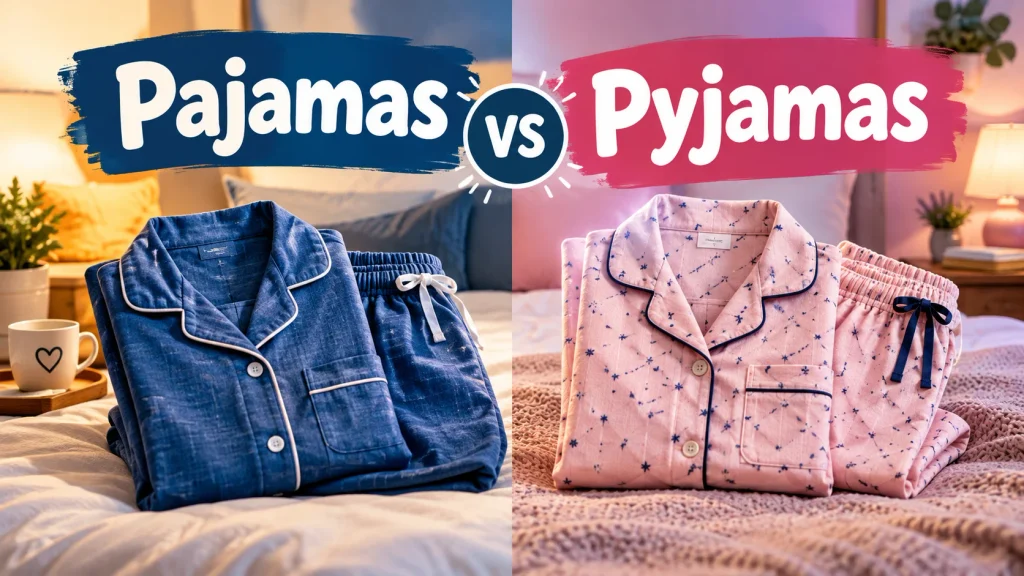
If you’ve ever wondered whether pajamas and pyjamas mean different things, the answer is refreshingly simple: they usually mean the same thing. The real difference is regional spelling. American English generally uses pajamas, while British English uses pyjamas. Dictionaries such as Cambridge explicitly identify “pajamas” as the US spelling and “pyjamas” as the UK spelling.
That small spelling change can still create confusion. You might see pajamas on an American clothing website and pyjamas on a British retailer’s page. Both describe sleepwear. Neither spelling makes the garment more formal, more comfortable, or more correct.
The distinction becomes much easier once you connect the word to the variety of English you’re using. If you’re writing for readers in the United States, pajamas is the natural choice. If you’re following British English, pyjamas is the conventional spelling.
What Do Pajamas and Pyjamas Mean?
Pajamas and pyjamas refer to clothing worn for sleeping or relaxing, traditionally consisting of a loose-fitting shirt or top and pants or trousers. Cambridge defines pajamas as clothes worn in bed that consist of a loosely fitting shirt and pants. Its British-English entry gives the corresponding definition for pyjamas.
The word can describe several styles today. A traditional pair might have a button-up top and matching pants. Modern sleepwear can also include shorts, T-shirts, nightshirts, lightweight sets, thermal designs, and other comfortable garments intended for nighttime use.
In everyday English, you’ll often hear people use related expressions such as:
- pajama set
- pyjama set
- pajama pants
- pyjama bottoms
- pajama top
- pyjama top
- pajamas
- pyjamas
- PJs
The shortened form PJs is especially common in casual American English. The Online Etymology Dictionary dates this abbreviation to 1964.
So, when someone says, “I need a new pair of pajamas,” they aren’t talking about a different garment from someone who says, “I need a new pair of pyjamas.” The clothing is essentially the same. The spelling tells you more about the writer’s regional English than about the item itself.
Definition of Pajamas
In American English, pajamas is the standard spelling. It is normally treated as a plural noun, which explains the common expression a pair of pajamas. Cambridge lists “pajamas” as a plural noun and gives “I need a new pair of pajamas” as a typical example.
For example:
I changed into my pajamas before watching a movie.
Here, “pajamas” simply means the clothing worn for sleeping or lounging.
British English uses the spelling pyjamas for the same basic concept:
I changed into my pyjamas before watching a movie.
Nothing about the meaning changes. The spelling changes because the sentence follows a different English convention.
It’s also useful to separate pajama from pajamas. In American English, “pajama” can appear before another noun as a modifier, as in pajama pants or pajama top. British English commonly uses pyjama in the same role, such as pyjama bottoms or pyjama top. Cambridge recognizes “pyjama” as a noun and adjective in British English.
Are Pajamas and Pyjamas the Same?
Yes. In ordinary modern English, pajamas and pyjamas are two regional spellings of the same word.
| Feature | Pajamas | Pyjamas |
| Basic meaning | Sleepwear | Sleepwear |
| Main spelling tradition | American English | British English |
| Refers to | Clothing worn for sleeping or relaxing | Clothing worn for sleeping or relaxing |
| Meaning difference | None in ordinary use | None in ordinary use |
| Common regional form | United States | United Kingdom and other varieties influenced by British English |
| Typical phrase | a pair of pajamas | a pair of pyjamas |
This is similar to many other American and British spelling pairs. For example, American English uses color, while British English uses colour. American English uses favorite, while British English uses favourite. The different spelling doesn’t create a different concept.
The same principle applies here. Pajamas isn’t an American version of one garment while pyjamas describes another. They’re regional forms of the same word.
What Type of Clothing Does the Word Describe?
Traditionally, pajamas consist of two coordinated pieces: a top and a lower garment. The top may resemble a shirt, while the lower part usually resembles loose pants or trousers. Cambridge describes pyjamas as soft, loose clothing worn in bed and consisting of trousers and a type of shirt.
Modern sleepwear has become much broader, though. A clothing company might label a lightweight summer set as pajamas even if it includes shorts instead of full-length pants. Similarly, a winter set may use flannel or another warm fabric.
Common pajama styles include:
- Button-front pajama sets
- T-shirt and pants sets
- Shorts and top sets
- Flannel pajamas
- Silk pajamas
- Satin sleepwear
- Thermal sleepwear
- Children’s pajamas
- Matching family pajamas
- Nightshirts
- Lounge-style pajama sets
The word therefore identifies a category of sleepwear, not one rigid design.
That’s important because language follows real-world use. Clothing styles change over time, yet the core word remains useful. A modern pajama set can look quite different from the loose two-piece garments associated with the word’s earlier history.
The Simple Difference Explained
The quickest way to remember the difference is this:
Pajamas = American English.
Pyjamas = British English.
Cambridge directly labels “pajamas” as the US spelling of “pyjamas,” while its British entry identifies “pyjamas” as the UK form.
That makes the choice fairly straightforward when you know your audience.
If you’re writing an American blog post, use pajamas consistently. If you’re writing for a British publication, pyjamas will usually fit better. The same principle can guide product descriptions, school assignments, business writing, and other forms of communication.
Consider these examples:
American English:
My daughter put on her pajamas and went to bed.
British English:
My daughter put on her pyjamas and went to bed.
Both sentences communicate the same idea.
The important point is consistency. Switching between the two forms randomly can make an article look poorly edited, especially when the surrounding vocabulary clearly follows one regional variety.
For example, an American-focused article might use pajamas, pants, apartment, and color. A British-focused article might use pyjamas, trousers, flat, and colour. Keeping the spelling and vocabulary aligned creates a smoother reading experience.
Why Does the Spelling Change?
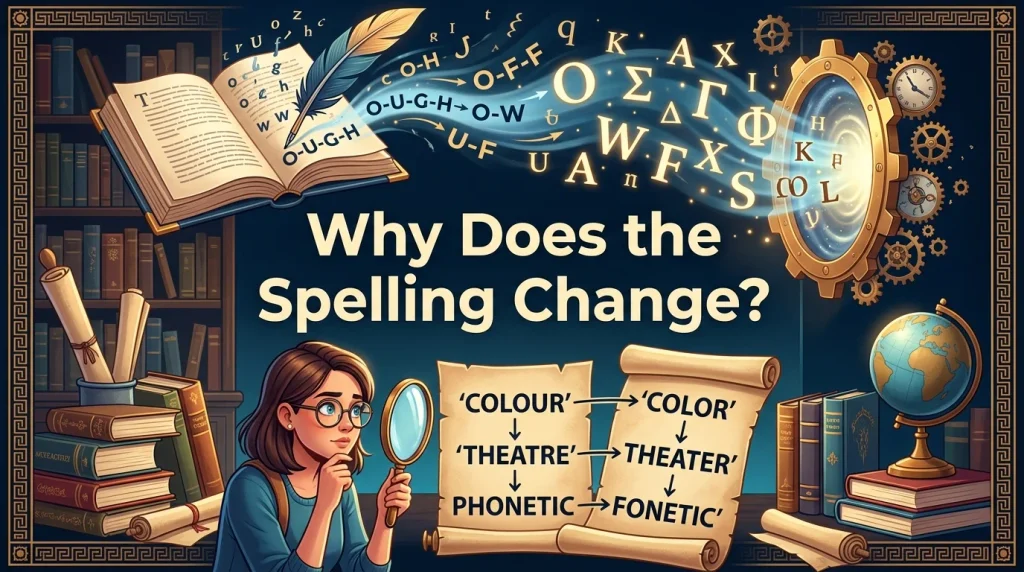
The spelling difference has a long history rather than being a recent disagreement between American and British writers.
The English word traces back to South Asian usage. The Online Etymology Dictionary records pajamas in English from around 1800, with earlier forms such as pai jamahs. It connects the word to Hindi pajama and probably further to Persian paejamah, literally referring to “leg clothing.”
The original garment wasn’t necessarily the sleepwear set that most English speakers picture today. The historical term referred to loose trousers tied around the waist. Europeans in India adopted the clothing and the word, with the term becoming associated with nightwear in English.
Over time, English speakers adapted the borrowed word to their own spelling conventions. Early English spellings included forms such as pai jamahs, pigammahs, and peijammahs. The modern American spelling pajamas was established by the mid-19th century, while British usage developed toward pyjamas.
This history explains why the two modern spellings can look surprisingly different even though they share the same origin.
The Persian and Hindi Connection
The etymology becomes even more interesting when you break the historical word into its components.
The Online Etymology Dictionary traces the English term through Hindi pajama, probably from Persian paejamah. The Persian elements are associated with pae, meaning “leg,” and jamah, meaning clothing or garment.
In other words, the older term was closely connected to clothing worn on the legs.
That connection makes sense because the original garment was a loose pair of trousers rather than the complete matching sleepwear set that many people imagine today.
Language often works this way. A borrowed word can enter another language with one specific meaning, then gradually develop a broader or slightly different everyday meaning. Pajamas provide a good example of that process.
How the Word Entered English
The word entered English through British contact with South Asia during the period when English speakers encountered and adopted local words, foods, clothing terms, and cultural concepts.
The English form appeared around 1800. The word was initially associated with loose trousers worn in India. Europeans adopted both the garment and its name, and the term eventually became strongly associated with nighttime clothing in English.
That historical path also explains why pyjamas and pajamas share the same linguistic roots despite their modern spelling difference.
A useful way to remember the history is to think of the word as a linguistic traveler. It moved through languages and regions, changed its spelling as English varieties developed, and eventually settled into the everyday meaning familiar today.
Is There Any Difference in Meaning or Pronunciation?
For ordinary use, there is no meaningful difference in definition between the two spellings. Both refer to sleepwear.
Pronunciation can vary slightly by regional accent, just as many words do across American and British English. Cambridge gives pronunciations for both forms and shows that the spelling distinction does not create a completely different spoken word.
The key distinction remains written form.
If you’re learning American English, you’ll most likely encounter pajamas. If you’re learning British English, pyjamas is the spelling to recognize and use.
You don’t need to memorize two separate definitions. Instead, remember one meaning and two regional spellings.
That makes this a relatively easy vocabulary issue for English learners. The challenge isn’t understanding the word. It’s knowing which spelling fits the variety of English you’re using.
A Quick Way to Remember the Difference
Think of the spelling pattern this way:
American English → pajama → pajamas
British English → pyjama → pyjamas
Once that pattern becomes familiar, the difference stops being confusing.
It also helps to remember that English contains many regional spelling pairs. The -or/-our distinction in words such as color/colour follows a similar regional pattern. So does the -er/-re distinction in center/centre.
Pajamas vs. pyjamas belongs to that larger family of American and British English differences.
The word itself isn’t changing its identity. The spelling is simply wearing a different regional outfit.
Which Spelling Should You Use?
Once you know that pajamas and pyjamas carry the same basic meaning, the next question is practical: which spelling should you actually use? The best answer depends on your audience and variety of English.
For American readers, pajamas is the standard choice. Cambridge identifies “pajamas” as the US spelling of “pyjamas.” For British readers, pyjamas is the established UK form.
That distinction matters most when you’re writing for a clearly defined audience. A US school assignment, American lifestyle blog, or product page aimed at US shoppers will normally look more natural with pajamas. A British publication or UK-focused clothing store will generally choose pyjamas.
The choice doesn’t affect correctness. Instead, it signals which English convention you’re following.
| Audience or English variety | Recommended spelling |
| United States | pajamas |
| United Kingdom | pyjamas |
| American English learners | pajamas |
| British English learners | pyjamas |
| International audience | Follow the chosen editorial style |
| Mixed-language website | Keep usage consistent or localize by market |
Pajamas in American English
In American English, pajamas is the ordinary spelling for sleepwear. Cambridge labels it as the US spelling and defines it as soft, loose clothing worn in bed, typically consisting of pants and a type of shirt.
You’ll see the American spelling in everyday conversations, retail descriptions, children’s books, advertising, magazines, and online content.
For example:
- I bought new pajamas for winter.
- The children changed into their pajamas before the movie.
- These cotton pajamas are lightweight and comfortable.
- She packed two pairs of pajamas for the trip.
- He wore striped pajamas to the costume party.
American English also commonly uses pajama as a modifier before another noun:
- pajama pants
- pajama top
- pajama set
- pajama party
- pajama shorts
Cambridge lists pajama as a noun and adjective and identifies it as the US spelling of British pyjama.
This distinction becomes useful when you encounter phrases that don’t contain the full plural noun. A sentence such as “She bought a pajama top” still follows American spelling even though the word appears in singular modifier form.
American English also commonly shortens pajamas to PJs or PJ’s in informal contexts. Cambridge lists “pj’s” as an informal form.
So you might see:
Don’t forget your PJs before we leave.
That’s casual language rather than a different word for a different kind of clothing.
Pyjamas in British English
In British English, the usual spelling is pyjamas. Cambridge labels the word as UK usage and gives the US form as “pajamas.”
British writers commonly use pyjamas in ordinary conversation, newspapers, books, product descriptions, and other forms of writing.
For example:
- I bought a new pair of pyjamas.
- The children put on their pyjamas before bedtime.
- These cotton pyjamas feel soft against the skin.
- She packed two pairs of pyjamas for the holiday.
- He left his pyjamas on the chair.
The singular modifier also changes:
- pyjama top
- pyjama bottoms
- pyjama set
- pyjama party
Cambridge identifies pyjama as the UK spelling of American pajama and gives it both noun and adjective functions.
Notice how the spelling remains consistent even when the grammatical role changes. That’s an important point for English learners. You don’t switch to “pajama” simply because the word modifies another noun. The regional spelling remains part of the expression.
Other English-Speaking Countries
The picture becomes less tidy once you move beyond the United States and United Kingdom.
English-speaking countries don’t all use the same vocabulary or spelling conventions. Historical ties, education systems, publishing standards, media exposure, and proximity to other English varieties can all influence word choice.
In countries where British English has historically had strong influence, pyjamas is often familiar and widely used. In environments strongly influenced by American media and commerce, pajamas may also appear frequently.
Canada is a useful example because Canadian English has developed under both British and American influence. You may encounter forms associated with either tradition depending on the publication, speaker, retailer, or regional context.
Australia and New Zealand also have English varieties with many conventions historically associated with British English. That makes pyjamas a familiar form there, although global media means that pajamas is hardly an unfamiliar spelling.
India adds another interesting layer because the word itself has South Asian linguistic roots. Modern Indian English can use pyjamas, particularly in contexts influenced by British English, while pajamas can also appear in international commerce and American-influenced material.
The practical lesson is simple: don’t assume that every country has one spelling rule that every writer follows without exception.
When accuracy matters, check the style guide or publication standard you’re expected to follow.
Which Spelling Is Better for International Writing?
If your writing targets an international audience, you don’t need to invent a third spelling. Choose a consistent variety of English and make that choice clear through the rest of your vocabulary.
For a website written primarily in US English, pajamas is the sensible default. For a British-English website, use pyjamas.
If a company operates internationally, it may maintain localized versions of its website. A US storefront might say “pajamas,” while a UK storefront says “pyjamas.” That approach can make the content feel more natural to local readers.
The key principle is consistency rather than universality.
A reader isn’t likely to misunderstand “pajamas” simply because they normally write “pyjamas.” However, inconsistent spelling can make professional content feel careless.
For example, imagine an article that begins with “pajamas,” later switches to “pyjamas,” and then returns to “pajamas.” Nothing becomes grammatically incomprehensible. Still, the inconsistent editorial style distracts readers.
A cleaner approach is:
Choose the spelling that matches your audience, then stick with it.
The Origin and History of Pajamas and Pyjamas
The story behind pajamas is more interesting than its modern bedroom association suggests. The English word didn’t originate as a term specifically for bedtime clothing.
Its deeper history reaches into South Asia and Persian, where related words referred to loose garments worn on the legs. English speakers later adopted the term and gave it a more specialized meaning.
That history helps explain why the spelling looks unusual compared with many traditional English words.
The English word is generally traced through Hindi pajama to Persian pāy-jāma. The Persian elements relate to the leg and clothing. The word therefore originally had a much broader clothing connection than today’s familiar sleepwear meaning.
Etymology of Pajamas/Pyjamas
The word’s etymology explains why pajamas and pyjamas look different while remaining closely related.
The Online Etymology Dictionary records pajamas in English from around 1800 and connects it with Hindi pajama, from Persian paejamah. The historical sense referred to loose trousers or leg clothing.
English has borrowed thousands of words from other languages. Once a borrowed word enters English, speakers don’t necessarily preserve its original spelling. They adapt it to local writing habits, pronunciation, and established spelling patterns.
That’s what happened here.
The spelling eventually developed along different regional paths. American English settled on pajamas, while British English retained the form pyjamas.
This wasn’t a case of one side changing the word’s meaning. It was primarily a matter of how English speakers represented the same borrowed term in writing.
The Persian and Hindi Connection
The Persian connection is especially useful because it reveals what the word originally described.
The historical Persian expression pāy-jāma is associated with leg clothing. The Hindi form pajama then entered wider use, referring to loose trousers. English adopted the term during the period of British involvement in South Asia.
That original clothing was different from the coordinated sleepwear sets commonly sold today.
A historical pair of pajamas could be understood primarily as loose trousers. The modern English sense gradually became associated with clothing worn for sleeping.
This is a good example of semantic development. A word can keep its basic identity while its everyday meaning becomes more specialized.
Think of it like a path that gradually narrows. The older term described a type of leg garment. English later used the word for a particular kind of nightwear. Today, pajamas can describe an entire sleepwear set rather than merely trousers.
The connection remains visible in expressions such as pajama pants and pyjama bottoms, but the everyday meaning is much broader.
How the Word Entered English
English speakers encountered the word in South Asia and gradually incorporated it into English vocabulary. Historical records show several early spellings before the modern forms became established.
Those variations are a reminder that spelling wasn’t always as standardized as it is today.
Before modern dictionaries, mass education, publishing conventions, and digital spell-checkers helped stabilize written English, borrowed words could appear in several forms. Writers often spelled unfamiliar words according to how they heard them.
Over time, repeated usage favored particular forms.
American English developed pajamas, while British English developed pyjamas. Both forms survived because English does not have one central authority that dictates a single worldwide spelling system.
That point matters when people ask which version is “correct.”
Both are correct within the appropriate regional convention.
Regional Spelling Differences Around the World
The difference between pajamas and pyjamas makes more sense when viewed alongside other regional spelling patterns.
American and British English frequently use different spellings for the same word. The differences can reflect historical developments, pronunciation, dictionary traditions, and deliberate standardization.
Consider these familiar pairs:
| American English | British English |
| pajamas | pyjamas |
| color | colour |
| favorite | favourite |
| center | centre |
| theater | theatre |
| organize | organise |
| traveled | travelled |
Not every spelling difference follows the same historical path. Still, they demonstrate an important feature of English: regional varieties can develop their own stable conventions.
United States
The United States strongly favors pajamas.
For American readers, “pyjamas” may look foreign or British even though its meaning is completely clear. American dictionaries and educational resources generally present pajamas as the expected spelling.
If you’re writing for a US audience, use:
pajamas
rather than:
pyjamas
The same preference applies to compounds such as pajama party, pajama pants, and pajama top.
United Kingdom
The United Kingdom generally uses pyjamas.
Cambridge lists pyjamas as the UK form and pajamas as the US equivalent.
A British reader would naturally expect sentences such as:
I need to buy a new pair of pyjamas.
The spelling also appears in compounds:
- pyjama top
- pyjama bottoms
- pyjama set
- pyjama party
This regional pattern is well established rather than a matter of personal preference.
Canada
Canadian English occupies an interesting middle ground because it has developed under both British and American influence.
You may encounter pajamas and pyjamas in Canadian contexts, depending on the source and editorial convention. American media and trade have influenced Canadian vocabulary and spelling, while British traditions have also left a lasting mark.
For Canadian writing, the safest approach is to follow the relevant publication, institution, or brand style rather than assuming that one form must apply everywhere.
If you’re preparing content for a Canadian publication, check its house style before making a final choice.
Australia and New Zealand
Pyjamas is a familiar spelling in Australian and New Zealand English, reflecting the strong historical influence of British English.
However, modern readers in these countries regularly encounter American spelling through films, television, social media, international brands, and online commerce. As a result, pajamas is recognizable even when it isn’t the traditional local preference.
For formal or locally targeted writing, follow the spelling conventions of the publication or audience.
India and Other Commonwealth Countries
India is particularly interesting because the word has roots in the region.
English in India developed through a long period of British influence, so pyjamas remains a well-established spelling in Indian English. At the same time, the word exists in a much broader cultural context than the modern Western sleepwear sense.
For example, pyjama can refer to loose trousers as part of South Asian clothing traditions. Cambridge’s examples include uses involving kurta pyjamas, showing that the term can appear in contexts beyond Western-style sleepwear.
That distinction is worth remembering.
The English word pyjamas can refer to nighttime clothing, but related South Asian garments can have different cultural functions. The shared word doesn’t mean every garment called a pyjama is identical in design or purpose.
Global Spelling Preferences
Global English is not a single uniform system.
A person reading an American website may repeatedly see pajamas. Someone reading British newspapers may repeatedly encounter pyjamas. Both readers understand the word because the underlying vocabulary is shared.
For writers, this creates a practical choice rather than a linguistic problem.
Match the spelling to the reader whenever the audience is clear.
If the audience isn’t tied to one region, establish a consistent editorial style. Don’t alternate between spellings merely to capture every possible variation.
Everyday, Formal, and Online Writing
The spelling choice becomes especially important when you write for a specific purpose.
Everyday Conversation
In casual speech, spelling usually doesn’t matter because listeners hear the word rather than see it.
You can say:
“I forgot to pack my pajamas.”
A British speaker can say the same thing using the local pronunciation associated with pyjamas.
The distinction becomes visible when you text someone, write a message, post on social media, or type a shopping list.
For casual American writing:
Don’t forget your pajamas.
For British writing:
Don’t forget your pyjamas.
Neither version needs a formal explanation.
Formal Writing
Formal writing should follow the relevant regional standard.
If you’re preparing a report for an American organization, pajamas will normally fit the document’s style. A British institution will generally expect pyjamas.
The important factor isn’t formality itself. It’s editorial consistency.
A formal document doesn’t become more correct simply because it chooses one spelling over the other.
Academic Writing
Academic writing adds another consideration: style guides.
Different institutions and journals can prescribe particular varieties of English. If your university requires American English, use pajamas. If a journal requests British English, use pyjamas.
Quoted material deserves special attention. If a source uses British spelling and you quote it directly, don’t casually alter the spelling just to match your preferred variety. Follow the citation and quotation rules that apply to your assignment or publication.
Business and Marketing Content
Businesses should think about target customers.
An American clothing retailer selling sleepwear to US shoppers will naturally use terms such as:
- pajamas
- pajama sets
- pajama pants
- women’s pajamas
- men’s pajamas
- children’s pajamas
A British retailer may use:
- pyjamas
- pyjama sets
- pyjama bottoms
- women’s pyjamas
- men’s pyjamas
- children’s pyjamas
The difference may look tiny, but consistent regional language can make an online store feel more familiar to its customers.
SEO and Online Content
For online content, spelling also intersects with search behavior.
Search engines can understand that pajamas and pyjamas are closely related variants. Writers therefore don’t need to awkwardly force both spellings into every sentence.
Instead, choose the primary spelling that matches the intended audience and use related variants naturally when they genuinely help the reader.
For example, a US-focused article can primarily use pajamas while mentioning pyjamas when explaining the British spelling.
That approach serves two goals at once: it answers the user’s question directly and keeps the language natural.
A useful SEO structure might include:
- Pajamas vs. Pyjamas: What’s the Difference?
- Pajamas in American English
- Pyjamas in British English
- Why Are Pajamas and Pyjamas Spelled Differently?
- Are Pajamas and Pyjamas the Same?
The goal isn’t to repeat a keyword until the writing sounds robotic. Good topical coverage naturally introduces the related vocabulary readers expect.
Comparison Table
A compact comparison can settle the issue quickly.
| Question | Pajamas | Pyjamas |
| What does it mean? | Sleepwear | Sleepwear |
| Where is it standard? | American English | British English |
| Is it correct? | Yes | Yes |
| Is the clothing different? | No | No |
| Is the meaning different? | No | No |
| Can it describe a two-piece set? | Yes | Yes |
| Can it appear as a modifier? | pajama pants | pyjama bottoms |
| Common regional audience | US readers | UK readers |
| Historical origin | Same word family | Same word family |
| Best practice | Match US style | Match UK style |
The table reveals the central fact: the difference is primarily orthographic and regional.
You don’t need separate definitions for the two words. You need one definition and an understanding of where each spelling belongs.
Quick Summary
If you remember only a few points, remember these:
- Pajamas is the standard American spelling.
- Pyjamas is the standard British spelling.
- Both refer to sleepwear.
- The spelling does not normally change the meaning.
- Related singular forms are pajama and pyjama.
- Regional English determines the preferred spelling.
- Consistency matters when you’re writing.
- International websites should choose a clear editorial or regional style.
Once those points click, the supposed “difference” between pajamas and pyjamas becomes much less mysterious.
Pajamas vs. Pyjamas: Example Sentences
Seeing pajamas and pyjamas in real sentences makes the difference much easier to understand. The words work in essentially the same way, but the preferred spelling depends on the variety of English.
Cambridge classifies both pajamas and pyjamas as plural nouns for clothing worn in bed.
Examples Using “Pajamas”
These examples follow standard American English usage:
- I put on my pajamas before reading in bed.
- She bought a comfortable pair of pajamas for winter.
- My son refuses to sleep without his favorite pajamas.
- These cotton pajamas feel soft and breathable.
- I packed three pairs of pajamas for our vacation.
- The children wore matching pajamas during the sleepover.
- He changed into his pajamas after dinner.
- Those striped pajamas would make a great gift.
- I left my pajamas beside the bed.
- The store has a large selection of children’s pajamas.
Notice that American English commonly uses pajamas even when the sentence refers to one complete set.
For example:
I bought a new pair of pajamas.
The word remains plural because the clothing traditionally consists of multiple pieces.
Examples Using “Pyjamas”
These examples follow standard British English usage:
- I put on my pyjamas before going to bed.
- She bought a warm pair of pyjamas for winter.
- The children changed into their pyjamas upstairs.
- He packed two pairs of pyjamas for the trip.
- These cotton pyjamas are very comfortable.
- I left my pyjamas on the chair.
- She received a new pair of pyjamas for her birthday.
- The children wore matching pyjamas at the sleepover.
- He always wears striped pyjamas.
- The hotel provided clean pyjamas for guests.
The grammatical pattern stays the same. Only the regional spelling changes.
Examples in Different Contexts
The spelling can appear in almost any context involving sleepwear. The following examples show how naturally the terms fit into everyday communication.
Everyday Conversation
Casual conversations often use the word without any special emphasis:
“I’m going to change into my pajamas.”
A British speaker might write:
“I’m going to change into my pyjamas.”
Both sentences communicate the same basic idea.
You might also hear informal expressions such as PJs in American English. Cambridge lists “PJs” as an informal form related to pajamas.
For example:
“I’m staying in my PJs all morning.”
This shortened form feels relaxed and conversational. It’s common in texts, social posts, casual advertisements, and everyday speech.
Shopping
Shopping language often uses pajamas or pyjamas as part of product names.
An American store might advertise:
- Women’s cotton pajamas
- Men’s flannel pajamas
- Kids’ holiday pajamas
- Matching family pajama sets
- Lightweight summer pajamas
A British retailer may instead use:
- Women’s cotton pyjamas
- Men’s flannel pyjamas
- Children’s Christmas pyjamas
- Matching family pyjama sets
- Lightweight summer pyjamas
The difference can even appear in related product terms. British English commonly uses expressions such as pyjama bottoms, while American English often says pajama pants.
Travel
Travel writing frequently mentions pajamas because people need comfortable clothing for overnight journeys, hotels, and vacations.
For example:
Pack a warm pair of pajamas if the hotel room gets chilly.
Or:
Don’t forget your pyjamas when you pack for the weekend.
The spelling should match the English variety used throughout the travel content.
If a travel company writes primarily for American customers, pajamas will generally feel more natural. A British travel publication will normally favor pyjamas.
Hospitality
Hotels, resorts, and accommodation providers may mention sleepwear when describing rooms, amenities, or packing suggestions.
Examples include:
Guests should bring comfortable pajamas for overnight stays.
The children arrived wearing their pyjamas.
However, hotels typically don’t provide pajamas unless they specifically advertise sleepwear as an amenity. The word itself doesn’t imply that a hotel supplies the clothing.
Healthcare
Healthcare writing can also use these terms when describing a patient’s clothing or preparation for an overnight stay.
For example:
Please bring comfortable pajamas for your hospital stay.
Or:
Patients should pack clean pyjamas and other personal items.
The spelling again depends on the publication’s English variety.
In practical writing, consistency matters more than choosing one spelling as universally superior.
Common Mistakes With “Pajamas” and “Pyjamas”
Most mistakes involving these words aren’t about meaning. They’re usually caused by regional spelling, grammar, or inconsistency.
Understanding the common errors can help you avoid them.
Mixing American and British Spellings
One of the most noticeable mistakes is switching between English varieties without a reason.
For example:
The article recommends comfortable pajamas and colourful pyjamas.
This sentence combines the American pajamas with the British spelling colourful and then repeats the sleepwear word in its British form.
That isn’t automatically grammatically wrong. However, it creates an inconsistent editorial voice.
A better approach is to choose one variety.
American English:
The article recommends comfortable pajamas and colorful sleepwear.
British English:
The article recommends comfortable pyjamas and colourful sleepwear.
Consistency gives your writing a smoother rhythm.
Assuming They Have Different Meanings
Another common mistake is believing that pajamas and pyjamas describe different garments.
They don’t normally carry different meanings.
The spelling tells readers which English convention you’re using. It doesn’t normally tell them whether the clothing is made from cotton, silk, flannel, or another material.
For example:
Cotton pajamas
and
Cotton pyjamas
can describe the same type of sleepwear.
The fabric changes the garment’s characteristics. The spelling does not.
Changing Spelling Within the Same Article
Suppose you’re writing an American English article and use pajamas throughout the introduction. Later, you suddenly write pyjamas because you saw that spelling somewhere else.
That switch can make the article look poorly edited.
The solution is simple: establish your preferred English variety before drafting.
If the target audience is American, consistently use:
pajamas, pajama pants, pajama top, pajama set
If the target audience is British, consistently use:
pyjamas, pyjama bottoms, pyjama top, pyjama set
There may be legitimate reasons to mention the alternative spelling. For example, an article specifically comparing the two forms should obviously use both. The key is to explain the difference rather than switch randomly.
Ignoring Your Audience
Writers sometimes choose a spelling based entirely on personal preference.
Audience matters more.
Imagine an American clothing company using pyjamas across every product page. The word is understandable, but the spelling may feel out of place to its primary customers.
Likewise, a British lifestyle publication that consistently uses pajamas may appear heavily influenced by American English.
Neither choice makes the writer unintelligent. It simply creates a mismatch between language and audience.
When you’re unsure, ask:
- Who will read this?
- Which English variety does the publication use?
- What does the company’s existing content use?
- Does a style guide specify American or British English?
- Should regional versions of the content use different spellings?
Those questions usually make the answer obvious.
Other American and British Spelling Differences
Pajamas vs. pyjamas belongs to a much larger pattern.
American and British English developed different spelling preferences in several areas. Learning these patterns can make regional differences easier to recognize.
Why Do These Differences Exist?
English spelling has never been completely uniform.
American English developed its own conventions over time, influenced partly by efforts to simplify certain spellings. British English retained or developed other forms through established dictionaries, education, publishing, and historical usage.
Consider the following examples:
| American English | British English |
| pajamas | pyjamas |
| color | colour |
| favorite | favourite |
| honor | honour |
| center | centre |
| theater | theatre |
| meter | metre |
| gray | grey |
| check | cheque |
| truck | lorry |
These pairs don’t all represent the same type of difference. Some involve spelling, while others involve vocabulary.
Still, they demonstrate why English learners should avoid treating one national variety as the only legitimate form.
American English and British English are both established varieties of English.
Once you understand that principle, pajamas vs. pyjamas becomes much easier to remember.
Are “Pajamas” and “Pyjamas” Singular or Plural?
Grammar adds another interesting detail to this word.
In standard English usage, pajamas and pyjamas are normally treated as plural nouns. Cambridge explicitly labels both forms as plural nouns.
That’s why you commonly hear:
I bought a pair of pajamas.
rather than:
I bought a pajama.
However, the singular forms pajama and pyjama do exist. They have particular grammatical and descriptive uses.
How the Word Works Grammatically
Because pajamas usually refer to a set of clothing with separate upper and lower pieces, English commonly treats the word as plural.
You can say:
- My pajamas are comfortable.
- Her pajamas were on the bed.
- These pajamas look soft.
- I need a new pair of pajamas.
The verb agrees with the plural noun.
For example:
My pajamas are clean.
Not:
My pajamas is clean.
The same pattern applies to pyjamas:
My pyjamas are on the chair.
This is similar to other clothing terms that often occur in plural form, such as pants, shorts, and scissors.
Can You Say “Pajama” or “Pyjama”?
Yes.
The singular forms pajama and pyjama appear especially when the word modifies another noun.
For example, American English uses:
- pajama top
- pajama pants
- pajama set
- pajama party
British English uses:
- pyjama top
- pyjama bottoms
- pyjama set
- pyjama party
Cambridge identifies pyjama as a noun and adjective and gives examples such as pyjama bottoms and pyjama top.
The distinction becomes clearer when you compare these sentences:
I bought new pajamas.
Here, pajamas functions as the main noun.
I bought a new pajama top.
Here, pajama modifies top.
The same principle works in British English:
I bought new pyjamas.
I bought a new pyjama top.
So don’t assume that the singular form is incorrect. It simply has a different grammatical role in many everyday expressions.
What Are Pajamas Made From?
The word pajamas describes a type of clothing, not one particular fabric.
Manufacturers make pajamas from many materials. The best choice depends on temperature, personal comfort, durability, and the intended use of the garment.
Common options include cotton, flannel, silk, linen, rayon, modal, polyester, and fabric blends.
Cambridge specifically gives examples of cotton, silk, and flannel sleepwear in its dictionary material.
Common Pajama Fabrics
Cotton remains a popular choice because it’s soft, familiar, and versatile. Lightweight cotton can work especially well in warmer conditions.
Flannel is associated with warmer sleepwear. Cambridge describes flannel as a soft fabric used for clothing, including pajamas.
Silk creates a smooth, lightweight feel and is often associated with more luxurious sleepwear.
Linen can provide an airy option for warm weather. Its relaxed texture also gives sleepwear a casual appearance.
Modal and other soft blends are often chosen for their smooth feel and flexibility.
Polyester and synthetic blends can offer durability and easy care, although comfort varies by fabric construction and personal preference.
The right fabric isn’t determined by whether you spell the word pajamas or pyjamas. That’s a spelling issue, not a clothing-design issue.
Choosing Pajamas for Different Seasons
Your sleepwear fabric can make a noticeable difference in comfort.
For hot weather, lightweight cotton, linen, and breathable blends may feel more comfortable.
For cold weather, flannel and heavier fabrics can provide additional warmth. Cambridge describes flannel as a soft material used for pajamas and other clothing.
For mild temperatures, medium-weight cotton or soft blended fabrics offer a flexible middle ground.
A simple seasonal guide looks like this:
| Season or condition | Common choices |
| Hot weather | Lightweight cotton, linen, breathable blends |
| Mild weather | Cotton, modal, lightweight blends |
| Cold weather | Flannel, heavier cotton, warm blends |
| Luxury sleepwear | Silk and smooth specialty fabrics |
| Everyday use | Cotton and durable blends |
Ultimately, comfort depends on more than fabric alone. Weave, thickness, fit, humidity, room temperature, and personal preference all matter.
The spelling of pyjamas or pyjamas won’t change any of those physical characteristics. It simply tells the reader which regional English convention you’re following.
Quick Reference
At a glance, pajamas and pyjamas are two regional spellings of the same clothing term. The difference is mainly tied to English variety, not meaning, pronunciation, or the type of garment.
Oxford lists pajamas as the North American form and notes pyjamas for British and Canadian English. It also classifies the noun as plural.
| Feature | Pajamas | Pyjamas |
| Main English variety | American English | British English |
| Also used in | North American contexts | British, Canadian, and other contexts |
| Meaning | Clothing worn in bed | Clothing worn in bed |
| Singular modifier | pajama | pyjama |
| Example | pajama pants | pyjama bottoms |
| Common short form | PJs, PJ’s | PJs |
| Meaning difference | None | None |
| Clothing difference | None | None |
| Best choice | US-focused writing | UK-focused writing |
The Fastest Way to Remember the Difference
A simple memory trick can make the spelling distinction stick.
Think:
Pajamas = American English
Pyjamas = British English
The extra y in pyjamas doesn’t create a different garment. It simply reflects a different spelling tradition.
You can also remember the related forms:
- pajama → American English
- pyjama → British English
- pajamas → American English plural
- pyjamas → British English plural
- PJs → informal abbreviation
Oxford lists PJs as an informal plural noun and gives it as a shortened form of pyjamas.
In American English, PJ’s also appears as an informal spelling for pajamas.
The important point is that abbreviations don’t create another type of sleepwear. They’re simply shorter ways to refer to the same general clothing.
Frequently Confused Uses of Pajama and Pyjama
Although the main spelling difference is straightforward, several related expressions can confuse English learners.
Pajama Pants vs. Pyjama Bottoms
One of the clearest regional differences appears in the words used for the lower part of the outfit.
American English commonly uses:
pajama pants
British English commonly uses:
pyjama bottoms
Both refer to the lower garment worn as part of a pajama or pyjama set.
For example:
I bought a comfortable pair of pajama pants.
British English can express the same idea as:
I bought a comfortable pair of pyjama bottoms.
The difference here involves both spelling and regional vocabulary.
Pajama Top vs. Pyjama Top
The upper part of the outfit creates a simpler comparison.
American English:
pajama top
British English:
pyjama top
Oxford identifies pyjama as an adjective used before nouns such as pyjama bottoms, while the American form is pajama.
For example:
She packed a matching pajama top and pants.
Or:
She packed a matching pyjama top and bottoms.
Again, the basic concept stays the same.
Pajama Set vs. Pyjama Set
Retailers frequently use the word set to describe coordinated sleepwear.
American:
This pajama set includes a long-sleeved top and pants.
British:
This pyjama set includes a long-sleeved top and bottoms.
This distinction can matter for product descriptions because shoppers naturally search using the vocabulary familiar in their region.
How to Use Pajamas and Pyjamas Correctly
Correct usage becomes much easier when you separate meaning, grammar, and regional spelling.
Use “Pajamas” for American English
Choose pajamas when your content follows American English conventions.
Examples include:
- pajamas
- pajama pants
- pajama top
- pajama set
- pajama party
- pajama day
A sentence might read:
The children wore matching pajamas for the school sleepover.
This spelling is particularly suitable for US-focused blogs, product descriptions, school materials, advertisements, and general online content.
Use “Pyjamas” for British English
Choose pyjamas when you’re writing in British English.
Examples include:
- pyjamas
- pyjama bottoms
- pyjama top
- pyjama set
- pyjama party
- pyjama day
For example:
The children wore matching pyjamas for the school sleepover.
The sentence communicates the same idea. Only the regional language convention changes.
Keep Your Spelling Consistent
Consistency is one of the easiest ways to make writing look polished.
If an article uses American English, keep related spellings consistent throughout the piece. Don’t use pajamas in one section and pyjamas in another simply because both forms are technically understandable.
The same principle applies beyond this one word.
If you choose American English, you might write:
- color
- favorite
- center
- pajamas
If you choose British English, you might write:
- colour
- favourite
- centre
- pyjamas
A consistent style creates a smoother reading experience.
English Learners
English learners often wonder whether they need to memorize both forms.
The answer depends on where and how you use English.
If you’re studying American English, learn pajamas as your primary form. If you’re studying British English, learn pyjamas as your primary form.
You should still recognize the alternative because you’ll encounter it in books, websites, films, product descriptions, and conversations.
This is an important language-learning strategy: active vocabulary and passive vocabulary don’t have to match perfectly.
You might actively write pajamas while easily recognizing pyjamas when reading British content.
Does Pronunciation Change?
The spelling difference doesn’t normally create a major difference in pronunciation.
Oxford gives pronunciation information for pajamas and identifies its North American usage, while its related entries distinguish the British pyjama form.
Regional accents can naturally affect vowel sounds and rhythm. That’s different from the spelling distinction itself.
In other words, don’t expect pajamas and pyjamas to sound like completely unrelated words.
They’re recognizable forms of the same word family.
Is “Pajamas” More Correct Than “Pyjamas”?
No.
Calling one spelling “more correct” misses the point.
Pajamas is correct in American English.
Pyjamas is correct in British English and is also used in other English varieties.
Oxford specifically identifies pyjamas as the British and Canadian form of pajamas.
The better question is:
Which English variety am I using?
Once you answer that question, the spelling usually follows naturally.
Can You Use Both Spellings on One Website?
Yes, but you should have a good reason.
A website explaining the difference between American and British English obviously needs both pajamas and pyjamas. In that situation, using both forms is necessary.
A general US lifestyle website, however, usually doesn’t need to alternate between the two spellings.
A global clothing company may have an even better reason to use both. It could use pajamas on its US store and pyjamas on a British or Canadian version.
The important distinction is between purposeful variation and random inconsistency.
Purposeful:
US site: Pajamas
UK site: Pyjamas
Unnecessary:
New pajamas are available. Our pyjamas collection includes several colors. Shop pajamas today.
The second example mixes regional conventions without giving the reader a reason.
In SEO Content
For SEO writing, the best approach is to satisfy the reader first.
People may search for:
- pajamas vs pyjamas
- pajamas vs. pyjamas
- difference between pajamas and pyjamas
- is pyjamas British
- is pajamas American
- pajama or pyjama
- which spelling is correct
- American spelling of pyjamas
- British spelling of pajamas
These variations represent closely related search intent.
A useful article can address those questions naturally without repeating the same phrase in every paragraph.
Should You Use Both Keywords?
If the article specifically explains the spelling difference, using both terms makes sense.
The primary topic might be:
Pajamas vs. Pyjamas
Then supporting terms can appear naturally throughout the article:
- American English pajamas
- British English pyjamas
- pajama spelling
- pyjama spelling
- pajama meaning
- pyjama meaning
- pajamas pronunciation
- pyjamas pronunciation
- pajama set
- pyjama set
The goal is topical completeness rather than mechanical repetition.
Search-friendly writing should still sound like something a real person would want to read.
Where Should the Main Keyword Appear?
A well-structured article can naturally place the primary phrase in:
- The main title
- The introduction
- A relevant section heading
- One or more explanatory paragraphs
- Comparison tables
- Example sentences
- A final selection section
Avoid forcing the keyword into places where it sounds unnatural.
For instance, this sentence feels awkward:
Pajamas vs. pyjamas is a pajamas vs. pyjamas topic that explains pajamas vs. pyjamas.
It contains the keyword repeatedly, but it doesn’t help the reader.
A natural sentence is much stronger:
Pajamas vs. pyjamas is a spelling difference between American and British English.
Clear, direct, and useful.
A Practical Style Guide for Pajamas and Pyjamas
If you’re writing an article, website, school assignment, or product description, this mini style guide can keep your usage consistent.
For American English
Use:
pajamas
Preferred examples:
- pajama pants
- pajama top
- pajama set
- pajama party
- children’s pajamas
- men’s pajamas
- women’s pajamas
For British English
Use:
pyjamas
Preferred examples:
- pyjama bottoms
- pyjama top
- pyjama set
- pyjama party
- children’s pyjamas
- men’s pyjamas
- women’s pyjamas
For Mixed or International Audiences
Pick one primary English variety and use it consistently.
If the content specifically compares regional English, introduce both forms and explain their roles.
This strategy keeps the article accessible without making readers guess why the spelling suddenly changed.
Which One Should You Choose?
Choosing between pajamas and pyjamas doesn’t have to feel like a linguistic coin toss. The audience usually gives you the answer.
Choose “Pajamas” for US English
If your readers are primarily in the United States, pajamas is the natural choice.
Use related American forms such as:
- pajama pants
- pajama top
- pajama set
- pajama party
This keeps your vocabulary aligned with American English.
Choose “Pyjamas” for British English
If you’re writing for readers in the United Kingdom, pyjamas is the standard choice.
Use related forms such as:
- pyjama bottoms
- pyjama top
- pyjama set
- pyjama party
That choice makes your writing sound natural within British English.
Match the Spelling to Your Audience
When the audience isn’t obvious, look at the surrounding language.
If your content already uses color, favorite, center, and organize, American English is probably the intended variety. Pajamas fits naturally with that style.
If your content uses colour, favourite, centre, and organise, British English is likely the better fit. Pyjamas belongs naturally in that system.
The larger lesson goes beyond sleepwear. English can have multiple accepted forms without one being universally superior. Regional spelling reflects the history and habits of different English-speaking communities.
So, when deciding between pajamas and pyjamas, don’t ask which word is “right” in every situation. Ask which spelling is right for your audience, your English variety, and your writing context.
That small shift in thinking makes the choice surprisingly simple.
Conclusion
The difference between pajamas and pyjamas is simple once you know the regional pattern. Both words describe the same type of comfortable clothing worn for sleeping, and neither spelling is inherently more correct. Pajamas is the standard American English form, while pyjamas is preferred in British English.
The best choice depends on your audience and the English variety you’re following. If you’re writing for American readers, choose pajamas. For British readers, pyjamas is the natural option. Most importantly, keep your spelling consistent throughout your writing. Once this small distinction becomes familiar, choosing between pajamas and pyjamas is as easy as picking your favorite pair for a cozy night in.
FAQs
Is “Pajamas” the Correct Spelling?
Yes. Pajamas is the standard spelling in American English. It refers to clothing worn for sleeping, usually consisting of a loose-fitting top and pants. Cambridge identifies pajamas as the US spelling of British pyjamas. Therefore, American writers can confidently use “pajamas” in everyday, academic, professional, and online writing.
Is “Pyjamas” Also Correct?
Yes. Pyjamas is the standard British English spelling of the same word. It describes soft, loose clothing worn in bed. British writers commonly use “pyjamas” in everyday conversation, formal writing, advertising, and educational content. The spelling doesn’t indicate a different garment or meaning. It simply reflects a different regional variety of English.
Which Spelling Is More Common Worldwide?
There isn’t one spelling that works as the universal standard worldwide. Pajamas is strongly associated with American English, while pyjamas is associated with British English and other varieties influenced by British usage. Your audience should guide your choice. For international content, select a consistent English style rather than switching randomly between the two forms.
Do “Pajamas” and “Pyjamas” Have Different Meanings?
No. Pajamas and pyjamas generally have the same meaning. Both describe clothing designed to be worn for sleeping or relaxing at bedtime. The primary difference is spelling based on regional English conventions. You can therefore replace one form with the other without changing the basic meaning of a sentence, provided the regional style remains consistent.
Are “Pajamas” and “Pyjamas” Pronounced Differently?
They are generally recognizable as the same word, although pronunciation can vary slightly between American and British speakers. Regional accents can influence vowel sounds and rhythm. The spelling difference itself doesn’t create a completely different pronunciation. In practical communication, speakers of American and British English easily understand both forms when discussing sleepwear.
Why Are There Two Spellings?
The two spellings developed through different English language traditions. Pajamas became the established American form, while pyjamas remained the British form. English has many regional spelling differences because varieties of the language developed their own conventions over time. This is why both forms can be correct even though they look different on the page.
Which Spelling Should English Learners Use?
English learners should choose the spelling that matches the variety of English they’re studying. If you’re learning American English, use pajamas. If you’re learning British English, use pyjamas. It’s also useful to recognize the alternative spelling because you’ll encounter it in books, websites, advertisements, and international communication.
Is “Pajamas” or “Pyjamas” Singular or Plural?
Pajamas and pyjamas are normally treated as plural nouns. That’s why you can say, “My pajamas are comfortable” or “Her pyjamas are clean.” The singular forms pajama and pyjama also exist, particularly when they modify another noun, as in “pajama top” or “pyjama top.”
Can You Use Both Spellings on the Same Website?
Yes, but consistency usually produces better writing. If a website specifically compares American and British English, using both forms is appropriate. Otherwise, choose the spelling that matches your primary audience. A US-focused website should generally use pajamas, while a British-focused website should generally use pyjamas. This creates a clearer and more professional editorial style.
What Fabrics Are Pajamas Commonly Made From?
Pajamas and pyjamas come in many fabrics, including cotton, flannel, silk, linen, modal, polyester, and blended materials. Lightweight cotton and linen can work well in warm conditions, while flannel and heavier fabrics are popular for colder weather. Fabric choice affects comfort, warmth, breathability, and durability, but it doesn’t affect whether you spell the word “pajamas” or “pyjamas.”