
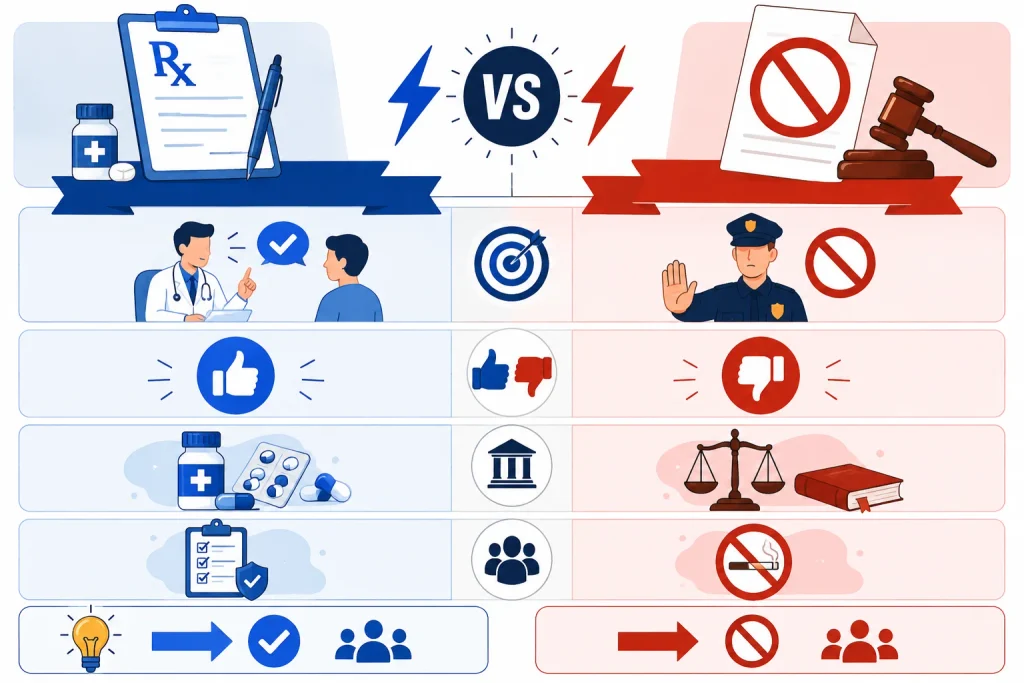
Some English words look so similar that even experienced writers can hesitate before choosing one. Prescribe and proscribe are a perfect example. They share the same ending, contain the same letters in nearly the same order, and both can appear in formal writing about rules, instructions, laws, or official decisions.
Yet their meanings point in opposite directions.
Prescribe generally means to recommend, order, or establish what should be done. A doctor can prescribe medication, while a law can prescribe a particular procedure. Proscribe, on the other hand, means to forbid, ban, or officially declare something unacceptable. An authority can proscribe an activity under a law or regulation.
That single difference can completely change a sentence.
Consider these two statements:
- The doctor prescribed a new treatment.
- The law proscribed the practice.
The first sentence says something was ordered or recommended. The second says something was forbidden.
This guide explores prescribe vs. proscribe in detail, including their meanings, pronunciation, grammatical uses, medical and legal contexts, examples, memory tricks, and the subtle clues that make these commonly confused words easier to distinguish.
What’s the Difference?
The easiest way to understand prescribe vs. proscribe is to focus on the direction of the action.
Prescribe tells someone what to do, use, follow, or have.
Proscribe tells someone what not to do because an authority has forbidden it.
| Word | Core meaning | Typical idea | Common contexts |
| Prescribe | To recommend, order, or establish | “Do this.” | Medicine, rules, procedures, standards |
| Proscribe | To officially forbid or ban | “Do not do this.” | Law, government, regulation, formal policy |
| Prescription | An instruction or recommended treatment | A course of action | Medicine, rules, solutions |
| Proscription | An official prohibition | A ban or restriction | Law, policy, regulation |
The distinction becomes particularly useful when the two verbs appear in formal writing.
For example:
The physician prescribed antibiotics for the infection.
Here, the physician determines what treatment the patient should receive.
Now compare:
The regulations proscribe the unauthorized use of the equipment.
Here, the regulations determine what users must not do.
The words therefore aren’t interchangeable. Replacing one with the other can reverse the intended meaning.
A quick rule to remember
Think:
Prescribe = provide a course of action.
Proscribe = prohibit an action.
That rule isn’t a complete explanation of every historical or specialized use, but it works extremely well for modern English.
What Does Prescribe Mean?
Prescribe is a verb with several related meanings. At its heart, the word involves setting out what should happen, what someone should do, or what treatment someone should receive.
The most familiar meaning occurs in medicine.
A doctor may prescribe medication, physical therapy, rest, a particular dosage, or another form of treatment. Cambridge Dictionary defines this medical use as a doctor saying what medical treatment someone should have.
For example:
- The doctor prescribed antibiotics for the infection.
- Her physician prescribed a lower dose.
- The specialist prescribed physical therapy after the injury.
- The patient was prescribed medication for several weeks.
Notice the underlying idea: someone with appropriate authority determines a recommended or required course of action.
But prescribe isn’t limited to medicine.
The word can also mean to establish a rule, requirement, procedure, or standard.
For instance:
- The law prescribes penalties for certain violations.
- The policy prescribes how employees should report an incident.
- The regulations prescribe minimum safety standards.
- The instructions prescribe a specific method for completing the process.
Cambridge also recognizes this broader meaning: to tell someone what they must have or do, or to establish something as a rule.
This broader sense explains why you may encounter prescribe in legal, academic, technical, governmental, and professional writing.
The central idea behind prescribe
When you see prescribe, ask:
What action, treatment, behavior, or procedure is being set out?
If the sentence establishes what someone should do, prescribe is often the appropriate choice.
Prescribe in Medical Contexts
Medicine is probably the easiest place to recognize prescribe because the word appears constantly in healthcare vocabulary.
A doctor doesn’t usually “proscribe” medicine for a patient. A doctor prescribes medicine.
For example:
The physician prescribed an antiviral medication.
The physician has selected a treatment and instructed the patient to use it.
Similarly:
The doctor prescribed rest and physical therapy.
Again, the verb describes the recommended treatment.
Prescribe, prescription, and prescribed.
Several related words come from prescribe:
- Prescribe — the verb
- Prescribed — the past tense or past participle
- Prescribing — the present participle
- Prescription — the noun
- Prescriber — someone authorized to prescribe
A prescription can refer to the written or electronic instruction for medication or treatment. Cambridge Dictionary also recognizes a broader sense involving instructions about what someone should do.
Consider the progression:
The doctor prescribed medication.
The doctor wrote a prescription.
The medication was prescribed for the patient.
Safe prescribing requires careful consideration of the patient’s circumstances.
These forms are connected, but their grammatical roles differ.
Why “prescribe” makes sense in medicine
The medical meaning is closely tied to the idea of setting out a course to follow.
A treatment plan can function almost like a set of instructions:
- Identify the medical problem.
- Select an appropriate treatment.
- Specify the treatment or medication.
- Provide instructions for its use.
- Monitor the patient’s response when appropriate.
That doesn’t mean every prescription guarantees a particular outcome. Rather, prescribe describes the professional act of ordering or recommending treatment.
More examples of prescribe in healthcare
The specialist prescribed a different medication after reviewing the patient’s symptoms.
The physician prescribed physical therapy twice a week.
The doctor did not prescribe antibiotics because they weren’t appropriate for the condition.
The patient followed the treatment that had been prescribed.
The important semantic pattern remains the same: something is being designated as the appropriate course of action.
Prescribe Beyond Medicine
Here’s where the word becomes more interesting.
Although many people first associate prescribe with doctors and medicine, the verb has a much broader formal meaning.
It can describe rules, procedures, standards, requirements, and expected behavior.
For example:
The regulations prescribe strict safety procedures.
This doesn’t mean the regulations recommend medicine. It means they set out what must be done.
Another example:
The contract prescribes how disputes must be resolved.
The contract establishes the required process.
And:
The law prescribes penalties for certain violations.
The law specifies what happens under particular circumstances. Cambridge gives similar examples involving penalties established by law and rules governing how language may be used.
Prescribe in rules and regulations.
In formal contexts, prescribe often carries a stronger sense than the everyday verb “suggest.”
Compare:
- The manager suggested a new procedure.
- The regulations prescribed a new procedure.
A suggestion may be optional.
A prescribed procedure usually carries some degree of authority or obligation.
That distinction makes prescribe particularly common in:
- Laws
- Regulations
- Contracts
- Professional standards
- Technical specifications
- Institutional policies
- Academic discussions
- Official procedures
Examples outside medicine
The building code prescribes minimum safety requirements.
The university’s regulations prescribe the conditions for graduation.
The agreement prescribes a specific process for resolving disputes.
The policy prescribes how confidential information must be handled.
The grammar guide prescribes certain conventions for formal writing.
In each case, something establishes a standard or tells people what should happen.
What Does Proscribe Mean?
Now comes the word that causes the real confusion.
Proscribe means to forbid, ban, or officially declare something unacceptable or prohibited.
It is especially common in formal contexts involving governments, authorities, laws, regulations, organizations, or official rules.
Cambridge Dictionary defines proscribe as formally not allowing something, particularly when a government or other authority is involved. Its American Dictionary definition similarly describes the word as officially forbidding an action or practice.
For example:
The law proscribes the unauthorized use of the materials.
The meaning is essentially:
The law forbids the unauthorized use of the materials.
Another example:
The regulations proscribe certain forms of discrimination.
The regulations prohibit those actions.
The core idea behind proscribe
When you encounter proscribe, ask:
What is being forbidden?
If the sentence describes an official ban, prohibition, or restriction, proscribe is likely the word you need.
Useful synonyms include:
- Forbid
- Prohibit
- Ban
- Outlaw
- Disallow
- Veto
Cambridge specifically lists several of these as synonyms or closely related terms.
Proscribe in Legal and Formal Contexts
Proscribe appears most naturally in formal writing because the concept itself often involves authority.
Laws can proscribe conduct.
Regulations can proscribe practices.
Governments can proscribe activities.
Official organizations can proscribe certain behavior.
For example:
Federal law proscribes the unauthorized disclosure of certain information.
The sentence means the law officially forbids that disclosure.
Another example:
The organization proscribed the use of misleading advertising.
The organization prohibited the practice.
And:
International law proscribes certain forms of conduct.
The point isn’t merely that the conduct is unpopular. The wording emphasizes an official prohibition.
Proscribe does not simply mean “dislike”
This distinction matters.
You wouldn’t normally say:
My friend proscribed chocolate because she doesn’t like it.
That sounds unnecessarily formal and semantically inappropriate.
Instead:
My friend dislikes chocolate.
Or:
My friend avoids chocolate.
Proscribe works best when a person or institution has the authority to prohibit something or when the context involves a formal restriction.
Proscribe in policy writing
Policy documents frequently need to distinguish between recommended behavior and prohibited behavior.
For example:
The policy prescribes regular security reviews.
This establishes something that should be done.
Meanwhile:
The policy proscribes unauthorized access.
This establishes something that must not be done.
That’s an especially useful way to see the contrast.
Prescribe establishes the required or recommended course.
Proscribe establishes the forbidden course.
The One-Line Difference
If you remember only one distinction, remember this:
Prescribe means to set out what should be done; proscribe means to officially forbid what must not be done.
Here’s the contrast in its simplest form:
| Prescribe | Proscribe |
| Recommend or order | Forbid or ban |
| Establish a course of action | Establish a prohibition |
| “Do this.” | “Don’t do this.” |
| Common in medicine | Common in law and formal policy |
| Can establish rules | Can prohibit practices |
| Prescription | Proscription |
Compare these sentences
The doctor prescribed medication.
The doctor said what treatment the patient should receive.
The law proscribed the practice.
The law said the practice was forbidden.
Now consider a more subtle pair:The policy prescribes appropriate security procedures.The policy establishes what employees should do.The policy proscribes unauthorized access.The policy establishes what employees must not do.
The two verbs can therefore appear in the same document while performing opposite semantic functions.
Why “Prescribe vs. Proscribe” Is So Easy to Confuse
The confusion isn’t surprising.
Both words:
- Begin with “pro-/pre-” style prefixes
- End in “-scribe”
- Contain the sequence scribe
- Have formal, somewhat academic sounds
- Can appear in legal or regulatory writing
- Can relate to rules or official decisions
- Are pronounced similarly enough to cause hesitation
- Have closely related historical roots
The spelling creates a visual trap.
A reader may see:
pre + scribe
and
pro + scribe
and assume the difference is tiny.
Grammatically, the difference is indeed tiny.
Semantically, however, the difference is enormous.
One word can establish a required action while the other can prohibit it.
The “Scribe” Clue You Should Notice
The shared -scribe element comes from a Latin root associated with writing.
You can see related forms in English words such as:
- Describe
- Inscription
- Manuscript
- Subscribe
- Transcribe
- Script
This shared element helps explain why prescribe and proscribe look so closely related.
But don’t let the shared scribe ending fool you into thinking the words have nearly identical meanings.
The prefixes help distinguish their functions, while modern usage gives each word its own established meaning.
For practical English, however, there’s no need to memorize complicated Latin history before you can use them correctly.
The semantic contrast is far more useful:
Prescribe → set out a course or requirement.
Proscribe → prohibit something.
A Simple Memory Trick That Actually Works
Here’s a quick memory device for prescribe vs. proscribe:
Pre = Prepare a plan
Think of prescribe as preparing or setting out a course of action.
A doctor prescribes treatment.
A regulation prescribes a procedure.
A policy prescribes requirements.
So:
Prescribe → What should happen.
Pro = Prohibit
Think of proscribe as connected to prohibit.
Both words begin with pro-, and both involve saying no to something.
So:
Proscribe → What must not happen.
This creates an easy mental pairing:
Prescribe = “Do this.”
Proscribe = “Don’t do this.”
It’s not a substitute for understanding context, but it provides a quick mental checkpoint when you’re writing.
A Fast Decision Test
When you’re unsure which word to use, ask yourself three questions.
Is someone setting out an action?
If yes, consider prescribe.
The doctor prescribed a treatment.
The regulations prescribe safety procedures.
Is someone officially banning an action?
If yes, consider proscribe.
The law proscribes the practice.
The organization proscribed the activity.
Could you replace the word with “prohibit”?
If prohibit fits naturally, proscribe may be the correct choice.
For example:
The law proscribes unauthorized disclosure.
becomes:
The law prohibits unauthorized disclosure.
The basic meaning remains intact.
By contrast:
The doctor prescribes medication.
cannot become:
The doctor prohibits medication.
That would reverse the meaning entirely.
A Closer Look at the Grammar of Prescribe
Understanding how each verb behaves in a sentence makes the distinction even clearer.
Prescribe commonly takes an object:
The doctor prescribed medication.
It can also take a person and a treatment:
The doctor prescribed the patient antibiotics.
Or it can describe a rule:
The law prescribes certain procedures.
It also frequently appears in passive constructions:
The medication was prescribed by a physician.
The procedure is prescribed by law.
The passive form is especially common in formal writing because the rule, treatment, or procedure may matter more than the person who established it.
Common structures with prescribe
| Structure | Example |
| prescribe + treatment | The doctor prescribed medication. |
| prescribe + procedure | The policy prescribes a review process. |
| prescribe + rule | The regulation prescribes specific standards. |
| be prescribed + treatment | She was prescribed antibiotics. |
| be prescribed + by | The procedure is prescribed by law. |
This flexibility explains why prescribe appears across many professional fields.
A Closer Look at the Grammar of Proscribe
Proscribe also works as a transitive verb, meaning it normally takes a direct object.
For example:
The law proscribes certain activities.
The regulations proscribe unauthorized access.
The government proscribed the organization.
The object represents whatever is being prohibited.
It can also appear in passive constructions:
The activity is proscribed by law.
Certain practices are proscribed under the regulations.
This construction is particularly common in formal and legal language.
Common structures with proscribe
| Structure | Example |
| proscribe + activity | The law proscribes the activity. |
| proscribe + practice | The regulation proscribes the practice. |
| proscribe + conduct | The policy proscribes certain conduct. |
| be proscribed + by | The practice is proscribed by law. |
| be proscribed + under | The conduct is proscribed under the regulation. |
The grammar isn’t what separates the two verbs most strongly.
Meaning does. The Same Sentence
One of the best ways to understand the distinction is to use both words together.
Consider:
The workplace policy prescribes mandatory safety training but proscribes the unauthorized use of certain equipment.
The sentence contains both concepts:
- Prescribes → tells employees what they must do.
- Proscribes → tells employees what they must not do.
Another example:
The regulations prescribe procedures for handling confidential records and proscribe unauthorized disclosure.
This is a powerful pattern because it shows that the two words aren’t merely different vocabulary choices. They describe opposing regulatory functions.
A rule can tell you what to do.
A rule can also tell you what not to do.
Those two functions are where prescribe and proscribe become useful.
Examples at a Glance
Here are several examples to reinforce the difference:
Examples with prescribe
- The doctor prescribed a new medication.
- The specialist prescribed physical therapy.
- The law prescribes specific reporting requirements.
- The contract prescribes a procedure for resolving disputes.
- The regulations prescribe minimum safety standards.
- The policy prescribes how employees should handle confidential data.
Examples with proscribe
- The law proscribes unauthorized access.
- The regulations proscribe certain practices.
- The organization proscribed the use of misleading materials.
- The policy proscribes discrimination.
- The government proscribed the activity under the applicable law.
- The rules proscribe conduct that creates a safety risk.
The pattern is remarkably consistent.
Prescribe points toward an established course of action.
Proscribe points away from a forbidden action.
The Most Important Takeaway So Far
The difference between prescribe and proscribe isn’t simply a spelling detail. It’s a difference in direction and meaning.
When something prescribes an action, it establishes, recommends, or orders what should happen.
When something proscribes an action, it officially forbids or rules it out.
That distinction becomes especially important in medical, legal, regulatory, academic, and professional writing. A misplaced word can make a sentence communicate almost the opposite of what you intended.
A useful mental shortcut is:
Prescribe = prescribe a course.
Proscribe = prohibit a course.
Once that contrast becomes familiar, these two look-alike words become much easier to separate.
Why “Prescribe” and “Proscribe” Feel So Similar
The prescribe vs. proscribe confusion has a perfectly reasonable explanation: the words are visually and historically related, yet modern English gives them sharply different meanings. Both come from Latin verbs built around scribere, meaning “to write,” and both eventually developed connections with official instructions, declarations, and authority.
That shared history creates a linguistic illusion. When you see prescribe and proscribe side by side, they look like variations of the same word. When you hear them in rapid conversation, they can sound remarkably close as well.
But their meanings move in different directions:
Prescribe tells you what to do. Proscribe tells you what not to do.
Merriam-Webster captures the contrast particularly well by describing signs as things that either prescribe “do this” or proscribe “don’t do that.”
Once you understand that opposition, the spelling becomes much less intimidating.
They Look Almost Identical
At first glance, the difference seems tiny:
prescribe
proscribe
Only a couple of letters change, yet those letters separate two distinct ideas.
This is one reason prescribe and proscribe belong among commonly confused English words. Your eyes recognize the familiar -scribe pattern first, while the prefixes can get overlooked.
The same phenomenon appears with many English word pairs that share roots. Once a familiar word shape becomes visually dominant, the brain may process the unfamiliar word as if it were a variation of the familiar one.
That’s particularly easy with prescribe, because it occurs much more often in everyday life than proscribe. You may hear about a doctor prescribing medication, but you may encounter proscribe mainly in formal legal, political, academic, or regulatory writing.
The spelling creates a false sense of similarity
Consider these examples:
The doctor prescribed medication.
The law proscribed the activity.
The sentence structures look almost identical.
Both contain:
- A subject
- One of the confusing verbs
- An object
- Formal or authoritative language
Yet the actions differ fundamentally.
In the first sentence, the doctor orders or recommends something to be used.
In the second, the law forbids something.
That’s why spelling alone isn’t a reliable guide. Context supplies the missing meaning.
The “Scribe” Clue You Should Notice
The shared -scribe element isn’t accidental.
Both words trace back to Latin forms involving scribere, meaning “to write.” Merriam-Webster identifies prescribe as coming from Latin praescribere, associated with writing beforehand and with dictating or ordering. Proscribe comes from Latin proscribere, associated with publishing something in writing and later with condemning or outlawing it.
This historical connection explains why the words look so much alike.
It also explains why their meanings developed around official statements and authority.
Other words built around “scribe”
You already know several English words with the same basic root:
- Describe — to give an account of something
- Transcribe — to write or copy something into another form
- Subscribe — historically, to write underneath or sign
- Inscription — writing engraved or written on something
- Manuscript — a document written by hand or, more broadly, an author’s written work
- Script — written text
The common thread is writing.
But prefixes can dramatically alter what the resulting word means.
That’s an important lesson for vocabulary building: knowing a root can help you recognize relationships, but it doesn’t always let you predict a modern word’s exact meaning.
So while the -scribe connection explains why prescribe and proscribe look related, you still need to memorize their modern distinction.
Why the Prefixes Don’t Give You the Whole Answer
It’s tempting to think:
“Pre means before, and pro means for, so I can figure out the meanings.”
That approach can lead you into trouble.
Historical prefixes don’t always map neatly onto the meanings modern English speakers assign to entire words.
For example, Merriam-Webster traces prescribe to Latin praescribere, while proscribe comes from Latin proscribere. Both Latin formations contain prefixes associated with “before” and the same underlying writing verb.
So the easiest memory trick isn’t really a strict etymological rule.
Instead, use the modern semantic contrast:
Prescribe → establish or order an action.
Proscribe → forbid an action.
That’s much safer when you’re writing.
A Simple Memory Trick That Actually Works
When two words are this close, a short mnemonic can save you from second-guessing yourself.
Try this:
Prescribe = “Do this.”
Imagine a doctor handing you a treatment plan.
The doctor prescribes medication.
A regulation prescribes a procedure.
A policy prescribes certain requirements.
Each one establishes something that should be done.
Proscribe = “Don’t do this.”
Now imagine a large PROHIBITED sign.
The law proscribes the behavior.
A regulation proscribes the practice.
An authority proscribes the activity.
Each one establishes something that isn’t allowed.
The shortcut
PREscribe → prescribe a plan.
PROscribe → prohibit something.
This is especially useful when you’re proofreading. Instead of staring at the spelling and wondering which word “looks right,” ask what the sentence is actually saying.
Think in Opposite Directions
A useful way to visualize the difference is to imagine two arrows.
Prescribe → toward an action
Proscribe → away from an action
For example:
The doctor prescribed exercise.
The instruction points toward exercise.
The regulations proscribe unsafe practices.
The rule points away from unsafe practices.
This mental picture can be surprisingly effective because it connects the vocabulary to the function of the words rather than just their spelling.
A practical substitution test
When you’re unsure, replace the verb with a simpler word.
For prescribe, try:
- recommend
- order
- specify
- establish
- direct
- dictate
For proscribe, try:
- prohibit
- forbid
- ban
- outlaw
- disallow
If prohibit fits naturally, you’re probably dealing with proscribe.
If recommend, order, or specify fits, prescribe may be the better choice.
Real-Life Usage: Where You Actually See These Words
The easiest way to master prescribe vs. proscribe is to see the words working in different environments.
They don’t appear with equal frequency across all subjects.
Prescribe has a broad range of uses. It is common in medicine and also appears in rules, regulations, procedures, and formal instructions. Merriam-Webster defines it both as laying down a rule and as ordering the use of something as a remedy.
Proscribe is narrower and more formal. It usually describes something that an authority officially forbids or condemns as harmful or unlawful.
That difference in frequency and context gives you another useful clue.
Medical World: Where “Prescribe” Rules
Medicine is the clearest home for prescribe.
Doctors and other authorized healthcare professionals may prescribe medications, treatments, therapies, or other interventions.
Examples include:
The physician prescribed an antibiotic.
The specialist prescribed physical therapy.
The doctor prescribed a different dosage.
The patient was prescribed medication for the condition.
Merriam-Webster’s medical definition describes prescribe as writing or giving medical prescriptions and ordering the use of something as a remedy.
Prescription vs. proscription
This creates an important noun distinction.
Prescription relates to something prescribed.
Proscription relates to something proscribed.
Compare:
The patient received a prescription for medication.
with:
The policy established a proscription against unauthorized access.
These nouns may look equally formal, but they describe very different concepts.
| Word | Meaning |
| Prescription | An instruction, especially for medical treatment |
| Proscription | An official prohibition or ban |
This distinction becomes particularly important in technical writing because a single letter can change the entire meaning.
Legal World: Where “Proscribe” Takes Over
Legal writing provides some of the strongest examples of proscribe.
A law can proscribe conduct by officially forbidding it.
For example:
The statute proscribes unauthorized disclosure of protected information.
That means the statute prohibits the disclosure.
Similarly:
The regulations proscribe certain forms of conduct.
The regulations declare that conduct impermissible.
Oxford describes proscribe as a formal verb meaning to say officially that something is banned.
But “prescribe” also appears in law
Here’s where things become interesting.
Legal writing can use both words.
A law might:
prescribe the procedure that officials must follow.
And it might:
proscribe conduct that officials or citizens must not engage in.
For example:
The regulation prescribes a seven-step review process.
The regulation proscribes unauthorized interference with that process.
One establishes the required procedure.
The other prohibits certain behavior.
That’s why legal writers need to understand the difference especially well.
Professional and Workplace Contexts
You don’t need to work in medicine or law to encounter these verbs.
Business policies, compliance documents, technical manuals, professional standards, and institutional rules can use both words.
Consider a workplace security policy:
The policy prescribes regular password reviews.
This tells employees what procedure the organization expects.
Now consider:
The policy proscribes sharing confidential credentials.
This tells employees what they aren’t allowed to do.
The contrast is clear:
| Workplace rule | Verb | Meaning |
| Complete security training | Prescribes | Establishes what employees should do |
| Use approved procedures | Prescribes | Sets a required process |
| Share confidential credentials | Proscribes | Forbids the behavior |
| Circumvent security controls | Proscribes | Bans the behavior |
This is one reason the distinction matters beyond vocabulary quizzes. The words can carry operational consequences in formal documents.
Everyday Life Examples You Might Miss
Although proscribe tends to sound formal, prescribe can appear in surprisingly ordinary situations.
You might read:
The instructions prescribe a specific method for assembling the product.
Or:
The recipe prescribes a particular cooking temperature.
The second sentence is somewhat formal because everyday English would more naturally say:
The recipe calls for a particular cooking temperature.
Still, prescribe can work when the writer wants to emphasize an established instruction or requirement.
Proscribe in everyday language
Proscribe is less common in casual conversation.
Most people would say:
The school banned phones during the exam.
rather than:
The school proscribed phones during the exam.
The latter is grammatically possible, but it sounds highly formal.
That difference in register is important.
Correct doesn’t always mean natural.
You can use a technically accurate word and still make a sentence sound unnecessarily stiff.
Formality Matters When Choosing Between Synonyms
English gives you several ways to express prohibition:
- Ban
- Forbid
- Prohibit
- Outlaw
- Disallow
- Proscribe
They overlap, but they don’t always sound equally natural.
For example:
The school banned the device.
Simple and direct.
The school prohibited the device.
Formal but common.
The school proscribed the device.
Highly formal and less common.
The same principle applies to prescribe.
Instead of:
The manager prescribed a new workflow.
you might naturally say:
The manager established a new workflow.
But prescribe becomes useful when the writer wants to emphasize authority, instruction, or a formally specified course.
When “Prescribe” Means More Than “Recommend”
A common misunderstanding is to treat prescribe as nothing more than a fancy synonym for suggest.
That’s too weak.
Prescribe can involve authority.
Merriam-Webster defines the broader verb as laying down a guide, direction, or rule of action and specifying something with authority.
Compare these:
The teacher suggested that students review the chapter.
The course syllabus prescribes the required reading.
The first is advice.
The second establishes a formal requirement.
That’s an important semantic difference.
Prescribe can imply obligation.
Depending on context, something prescribed may be:
- Recommended
- Required
- Ordered
- Officially established
- Formally specified
Context determines the strength.
For example:
The doctor prescribed rest.
This is medical instruction.
Meanwhile:
The law prescribes a specific procedure.
This can indicate a legal requirement.
So don’t automatically translate prescribe as “suggest.” In many contexts, it carries considerably more authority.
When “Proscribe” Means More Than “Dislike”
The same caution applies to proscribe.
It doesn’t simply mean that someone dislikes, rejects, or avoids something.
The word centers on official prohibition or condemnation, particularly in formal contexts.
Compare:
The editor dislikes excessive jargon.
with:
The editorial policy proscribes excessive jargon.
The first expresses personal preference.
The second establishes a rule against something.
That distinction helps explain why proscribe sounds so formal. It often places the action inside a framework of rules, authority, law, policy, or institutional standards.
A Historical Detail That Makes “Proscribe” Easier to Remember
The history of proscribe is surprisingly dramatic.
Merriam-Webster notes that its earlier legal sense involved publishing the name of someone who had been condemned, outlawed, or banished.
Etymological sources trace the word to Latin proscribere, originally involving the idea of publishing something in writing. Over time, the word developed senses associated with condemnation, outlawry, exile, and prohibition.
That history helps explain why proscribe carries such a strong association with official prohibition.
It wasn’t originally just a casual way of saying “I don’t approve.”
The word had serious legal and political associations.
Why this matters today
Modern English has simplified the concept.
You usually don’t need to know its historical meanings to use proscribe correctly.
Still, the history reinforces a useful association:
Proscribe → official condemnation or prohibition.
That makes the word easier to remember and helps explain its formal tone.
A Mini Context Exercise
Try choosing prescribe or proscribe in each sentence.
The physician _______ a new treatment plan.
The answer is prescribed.
The physician establishes the treatment.
The regulation _______ unauthorized entry.
The answer is proscribes.
The regulation forbids the entry.
The handbook _______ the procedure employees must follow.
The answer is prescribes.
The handbook establishes the procedure.
The law _______ conduct that threatens public safety.
The answer is proscribes.
The law prohibits the conduct.
The pattern to notice
Every example becomes easier when you stop looking at the spelling.
Ask:
Is the sentence establishing what should happen?
→ Prescribe
Is it forbidding what must not happen?
→ Proscribe
That two-question test works across most modern contexts.
Common Collocations With Prescribe
Learning common word combinations can make vocabulary much easier to use naturally.
Common combinations with prescribe
- prescribe medication
- prescribe treatment
- prescribe antibiotics
- prescribe therapy
- prescribe a procedure
- prescribe standards
- prescribe rules
- prescribe requirements
- prescribe penalties
- prescribe a course of action
Examples:
The doctor prescribed medication for the condition.
The regulations prescribe minimum safety standards.
The agreement prescribes a procedure for resolving disputes.
The noun prescription is also strongly associated with medical treatment, although its broader meaning involves an instruction or direction.
Common Collocations With Proscribe
Because proscribe is more formal, its common combinations tend to appear in institutional, legal, political, and academic writing.
Common combinations with proscribe
- proscribe conduct
- proscribe behavior
- proscribe practices
- proscribe activities
- proscribe organizations
- proscribe discrimination
- proscribe unauthorized access
- proscribe certain actions
- proscribe harmful practices
- proscribe unlawful conduct
Examples:
The statute proscribes discriminatory conduct.
The regulations proscribe unauthorized access.
The organization proscribed the practice under its internal rules.
Oxford specifically provides examples involving proscribed organizations and officials formally proscribing a procedure.
One More Way to Separate the Words
Think about what happens after the action.
With prescribe, the listener or reader usually receives a direction:
“Here is what you should do.”
With proscribe, the listener or reader encounters a restriction:
“Here is what you cannot do.”
That distinction can be represented like this:
| Question | Answer | Word |
| What should I do? | Follow this instruction. | Prescribe |
| What treatment should I receive? | Use this treatment. | Prescribe |
| What procedure must I follow? | Follow this established process. | Prescribe |
| What am I not allowed to do? | Avoid this prohibited action. | Proscribe |
| What conduct is forbidden? | This conduct is banned. | Proscribe |
| What practice has been officially rejected? | It is prohibited. | Proscribe |
This isn’t just a vocabulary trick. It gives you a semantic framework for interpreting unfamiliar sentences.
A Realistic Policy Example
Imagine a university creates a digital-security policy.
The policy says students must use multifactor authentication and must not share their login credentials.
A formal version could read:
The university policy prescribes multifactor authentication for student accounts and proscribes the sharing of login credentials.
Why does each word work?
Prescribes introduces a required security measure.
Proscribes introduces a forbidden behavior.
Now imagine reversing them:
The university policy proscribes multifactor authentication.
That would mean the university bans multifactor authentication.
That’s probably the opposite of the intended message.
Or:
The university policy prescribes the sharing of login credentials.
That would mean the policy requires students to share their credentials.
Again, the meaning flips.
This illustrates why word choice matters so much in formal communication.
The Big Lesson
The prescribe vs. proscribe distinction becomes much easier once you stop treating the words as spelling twins and start treating them as semantic opposites in many common contexts.
Prescribe establishes a course, instruction, treatment, rule, or requirement.
Proscribe establishes a prohibition or ban.
The words share a historical connection through Latin scribere, which helps explain their similar appearance. Their modern meanings, however, have developed in different directions.
If you encounter either word in a difficult sentence, don’t panic over the prefix.
Instead, ask one simple question:
Is the sentence telling someone what to do, or telling someone what not to do?
What to do → prescribe.
What not to do → proscribe.
That distinction will carry you through most everyday, professional, medical, legal, and academic uses.
Comparison, Pronunciation, Mistakes, and Context
The difference between prescribe and proscribe becomes much easier once you see how they behave in real sentences. Although the two verbs share a similar spelling and historical root, they perform very different jobs in modern English.
Prescribe generally establishes, recommends, or orders a course of action. Proscribe generally prohibits or officially rules something out. That distinction becomes especially important in formal writing, where a single misplaced word can reverse the intended message.
The sections below provide a closer comparison, pronunciation guidance, common mistakes, and a practical case study that shows exactly how context determines the correct choice.
Comparison Table
A side-by-side comparison is one of the fastest ways to make the distinction stick.
| Feature | Prescribe | Proscribe |
| Basic meaning | To recommend, order, or establish | To forbid, ban, or officially prohibit |
| Core idea | What should be done | What must not be done |
| Simple substitute | Recommend, order, specify | Prohibit, forbid, ban |
| Common context | Medicine, rules, procedures, standards | Law, regulation, policy, formal prohibition |
| Medical use | Very common | Rare and generally inappropriate for treatment |
| Legal use | Establishing requirements or procedures | Prohibiting conduct or practices |
| Typical object | Medication, treatment, procedure, rule, standard | Conduct, activity, practice, behavior |
| Noun form | Prescription | Proscription |
| Direction of meaning | Toward an action | Away from an action |
| Memory clue | “Do this.” | “Don’t do this.” |
| Example | The doctor prescribed medication. | The law proscribed the practice. |
The table reveals an important point: both words can appear in formal rules, but they don’t perform the same function.
A regulation might prescribe a reporting procedure while proscribing unauthorized disclosure.
A medical professional might prescribe treatment, while a professional code might proscribe unethical conduct.
This is why simply memorizing “one is medical, and one is legal” isn’t enough. The distinction is broader than that.
The Meaning in One Sentence
If you need a compact rule for writing, use this:
Prescribe means to establish or recommend what should be done, while proscribe means to officially forbid what should not be done.
That definition works across most contemporary uses.
Consider these pairs:
The doctor prescribed a treatment.
The regulations proscribed the practice.
Or:
The policy prescribes specific procedures.
The policy proscribes unauthorized access.
The first verb points toward an action. The second points away from one.
The Pronunciation Trap That Confuses Writers and Speakers
Spelling isn’t the only source of confusion. Pronunciation can also make prescribe and proscribe difficult to distinguish when someone hears them without seeing the words.
How to pronounce “prescribe”
Prescribe is commonly pronounced:
/prɪˈskraɪb/
The stress falls on the second syllable:
pre-SCRIBE
It rhymes with words such as:
- describe
- subscribe
- ascribe
- inscribe
The beginning sounds relatively light, while the -scribe portion receives the main stress.
How to pronounce “proscribe”
Proscribe is commonly pronounced:
/proʊˈskraɪb/
Again, the stress falls on the second syllable:
pro-SCRIBE
The ending is therefore almost identical to prescribe.
The major audible difference occurs in the first syllable:
- prescribe → /prɪ-/
- proscribe → /proʊ-/
Dictionary pronunciation guides from Merriam-Webster and Cambridge reflect this distinction.
Why the pronunciation matters
Imagine hearing this sentence without seeing it written:
“The regulation ___ certain conduct.”
If the speaker says proscribes, the meaning is that the regulation forbids the conduct.
If the speaker says prescribes, the meaning is that the regulation establishes or specifies the conduct or procedure.
The difference may seem obvious when spoken slowly, but rapid speech can make the words harder to distinguish.
A speaking tip
When saying the words aloud, exaggerate the opening vowel slightly while learning them:
PRE-scribe → establish or recommend
PRO-scribe → prohibit
Once the distinction becomes automatic, normal pronunciation will feel much easier.
Prescribe vs. Proscribe: Common Mistakes
These words cause several predictable mistakes. Most errors happen because writers focus on spelling rather than meaning.
Understanding the patterns can help you catch them during proofreading.
Mistake: Using “Proscribe” When You Mean “Prescribe”
This is one of the most serious errors because it can reverse the sentence’s intended meaning.
Incorrect:
The physician proscribed antibiotics for the patient.
That sentence suggests the physician forbade antibiotics.
If you mean that the physician ordered or recommended antibiotics, write:
The physician prescribed antibiotics for the patient.
The difference is substantial.
Remember
Prescribe medication.
Don’t use proscribe simply because the sentence sounds formal.
Mistake: Using “Prescribe” When You Mean “Proscribe”
The reverse error can be equally confusing.
Suppose a regulation prohibits unauthorized access.
Incorrect:
The regulation prescribes unauthorized access.
That sentence suggests the regulation requires or establishes unauthorized access.
The correct sentence is:
The regulation proscribes unauthorized access.
The simplest correction is to ask whether the rule establishes the behavior or prohibits it.
Mistake: Assuming “Prescribe” Only Applies to Medicine
Many learners first encounter prescribe in healthcare and then assume that the word belongs exclusively to doctors.
That’s too narrow.
A rule can prescribe a procedure.
A law can prescribe a penalty.
A policy can prescribe a process.
A standard can prescribe specific requirements.
For example:
The regulations prescribe minimum safety standards.
Here, no medication exists. The word still works because the regulations establish what is required.
Mistake: Assuming “Proscribe” Means Any Kind of Rejection
Proscribe is stronger and more formal than simply saying that someone doesn’t like something.
Incorrect or awkward in an ordinary personal context:
My brother proscribes spicy food.
If the meaning is simply that he doesn’t eat or like spicy food, more natural choices include:
- avoids
- dislikes
- refuses
- doesn’t eat
Proscribe usually suggests formal prohibition, condemnation, or authoritative restriction.
A better formal example would be:
The organization’s code of conduct proscribes discriminatory behavior.
Here, the organization has established a formal prohibition.
Mistake: Choosing the Word Based on the Prefix Alone
A common strategy is to think:
“Pre means before, so prescribe must mean something happening beforehand.”
Or:
“Pro means for, so proscribe must mean supporting something.”
Neither approach reliably produces the modern meanings.
The words have complex histories, and their modern meanings cannot be reconstructed simply by translating their prefixes.
Instead, memorize the functional distinction:
Prescribe = set out a course.
Proscribe = prohibit a course.
That approach is faster and more reliable.
Mistake: Ignoring the Sentence’s Subject
The subject often provides an important clue.
Look at:
The doctor prescribed medication.
A doctor is an authority who can establish a treatment.
Now:
The law proscribed the activity.
A law can establish a prohibition.
This isn’t an absolute rule because both words can occur with laws, regulations, organizations, and other authorities. However, identifying who or what is acting can help you interpret the sentence.
Ask:
What kind of authority is involved?
Then ask:
Is that authority setting a course or banning something?
Together, those questions usually resolve the ambiguity.
Mistake: apposite Spellings but Not Opposite Functions
The words aren’t simply two interchangeable versions of the same idea.
Their relationship becomes clearer when you think about rules.
A rule can have at least two basic functions:
Positive direction: establish what people should do.
Negative direction: establish what people must not do.
That gives you:
Prescribe → establish the required or recommended course.
Proscribe → establish the prohibited course.
This distinction is particularly useful when reading dense professional or legal documents.
How to Avoid Confusing Prescribe and Proscribe
A practical proofreading routine can eliminate most mistakes.
Check the action
Identify the action described by the verb.
Ask:
Is the word pointing toward an action?
If yes, prescribe may fit.
Ask:
Is the word saying that an action is forbidden?
If yes, proscribe may fit.
Replace the word with a simpler synonym
Try a mental substitution.
For prescribe:
- recommend
- order
- specify
- establish
- direct
For proscribe:
- prohibit
- forbid
- ban
- outlaw
- disallow
If your sentence still makes sense after substitution, you’ve probably found the correct word.
Read the sentence in its complete context.
Never choose between these words based solely on the four letters that differ.
Read the entire sentence.
Then read the surrounding sentence if the meaning remains unclear.
Formal writing often contains several layers of rules, exceptions, and conditions. Context can reveal whether the writer is establishing a requirement or banning conduct.
Education Policy Case Study: Prescribe vs. Proscribe in Context
Consider a fictional but realistic university policy designed to improve academic integrity and digital security.
The university introduces the following rules:
Students must complete identity verification before taking certain online examinations. They must also use approved software and follow the university’s examination procedures. Sharing account credentials or using unauthorized assistance is prohibited.
A formal policy might describe these rules as follows:
The university policy prescribes identity verification and approved examination procedures while proscribing unauthorized assistance and credential sharing.
Why do both verbs work?
What the policy prescribes
The policy prescribes:
- Identity verification
- Approved examination software
- Specific examination procedures
- Required compliance steps
These are actions or procedures the policy establishes.
The policy essentially says:
Do this.
What the policy proscribes
The policy proscribes:
- Unauthorized assistance
- Credential sharing
- Attempts to bypass verification
- Other prohibited conduct
These are behaviors the policy forbids.
The policy essentially says:
Don’t do this.
Why the distinction matters
Imagine changing just one word:
The university policy proscribes identity verification.
Now the sentence says the policy bans identity verification.
That completely changes the policy.
Likewise:
The university policy prescribes credential sharing.
Now the sentence says the university requires credential sharing.
Again, the meaning has been reversed.
This is why precise vocabulary matters in policies, contracts, regulations, and official instructions.
Case Study Analysis: What the Two Verbs Reveal
The university example demonstrates a broader principle about formal communication.
Rules don’t simply tell people whether something is “good” or “bad.” They establish specific actions, procedures, permissions, restrictions, and prohibitions.
That’s where these verbs become useful.
Prescribe focuses on the framework for action.n
When a policy prescribes a procedure, it tells readers how something should be done.
For example:
The policy prescribes a three-stage review process.
The reader now expects a defined sequence.
Proscribe focuses on boundaries.
When a policy proscribes conduct, it establishes a boundary that users cannot cross.
For example:
The policy proscribes unauthorized disclosure of examination materials.
The reader now knows what behavior falls outside the permitted boundaries.
Together, the verbs can describe an entire regulatory framework.
How Context Shapes Meaning in Real Writing
Context isn’t just helpful when distinguishing prescribe vs. proscribe. It’s one of the most important tools for understanding English vocabulary generally.
When a word has several related meanings, the surrounding sentence often tells you which meaning applies.
Use a three-step process.
Identify the Action
First, determine what the subject is actually doing.
Ask:
Is the subject establishing something?
Or:
Is the subject banning something?
For example:
The regulations prescribe reporting procedures.
The regulations establish procedures.
But:
The regulations proscribe unauthorized reporting methods.
The regulations prohibit certain methods.
The verbs make sense because their actions match their meanings.
Match the Word to the Action
Once you’ve identified the action, choose the verb.
If the action means:
- Recommend
- Order
- Establish
- Specify
- Set out
choose prescribe.
If it means:
- Prohibit
- Forbid
- Ban
- Outlaw
- Officially reject
choose proscribe.
This method works even when the surrounding vocabulary is unfamiliar.
Re-read the Sentence Out Loud
Reading aloud can expose a surprising number of vocabulary mistakes.
Consider:
The hospital policy proscribes the use of protective equipment.
If the writer intended to say that protective equipment is required, the sentence immediately sounds wrong once its meaning is considered.
The correct version might be:
The hospital policy prescribes the use of protective equipment.
Reading the sentence aloud doesn’t magically identify the correct word. Instead, it encourages you to process the sentence as a complete idea rather than focusing only on spelling.
Practical Examples of Prescribe vs. Proscribe
The following examples cover several contexts so you can see how the distinction works outside isolated definitions.
Medicine
The doctor prescribed a new medication.
Meaning: The doctor ordered or recommended the medication.
The hospital policy proscribes unauthorized access to patient records.
Meaning: The policy forbids unauthorized access.
Law
The statute prescribes the procedure for filing an appeal.
Meaning: The statute establishes the procedure.
The statute proscribes fraudulent claims.
Meaning: The statute prohibits fraudulent claims.
Education
The course syllabus prescribes the required reading.
Meaning: The syllabus establishes what students must read.
The academic integrity policy proscribes plagiarism.
Meaning: The policy prohibits plagiarism.
Workplace
The employee handbook prescribes the process for reporting safety concerns.
Meaning: The handbook establishes the reporting process.
The employee handbook proscribes retaliation against employees who report violations.
Meaning: The handbook prohibits retaliation.
Technology
The security standard prescribes a procedure for authenticating users.
Meaning: The standard specifies the procedure.
The security policy proscribes unauthorized access.
Meaning: The policy forbids unauthorized access.
Professional standards
The code prescribes standards for professional conduct.
Meaning: The code establishes expected standards.
The code proscribes conflicts of interest that compromise professional judgment.
Meaning: The code prohibits or formally rules out those conflicts.
Active and Passive Voice
Both verbs work in active and passive constructions.
Active voice with prescribe
The doctor prescribed the treatment.
The regulations prescribe the procedure.
Passive voice with prescribe
The treatment was prescribed by the doctor.
The procedure is prescribed by the regulations.
Active voice with proscribe
The law proscribes the practice.
The policy proscribes unauthorized disclosure.
Passive voice with proscribe
The practice is proscribed by law.
Unauthorized disclosure is proscribed under the policy.
For clear modern writing, active voice often makes the source of authority easier to identify.
Compare:
The procedure is prescribed by the regulations.
with:
The regulations prescribe the procedure.
The second version is more direct.
Likewise:
Unauthorized access is proscribed by the policy.
can become:
The policy proscribes unauthorized access.
Both are grammatically sound, but the active construction usually feels cleaner.
The Difference Between “Prescribed” and “Proscribed”
The past-tense and past-participle forms can create the same confusion.
Prescribed means something was recommended, ordered, or established.
The doctor prescribed the medication.
Proscribed means something was forbidden or officially prohibited.
The law proscribed the activity.
Don’t let the shared -scribed ending distract you from the prefix.
Compare these carefully
The treatment was prescribed.
→ The treatment was ordered or recommended.
The treatment was proscribed.
→ The treatment was officially forbidden.
Those sentences don’t merely differ in style. They communicate radically different outcomes.
The Difference Between “Prescription” and “Proscription”
The nouns deserve special attention because they can appear in sophisticated writing.
Prescription
A prescription is an instruction, especially a medical instruction concerning treatment or medication. It can also refer more broadly to a recommended or established course.
Example:
The patient received a prescription for the medication.
Proscription
A proscription is a formal prohibition or ban.
Example:
The regulation established a strict proscription against unauthorized disclosure.
A useful pairing is:
Prescription → instruction
Proscription → prohibition
That contrast mirrors the verbs themselves.
A Quick Error-Correction Challenge
Look at these sentences and determine whether the bolded word is appropriate.
The physician proscribed medication for the patient.
Incorrect if the intended meaning is that the physician ordered the medication.
Correct:
The physician prescribed medication for the patient.
The law proscribed fraudulent activity.
Correct.
The law forbids fraudulent activity.
The regulations prescribed the required reporting procedure.
Correct.
The regulations establish the procedure.
The policy prescribed unauthorized disclosure of confidential information.
Incorrect if the intended meaning is that disclosure is forbidden.
Correct:
The policy proscribed unauthorized disclosure of confidential information.
These examples demonstrate why context and intended meaning must come before spelling.
A Useful Editing Checklist
Before publishing an article, report, policy, assignment, or professional document, run through this quick checklist whenever you use prescribe or proscribe:
- Prescribe means establish, recommend, or order.
- Proscribe means prohibit or officially ban.
- Prescribe commonly appears in medical contexts.
- Proscribe commonly appears in formal legal and regulatory contexts.
- Both words can appear in rules and policies.
- Don’t choose based on spelling alone.
- Don’t assume prescribe is limited to medicine.
- Don’t use proscribe for ordinary personal dislike.
- Replace the word mentally with a simpler synonym.
- Check whether the sentence means “Do this” or “Don’t do this.”
- Read the sentence in context before finalizing it.
If you can answer those questions confidently, you’re unlikely to confuse the two.
A Practical Mental Model
Think of an official rule as having two sides.
On one side, it creates a path:
Follow this procedure.
That’s prescribe.
On the other side, it creates a boundary:
Do not cross this line.
That’s proscribe.
This mental image is more useful than trying to memorize a complicated dictionary definition.
Prescribe builds the path. Proscribe draws the boundary.
Once you internalize that distinction, the two words become much easier to recognize in professional and academic writing.
Why Prescribe vs. Proscribe Matters in Real Communication
The difference between prescribe and proscribe may look like a minor vocabulary issue, but precision matters when words describe rules, treatments, policies, or legal requirements. In casual conversation, choosing the wrong word might create a moment of confusion. In a contract, medical document, policy, academic paper, or regulatory statement, the consequences can be much more significant.
Imagine reading this sentence:
The policy prescribes the use of unauthorized software.
If the writer intended to say that unauthorized software isn’t allowed, the sentence communicates the opposite. Prescribes suggests that the policy establishes or requires the use of that software.
The intended sentence would be:
The policy proscribes the use of unauthorized software.
Now the meaning is clear: the policy prohibits it.
This example shows why prescribe vs. proscribe deserves careful attention. These words aren’t interchangeable stylistic alternatives. They can point in opposite directions.
Precision matters in medical writing
Medical language depends heavily on precise terminology. A healthcare professional may prescribe medication, treatment, therapy, or another course of care.
For example:
The physician prescribed a course of treatment.
The verb communicates an authorized recommendation or order.
Using proscribe would change the meaning:
The physician proscribed the treatment.
That would indicate that the physician officially prohibited or rejected the treatment.
In other words, replacing one word with the other can transform a treatment recommendation into a prohibition.
Precision matters in legal writing
Legal language creates another important distinction.
A statute may prescribe:
- A procedure
- A deadline
- A requirement
- A penalty
- A standard
- A process
A statute may proscribe:
- Fraudulent conduct
- Unauthorized activity
- Certain forms of discrimination
- Prohibited practices
- Unlawful behavior
Consider:
The regulation prescribes the procedure for submitting an application.
The regulation establishes the process.
Now compare:
The regulation proscribes fraudulent applications.
The regulation prohibits fraudulent conduct.
Both sentences can belong to the same legal document. Their verbs simply perform different jobs.
Why the Distinction Matters in Academic Writing
Academic writing often requires careful distinctions between what a source recommends and what it rejects.
Consider these examples:
The researchers prescribe a more systematic approach to data collection.
This means they recommend or advocate a particular approach.
Now:
The researchers proscribe the use of unreliable data sources.
This means they reject or prohibit their use within the relevant framework.
The distinction can make an academic argument considerably more precise.
However, there’s an important style consideration: proscribe is a formal word. It shouldn’t appear merely because a writer wants to make a sentence sound sophisticated.
Clear writing generally beats unnecessarily complicated vocabulary.
Instead of writing:
The guidelines proscribe the utilization of noncompliant methodologies.
you might write:
The guidelines prohibit noncompliant methods.
Both can communicate a similar idea, but the second is simpler.
Use proscribe when its formal tone suits the context and when it adds precision.
Government and Public Policy
Government documents frequently establish both requirements and prohibitions.
A policy might prescribe a process for citizens, businesses, or agencies to follow.
At the same time, it might proscribe conduct that violates the policy.
For example:
The regulation prescribes safety inspections for commercial facilities.
This establishes an expected procedure.
Then:
The regulation proscribes the operation of facilities that fail to meet specified safety requirements.
This establishes a prohibition.
The distinction can be summarized as:
Prescription creates a requirement or direction.
Proscription creates a restriction or prohibition.
This pattern appears in many kinds of formal documents.
Business Communication
Business writing often benefits from direct language, especially when policies affect employees, customers, or vendors.
Suppose a company’s cybersecurity policy states:
The policy prescribes the use of multifactor authentication.
This tells employees what security measure they are expected to use.
The same policy might state:
The policy proscribes the sharing of account credentials.
This tells employees what they must not do.
A concise internal summary could therefore say:
Prescribe the required security practice. Proscribe the prohibited behavior.
That distinction makes the policy easier to understand.
Examples in workplace communication
The employee handbook prescribes procedures for reporting workplace injuries.
The employee handbook proscribes retaliation against employees who report misconduct.
The safety manual prescribes protective procedures.
The safety manual proscribes the use of defective equipment.
Notice how naturally the two verbs complement each other.
Technical Writing
Technical documents often contain precise instructions and restrictions.
A manual might prescribe a sequence of steps:
The installation guide prescribes a specific configuration process.
A technical standard might proscribe a dangerous practice:
The safety standard proscribes the use of damaged components.
This distinction is valuable because technical writing often needs to separate required specifications from prohibited practices.
A useful editing question is:
Is the document telling the user how to perform an approved action, or telling the user which action is forbidden?
If it’s the first, prescribe may fit.
If it’s the second, proscribe may fit.
When “Prescribe” Is the Better Word
Choose prescribe when the sentence centers on establishing or recommending a course of action.
Common situations include:
- A doctor ordering treatment
- A professional recommending a course
- A regulation establishing requirements
- A policy specifying procedures
- A law establishing penalties
- A standard setting requirements
- An authority directing a particular process
Examples
The physician prescribed medication.
The therapist prescribed a rehabilitation program.
The regulation prescribes minimum safety standards.
The contract prescribes the procedure for resolving disputes.
The policy prescribes regular inspections.
The guidelines prescribe a consistent method for reporting results.
The common thread is direction.
Something is being established as the course to follow.
When “Proscribe” Is the Better Word
Choose proscribe when the sentence centers on an official prohibition.
Common situations include:
- A law banning conduct
- A regulation prohibiting an activity
- A policy forbidding behavior
- An organization formally rejecting a practice
- An authority outlawing a particular action
Examples
The statute proscribes fraudulent conduct.
The regulation proscribes unauthorized access.
The policy proscribes the disclosure of confidential information.
The organization proscribed the practice.
The rules proscribe behavior that creates a serious safety risk.
The common thread is restriction.
Something has been placed outside the permitted boundaries.
Quick Everyday Cheat Sheet
When you need an answer quickly, this cheat sheet can help.
| If you mean… | Use… |
| Recommend treatment | Prescribe |
| Order medication | Prescribe |
| Establish a procedure | Prescribe |
| Specify requirements | Prescribe |
| Set a standard | Prescribe |
| Establish a penalty | Prescribe |
| Forbid conduct | Proscribe |
| Ban an activity | Proscribe |
| Prohibit a practice | Proscribe |
| Officially reject conduct | Proscribe |
| Establish a formal prohibition | Proscribe |
The two-second test
Ask:
Does the sentence mean “do this”?
Use prescribe.
Ask:
Does the sentence mean “don’t do this”?
Use proscribe.
It’s difficult to find a shorter practical distinction.
Synonyms
Knowing synonyms can make the difference even easier to recognize.
Synonyms for prescribe
Depending on context, prescribe can overlap with:
- Recommend
- Order
- Specify
- Establish
- Direct
- Set
- Require
- Dictate
For example:
The doctor prescribed the treatment.
could be understood as:
The doctor ordered the treatment.
In a regulatory context:
The law prescribes the procedure.
could be understood as:
The law specifies the procedure.
The exact synonym depends on context.
Synonyms for proscribe
Proscribe can overlap with:
- Prohibit
- Forbid
- Ban
- Outlaw
- Disallow
- Bar
- Condemn
For example:
The law proscribes the practice.
could become:
The law prohibits the practice.
That substitution is particularly useful when you’re unsure whether proscribe is the correct word.
What “Prescribe” and “Proscribe” Do Not Mean
Sometimes the fastest way to understand a word is to identify what it doesn’t mean.
Prescribe does not automatically mean “suggest”
A prescription can be authoritative.
The physician prescribed the medication.
This isn’t merely a casual suggestion.
Likewise:
The regulations prescribe the procedure.
The regulations aren’t casually suggesting a procedure. They’re establishing one.
Proscribe does not simply mean “dislike”
Someone can dislike something without prohibiting it.
The manager dislikes the proposal.
That’s personal preference.
The organization’s policy proscribes the proposal’s proposed practice.
That’s a formal restriction.
The difference lies in the presence of authority, prohibition, or formal rejection.
A Useful Contrast: Recommend vs. Prohibit
If you’re still struggling with the difference, temporarily forget the two confusing words.
Start with two simple verbs:
Recommend
Prohibit
Now map them back:
Recommend / order / establish → prescribe
Prohibit / ban / forbid → proscribe
This method works because it strips away the distracting spelling.
For example:
The doctor ______ medication.
“Recommend” or “order” fits.
Therefore:
The doctor prescribed medication.
Now:
The regulation ______ unauthorized access.
“Prohibit” fits.
Therefore:
The regulation proscribes unauthorized access.
The vocabulary becomes a simple meaning-matching exercise.
Advanced Context Clues
Sometimes the sentence doesn’t explicitly contain words such as “required” or “forbidden.” You can still identify the correct verb by examining the surrounding context.
Look for requirement language
Words such as these may point toward prescribe:
- Required
- Must
- Should
- Procedure
- Standard
- Treatment
- Dosage
- Instruction
- Guideline
- Specification
Example:
The regulations prescribe the required reporting procedure.
The surrounding concept involves a defined procedure.
Look for prohibition language
Words such as these may point toward proscribe:
- Prohibited
- Forbidden
- Banned
- Unlawful
- Unauthorized
- Restricted
- Illegal
- Barred
- Impermissible
Example:
The policy proscribes unauthorized disclosure.
The surrounding concept clearly involves prohibition.
These aren’t absolute rules, but they’re valuable contextual signals.
A Final Case Study: One Policy, Two Verbs
Imagine a hospital creates a new data-security policy.
The policy contains four major provisions:
- Employees must complete annual security training.
- Staff must use approved authentication procedures.
- Employees may not share passwords.
- Unauthorized access to patient records is forbidden.
A formal summary could say:
The hospital policy prescribes annual security training and approved authentication procedures while proscribing password sharing and unauthorized access to patient records.
This single sentence captures the distinction perfectly.
What is prescribed?
The policy establishes:
- Training
- Authentication procedures
- Required security practices
These are actions employees are expected to perform.
What is proscribed?
The policy prohibits:
- Password sharing
- Unauthorized access
These are actions employees aren’t allowed to perform.
Why this example matters
The same authority—the hospital policy—can both prescribe and proscribe.
That means the words aren’t tied exclusively to particular institutions.
A doctor isn’t the only person who can prescribe.
A government isn’t the only entity that can proscribe.
The decisive factor is what the authority is doing.
If it establishes a course, prescribe works.
If it prohibits a course, proscribe works.
A Compact Formula for Remembering the Difference
Here is the simplest formula to keep in your vocabulary toolkit:
Prescribe = prescribe a course.
Proscribe = prohibit a course.
You can also remember:
Prescribe = “Do this.”
Proscribe = “Don’t do this.”
Or, if you prefer a visual image:
Prescribe builds the path. Proscribe blocks the path.
Any of these memory aids can work. The important thing is to connect each word with its function, rather than memorizing only its spelling.
Final Clarity: The Simple Decision Rule
When prescribe vs. proscribe leaves you wondering which word belongs in your sentence, stop looking at the spelling and look at the action.
If someone is recommending, ordering, establishing, specifying, or directing a course of action, use prescribe.
The doctor prescribed the treatment.
The regulations prescribe the procedure.
The policy prescribes specific security standards.
If an authority is forbidding, banning, outlawing, or formally rejecting something, use proscribe.
The law proscribes the conduct.
The policy proscribes unauthorized access.
The regulations proscribe the practice.
The difference can be reduced to one powerful contrast:
Prescribe = what should be done
Proscribe = what must not be done
Once you learn that distinction, the nearly identical spelling becomes much less threatening. You can focus on the sentence’s meaning, identify whether it establishes an action or prohibits one, and select the correct word with confidence.
The best vocabulary choices aren’t always the fanciest ones. They’re the ones that communicate the intended meaning accurately, naturally, and without ambiguity. In that respect, mastering prescribe and proscribe gives you more than two new dictionary definitions. It gives you a practical lesson in precision, context, and effective English word choice.
Conclusion
Understanding the difference between prescribe vs. proscribe becomes much easier once you focus on what each word does. Prescribe means to recommend, order, or establish something that should be followed, whether it involves medical treatment, professional standards, or formal rules. Proscribe, on the other hand, means to officially forbid or prohibit something. Think of prescribe as saying, “This is what you should do,” while proscribe says, “This is what you must not do.” Although their spelling and pronunciation can cause confusion, their meanings point in opposite directions. Remembering this simple distinction can help you write with greater precision in medical, legal, academic, workplace, and everyday contexts. When you pause and ask whether something is being required or forbidden, choosing the correct word becomes much more natural.
FAQs
What is the difference between prescribe and proscribe?
Prescribe means to recommend, order, or establish something that should be done. Proscribe means to officially forbid or prohibit something. For example, a doctor may prescribe medication, while an organization may proscribe certain conduct. The easiest way to remember the difference is that prescribe points toward an action or requirement, whereas proscribe places something outside what is allowed.
What does prescribe mean?
Prescribe means to officially recommend, order, or specify something. Doctors prescribe medicines and treatments, while authorities or organizations can prescribe rules, procedures, or standards. The word can therefore apply far beyond healthcare. In a sentence such as “The doctor prescribed antibiotics,” it describes medical treatment. In “The policy prescribes a specific procedure,” it describes an established requirement.
What does proscribe mean?
Proscribe means to officially forbid, ban, or prohibit something. It commonly appears in formal, legal, governmental, academic, and policy-related writing. For example, a regulation may proscribe unauthorized activity. Unlike prescribe, which identifies something that should be done or followed, proscribe identifies something that isn’t permitted. Its formal tone makes it less common in casual everyday conversation.
Is proscribe the opposite of prescribe?
In many practical contexts, proscribe can function as the opposite of prescribe. To prescribe something is to establish or recommend what should happen, while to proscribe something is to forbid what should not happen. However, they aren’t simply interchangeable opposites in every sentence. Their precise meanings depend on context, especially in formal, medical, legal, and policy writing.
Why are prescribe and proscribe so often confused?
The words prescribe and proscribe look and sound remarkably similar. Both contain the Latin-derived -scribe element associated with writing, which contributes to their resemblance. Their prefixes also don’t make the distinction immediately obvious to modern readers. Because prescribe is much more common, writers may accidentally substitute it for proscribe. Focusing on meaning rather than appearance prevents this mistake.
Can prescribe be used outside of medicine?
Yes. Although prescribe frequently appears in medical contexts, it also means to establish, specify, or lay down a rule or requirement. For example, “The guidelines prescribe regular safety checks” uses the word correctly. In this sense, a policy or authority determines what should happen. Therefore, limiting prescribe to doctors and medicine can create another common vocabulary mistake.
Is proscribe commonly used in everyday English?
Proscribe is correct in everyday English, but it has a distinctly formal tone and appears more often in legal, governmental, academic, and professional writing. In casual conversation, people usually choose simpler words such as ban, forbid, or prohibit. Still, proscribe is useful when you want precise, formal language to describe an officially prohibited action, practice, or activity.
What is an easy way to remember prescribe and proscribe?
A useful memory trick is to connect prescribe with “provide a plan” and proscribe with “prohibit.” If someone prescribes something, they establish what should be done. If someone proscribes something, they establish what must not be done. Think prescribe = do this and proscribe = don’t do this. This simple contrast works well when you’re proofreading or writing quickly.
What is the difference between prescribed and proscribed?
Prescribed means something has been recommended, ordered, specified, or established as a requirement. Proscribed means something has been officially forbidden or prohibited. For example, “The prescribed treatment was followed” refers to an established treatment plan, while “The proscribed behavior was reported” refers to behavior that rules prohibit. The surrounding context usually makes the intended meaning clear.
How can I use prescribe and proscribe correctly in a sentence?
First, determine whether the sentence describes a required action or a prohibited one. Use prescribe when something is recommended, ordered, or established, such as “The guidelines prescribe protective equipment.” Use proscribe when something is officially forbidden, such as “The rules proscribe unauthorized access.” Checking this basic meaning before choosing the word can eliminate most usage errors.