
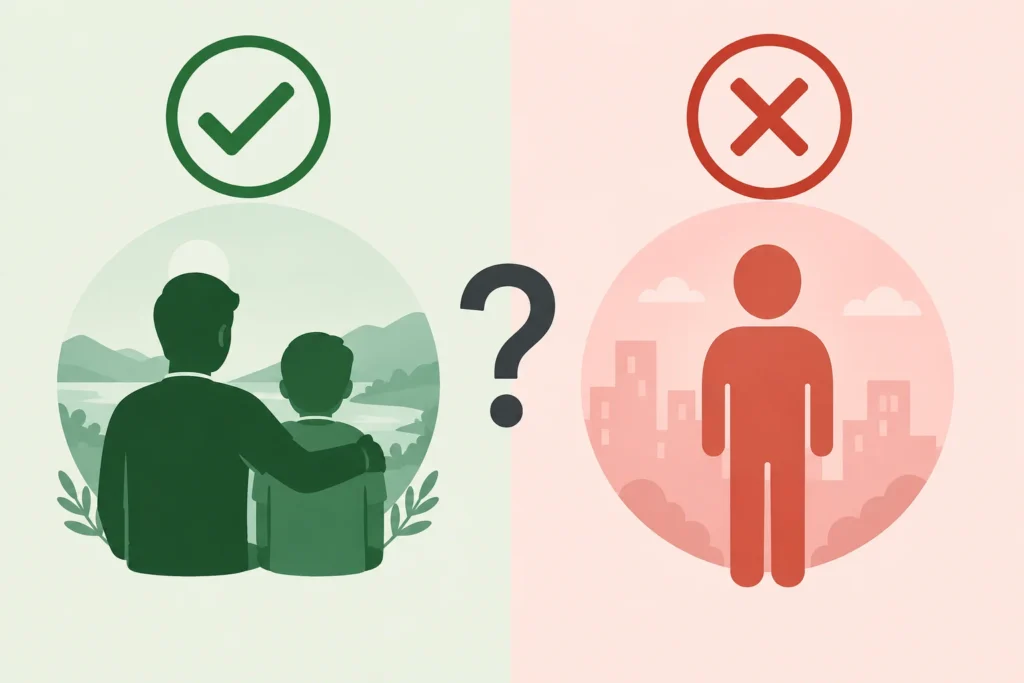
My father and I and my father and me can both be grammatically correct. The right choice depends on what the phrase does in the sentence. That single point clears up most of the confusion around “my father and I or my father and me.”
The my father and me grammar rule is simple: use “my father and I” as a subject and “my father and me” as an object.
The important thing isn’t which version sounds more formal. It isn’t even about putting yourself first or last. Grammar depends on function. In standard English, I serves as a subject pronoun, while me serves as an object pronoun. Purdue OWL likewise treats pronoun choice as a matter of grammatical case and function rather than personal preference.
That distinction becomes much easier once you stop looking at “my father and I” or “my father and me” as one fixed expression. Think of the phrase as two separate parts: my father + I/me. Then ask what role the phrase plays.
The Quick Rule: “My Father and I” vs. “My Father and Me”
Here’s the rule worth remembering:
| Grammatical role | Correct form | Example |
| Subject | my father and I | My father and I traveled together. |
| Direct object | my father and me | She called my father and me. |
| Indirect object | my father and me | He gave my father and me tickets. |
| Object after a preposition | my father and me | She went with my father and me. |
A useful shortcut is even simpler:
If the phrase does the action, use “my father and I.”
If the phrase receives the action or follows a preposition, use “my father and me.”
Consider these two sentences:
My father and I visited the museum.
The guide welcomed my father and me.
In the first sentence, my father and I act. They visited the museum. Therefore, I is correct.
In the second sentence, the guide acts. The guide welcomed them. Therefore, me is correct.
The sentence structure changes, so the pronoun changes with it.
Why This Grammar Choice Confuses So Many People
The confusion usually starts when two people appear together in one phrase. A speaker may know that “I” sounds correct in a sentence such as “I went home.” They may also know that “me” works in “She called me.” But once another person enters the picture, the grammatical relationship becomes harder to see.
Compare:
I went to the store.
My father and I went to the store.
The second sentence simply adds another person to the subject. The underlying pronoun remains I.
Now compare:
She called me.
She called my father and me.
Again, the grammatical role hasn’t changed. The extra noun phrase merely makes the sentence longer.
This is why a simple editing habit can help: temporarily remove “my father and.”
If the sentence becomes:
I went to the store.
then the original should use my father and I.
If it becomes:
She called me.
then the original should use my father and me.
This method works because the additional noun can distract you from the pronoun’s actual grammatical role.
Why People Get It Wrong
One common mistake comes from the belief that I always sounds more correct, educated, or formal than me.
That belief leads to sentences such as:
She invited my father and I.
The sentence may sound polished to some readers, but I don’t belong there in standard edited English because the phrase receives the action of being invited.
Remove the other person:
She invited me.
You wouldn’t normally write “She invited I.” Adding my father doesn’t change the case of the pronoun.
The opposite mistake happens too:
My father and me went shopping.
Remove my father and:
Me went shopping.
That immediately exposes the problem. Standard English requires I as the subject:
My father and I went shopping.
The Psychology Behind the Mistake
People often learn that they should avoid saying “me” in formal writing. That advice may come from repeated corrections such as “John and I” instead of “John and me.” The problem begins when that lesson turns into an overly broad rule.
A learner may internalize this:
I = correct and formal
and
me = incorrect and informal
That’s not how English pronouns work.
Both forms have legitimate grammatical jobs. I belongs in subject positions. Me belongs in object positions.
For example:
- I called my father.
- My father called me.
- I helped my father.
- My father helped me.
- My father and I helped each other.
- The teacher helped my father and me.
None of these examples requires a judgment about which pronoun sounds more sophisticated. The sentence structure makes the decision.
Why Correct Grammar Still Matters
A small pronoun error rarely prevents someone from understanding a sentence. Most readers will know what “She invited my father and I” means.
Still, accuracy matters when you want your writing to look polished.
Grammar affects how readers process your words. A clean sentence feels effortless. A questionable construction can interrupt that flow, especially in professional, academic, or formal writing.
Consider a workplace email:
My father and I will attend the meeting tomorrow.
That’s straightforward.
Now consider:
The coordinator confirmed that she would meet with my father and me tomorrow.
Here, me is completely appropriate. Replacing it with I simply because the message is formal would introduce an error rather than improve the tone.
Correct grammar doesn’t mean choosing the most formal-looking word. It means choosing the word that fits the sentence.
Understanding Subject and Object Pronouns
To master “my father and I or my father and me,” you only need a working understanding of subjects and objects.
What Is a Subject Pronoun?
The subject tells you who performs the action or occupies the subject position in the sentence.
Consider:
I called my father.
The subject is I. The verb is called. The subject acts.
Now add another person:
My father and I called the doctor.
The compound subject contains two people. Both participate in the action.
This pattern appears in many ordinary sentences:
- My father and I went fishing.
- My father and I watched the game.
- My father and I cooked dinner.
- My father and I discussed the plan.
- My father and I visited our relatives.
- My father and I are ready.
In each sentence, my father and I act as the subject.
What Is an Object Pronoun?
An object receives an action or appears after a preposition.
Consider:
My father called me.
Here, my father acts. Me receives it.
Now add another person:
My father called my sister and me.
The grammatical role remains the same. The phrase receives the action of calling.
This distinction also applies to my father and me:
The doctor called my father and me.
The doctor acted on them; the two people received it.
Other examples include:
- The teacher thanked my father and me.
- The manager contacted my father and me.
- The host welcomed my father and me.
- The guide helped my father and me.
- The organizer invited my father and me.
Why Pronouns Change Their Form
English uses different pronoun forms depending on grammatical function.
| Person | Subject form | Object form |
| First person singular | I | me |
| First person plural | we | us |
| Third person singular masculine | he | him |
| Third person singular feminine | she | her |
| Third person plural | they | them |
Notice the same pattern with we/us.
We visited the museum.
The guide spoke to us.
You wouldn’t normally switch those forms simply because one sounds more formal. The sentence determines the form.
The same principle applies to I/me.
I visited the museum.
The guide spoke to me.
Therefore:
My father and I visited the museum.
The guide spoke to my father and me.
The grammar remains consistent.
A Real-Life Example
Imagine two sentences from the same conversation:
My father and I arrived early.
Later, someone says:
The receptionist greeted my father and me.
There is no contradiction between the two forms. The first phrase acts arrived. The second phrase receives the action greeted.
This is one of the easiest ways to understand the rule. A person’s identity doesn’t determine whether you use I or me. Their grammatical role does.
Grammar Is About Function, Not Preference
The phrase “my father and I” often appears in formal writing, so people sometimes assume it must always be the preferred version. That’s a trap.
Look at these sentences:
My father and I attended the ceremony.
The speaker thanked my father and me.
Both sentences can appear in the same formal document. Both can sound polished. The pronouns differ because their grammatical jobs differ.
This distinction also explains why replacing I with me simply to sound conversational isn’t always correct.
My father and I attended the ceremony.
The problem isn’t that me sounds informal. The problem is that me doesn’t function as the standard subject pronoun there.
Likewise:
The speaker thanked my father and I.
The problem isn’t that I sounds too formal. The problem is that I doesn’t function as the standard object pronoun there.
When to Use “My Father and I”
Use my father and I when the phrase functions as the subject.
That’s the central rule.
“My Father and I” as the Subject
Look at this sentence:
My father and I went to the park.
Who went to the park?
My father and I.
That makes the phrase the subject.
The same structure appears in: My father and I planned the trip.My father and I watched the movie.My father and I cleaned the garage.My father and I discussed the problem.My father and I ordered dinner.
In each case, the phrase controls the action.
You can test every sentence by removing my father and:
- I planned the trip.
- I watched the movie.
- I cleaned the garage.
- I discussed the problem.
- I ordered dinner.
The remaining sentences work, so my father and I work in the original sentences.
Compound Subjects and Verb Agreement
When my father and I join with and, they create a compound subject. Because the sentence has two people, the verb normally takes a plural form.
Compare:
My father is ready.
My father and I are ready.
The first sentence has one subject. The second has two.
The same pattern appears with past tense:
My father was there.
My father and I were there.
And with present perfect constructions:
My father has finished.
My father and I have finished.
Here’s a quick reference:
| Singular | Compound subject |
| My father is ready. | My father and I are ready. |
| My father was there. | My father and I were there. |
| My father has arrived. | My father and I have arrived. |
| My father does the work. | My father and I do the work. |
This isn’t a special rule for the phrase my father and I. It’s ordinary subject-verb agreement. Purdue’s grammar resources also treat subject-verb agreement as a sentence-level issue that depends on the structure of the subject.
Common Situations Where “My Father and I” Is Correct
You’ll frequently need my father and I when talking about shared activities.
Talking about plans
My father and I are planning a trip.
Describing something you did together
My father and I visited the museum.
Explaining a shared experience
My father and I had a long conversation.
Describing a joint decision
My father and I decided to leave early.
Talking about an event
My father and I attended the ceremony.
Describing an ongoing activity
My father and I are working on the garden.
The common thread is simple: the pair performs or controls the action.
Watch for Compound Subjects
A compound subject doesn’t always appear at the beginning of a sentence.
For example:
After dinner, my father and I went for a walk.
The phrase still functions as the subject even though another phrase comes first.
Likewise:
Yesterday, my father and I visited the library.
The opening word yesterday doesn’t change the pronoun choice.
A longer sentence can hide the same structure:
Although it was raining, my father and I decided to continue the trip.
The dependent clause doesn’t change the role of the compound subject. My father and I still perform the action decided.
This is why looking for the main verb helps. Once you identify who performs that action, the pronoun choice becomes much clearer.
Common Mistakes to Avoid
The most common mistake is using me as the subject:
❌ My father and me went to the store.
✅ My father and I went to the store.
The removal test makes the correction obvious:
❌ Me went to the store.
✅ I went to the store.
Another common mistake involves the verb to be:
❌ My father and I was there.
✅ My father and I were there.
Here, the pronoun choice is correct, but the verb doesn’t agree with the compound subject.
A third mistake comes from using I when the phrase is an object:
❌ The teacher called my father and I.
✅ The teacher called my father and me.
Remove the extra noun:
The teacher called me.
That settles it.
A Simple Memory Tip
Don’t memorize “my father and I” as a phrase that must always stay together.
Instead, remember this:
I acts. Me receives.
Then apply it to the full phrase:
My father and I act.
Someone acts on my father and me.
For example:
Action performed by the pair:
My father and I drove home.
Action received by the pair:
The police officer stopped my father and me.
After a preposition:
The officer spoke with my father and me.
Once you see the phrase this way, the choice becomes much less mysterious.
A Quick Check You Can Use Anywhere
When you’re unsure, follow these steps:
- Find the main verb.
- Ask who acts.
- If the answer is the pair, choose my father and I.
- If the pair receives the action, choose my father and me.
- Look for a preposition such as with, for, to, or between.
- Remove my father, and if you’re still uncertain.
- Read the remaining sentence aloud.
For example:
The manager spoke with my father and ___.
The preposition is with.
Now remove my father and:
The manager spoke with me.
So the correct sentence is:
The manager spoke with my father and me.
Now try another:
My father and ___ went to the meeting.
Remove my father and:
I went to the meeting.
Therefore:
My father and I went to the meeting.
That’s the practical heart of the entire rule.
When to Use “My Father and Me”
The easiest way to recognize my father and me is to stop thinking about the phrase as a special expression. It follows the same pronoun rule as me, him, her, us, and them. When the phrase receives an action or follows a preposition, me is the standard object form. In contrast, my father and I belong in the subject position. This subject-object distinction is a basic feature of English pronoun case.
Consider the difference:
My father and I visited the museum.
The guide welcomed my father and me.
In the first sentence, the pair acted as the subject. In the second, the guide acts welcomed, while the pair receives it. The words around the phrase determine the correct pronoun.
Understanding Direct and Indirect Objects
An object is generally a person or thing affected by the action of a verb. When my father and me functions as a direct object, the verb acts directly on the two people.
For example:
The teacher praised my father and me.
Ask: Whom did the teacher praise?
The answer is my father and me.
Try removing my father:
The teacher praised me.
That sentence is grammatical, so me works in the original construction.
The same pattern appears in many everyday sentences:
- The doctor examined my father and me.
- The manager contacted my father and me.
- The host welcomed my father and me.
- The photographer photographed my father and me.
- The organizer invited my father and me.
- The receptionist called my father and me.
In every example, someone else acts. The phrase my father and I receives that action.
An indirect object works slightly differently. It often identifies the person who receives something, benefits from an action, or has something done for them.
For example:
The organizer gave my father and me two tickets.
The thing being given is two tickets. The people receiving them are my father and me.
You can rearrange the sentence:
The organizer gave two tickets to my father and me.
Now the preposition makes the object relationship especially obvious.
Another example:
The company sent my father and me an invitation.
The invitation is the direct object. My father and me identifies the recipients.
This distinction matters because writers sometimes see a phrase near a verb and automatically choose I. Instead, look at the actual structure. Ask who performs the action and who receives it.
| Sentence | Subject | Object | Correct phrase |
| My father and I called the doctor. | My father and I | the doctor | my father and I |
| The doctor called my father and me. | the doctor | my father and me | my father and me |
| The host gave my father and me tickets. | the host | my father and me | my father and me |
| My father and I bought tickets. | my father and I | tickets | my father and I |
This approach is more reliable than memorizing where a phrase appears in the sentence. My father and me doesn’t have to appear at the end. It can occur in the middle of a sentence because grammar depends on function, not simply position.
Using “My Father and Me” After Prepositions
Prepositions create another common source of confusion.
Words such as with, for, to, from, between, about, beside, near, and without normally introduce an object. When a first-person singular pronoun follows one of these prepositions, the standard form is me, not I.
So you write:
She traveled with my father and me.
Not:
❌ She traveled with my father and I.
Remove my father and:
She traveled with me.
The answer is immediately clear.
The same principle applies to other prepositions:
This package is for my father and me.
The letter came from my father and me.
The decision was discussed between my father and me.
She spoke about my father and me.
The guide stood beside my father and me.
Nobody came with my father and me.
A useful table makes the pattern easy to scan:
| Preposition | Correct example |
| with | She went with my father and me. |
| for | This gift is for my father and me. |
| to | They spoke to my father and me. |
| from | The message came from my father and me. |
| between | The agreement stayed between my father and me. |
| about | They talked about my father and me. |
| beside | She sat beside my father and me. |
| without | He left without my father and me. |
The Famous “Between My Father and Me” Rule
Between my father and me is one of the clearest examples of correct object-pronoun usage.
Between my father and me, the decision was easy.
The disagreement remained between my father and me.
The preposition between requires an object. Therefore, me is the standard choice.
A common error is:
❌ Between my father and I
This usually happens because I have acquired a reputation for being the more formal choice. But formality doesn’t override grammatical case.
The removal test makes the answer obvious:
Between my father and me
Remove my father:
Between me
That works.
Now try the incorrect version:
Between I
That doesn’t work in standard English.
The same test works with for:
This letter is for my father and me.
Remove my father:
This letter is for me.
Not:
This letter is for I.
The important lesson is simple: a preposition doesn’t care whether the sentence sounds formal. It still requires the appropriate object form.
The Removal Test Works Here Too
The removal test is especially useful because compound phrases can hide the pronoun’s role.
Take:
The teacher spoke with my father and me.
At first glance, you might hesitate because the sentence contains several words. Remove my father and:
The teacher spoke with me.
That’s clearly correct.
Now try:
My father and I spoke with the teacher.
Remove my father and:
I spoke with the teacher.
Again, the correct form becomes obvious.
Here’s another example:
The company invited my father and me to the ceremony.
Remove my father and:
The company invited me to the ceremony.
Therefore, my father and me is correct.
Now:
My father and I attended the ceremony.
Remove my father and:
I attended the ceremony.
Therefore, ” My father and I is correct.
The trick works because you’re testing the pronoun in the same grammatical environment. You aren’t guessing based on sound or formality. You’re checking what the sentence actually requires.
Everyday Examples You’ll Actually Use
The distinction appears constantly in ordinary conversations and writing.
Talking about invitations
The organizers invited my father and me to dinner.
The organizers are doing the inviting. The pair receives the invitation.
Talking about travel
My father and I traveled to California last summer.
The pair is traveling.
Talking about conversations
The manager spoke with my father and me.
The preposition with introduces the object.
Talking about plans
My father and I are planning a family trip.
The pair is the subject of are planning.
Talking about assistance
The nurse helped my father and me.
The nurse acts. The pair receives it.
Talking about shared responsibilities
My father and I handled the paperwork.
The pair acts.
Notice how naturally the rule operates when you focus on the verb or preposition. You don’t need to make the decision based on which phrase looks more sophisticated.
Comparing Both Forms Side by Side
Seeing the forms together is often more useful than reading another definition.
| Correct form | Why it works | Example |
| My father and I | Compound subject | My father and I went shopping. |
| My father and me | Direct object | She called my father and me. |
| My father and me | Indirect object | He gave my father and me tickets. |
| My father and me | Object after preposition | She spoke with my father and me. |
| My father and I | Subject in a longer clause | After lunch, my father and I left. |
| My father and me | Object in a longer clause | After lunch, the guide thanked my father and me. |
Now compare common mistakes:
| Incorrect | Correct | Reason |
| My father and me went home. | My father and I went home. | The phrase is the subject. |
| They invited my father and I. | They invited my father and me. | The phrase is the object. |
| She spoke with my father and I. | She spoke with my father and me. | With is a preposition. |
| Between my father and I | Between my father and me | Between takes an object pronoun. |
| My father and me are ready. | My father and I are ready. | The phrase performs the action/state. |
This comparison also shows why the phrase doesn’t have one permanently correct form. Both versions belong in good English. Their grammatical roles simply differ.
The Fastest Test for Choosing the Correct Phrase
When you need an answer quickly, use the remove-the-other-person test.
Take the sentence:
My father and ___ went to the store.
Remove my father and:
I went to the store.
So the answer is I.
Now try:
The cashier helped my father and ___.
Remove my father and:
The cashier helped me.
So the answer is me.
This works in seconds.
Example One: Subject
My father and ___ are visiting us tomorrow.
Remove the other person:
I am visiting us tomorrow.
The sentence structure requires the subject form I.
Therefore:
My father and I are visiting us tomorrow.
The exact context might call for a different wording, but the pronoun case is clear.
Example Two: Direct Object
The teacher called my father and ___.
Remove my father and:
The teacher called me.
Therefore:
The teacher called my father and me.
Example Three: Preposition
The invitation was sent to my father and ___.
Remove my father and:
The invitation was sent to me.
Therefore:
The invitation was sent to my father and me.
Why This Trick Works
The extra noun my father creates a compound phrase. That compound phrase can make the sentence feel more complicated than it actually is.
The removal test strips away that distraction.
You aren’t changing the grammar. You’re temporarily simplifying the sentence so the pronoun’s role becomes visible.
The method works with other pronoun combinations too:
My sister and I went home.
becomes:
I went home.
And:
The teacher called my sister and me.
becomes:
The teacher called me.
This is why the technique isn’t merely a trick for this one phrase. It’s a practical way to check compound pronouns generally.
Situations Where the Removal Test Helps
Use it whenever you see a construction such as:
- my father and I
- my father and me
- my mother and I
- my brother and me
- John and I
- Sarah and me
- my parents and me
- my friend and I
For example:
My brother and I went to the store.
Remove my brother and:
I went to the store.
Correct.
Now:
The shopkeeper spoke to my brother and me.
Remove my brother and:
The shopkeeper spoke to me.
Correct.
The method remains the same regardless of the noun.
Cases Where You Should Think Twice
The removal test is powerful, but some sentence structures deserve additional attention.
One example is a sentence involving a linking verb, especially constructions such as:
It was my father and I who organized the event.
This structure is more complicated than an ordinary subject or object sentence because it involves a cleft construction and a following relative clause. Traditional grammatical analysis and modern usage can produce different judgments about constructions of this kind.
If the sentence feels awkward, the best solution is often to rewrite it:
My father and I organized the event.
That version is shorter, clearer, and avoids an unnecessary grammatical puzzle.
Another potentially awkward construction involves apposition:
The two guests, my father and me, arrived late.
If the phrase renames a subject, traditional case agreement can make the construction more complicated than it first appears. Rewriting usually produces cleaner prose:
My father and I, who were two of the guests, arrived late.
Or simply:
My father and I arrived late.
Good grammar isn’t only about identifying the correct pronoun. Sometimes the best editing choice is to restructure a sentence so the grammatical relationship becomes unmistakable.
Another Helpful Shortcut: “We” or “Us”
There’s another useful test for compound phrases.
If the phrase can be replaced with we, the pronoun should generally be I.
If it can be replaced with us, the pronoun should generally be me.
Consider:
My father and I went fishing.
Replace the phrase:
We went fishing.
That works.
Therefore:
My father and I went fishing.
Now:
The guide helped my father and me.
Replace the phrase:
The guide helped us.
That works.
Therefore:
The guide helped my father and me.
This test is particularly useful when the sentence is long, and the removal test feels inconvenient.
| Replacement | Pronoun form | Example |
| we | I | My father and I arrived early. |
| us | me | The guide helped my father and me. |
The logic is straightforward:
we → I
us → me
Just remember that you’re replacing the entire compound phrase. You’re not replacing my father alone.
Practice the Test
Try these sentences mentally:
___ and my father went to the store.
Remove my father:
I went to the store.
Answer: I
Now:
The manager called my father and ___.
Remove my father:
The manager called me.
Answer: me
Next:
The package was delivered to my father and ___.
Remove my father:
The package was delivered to me.
Answer: me
Now:
My father and ___ are attending the meeting.
Remove my father:
I am attending the meeting.
Answer: I
Finally:
The invitation is for my father and ___.
Remove my father:
The invitation is for me.
Answer: me
This type of practice builds automatic recognition. Eventually, you won’t need to consciously run through every step.
The More You Practice, the Faster It Gets
At first, “my father and I or my father and me” can feel like a grammar question that requires careful analysis. After several examples, the pattern becomes much more natural.
The goal isn’t to memorize dozens of isolated sentences. It’s to recognize the structure.
When you see:
My father and ___ + verb
check whether the pair acts.
When you see:
verb + my father and ___
check whether the pair receives the action.
When you see:
preposition + my father and ___
choose the object form of me.
That gives you a compact mental framework:
Subject → I
Object → me
Preposition → me
And the most practical version is even shorter:
I do. Me receives.
With that distinction in place, even long sentences become manageable. The phrase my father and me isn’t a special exception. It’s simply an example of the broader English system of subject and object pronouns.
Common Sentence Patterns You’ll See Every Day
The difference between my father and I and my father and me becomes much easier when you stop treating it as a memorization exercise. In everyday English, the phrase appears in predictable sentence patterns. Once you recognize those patterns, you can usually choose the correct form without hesitation.
The key question remains the same: Is the phrase doing something, receiving something, or following a preposition?
At School
School situations provide simple examples because the sentence structures are familiar.
My father and I attended the parent meeting.
Here, the compound subject acts as the subject of attending.
Now change the sentence:
The teacher spoke with my father and me after class.
The teacher performs the action of speaking. The phrase follows the preposition with, so me is appropriate.
Another example:
My father and I met my English teacher.
But:
My English teacher contacted my father and me.
The difference isn’t subtle once you identify the grammatical role.
At Work
Professional communication often makes people especially cautious about pronouns. That’s understandable. A grammar mistake in an email, report, proposal, or formal message can distract readers from the information you’re trying to communicate.
Consider:
My father and I will attend the conference.
The phrase is the subject of will attend.
Now compare:
The event coordinator confirmed the schedule with my father and me.
Here, with introduces an object.
Another example:
My father and I discussed the contract.
But:
The attorney discussed the contract with my father and me.
The word with changes the grammatical relationship, so the pronoun changes too.
This distinction becomes particularly useful when writing sentences that sound formal. Don’t automatically choose I just because you’re preparing a professional document. A polished sentence can absolutely contain me.
During Everyday Conversations
Natural conversations produce countless examples: My father and I went out for dinner.My aunt invited my father and me.My father and I watched the game.My brother came with my father and me.My father and I talked about the trip.
The neighbors spoke to my father and me.
Notice how often I appears with action verbs such as went, watched, and talked. Meanwhile, me appears after verbs such as invited and after prepositions such as with and to.
That recurring pattern gives you a practical way to recognize the correct form in real time.
In Formal Writing
Formal writing doesn’t create a different pronoun system. It simply makes grammatical accuracy more visible.
In an academic paper, business letter, application, or official statement, you might write:
My father and I participated in the research project.
You might then write:
The committee interviewed my father and me.
Both sentences can belong in the same formal document.
The important point is that formal English doesn’t automatically prefer “I.” Standard grammar still requires the pronoun that matches the phrase’s function.
A common misconception is that replacing every occurrence of me with I makes writing sound more professional. It doesn’t. In fact, the result can sound awkward or incorrect.
For example:
❌ The committee spoke with my father and I.
✅ The committee spoke with my father and me.
The second sentence is both grammatical and professional.
In Emails and Text Messages
The same grammatical principles apply in digital communication.
An email might say:
My father and I appreciate your assistance.
Another might say:
Thank you for speaking with my father and me.
A casual text might be shorter:
Dad and I are on our way.
Or:
She asked Dad and me to wait.
The medium doesn’t change the underlying grammar. A text message can be informal in tone while still using standard pronoun forms.
Comparing Everyday Situations
One of the best ways to understand my father and I vs. my father and me is to compare similar situations.
| Situation | Correct sentence | Why? |
| Leaving together | My father and I left early. | The pair acts. |
| Being invited | They invited my father and me. | The pair receives the action. |
| Traveling together | My father and I traveled by train. | Compound subject. |
| Traveling with someone | She traveled with my father and me. | Object after with. |
| Receiving a gift | They gave my father and me gifts. | Indirect object. |
| Discussing something | My father and I discussed the issue. | Compound subject. |
| Being discussed | They talked about my father and me. | Object after about. |
| Attending an event | My father and I attended the event. | Compound subject. |
| Being contacted | The organizer contacted my father and me. | Direct object. |
| Being included | The invitation was sent to my father and me. | Object after to. |
The sentences are deliberately similar because that reveals the underlying pattern. The people remain the same. Their grammatical function changes.
Real-Life Case Study: A Workplace Email
Imagine that an employee needs to write a short email after attending a meeting with a parent.
The first draft says:
My father and I attended the meeting, and the manager spoke with my father and I mebout the documents.
There are two pronoun errors.
The corrected version is:
My father and I attended the meeting, and the manager spoke with my father and me about the documents.
Why?
The first phrase is the subject:
My father and I attended.
Remove my father and:
I attended.
The second phrase follows with:
spoke with my father and me
Remove my father and:
spoke with me.
This example demonstrates something important: the same sentence can legitimately require both forms.
You don’t have to choose either I or me for the entire sentence. You choose the form separately each time the pronoun appears.
Before and After
| Original | Improved |
| My father and me attended the meeting. | My father and I attended the meeting. |
| The manager spoke with my father and I. | The manager spoke with my father and me. |
| They gave my father and I the documents. | They gave my father and me the documents. |
| My father and me discussed the issue. | My father and I discussed the issue. |
The correction doesn’t require complicated grammar terminology. It requires identifying the role of the phrase.
Side-by-Side Examples You Can Copy
The following examples cover common situations where writers hesitate between my father and I and my father and me. Correct Subject ExamplesMy father and I went to the hospital.My father and I attended the ceremony.My father and I discussed the problem.My father and I are planning a vacation.My father and I were waiting outside.My father and I have finished the project.My father and I will arrive tomorrow.
In each sentence, the phrase acts as or occupies the subject position.
Correct Object Examples
The doctor examined my father and me.
The teacher thanked my father and me.
The organizer invited my father and me.
The company contacted my father and me.
The guide helped my father and me.
The receptionist called my father and me.
The photographer photographed my father and me.
Here, another person or entity acts.
Correct Prepositional Examples
She went with my father and me.
The gift was for my father and me.
They spoke to my father and me.
The message came from my father and me.
The decision was between my father and me.
They talked about my father and me.
Nobody came without my father and me.
The prepositions make the object role clear.
Before-and-After Corrections
Sometimes the quickest way to learn grammar is to see a mistake transformed into a correct sentence.
Example: Subject Error
Incorrect:
My father and me went shopping.
Correct:
My father and I went shopping.
Reason: The phrase is the subject of went.
Example: Object Error
Incorrect:
She invited my father and I.
Correct:
She invited my father and me.
Reason: The phrase receives the action of invited.
Example: Preposition Error
Incorrect:
He traveled with my father and I.
Correct:
He traveled with my father and me.
Reason: With is a preposition, so the object form is required.
Example: “Between” Error
Incorrect:
Between my father and I, the matter was settled.
Correct:
Between my father and me, the matter was settled.
Reason: Between is a preposition and takes the object form me.
Example: Verb Agreement Error
Incorrect:
My father and I was there.
Correct:
My father and I were there.
This example demonstrates a different issue. I is correct, but the compound subject requires the plural verb were.
That’s worth remembering because not every sentence involving my father and I is an I-versus-me problem. Sometimes the pronoun is fine, and the verb agreement is what needs attention.
Common Mistakes and How to Fix Them
Saying “My Father and Me” Everywhere
A person who learns that me works after verbs and prepositions may begin using it everywhere.
That creates sentences such as:
❌ My father and me went to dinner.
The phrase is the subject, so the standard form is:
✅ My father and I went to dinner.
The removal test confirms it:
I went to dinner.
Using “My Father and I” Everywhere
This is probably the more famous mistake because people often associate I with formal or educated writing.
Consider:
❌ The teacher called my father and I.
The teacher performs the action. The pair receives it.
Remove my father and:
The teacher called me.
Therefore:
✅ The teacher called my father and me.
The same issue occurs after prepositions:
❌ She sat beside my father and I.
✅ She sat beside my father and me.
Forgetting About Prepositions
Prepositions are powerful clues.
When you see with, to, for, from, between, about, beside, near, or without, check whether the following phrase is functioning as an object.
For example:
She spoke to my father and me.
The word to signals the relationship.
Another:
He waited with my father and me.
Again, with comes before the object.
A particularly common error is:
❌ This is between my father and I.
The standard form is:
✅ This is between my father and me.
The phrase may sound formal with I, but sound isn’t the deciding factor.
Letting Spoken English Influence Written English
Everyday speech doesn’t always follow the conventions of formal edited English perfectly. Speakers may use constructions that feel natural in conversation but wouldn’t be the preferred choice in carefully edited writing.
That doesn’t mean every informal construction needs correction in casual conversation. Context matters.
However, when you’re writing a professional email, school assignment, formal letter, report, application, or public-facing article, standard grammar gives your writing greater consistency.
A useful principle is:
Match your grammar to the standard expected by your audience.
You can still write naturally without abandoning grammatical accuracy.
Ignoring the Removal Test
The removal test takes only a few seconds, yet writers often skip it because they try to judge the complete phrase by ear.
That’s risky.
Consider:
The director asked my father and I to stay.
It may sound familiar because the phrase my father and I appears frequently in formal speech.
Remove the other person:
The director asked me to stay.
The correct form is immediately clear:
The director asked my father and me to stay.
The test turns an uncertain choice into a straightforward one.
Thinking Grammar Is Based on Politeness
Some speakers believe that placing themselves second is a matter of politeness:
My father and I
rather than:
I and my father
Putting another person first is often a natural stylistic choice, particularly when referring to a parent or another person in a respectful context. But word order and pronoun case are different issues.
The fact that my father comes first doesn’t automatically require I.
For example:
The teacher spoke with my father and me.
The phrase is still correct even though my father comes first.
Similarly:
My father and I spoke with the teacher.
Here, I is correct because the phrase is the subject.
The position of the noun doesn’t determine the pronoun. Grammar does.
“Me and My Father” vs. “My Father and I”
Another related question is whether you can say:
Me and my father went to the store.
This construction can occur in informal speech and in some varieties of English. However, in standard formal English, the conventional subject form is:
My father and I went to the store.
Two separate issues are involved here.
First, I is the standard subject pronoun.
Second, English style often places the other person before I in a compound subject:My father and IMy sister and IMy teacher and IMy friend and I
This ordering is a matter of convention and style. The more important grammatical point is that I functions as the subject.
For an object, standard English similarly uses:
my father and me
rather than:
me and my father
in formal contexts where the compound object is being carefully presented.
For example:
The teacher invited my father and me.
The phrase follows the standard object pattern.
Does “Dad and I” Follow the Same Rule?
Yes.
Changing my father to Dad doesn’t change the pronoun rule.
Dad and I went to the store.
She invited Dad and me.
The same thing happens with other family terms:
My mother and I went shopping.
The teacher spoke with my mother and me.
Or:
My brother and I arrived early.
They called my brother and me.
The noun changes. The grammatical principle doesn’t.
Does Formal English Prefer One Over the Other?
Formal English doesn’t simply choose I over me.
Instead, formal English expects the standard pronoun form for the grammatical role.
That means you can find perfectly formal sentences containing me:
The committee spoke with my father and me.
The director sent the documents to my father and me.
The organization invited my father and me to the event.
There’s nothing informal about those sentences.
Likewise, I can appear naturally in formal writing:
My father and I attended the meeting.
My father and I submitted the application.
The important distinction is not formal versus informal. It’s subject versus object.
Spoken English vs. Written English
Spoken English often moves quickly. Speakers rely on context, rhythm, shared knowledge, and conversational habits. Written English gives readers more time to inspect the structure.
That difference can make certain errors more noticeable in writing.
For example, a speaker might say:
“Me and my father went there.”
The meaning is clear.
In a formal written sentence, however, standard edited English would generally use:
My father and I went there.
Likewise, some speakers may overcorrect themselves in formal settings:
“The manager spoke with my father and I.”
Here, the speaker may be trying to sound careful but has selected the wrong pronoun.
The solution isn’t to make speech sound overly formal. It’s to understand the grammatical function of each form.
When Grammar Really Matters
Not every conversation needs a grammar lecture. Most people communicate successfully without consciously analyzing every pronoun.
Still, accuracy becomes especially valuable when your words represent you in a formal setting.
Pay particular attention to I/me choices in:
- Job applications
- Business emails
- Academic assignments
- Research papers
- Reports
- Cover letters
- Professional presentations
- Formal correspondence
- Public-facing websites
- Official statements
In these settings, small grammatical details contribute to a polished impression.
That doesn’t mean grammar should make your writing stiff. The strongest formal writing is usually clear, direct, and natural.
Grammar Tips That Make the Rule Easy to Remember
Replace the Phrase With “I” or “Me”
This remains the fastest technique.
My father and ___ went home.
Replace the blank:
I went home.
Answer: my father and I.
Now:
The teacher called my father and ___.
Replace the blank:
The teacher called me.
Answer: my father and me.
Find the Verb First
Look for the main action.
My father and I visited the museum.
The pair performs visited.
But:
The guide welcomed my father and me.
The guide performs welcomed.
Once you identify the actor and receiver, the pronoun choice becomes much easier.
Look for Prepositions
A preposition can provide an immediate clue.with my father and mefor my father and meto my father and mebetween my father and meabout my father and meWhen I appears after one of these prepositions, pause and check the sentence carefully.
Replace the Phrase With “We” or “Us”
This is another quick diagnostic.
My father and I went home.
→ We went home.
Therefore, I.
Now:
The guide helped my father and me.
→ The guide helped us.
Therefore, me.
Think of the pair as:
we → my father and I
us → my father and me
This is especially helpful when the sentence contains several clauses.
Read the Sentence Out Loud
Reading aloud can expose awkward structures, although sound alone shouldn’t replace grammatical analysis.
Try:
My father and me went to the store.
It may sound familiar because similar constructions occur frequently in everyday speech. Now remove the additional noun:
Me went to the store.
The error becomes easier to hear.
Do the same with:
The teacher spoke with my father and I.
Remove the noun:
The teacher spoke with I.
That sounds immediately wrong in standard English.
Reading aloud works best when combined with the removal test.
Practice With Everyday Sentences
Short practice sentences build confidence faster than memorizing definitions.
Try these:
My father and I went fishing.
The guide helped my father and me.
My father and I bought lunch.
The waiter spoke with my father and me.
My father and I discussed the trip.
The organizer called my father and me.
My father and I arrived early.
The host welcomed my father and me.
Each example reinforces the same underlying distinction.
Think About Meaning Instead of Memorizing Rules
Grammar rules are useful, but understanding the relationship between words is even more useful.
Ask:
Who is doing something?
If the answer is the pair, use my father and I.
Ask:
Who is receiving something?
If the answer is the pair, use my father and me.
Ask:
Does a preposition come directly before the pair?
If so, my father and I is normally the standard choice.
Once you understand the meaning and function, the rule becomes less like a school exercise. Practice Quiz: My Father and I or My Father and Me.
A short quiz can show whether the my father and I vs. my father and me rule has really clicked. For each sentence, choose the form that fits the grammatical role of the phrase. Don’t rely only on what sounds formal. Check whether the phrase acts as a subject, object, or object of a preposition.
Question 1
My father and ___ went to the bookstore after lunch.
Answer: I
The phrase acts as the subject, so it functions as the subject.
Question 2
The teacher invited my father and ___ to the school event.
Answer: me
The teacher performs the action of inviting, while the pair receives that action.
Question 3
The manager spoke with my father and ___ about the schedule.
Answer: me
The preposition with takes an object, so me is correct.
Question 4
My father and ___ are planning the family trip.
Answer: I
The pair performs the action expressed by are planning.
Question 5
The doctor spoke to my father and ___ after the examination.
Answer: me
The preposition to introduces the object of the sentence.
Question 6
My father and ___ discussed the problem yesterday.
Answer: I
Try removing my father and:
I discussed the problem yesterday.
Because I work as the subject, the complete phrase is my father and I.
Question 7
The organizer sent an email to my father and ___.
Answer: me
The phrase follows to, making me the appropriate object pronoun.
Question 8
My father and ___ attended the graduation ceremony.
Answer: I
The compound subject acts attended.
Question 9
The photographer took a picture of my father and ___.
Answer: me
The preposition of introduces the object phrase.
Question 10
Between my father and ___, the decision was easy.
Answer: me
Between is a preposition, so the object form me is standard.
Quiz Score Guide
Your score can help you identify whether you understand the rule or simply recognize familiar phrases.
| Score | What It Means |
| 9–10 | You have a strong command of the distinction. |
| 7–8 | You understand the main rule but should review object and preposition patterns. |
| 5–6 | You know the basics but may still rely too heavily on what sounds natural. |
| 0–4 | Review subject pronouns, object pronouns, and the removal test before moving on. |
The most important takeaway isn’t the score. It’s whether you can explain why each answer works.If you can replace the phrase with I or me, you have a dependable shortcut. If I works alone, choose my father and I. If me works alone, choose my father and me.
Quick Reference: My Father and I vs. My Father and Me
| Use | Correct Form | Example |
| Subject | My father and I | My father and I visited the museum. |
| Direct object | My father and me | They invited my father and me. |
| Indirect object | My father and me | She gave my father and me tickets. |
| After a preposition | My father and me | She traveled with my father and me. |
| After “to” | My father and me | Send the letter to my father and me. |
| After “for” | My father and me | This gift is for my father and me. |
| After “between” | My father and me | The choice was between my father and me. |
| After “with” | My father and me | He spoke with my father and me. |
Final Rule to Remember
When you’re unsure about my father and I or my father and me, don’t guess based on which version sounds morepolished. Focus on the phrase’s job.My father and I is the subject form.My father and I went to the meeting.My father and me is the object form.
The organizer invited my father and me.
After a preposition, use the object form:
She spoke with my father and me.
The easiest test is to remove my father and. If the sentence needs I, choose my father and I. If it needs me, choose my father and me.
Once this habit becomes automatic, the choice takes only a second. You don’t need to memorize dozens of isolated examples. You only need to recognize the grammatical role of the pronoun.
Conclusion
The choice between my father and I and my father and me isn’t really about which phrase sounds more educated or formal. It’s about grammatical function. Use my father and I when the pair acts as the subject: “My father and I attended the meeting.” Use my father and me when the pair receives an action or follows a preposition: “They invited my father and me” or “She spoke with my father and me.” When doubt creeps in, remove my father and test the remaining sentence. If I fits, use my father and I. If me fits, use my father and me. This simple method works across emails, essays, conversations, workplace writing, and everyday sentences. Once you understand the difference between subject and object pronouns, this once-confusing choice becomes remarkably straightforward.
FAQs
Is “my father and I” always correct?
No. My father and I is correct when the phrase functions as a subject. It isn’t correct simply because the sentence sounds formal.
My father and I visited the museum.
But:
The guide helped my father and me.
Is “my father and me” grammatically correct?
Yes. My father and me is grammatically correct when the phrase functions as an object or follows a preposition.
She invited my father and me.
She traveled with my father and me.
Which is correct: “my father and I went” or “my father and me went”?
The standard form is:
My father and I went.
The phrase is the subject of went. Remove my father and, and you get I went, not me went.
Which is correct: “between my father and I” or “between my father and me”?
The standard form is:
Between my father and me
The word between is a preposition, so it takes the object pronoun me.
Why do people say “my father and I” when it isn’t correct?
Many people have learned that I sounds more formal or grammatically careful. As a result, they sometimes use I where me is required.
For example:
❌ The teacher spoke with my father and I.
✅ The teacher spoke with my father and me.
Can I use the removal test every time?
For most ordinary sentences, yes. Remove my father and see whether I or me fits.
My father and ___ went home.
→ I went home.
The teacher called my father and ___.
→ The teacher called me.
It’s one of the quickest practical grammar checks available.
Does the same rule apply to “Dad and I” and “Dad and me”?
Yes. The noun Dad doesn’t change the pronoun rule.
Dad and I went shopping.
She invited Dad and me.
The grammatical function determines the pronoun.
Is “me and my father” always wrong?
Not necessarily in every variety or context of English, especially informal speech. However, my father and I is the standard choice for a compound subject in formal edited English:
My father and I went to the store.
For a compound object:
The teacher called my father and me.
Does formal English prefer “I” over “me”?
No. Formal English requires the appropriate form for the grammatical function.
Both are perfectly acceptable in formal writing:
My father and I attended the ceremony.
The committee contacted my father and me.
Using I everywhere doesn’t make writing more formal.
What’s the fastest way to remember the difference?
Think:
I = subject
Me = object
Then apply it to the complete phrase:
My father and I = subject
My father and me = object
If you’re still unsure, remove my father and. The remaining sentence usually gives you the answer immediately.
Precise and more like a natural part of sentence building.