
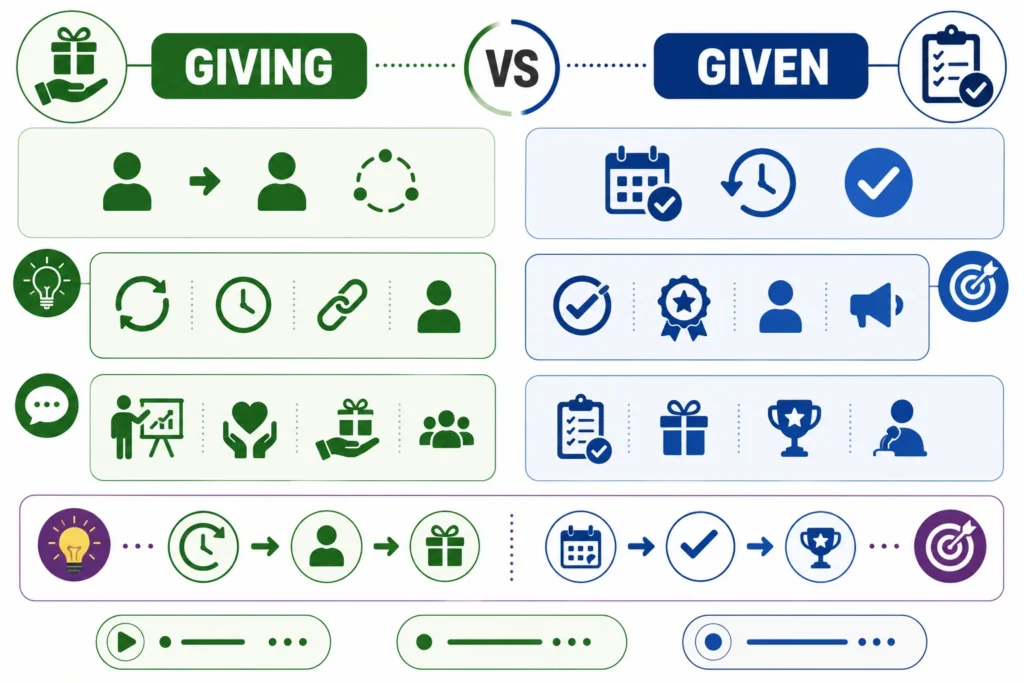
Choosing between giving and given can feel tricky because both words come from the same verb: give. Yet they perform different jobs in a sentence. The key isn’t the meaning of give itself. Instead, you need to look at the verb form, tense, grammatical function, and sentence structure around it.
In simple terms, giving is the present participle of give. It commonly appears in continuous verb forms, such as is giving or was giving. It can also work as a gerund when the activity itself becomes the subject or object of a sentence. Given, on the other hand, is the past participle. You commonly see it after have, has, or had, and it appears in passive constructions such as was given. Cambridge identifies giving as the present participle, gave as the past tense, and given as the past participle of give.
That distinction becomes much easier once you stop treating these words as interchangeable forms. Think of the sentence as a small machine. The helping verb tells you which part the main verb needs.
Giving vs. Given: What’s the Difference?
The simplest way to separate giving and given is to examine what comes before the word.
Consider these three sentences:
- I am giving her the report.
- I have given her the report.
- She was given the report.
All three sentences involve the same basic action, but the grammar changes.
In the first sentence, am giving forms the present continuous. The action is in progress. In the second, have given forms the present perfect. The action has happened, and the speaker connects it to the present situation. In the third, was given uses the passive voice. The focus shifts from the person who acted to the person who received it.
Here’s the pattern at a glance:
| Form | Common grammatical role | Typical structure | Example |
| giving | Present participle | am/is/are + giving | She is giving a speech. |
| giving | Present participle | was/were + giving | They were giving instructions. |
| giving | Gerund | Giving + noun/verb phrase | Giving advice takes patience. |
| given | Past participle | have/has/had + given | He has given his answer. |
| given | Passive participle | be + given | She was given a chance. |
| given | Preposition | given + noun phrase | Given the weather, we’ll stay home. |
| given | Adjective | given + noun | Under the given conditions, we should wait. |
The important point is that given doesn’t simply mean “past.” The simple past form of give is gave. Given is the past participle, so it normally needs a helping verb in a perfect construction or passive structure. Cambridge lists the forms as give → gave → given, with giving as the present participle.
Giving, Given, and Gave Compared
This three-way comparison clears up one of the most common mistakes.
- I give the students their assignments every Monday. → present
- I gave the students their assignments yesterday. → simple past
- I have given the students their assignments already. → present perfect
- I am giving the students their assignments now. → present continuous
Notice what changes. The basic action remains the same, but the verb form tells the reader when the action happens and how the speaker views it.
A useful shortcut is:
giving usually connects with an ongoing action, gave marks simple past, and given usually works with a helping verb or has another grammatical function.
That shortcut won’t solve every sentence, but it gives you a reliable starting point.
Giving vs. Given at a Glance
If you’re checking a sentence quickly, look for the word immediately before giving or given.
| If you see… | You will often need… | Example |
| am, is, are | giving | She is giving a lecture. |
| was, were | giving for an active continuous action | He was giving directions. |
| will be | giving | They will be giving a presentation. |
| have, has, had | given | She has given her answer. |
| was/were + passive meaning | given | He was given a ticket. |
| given + noun phrase | given | Given the evidence, we should reconsider. |
| noun describing something specified | given | At any given time, conditions can change. |
This method works because English uses different forms of a verb to build different grammatical structures. The surrounding words act like clues. Once you recognize those clues, choosing between giving and given becomes much less mysterious.
Why People Confuse Giving and Given

The confusion usually starts with the fact that both words come from give, yet they don’t behave the same way.
English verbs often have several forms that look related but serve different grammatical purposes. For give, the main forms are:
give → gives → gave → given → giving
Each form has its own role.
| Verb form | Name | Example |
| give | Base form | I give useful advice. |
| gives | Third-person singular present | She gives useful advice. |
| gave | Simple past | She gave useful advice yesterday. |
| given | Past participle | She has given useful advice. |
| giving | Present participle/gerund | She is giving useful advice. |
The mistake often happens when writers focus on the meaning instead of the grammar around the verb.
For example, these sentences describe nearly the same event:
- The teacher is giving students feedback.
- The teacher has given students feedback.
- The teacher gave students feedback.
- The students were given feedback.
The meaning changes slightly, but the major difference comes from the verb structure.
If you say “The teacher has giving feedback,” the reader can still guess what you mean. However, the sentence is grammatically incorrect because has requires the past participle given, not the present participle giving.
Understanding “Giving” in English Grammar
Giving is the present participle form of give. It has a wide range of uses, but its most familiar role appears in continuous tenses.
Cambridge’s American Dictionary identifies giving as the present participle of give. The dictionary also shows common uses of give involving providing something, performing an action, producing an effect, or organizing an event.
That broad meaning explains why giving appears in many everyday expressions:
- giving advice
- giving information
- giving instructions
- giving permission
- giving a speech
- giving a presentation
- giving someone a chance
- giving support
- giving feedback
- giving a gift
- giving someone time
- giving an answer
The word doesn’t always describe handing over a physical object. You can give advice, give someone an opportunity, or give an impression. In each case, give expresses the idea of providing, causing, communicating, or performing something.
What Does “Giving” Mean?
At its core, giving describes the act of providing, offering, transferring, or causing something.
For example:
- She is giving her brother a present.
- He is giving the team useful advice.
- The manager is giving employees more time.
- The speaker is giving a presentation.
- That experience is giving me confidence.
These examples show why you shouldn’t define giving only as “handing something to another person.” English uses give in many broader patterns. Cambridge includes meanings related to offering or providing something, performing an action, and producing or causing an effect.
That flexibility carries over into giving.
When you say “She is giving me advice,” you’re describing an action in progress. When you say “Giving advice requires experience,” you’re naming the activity itself. The spelling remains the same, but the grammatical role changes.
“Giving” as the Present Participle of “Give”
The most common grammatical use of giving appears in continuous verb phrases.
The basic pattern is:
form of be + giving
For example:
- I am giving a presentation.
- She is giving an interview.
- They are giving us instructions.
- He was giving directions.
- We were giving the students feedback.
- I will be giving a speech tomorrow.
The helping verb carries the tense, while giving describes the ongoing action.
This distinction matters. In “She is giving a presentation,” is marks the present time, and giving shows the action in progress. If you replace giving with given, you no longer have the same grammatical structure.
Compare:
- She is giving a presentation. ✔
- She has given a presentation. ✔
- She was given a presentation. ✔
- She is given a presentation. ✔, but it has a different meaning.
The last sentence is especially important. Is given can form a passive construction. It doesn’t mean that she acts. It means someone gives something to her.
When to Use “Giving” in a Sentence
Use giving when the grammar calls for the present participle or when you use the word as a gerund.
The clearest cases include continuous tenses.
Present Continuous
Use am/is/are + giving for an action happening now or around the current period.
Examples:
- I am giving a presentation right now.
- She is giving her students extra practice.
- They are giving away free samples.
- The company is giving customers more options.
The action doesn’t necessarily need to happen at the exact second you speak. Present continuous can also describe something currently underway.
For instance:
The university is giving students more opportunities to study online.
The university isn’t necessarily handing someone an opportunity at this exact second. The sentence describes an ongoing development.
Past Continuous
Use was/were + -ing when an action was in progress at a particular point in the past.
Examples:
- I was giving directions when my phone rang.
- She was giving a lecture when the fire alarm sounded.
- They were giving interviews throughout the afternoon.
The past continuous places the reader inside an unfolding moment. The action had already started and was still in progress at the relevant time.
Future Continuous
Use will be + -ing when an action will be underway at a future time.
Examples:
- She will be giving a presentation tomorrow morning.
- We will be giving customers an update next week.
- The professor will be giving a lecture at 10 a.m.
Here, giving does not indicate the future by itself. Will be establishes the future continuous structure.
“Giving” in Perfect Continuous Tenses
You can also use giving in perfect continuous constructions.
The structure is:
have/has/had + been + giving
Examples include:
- She has been giving piano lessons for five years.
- They have been giving customers regular updates.
- He had been giving interviews all morning.
- We have been giving the project our full attention.
This pattern often emphasizes duration.
Compare:
- She has given piano lessons for five years.
- She has been giving piano lessons for five years.
Both can be grammatical, but the continuous version places more emphasis on the ongoing activity.
The distinction becomes useful when you want to show that an activity has continued over time rather than simply report that the person has performed it.
“Giving” as a Gerund
Not every giving form describes an action happening right now.
Sometimes giving functions as a gerund, which means the -ing form acts like a noun.
Consider:
Giving useful advice requires experience.
Here, giving isn’t part of a continuous verb phrase. There is no is, was, or are before it. Instead, giving useful advice acts as the subject of the sentence.
You can also use giving as an object:
I enjoy giving useful advice.
The verb enjoy is followed naturally by a gerund. In this sentence, giving useful advice names the activity the speaker enjoys.
More examples include:
- Giving compliments can brighten someone’s day.
- She enjoys giving gifts to her family.
- They discussed giving employees more flexibility.
- We talked about giving students additional support.
- Giving someone a second chance can change a relationship.
This is one reason the simple rule “-ing means something happening now” doesn’t work. Giving can describe an ongoing action, or it can name an activity as a noun.
Giving as a Sentence Subject
When giving begins a sentence, check whether it names an activity.
Giving to others can strengthen a community.
The entire phrase giving to others acts as the subject.
Another example:
Giving clear instructions helps prevent mistakes.
The sentence doesn’t tell us that someone is giving instructions at this moment. It makes a general statement about the value of that activity.
Giving as a Sentence Object
The same gerund can appear after another verb:
She enjoys giving helpful feedback.
Here, enjoys is the main verb. Giving helpful feedback functions as its object.
Common verbs that can introduce gerund phrases include:
- enjoy
- avoid
- consider
- discuss
- suggest
- practice
- keep
- finish
So you might write:
- He enjoys giving presentations.
- They discussed giving employees more training.
- She avoids giving unnecessary advice.
- We considered giving the team another opportunity.
The grammar changes, but the form giving stays the same.
Common Expressions With “Giving”
Because give has many meanings, giving appears in a large number of everyday expressions.
Some common combinations include:
| Expression | Meaning | Example |
| giving advice | offering guidance | She is giving me useful advice. |
| giving feedback | providing an evaluation or response | The manager is giving feedback. |
| giving permission | allowing something | The teacher is permitting me to leave. |
| giving instructions | explaining what someone should do | He is giving instructions. |
| giving a speech | delivering a speech | She is giving a speech tonight. |
| giving a presentation | presenting information | They are giving a presentation. |
| giving someone a chance | allowing an opportunity | The coach is giving him another chance. |
| giving support | helping or encouraging someone | Friends are giving her support. |
| giving information | providing facts or details | The guide is giving us information. |
| giving an answer | responding to a question | The student is answering. |
These combinations also demonstrate why context matters. The verb give can connect with physical objects, information, emotions, actions, opportunities, and abstract ideas. Cambridge lists uses of give that include offering something, performing actions such as giving a call, and producing or causing an effect.
For example:
- The company is giving customers a discount.
- The speaker is giving a lecture.
- The experience is giving him confidence.
- She is giving her friend a warning.
In each sentence, giving describes an active process.
A Quick Test for “Giving”
When you’re unsure whether giving fits, look for an active action that is unfolding.
Ask:
Is someone actively providing, offering, performing, or causing something?
If the sentence also uses a continuous form of be, giving is often the correct choice.
For example:
The teacher is giving the students feedback.
The teacher acts. The action is presented as ongoing. Therefore, giving fits naturally.
Now compare:
The students have given their teacher feedback.
The students completed the action, and the sentence uses the present perfect. That structure requires given, not giving.
One small change in the helping verb can completely alter the correct form. That’s why checking the whole verb phrase works better than looking at the word in isolation.
Understanding “Given” in English Grammar
Given does more grammatical work than many learners realize. It is the past participle of give, but it can also function as an adjective and a preposition. Cambridge lists given as the past participle of give, while Merriam-Webster separately records given as an adjective and preposition.
That means you shouldn’t automatically assume that every occurrence of given describes a completed action. Sometimes it does. Other times, it introduces a condition, describes something specific, or tells the reader what information to consider.
The surrounding words usually reveal the difference.
| Use of given | Common pattern | Example |
| Past participle | have/has/had + given | She has given her answer. |
| Passive voice | be + given | He was given a chance. |
| Preposition | given + noun phrase | Given the weather, we stayed home. |
| Adjective | given + noun | Under the given conditions, we waited. |
This distinction matters because the same spelling can perform different grammatical jobs. Once you identify that job, the correct interpretation becomes much easier.
What Does “Given” Mean?
As a verb form, given describes something that someone has provided, offered, handed over, or caused through the verb give. Cambridge lists give among verbs that can mean offering or providing something to another person.
For example:
- She has given me the documents.
- They have given the students extra time.
- He had given his manager an explanation.
In each case, given belongs to a perfect verb phrase.
However, given can also introduce information that the writer wants the reader to consider:
Given the circumstances, waiting makes more sense.
Here, given means something close to “considering” or “in view of.” Merriam-Webster specifically defines this prepositional use as “in view of” or “considering.”
There is another common use:
We need to work within the given time.
Here, given describes the time as specified or established. Merriam-Webster lists this adjectival meaning as “particular” or “specified.”
So the word can carry several related meanings:
- provided or supplied
- received in a passive construction
- completed as part of a perfect tense
- considering a particular fact
- specified or established
Context tells you which meaning applies.
“Given” as the Past Participle of “Give”
The most important verb-related use of given is its role as the past participle of give.
The basic forms are:
give → gave → given
Cambridge identifies gave as the past tense and given as the past participle. It also lists giving as the present participle.
That distinction explains a common error:
❌ She has gave me the report.
❌ She has giving me the report.
✅ She has given me the report.
The first sentence uses the simple past form gave after has. The second uses the present participle giving. Neither fits the present perfect structure.
The correct pattern is:
have/has + given
For past perfect:
had + given
For future perfect:
will have + given
These structures are worth learning as patterns rather than isolated rules.
Verb Forms of “Give”
| Verb form | Grammatical name | Example |
| give | Base form | Please give me a minute. |
| gives | Third-person singular | She gives useful advice. |
| gave | Simple past | She gave useful advice yesterday. |
| given | Past participle | She has given useful advice. |
| giving | Present participle/gerund | She is giving useful advice. |
A useful way to remember the difference is to attach each irregular form to its usual grammatical environment.
Gave can stand as the main verb in a simple past sentence:
She gave me the report yesterday.
Given usually needs a supporting structure when it acts as the past participle:
She has given me the report.
Giving commonly appears in continuous constructions:
She is giving me the report now.
The forms aren’t interchangeable simply because they all come from the same verb.
Using “Given” in Perfect Tenses
Perfect tenses use a form of have together with a past participle. Because given is the past participle of give, it naturally appears in these constructions.
The basic patterns are:
- have/has + given → present perfect
- had + given → past perfect
- will have + given → future perfect
The tense changes the time relationship, but given remains the past participle.
Present Perfect
Use has given or have given when a past action connects to the present in some way.
Examples:
- I have given him the information.
- She has given three presentations this month.
- They have given the team more time.
- We have given the issue careful consideration.
Compare:
She gave three presentations last month.
with:
She has given three presentations this month.
The simple past places the event in a finished past period. The present perfect connects the completed action to a period or situation that still matters now.
Another example makes the difference clearer:
He gave me the documents yesterday.
He has given me the documents already.
The first sentence identifies a finished past time. The second focuses on the current result: the documents have now been provided.
Past Perfect
Use had given when one past action happened before another past reference point.
For example:
She had given her answer before the meeting ended.
Two events occurred:
- She gave her answer.
- The meeting ended.
The past perfect places the giving earlier than the other past event.
More examples:
- They had given the students instructions before the test began.
- I had given him the files before he asked for them again.
- The manager had given everyone a deadline before the project started.
This structure can be particularly useful when a sentence contains multiple past events, and you need to make their order clear.
Future Perfect
Use will have given when an action will be completed before a specified future point.
Examples:
- By Friday, we will have given every applicant an answer.
- By noon, she will have given her presentation.
- By the end of the month, the company will have given employees the updated information.
The structure is:
will + have + given
Here, given doesn’t indicate the future by itself. The phrase will have establishes the future perfect.
Perfect Tense Comparison
| Tense | Structure | Example | Main idea |
| Present perfect | have/has + given | She has given her answer. | Completed action connected to now |
| Past perfect | had + given | She had given her answer before lunch. | Earlier past action |
| Future perfect | will have + given | She will have given her answer by noon. | Completed before a future point |
The key takeaway is simple: when you use the perfect forms of give, choose given, not giving or gave.
“Given” in Passive Voice
Given also appears frequently in the passive voice.
In an active sentence, the subject acts:
The manager gave Maria a promotion.
In a passive sentence, the person or thing receiving the action becomes the subject:
Maria was given a promotion.
The meaning remains closely connected, but the focus changes.
Active Voice
The active structure makes the performer prominent.
The teacher gave the students extra time.
Here:
- The teacher = person performing the action
- gave = action
- the students = recipients
- extra time = thing provided
Active voice often feels direct because the sentence tells you immediately who did what.
More examples:
- The company gave employees new equipment.
- The doctor gave the patient clear instructions.
- The manager gave Sarah additional responsibility.
Passive Voice
The passive structure shifts the focus toward the recipient.
The students were given extra time.
Now:
- The students = recipients
- were given = passive verb phrase
- extra time = thing received
The person who acted may remain unnamed because it isn’t important.
For example:
Employees were given additional training.
The sentence doesn’t tell us who provided the training. That information may not matter.
The passive structure is:
form of be + given
Examples include:
- The award was given to the winner.
- The instructions were given before the test.
- The patient was given medication.
- Employees were given additional time.
- The information has been given to the committee.
Why “Giving” Doesn’t Work in These Passive Sentences
A common mistake is to write:
❌ The students were giving extra time.
That sentence doesn’t normally mean that someone provided extra time to the students. Instead, were giving is an active continuous construction. It suggests that the students themselves were performing the act of giving.
The intended passive sentence is:
✅ The students were given extra time.
If you want both passive voice and continuous aspect, you need the complete structure:
The students were being given extra time.
That means the process of providing the extra time was underway.
Compare these carefully:
| Sentence | Meaning |
| The teacher was giving students extra time. | The teacher was actively acting. |
| The students were given extra time. | The students received the extra time. |
| The students were being given extra time. | The process of giving the extra time was underway. |
| The students had been given extra time. | They received it before another past event. |
This is one of the most useful distinctions in the entire giving vs. given question.
“Given” as a Preposition
Here’s where the grammar becomes more interesting: given doesn’t always function as a verb.
Merriam-Webster recognizes given as a preposition meaning “in view of” or “considering.”
A preposition typically introduces a noun phrase or another complement. Merriam-Webster describes prepositions as function words that commonly combine with noun phrases.
Consider:
Given the weather, the match was canceled.
Here, given doesn’t mean that someone handed over the weather. It means:
Considering the weather, the match was canceled.
That meaning becomes even clearer if you replace given with considering.
Examples of “Given” as a Preposition
- Given the circumstances, we should wait.
- Given the evidence, the decision seems reasonable.
- Given his experience, he is a strong candidate.
- Given the weather, traveling may be difficult.
- Given the current situation, we need another plan.
- Given the cost, the alternative seems attractive.
In each example, given introduces information that affects the judgment or conclusion that follows.
It works almost like a signpost. The writer says, in effect, “Take this fact into account before you consider what comes next.”
“Given That” + Clause
You can also use given that before a complete clause.
For example:
Given that the deadline is tomorrow, we need to finish today.
The phrase introduces a fact or circumstance that supports the main statement.
More examples:
- Given that the roads are closed, we’ll take another route.
- Given that she has already finished, there’s no reason to delay.
- Given that prices have increased, the budget needs revision.
- Given that everyone agrees, we can move forward.
The difference is structural: Given + noun phraseGiven the circumstances, we should leave.Given that + clauseGiven that the circumstances have changed, we should leave.
Both constructions introduce a condition or fact that influences the main idea.
Common Expressions With “Given” as a Preposition
Certain expressions appear frequently in formal and everyday English.
Given the Circumstances
Given the circumstances, canceling the event was sensible.
This means considering the circumstances.
Given the Situation
Given the situation, we should postpone the meeting.
This phrase is common when a current condition influences a decision.
Given the Evidence
Given the evidence, the conclusion appears reasonable.
This construction is especially useful in analytical, academic, legal, and professional writing.
Given the Facts
Given the facts, there is little reason to change the decision.
It tells readers that the following conclusion depends on known information.
Given the Conditions
Given the conditions, the equipment should remain indoors.
This phrase highlights circumstances that affect what should happen next.
Given That
Given that the report is incomplete, we need more information.
This structure introduces a complete reason or fact.
The word given therefore has a broader role than simply marking a completed act. In these expressions, it helps establish a logical relationship between information and a conclusion.
“Given” as an Adjective
Given can also describe a noun. In this role, it often means particular, specified, or established. Merriam-Webster gives examples such as “a given amount of time” and “at a given time.”
For example:
We must complete the task within the given time.
Here, given modifies time. It means the time that has been specified or allowed.
Other examples include:
- Under the given conditions, the experiment should work.
- At any given time, thousands of users may be online.
- The team must stay within the given budget.
- For a given amount of money, this option offers better value.
- The results may change under different conditions.
This adjective use can look similar to the passive participle, but the grammatical function differs.
Compare:
The teacher was given the report.
Here, was given is a passive verb phrase.
Now compare:
The teacher reviewed the given instructions.
Here, given modifies instructions.
The first sentence tells us what happened to the teacher. The second describes which instructions the teacher reviewed.
Common Adjective Phrases With “Given”
Some combinations occur so often that they are worth recognizing as fixed or familiar patterns.
At Any Given Time
At any given time, several customers may be waiting.
This means at any particular moment.
A Given Amount
The machine can process a given amount of material within an hour.
Here, given means a particular or specified amount.
A Given Situation
The best solution depends on the given situation.
The phrase refers to the particular circumstances being discussed.
Under the Given Conditions
Under the given conditions, the experiment should produce similar results.
This means under the conditions already specified.
Given Circumstances
Under these given circumstances, changing the schedule would be difficult.
The adjective use emphasizes established circumstances rather than the act of giving something.
How to Tell Which “Given” You Are Looking At
When you see given, don’t immediately label it as a past participle. First, examine what surrounds it.
Ask these questions:
- Does given follow have, has, or had?
- It is probably the past participle.
- Does given follow a form of be and describe something received?
- It may be passive.
- Does given introduce a reason or condition?
- It may function as a preposition.
- Does given directly modify a noun?
- It may function as an adjective.
For example:
She has given me the report.
Given follows has, so it is the past participle.
She was given the report. Given follows was, and the subject receives the action, so it forms a passive construction.Given the deadline, we should hurry.Given introduces a circumstance, so it functions as a preposition.
We must work within the given deadline.
Given modifies deadline, so it functions as an adjective.
The spelling stays the same. The grammar around it changes.
A Practical Comparison: Giving vs. Given
| Sentence | Correct form | Why |
| She is giving a presentation. | Giving | Present continuous |
| She has given a presentation. | Given | Present perfect |
| She was giving a presentation. | Giving | Past continuous |
| She was given an award. | Given | Passive voice |
| She had given her answer. | Given | Past perfect |
| Giving advice takes experience. | Giving | Gerund |
| Given the circumstances, we should wait. | Given | Preposition |
| Under the given conditions, the test is valid. | Given | Adjective |
The fastest way to master these forms isn’t memorizing hundreds of examples. Instead, learn to identify the structure.
Look left. If you see is giving, you’re probably looking at a continuous active construction.If you see has given, you’re looking at a perfect construction.If you see was given, you’re probably looking at passive voice.If you see given the circumstances, you’re dealing with the prepositional use.If you see the given circumstances, you’re dealing with an adjectival use.
That small habit can prevent a surprising number of grammar errors.
Giving, Given, and the Role of the Helping Verb
Helping verbs provide some of the strongest clues.
| Helping verb pattern | Correct form | Example |
| am/is/are + ___ | giving | He is giving advice. |
| was/were + ___ | giving (active continuous | They were giving instructions. |
| will be + ___ | giving | She will be giving a lecture. |
| have/has + ___ | given | She has answered. |
| had + ___ | given | She had answered. |
| will have + ___ | given | She will have answered. |
| was/were + passive ___ | given | He was answered. |
| is/are being + ___ | given | He is being answered. |
| has/have been + ___ | given | He has been answered. |
This table also reveals an important detail: was/were can work with either form depending on the structure.
Compare:
He was giving the presentation.
The subject, he, acts.
He was given the presentation materials.
The subject, he, receives something.
The helping verb alone doesn’t always solve the problem. You must also determine whether the sentence uses active or passive voice.
A Simple Rule for “Given”
When given acts as a verb form, remember:
have/has/had + given
and:
be + given in passive constructions.
When given isn’t acting as a verb, check whether it means “considering” or “specified.”
That gives you four useful questions:
- Is the sentence perfect? → Use given.
- Is the sentence passive? → Use given.
- Does it mean “considering”? → Use given.
- Does it describe something specified? → Use given.
If none of these apply, don’t force given into the sentence. Check whether giving or gave fits the intended structure instead.
Giving vs. Given: Side-by-Side Comparison
The easiest way to understand giving vs. given is to compare the grammatical structures in which each form appears. Although both forms come from give, they signal different relationships between the action, the subject, and the time of the event.
Giving is the -ing form. It commonly describes an action in progress or names the activity itself. Given is the past participle, but it also works as a preposition and adjective.
| Form | Main function | Typical structure | Example |
| giving | Present participle | be + giving | She is giving advice. |
| giving | Gerund | giving + complement | Giving advice takes patience. |
| given | Past participle | have + given | She has given advice. |
| given | Passive participle | be + given | She was given advice. |
| given | Preposition | given + noun phrase | Given the circumstances, we left. |
| given | Adjective | given + noun | Under the given conditions, it worked. |
| gave | Simple past | subject + gave | She gave advice yesterday. |
The most useful distinction is this:
Giving usually presents the action as ongoing, while given commonly presents it as completed, received, considered, or specified.
However, don’t turn that into a rigid rule about time. Given doesn’t always mean that something happened in the past. In “Given the circumstances,” for example, it introduces a condition. Likewise, “the given information” describes information that has already been specified.
Think About Time
Time helps you choose between giving, gave, and given, but the helping verb often provides the strongest clue.
Look at these examples:
- She gives presentations every month.
- She gave a presentation yesterday.
- She is giving a presentation now.
- She has given several presentations this year.
- She had given a presentation before the meeting.
- She will be giving another presentation tomorrow.
- She will have given five presentations by Friday.
Each sentence describes the same basic activity. The difference comes from how the speaker positions that activity in time.
Simple Present
Gives describes a regular action or general fact.
The professor gives lectures every Monday.
Simple Past
Gave describes a completed action at a definite or understood past time.
The professor gave a lecture yesterday.
Present Continuous
Giving appears after am, is, or are when the action is ongoing.
The professor is giving a lecture now.
Present Perfect
Given appears after has or have.
The professor has given three lectures this week.
Past Perfect
Given appears after had.
The professor had given the lecture before the guests arrived.
The forms become much easier to distinguish when you stop asking, “Which word means giving?” and start asking, “What verb structure does this sentence need?”
A Simple Timeline for Giving, Gave, and Given
A timeline can make the difference especially clear.
PAST ———————— NOW ———————— FUTURE
gave
●
Completed past action
has/have given
●——————-●
Past action connected to the present
am/is/are giving
●───────►
Action in progress
will be giving
●───────►
Future action in progress
will have given
●
Completed before
a future point
Consider this sequence:
Maria gave the report at 9 a.m.
The sentence simply reports a past event.
Maria has given the report to the manager.
Now the speaker emphasizes the current result. The manager has the report.
Maria is giving the report to the manager.
The action is happening now or around the present moment.
This timeline is particularly useful when you’re proofreading.
When to Use “Giving”
Use giving when the sentence needs the present participle or gerund form of give.
The most common structures include:
- am giving
- is giving
- are giving
- was giving
- were giving
- will be giving
- has been giving
- have been giving
- had been giving
For example:
The company is giving employees more flexibility.
The action is presented as an ongoing development.
Another example:
The company has been giving employees more flexibility for several months.
Here, the present perfect continuous structure emphasizes duration.
Use “Giving” in Continuous Tenses
Continuous tenses use a form of be + present participle.
Because the present participle of give is giving, continuous forms require giving rather than given.
| Tense | Structure | Example |
| Present continuous | am/is/are + giving | She is giving a lesson. |
| Past continuous | was/were + giving | She was giving a lesson. |
| Future continuous | will be + giving | She will be giving a lesson. |
| Present perfect continuous | has/have been + giving | She has been giving lessons. |
| Past perfect continuous | had been + giving | She had been giving lessons. |
| Future perfect continuous | will have been + giving | She will have been giving lessons. |
The continuous structure focuses on an activity that is ongoing, temporary, repeated over a period, or viewed as a process.
Present Continuous: “Is Giving”
Use is giving with a singular third-person subject.
Examples:
- The teacher is giving the class a quiz.
- Sarah is giving her presentation.
- The company is giving customers more choices.
- The coach is giving the players new instructions.
For first-person singular:
I am giving a presentation.
For plural subjects and you:
They are giving us more time.
This structure often answers the question “What is happening now?”
For example:
What is the manager doing?
She is giving the team feedback.
The action remains active. The manager performs it.
Past Continuous: “Was Giving” and “Were Giving”
Use was giving or were giving for an action that was in progress at a past moment.
Examples:
- I was giving a presentation when the computer stopped working.
- She was giving instructions when the students started moving.
- They were giving interviews throughout the morning.
- We were giving customers directions when the power went out.
A particularly useful pattern combines the past continuous with the simple past:
She was giving a presentation when the fire alarm rang.
The presentation was already underway. The alarm interrupted it.
This distinction lets you show the relationship between two past events rather than merely listing them.
Future Continuous: “Will Be Giving”
Use will be giving when the action will be underway at a particular future time.
Examples:
- She will be giving a speech at 8 p.m.
- The manager will be giving the team an update tomorrow.
- They will be giving presentations throughout the afternoon.
Compare:
She will give a speech tomorrow.
This simply states a future event.
She will be giving a speech at 8 p.m.
This presents the speech as an activity that will be in progress at that specific time.
The difference is subtle but useful, particularly in professional scheduling and formal communication.
Present Perfect Continuous: “Has Been Giving”
The present perfect continuous uses:
has/have + been + giving
Examples:
- She has been giving piano lessons for six years.
- The company has been giving customers regular updates.
- They have been giving the project their full attention.
- He has been giving interviews since early morning.
This structure often emphasizes an activity that began in the past and continues into the present or has recently stopped with a present connection.
Compare:
She has given piano lessons for six years.
She has been giving piano lessons for six years.
Both can be acceptable depending on the intended emphasis. The continuous version draws more attention to the ongoing activity itself.
Common Sentence Patterns With “Giving”
Learning useful patterns can be more practical than memorizing abstract grammar definitions.
Pattern One: Subject + Be + Giving + Object
This is a standard continuous structure.
The teacher is giving students feedback.
More examples:
- The manager is giving employees new instructions.
- The doctor is giving the patient advice.
- The speaker is giving the audience useful information.
The subject actively performs the act.
Pattern Two: Giving + Object as the Subject
Here, giving functions as a gerund.
Giving constructive feedback requires good judgment.
The phrase giving constructive feedback acts as the subject of the sentence.
More examples:
- Giving clear instructions reduces confusion.
- Giving honest feedback can improve performance.
- Giving students enough time can improve their results.
- Giving people useful information helps them make better decisions.
This structure is common in educational, professional, and academic writing.
Pattern Three: Verb + Giving
Some verbs naturally take an -ing form after them.
Examples:
- She enjoys giving presentations.
- They discussed giving employees more flexibility.
- He considered giving the team another opportunity.
- We avoided giving unnecessary details.
Here, giving doesn’t function as part of a continuous tense. It works as a gerund within a larger phrase.
That distinction matters because not every -ing form represents an action happening at the moment of speaking.
When to Use “Given”
Use given when the sentence requires the past participle of give, or when given works as a preposition or adjective.
The most common verb structures are:
- has given
- have given
- had given
- will have given
- was given
- were given
- is given
- are given
- has been given
- have been given
- had been given
For example:
The students have been given extra time.
This sentence combines the perfect and passive structures. Given is the past participle, while been completes the passive perfect construction.
Use “Given” in Perfect Tenses
Remember the central pattern:
have/has/had + given
Examples: She has given me the documents.She had given me the documents before the meeting.She will have given me the documents by tomorrow.
The word given stays unchanged even though the tense changes.
What changes is the helping verb:
- has given → present perfect
- had given → past perfect
- will have given → future perfect
This is why “has giving” and “had gave” are incorrect.
Common Error
❌ He has gave me the information.
Correct:
✅ He has given me the information.
Another common error:
❌ She had giving the team enough time.
Correct:
✅ She had given the team enough time.
The rule is structural rather than stylistic. A perfect construction requires the past participle.
Use “Given” in Passive Voice
The passive voice uses a form of be + past participle.
Because given is the past participle of give, it works naturally in passive constructions.
Examples:
- The students were given extra time.
- The winner was given a trophy.
- The employees were given new instructions.
- The patient was given clear information.
- The documents were given to the manager.
Compare active and passive forms:
| Active | Passive |
| The teacher gave students extra time. | Students were given extra time. |
| The manager gave Sarah the report. | Sarah was given the report. |
| The doctor gave the patient instructions. | The patient was given instructions. |
| The company gave employees new equipment. | Employees were given new equipment. |
The active version emphasizes who acted. The passive version emphasizes who received it.
Use “Given” to Introduce a Condition
Another important use appears in phrases such as:
Given the circumstances, we should postpone the meeting.
Here, given means something like “considering” or “taking into account.”
More examples:
- Given the weather, traveling tonight would be risky.
- Given the evidence, the conclusion seems reasonable.
- Given his experience, he is well qualified for the role.
- Given the current budget, we need a cheaper option.
- Given the circumstances, the delay is understandable.
This use doesn’t describe an act of giving. Instead, given introduces a fact that influences the statement that follows.
The same pattern can use given that:
Given that the deadline has changed, we need to revise the schedule.
Here, given that introduces a complete clause.
Giving vs. Given vs. Gave
Many mistakes disappear once these three forms are compared directly.
| Form | Main role | Example |
| give | Base form | Please give me the file. |
| gives | Present, third person singular | She gives clear instructions. |
| gave | Simple past | She gave me the file yesterday. |
| given | Past participle | She has given me the file. |
| giving | Present participle/gerund | She is giving me the file. |
Consider this mini-sequence:
James gives presentations every month.
This describes a routine.
James gave a presentation yesterday.
This reports a completed past event.
James is giving a presentation now.
This describes an ongoing event.
James has given three presentations this month.
This reports completed presentations connected to the current period.
The four sentences contain different forms because the grammar communicates different time relationships.
Grammar Rules You Should Remember
A few practical rules cover most situations.
Rule One: Use “Giving” After Continuous Forms of “Be”
Use:
am/is/are + giving
was/were + giving
will be + giving
Examples:
- She is giving a lesson.
- They were giving instructions.
- He will be giving a presentation.
Rule Two: Use “Given” After “Have,” “Has,” or “Had”
Use:
have/has/had + given
Examples:
- She has given her answer.
- They have given us enough time.
- He had given the matter serious thought.
Rule Three: Use “Gave” for the Simple Past
Don’t use given as the simple past form.
❌ She given me the book yesterday.
❌ She has gave me the book.
✅ She gave me the book yesterday.
✅ She has given me the book.
The difference is easy to remember once you associate gave with the simple past and given with the past participle.
Rule Four: Check Whether “Given” Means “Considering”
If given introduces a circumstance, it may function as a preposition.
Given the circumstances, the decision makes sense.
You could replace it with:
Considering the circumstances, the decision makes sense.
If that substitution works naturally, you’re probably dealing with the prepositional use of given.
A Quick Memory Trick
Think of the three forms as three different snapshots:
Gave = finished past event
She gave me the book yesterday.
Giving = action in progress
She is giving me the book now.
Given = completed action with a helper
She has given me the book already.
There’s also a fourth clue:
Given = considering
Given the weather, we’ll stay home.
This simple mental system covers a large percentage of everyday giving vs. given questions.
Mini Case Study: Two Students, Two Verb Choices
Imagine two students are writing about a teacher who provided extra time during an exam.
Student A
The teacher was giving the students extra time.
This sentence describes the teacher actively acting at a particular moment.
Student B
The students were given extra time.
This sentence uses passive voice. The focus is on the students who received the extra time.
Neither sentence is automatically wrong. They simply tell the story from different perspectives.
Now imagine the students want to describe what happened before another event.
The teacher had given the students extra time before the exam ended.
Here, given is required because the sentence uses the past perfect.
The lesson is straightforward: don’t choose the word based only on the general meaning of give. Identify who acts, who receives it, and which tense the sentence requires.
Quick Self-Test
Choose giving, given, or gave in each sentence.
- She is ___ a presentation today.
- He has ___ me the information.
- They ___ us directions yesterday.
- The students were ___ additional time.
- We were ___ instructions when the alarm sounded.
- She had ___ the manager the report before lunch.
- ___ the circumstances, the decision seems fair.
- He will be ___ a speech tomorrow.
- ___ clear feedback requires patience.
- The company has ___ employees more flexibility.
Answers
- giving
- given
- gave
- given
- giving
- given
- Given
- giving
- Giving
- given
Notice how the surrounding structure provides the answer.
Is giving → continuous.
Has given → perfect.
Gave → simple past.
Were given → passive.
Were giving → active continuous.
Had given → past perfect.
Given the circumstances → prepositional use.
Will be giving → future continuous.
Giving clear feedback → gerund.
Has given → present perfect.
Once these patterns become familiar, the choice becomes much more automatic.
Giving and Given in Real-Life Examples
The difference becomes clearer when you see these forms in realistic situations rather than isolated grammar exercises.
Everyday Conversations
In casual conversation, giving often describes something happening now.
I’m giving my sister a ride home.
She’s giving me some great advice.
They’re giving away free samples.
Given commonly appears when talking about something already provided:
He’s given me plenty of time.
They’ve given us all the information we need.
It can also introduce a circumstance:
Given the traffic, we’d better leave early.
Workplace Examples
Professional communication uses all three forms frequently.
Giving:
The manager is giving the team an update this afternoon.
Given:
The manager has given the team an updated schedule.
Gave:
The manager gave the team an update yesterday.
The tense tells readers when the action occurred. The choice between giving and given therefore affects more than grammar. It affects the timeline of the information.
Academic Writing Examples
Academic writing often uses given to introduce conditions or assumptions.
Given the available evidence, the researchers rejected the original hypothesis.
It also uses giving as a gerund:
Giving students timely feedback can improve learning outcomes.
And given appears naturally in perfect and passive constructions:
Researchers have given considerable attention to this issue.
Participants were given detailed instructions before the experiment.
The same verb forms work across everyday and academic English. The context changes, but the underlying grammar remains stable.
Formal vs. Informal Usage
The grammatical rules don’t change simply because the writing becomes more formal. However, given appears particularly often in formal analytical language.
Compare:
Considering the current situation, we should wait.
with:
Given the current situation, we should wait.
Both are grammatical. The second sounds more compact and is common in professional and academic writing.
Similarly:
She is giving the committee more information.
is perfectly natural in both formal and informal contexts.
The important thing isn’t to make your writing unnecessarily formal. Choose the form that expresses the intended relationship clearly.
Common Mistakes to Avoid
Mistake: Using “Giving” After “Has,” “Have,” or “Had”
This is one of the most common errors.
❌ She has giving me the report.
Correct:
✅ She has given me the report.
The perfect structure requires the past participle.
Mistake: Using “Given” in Continuous Tenses
Another common error is:
❌ She is given a presentation.
If the intended meaning is that she is actively presenting, write:
✅ She is giving a presentation.
However, “She is given a presentation” can be grammatical if it means someone provides a presentation to her. Context changes everything.
Mistake: Confusing “Given” With “Gave”
Don’t use given as the simple past form.
❌ He given me the book yesterday.
Correct:
✅ He gave me the book yesterday.
But:
✅ He has given me the book.
The first sentence uses simple past. The second uses the present perfect.
Mistake: Forgetting That “Given” Can Be a Preposition
Consider:
Given the circumstances, we should leave.
Trying to interpret given only as a past participle makes the sentence harder to understand.
Here, given means considering.
Mistake: Overusing Passive Voice
Passive constructions with given are grammatically useful:
The students were given extra time.
But active voice can be clearer when the person responsible matters:
The teacher gave the students extra time.
If the actor is important, active voice usually gives the reader a more direct sentence. If the recipient or result matters more, passive voice may be the better choice.
Advanced Grammar Tips
Remember That Grammar Depends on Function
Don’t judge giving or given by spelling alone. Ask what function the word performs.
In:
She is giving advice.
Giving is part of a continuous verb phrase.
In:
Giving advice requires experience.
Giving functions as a gerund.
In:
She has given advice.
Given is a past participle.
In:
Given the evidence, we should reconsider.
Given functions as a preposition.
The same root verb can therefore produce several structures.
Pay Attention to Helping Verbs
Helping verbs often act as grammatical signposts.
Look for:
- is/are/am → often giving
- was/were → giving for active continuous, given for passive
- has/have/had → given
- will be → giving
- will have → given
- being → often followed by given in passive continuous structures
For example:
The team is giving customers more choices.
The team has given customers more choices.
Customers are being given more choices.
Each sentence uses a different structure and therefore communicates a different relationship between the participants and the action.
Watch for Signal Words
Time expressions can help you identify the appropriate tense.
Words such as:
- now
- right now
- at the moment
- yesterday
- last week
- already
- yet
- just
- before
- by Friday
- since
- for
can provide useful clues.
For example:
She is giving a presentation right now.
The phrase right now supports the present continuous.
She has given three presentations this week.
The unfinished time period this week can support the present perfect when the speaker connects the completed events to the current period.
She gave a presentation yesterday.
The finished past time yesterday naturally supports the simple past.
These clues aren’t mechanical rules for every sentence, but they can make tense selection much easier.
Professional Writing Examples
In professional writing, precision matters because a small verb-form mistake can make an otherwise polished message look careless.
Business Email
The finance team is giving us an update this afternoon.
This tells the reader that the update is scheduled as an ongoing event.
Another option:
The finance team has given us the revised figures.
This tells the reader that the figures have already been provided.
Project Update
The development team has given the project a new delivery date.
The present perfect connects the completed decision to the current project status.
Compare:
The development team gave the project a new delivery date yesterday.
This version emphasizes the specific past event.
Meeting Notes
The committee was given three options before the discussion began.
The passive voice emphasizes what the committee received.
If the source matters:
The project manager gave the committee three options before the discussion began.
The active version makes the actor explicit.
Performance Review
The manager has been giving the employee regular feedback.
The perfect continuous emphasizes an activity that has continued over a period.
Compare:
The manager has given the employee regular feedback.
This reports the completed instances of feedback without emphasizing the continuing process as strongly.
The choice between giving and given therefore lets professional writers control emphasis, not merely grammar.
Expert Tip for Better Writing
When you hesitate between giving and given, don’t stare at the two words. Read the entire verb phrase.
Instead of asking:
“Should this be giving or given?”
ask:
“What comes before the blank, and what role does the verb need to perform?”
If you have:
is + ___
you’ll often need giving.
If you have:
has + ___
you’ll normally need given.
If the sentence says:
___ the circumstances
then given may mean considering.
If the sentence says:
the ___ conditions
then given may be an adjective describing specified conditions.
That approach is more reliable than memorizing a single “giving equals present” rule.
Simple Grammar Rule to Remember
The fastest way to choose between giving and given is to look at the words around them. Giving is the present participle or gerund form of give, while given is the past participle and can also work as a preposition or adjective. If you see am, is, are, was, or were and the sentence describes an action in progress, giving will usually fit: “She is giving a presentation.” If you see has, have, or had, the sentence normally needs given: “She has given a presentation.” When given introduces a condition, it can mean “considering,” as in “Given the circumstances, we should wait.” This small check prevents many common errors because it focuses on sentence structure rather than guesswork.
A Simple Decision Chart
| Question | Choose | Example |
| Is the action happening now? | giving | She is giving advice. |
| Was the action in progress in the past? | giving | She was giving advice. |
| Will the action be in progress later? | giving | She will be giving advice. |
| Does the sentence use has, have, or had? | given | She has given advice. |
| Does the sentence use a passive structure? | given | She was given advice. |
| Does “given” mean “considering”? | given | Given the evidence, we agree. |
| Is the sentence simply reporting a completed past action? | gave | She gave advice yesterday. |
The chart becomes especially useful when you’re editing quickly. Rather than relying on how a sentence sounds, identify the grammatical structure first.
Easy Memory Tricks
A few short memory tricks can make the distinction stick.
Trick One: Look at the Ending
The ending gives you an immediate clue.
Giving ends in -ing, so associate it with an action in progress:
They are giving instructions.
Given ends in -en, which can remind you that it commonly appears as the past participle:
They have given instructions.
This isn’t a complete grammar rule, but it provides a useful first check.
Trick Two: Remember the Helping Verb
Think of the helping verb as a signpost.
Be + giving
She is giving.
Have + given
She has given.
This pattern covers many everyday sentences.
Remember:
Be → giving
Have → given
Then check the context to make sure the structure makes sense.
Trick Three: Replace “Given”
When given appears at the beginning of a sentence, try replacing it with considering.
Given the weather, we’ll stay home.
becomes:
Considering the weather, we’ll stay home.
If the meaning remains nearly the same, given is functioning as a preposition.
This trick won’t work when given acts as a past participle:
She has given me the report.
You can’t naturally replace it with considering.
One-Minute Test to Choose the Correct Word
When you’re unsure, run through these questions:
Is the action happening or continuing?
If yes, check for giving.
He is giving a speech.
Does the sentence contain has, have, or had?
If yes, check for given.
He has given a speech.
Is someone receiving something in a passive sentence?
You may need given.
He was given an award.
Does “given” mean “considering”?
Use given.
Given the circumstances, we should leave.
Is it a completed event in simple past?
Use gave.
He gave a speech yesterday.
This five-question check usually takes only a few seconds. It also helps prevent the common mistake of treating giving, gave, and given as interchangeable forms.
Giving vs. Given: Example Sentences
Here are practical examples showing how the forms work in different structures
- She is giving the students extra time.
- They are giving customers more options.
- I was giving a presentation when the projector failed.
- We will be giving the team an update tomorrow.
- Giving clear instructions can prevent mistakes.
- He enjoys giving useful advice.
- They have been giving regular updates.
- She has given me the report.
- They have given us enough information.
- He had given the issue careful consideration.
- The students were given additional time.
- The employees were given new instructions.
- Given the evidence, the conclusion is reasonable.
- Given the current situation, we should wait.
- She gave me the report yesterday.
- He gave the students extra time.
- They gave us clear directions.
- The manager gave the team an update last Friday.
The examples show why context matters. A single sentence can require a completely different form depending on tense, voice, or function.
Practice Exercise
Complete each sentence with giving, given, or gave.
The teacher is ___ the students feedback.
She has ___ me the correct answer.
They ___ us directions yesterday.
The employees were ___ extra time.
He was ___ a presentation when the lights went out.
We have ___ the proposal careful consideration.
___ the weather, the event may be postponed.
She will be ___ a speech tomorrow.
___ useful feedback takes practice.
The manager ___ the team new instructions last week.
They had ___ us plenty of notice.
The patient was ___ clear instructions.
I am ___ my friend a ride home.
He has been ___ the project his full attention.
___ the available evidence, the conclusion seems reasonable.
Questions to Ask YourselfDon’t simply choose the word that sounds familiar. Check the structure.For sentence 1, look at is.For sentence 2, look at has.For sentence 3, look for the finished past time yesterday.For sentence 4, notice the passive structure were + past participle.For sentence 5, look at was and the ongoing action.For sentence 7, notice that given means considering.For sentence 8, look at will be.For sentence 9, notice that giving begins a gerund phrase functioning as thesubject.These clues provide the answer without requiring you to memorize every example.
Final Check: Giving or Given?
The difference between giving and given becomes much easier once you focus on function instead of spelling. Giving usually appears in continuous structures or works as a gerund: “She is giving advice” or “Giving advice requires experience.” Given commonly appears after has, have, or had, in passive constructions, or in expressions meaning considering: “She has given advice,” “She was given advice,” and “Given the circumstances, we should wait.” Meanwhile, gave handles the simple past: “She gave advice yesterday.” If you remember these core patterns, you can solve most giving vs. given questions quickly and accurately. The best approach is simple: check the helping verb, identify the tense, determine who performs or receives the action, and then consider whether given introduces a condition. That small habit can make your writing noticeably clearer and more confident.
Conclusion
Understanding giving vs. given becomes much easier when you focus on the job each word performs in a sentence. Giving is the -ing form of give and commonly appears in continuous tenses or works as a gerund, as in “She is giving advice” or “Giving advice takes patience.” Given is the past participle and appears with helping verbs such as has, have, and had. It also works in passive sentences and can introduce a condition, as in “Given the circumstances, we should wait.” Don’t forget gave, which serves as the simple past form. Once you recognize these patterns, choosing the right form becomes far less confusing. When proofreading, check the helping verb, tense, and intended meaning before making your choice. With a little practice, giving, given, and gave will feel natural and much easier to use correctly.
FAQs
What is the difference between giving and given?
Giving is the present participle or gerund form of give, while given is the past participle. Use giving in continuous structures such as “She is giving advice.” Use given after has, have, or had, as in “She has given advice.” Given can also mean “considering,” as in “Given the circumstances.”
Is giving the present tense of give?
No. Giving is the present participle, not the simple present form. The simple present uses give or gives, depending on the subject. For example, “They give advice” uses the simple present, while “They are giving advice” uses the present continuous. The distinction matters because each form serves a different grammatical function.
Is given the past tense of give?
No. Gave is the simple past form of give, while given is the past participle. For example, “She gave me the book yesterday” uses the simple past. However, “She has given me the book” uses the present perfect. Remembering give, gave, given makes the three principal forms easier to distinguish.
When should I use giving in a sentence?
Use giving when you need the present participle or gerund form. It commonly follows forms of be in continuous tenses: “He is giving a presentation.” It can also function as a noun-like gerund: “Giving helpful feedback requires patience.” The surrounding words and sentence structure usually tell you whether giving is appropriate.
When should I use given in a sentence?
Use given as the past participle after has, have, or had, or in passive constructions such as “The students were given extra time.” Given can also introduce a condition or circumstance: “Given the weather, we should stay home.” In that use, it often means considering or taking into account.
What is the difference between gave and given?
Gave is the simple past form, while given is the past participle. Say “She gave me the report yesterday” when describing a completed past event. Say “She has given me the report” when using the present perfect. Given needs an appropriate helping verb in perfect constructions, while gave does not.
Can given be used as a preposition?
Yes. Given can function as a preposition when it introduces a circumstance or condition. For example, “Given the circumstances, the decision was reasonable.” Here, given means something similar to considering. This use differs from the past participle in “She has given me the information,” where given forms part of the verb phrase.
Can given be used in passive voice?
Yes. Given frequently appears in passive constructions because it is the past participle of give. For example, “The students were given extra time” means someone provided extra time to the students. The passive construction emphasizes the recipients rather than the person who acted, while an active version would say, “The teacher gave the students extra time.”
Is “I am given” grammatically correct?
Yes, but its meaning differs from “I am giving.” “I am giving the presentation” means you are acting. “I am given the presentation” means someone provides the presentation to you, although that wording may sound less natural depending on context. The distinction comes from active versus passive meaning, not simply from the verb form.
How can I remember when to use giving or given?
Look at the helping verb and sentence structure. Be + giving commonly describes an action in progress, as in “She is giving advice.” Have/has/had + given forms perfect tenses, as in “She has given advice.” If given means “considering,” it introduces a circumstance. For simple past actions, use gave.