
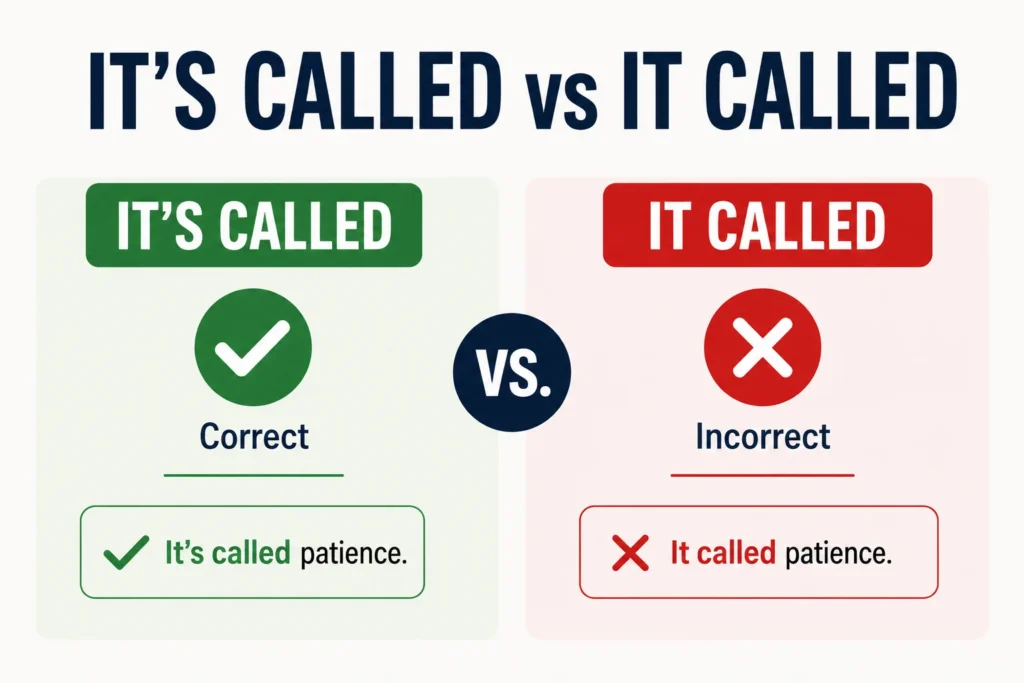
If you’ve ever paused over “it’s called” and “it called,” you’re dealing with a small spelling difference that creates a big grammatical change. The two expressions share the word called, but they do not perform the same job in a sentence. When you’re giving something a name, the standard expression is “it’s called,” which means “it is called.” When “it called” appears without the apostrophe, called usually functions as a past-tense verb, meaning that it acted such as telephoning, making a sound, or calling for someone. That distinction becomes much easier once you look at the structure instead of memorizing a single rule. This guide breaks down the grammar, explains when each form works, shows common mistakes, and gives practical tests you can use whenever you’re unsure.
It’s Called vs It Called: The Quick Difference
The fastest way to understand “it’s called vs it called” is to ask what you’re trying to say.
If you’re naming or identifying something, use “it’s called.”
It’s called a smartphone.
Here, it means it is, so the complete sentence is:
It is called a smartphone.
If you’re saying that something acted of calling in the past, use “it called.”
It called me yesterday.
Here, called is the past tense of call. The sentence means that something or someone telephoned me.
The difference looks tiny on the page, but the grammar underneath is completely different.
| Expression | Full structure | Main purpose | Example |
| It’s called | It is + called | Naming or identifying | It’s called a tablet. |
| It called | It + called | Describing a past action | It called me yesterday. |
| It is called | It + is + called | Naming or identifying | It is called a tablet. |
| It calls | It + calls | Describing a present or repeated action | It calls every morning. |
So, if someone asks, “What is this?”, you might answer, “It’s called a stapler.” If someone asks what happened yesterday and you say, “It called me,” you’re describing an event rather than giving something a name.
That is the central rule. Everything else follows from it.
What Does “It’s Called” Mean?
“It’s called” is the contracted form of “it is called.” The apostrophe matters because it shows that letters have been omitted from the contraction. In this case, it’s represents it is.
Consider this sentence:
It’s called a compass.
Expand the contraction:
It is called a compass.
Nothing about the meaning changes. The shorter version simply sounds more natural in ordinary conversation and informal writing.
You use “it’s called” when you want to tell someone the name, label, title, or established term for something. The thing could be almost anything: an object, place, food, animal, language, process, method, product, song, movie, or idea.
For example:
- It’s called a telescope.
- It’s called Spanish.
- It’s called photosynthesis.
- It’s called a cappuccino.
- It’s called artificial intelligence.
- It’s called the Eiffel Tower.
- It’s called a deadline.
- It’s called a palindrome.
Each sentence answers essentially the same question:
What is it called?
The subject changes, but the naming structure stays the same.
The Basic Pattern of “It’s Called”
A useful pattern to remember is:
It’s called + name or term.
For example:
It’s called a bicycle.
Or:
It’s called the Blue House.
Or:
It’s called machine learning.
You can also use a specific noun phrase before the expression:
This process is called evaporation.
The shorter conversational version might be:
It’s called evaporation.
The important point is that called does not work alone here. It appears with the helping verb is, which is represented by the apostrophe in it’s.
Why “It’s Called” Works for Naming
There’s an interesting grammatical reason English naturally uses this construction. In “It’s called a smartphone,” the thing being discussed receives the name. It doesn’t perform the naming action.
Compare these two sentences:
People call it a smartphone.
It is called a smartphone.
The first sentence uses an active structure. People act as the ones doing the calling.
The second uses a passive structure. It receives the action.
In everyday English, the passive version becomes:
It’s called a smartphone.
That makes “it’s called” especially useful when the identity or name matters more than who gave it that name. Grammar references likewise describe this as a present passive construction built from is + past participle.
What Does “It Called” Mean?
Now remove the apostrophe:
It called.
The grammatical picture changes.
Here, it functions as the subject, and called functions as a simple past verb. The sentence says that it acted in the act of calling.
For example:
It called me yesterday.
That means:
It telephoned me yesterday.
The word called can carry several meanings depending on the context. It might refer to making a telephone call, producing a vocal sound, summoning someone, or directing a call toward someone.
Consider these examples:
- The machine called the number automatically.
- The bird called from the tree.
- The dog called for attention.
- The alarm system called the emergency number.
- It called me twice yesterday.
- The owl called during the night.
- The child called for his mother.
In every example, called describes an action.
That’s why “it called” isn’t simply a misspelled version of “it’s called.” The two expressions have different grammatical structures.
When “It Called” Is Correct
It would be misleading to say that “it called” is always wrong. It isn’t.
The expression can be perfectly grammatical when it genuinely performs a calling action.
For example:
The automated system detected the problem. It called the support number.
Here, the system acts.
Likewise:
The owl flew into the tree, then it called several times.
The owl makes a sound, so called describes what it did.
The context determines the meaning.
The Structure of “It Called”
A simple way to break the sentence down is:
It + called + object
Take:
It called me.
- It = subject
- called = past-tense verb
- me = object
Now compare:
It’s called a modem.
- It = subject
- is = helping verb
- called = past participle
- a modem = name or label
That side-by-side comparison reveals why the expressions cannot replace each other.
It’s Called vs It Called: The Main Grammar Difference
The heart of the “it’s called vs it called” question is the difference between a passive naming structure and an active past-tense action.
| Feature | It’s called | It called |
| Expanded form | It is called | No contraction |
| Main verb structure | is + called | called |
| Voice | Passive | Active |
| Tense | Present passive | Simple past |
| Main function | Names or identifies | Describes an action |
| Typical question | What is it called? | What did it call? |
| Example | It’s called a drone. | It called me yesterday. |
“It’s Called” Identifies Something
Suppose you find an unfamiliar kitchen tool.
You ask:
What is this called?
Someone answers:
It’s called a whisk.
The speaker isn’t describing an action performed by the whisk. They’re giving you its name.
The same pattern works with technical vocabulary:
What is this process called?
It’s called photosynthesis.
Or with a cultural term:
What is that type of architecture called?
It’s called Brutalism.
The phrase introduces terminology.
“It Called” Describes Something That Happened
Now imagine your phone rings.
Later, someone asks:
What happened this morning?
You might say:
It called me three times.
Here, called refers to an event that already happened.
The distinction becomes obvious if you substitute another verb:
It called me.
→ It telephoned me.
That substitution works.
But:
It’s called a smartphone.
→ It is named a smartphone.
That substitution reveals the naming function.
Active vs Passive: Why It Matters
Active and passive voice can sound like technical grammar terms, but the concept is straightforward.
In an active sentence, the subject acts:
People call this device a router.
In the passive version, the focus moves to the device:
This device is called a router.
In conversational English:
It’s called a router.
The passive structure lets you focus on the thing being named rather than the person or group that gives it that name. That’s why “it’s called” fits naturally when you identify terms and labels.
By contrast:
It called me.
has no passive structure. It acts.
Why “It’s” and “Its” Cause So Much Confusion
The apostrophe in it’s creates another common problem because its is also a real English word.
But the two words have different jobs.
It’s is a contraction meaning it is or it has.
Its shows possession or association.
For example:
It’s called a tablet.
means:
It is called a tablet.
But:
The tablet lost its connection.
Here, its tells us that the connection belongs to or is associated with the tablet.
The “It Is” Test
The easiest test is to expand it’s.
If the sentence still makes sense with it is, use it’s.
It’s called a tablet.
Expand it:
It is called a tablet.
Correct.
Try another:
It’s expensive.
→ It is expensive.
Correct.
Now look at:
The company changed its name.
Replace its with it is:
The company changed it is name.
That doesn’t work.
So its is correct because the sentence expresses possession or association.
Why “Its Called” Is Incorrect for Naming
One of the most common mistakes is:
❌ Its called a smartphone.
The intended sentence is:
✅ It’s called a smartphone.
Why?
Because the intended meaning is:
It is called a smartphone.
The word its cannot stand in for it is. It is a possessive form.
A useful rule is:
it’s = it is / it has
its = belonging to it
The National Laboratory of the Rockies gives the same basic distinction: it’s is a contraction, while its is the possessive form and does not take an apostrophe.
“It’s Called” vs “It Is Called”
Both forms are correct:
It’s called a tablet.
It is called a tablet.
The difference is style rather than meaning.
“It’s called” sounds relaxed and natural. You’ll hear it frequently in conversation, explanations, emails, articles, and ordinary writing.
“It is called” sounds more deliberate because the contraction has been expanded. That can make it useful when you want a more formal or emphatic tone.
For example:
The process is commonly known as osmosis.
Or:
It is called osmosis.
In formal writing, the full form can sometimes fit the surrounding tone better. However, there’s no universal grammar rule saying that “it’s called” is incorrect in formal writing. The choice depends on the style and context.
Full Form vs Contraction
| Form | Meaning | Typical feel |
| It’s called | It is called | Conversational, natural |
| It is called | It is called | More deliberate or formal |
| It was called | It was called | Past naming |
| It used to be called | It previously had that name | Former naming |
Notice that changing is to was changes the time reference:
It is called New Town.
This means that is its current name.
It was called New Town.
This places the name in the past.
That distinction becomes useful when discussing historical names, renamed organizations, former titles, or older terminology.
“What’s It Called?” vs “What Is It Called?”
If you’re asking someone for the name of something, both of these are correct:
What’s it called?
What is it called?
Here, what’s means what is.
The expanded question is:
What is it called?
The contracted version is:
What’s it called?
The meaning remains the same.
Why “What Is It Called?” Works
The structure is:
What + is + it + called?
You’re asking for the name or term associated with something.
For example:
I found this strange kitchen tool. What is it called?
Answer:
It’s called a mandoline.
Or:
There’s a word for that feeling. What is it called?
Answer:
It’s called nostalgia.
This question-and-answer pattern is one of the most natural ways to see the relationship between the two expressions.
Why “How Is It Called?” Doesn’t Work
English learners sometimes use:
❌ How is it called?
when they mean:
✅ What is it called?
The problem is that what asks for the identity or name, while how generally asks about manner, method, or means.
Compare:
What is it called?
You want the name.
How is it made?
You want the method.
How is it used?
You want the manner of use.
That’s why “What is it called?” is the standard English question when you want to know a name.
Common Mistakes With “It’s Called” and “It Called”
Small errors become much easier to fix when you understand the pattern behind them.
Leaving Out “Is”
Incorrect:
❌ It called a smartphone.
Correct:
✅ It’s called a smartphone.
Or:
✅ It is called a smartphone.
If you’re naming something, you need the is + called structure.
Confusing “It’s” With “Its”
Incorrect:
❌ Its called a smartphone.
Correct:
✅ It’s called a smartphone.
Remember that its shows possession.
Assuming “It Called” Is Always Wrong
This is the opposite mistake.
It called me yesterday.
That’s grammatically valid if it refers to something capable of making a call.
Likewise:
The bird called from the roof.
Here, the bird made a sound.
The issue isn’t the phrase itself. The issue is whether the sentence communicates the intended meaning.
Using “What It Called”
When asking for a name, don’t leave out the helping verb.
Incorrect:
❌ What it called?
Correct:
✅ What is it called?
The auxiliary verb is necessary to form the standard question.
Using “How Is It Called?”
Incorrect:
❌ How is it called?
Correct:
✅ What is it called?
Or:
✅ What do you call it?
The second alternative is particularly natural in conversation.
When “It Called” Can Be Correct
Because the phrase is often presented as an error, it’s worth looking at its legitimate uses more closely.
Telephone Calls
The phone rang, and it called the backup number.
Here, called means made a telephone call.
A more natural version might be:
The system called the backup number.
The important point is grammatical rather than stylistic: the subject acts.
Animal Sounds
The owl called from the forest.
If you use it after establishing the owl as the subject:
It called from the forest.
Again, called describes a sound.
Calling for Someone
The child called for his mother.
With a suitable antecedent:
It called for its owner.
The meaning depends entirely on context.
Automated Systems
Modern technology also creates situations where it called can occur naturally:
The security system detected smoke, then it called the monitoring center.
Here, the machine or system acts.
This is why saying that “it called” is always incorrect would be inaccurate. It can be grammatical. It simply doesn’t normally mean “it is called.”
Real-Life Examples of “It’s Called”
The naming construction appears across nearly every area of English.
Everyday Objects
It’s called a stapler. It’s called a measuring cup. It’s called a flashlight.
You’re identifying an object by name.
Food
It’s called ramen. It’s called paella. It’s called sourdough.
The structure remains unchanged even when the noun refers to food.
Science
It’s called photosynthesis. It’s called evaporation. It’s called gravitational force.
In technical writing, the same construction introduces terminology.
Technology
It’s called cloud storage. It’s called two-factor authentication. It’s called machine learning.
These examples show why the phrase is so useful: “it’s called” doesn’t belong to one subject area. It works whenever you need to identify a name or term.
Places and Landmarks
It’s called the Grand Canyon. It’s called Central Park.It’s called the Eiffel Tower.
Again, you’re identifying rather than describing an action.
A Practical Case Study: Fixing the Sentence in Context
Imagine an English learner writes:
This process is called evaporation.
At first glance, the problem might seem to be the word called. It isn’t.
The real problem is the missing form of be.
The intended meaning is:
This process is called evaporation.
Or, in a different sentence structure:
It’s called evaporation.
Now imagine another sentence:
The machine it called the emergency number.
This one has a different problem. If the machine acted, the sentence should be:
The machine called the emergency number.
No is is necessary because called is the main past-tense verb.
This comparison reveals an important editing principle: don’t correct a sentence by looking only at the word “called.” Look at what grammatical job the word performs.
A Simple Memory Trick That Actually Works
You don’t need to memorize a complicated grammar chart.
Use three quick questions.
Are You Naming Something?
If yes:
It’s called.
Example:
It’s called a kayak.
Did Something Perform a Calling Action?
If yes:
It called.
Example:
It called me yesterday.
Are You Showing Possession?
If yes:
Its.
Example:
The kayak lost its paddle.
This creates a simple mental map:
| Meaning | Correct form |
| Name or label | It’s called |
| Past calling action | It called |
| Possession | Its |
| Full naming form | It is called |
If you remember only one thing, remember this:
Name? → It’s called. Action? → It’s called. Possession? → Its.
It’s Called vs It Called: Quick Practice
Try choosing the correct form before checking the answers.
Practice Sentences
- This tool is unfamiliar. _____ a torque wrench.
- The phone rang earlier. _____ me twice.
- The cat moved _____ tail.
- What is this process called? _____ photosynthesis.
- The automated system detected the problem. _____ the support line.
- What do you call this type of fabric? _____ linen.
Answers
| Sentence | Answer | Why |
| This tool is unfamiliar. | It’s called a torque wrench. | You’re naming the tool. |
| The phone rang earlier. | It called me twice. | It performed the calling action. |
| The cat moved | its tail. | The word shows possession. |
| What is this process called? | It’s called photosynthesis. | You’re identifying a name. |
| The system detected a problem. | It called the support line. | The system acted. |
| What do you call this fabric? | It’s called linen. | You’re identifying the term. |
This kind of practice works because it makes you focus on meaning and sentence structure, not just spelling.
A Closer Look at “Called”
The word called creates much of the confusion because English uses the same form in several grammatical situations.
In:
It’s called a camera.
called is the past participle used with is to form a passive construction.
In:
It called me yesterday.
called is the simple past tense of call.
The spelling doesn’t change.
The surrounding grammar does.
That’s a useful lesson beyond this particular phrase. English often relies on the words around a verb to reveal its grammatical role.
Compare:
The package was delivered.
Here, delivered works with was in a passive construction.
The courier delivered the package.
Here, delivered is the simple past.
The same basic contrast helps explain:
It is called a camera.
versus:
It called me.
The helping verb is doing important grammatical work.
Why the Apostrophe Matters
An apostrophe can look insignificant, especially in quick writing. Here, however, it carries real grammatical information.
In:
it’s
The apostrophe signals omitted letters from it is or it has.
So:
it is → it’s
and:
it has → it’s
But:
its
is not a contraction.
It is a possessive form.
That means the apostrophe isn’t merely decorative punctuation. It tells you what grammatical structure you’re looking at.
Consider:
It’s raining.
→ It is raining.
But:
The company changed its policy.
The second sentence expresses possession or association.
This is why proofreading “its called” deserves attention. If you mean “it is called,” the apostrophe is essential.
“It’s Called” in Everyday Conversation vs Formal Writing
English speakers use contractions constantly in ordinary conversation.
You might hear:
What’s it called?
It’s called a pressure cooker.
That exchange sounds completely natural.
In a more formal report, you might instead write:
The device is called a pressure cooker.
Or:
It is called a pressure cooker.
The choice depends on the surrounding style.
More Conversational
What’s it called?
It’s called a pressure cooker.
More Formal
What is it called?
It is called a pressure cooker.
Neither version changes the underlying grammar.
A contraction doesn’t make the sentence grammatically inferior. It simply creates a shorter form. In polished writing, the best choice is the one that matches your audience, tone, and publication style.
Formal Alternatives to “It’s Called”
Sometimes you don’t want to repeat “it’s called” throughout an article. English gives you several alternatives.
“It Is Known As”
It is known as the Industrial Revolution.
This can sound slightly more formal and works well when discussing established names or labels.
“It Is Referred To As”
It is referred to as a control variable.
This is common in academic and technical writing.
“The Term for This Is”
The term for this is confirmation bias.
This directly introduces terminology.
“People Call It”
People call it a shortcut.
This uses an active structure instead of the passive.
The best option depends on what you want to emphasize. If the name itself is the focus, “it’s called” remains one of the clearest and most natural choices.
A Useful Comparison: “People Call It” vs “It’s Called”
These two sentences communicate nearly the same basic information:
People call it a smartwatch.
It’s called a smartwatch.
The difference is focus.
In the first sentence, people are the subject and perform the naming action.
In the second, it becomes the focus and receives the name.
That makes the passive version especially convenient when the person doing the naming isn’t important.
You don’t usually need to say:
Engineers call it a gyroscope.
when your real point is simply:
It’s called a gyroscope.
The second sentence gets to the name faster.
Why Context Matters More Than the Apostrophe Alone
It’s tempting to think the entire rule is simply:
Apostrophe = correct. No apostrophe = incorrect.
That’s too simplistic.
The real distinction comes from meaning and grammatical function.
Consider:
It’s called every morning.
That doesn’t naturally communicate a name. The contraction may be grammatically possible in another context, but the sentence needs more information.
Now consider:
It called every morning.
This could describe something that made a call every morning.
The words themselves don’t determine the meaning in isolation. Context completes the grammar.
That’s why good editing looks at the entire sentence rather than correcting punctuation mechanically.
It’s Called vs It Called: A Final Quick Reference
| If you want to… | Use | Example |
| Give something a name | It’s called | It’s called a kayak. |
| Give something a name formally | It is called | It is called a kayak. |
| Describe a past calling action | It called | It called me last night. |
| Show possession | Its | The kayak lost its paddle. |
| Ask for a name | What is it called? | What is it called? |
| Ask casually for a name | What’s it called? | What’s it called? |
| Ask what someone calls something | What do you call it? | What do you call it? |
The One-Line Rule
Use “it’s called” when you’re naming something, and use “it called” when “it” acted of calling in the past.
If you’re still unsure, apply the two-part test:
Can “it’s” become “it is”?
If yes, it’s is probably right.
Then ask:
Is “called” describing an action that it performed?
If yes, it called may be right.
These two questions solve most cases quickly.
The important takeaway isn’t simply to memorize that one form is “correct” and the other is “wrong.” “It’s called” and “it called” are correct in different grammatical situations. When you’re identifying a name, term, label, or title, “it’s called” is the natural choice. When a subject actually performed a calling action in the past, “it called” can be completely grammatical. Once you recognize whether you’re talking about a name or an action, the distinction becomes much easier to use accurately.
It’s Called vs It Called: The Grammar Difference in Real Sentences
The biggest mistake with “it’s called” vs “it called” is treating them as two spellings of the same expression. They aren’t. The apostrophe in it’s represents the missing letters in it is, while it called contains the ordinary past-tense verb called. That small distinction changes the entire sentence structure.
What Does “It Called” Mean?
“It called” can be completely correct English when it acts calling. In this structure, called works as the simple past tense of the verb call. The sentence therefore describes something that happened in the past rather than giving a name to something.
For example:
The alarm detected a problem, and it called the emergency number.
Here, the alarm acts. You could replace called with contacted or phoned without changing the basic idea:
The alarm detected a problem, and it contacted the emergency number.
The expression can also describe sounds or cries:
The owl flew into the tree, and it called several times.
In this sentence, called doesn’t mean “was named.” It describes a sound made by the owl.
Common Meanings of “Called”
The verb call has several meanings, so it called can appear in different situations.
- Telephoned: It called me yesterday.
- Made a sound: The bird called from the forest.
- Shouted: It called across the room.
- Summoned: The system called for assistance.
- Contacted: The device called the monitoring center.
- Requested action: The report called for immediate changes.
Context tells you which meaning applies.
That’s why the statement “it called is always wrong” isn’t accurate. The expression can be grammatical when it genuinely performs an action associated with call. The real problem occurs when someone uses it called to mean “it is called.”
When Is “It Called” Grammatically Correct?
The easiest way to recognize a correct use is to identify the subject.
Ask yourself:
Is “it” doing the calling?
If the answer is yes, it called may be exactly what you need.
Consider these examples:
The automated system received the request. It called the customer.
The bird heard another bird nearby. It called back.
The phone was on the desk. It called twice before anyone answered.
The security device detected smoke. It called the monitoring center.
Each sentence describes an action that happened in the past.
“It Called” With a Phone or Device
Modern technology gives us plenty of situations where this construction makes sense.
For example:
The backup system detected the failure and called the administrator.
You could also write:
The backup system detected the failure. It called the administrator immediately.
Here, it refers to the backup system. The system acts, so called the main past-tense verb.
The same principle applies to automated services, communication systems, smart devices, and other technologies that can initiate calls.
“It Called” With Animals
Animals provide another useful example.
The dog heard its owner and called from the yard.
After establishing that the dog is the subject:
It called from the yard.
Again, the animal acts.
The same pattern works with birds:
The crow landed on the branch. It called loudly.
Here, called means the bird made a vocal sound.
This context is important because it doesn’t always refer to an inanimate object. English can use it for animals when the animal’s sex isn’t specified or isn’t relevant.
“It Called” in a Past-Time Context
The simple past often appears alongside time expressions such as:
- yesterday
- last night
- earlier
- this morning
- two hours ago
- last week
- a few minutes ago
- before lunch
For example:
It called me yesterday. It called twice this morning.It called again a few minutes ago. These time markers reinforce the idea that called describes a completed past action.
Why “It Called” Doesn’t Mean “It Is Called”
This is where the confusion usually begins.
Suppose someone wants to say:
It is called a telescope.
They might accidentally write:
❌ It called a telescope.
But removing is doesn’t create a shorter version of the original sentence. It creates a different grammatical structure.
Compare the two:
It’s called a telescope.
It called me yesterday.
The first sentence identifies a name.
The second reports an action.
The missing apostrophe isn’t a minor punctuation issue. It contains the helping verb is, while it is followed by called, not does.
Look at the Structure
It’s called:
It + is + called + name
Example:
It’s called a telescope.
It called:
It + called + object
Example:
It called me.
The first structure uses called as a past participle in a passive construction. The second uses called as a simple past verb.
Once you see those structures, the distinction becomes much easier to remember.
“It’s Called” Is a Passive Construction
There’s a deeper grammar point behind “it’s called.”
Consider:
People call this device a scanner.
This is an active sentence because people act as the ones doing the calling.
Now shift the focus to the device:
This device is called a scanner.
That is a passive construction. The device receives the naming action.
In conversational English, you can shorten the sentence:
It’s called a scanner.
The complete structure is:
It is called a scanner.
This explains why “it’s called” works so naturally when you’re identifying a name, term, title, or label. The thing being discussed receives the name rather than performing the naming action.
Active and Passive Side by Side
| Active construction | Passive construction |
| People call it a scanner. | It is called a scanner. |
| Scientists call it photosynthesis. | It is called photosynthesis. |
| Engineers call it a safety valve. | It is called a safety valve. |
| People call it a shortcut. | It is called a shortcut. |
The passive version becomes especially useful when who gave the name isn’t important.
You usually care about the name itself:
It’s called photosynthesis.
You don’t necessarily need to identify the people who use that term.
Why “It Called” Is an Active Past-Tense Structure
Now compare that passive construction with:
It called me.
Here, it doesn’t receive an action. It performs one.
The structure is straightforward:
Subject + past-tense verb + object
In:
It called me.
It is the subject, called is the verb, and me is the object.
That means the sentence describes something that it did.
You can test this by changing the verb: It called me.It contacted me.It phoned me.It texted me.
The sentence remains an action statement.
Now try the same test with:
It’s called a smartphone.
Replacing called with contacted doesn’t work:
❌ It is contacted a smartphone.
Instead, the sentence means:
It is named a smartphone.
That is a completely different relationship.
It’s Called vs It Called: A Detailed Comparison
| Feature | It’s called | It called |
| Full form | It is called | It called |
| Main structure | It + is + called | It + called |
| Verb form | Past participle with is | Simple past |
| Voice | Passive | Active |
| Main purpose | Naming or identifying | Describing an action |
| Time reference | Present identification | Completed past action |
| Typical meaning | “It is named…” | “It phoned/made a call…” |
| Example | It’s called a modem. | It called me yesterday. |
This comparison gives you a reliable shortcut.
If you’re answering “What is its name?”, think it’s called.
If you’re explaining “What did it do?”, think it called.
The Apostrophe Changes the Grammar
An apostrophe may look like a tiny punctuation mark, but contractions depend on it.
It’s is a contraction of it is or it has. In “it’s called,” the intended expansion is “it is called.”
So:
It’s called a camera.
becomes:
It is called a camera.
The sentence remains complete.
Without the apostrophe:
It called a camera.
The reader sees it as a pronoun and called as a past-tense verb.
That sentence could theoretically be grammatical in a very different context, but it doesn’t mean “it is called a camera.”
This is why you shouldn’t think of the apostrophe as an optional punctuation mark. It represents missing grammatical material.
What Happens When You Remove “Is”?
Consider this sentence:
It is called a bicycle.
Now remove is:
It called a bicycle.
You’ve changed the sentence from a passive naming structure into an active past-tense structure.
The original means:
The thing has the name “bicycle.”
The second suggests:
The thing acted of calling a bicycle.
That second interpretation might be grammatically possible in an unusual context, but it doesn’t communicate the intended naming meaning.
This is a useful lesson for English learners: removing a helping verb can completely change a sentence’s grammar.
Small words often carry more grammatical weight than they appear to.
“It’s Called” vs “It Called” in Questions
Questions make the distinction even clearer.
If you want to ask for the name of something, say:
What is it called?
or:
What’s it called?
The answer naturally becomes:
It’s called a microscope.
The question and answer fit together perfectly.
Asking for a Name
What is it called?
It’s called a compass.
Asking About a Past Action
If you’re asking what something did, the question changes:
What did it call?
The answer might be:
It called the emergency number.
Or:
Who did it call?
It called the manager.
Notice that the question changes because the meaning changes.
You aren’t asking for a name anymore. You’re asking about an action.
“What Is It Called?” vs “What Did It Call?”
These two questions look similar, but they test completely different grammar.
| Question | What you’re asking | Possible answer |
| What is it called? | What is its name? | It’s called a telescope. |
| What did it call? | What did it contact or summon? | It called the emergency line. |
| Who did it call? | Whom did it contact? | It called the manager. |
| What did they call it? | What name did they give it? | They called it a prototype. |
The distinction becomes almost impossible to miss when you put the questions side by side.
Why “How Is It Called?” Is Not the Standard Question
Another related error is:
❌ How is it called?
When asking for a name, standard English uses what, not how:
✅ What is it called?
You can also say:
✅ What do you call it?
The reason is simple. What asks for the identity or name of something. How generally asks about a method, manner, or process.
Compare:
What is it called? → asks for a name.
How is it made? → asks about a process.
How is it used? → asks about the method of use.
This distinction matters because direct translations from another language can sometimes produce “How is it called?”, even though English normally uses “What is it called?” for this purpose.
Common Errors With “It Called”
Let’s look at the mistakes that cause the most trouble.
Using “It Called” to Give a Name
Incorrect:
❌ It called a smartphone.
Correct:
✅ It’s called a smartphone.
The intended meaning is “It is called a smartphone.”
Writing “Its Called”
Incorrect:
❌ Its called a smartphone.
Correct:
✅ It’s called a smartphone.
Here, its cannot represent it is.
The apostrophe matters.
Dropping the Helping Verb
Incorrect:
❌ It called photosynthesis.
Correct:
✅ It’s called photosynthesis.
The missing is is what breaks the intended naming structure.
Assuming Every “It Called” Sentence Is Wrong
Incorrect assumption:
❌ “It called” is never grammatical.
Better understanding:
“It called” is grammatical when “it” acts calling.
For example:
The automated system called me.
Or:
It called me later.
The phrase becomes incorrect only when you’re trying to use it as a substitute for “it is called.”
A Real-World Editing Example
Imagine a technical article contains this sentence:
The security process is called two-factor authentication.
A careful editor wouldn’t simply focus on the word called. The editor would examine the sentence structure.
The intended sentence is:
The security process is called two-factor authentication.
Or, if the context allows:
It’s called two-factor authentication.
Now consider:
The security system detected unusual activity, and it called the administrator.
That sentence is different. Here, the system acactually acts onThe security system called the administrator.
No is belongs before called.
This is why context matters more than memorizing a mechanical correction. The correct form depends on whether called identifies something or describes something the subject did.
“It Called” Can Also Describe a Request
The verb call doesn’t always mean making a telephone call.
For example:
The report called for immediate action.
If you replace the subject with it after the context is clear:
It called for immediate action.
Here, called for means demanded, requested, or required.
Another example:
The situation became serious, and it called for a different approach.
This sentence is perfectly grammatical.
However, notice that called for has a specific phrasal meaning. It still doesn’t mean “was called.”
This distinction demonstrates why you should read the whole phrase rather than judge called in isolation.
“It Called” vs “It Calls”
There’s another useful comparison:
It called me yesterday.
It calls me every day.
The first uses the simple past.
The second uses the simple present.
| Form | Tense | Example |
| It calls | Simple present | It calls every morning. |
| It called | Simple past | It called yesterday. |
| It is calling | Present progressive | It is calling now. |
| It has called | Present perfect | It has called three times. |
These forms describe actions rather than names.
Compare all of them with:
It’s called a smart assistant.
Here, called belongs to a passive naming structure rather than a simple active verb.
A Simple Test for Choosing the Right Form
When you’re unsure, don’t stare at the apostrophe. Ask what you mean.
Test One: Can You Say “It Is”?
Try expanding it’s.
It’s called a telescope.
→ It is called a telescope.
It works.
So it’s called is correct.
Test Two: Are You Giving a Name?
Ask:
Am I telling someone what this thing is named?
If yes, use:
It’s called…
For example:
It’s called a sundial.
Test Three: Did “It” Perform the Action?
Ask:
Did it actually call someone or make a call?
If yes, it called may be correct.
For example:
It called me after dinner.
Test Four: Can You Replace “Called” With “Phoned”?
If you can naturally replace called with phoned, you’re probably describing an action.
It called me.
→ It phoned me.
But:
It’s called a phone.
→ It is phoned a phone. ❌
That test quickly exposes the difference.
Quick Practice: Choose “It’s Called” or “It Called”
Try these before reading the answers.
- This device has a special name. _____ a barcode scanner.
- The machine detected an error. _____ the technician.
- I don’t recognize this process. What _____?
- The bird flew away, then _____ from the tree.
- This technique has a specific term. _____ active listening.
- The system detected smoke and _____ the emergency center.
Answers
- It’s called a barcode scanner.
- It called the technician.
- What is it called?
- It called from the tree.
- It’s called active listening.
- It called the emergency center.
The pattern is consistent: names take “it’s called,” while past calling actions take “it called.”
The Most Important Distinction to Remember
The easiest way to remember “it’s called vs it called” is to stop thinking about spelling and start thinking about function.
When called helps identify a name:
It’s called a telescope.
When called describes something the subject did:
It called me yesterday.
The first sentence answers:
What is its name?
The second answers:
What did it do?
That’s the real dividing line.
Apostrophes matter, but meaning comes first. Once you understand the grammatical job each phrase performs, choosing between “it’s called” and “it called” becomes far more straightforward.
It’s vs Its: The Apostrophe Makes a Difference
One of the most common mistakes involving “it’s called” isn’t actually about called. It’s about confusing it’s with its.
These two words have different grammatical functions:
| Word | Meaning | Example |
| it’s | it is,, or it has | It’s called a tablet. |
| its | belonging to or associated with it | The tablet lost its connection. |
The simplest rule is remarkably effective:
It’s = it is / it has
Its = possessive
So when you write:
It’s called a tablet.
you can expand it to:
It is called a tablet.
The sentence still works perfectly.
Now try the same test with:
The tablet lost its connection.
Replace its with it is:
The tablet lost it is connection.
That doesn’t work. The sentence needs a possessive word because the connection belongs to or relates to the tablet.
Why “Its Called” Is Usually Wrong
Suppose you’re introducing the name of an object:
❌ Its called a smartwatch.
The correct version is:
✅ It’s called a smartwatch.
The intended meaning is “It is called a smartwatch.” Therefore, the contraction requires an apostrophe.
This mistake happens frequently because its and it’s sound almost identical when people speak quickly. Writing removes that sound-based clue, so you have to rely on grammar instead.
A Quick “It Is” Test
Whenever you’re uncertain, mentally replace it’s with it is.
It’s called a pressure cooker.
→ It is called a pressure cooker. ✔
It’s difficult to explain.
→ It is difficult to explain. ✔
It’s been repaired.
→ It has been repaired. ✔
But:
The company changed its name.
→ The company changed its name. ✘
That quick substitution test works in a surprising number of situations.
It’s Called vs It Is Called
Another related question concerns the difference between “it’s called” and “it is called.”
There is no difference in basic meaning.
It’s called a telescope.
and:
It is called a telescope.
Both mean:
It has the name “telescope.”
The difference comes from style and emphasis.
When “It’s Called” Sounds Natural
In ordinary conversation, it’s called is often the most natural choice.
What’s that tool called?
It’s called a torque wrench.
The contraction keeps the exchange relaxed and conversational.
You might also use it in general explanatory writing:
This type of storage is called cloud storage.
Or:
It’s called cloud storage because the data is stored on remote servers.
The contraction doesn’t make the grammar less correct.
When “It Is Called” May Be Better
The full form can sound more deliberate.
For example:
The structure is called a double helix.
Or:
It is called a double helix.
A writer might choose the expanded form when the surrounding prose has a formal tone or when it deserves emphasis.
Consider:
It isn’t simply a temporary measure. It is called a long-term intervention.
The full form gives it more weight.
So the choice isn’t really about correctness. It’s about tone, rhythm, emphasis, and context.
What’s It Called vs What Is It Called?
If you’re asking someone to identify a name, you’ll often hear either:
What’s it called?
or:
What is it called?
Both are correct.
Here, what’s means what is.
“What’s It Called?”
This version sounds especially natural in conversation.What’s this tool called?What’s that song called?What’s the process called?What’s this type of fabric called?It’s concise and easy to say.
“What Is It Called?”
The expanded version is equally grammatical:What is this tool called?What is that song called?What is the process called?The difference is mainly one of style and emphasis.
A useful pairing is:
Question: What’s it called?
Answer: It’s called a telescope.
Or:
Question: What is it called?
Answer: It is called a telescope.
The question and answer mirror each other naturally.
What Do You Call It? Another Natural Alternative
English gives you another common way to ask for a name:
What do you call it?
This is often very natural in conversation.
For example:
I’ve never seen this kitchen tool before. What do you call it?
It’s called a zester.
The two sentences use different grammatical structures, but they perform the same communicative job.
Compare:
| Question | Meaning |
| What is it called? | What is its name? |
| What’s it called? | What is its name? |
| What do you call it? | What name do people use for it? |
This gives you flexibility without changing the underlying idea.
Why “How Is It Called?” Sounds Unnatural
English learners sometimes say:
❌ How is it called?
when they want to ask for a name.
Standard English normally uses:
✅ What is it called?
or:
✅ What do you call it?
The distinction comes from the meaning of what and how.
What asks about identity, information, or a thing.
How usually asks about manner, method, condition, or process.
Compare:
What is it called?
I want the name.
How is it made?
I want the method.
How is it used?
I want to know the way it works.
How did it happen?
I want to know the manner or circumstances.
That makes “what is it called?” the natural choice when the answer should be a name or term.
It’s Called vs It Was Called
Time also changes the structure.
Compare:
It’s called Riverstone.
It was called Riverstone.
The first normally presents the name as current.
The second places the name in the past.
For example:
The building is called City Hall.
This tells the reader what the building is currently called.
But:
The building was called City Hall.
This suggests that the name belonged to an earlier period.
You can also use:
It used to be called City Hall.
That makes the former name meaning even clearer.
Naming Across Different Time Periods
| Expression | Time or meaning |
| It’s called | Current name |
| It was called | Name used in the past |
| It used to be called | Former name |
| It has been called | Name used at some point or repeatedly over time |
| It will be called | Future name |
For example:
The neighborhood used to be called East Village.
This is different from:
The neighborhood is called East Village.
The first refers to an earlier name. The second identifies the current name.
It’s Called vs It Is Known As
Sometimes “it’s called” isn’t the only appropriate phrase.
You can also say:
It is known as a watershed moment.
or:
It is referred to as a watershed moment.
These alternatives can be useful when you want a slightly different tone.
| Expression | Typical use |
| It’s called | General naming and everyday explanation |
| It is called | Naming with a more deliberate tone |
| It is known as | Established name, reputation, or common designation |
| It is referred to as | Formal, academic, or technical contexts |
| People call it | Active, conversational wording |
| The term for it is | Directly introducing terminology |
For example:
It’s called confirmation bias.
It is known as confirmation bias.
It is referred to as confirmation bias.
All three can identify the same concept. The wording changes the tone and emphasis.
Formal and Informal Use of “It’s Called”
Contractions often appear more frequently in conversational English, but that doesn’t mean they’re automatically inappropriate in serious writing.
Consider a general explanation:
This pattern is called parallel structure.
That’s perfectly suitable for educational writing.
In a more conversational explanation, you might write:
You might see this pattern in several places. It’s called parallel structure.
The second version speaks directly to the reader and creates a lighter rhythm.
The important factor is consistency. If your writing uses a highly formal style throughout, you may prefer fewer contractions. If you’re writing an accessible guide, contractions can make the explanation sound more natural.
Common Sentence Patterns With “It’s Called”
Learning a few reliable patterns can make the phrase much easier to use.
Pattern: It’s Called + Noun
It’s called a microscope.
This directly identifies an object.
Pattern: It’s Called + Proper Name
It’s called the Pacific Crest Trail.
This identifies a specific place or title.
Pattern: It’s Called + Technical Term
It’s called photosynthesis.
This introduces specialized vocabulary.
Pattern: It’s Called + Adjective/Noun Combination
It’s called a passive construction.
This identifies a grammatical category.
Pattern: What Is It Called?
What is it called?
This asks for the corresponding name.
Pattern: People Call It
People call it a shortcut.
This expresses the same general naming idea through an active construction.
These patterns cover a large share of everyday uses.
Common Sentence Patterns With “It Called”
The structure changes when called becomes the main past-tense verb.
Pattern: It Called + Person
It called me yesterday.
Pattern: It Called + Organization
It called the office before noon.
Pattern: It Called + Number
It called the wrong number.
Pattern: It Called From + Place
It called from the other room.
Pattern: It Called for + Noun
It called for immediate action.
These sentences don’t identify a name. They describe something that happened or a situation that demanded a particular response.
A Practical Case Study: A Confusing Product Description
Imagine a product guide contains this sentence:
This feature is called automatic sync.
The intended meaning is clear, but the grammar isn’t complete.
A polished version would be:
This feature is called automatic sync.
Or:
It’s called automatic sync.
Now imagine the next sentence:
After detecting a problem, it called the support team.
This sentence works because the product or system actually contacted the support team.
The two sentences could appear next to each other:
This feature is called automatic sync. When the system detects a problem, it callsthe support team.
The first sentence names something. The second describes an action.
That contrast is exactly what makes the distinction useful.
A Second Case Study: Classroom Grammar
Consider a teacher explaining a scientific process.
The teacher might say:
What is this process called?
A student answers:
It’s called condensation.
Later, the teacher describes an experiment:
The sensor detected the temperature change, nd it called the laboratory system.
The students hear called twice, but the grammatical roles differ.
In the first example:
It’s called condensation.
The phrase gives a name.
In the second:
It’s called the laboratory system.
The subject acts.
This kind of contrast can help learners understand grammar more effectively than memorizing isolated rules.
How to Choose the Correct Form Quickly
When you’re writing quickly, use this short decision process.
Start With the Meaning
Ask:
Am I giving something a name?
If yes, use:
It’s called…
Example:
It’s called a sundial.
If you’re describing something that performed a calling action, use:
It called…
Example:
It called the manager.
Check the Full Form
If you wrote it’s, expand it mentally:
it is
If the sentence still makes sense, the contraction is probably correct.
It’s called a sundial.
→ It is called a sundial. ✔
Check Whether “Its” Shows Possession
If the word means belonging to it, use its.
The machine changed its settings.
The settings belong to or are associated with the machine.
Check the Verb Tense
If you’re describing a completed action:
It called me yesterday.
If you’re identifying a current name:
It’s called a telephone.
This final check catches many errors.
A Compact Decision Table
| Your intended meaning | Best choice |
| Give something a name | It’s called |
| Give something a name formally | It is called |
| Describe a past calling action | It called |
| Show possession | Its |
| Ask for a name | What is it called? |
| Ask casually for a name | What’s it called? |
| Ask what name people use | What do you call it? |
| Describe a former name | It was called |
| Describe a previous name | It used to be called |
| Use a more formal naming phrase | It is referred to as |
Common Errors and Their Corrections
| Incorrect or confusing form | Better form | Reason |
| ❌ It’s called a camera. | ✅ It’s called a camera. | It means it is. |
| ❌ It called a camera. | ✅ It’s called a camera. | Naming requires is + called. |
| ❌ How is it called? | ✅ What is it called? | What normally asks for the name. |
| ❌ What it called? | ✅ What is it called? | The question needs is. |
| ❌ It’s called me yesterday. | ✅ It called me yesterday. | Called describes a past action. |
| ❌ It called a type of bird. | ✅ It’s called a type of bird. | The intended meaning is identification. |
The key is to correct the meaning and structure together, rather than simply adding or removing an apostrophe.
A Useful Way to Think About the Difference
Think of “it’s called” as a name tag.
A name tag tells you what something is called:
It’s called a compass.
Now think of “it called” as an action report.
An action report tells you what something did:
It called the office.
The word called remains the same, but the surrounding grammar changes its role.
This mental image can be especially useful if you’re learning English and tend to confuse contractions with ordinary verb forms.
Quick Practice: Naming or Action?
Choose the form that fits each sentence.
This tool has a special name. _____ a caliper.
Answer: It’s called a caliper.
The automated service detected the issue. _____ the technician.
Answer: It called the technician.
I’ve never seen this before. What _____?
Answer: What is it called?
The cat heard a noise and _____ from the hallway.
Answer: it called
This grammatical pattern has a specific term. _____ subject-verb agreement.
Answer: It’s called subject-verb agreement.
The company changed _____ policy.
Answer: its
These examples cover the three major forms that confuse: it’s called, it called, and its.
The Grammar Rule in Plain English
You don’t need a long list of technical terms to remember the difference.
Use “it’s called” when you tell someone the name of something.
It’s called a telescope.
Use “it called” when something performed the action of calling in the past.
It called me last night.
Use “its” when you show possession.
The telescope changed its position.
And when you want the expanded version of “it’s called,” write:
It is called a telescope.
That simple distinction handles most everyday examples.
It’s Called vs It Called: What to Check Before You Write
Before choosing between the two expressions, run through these questions:
- Am I giving a name or label? → It’s called
- Did “it” perform a calling action? → It called
- Can I expand “it’s” to “it is”? → If yes, it works.
- Does the word show possession? → Use its.
- Am I asking for a name? → What is it called?
- Am I talking about a former name? → It was called, or it used to be called.
- Do I need a more formal expression? → Consider it is known as or it is referred to as.
Once you focus on what the sentence actually means, the choice becomes much less confusing. The apostrophe is important, but it isn’t the whole story. “It’s called” contains the helping verb is and normally identifies a name. “It called” uses called as a past-tense verb and normally describes an action. “Its”, meanwhile, belongs to an entirely different grammatical category because it expresses possession. Understanding those three functions gives you a reliable foundation for choosing the right form in everyday conversation, professional writing, academic explanations, and technical content.
The Real Difference Between “It’s Called” and “It Called”
The two expressions may look almost identical, but they don’t perform the same grammatical job.
It’s called contains the contraction it’s, which normally means it is in this construction.
It’s called a telescope.
The expanded version is:
It is called a telescope.
The sentence tells you the object’s name.
By contrast:
It called me yesterday.
Here, called is the simple past tense of call. The subject acts.
You can see the difference more clearly by asking two questions:
| Question | Correct expression |
| What is its name? | It’s called… |
| What did it do? | It called… |
That’s the core distinction. Everything else builds on it.
Side-by-Side Examples
A few direct comparisons make the rule easier to remember.
| Naming something | Describing a past action |
| It’s called a compass. | It called the office. |
| It’s called a hybrid car. | It called me yesterday. |
| It’s called condensation. | It called the technician. |
| It’s called a shortcut. | It called twice. |
| It’s called a safety valve. | It called for immediate action. |
Notice how the meaning changes even though called appears in both columns.
In the left column, you’re identifying something.
In the right column, you’re describing an event, action, or demand.
The One-Line Rule
Here’s the rule worth remembering:
Use “it’s called” for a name; use “it called” for a past calling action.
For example:
The process is called evaporation.
The system called the administrator. If you’re writing the sentence yourself, ask what you want the reader to understand. If you’re naming something, use it’s called. If you’re reporting what something did, use it called.
Why Learners Keep Confusing These Forms
This mistake persists because spoken English hides some of the information that written English displays.
When people say:
It’s called a telescope.
The contraction it’s sounds like a single syllable. A learner may hear something close to:
it called a telescope
The missing is can therefore go unnoticed.
English also contains many contractions:
- I’m = I am
- you’re = you are
- he’s = he is
- we’re = we are
- they’re = they are
- it’s = it is / it has
Because contractions compress words during speech, learners sometimes reproduce what they hear rather than the underlying grammatical structure.
Writing requires you to unpack that structure.
A Helpful Listening Strategy
When you hear it’s, don’t immediately interpret it as one word.
Mentally expand it:
it’s → it is
Then listen to the rest of the sentence.
It’s called a microscope.
becomes:
It is called a microscope.
That small habit can improve both writing and listening accuracy.
“It’s Called” and the Passive Voice
There is another important reason “it’s called” looks different from “it called.”
The first is part of a passive construction.
Compare:
People call this process evaporation.
with:
This process is called evaporation.
The first sentence emphasizes the people acting.
The second focuses on the thing receiving the name.
You can then use the contraction:
It’s called evaporation.
The grammatical pattern is:
subject + be + past participle
In this case:
it + is + called
That is why called isn’t functioning as the simple past verb in “it’s called.”
Active vs Passive
| Active | Passive |
| People call it a landmark. | It is called a landmark. |
| Scientists call it a reaction. | It is called a reaction. |
| Users call it a shortcut. | It is called a shortcut. |
| Experts call it a breakthrough. | It is called a breakthrough. |
This distinction is useful far beyond this particular phrase. Understanding the difference between an active verb and a passive construction helps you recognize why seemingly similar sentences behave differently.
“It Called” Has Several Legitimate Uses
It’s important not to overcorrect.
It called isn’t an incorrect phrase by itself.
It becomes incorrect only when someone intends it to mean “it is called.”
For example:
The machine detected an error, and it called the technician.
That’s grammatically sound.
Here, it refers to the machine, and the machine initiated the call.
Another example:
The bird heard another bird nearby, and it called back.
Again, called describes an action.
The phrase can also appear with for:
The situation called for immediate action.
Here, called for means something like required, demanded, or made necessary.
So don’t memorize:
“It called” is wrong.
Memorize:
“It called” is wrong when you use it to mean “it is called.”
That version is much more accurate.
Related Confusion: “It’s” vs “Its”
The it’s/its distinction deserves special attention because it causes many errors.
It’s
It’s is a contraction.
It can mean:
it is
or:
it has
Examples: It’s called a telescope.It’s difficult to explain.It’s been repaired.
Its
Its is possessive.
Examples:
The company changed its name.
The dog wagged its tail.
The machine updated its settings.
A useful trick is to replace it’s with it is, or it has.
If the sentence works, it’s may be correct.
If the sentence doesn’t work, you may need its.
Why Apostrophes Matter Here
An apostrophe isn’t decoration.
In it’s, the apostrophe signals a contraction.
it is → it’s
The letters have been compressed.
In its, there is no apostrophe because the word functions as a possessive determiner.
This is different from many other English possessives. For example:
the company’s name
uses an apostrophe because company’s is possessive.
But:
its name
doesn’t use an apostrophe.
That’s one reason its is unusual and therefore easy to misuse.
“It’s Called” vs “It Was Called”
The choice between is and was depends on the time you’re describing.
It’s called the Old Market.
This normally presents the name as current.
It was called the Old Market.
This places the name in the past.
You can make the former-name meaning even clearer:
It used to be called the Old Market.
Consider these examples:
| Sentence | Meaning |
| It’s called Central Station. | That’s its current name. |
| It was called Central Station. | That was its name in the past. |
| It used to be called Central Station. | It had that name previously. |
| It will be called Central Station. | That will be its future name. |
This distinction becomes particularly useful when discussing businesses, streets, buildings, organizations, products, historical events, or renamed places.
“What Is It Called?” vs “What Did It Call?”
These questions are almost mirror images, yet they ask for completely different information.
What is it called?
Asks for a name.
What did it call?
Asks what something is called or contacted.
For example:
What is this tool called?
It’s called a torque wrench.
But:
What did the system call?
It called the emergency center.
You could also ask:
Who did it call?
The answer:
It called the manager.
This distinction is particularly important because did already carries the past tense in the question. The main verb then returns to its base form:
What did it call?
not:
❌ What did it called?
That gives you another useful grammar lesson from the same topic.
Why “What Did It Called?” Is Incorrect
English questions using did follow a predictable pattern.
did + subject + base verb
So:
What did it call?
is correct.
Not:
❌ What did it called?
Compare:
It called the manager.
but:
What did it call?
The past tense moves from called to the auxiliary did.
This principle applies to many other verbs:
She walked home.
Did she walk home?
He called yesterday.
Did he call yesterday?
They visited the office.
Did they visit the office?
Understanding this pattern prevents another common error around called.
“It’s Called” in Academic and Professional Writing
The phrase works well in many forms of writing, especially when introducing terminology.
For example:
This approach is called incremental learning.
The pattern is called parallel structure.
This phenomenon is called confirmation bias.
The measurement is called standard deviation.
In professional writing, you can often introduce a technical term naturally by explaining it immediately afterward.
It’s called progressive disclosure, a design approach that reveals information as users need it.
This makes the term easier to understand because the reader receives both the label and the explanation.
However, don’t use it’s called merely to sound technical. Use it when you’re genuinely identifying a term, name, or label.
When “It Is Called” Is Better Than “It’s Called”
Contractions are perfectly grammatical, but the full form can sometimes create a stronger rhythm.
Compare:
It’s called a compound sentence.
with:
It is called a compound sentence.
The second can sound more deliberate, especially when it receives emphasis.
For example:
It isn’t a compound word. It is called a compound sentence.
The expanded form helps create contrast.
In ordinary conversational writing, however, it’s called often sounds more relaxed.
Neither is inherently more correct.
A Practical Editing Checklist
When proofreading a sentence containing called, use this checklist:
- Does the sentence give a name?
Use it’s called or it is called. - Does “it” perform a past calling action?
Use it called. - Can “it’s” become “it is”?
If yes, the contraction is probably correct. - Does “its” show possession?
Use its without an apostrophe. - Does the question ask for a name?
Use What is it called? - Does the question use “did”?
Use the base verb: What did it call? - Are you discussing a former name?
Use it was called or it used to be called.
This checklist catches most errors without requiring complicated grammatical analysis.
Practice: Correct the Sentences
Here are some common mistakes worth testing.
Example 1
❌ Its called a pressure gauge.
Correct:
✅ It’s called a pressure gauge.
Why? The intended meaning is “It is called a pressure gauge.”
Example 2
❌ It called a pressure gauge.
Correct:
✅ It’s called a pressure gauge.
Why? The sentence identifies the object rather than describing an action.
Example 3
❌ What did it called?
Correct:
✅ What is it called? Why? Did carries the past tense, so call stays in its base form.
Example 4
❌ How is it called?
Correct:
✅ What is it called?
Why? What naturally asks for a name.
Example 5
❌ The system changed it’s settings.
Correct:
✅ The system changed its settings.
Why? It shows possession.
A Mini Practice Test
Choose the best option for each sentence.
- This tool is unusual. _____ a caliper.
- The automated system detected an error and _____ the engineer.
- _____ this type of fabric called?
- The device changed _____ settings.
- The building _____ the Civic Center, but its name changed last year.
- The report _____ for immediate action.
- _____ the name of the former organization?
- The bird heard a noise and _____ back.
Answers
- It’s called
- it called
- What is
- its
- was called
- called
- What is
- called
The important part isn’t simply getting the answers right. Look at why each form works.
A Final Comparison of the Main Forms
| Form | Grammatical role | Example |
| it’s called | It is + passive naming | It’s called a telescope. |
| it is called | Full passive naming structure | It is called a telescope. |
| it called | Simple past active verb | It called me yesterday. |
| its | Possessive determiner | It changed its name. |
| it was called | Past passive naming | It was called something else. |
| whWhats it called? | Question asking for a name | What is it called? |
| What did it call? | Past question about an action | What did it call? |
| What do you call it? | Active question asking for a name | What do you call it? |
This table brings the entire distinction together.
Related Grammar Confusions Worth Knowing
The same kind of confusion appears in other pairs where tiny grammatical differences affect meaning.
Its vs It’s
It’s cold today.
The dog hurt its paw.
Your vs You’re
You’re correct.
Is this your book?
They’re vs Their vs There
They’re ready.
Their car is outside.
The car is over there.
Who’s vs Whose
Who’s calling?
Whose phone is this?
These pairs demonstrate a broader principle: English contractions often look similar to possessive forms, but their grammatical functions differ.
Learning the function is more reliable than memorizing the spelling alone.
Final Clarity Check: It’s Called vs It Called
Before you finish a sentence, pause for one second and identify the intended meaning.
If you’re saying:
This is its name…
then use:
It’s called…
If you’re saying:
This is what it did…
and the action was calling, use:
It called…
For example:
The process is called oxidation.
The machine called the technician.
The first identifies a term.
The second describes an action.
That’s all you need to separate the two in most situations.
Conclusion
Understanding “it’s called vs it called” becomes much easier once you focus on meaning rather than appearance. “It’s called” means “it is called” and is used when you give the name, title, label, or term for something. “It called”, however, uses called as a past-tense verb to describe an action, such as contacting someone or making a sound. The apostrophe in it’s isn’t optional because it represents the missing letters in it is. Also, don’t confuse it’s with its, which shows possession. When you’re unsure, ask yourself whether you’re naming something or describing what it did. That simple check can prevent many common grammar mistakes. With regular practice, choosing between these forms becomes almost automatic, helping your writing sound clearer, more accurate, and more natural in everyday and professional English.
FAQs
Is “it’s called” grammatically correct?
Yes, “it’s called” is grammatically correct when it means “it is.” You use this expression when identifying the name or term for something. For example, “It’s called a telescope” means “It is called a telescope.” This construction is common in both everyday conversation and informative writing when introducing names, labels, or terminology.
Is “it called” grammatically correct?
Yes, “it called” can be grammatically correct when called functions as the simple past tense of call. For example, “The machine called the technician” describes an action performed by the machine. However, “it called” isn’t correct when you intend to say “it is called.” The correct naming expression is “it’s called.”
What is the difference between “it’s called” and “it called”?
“It’s called” usually identifies the name of something and means “it is called.” “It called” describes a past action performed by the subject. For example, “It’s called a compass” gives a name, while “It called me yesterday” describes an action. The difference depends on the sentence’s meaning and grammatical structure.
Should I write “its called” or “it’s called”?
When you mean “it is called,” always write “it’s called.” The apostrophe shows that it’s is a contraction of “it is.” “Its” without an apostrophe is possessive, as in “The company changed its name.” Therefore, “Its called a camera” is incorrect when you’re introducing the name of an object.
What does “it’s called” mean?
“It’s called” means “it is called” and is used to identify what something is named. You might say, “It’s called a microscope” when introducing an object or “It’s called photosynthesis” when naming a scientific process. The phrase can introduce common names, technical terms, titles, labels, and other forms of identification.
Can “it called” mean “it is called”?
No. “It called” doesn’t normally mean “it is called.” Without the helping verb is, the sentence has a different grammatical structure. “It called” generally means that something acted of calling in the past. To identify a name, use “it’s called” or the more formal “it is called.”
What is the correct way to ask for the name of something?
The most natural question is “What is it called?” You can also use the contraction “What’s it called?” in conversational English. Another common option is “What do you call it?” All three forms can ask about the name of something, although “What is it called?” is especially clear and widely used.
Is “how is it called?” correct English?
“How is it called?” isn’t the standard expression when you’re asking for the name of something. In this situation, use “What is it called?” or “What do you call it?” English normally uses what to ask for a name or identity, while how generally asks about a method, manner, process, or condition.
What is the difference between “it’s” and “its”?
“It’s” is a contraction meaning “it is” or “it has.” “Its” is a possessive word that shows something belongs to or relates to another thing. For example, “It’s called a tablet” uses the contraction, while “The tablet lost its cover” uses the possessive form. The apostrophe changes the grammatical function.
How can I easily remember when to use “it’s called”?
Use the name-versus-action test. If you’re telling someone what something is named, choose “it’s called.” If you’re describing something that made a call or performed another action associated with a call, choose “it called.” You can also expand “it’s” to “it is” to check whether the sentence remains grammatically complete.