

If you’ve ever written “to fast” when you meant “too fast,” you’re certainly not alone. These two phrases sound almost identical in ordinary speech, yet they perform completely different jobs in English grammar. One can describe the act of going without food, while the other describes something happening at an excessive speed or rate. That small extra o changes the meaning entirely.
The good news is that the difference becomes much easier once you look at the grammar behind each phrase. To commonly introduces an infinitive, while too works as an adverb with meanings such as “more than necessary” or “also.”
This guide breaks down to fast vs. too fast with practical examples, grammar rules, comparisons, common mistakes, and simple tests. By the end, you’ll know exactly which form belongs in your sentence.
What Is the Difference Between “To Fast” and “Too Fast”?
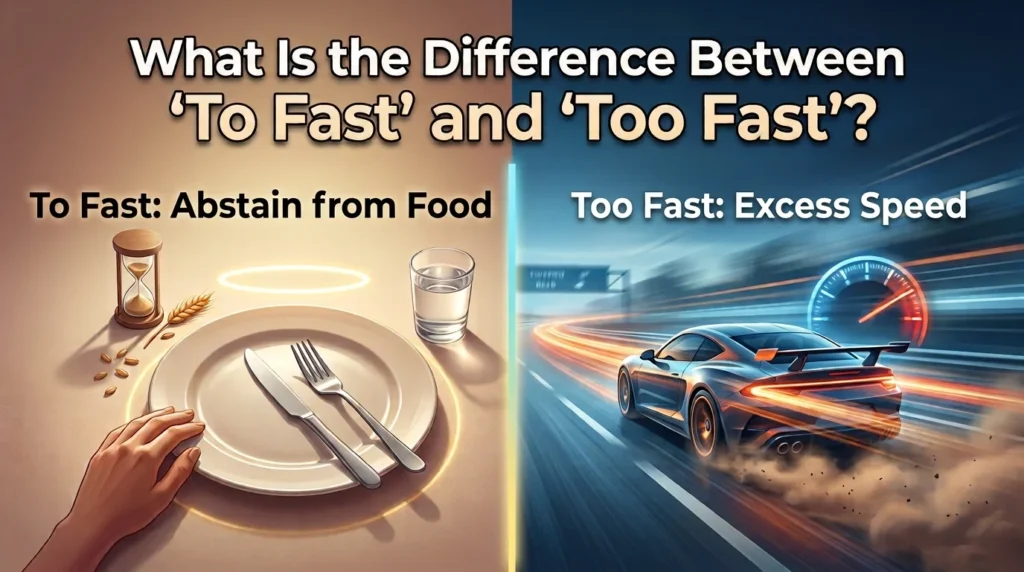
The difference between to fast and too fast comes down to both meaning and grammatical function. Although to and too often share the same pronunciation, they aren’t interchangeable in writing.
To fast uses to as part of the infinitive form of the verb fast. Here, fast means to deliberately go without food for a period. For example:
I decided to fast tomorrow.
In that sentence, to fast describes an action that someone intends to perform.
Too fast, on the other hand, uses too as an adverb. It means that something happens at a speed or rate that exceeds what is suitable, necessary, safe, or desired.
You’re driving too fast.
The sentence doesn’t say anything about abstaining from food. Instead, it says the person’s driving speed is excessive.
This distinction follows a broader English grammar pattern. Cambridge Grammar explains that to can form a to-infinitive when it appears before a verb. Cambridge also defines too as an adverb that can indicate something is more than needed, wanted, suitable, or enough.
“To Fast” Means to Go Without Food
The phrase to fast contains the verb fast. As a verb, fast means to abstain from food, usually for a particular period or purpose.
The phrase follows the familiar infinitive pattern:
to + base verb
Consider these examples:
- I plan to fast tomorrow.
- She decided to fast for a day.
- They want to fast during the observance.
- He chose to fast before the event.
- We agreed to fast together.
- She hopes to fast next week.
In each sentence, fast names an action. The word to introduces that action as an infinitive.
This isn’t a special rule created just for fast. English regularly uses to + base verb after verbs such as want, need, plan, decide, choose, hope, intend, and agree.
For instance:
| Infinitive | Example |
| to fast | I decided to fast. |
| to run | She wants to run. |
| to study | They plan to study. |
| to travel | We hope to travel. |
| to speak | He needs to speak. |
The grammar stays consistent. Only the meaning of the verb changes.
When Should You Use “To Fast”?
Use to fast when fast means the act of abstaining from food.
A useful clue appears before the phrase. Verbs such as want, plan, decide, and choose often take a to-infinitive.
For example:
I want to fast tomorrow.
Here, want expresses an intention. The infinitive to fast identifies the intended action.
Compare that sentence with:
You’re walking too fast.
Now fast doesn’t describe fasting. It describes the speed of walking. Therefore, too is the correct word.
The easiest way to separate these meanings is to ask one question:
What does “fast” mean in this sentence?
If it means abstain from food, choose to fast.
If it means move, speak, work, read, or happen at excessive speed, choose too fast.
“To Fast” in Context
Context makes the distinction especially clear.
Consider these two sentences:
She decided to fast.
She decided that the car was moving too fast.
The first sentence concerns an eating practice. The second concerns speed.
Now look at a slightly trickier pair:
I want to fast this weekend.
I don’t want the process to move too fast.
The pronunciation may sound similar when spoken quickly. The grammatical structure doesn’t.
The first sentence contains an infinitive. The second contains an adverb modifying fast.
That difference matters because English spelling often depends on grammatical function rather than sound. A listener may hear the same syllable, but a reader needs the correct written form.
“Too Fast” Means Excessively Fast
The phrase too fast expresses excess.
Cambridge defines too as meaning “more than is needed or wanted” or more than is suitable or enough. It commonly appears before adjectives and adverbs.
Because fast can function as an adverb, too can modify it:
The car is going too fast.
The meaning is not simply “fast.” It means the speed has crossed some relevant limit.
That limit can be physical, practical, emotional, or even subjective.
For example:
- The car is moving too fast.
- You’re speaking too fast.
- She reads too fast.
- The children are running too fast.
- He finished the task too fast.
- The changes happened too fast.
In every example, too adds the idea of excess.
“Too Fast” Can Describe More Than Physical Speed
One common misconception is that too fast only applies to cars, runners, or other moving objects.
It doesn’t.
English speakers use too fast for many kinds of rates and processes.
You’re talking too fast for me to understand.
The person may not be physically moving at all. Their speech has an excessive pace.
Likewise:
This course moves too fast for beginners.
Here, fast describes the pace of instruction.
Another example:
The company grew too fast to manage the expansion smoothly.
The phrase describes a rate of growth rather than physical movement.
This broader use is important because it helps you recognize too fast in real writing. The phrase often describes anything that progresses more quickly than a particular situation can reasonably handle.
Why These Two Phrases Are Often Confused
The biggest reason is pronunciation.
In many common contexts, to and too are pronounced alike. Cambridge lists the US pronunciation of to with strong and weak forms, while too has the pronunciation /tuː/.
That creates a familiar problem.
When people hear:
You’re going too fast.
They may know exactly what the speaker means. However, when they write the sentence, they might accidentally choose to.
This is a classic sound-versus-spelling problem.
English contains many confusing word pairs because spelling doesn’t always provide a direct clue to pronunciation. To and too are especially tricky because both forms can appear naturally before or around verbs.
The solution isn’t to memorize hundreds of isolated examples. Instead, identify the grammatical role.
Ask:
- Is fast the action someone intends to perform?
- Does too mean “excessively”?
- Could too be replaced by excessively?
- Is to fast part of an infinitive construction?
These questions usually settle the matter quickly.
Is “To Fast” or “Too Fast” Correct?
Both to fast and too fast can be grammatically correct. The correct choice depends on what you mean.
That point deserves emphasis because people sometimes assume one form must always be wrong. That’s not the case.
To fast is correct when fast functions as a verb meaning to abstain from food.
Too fast is correct when fast describes an excessive speed or rate.
The phrases belong to different grammatical constructions.
When “To Fast” Is Correct
Use to fast when fast acts as a verb.
I decided to fast tomorrow.
The verb decided is followed by a to-infinitive. Cambridge lists verbs such as choose, decide, intend, plan, want, and wish among verbs that can be followed by a to-infinitive.
More examples include:
She wants to fast this week.
He plans to fast during the observance.
They chose to fast together.
I hope to fast tomorrow.
We agreed to fast for one day.
Notice the pattern:
subject + verb + to + fast
The word fast remains in its base form because the phrase uses the infinitive.
You wouldn’t write:
I decided too fast tomorrow.
That changes the grammar and meaning completely.
Likewise, you wouldn’t write:
I want too fast tomorrow.
The sentence needs the infinitive marker to before the verb fast.
When “Too Fast” Is Correct
Use too fast when something happens at an excessive speed or rate.
You’re driving too fast.
She speaks too fast.
The train is moving too fast.
He works too fast and makes avoidable errors.
The lesson moves too fast for me.
Here, too modifies fast.
The phrase follows a useful pattern:
too + adverb
Cambridge Grammar specifically gives examples such as too quickly and too fast, showing how too can come immediately before an adverb.
The meaning is therefore about degree.
Compare:
He runs fast.
This simply describes his running speed.
He runs too fast.
This says his speed is excessive for the situation.
The second sentence contains an evaluation. Something about the speed creates a problem or exceeds an appropriate level.
Quick Rule to Remember
Here’s the simplest practical rule:
To + verb = too fast.
Too + fast = excessive speed or pace.
You can also use the “excessively” test.
Replace too with excessively.
She speaks too fast.
becomes:
She speaks excessively fast.
The meaning remains clear, although the second version sounds more formal.
Now try:
I want to fast.
Replacing to with excessively gives:
I want excessively fast.
That doesn’t make grammatical sense.
The test isn’t perfect for every use of too, but it works extremely well for this specific confusion.
Another helpful test is the action test.
If fast means “abstain from food,” use to fast.
If fast answers the question “How quickly?” use too fast when the speed is excessive.
| Question | Correct form |
| Do you mean abstaining from food? | to fast |
| Do you mean excessive speed? | too fast |
| Do you mean an excessive speaking rate? | too fast |
| Do you mean an intended fasting action? | to fast |
| Do you mean excessive progress? | too fast |
Understanding “To” vs. “Too” in English Grammar
The confusion becomes much easier when you understand the individual words.
To and too aren’t simply different spellings of the same word. They have different grammatical functions and meanings.
How “To” Functions in a Sentence
The word to has several uses in English. One major use involves the infinitive.
I want to learn.
She needs to leave.
They plan to travel.
We decided to wait.
In each example, to comes before a base-form verb. Cambridge describes this as the to-infinitive.
That same pattern gives us:
I want to fast.
The phrase to fast therefore works just like to learn, to travel, or to wait.
However, to also functions as a preposition.
We went to the store.
She spoke to her friend.
He walked to the door.
That use isn’t relevant to to fast because fast is a verb in the phrase.
This distinction helps prevent overgeneralization. Not every appearance of to introduces an infinitive, but to fast is an infinitive construction.
How “Too” Functions in a Sentence
Too is an adverb with two major everyday meanings.
The first means more than necessary, suitable, wanted, or enough.
The bag is too heavy.
You’re moving too fast.
The room is too cold.
She arrived too late.
The second meaning is also.
I want to come too.
She likes coffee too.
He’ll be there too.
Cambridge identifies both major uses of too.
In too fast, only the first meaning applies.
The phrase means excessively fast, not “fast also.”
Excess: The Meaning Used in “Too Fast”
The excess meaning appears before adjectives and adverbs.
For example:
- too slow
- too loud
- too expensive
- too quickly
- too carefully
- too fast
The basic idea is always similar.
Something has gone beyond an acceptable or suitable degree.
Consider:
The car is fast.
There is no built-in criticism.
Now:
The car is too fast.
The speaker believes the speed exceeds an appropriate level.
That level depends on context.
A race car can be fast by design. Yet it might still be too fast for a narrow residential street.
The word too therefore introduces a judgment about degree.
Addition: The Other Meaning of “Too”
The other meaning of too is also.
Sarah is coming too.
This use doesn’t create the same grammatical relationship found in too fast.
Compare:
Sarah is coming too.
Here, too means Sarah is coming also.
Now:
Sarah is walking too fast.
Here, too means Sarah is walking at an excessive speed.
The position and surrounding words help reveal the meaning.
Cambridge notes that too commonly appears at the end of a clause when it means “also.”
Common Grammar Patterns With Each Word
Understanding common patterns gives you a reliable framework.
| Pattern | Function | Example |
| to + verb | Infinitive | I want to fast. |
| too + adjective | Excessive degree | The meal is too expensive. |
| too + adverb | Excessive degree | She walks too fast. |
| verb + to + noun | Preposition | We went to school. |
| sentence + too | Addition | I want to come too. |
This table reveals why to fast and too fast shouldn’t be treated as spelling variants.
They represent different structures.
Examples of “To Fast” and “Too Fast” in Real English
Real examples make grammar easier to remember because they connect rules with situations readers actually encounter.
Examples of “To Fast”
When fast means abstaining from food, use to fast.
I plan to fast tomorrow.
She decided to fast during the observance.
He wants to fast for a day.
They agreed to fast together.
We hope to fast during the upcoming period.
The phrase can appear after many verbs that commonly introduce infinitives.
| Preceding verb | Example |
| want | I want to fast. |
| plan | We plan to fast. |
| decide | She decided to fast. |
| choose | He chose to fast. |
| hope | They hope to fast. |
| intend | I intend to fast. |
| need | She needs to fast. |
These examples show a productive English grammar pattern rather than a special exception.
Religious and Spiritual Fasting
The verb fast frequently appears in discussions of religious observance.
Different religious traditions have their own rules and practices surrounding fasting. The grammar itself, however, remains the same.
For example:
Many people choose to fast during a religious observance.
She plans to fast during the designated period.
They decided to fast as part of their observance.
The phrase to fast describes the action. It doesn’t describe how quickly someone performs another action.
That’s an important distinction.
Health and Lifestyle Contexts
People also use fast when discussing personal eating schedules or lifestyle practices.
For example:
He plans to fast until the afternoon.
She decided to fast for a specific period.
They want to fast on certain days.
These sentences focus on the act of fasting.
The grammar doesn’t change simply because the context changes from religious practice to personal routine.
Everyday Uses of “Fast” as a Verb
Although the verb fast often appears in religious contexts, it isn’t restricted to them.
The key point remains grammatical:
fast = verb
Therefore:
to fast = infinitive
This makes the structure easy to recognize.
If another verb expresses intention, desire, choice, or planning, to fast may naturally follow.
I chose to fast.
She hopes to fast.
We decided to fast.
He wants to fast.
The surrounding verb provides a strong grammatical clue.
Examples of “Too Fast”
Now switch the meaning from fasting to speed.
You’re driving too fast.
The dog is running too fast.
She talks too fast.
He reads too fast.
The machine is operating too fast.
The process is moving too fast.
Every example describes an excessive rate.
The phrase doesn’t mean “fast also.” It means the speed has gone beyond a suitable point.
Talking About Speed
Physical speed is the most obvious use.
The driver was going too fast.
That cyclist is moving too fast.
The elevator is going too fast for my comfort.
The children ran too fast for the coach to keep up.
These sentences use fast as an adverb describing how an action occurs.
The word too modifies that adverb.
This is why too fast works grammatically.
Describing Actions and Events
The phrase can also describe the pace of an action.
You’re typing too fast.
He finished too fast.
She answered too fast without considering the question.
The presentation moved too fast.
Here, fast describes the rate at which something happens.
The phrase can therefore express more than physical velocity.
Talking About Speech
Speech provides an especially useful example because the meaning is easy to understand.
You’re speaking too fast.
This doesn’t mean the speaker is moving quickly. It means the words are coming at a rate that makes comprehension difficult.
Similarly:
The teacher spoke too fast for the students to take notes.
He talks too fast when he’s nervous.
The recording plays too fast to follow comfortably.
These examples show how context determines meaning.
Talking About Reading and Learning
The same structure works for mental activities.
She reads too fast to notice every detail.
The class is moving too fast for some students.
He learned the material too fast to explain each step clearly.
The phrase focuses on pace rather than literal movement.
This broader use makes too fast a flexible expression in everyday English.
Common Everyday Expressions
Some natural expressions include:
- going too fast
- driving too fast
- talking too fast
- speaking too fast
- reading too fast
- moving too fast
- working too fast
- growing too fast
- changing too fast
- happening too fast
Notice how the phrase works across different verbs.
That’s because too modifies the degree of fast, while the main verb supplies the action or process.
A Practical Comparison
Consider these paired sentences:
I decided to fast tomorrow.
I think you’re driving too fast.
The first sentence contains an infinitive.
The second contains an adverbial expression describing excessive speed.
Now compare:
She wants to fast.
She speaks too fast.
Again, the difference becomes obvious once you identify the role of fast.
| Sentence | Meaning of fast | Correct form |
| I want to fast. | Abstain from food | to |
| You drive too fast. | Move quickly | too |
| She plans to fast. | Abstain from food | to |
| He speaks too fast. | Speak quickly | too |
| We decided to fast. | Abstain from food | to |
| The train moves too fast. | Move quickly | too |
This comparison captures the central rule.
Common Mistakes With “To Fast” and “Too Fast”
Using “To” Instead of “Too”
One of the most common mistakes looks like this:
❌ You are driving to fast.
The corrected version is:
✅ You are driving too fast.
Why?
Because too means the driving speed is excessive.
Another example:
❌ She talks too fast.
✅ She talks too fast.
The sentence describes speaking speed, so too is required.
A useful editing habit is to pause whenever too fast appears in a sentence. Ask whether fast means fasting.
If it doesn’t, check whether too fast is the intended phrase.
Confusing Sound With Meaning
Pronunciation can mislead writers.
When spoken naturally, to often has a weak pronunciation. Cambridge lists several pronunciations for to in American English, including /tu/, /tʊ/, and /tə/.
Too, by contrast, has the strong /tu/ sound.
In ordinary conversation, the difference may be subtle or absent depending on the sentence.
Writing requires another strategy.
Instead of asking:
“Which word sounds right?”
ask:
“Which meaning does the sentence need?”
That small shift can eliminate many spelling mistakes.
Proofreading Tips to Catch Errors
A quick proofreading routine can catch to/too mistakes without slowing you down.
When you see to fast, check three things:
First, identify the meaning of fast.
Does it mean abstaining from food?
If yes, to fast may be correct.
Second, test “excessively.”
You’re going too fast.
You’re going excessively fast.
If the replacement works, too is probably correct.
Third, inspect the surrounding verb.
I decided to fast.
She wants to fast.
These structures strongly suggest an infinitive.
This three-step check works especially well when proofreading emails, essays, assignments, and website content.
A Common False Shortcut
Some writers memorize the idea that too always means “more than necessary.”
That rule is useful, but incomplete.
Too can also mean also.
I want to go too.
Therefore, the better rule is:
Too can mean “excessively” or “also.”
In too fast, it means “excessively.”
This distinction prevents another common misunderstanding.
Why Context Matters More Than Sound
English grammar often depends on relationships between words.
The word to doesn’t carry the same function in every sentence. Likewise, too can express excess or addition.
Context reveals which role the writer intends.
Compare:
I want to fast.
You’re moving too fast.
The words sound similar around the phrase, yet the structures are completely different.
One describes an intended action.
The other evaluates a rate.
That is why context is the strongest guide when spelling these forms.
A Quick Editing Checklist
Before publishing a sentence, ask:
- Does fast mean abstaining from food?
- Is fast functioning as a verb?
- Does too mean excessively?
- Does the sentence describe speed or pace?
- Can too be replaced with excessively?
- Does to introduce a base-form verb?
- Would changing to too change the meaning?
If you can answer these questions, the correct form is usually obvious.
A Compact Rule Worth Remembering
Keep this distinction in mind:
to fast = to abstain from food
too fast = excessively fast
That rule covers the overwhelming majority of situations involving these two phrases.
The extra o isn’t decorative. It signals a different word with a different grammatical function.
When you focus on meaning rather than sound, the confusion largely disappears.
Understanding “To” vs. “Too” in English Grammar
The difference between to and too looks tiny on the page, yet it can completely change a sentence. That’s why to fast and too fast deserve more than a spelling trick. The real solution comes from understanding what each word does in the sentence.
To commonly works as an infinitive marker before a base verb. In too fast, the word fast acts as a verb meaning to abstain from food for a period. By contrast, too is an adverb that can express excess. In too fast, it tells the reader that something happens faster than is suitable, wanted, safe, or expected. Cambridge Grammar specifically identifies too as an adverb that can appear directly before adjectives and adverbs, including too fast.
That grammatical distinction gives you a dependable way to choose the right spelling. You don’t need to rely on how the phrase sounds.
How “To” Functions in a Sentence
English uses to in several important ways. One of the most common uses appears in the to-infinitive, where to comes before the base form of a verb.
Consider these examples:
- I want to fast tomorrow.
- She plans to travel next month.
- They decided to leave early.
- He hopes to improve his writing.
- We need to wait outside.
The pattern is straightforward:
to + base verb
In to fast, therefore, fast must function as a verb. The phrase doesn’t describe speed. Instead, it names an action.
This is the same grammatical structure found in to eat, to sleep, to run, and to study. The verb changes, but the infinitive pattern remains intact.
For example:
| Infinitive | Meaning |
| to eat | act like eating |
| to sleep | act sleeping |
| to run | act like running |
| to fast | abstain from food for a period |
| to study | pactstudying |
That comparison makes to fast much easier to understand. The word to isn’t expressing excess. It simply introduces the verb fast.
“To” as an Infinitive Marker
When to appears immediately before a base verb, it often creates an infinitive.
For example:
I want to learn.
She decided to leave.
He plans to fast.
The structure after the main verb remains consistent.
The first sentence expresses a desire. The second expresses a decision. The third expresses an intention involving fasting.
Several common verbs can naturally introduce this construction:
- want to
- need to
- plan to
- decide to
- choose to
- hope to
- intend to
- promise to
- agree to
- expect to
So you can write:
She decided to fast.
You can’t replace to with too without changing the grammar:
❌ She decided too fast.
That version doesn’t express the intended infinitive. It changes too into an adverb and leaves the sentence without the structure it needs.
The distinction becomes even clearer when you swap fast for another verb: She decided to eat.She decided to sleep.She decided to fast.
All three follow the same pattern.
“To” as a Preposition
To also works as a preposition. In this role, it can show movement, direction, destination, or a relationship.
For example:
We walked to the park.
She drove to work.
He gave the book to his friend.
Here, to doesn’t introduce a verb. It connects one part of the sentence to another element, often a noun or pronoun.
This use differs from to fast.
Compare:
We walked to the store.
We decided to fast.
In the first sentence, to functions as a preposition. In the second, it introduces the infinitive fast.
This distinction matters because writers sometimes treat to as though it has one single job. It doesn’t. Its grammatical function depends on what follows and how the sentence works.
Why “To” Cannot Mean “Excessively”
Here’s the key point for this topic:
To does not mean “excessively.”
If you’re describing an excessive speed, to isn’t the correct word.
Consider:
❌ The driver was going to fast.
The intended meaning is that the driver was going at an excessive speed.
The correct sentence is:
✅ The driver was going too fast.
The word too supplies the meaning the sentence needs.
You can test it by replacing too with excessively:
The driver was going excessively fast.
The wording sounds more formal, but the meaning remains understandable.
Try the same replacement with to fast:
The driver was going excessively fast.
The replacement reveals why too belongs in the original sentence.
The problem isn’t merely spelling. The wrong word creates the wrong grammatical relationship.
How “Too” Functions in a Sentence
Unlike to, too functions as an adverb.
It has two major everyday meanings.
The first expresses excess:
The coffee is too hot.
The box is too heavy.
She speaks too fast.
The movie was too long.
The second also means:
I want to come too.
She likes pizza too.
He’ll join us too.
Cambridge Grammar identifies these two major uses of too and explains that the excess meaning commonly appears before adjectives and adverbs.
For too fast, the relevant meaning is excess.
“Too” Meaning “Excessively”
When too means “more than enough” or “more than suitable,” it signals a problem with degree.
Compare these sentences:
The car is fast.
The car is too fast.
The first sentence simply describes the car’s speed.
The second adds an important judgment. The speed exceeds some relevant limit.
That limit depends on context.
A race car can be fast by design. Yet the same car could be too fast for a crowded parking lot.
Likewise:
She speaks fast.
Simply describes her speaking pace.
But:
She speaks too fast.
suggests that her pace creates a problem, perhaps because listeners struggle to understand her.
This is why too adds more than emphasis. It often carries an idea of excess relative to a standard.
“Too” Before Adverbs
One especially useful grammar pattern is:
too + adverb
The phrase too fast follows this structure.
Here, fast functions as an adverb because it describes how an action happens.
Consider:
He runs fast.
The word fast tells us how he runs.
Now add too:
He runs too fast.
The word too modifies fast and tells us that the speed exceeds an appropriate level.
Cambridge gives the same general pattern with examples such as too quickly and too fast.
Other examples include:
- too slowly
- too loudly
- too quietly
- too carefully
- too quickly
- too fast
The grammatical pattern remains the same.
“Too” Can Also Mean “Also”
Don’t overlook the second meaning of too.
In:
I want some too.
too means also.
In:
She is coming too.
It means that she is coming also.
This meaning differs completely from the one in too fast.
Compare:
You’re driving too fast.
Here, too means excessively.
I’m coming too.
Here, too means also.
The surrounding words make the difference clear.
Cambridge notes that too commonly appears at the end of a clause when it means “also,” especially in informal English.
That gives you another useful rule:
too + adjective/adverb = excessive degree
too at the end of a clause = often “also”
These aren’t absolute descriptions of every possible construction, but they’re highly useful patterns for everyday writing.
Excess vs. Addition
The two meanings of too can look confusing until you examine the sentence position and context.
| Sentence | Meaning of “too” |
| You’re driving too fast. | excessively |
| The water is too cold. | excessively |
| She speaks too loudly. | excessively |
| I want to come too. | also |
| He likes coffee too. | also |
| Sarah joined us too. | also |
The first three sentences describe excess.
The final three express addition.
This distinction matters because too doesn’t always signal a problem. In “I want to come too,” the word simply adds another person to the action.
How “Too” Modifies “Fast”
The relationship between too and fast becomes clearer when you remove too.
He drives fast.
This tells us something about his driving speed.
He drives too fast.
Now the speaker judges that speed as excessive.
The addition of one small word changes the sentence’s meaning.
You can see the same pattern with other adverbs:
She speaks quickly.
She speaks too quickly.
He works carefully.
He works too carefully.
They moved slowly.
They moved too slowly.
The word too works as a degree modifier.
This is why too fast is grammatically natural while to fast, when intended to describe speed, isn’t.
Common Grammar Patterns With “To”
Understanding a few common patterns makes to easier to recognize.
To + Base Verb
This is the pattern most relevant to to fast.
Examples:
- to fast
- to eat
- to run
- to sleep
- to study
- to work
- to travel
Example:
I need to fast tomorrow.
The word fast functions as the verb.
Verb + To + Verb
Many verbs naturally take a to-infinitive.
Examples:
I want to fast.
She plans to fast.
He decided to fast.
They hope to fast.
The first verb establishes the relationship. To then introduces the second verb.
To + Noun or Pronoun
This pattern usually involves the preposition to.
Give it to me.
Walk to school.
Send the message to her.
Here, to doesn’t introduce a verb.
Knowing this difference helps you recognize the role of to in a sentence instead of treating every occurrence identically.
This pattern is particularly useful for identifying the correct spelling in sentences about speed.
If you see a sentence such as:
The car is moving ___ fast.
the grammar calls for the degree adverb too when the intended meaning is excessive speed.
“Too” vs. “Very”
Another useful distinction is the difference between too and very.
These words aren’t interchangeable.
Compare:
She is very careful.
This means she is careful to a high degree.
Now:
She is too careful.
This suggests that her level of care exceeds what is necessary or useful.
The same distinction appears with fast:
He runs very fast.
This simply emphasizes his speed.
He runs too fast.
This says his speed exceeds a suitable level.
Cambridge explicitly distinguishes very from too by noting that very strengthens an adjective or adverb, while too indicates that the degree is more than necessary.
That’s an important semantic difference.
Very fast can be positive, neutral, or simply descriptive.
Too fast usually introduces a problem, limit, or unwanted result.
Understanding “Fast” Makes Everything Easier
The word fast itself causes much of the confusion because English uses it in several grammatical roles.
It can function as a verb, adjective, or adverb.
Fast as a Verb
As a verb, fast means to abstain from food.
She decided to fast.
Here, fast is an action.
Fast as an Adjective
As an adjective, fast can describe a noun.
He drives a fast car.
Here, fast modifies car.
Fast as an Adverb
As an adverb, fast can describe how an action happens.
He drives fast.
Here, fast modifies drives.
Add too:
He drives too fast.
Now too modifies the adverb fast.
This three-way distinction explains the entire issue.
| Role of fast | Example | Meaning |
| Verb | I want to fast. | Abstain from food |
| Adjective | He owns a fast car. | Quick or rapid |
| Adverb | He drives fast. | At high speed |
| Adverb with too | He drives too fast. | At excessive speed |
Once you identify which role fast plays, the correct phrase usually becomes obvious.
A Simple Three-Question Test
When you’re unsure whether to write to fast or too fast, ask these questions.
Does “fast” mean abstain from food?
If yes, use:
to fast
Does “fast” describe speed or pace?
If yes, and the speed is excessive, use:
too fast
Can “too” be replaced with “excessively”?
If yes, too is likely correct.
For example:
You’re driving too fast.
becomes:
You’re driving excessively fast.
That replacement preserves the basic meaning.
Now test:
I want to fast.
Replacing to with excessively destroys the sentence.
That’s your clue.
The Fastest Way to Spot the Correct Form
Don’t start with spelling.
Start with meaning.
If someone says:
“I want ___ fast tomorrow.”
The sentence likely needs to be changed if the intended meaning is fasting:
“I want to fast tomorrow.”
But if someone says:
“You’re driving ___ fast.”
the meaning concerns speed:
“You’re driving too fast.”
The surrounding verb often provides the answer.
Want to fast points toward an infinitive.
Drive too fast points toward excessive speed.
Once this pattern becomes familiar, the spelling choice takes only a moment.
Quick Reference Table
| Word or phrase | Grammar role | Meaning | Example |
| to | Infinitive marker | Introduces a base verb | to fast |
| to | Preposition | Shows direction or relationship | go to school |
| too | Adverb | Excessively | too fast |
| too | Adverb | Also | I want to go too |
| fast | Verb | Abstain from food | to fast |
| fast | Adjective | Quick or rapid | a fast car |
| fast | Adverb | At high speed | drive fast |
This is the grammar framework behind to fast vs. too fast. Once the roles are clear, the spelling stops feeling like a guessing game.
Examples of “To Fast” vs. “Too Fast” in Everyday English
The clearest way to master to fast vs. too fast is to see how each phrase behaves in real sentences. The spelling difference may be only one letter, but the meanings sit on opposite sides of the grammar fence. To fast refers to the action of abstaining from food, while too fast describes an excessive speed, pace, or rate. Context does the heavy lifting.
Examples of “To Fast” in Sentences
Use to fast when fast works as a verb meaning to abstain from food. The word to introduces that verb as an infinitive.
I decided to fast tomorrow.
She wants to fast during the observance.
He plans to fast for one day.
They chose to fast together.
We hope to fast this weekend.
Notice the pattern: another verb comes before to fast, and fast names an action. The sentence isn’t describing speed at all.
| Sentence | Why to fast works |
| I want to fast tomorrow. | Fast means abstain from food. |
| She decided to fast today. | To introduce the infinitive. |
| He plans to fast for a day. | Fast functions as a verb. |
| They hope to fast together. | The sentence expresses an intended action. |
| We chose to fast this week. | To fast completes the verb chose. |
A useful clue is the verb immediately before the phrase. Words such as want, plan, decide, hope, and choose commonly introduce a to-infinitive. That doesn’t mean every sentence containing one of these verbs must use to, but it provides a strong grammatical signal.
Religious and Spiritual Contexts
The verb fast often appears when people discuss religious observances, spiritual practices, or periods of abstinence. The grammar remains straightforward:
Many people choose to fast during religious observances.
She plans to fast during the designated period.
He decided to fast as part of his spiritual practice.
The important point isn’t the particular tradition. It’s the grammatical function of fast.
In each example, fast represents an action. Therefore, to fast forms the infinitive.
A simple substitution can make this clearer:
She plans to fast.
Replace fast with another action: She plans to pray.She plans to study.She plans to travel.
The structure remains intact:
verb + to + base verb
This shows that to fast isn’t an unusual construction. It follows an ordinary English pattern.
Health and Lifestyle Contexts
You may also encounter to fast in conversations about eating schedules, personal routines, or lifestyle choices.
For example:
He decided to fast until noon.
She plans to fast for a specific period.
They want to fast on certain days.
Again, fast describes an action rather than a rate.
That distinction becomes especially important when a sentence contains both meanings of fast nearby.
Consider:
She decided to fast, but she didn’t want to exercise too fast afterward.
The first fast means abstaining from food.
The second fast describes exercise speed.
The words surrounding each occurrence reveal the intended meaning.
Everyday Uses of “Fast” as a Verb
Although people often associate fast with religious observance, the verb can appear in ordinary discussions of abstaining from food.
For example:
I don’t usually fast, but I plan to fast tomorrow.
She has decided to fast for a short period.
He wants to fast before the event.
Here, fast clearly acts as a verb.
The infinitive construction remains:
to + fast
This is fundamentally different from:
too + fast
The first construction identifies an action. The second modifies the degree of speed.
Examples of “Too Fast” in Sentences
Now consider the opposite meaning.
Use too fast when fast describes speed, pace, or rate and too indicates excess.
You’re driving too fast.
The car is moving too fast.
She talks too fast.
He reads too fast.
The lesson moves too fast.
Each sentence describes something happening faster than the speaker considers suitable.
The phrase can refer to physical movement, speech, learning, work, growth, or change.
| Sentence | What is excessive? |
| You’re driving too fast. | Driving speed |
| She speaks too fast. | Speaking rate |
| He reads too fast. | Reading pace |
| The class moves too fast. | Learning pace |
| The company grew too fast. | Growth rate |
| The process changed too fast. | Rate of change |
Talking About Physical Speed
Physical movement provides the most obvious examples.
The driver was going too fast.
That cyclist is moving too fast.
The child ran too fast for the group.
The train was traveling too fast.
In these sentences, fast describes how quickly someone or something moves.
Adding too changes the statement from simple description to evaluation.
Compare:
The car is going fast.
with:
The car is going too fast.
The first sentence tells you about speed.
The second says that the speed exceeds an appropriate limit.
That limit might be a posted speed limit, a safety concern, a person’s comfort level, or another practical standard. The exact standard comes from context.
Talking About Speech
Too fast also commonly describes speech.
You’re speaking too fast.
The teacher talks too fast for me to take notes.
He speaks too fast when he’s nervous.
The recording plays too fast to understand comfortably.
None of these sentences involves physical movement.
Instead, fast describes the rate at which spoken language arrives.
This is a useful example because it demonstrates that too fast means more than “high physical speed.” It can describe an excessive pace.
Talking About Reading
Reading provides another natural context.
She reads too fast to notice every detail.
I read too fast when I’m tired.
He went through the instructions too fast.
The reader isn’t necessarily moving quickly through space. The activity itself happens at a rate that may be considered excessive.
The same principle works with writing, studying, explaining, and teaching.
The instructor explained the concept too fast.
He completed the exercise too fast and missed a step.
The phrase remains consistent because fast describes the pace of the action.
Talking About Work and Processes
You can use too fast when describing processes as well.
The team is working too fast and overlooking details.
The project moved too fast for proper testing.
The company expanded too fast.
The changes happened too fast.
Here, too fast expresses an excessive rate rather than literal speed.
This broader use is common in professional writing because projects, markets, organizations, and systems can all develop at different rates.
“Too Fast” Doesn’t Always Mean Objectively Fast
This point is easy to overlook.
When someone says:
You’re moving too fast.
they aren’t necessarily claiming that the movement is objectively fast by some universal measurement.
They may mean too fast for this situation.
For example:
The runner is moving too fast for the beginner group.
The same runner might be moving at a perfectly appropriate pace in an advanced group.
Likewise:
The teacher is moving too fast for me.
This doesn’t necessarily mean the teacher is objectively speaking at an extreme speed. The speaker simply cannot comfortably follow the pace.
The word too therefore often depends on an implied standard.
Side-by-Side Comparison: “To Fast” vs. “Too Fast”
Putting the phrases next to each other makes the difference almost impossible to miss.
| To Fast | Too Fast |
| Uses to before a verb | Uses too as an adverb |
| Fast means abstain from food | Fast describes speed or pace |
| Forms an infinitive | Expresses excessive speed |
| Example: I want to fast. | Example: You’re driving too fast. |
| Focuses on an action | Focuses on degree or rate |
Consider these pairs:
I decided to fast.
I decided the car was moving too fast.
The first sentence discusses fasting.
The second discusses speed.
Another pair:
She wants to fast tomorrow.
She speaks too fast during presentations.
The first describes an intended action. The second evaluates a speaking rate.
Why This Comparison Matters in Real Writing
This distinction matters most when writing without immediate grammatical support. A spelling checker might catch some mistakes, but it may not understand every intended meaning.
Consider:
I want to fast tomorrow.
The sentence is correct.
Now change one letter:
I want too fast tomorrow.
The result is no longer the intended grammatical construction.
The same problem occurs in reverse:
You’re driving to fast.
The reader can probably understand the meaning, but the spelling is incorrect for standard English.
Correct:
You’re driving too fast.
This illustrates an important principle in English: pronunciation doesn’t always tell you which spelling to choose.
A Useful Meaning Test
When you’re unsure, translate each phrase into a simpler meaning.
To fast:
to abstain from food
Too fast:
excessively quickly
For example:
I want to fast.
means:
I want to abstain from food.
Meanwhile:
You’re driving too fast.
means:
You’re driving excessively quickly.
If that replacement preserves the intended idea, you’ve likely selected the correct phrase.
A Useful Grammar Test
You can also examine what fast is doing.
Ask:
Is fast the verb?
If yes:
to fast
Ask:
Does fast describe how an action happens?
If yes, and the pace is excessive:
too fast
This test is particularly useful because it focuses on grammar rather than pronunciation.
Common Mistakes People Make
The most frequent mistake is writing to fast when the intended meaning is excessive speed.
Incorrect:
❌ The car is going to fast.
Correct:
✅ The car is going too fast.
Another common mistake is using too fast when the writer means the action of fasting.
Incorrect:
❌ I decided too fast tomorrow.
Correct:
✅ I decided to fast tomorrow.
The surrounding words often reveal the problem immediately.
Similar Confusions: “To,” “Too,” and “Two”
The confusion becomes easier to understand when you place to, too, and two together.
| Word | Main function or meaning | Example |
| to | Infinitive marker or preposition | I want to fast. |
| too | Excess or addition | You’re going too fast. |
| two | Number 2 | I have two books. |
These words are commonly confused because to and too can sound alike in many sentences. Two also has the same basic pronunciation.
The spelling, however, carries different information. I have two options.I want to choose one.I don’t want to decide too quickly.
Three words can sound similar, yet their grammatical roles differ sharply.
Similar Confusing Word Pairs
The same kind of sound-based confusion appears elsewhere in English.
Common examples include:
- your / you’re
- than / then
- there / their / they’re
- its / it’s
- two / to / too
These aren’t identical grammar problems, but they share an important feature: pronunciation can make different written words difficult to distinguish.
That means good proofreading should consider meaning and grammatical function, not sound alone.
Easy Tricks to Remember “To” and “Too”
A few memory devices can make the distinction stick.
The Extra “O” Rule
Think of the extra o in too as representing more.
Too has an extra o, and it often expresses something extra or excessive.
The bag is too heavy.
You’re moving too fast.
She talks too loudly.
The word too has something “extra” built into its meaning.
This isn’t a complete grammar rule, but it’s a handy memory aid.
The Context-Based Memory Method
Instead of memorizing spelling in isolation, connect each phrase with an image.
For to fast, picture someone intentionally abstaining from food.
For too fast, picture a car passing a reasonable speed.
Those two mental images are completely different.
That difference can help your memory.
The Sentence Replacement Test
Try replacing too with excessively.
You’re driving too fast.
becomes:
You’re driving excessively fast.
The meaning still works.
Now try the same idea with:
I want to fast.
The replacement doesn’t work.
This simple test can quickly expose the intended meaning.
Practice: Choose “To” or “Too”
Try these sentences before checking the explanations.
I want ___ fast tomorrow.
You’re walking ___ fast.
She decided ___ fast during the observance.
The speaker is talking ___ fast.
They plan ___ fast next week.
The car is moving ___ fast for this road.
The answers depend entirely on meaning and grammar.
| Sentence | Answer | Reason |
| I want ___ fast tomorrow. | to | Fast is a verb meaning abstain from food. |
| You’re walking ___ fast. | too | The walking speed is excessive. |
| She decided ___ fast. | to | To introduces the infinitive verb. |
| The speaker is talking ___ fast. | too | Too expresses excessive speaking speed. |
| They plan ___ fast. | to | Fast names an intended action. |
| The car is moving ___ fast. | too | Too fast means excessively fast. |
Why Context Solves the Problem
The phrases to fast and too fast may sound similar, but context gives you the missing information.
Look at the words around fast.
I plan to fast.
The verb plan suggests an intended action.
Now:
The driver is going too fast.
The verb going creates a speed-related context.
That doesn’t mean every surrounding verb automatically determines the answer. Instead, the entire sentence supplies clues.
You should consider the subject, verb, meaning, and relationship between the words.
The Most Reliable Rule
When the sentence means abstain from food, write:
to fast
When the sentence means excessively quickly, write:
too fast
When you’re still uncertain, identify the role of fast.
If fast is the action itself, to fast works.
If fast describes the manner or rate of an action, too fast works when the rate exceeds an appropriate level.
That distinction is simple enough for everyday writing yet powerful enough to prevent most errors involving these phrases.
Common Mistakes, Usage Patterns, and Easy Ways to Remember “To Fast” vs. “Too Fast”
Even after learning the basic rule, to fast and too fast can still cause mistakes because they sound alike in many spoken sentences. The best way to avoid errors is to connect each spelling with its grammatical job. To fast contains an infinitive marker before the verb fast, while too fast uses too to describe excessive speed or pace. Once you recognize that difference, proofreading becomes much easier.
Why “To Fast” and “Too Fast” Get Confused
The main source of confusion is pronunciation. In natural speech, to often has a weak pronunciation, while too has a longer vowel sound. In connected speech, however, listeners may not notice much difference. That creates a trap when you later write what you heard.
There’s another reason for the confusion. Both phrases can appear in otherwise similar sentence structures.
I want to fast tomorrow.
You don’t want to drive too fast tomorrow.
The words look almost identical, but fast performs a different grammatical role.
In the first sentence, fast is a verb. In the second, fast functions as an adverb describing driving speed.
The Most Common Error: “To Fast” for Speed
If you mean that something happens at an excessive speed, too fast is the correct expression.
Incorrect:
The car is going to fast.
Correct:
The car is going too fast.
Incorrect:
You’re talking to fast.
Correct:
You’re talking too fast.
Incorrect:
The lesson is moving to fast.
Correct:
The lesson is moving too fast.
The quickest way to catch this mistake is to replace too with excessively.
You’re talking too fast.
You’re talking excessively fast.
The wording becomes more formal, but the basic meaning remains intact.
The Opposite Error: “Too Fast” for Fasting
Writers can also make the mistake in reverse.
Suppose someone means that they intend to abstain from food:
❌ I decided too fast tomorrow.
That sentence doesn’t express the intended meaning.
The correct version is:
✅ I decided to fast tomorrow.
Here, to introduces the verb fast.
The same pattern appears with other verbs:
I want to fast.
She plans to fast.
They hope to fast.
He chose to fast.
In every example, fast represents an action.
A Three-Step Method for Choosing the Right Word
When you’re uncertain, don’t guess based on pronunciation. Use this quick method.
First, identify the meaning of fast.
If it means abstaining from food, choose to fast.
If it describes speed or pace, continue to the next question.
Second, ask whether the speed is excessive.
If something happens faster than appropriate, choose too fast.
Third, try the replacement test.
Replace too with excessively.
The speaker talks too fast.
The speaker talks excessively fast.
If the meaning survives, too fits.
This method works because it combines vocabulary, grammar, and context rather than relying on spelling alone.
Why Context Matters More Than Pronunciation
English contains many words that sound alike but carry different meanings. These words are called homophones when they share pronunciation but differ in meaning or spelling.
To, too, and two provide a familiar example.
I want to leave.
It’s too late.
I have two choices.
The pronunciation can create confusion, but the grammatical role gives each word its place.
The same principle applies to to fast and too fast. Don’t ask which spelling sounds right. Ask what the sentence means.
That small change in thinking makes a surprisingly big difference.
Similar Word Pairs That Cause Confusion
The to/too problem belongs to a larger group of commonly confused English words.
| Confusing words | Difference | Example |
| to / too | Infinitive or preposition vs. excess or addition | to fast / too fast |
| to / two | Function word vs. number | go to school / two books |
| your / you’re | Possessive vs. contraction | your car / you’re ready |
| than / then | Comparison vs. time or sequence | faster than / then leave |
| its / it’s | Possessive vs. contraction | its color / it’s blue |
| there / their / they’re | Place, possession, contraction | there / their / they’re |
These pairs teach the same lesson: sound alone isn’t enough.
Grammar and meaning provide the real clues.
“To,” “Too,” and “Two” in One Example
These three words deserve special attention because they’re pronounced alike in many varieties of English.
Consider:
I want to buy two books too.
Each word has a completely different job.
- to introduces the verb buy.
- two represents the number 2.
- too means also.
Now compare:
I don’t want to drive too fast.
Here, too means excessively.
Understanding these differences gives you a stronger foundation than memorizing individual spellings.
Frequency and Everyday Usage
Too fast appears in many ordinary conversations because people frequently discuss speed, pace, and timing.
You might hear:
You’re going too fast.
That car is too fast.
You’re speaking too fast.
The instructions are coming too fast.
This project is moving too fast.
By contrast, to fast requires a specific meaning because fast must function as a verb.
You might see it in sentences such as:
I want to fast.
She decided to fast.
They plan to fast.
This explains why too fast may seem much more familiar in everyday writing. It applies to many situations involving speed or pace, while to fast appears specifically when someone discusses fasting.
However, frequency doesn’t determine correctness.
A less common phrase can still be completely grammatical.
How Context Changes the Meaning
Sometimes the surrounding sentence contains enough information to make the difference obvious.
Compare:
She decided to fast.
The word decided introduces an intended action.
Now compare:
She walked too fast.
The word walked creates a movement context, while too indicates excessive pace.
A particularly useful example combines both forms:
She decided to fast, but she didn’t want to exercise too fast afterward.
The first phrase concerns eating.
The second concerns speed.
One letter changes the written word, but the grammatical difference explains why.
Easy Tricks to Remember the Difference
A few simple memory tricks can make this distinction automatic.
This isn’t a complete grammar rule, but it’s an excellent memory aid.
When the sentence describes excessive speed, remember:
Extra O = too much = too fast.
Use the “Excessively” Test
This is one of the most useful practical tests.
Take your sentence:
You’re driving too fast.
Replace too with excessively:
You’re driving excessively fast.
The sentence still communicates essentially the same idea.
Now try:
I want to fast.
Replacing to with excessively produces nonsense:
I want excessively fast.
The test quickly separates the two constructions.
Use the “Fasting” Test
Ask yourself what fast means.
If the sentence means abstain from food, use to fast.
I plan to fast tomorrow.
If the sentence means move or happen quickly, use too fast when the rate is excessive.
The car is moving too fast.
This test is especially helpful because the two meanings of fast are dramatically different.
Use the Sentence Replacement Test
Another useful strategy involves replacing the entire phrase.
If you can replace to fast with:
to abstain from food
the phrase is probably correct.
For example:
She decided to fast.
becomes:
She decided to abstain from food.
The basic meaning remains intact.
For too fast, try:
excessively quickly
For example:
He runs too fast.
becomes:
He runs excessively quickly.
Again, the basic meaning remains.
This technique forces you to think about meaning rather than spelling.
A Real-World Editing Example
Imagine proofreading this sentence:
The presenter was speaking ttoofast, so several people missed the explanation.
At first glance, the mistake is easy to overlook because to fast sounds natural when spoken.
Now apply the meaning test.
Is the presenter abstaining from food?
No.
Does the sentence describe speaking speed?
Yes.
Is the speed excessive?
Yes.
Therefore:
The presenter was speaking too fast, so several people missed the explanation.
The correction becomes obvious once the sentence receives a grammatical diagnosis.
Another Editing Example
Consider:
She wants too fast during the religious observance.
The phrase doesn’t describe speed. The writer intends to describe an action involving abstaining from food.
The corrected sentence is:
She wants to fast during the religious observance.
Here, wants naturally takes a to-infinitive.
The sentence therefore follows:
want + to + base verb
This pattern gives you another strong clue.
Practice Sentences: Choose the Correct Form
Test your understanding with these examples.
The runner was going ___ fast for the coach.
I decided ___ fast tomorrow.
She speaks ___ fast during presentations.
They plan ___ fast for one day.
The lesson is moving ___ fast for beginners.
He wants ___ fast during the observance.
Answers
| Sentence | Correct word | Explanation |
| The runner was going ___ fast. | too | The runner’s speed is excessive. |
| I decided ___ fast tomorrow. | to | To introduces the verb fast. |
| She speaks ___ fast. | too | Her speaking pace is excessive. |
| They plan ___ fast. | to | Fast means abstain from food. |
| The lesson is moving ___ fast. | too | The lesson progresses excessively quickly. |
| He wants ___ fast. | to | To fast forms an infinitive. |
Why These Answers Work
The answers don’t depend on memorization alone.
The first, third, and fifth sentences describe excessive speed or pace. Therefore, they require too.
The second, fourth, and sixth sentences use fast as a verb meaning to abstain from food. Therefore, they require to.
This distinction remains consistent even when you change the subject, tense, or surrounding vocabulary.
A Quick Decision Chart
When proofreading your own sentence, use this mental flow:
Does “fast” mean abstain from food?
→ Use to fast.
Does “fast” describe speed or pace?
→ Continue.
Does the speed exceed an appropriate level?
→ Use too fast.
Does “too” mean “also” instead?
→ It may appear elsewhere in the sentence, but that isn’t the meaning in too fast.
This process takes only a few seconds once you’ve practiced it.
Common Questions About “To Fast” and “Too Fast”
Is “To Fast” Grammatically Correct?
Yes. To fast is grammatically correct when fast functions as a verb meaning to abstain from food.
I want to fast tomorrow.
Here, to introduces the infinitive fast.
However, to fast isn’t correct when you mean that something moves or happens at an excessive speed. In that context, write too fast.
Is “Too Fast” Grammatically Correct?
Yes. Too fast is grammatically correct when too modifies fast to express excessive speed or pace.
You’re driving too fast.
She talks too fast.
The process is moving too fast.
The phrase can describe physical movement or the rate of an activity.
Can “Fast” Be a Verb and an Adverb?
Yes. Fast can serve several grammatical roles.
As a verb:
I decided to fast.
As an adverb:
He drives fast.
As an adjective:
He drives a fast car.
Recognizing these roles helps you determine whether to or too belongs before fast.
Is “Too Fast” an Adverb Phrase?
Yes, too fast can function as an adverbial phrase. Too modifies fast, which describes the manner or rate of an action.
She runs too fast.
The phrase tells us how she runs and indicates that her speed exceeds an appropriate level.
Why Does “Too Fast” Mean Excessive Speed?
Because too expresses a degree beyond what is suitable, necessary, wanted, or acceptable in the relevant context.
You’re driving too fast.
The statement implies that the driving speed exceeds a meaningful limit.
That limit might involve safety, comfort, rules, or the needs of a particular situation.
Is “I Want to Fast” Correct?
Yes.
I want to fast.
Here, want takes the to-infinitive, and fast functions as a verb.
The sentence means that the speaker wants to abstain from food for a period.
Is “You’re Going Too Fast” Correct?
Yes.
You’re going too fast.
Here, too modifies fast and indicates excessive speed.
The phrase doesn’t refer to fasting.
What Does “Fast” Mean in a Religious Context?
As a verb, fast means to abstain from food, usually for a particular period or purpose. Religious traditions may have different rules concerning fasting, but the grammatical construction remains the same.
They decided to fast during the observance.
The word fast functions as the verb.
How Do I Remember “To” and “Too”?
Use two quick associations.
To often introduces a verb:
to fast
Too can mean excessively:
too fast
You can also remember the extra o in too as a reminder of something extra or excessive.
Are There Other Similar Grammar Mistakes?
Yes. English has many commonly confused word pairs, including your/you’re, than/then, its/it’s, there/their/they’re, and to/too/two.
The best solution isn’t simply memorizing spellings. Learn each word’s grammatical role and meaning. That approach helps you handle unfamiliar sentences instead of relying on a single memorized trick.
Final Quick Reference
| If you mean… | Write… | Example |
| Abstain from food | to fast | I plan to fast tomorrow. |
| Excessive physical speed | too fast | You’re driving too fast. |
| Excessive speaking pace | too fast | She speaks too fast. |
| Excessive reading pace | too fast | He reads too fast. |
| Excessive rate of change | too fast | The process changed too fast. |
| An intended fasting action | to fast | They chose to fast. |
The simplest rule remains the strongest one: to fast means to perform the action of fasting, while too fast means excessively fast. When pronunciation causes doubt, let grammar and meaning settle the question. Once you train yourself to identify what fast means in context, this tiny spelling difference becomes much easier to control.
Conclusion
Understanding to fast and too fast becomes much easier when you focus on meaning and grammatical function. To fast is correct when fast acts as a verb meaning to abstain from food. In contrast, too fast describes excessive speed, pace, or rate. This small spelling difference can change the entire meaning of a sentence, so context matters. When you’re unsure, ask whether the sentence discusses fasting or something happening excessively quickly. You can also replace too with “excessively” to test the meaning. With a little practice, this distinction becomes almost automatic. Whether you’re writing an email, completing an assignment, or polishing professional content, choosing the right form helps your writing sound clear and confident. Once you understand how to and too function, this commonly confused pair is much easier to use correctly.
FAQs
Is “to fast” grammatically correct?
Yes, to fast is grammatically correct when fast functions as a verb meaning to abstain from food. For example, “I plan to fast tomorrow” uses the infinitive to fast correctly. However, don’t use to fast when describing excessive speed. In that situation, too fast is the correct expression.
What does “too fast” mean?
Too fast means excessively fast or faster than appropriate for a particular situation. For example, “You’re driving too fast” means the vehicle’s speed exceeds a suitable level. The phrase can describe physical movement, speech, reading, work, learning, or other activities. The exact standard for “too” depends on the context.
When should I use “to fast”?
Use to fast when fast means to abstain from food. It commonly appears after verbs such as want, plan, decide, and choose. For example, “She decided to fast during the observance” uses the phrase correctly. Here, to introduces the base verb fast and forms an infinitive.
When should I use “too fast”?
Use too fast when something happens at an excessive speed or pace. For example, “The speaker talks too fast” means the speaker’s rate of speech is higher than comfortable or suitable. Too modifies fast and expresses excess. The phrase can apply to movement, speech, reading, learning, work, and change.
Is “I want to fast” correct English?
Yes, “I want to fast” is correct English. In this sentence, want is followed by the infinitive to fast. The verb fast means to abstain from food for a period. The sentence doesn’t describe speed. Therefore, to is the correct choice rather than too.
Is “You are going too fast” correct?
Yes, “You are going too fast” is grammatically correct. Here, too means excessively, while fast describes the rate of movement. The sentence tells someone that their speed exceeds what the speaker considers appropriate. You could use it when discussing driving, walking, running, cycling, or another type of movement.
Why are “to” and “too” commonly confused?
To and too are commonly confused because they sound alike in many varieties of English. Their grammatical roles, however, differ. To commonly works as a preposition or infinitive marker, while too can express excess or addition. Looking at the sentence’s meaning and grammar makes the correct spelling easier to identify.
Can “fast” be a verb?
Yes, fast can function as a verb. As a verb, it means to abstain from food. For example, “They plan to fast tomorrow” uses fast as a verb. Fast can also function as an adjective or adverb, depending on the sentence. Its grammatical role helps determine how surrounding words should be used.
How can I remember “to fast” versus “too fast”?
Use meaning as your shortcut. If fast means abstaining from food, choose to fast. If fast describes excessive speed or pace, choose too fast. You can also replace too with “excessively.” If that replacement keeps the meaning, too is probably correct.
What is the easiest rule for “to fast” and “too fast”?
The easiest rule is simple: to fast means to perform the action of fasting, while too fast means excessively quickly. Ask yourself what fast means in the sentence. If it refers to abstaining from food, use to. If it describes excessive speed or pace, use too.