

If you’ve seen yupper or yuppers in a text, comment, or casual conversation, you may have paused and wondered, “Is that actually a word?” The short answer is yes, people use these forms, but their status needs a little explanation. Yupper is informal and much less established than familiar forms such as yup and yep. Yuppers, meanwhile, is documented as an informal affirmative and as an alternative form of yeppers. Collins currently lists yuppers as a “New Word Suggestion” meaning “yes; sure” and says it is being monitored for evidence of usage.
That distinction matters because “real word” and “standard dictionary word” aren’t identical ideas. English speakers create, adapt, shorten, and reshape expressions constantly. Some forms become widely accepted, while others remain casual slang. Yupper sits closer to the informal end of that spectrum.
There’s another wrinkle worth knowing. Yooper, a separate word, refers to someone from Michigan’s Upper Peninsula. It can look and sound similar to yupper, but the meanings have nothing to do with each other. Cambridge and Dictionary.com both recognize Yooper as an informal term for someone from Michigan’s Upper Peninsula.
So, what does yupper mean, where do yuppers fit in, and when should you actually use either expression? Let’s break it down.
Is Yupper a Real Word?
Yupper can function as a real word in informal communication, but it doesn’t have the same status as yes, yep, or yup.
That’s an important distinction. A word doesn’t become useless simply because you won’t find it as a standard headword in every dictionary. People use plenty of informal expressions that dictionaries either label as slang, list under another form, or haven’t included at all.
In the affirmative sense, yupper is generally understood as a playful way to express agreement or confirmation. Its meaning is close to yup, yep, or yes, although its tone tends to be more marked.
Consider these responses:
- Yes. — neutral and direct
- Yep. — casual
- Yup. — relaxed and informal
- Yupper! — playful and less conventional
- Yuppers! — playful, emphatic, and highly informal
The progression isn’t a strict grammatical scale. Instead, it illustrates how spelling can add personality to a short response.
The better question, therefore, isn’t simply “Is yupper a word?” It’s “What kind of word is yupper, and where does it fit naturally?”
That answer is much clearer.
Yupper works best as an informal affirmative expression. You might see it in texting, joking conversations, social media, or relaxed dialogue. You wouldn’t normally choose it for a formal report, academic essay, job application, or serious business letter.
A useful rule of thumb
If “yes” sounds appropriate but slightly too serious for the moment, an informal form such as “yup” may work. “Yupper” or “yuppers” pushes the tone even further toward playful language.
That difference in register is more important than whether someone labels the expression “slang” or “a word.”
Is Yupper in the Dictionary?
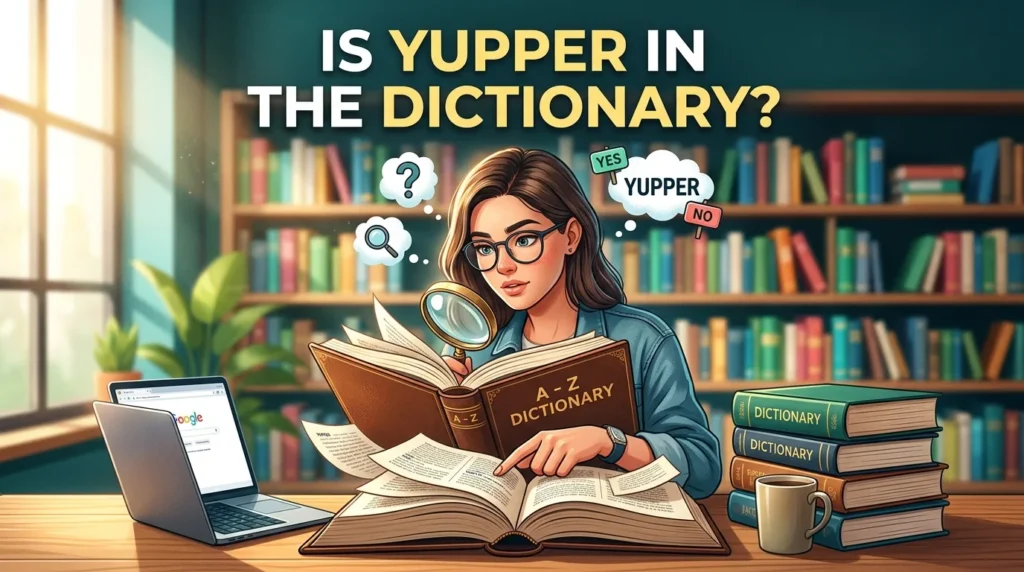
This is where the answer gets more nuanced.
A search for yupper won’t give you the same dictionary evidence you’ll find for yup. Merriam-Webster, for example, has a clear entry for yup, defining it as an informal variant of yep meaning “yes.” Cambridge likewise defines yup as an informal word meaning “yes.”
The evidence for yuppers is different.
Collins currently lists yuppers as a New Word Suggestion, with the meaning “yes; sure” and the part of speech interjection. Collins also states that the word is being monitored for evidence of usage.
Wiktionary provides another useful piece of evidence. It lists yeppers as an informal interjection meaning “yes” and gives yepper and yuppers as alternative forms. It also traces yeppers to yep + -ers.
That doesn’t mean every dictionary treats the forms identically.
| Expression | Dictionary evidence | Meaning | Register |
| yes | Strong standard-dictionary recognition | Affirmation | Neutral |
| yep | Established dictionary word | Yes | Informal |
| yup | Established dictionary word | Yes | Informal |
| yeppers | Recorded in informal lexical sources | Yes | Very informal |
| yuppers | Collins monitors it as a new-word suggestion | Yes; sure | Very informal |
| yupper | Much less established | Informal affirmative | Very informal |
The lesson is simple: dictionary status varies by spelling.
You shouldn’t claim that yupper is a fully standardized English word simply because people understand it. At the same time, you shouldn’t claim that it has no linguistic existence simply because major dictionaries don’t give it the same treatment as yes.
Language lives in actual use. Dictionaries document that use. They don’t create every expression from scratch.
Is Yupper Standard English or Slang?
Yupper is best treated as informal slang or playful conversational language.
That label tells you more about when to use it than about whether the expression has meaning.
English has many informal affirmative forms. Merriam-Webster identifies yup as an informal variant of yep, while Cambridge also labels yup informal.
Yupper takes that informal pattern one step further.
You could think of the register like this:
yes → yep/yup → yeppers/yuppers/yupper
That isn’t a formal linguistic ranking. It simply shows how the expressions can move from neutral toward playful and marked.
What makes an expression slang?
Slang often has several traits:
- It appears more frequently in casual communication.
- It can signal familiarity between speakers.
- It may carry emotional or humorous meaning.
- Its spelling can vary.
- It may spread through speech, texting, social media, or popular culture.
- Its popularity can change quickly.
Yupper fits several of these traits.
That makes it useful in the right setting. It also makes it risky in formal writing.
You wouldn’t normally write:
Yupper, I agree with the proposed changes.
In a formal business report.
You could easily write:
Yes, I agree with the proposed changes.
The second sentence communicates the same basic idea without adding unnecessary informality.
What Does Yupper Mean?
Definition of Yupper
In its affirmative use, yupper means roughly “yes,” “yup,” or “yep.”
The important difference lies in tone.
A plain yes usually gives information. Yupper can give information while also signaling attitude.
For example:
“Are you coming with us?”
“Yupper!”
The answer means yes, but the unusual spelling adds a playful flavor.
It can suggest:
- Agreement
- Confirmation
- Enthusiasm
- Friendliness
- Humor
- Lightheartedness
However, context controls the final interpretation.
Compare:
“Did you send the report?”
“Yes.”
That sounds straightforward.
Now compare:
“Did you send the report?”
“Yuppers!”
The second response sounds more casual. Depending on the relationship between the speakers, it could even sound deliberately goofy.
Is Yupper Common?
Yupper is not as established or familiar as yup, yep, or yes.
That matters for English learners especially.
If you use yup, most English speakers will understand you immediately. Merriam-Webster and Cambridge both document it as an informal form of yes.
With yupper, the listener may understand the intended meaning from context, but the expression feels less conventional.
For everyday communication, these are safer choices:
- Yes
- Yeah
- Yep
- Yup
- Sure
- Absolutely
- Definitely
Then use yupper when the playful tone itself is useful.
What Does Yuppers Mean?
Yuppers means “yes” or “sure” in informal, playful English.
This meaning has stronger documentary support than the standalone yupper spelling. Collins lists yuppers as an informal interjection meaning “yes; sure” and says it is currently being monitored for usage.
Wiktionary lists yuppers as an alternative form of yeppers, which it defines as an informal way to say “yes.”
That gives us a useful distinction:
Yupper → less established, informal affirmative form
Yuppers → documented informal affirmative form related to yeppers
For example:
“Are you ready to leave?”
“Yuppers!”
The response doesn’t change the basic meaning of yes. It changes the social flavor.
Why Does Yuppers Sound More Playful?
The ending makes the word feel more expressive.
English speakers often alter familiar words to make them sound warmer, funnier, cuter, or more emphatic. Yuppers fits that broader conversational habit.
It doesn’t mean that every speaker interprets it identically. Some people may find it charming. Others may find it silly or dated.
That’s normal with expressive vocabulary.
Words aren’t just containers for dictionary definitions. They also carry register, attitude, identity, and social meaning.
Yupper vs. Yuppers
The two forms are closely related in casual usage, but they aren’t equally established.
| Feature | Yupper | Yuppers |
| Basic affirmative meaning | Yes | Yes / sure |
| Formality | Very informal | Very informal |
| Familiarity | Lower | Higher |
| Dictionary evidence | Limited | Stronger informal documentation |
| Typical function | Casual affirmative | Casual affirmative |
| Tone | Playful | Playful or emphatic |
| Best setting | Informal conversation | Texting, chats, casual conversation |
A key point deserves emphasis: yuppers isn’t simply the plural of yupper.
English learners sometimes assume the -s ending must create a plural. Here, it doesn’t work that way.
Yuppers functions as an expressive lexical form. Wiktionary treats it as an alternative spelling of yeppers, not as a plural noun formed from yupper.
That’s why:
“Yuppers!”
doesn’t mean “multiple yuppers.”
It means something closer to:
“Yes!”
or
“Sure!”
Examples of Yupper and Yuppers in Sentences
The easiest way to understand informal vocabulary is to see it in realistic contexts.
Everyday Conversation Examples
Here are natural examples of the affirmative use:
“Are we still meeting at six?”
“Yupper. I’ll be there.”
“Did you remember the tickets?”
“Yuppers!”
“Want some pizza?”
“Yuppers, absolutely.”
“Are you coming with us?”
“Yupper!”
Notice what these examples have in common. They involve casual relationships and low-stakes situations.
You wouldn’t normally use the same expression to answer a judge, write a legal document, or submit an academic paper.
Texting Examples
Texting is one of the environments where playful spellings make particular sense.
Digital communication lacks many of the signals available during face-to-face conversation. A person can use spelling, punctuation, capitalization, and emojis to suggest tone.
Compare:
Yes.
Yup!
Yuppers! 😂
The factual meaning stays close to the same. The emotional presentation changes dramatically.
The final response feels more animated because the spelling itself becomes part of the message.
Casual Workplace Examples
Workplace communication needs more care.
In a friendly team chat, someone might write:
“Can everyone review the slides before lunch?”
A colleague might respond:
“Yup, I’m on it.”
That’s fairly casual but still widely understood.
Yuppers would sound more playful:
“Yuppers! I’ll check them now.”
Whether that works depends on the workplace culture.
A formal client email, however, should use:
“Yes, I’ll review them this morning.”
The rule isn’t complicated: match the word to the audience and purpose.
When Should You Use Yupper?
Use yupper when the conversation welcomes playful, relaxed language.
The word works best when the social situation already feels informal. Think of it as a conversational accessory. It adds personality, but you don’t need it to communicate the underlying message.
Good Situations to Use Yupper
Yupper or yuppers can fit naturally in:
- Text messages with friends
- Casual group chats
- Playful online conversations
- Friendly social-media replies
- Humorous dialogue
- Informal creative writing
- Lighthearted conversations with people you know well
For example:
“Want to grab coffee after work?”
“Yuppers!”
That response sounds relaxed and cheerful.
When to Avoid Yupper
Avoid it when the audience expects polished or formal language.
That includes:
- Academic assignments
- Research papers
- Job applications
- Resumes
- Formal business letters
- Legal documents
- Official complaints
- Professional reports
- Serious announcements
In those situations, use yes, certainly, absolutely, I agree, or another precise alternative.
The issue isn’t that yupper is grammatically dangerous. The issue is register.
Formal vs. Informal Communication
Understanding register can solve most problems with yupper.
Register refers to the way language changes according to audience, situation, purpose, and relationship.
Consider these three versions:
| Situation | Better response |
| Formal report | Yes. |
| Professional email | Yes, certainly. |
| Friendly text | Yup! |
| Playful text | Yuppers! |
| Joke between friends | Yupper! |
The meaning stays similar. The social message changes.
This is why “correct” doesn’t always mean “appropriate.”
A sentence can be grammatically understandable and still sound strange for its setting.
Imagine a lawyer writing:
“Yuppers, the contract has been approved.”
Nothing about the sentence is impossible to understand. Yet the tone doesn’t fit the professional context.
Now imagine two close friends:
“Yuppers, pizza it is!”
That sounds much more natural.
Good writing isn’t only about grammar. It’s also about judgment.
Why Do People Say Yupper Instead of Yes?
The simplest explanation is expressiveness.
“Yes” communicates agreement efficiently. Informal alternatives can add attitude.
Merriam-Webster defines yup as an informal variant of yep meaning “yes,” while Cambridge likewise identifies yup as informal.
From there, speakers can create playful extensions such as yeppers or yuppers.
Wiktionary records yeppers as an informal “yes” and traces its formation to yep + -ers.
This kind of word formation is not unusual.
English speakers often modify familiar expressions for effect. They may stretch a word, repeat it, add a suffix, or alter its spelling.
Think about expressions such as:
- okay → okie
- bye → bye-bye
- yep → yeppers
- yup → yuppers
These forms don’t necessarily add new factual information. Instead, they add social texture.
That’s the real appeal of yupper and yuppers.
Common Situations Where Native Speakers Use Yupper
Friends and Family
Close relationships give people more freedom to experiment with language.
A friend might ask:
“Want to order takeout?”
A playful answer could be:
“Yuppers!”
The word feels natural because the relationship already permits informal language.
Text Messages
Texting encourages short responses.
Instead of writing:
“Yes, that sounds like a good idea.”
someone might simply write:
“Yup!”
A more playful person could write:
“Yuppers!”
The shorter response works because the surrounding conversation supplies the missing context.
Social Media
Social media also encourages expressive language.
Someone posts:
“Best movie of the year?”
A playful reply might be:
“Yuppers!”
The word works as a quick affirmation.
Still, social media isn’t one uniform register. A professional company’s public account should probably avoid slang unless its brand voice deliberately uses it.
Casual Workplace Chats
Internal workplace messaging sits somewhere between personal conversation and formal writing.
A close-knit team might comfortably use:
“Yuppers, I’ll handle that.”
Another workplace might find it too casual.
That’s why workplace culture matters more than an absolute rule.
Common Mistakes When Using Yupper
Mistake: Treating Yupper as Formal English
The biggest mistake is assuming that because people understand Yupper, you can use it everywhere.
You can’t.
The safer formal alternative is yes.
Mistake: Using It in Academic Assignments
Academic writing values precision, consistency, and an appropriate formal register.
Writing:
“Yuppers, the results support the hypothesis.”
would undermine the tone.
Use:
“Yes, the results support the hypothesis.”
Or better yet, restructure the sentence so you don’t need an isolated affirmation at all.
Mistake: Overusing It
Even playful language becomes irritating when repeated too often.
Imagine this exchange:
“Yuppers!”
“Yuppers!”
“Yuppers!”
“Yuppers!”
The word quickly loses its charm.
Expressive vocabulary works best when you use it sparingly.
Mistake: Assuming It’s Appropriate Everywhere
A word’s meaning isn’t the only thing that matters.
You should also consider:
- Who you’re speaking to
- Why you’re speaking
- Where you’re communicating
- How formal the situation is
- Whether the reader knows the expression
- Whether the word could distract from your message
That final point matters in professional writing.
If the reader stops to wonder what yuppers means, the expression has become a distraction rather than a useful stylistic choice.
Yupper vs. Similar Words
The easiest way to understand yupper is to compare it with familiar alternatives.
| Word | Meaning | Tone | Formal use |
| Yes | Agreement | Neutral | Excellent |
| Yeah | Agreement | Casual | Limited |
| Yep | Yes | Casual | Usually avoid |
| Yup | Yes | Casual | Usually avoid |
| Yeppers | Yes | Playful | Avoid |
| Yuppers | Yes / sure | Playful | Avoid |
| Yupper | Yes | Playful, uncommon | Avoid |
| Absolutely | Strong agreement | Confident | Excellent |
| Certainly | Agreement | Polished | Excellent |
| Sure | Agreement | Neutral/casual | Context-dependent |
Merriam-Webster and Cambridge both give yup the core meaning “yes” and classify it as informal.
That makes yup a useful comparison point.
Yupper vs. Yup
Yup is much more established.
If you’re looking for the safest casual version, choose yup.
“Are you ready?”
“Yup.”
Yupper sounds more playful and less conventional:
“Are you ready?”
“Yupper!”
Yupper vs. Yep
Yep is also widely understood and informal.
“Did you finish?”
“Yep.”
Compared with yupper, it sounds cleaner and more ordinary.
Yuppers vs. Yeppers
These two forms are particularly close.
Wiktionary explicitly lists yuppers as an alternative form of yeppers.
Both can express an informal yes.
Yupper vs. Yes
This is really a question of register.
Yes. → direct and neutral
Yupper! → playful and marked
Neither response needs to be grammatically wrong. They simply suit different situations.
Can You Use Yupper in Professional Communication?
Generally, no.
If you’re writing to a client, manager, professor, recruiter, customer, or official organization, yes is almost always the better choice.
Compare:
“Yuppers, I’ll send the document this afternoon.”
with:
“Yes, I’ll send the document this afternoon.”
The second version sounds professional without becoming stiff.
For stronger agreement, you can choose:
- Absolutely.
- Certainly.
- Definitely.
- I agree.
- That works for me.
- I’ll take care of it.
These expressions communicate more precisely than playful slang.
What About Internal Team Chats?
That’s different.
A private team chat can have its own informal culture. If everyone communicates casually, yup may be completely normal.
Yuppers is still more playful and should match the existing tone.
The key is not to treat workplace communication as one giant category. A legal memo and a friendly Slack message may belong to the same organization, yet they require very different language.
Is Yupper Grammatically Correct?
Yupper can function grammatically as an informal standalone response, especially when used as an interjection.
It doesn’t need to follow a normal subject-verb structure.
For example:
“Are you coming?”
“Yuppers!”
The one-word response works because the question provides the missing context.
You could expand it:
“Yuppers, I’ll be there.”
Here, the informal affirmative appears before the rest of the sentence.
Still, grammatically possible doesn’t mean stylistically appropriate.
That’s an important distinction for English learners.
Is Yupper an Interjection?
The affirmative use of yupper can be analyzed as an interjection because it can stand independently as a conversational response.
Merriam-Webster defines an interjection as a word or phrase that is grammatically independent from surrounding words and mainly expresses feeling rather than ordinary propositional meaning. It also notes that interjections occur commonly in speech and electronic messages.
That description fits the way yuppers and yuppers operate in casual conversation.
Consider:
“Are you hungry?”
“Yuppers!”
The response doesn’t function like an ordinary verb in a full sentence. Instead, it serves as an independent conversational reaction.
Collins also identifies yuppers as an interjection in its new-word suggestion.
So, for the affirmative use, interjection is a useful grammatical label.
Pronunciation of Yupper
Because yupper is uncommon and lacks the same standardized dictionary treatment as yup, pronunciation can be less firmly documented.
The closely related yeppers is documented by Wiktionary with General American pronunciation /ˈjɛpɚz/.
The safest practical approach is to avoid treating an informal spelling as though it has one universally prescribed pronunciation.
If you encounter yupper in conversation, context usually makes the intended meaning clear.
Don’t confuse the affirmative form with Yooper, though. Cambridge gives Yooper as /ˈjuː.pɚ/ in American English and defines it as someone from Michigan’s Upper Peninsula.
That distinction becomes especially important when reading the words rather than hearing them.
Where Did the Word Yupper Come From?
The origin of yupper itself isn’t as firmly documented as the history of yup.
For the broader affirmative family, there is stronger evidence.
Merriam-Webster identifies yup as an informal variant of yep, meaning “yes.” Dictionary.com traces yup to an emphatic form related to yeah, noting the role of the final p in the spoken form.
Wiktionary traces yeppers to yep + -ers and lists yuppers as an alternative form.
That gives us a reasonable linguistic path:
yes → yep → yeppers / yuppers
The exact development of yupper should be treated more cautiously.
It’s tempting to invent a neat origin story, but good language analysis separates documented evidence from reasonable inference.
Why Do These Variants Appear?
Informal English often rewards expressiveness.
A speaker may take a familiar word and reshape it to make the response sound:
- More cheerful
- More humorous
- More emphatic
- More personal
- Less stiff
That’s likely why forms related to yep and yup can develop multiple playful variants.
Is Yupper Common in American English?
Yupper is not a mainstream American English form.
American English speakers are far more likely to recognize yes, yeah, yep, and yup.
Merriam-Webster and Cambridge both document yup as an informal form of yes, which gives it a much stronger dictionary footing.
Yuppers has clearer evidence as an informal affirmative than yupper. Collins currently monitors it as a new-word suggestion, while Wiktionary records it as an alternative form of yeppers.
So it would be misleading to describe yupper as a common everyday word across American English.
A better description is:
Yupper is an uncommon, highly informal affirmative expression that some speakers may understand or use playfully.
That’s more precise.
Is Yupper Common in British English?
There is no strong reason to treat yupper as a standard British English expression.
The broader form yup, however, is recognized in British English dictionaries. Cambridge lists yup as an informal word meaning “yes” in both its general English and American dictionary material.
That distinction matters.
You shouldn’t assume that because British English uses yup, British speakers commonly use yupper.
The forms overlap in meaning, but their frequency and social familiarity can differ.
If you’re writing for a broad English-speaking audience, yes, yep, or yup will usually be clearer.
Is Yupper Used Around the World?
English travels well, but informal slang doesn’t always travel evenly.
A learner in one country may encounter yuppers online without hearing it in everyday local speech. Another speaker may recognize it instantly from American internet culture.
This creates an important distinction between:
English understood internationally and English commonly used locally.
Words such as yes have global recognition. Informal forms such as yupper depend much more on exposure.
Online communication can also blur regional boundaries. A person may pick up an American slang expression from videos, games, social media, or online communities without using it naturally in local conversation.
For English learners, that means recognition and production aren’t the same skill.
You may understand yuppers perfectly without needing to use it yourself.
Yupper and Yooper: Don’t Confuse Them
This is one of the most useful distinctions in the entire topic.
Yupper and Yooper look similar, but they can refer to completely different things.
Yooper is an established regional term for a native or resident of Michigan’s Upper Peninsula. Cambridge lists it as an informal noun and adjective, while Dictionary.com gives the same regional meaning.
Michigan State University Extension explains that Yooper is a nickname for a resident of Michigan’s U.P. and connects the form with “U.P.-er.”
So:
“Yuppers!” → informal “yes”
“She’s a Yooper.” → someone from Michigan’s Upper Peninsula
Those are entirely different uses.
Why the Confusion Happens
The spelling looks close:
Yupper
Yooper
Both contain the y sound and an ending that resembles an English person-word formation.
But spelling similarity doesn’t establish shared meaning or origin.
That’s a useful lesson beyond this particular word. English contains many near-matches that look related while having completely different histories.
Tips for English Learners
If you’re learning English, you don’t need to memorize every playful variation you encounter online.
Focus first on the expressions that give you the broadest usefulness.
Learn These First
- Yes — neutral and standard
- Yeah — common and casual
- Yep — casual
- Yup — casual
- Sure — flexible
- Absolutely — emphatic
- Certainly — more formal
Once those forms feel natural, you’ll understand playful variants more easily.
Treat Yupper as Recognition Vocabulary
For many learners, yupper is more useful as a word to recognize than a word to actively produce.
If someone writes:
“Yuppers! I’m coming.”
you should understand that the speaker means something like:
“Yes! I’m coming.”
You don’t have to copy the expression to communicate naturally.
Pay Attention to Register
When learning vocabulary, ask three questions:
- What does the word mean?
- Who normally uses it?
- Where would it sound natural?
That third question often separates advanced language users from beginners.
Knowing that yupper means “yes” is useful. Knowing that it sounds playful and informal is even more useful.
Use the Safest Alternative When Unsure
If you aren’t sure whether yupper fits, use yes.
You can always sound more casual later.
The reverse is harder. A playful word can make a formal message sound careless.
A Practical Yupper Usage Guide
| If you’re writing… | Use | Avoid |
| Academic paper | Yes | Yupper |
| Job application | Yes | Yuppers |
| Formal email | Yes / Certainly | Yupper |
| Client communication | Yes / Absolutely | Yuppers |
| Friendly text | Yup / Yep | Usually fine, but Yupper is more marked |
| Joke with friends | Yupper / Yuppers | No major issue |
| Social-media banter | Yuppers | Depends on audience |
| Creative dialogue | Yupper / Yuppers | Only if the character’s voice supports it |
The table captures the central rule: meaning tells you what a word says, while register tells you where it belongs.
The Bottom Line on Yupper and Yuppers
Yupper is understandable as an informal affirmative expression, but it isn’t as established as yes, yep, or yup. Yuppers has stronger evidence as an informal form meaning “yes” or “sure.” Collins currently monitors yuppers as a new-word suggestion, while Wiktionary records it as an alternative form of yeppers, another informal affirmative.
The practical answer is straightforward. Use yupper or yuppers when you deliberately want a playful, relaxed tone. Don’t use them when your audience expects formal or professional English.
And remember the regional distinction: Yooper means a person from Michigan’s Upper Peninsula. It isn’t another spelling of the affirmative expression.
So if someone texts “Yuppers!”, you can safely read it as an enthusiastic “yes.” If someone says “She’s a Yooper,” you’re hearing something completely different.
That small distinction turns a confusing slang question into a useful lesson about meaning, register, dictionary status, word formation, and real-world English usage.
Yupper vs. Yuppers: Are They Actually Different?
Yupper and yuppers generally point toward the same basic idea: an informal, playful way to express “yes.” However, the two forms don’t have the same level of recognition. Yuppers has clearer lexical documentation. Wiktionary lists it as an alternative spelling of yeppers, which it defines as an informal interjection meaning “yes.”
The extra -s in yuppers shouldn’t be treated as an ordinary plural ending. In this expression, it doesn’t mean “more than one yupper.” Instead, the spelling belongs to an expressive form that developed around informal affirmative words. Wiktionary traces yeppers to yep + -ers.
So, if someone asks:
“Are you coming with us?”
Either of these could appear in a playful conversation:
Yupper!
Yuppers!
Both communicate agreement. Yuppers, however, can sound more exaggerated, cheerful, or deliberately playful.
Yupper vs. Yup
The difference becomes clearer when you compare yupper with yup.
Yup has much stronger dictionary recognition. Oxford lists yup as an informal exclamation used to say “yes,” while the American Heritage Dictionary also defines it as informal “yes.”
That makes yup the safer choice when you want casual English that most readers will recognize immediately.
Compare these responses:
| Expression | Meaning | Typical impression |
| Yes | Agreement | Neutral |
| Yep | Agreement | Casual |
| Yup | Agreement | Casual and relaxed |
| Yupper | Agreement | Playful and less conventional |
| Yuppers | Agreement | Playful and expressive |
Oxford gives both yep and yup as informal forms meaning “yes.”
That distinction gives English learners a practical shortcut: use yup when you want familiar casual English; use yupper only when you intentionally want a more playful flavor.
Yupper vs. Yep
Yep also has solid dictionary support. Oxford describes it as an informal exclamation meaning “yes,” and Dictionary.com identifies it as an informal form with the same basic meaning.
In everyday conversation, yep usually sounds more natural than yupper.
For example:
“Did you send the email?”
“Yep.”
That response feels ordinary and effortless.
Now change it:
“Did you send the email?”
“Yupper!”
The second response sounds more noticeable. It may suggest humor, enthusiasm, or a deliberately quirky personality.
That’s the key distinction. Yupper adds style where yep simply confirms information.
What Does Yuppers Mean?
Yuppers means “yes,” “sure,” or another enthusiastic form of agreement in informal usage.
Wiktionary lists yuppers as an alternative spelling of yeppers. Its entry for yeppers defines the expression as an informal “yes” and gives yuppers as an alternative form.
You can therefore understand the expression without treating it as a complicated vocabulary item.
For example:
“Want to grab lunch?”
“Yuppers!”
The speaker isn’t saying anything fundamentally different from:
“Yes!”
The spelling simply adds a little personality.
Why Does Yuppers Sound More Expressive?
Short affirmative words can carry more than their literal meaning.
Think about the difference between these responses:
Yes.
Yep.
Yup!
Yuppers!
The basic answer remains affirmative. The social tone changes.
Yes sounds neutral.
Yep sounds casual.
Yup sounds relaxed.
Yuppers sounds playful, cheerful, or intentionally exaggerated.
The expression can even become humorous when the speaker uses it in an obviously informal situation.
For instance:
“Did you really eat the entire pizza?”
“Yuppers.”
That response may sound mischievous rather than merely informative.
How Yuppers Work in Digital Communication
Informal affirmative expressions fit especially well in texting and online conversation because digital messages don’t carry all the signals of face-to-face speech.
When someone speaks, listeners can hear:
- Vocal pitch
- Stress
- Timing
- Volume
- Hesitation
- Laughter
Text removes most of those cues.
Writers compensate by using:
- Spelling variations
- Capitalization
- Exclamation points
- Emojis
- Repetition
- Informal vocabulary
That’s why a person may write “Yuppers!” instead of “Yes.”
The first response creates a stronger sense of personality.
Compare:
Yes.
with:
Yuppers! 😄
The factual answer remains almost identical. The emotional signal changes considerably.
Texting Examples
“Movie tonight?”
“Yuppers!”
“Are you bringing snacks?”
“Yupper, obviously.”
“Did you finish the assignment?”
“Yuppers. Finally!”
These examples work because the conversations are relaxed. Nobody expects formal prose in a quick text exchange.
When Should You Use Yupper?
The safest rule is simple:
Use yupper when the situation welcomes playful, informal language.
You don’t need to force it into ordinary conversations. In fact, yup, yep, or yes will often sound more natural.
Use yupper when the unusual expression itself adds something to the conversation.
Good Situations for Yupper
Yupper can work in:
- Friendly text messages
- Group chats
- Casual conversations
- Playful social-media replies
- Humorous dialogue
- Informal online communities
- Character dialogue in fiction
- Jokes between people who know each other well
For example:
“Want to go for ice cream?”
“Yupper!”
That feels light and friendly.
The same word could sound strange in a formal situation:
“Yupper, I accept the terms of the contract.”
The grammar isn’t the main problem. The register is.
When to Avoid Yupper
Avoid yupper when your reader expects polished, professional English.
That includes:
- Academic papers
- Job applications
- Resumes
- Formal business emails
- Legal documents
- Official reports
- Professional proposals
- Formal customer communication
- Serious workplace announcements
Instead, choose a form that matches the situation:
Yes, I agree.
Certainly.
Absolutely.
Yes, that works for me.
I agree with that approach.
These alternatives communicate agreement without introducing unnecessary slang.
Yupper in Casual Workplace Communication
Workplace communication deserves a little more nuance.
Not every workplace conversation requires formal English. A private team chat can be quite relaxed, especially when coworkers already know one another.
For example:
“Everyone ready for the meeting?”
“Yup!”
That’s casual but familiar.
Yuppers pushes the tone further:
“Yuppers! Let’s do this.”
That could work in a friendly team environment. However, it might feel out of place in a conservative corporate setting.
The same organization can contain different communication styles.
A team chat might allow:
“Yuppers, I’ll handle it.”
A client email should probably say:
“Yes, I’ll handle it.”
The audience changes. So does the appropriate register.
Why Do People Say Yupper Instead of Yes?
People don’t always choose words based on literal meaning alone.
Sometimes they choose a word because of how it sounds.
Yes is efficient. It does the job.
Yup feels more relaxed.
Yupper sounds more playful.
Yuppers can sound even more expressive.
This reflects a broader feature of conversational English. Speakers often modify familiar expressions to show emotion, familiarity, humor, or personality.
Dictionary.com explains the development of yup as a form related to yeah, with the final p associated with closing the lips at the end of the utterance.
The related forms then show how informal affirmative language can develop additional variants.
Wiktionary specifically records yeppers as deriving from yep + -ers and lists yuppers as an alternative form.
That evidence gives us a useful linguistic picture without pretending that every spelling has a perfectly documented history.
Yupper, Yuppers, and Tone
Tone may be the most important part of understanding these expressions.
Consider this short exchange:
“Are you coming?”
“Yes.”
The response is neutral.
Now:
“Are you coming?”
“Yup!”
The response sounds casual.
Now:
“Are you coming?”
“Yuppers!”
The answer sounds more animated.
That doesn’t mean yuppers always communicate enthusiasm. Context can change the interpretation.
Someone might write:
“Yuppers…”
with an ellipsis to sound reluctant or sarcastic.
Someone else might write:
“YUPPERS!”
to exaggerate excitement.
The vocabulary stays the same. The surrounding signals reshape the message.
Punctuation Can Change the Feeling
Compare:
- Yupper.
- Yupper!
- Yuppers!
- Yuppers…
- YUPPERS!
These forms can create different impressions even though the underlying answer remains affirmative.
This is particularly important in digital communication because punctuation often replaces vocal expression.
Is Yuppers More Common Than Yupper?
The available lexical evidence supports yuppers more clearly than yupper as an informal affirmative form.
Wiktionary has a dedicated yuppers entry and identifies it as an alternative spelling of yeppers.
By contrast, the evidence for yupper is less standardized. Search results show informal usage, but that doesn’t establish the expression as a widely recognized standard-English headword.
This distinction is worth making because online articles sometimes overstate the popularity of unusual slang.
It’s more accurate to say:
Yuppers has clearer documentation as an informal affirmative expression, while yupper remains a less established variant.
That wording respects actual evidence without dismissing real-world usage.
Is Yupper Grammatically Correct?
In a casual conversation, yupper can work as an independent affirmative response.
For example:
“Are you ready?”
“Yupper!”
This resembles other standalone conversational responses such as:
“Yep!”
“Sure!”
“Absolutely!”
The expression doesn’t need a subject and verb because it functions as an independent response.
However, grammatical possibility doesn’t make every context appropriate.
A student could write:
“Yupper, the evidence supports the argument.”
A professor would likely find the wording unnecessarily casual.
A better academic sentence would simply say:
“Yes, the evidence supports the argument.”
Or, even better, integrate the point directly into the argument.
The important lesson is this: grammar and register are separate questions.
A form can work grammatically while still being a poor stylistic choice.
Is Yupper an Interjection?
For its affirmative use, yupper can be understood as an interjection.
An interjection can function independently and express an immediate reaction, feeling, or response. Yuppers has stronger explicit support for this classification. Wiktionary labels an interjection yuppers, while its yeppers entry also labels that form an interjection.
Consider:
“Did you enjoy the concert?”
“Yuppers!”
The response stands alone.
It doesn’t describe an action like a conventional verb. It doesn’t name a person or object like a noun. Instead, it performs a conversational function: affirming what the other person asked.
That’s why the interjection label makes practical sense.
Yupper vs. Similar Affirmative Words
The easiest way to choose correctly is to compare the expressions side by side.
| Expression | Meaning | Formality | Typical tone |
| Yes | Agreement | Formal/neutral | Direct |
| Certainly | Strong agreement | Formal | Polished |
| Absolutely | Strong agreement | Neutral/formal | Confident |
| Sure | Agreement | Neutral/casual | Relaxed |
| Yep | Yes | Informal | Casual |
| Yup | Yes | Informal | Relaxed |
| Yeppers | Yes | Very informal | Playful |
| Yuppers | Yes/sure | Very informal | Playful |
| Yupper | Yes | Very informal | Playful/uncommon |
Oxford confirms that yep and yup function as informal ways to say yes.
This makes them much safer choices for casual English learners.
Yupper vs. Yeah
Yeah is far more common in ordinary spoken English.
“Are you hungry?”
“Yeah.”
That sounds completely natural.
“Are you hungry?”
“Yupper!”
The second response deliberately draws attention to itself.
That’s not necessarily bad. It simply creates a different conversational effect.
Yupper vs. Absolutely
These expressions don’t have the same force.
Absolutely often communicates strong agreement or certainty.
“Do you agree?”
“Absolutely.”
Yupper mainly communicates affirmative agreement with a playful tone.
“Do you agree?”
“Yupper!”
If clarity and confidence matter, absolutely usually works better.
If humor matters, yupper may fit.
Common Mistakes With Yupper and Yuppers
Using Yupper in Formal Writing
This is the most obvious mistake.
Don’t write:
“Yuppers, the company accepts the proposal.”
Write:
“Yes, the company accepts the proposal.”
The formal version communicates the point more cleanly.
Assuming Yuppers Is a Standard Synonym for Yes
It’s safer to describe yupper as an informal affirmative expression, not as a standard replacement for yes in every context.
That distinction prevents awkward writing.
Treating Yuppers as a Normal Plural
The -s in yuppers doesn’t function like the plural ending in ordinary nouns.
It doesn’t mean several “yuppers.”
Wiktionary instead treats yuppers as an alternative spelling of yeppers.
Assuming Every Speaker Uses It
Informal slang varies widely.
One speaker may use yuppers regularly. Another may find it unfamiliar or overly cute.
That variation is normal.
Overusing the Expression
A playful word loses its impact when you repeat it constantly.
One yuppers can sound amusing.
Ten yuppers in the same conversation can become distracting.
Use expressive vocabulary like seasoning. A little adds flavor. Too much overwhelms the dish.
A Quick Decision Guide
When you’re unsure whether to use yupper, ask yourself:
Is the conversation casual?
If yes, it may fit.
Does the person understand playful slang?
If you’re unsure, choose yup or yes.
Is the message professional?
Choose yes, certainly, or absolutely.
Are you writing academically?
Avoid yupper and yuppers.
Are you deliberately creating a playful voice?
Then yupper or yuppers can work when the character or speaker’s personality supports it.
The best vocabulary choice isn’t always the fanciest one. It’s the one that fits the moment.
Practical Examples: Which One Sounds Best?
| Situation | Natural choice | Why |
| Friend asks if you’re free | Yup! | Casual and familiar |
| Close friend jokes with you | Yuppers! | Playful |
| You need a neutral answer | Yes. | Clear and universal |
| Client asks for confirmation | Absolutely. | Professional and confident |
| Professor asks for agreement | Yes. | Appropriate register |
| Funny text exchange | Yupper! | Adds personality |
| Formal report | Yes | Clear and professional |
| Social-media banter | Yuppers! | Informal and expressive |
This is the practical heart of the topic.
You don’t need to decide whether yupper is “good” or “bad” English in isolation. Ask whether it fits the communication situation.
That approach gives you a much more useful answer than a simple dictionary yes-or-no test.
Where Did Yupper Come From?
The history of yupper is less straightforward than the history of common words such as yes, yep, or yup. There isn’t strong evidence for a single, clearly documented moment when yupper entered English. Instead, it fits a broader pattern of informal English speakers modifying short affirmative expressions to make them sound more playful or emphatic.
The closest well-documented form is yeppers. Wiktionary lists yepper and yuppers as alternative forms of yeppers and gives its formation as yep + -ers. It also classifies yeppers as an informal interjection meaning “yes.”
That development makes linguistic sense. English speakers frequently attach endings to familiar words to create expressive forms. The result doesn’t necessarily introduce a new idea. Instead, it changes the tone.
Think of the progression this way:
yes → yep → yeppers / yuppers
Each form remains connected to affirmation, but the later forms sound increasingly informal.
Historical discussion of yeppers also points to older American usage. One linguistic discussion cites yep in American sources from the late nineteenth century and describes yeppers as a later colloquial formation. The evidence suggests that these forms developed through spoken language rather than through a single deliberate naming event.
That distinction matters. Informal expressions often leave a messy paper trail because people say them long before writers record them.
The Connection Between Yupper, Yep, and Yeppers
The strongest linguistic connection is between yupper and the broader family of informal affirmative forms built around yep and yup.
Yep and yup are established informal forms of yes. The longer forms add an expressive layer.
| Form | Basic meaning | Main effect |
| Yes | Affirmation | Neutral |
| Yep | Yes | Casual |
| Yup | Yes | Relaxed |
| Yupper | Yes | Playful or emphatic |
| Yeppers | Yes | Playful or emphatic |
| Yuppers | Yes | Playful and informal |
Wiktionary’s entry for yeppers provides particularly useful evidence because it explicitly traces the word to yep + -ers.
So, rather than imagining yupper as a completely unrelated invention, it’s more useful to understand it within the larger family of playful affirmative expressions.
Why Does English Create Words Like Yupper?
English doesn’t stand still.
Speakers constantly shorten, extend, remix, and reshape words. Sometimes those changes eventually become standard vocabulary. Other times, they remain slang or conversational expressions.
Short responses are especially easy to modify.
Consider these familiar forms:
- yes
- yeah
- yep
- yup
- nope
- nah
- sure
- absolutely
Speakers can make these responses sound warmer, funnier, stronger, or more exaggerated through pronunciation and word formation.
Yupper fits that conversational pattern.
It isn’t valuable because it expresses a meaning that yes cannot express. Its value comes from the social flavor it adds to the response.
That’s why a person might choose:
“Yupper!”
instead of:
“Yes.”
The information stays almost identical. The personality changes.
Is Yupper Related to Yooper?
This is an important distinction because yupper and Yooper look and sound similar.
They aren’t the same word.
Yooper is a regional term associated with a person from Michigan’s Upper Peninsula, commonly abbreviated as the U.P. The term has a distinct geographical and cultural meaning.
Yupper, when used as an affirmative expression, is instead connected with informal yup/yes language.
So don’t assume that someone using yupper is referring to Michigan’s Upper Peninsula.
| Word | Meaning |
| Yupper | Informal affirmative expression in some usage |
| Yuppers | Informal affirmative expression; alternative spelling of yeppers |
| Yooper | Person associated with Michigan’s Upper Peninsula |
| Yuppie | Informal term historically associated with young urban professionals |
The visual similarity can create confusion, particularly for English learners. Context usually resolves the issue quickly.
If someone says:
“Are you coming to dinner?”
Yupper probably signals agreement.
If someone says:
“He’s a Yooper.”
The conversation is almost certainly about Michigan’s Upper Peninsula.
How Do You Pronounce Yupper?
Because yupper isn’t as standardized as yes, yep, or yup, pronunciation can vary somewhat in informal use.
A natural pronunciation is approximately:
YUP-er
The first syllable sounds like yup, followed by a relaxed -er sound.
For the related word yeppers, Wiktionary gives General American pronunciation as approximately /ˈjɛpɚz/.
That corresponds roughly to:
YEP-ers
The distinction between yupper and yuppers can therefore be subtle when spoken quickly.
Pronunciation Breakdown
For yupper:
YUP + er
For yuppers:
YUP + ers
The first part carries the main meaning. The ending contributes to the playful quality.
You don’t need to pronounce the word dramatically. In natural conversation, it usually sounds like a quick, casual affirmative response.
For example:
“Ready to leave?”
“Yupper.”
The speaker may deliver it quickly, almost like “yup” with an extra syllable.
Is Yupper American English?
Yupper appears primarily in informal American English contexts, although that doesn’t mean every American speaker uses it.
The strongest evidence surrounding the related yeppers/yuppers forms points toward American informal usage. Reverso, for example, labels yeppers as a rare informal US expression meaning agreement.
That label is useful because it prevents an important misunderstanding.
Informal American usage does not equal universal American usage.
A person from one part of the United States may recognize yuppers immediately. Someone else may rarely encounter it.
Language communities aren’t perfectly uniform.
Regional background, age, social group, online habits, and personal vocabulary all influence which slang expressions people recognize.
Is Yupper Common in American English?
It’s better to describe yupper as uncommon and highly informal rather than as a standard everyday American word.
Forms such as yes, yeah, yep, and yup are much more broadly recognizable.
The related yuppers has explicit dictionary-style documentation as an alternative spelling of yeppers.
That gives us a useful hierarchy:
Most widely recognizable:
yes → yeah → yep → yup
More playful and less conventional:
yeppers → yuppers → yupper
This doesn’t mean the less conventional forms are meaningless. It means readers should expect more variation in recognition and acceptance.
Is Yupper Common in British English?
There is less reason to treat yupper as a characteristic British-English expression.
British speakers certainly use informal affirmative forms such as yeah, yep, and yup. However, the playful yupper/yuppers forms are not among the most established general-purpose affirmative expressions in British English.
That difference matters for international readers.
If you’re writing for a global audience, yes, yep, or yeah will usually create fewer comprehension problems.
If you’re deliberately reproducing informal American-style dialogue, however, an expression such as yupper may work when the character’s voice supports it.
Why Regional Recognition Matters
Slang doesn’t behave like a mathematical formula.
You can’t assume:
“One American uses it, therefore every American knows it.”
That approach creates problems with many informal expressions.
Instead, think about recognition, context, and audience.
A close friend may understand yuppers instantly.
A British business client may find it unusual.
An English learner may mistake it for a standard dictionary word.
A formal editor may remove it entirely.
All four reactions are plausible.
Is Yupper Used Around the World?
English speakers around the world encounter informal American expressions through movies, television, gaming, social media, messaging apps, and online communities.
That exposure can spread vocabulary far beyond its original speech community.
Still, recognition doesn’t automatically make a word standard.
Someone in another country might understand:
“Yuppers!”
because they have seen it online.
That doesn’t mean the expression has become equally common in their local variety of English.
This distinction is especially important for English learners.
Online exposure can make unusual expressions look more common than they actually are. Social media tends to amplify expressive vocabulary because playful words attract attention and fit short messages.
Online English Changes the Picture
Digital communication creates an environment where unusual spellings can thrive.
A person can type:
“Yuppers!”
without worrying about formal editorial standards.
That message may then be copied, shared, quoted, or used as a joke.
Over time, repeated exposure makes the expression familiar to more people.
However, familiarity and standardization aren’t the same thing.
A slang term can become widely recognizable without becoming appropriate for formal writing.
That’s exactly why context matters so much with yupper.
Yupper in Social Media and Online Communities
Online spaces provide a natural home for playful affirmative expressions.
People often want their messages to sound:
- Friendly
- Energetic
- Humorous
- Relaxed
- Approachable
- Enthusiastic
A plain yes can sometimes sound too stiff in a casual conversation.
Compare:
“Are you joining us?”
“Yes.”
with:
“Are you joining us?”
“Yuppers!”
The second reply carries more personality.
That’s particularly useful in social-media comments, gaming chats, group conversations, and memes.
Social Media Example
Imagine someone posts:
“Who else is excited for the weekend?”
A response such as:
“Yuppers!”
sounds deliberately cheerful.
A response such as:
“Yes.”
sounds much more neutral.
Neither answer is grammatically problematic. They’re simply performing different social functions.
Yupper in Gaming and Group Chats
Gaming communities often favor short, expressive responses.
Players need to communicate quickly. A long sentence isn’t always practical.
You might see:
“Ready?”
“Yup.”
Or, in a more playful group:
“Yuppers!”
The expression works because the context already establishes an informal relationship.
The same principle applies to group chats among friends.
“Pizza tonight?”
“Yupper.”
“What time?”
The first response confirms agreement. The second moves the conversation forward.
There’s no need to make the word carry more meaning than it actually has.
Can Yupper Sound Sarcastic?
Yes. Like many short affirmative expressions, yupper can become sarcastic depending on context.
Consider:
“You definitely remembered to charge your phone, right?”
“Yupper…”
The answer technically sounds affirmative. The ellipsis, situation, or surrounding conversation may suggest that the speaker actually feels doubtful or embarrassed.
Another example:
“You want to clean the whole house tonight?”
“Yupper.”
If the speaker normally hates cleaning, the response could sound intentionally exaggerated.
This demonstrates an important feature of informal language:
Meaning isn’t determined by vocabulary alone.
Tone, punctuation, timing, relationship, and context all contribute.
How Yupper Works in Dialogue
Writers can use expressions like yupper to reveal personality.
Imagine two characters answering the same question.
Character A:
“Yes.”
Character B:
“Yuppers!”
The words tell readers something about their voices.
Character A may sound reserved or straightforward.
Character B may sound energetic, humorous, or deliberately casual.
That makes informal expressions useful in fiction and dialogue.
A Small Dialogue Case Study
Consider this exchange:
“Did you actually volunteer to organize the party?”
“Yupper.”
“You know that means buying all the decorations, right?”
“Yuppers.”
Here, repetition isn’t just grammatical filler. It helps establish a playful character.
The same exchange using yes would sound much more neutral:
“Did you actually volunteer to organize the party?”
“Yes.”
“You know that means buying all the decorations, right?”
“Yes.”
The information remains identical. The characterization changes.
What English Learners Should Know About Yupper
English learners should recognize yupper without feeling obligated to use it.
That’s an important difference.
Vocabulary knowledge has two sides:
Recognition vocabulary includes words you understand when someone else uses them.
Production vocabulary includes words you confidently use yourself.
You can recognize yupper as an informal affirmative expression while still choosing yes, yep, or yup when speaking.
That’s often the smarter approach.
A Practical Learning Strategy
When you encounter an unfamiliar informal expression, ask three questions:
What does it mean?
For yupper, the affirmative use generally means yes.
How formal is it?
It’s highly informal and playful.
Where would a native speaker naturally use it?
Usually in casual speech, texting, online conversations, humor, or relaxed dialogue.
This method works for many slang expressions beyond yupper.
Yupper vs. Yuppers: Which Form Should You Choose?
If you’re intentionally using the expression, yuppers has clearer lexical documentation because it appears as an alternative spelling of yeppers.
Yupper can still appear in informal usage, but its status is less standardized.
That leads to a practical recommendation: For recognition: understand both forms.For casual playful writing: either may work if the audience understands the expression.For formal writing: use yes or another standard affirmative expression.For English-learning purposes: prioritize yes, yeah, yep, and yup before learning rarer variants.
This approach gives you both accuracy and flexibility.
A Useful Register Guide for Yupper
| Communication setting | Yupper | Yuppers | Better alternative |
| Close friends | ✅ | ✅ | — |
| Family texting | ✅ | ✅ | Yup |
| Social media banter | ✅ | ✅ | Yep |
| Gaming chat | ✅ | ✅ | Yup |
| Humorous dialogue | ✅ | ✅ | — |
| Casual coworker chat | ⚠️ | ⚠️ | Yep |
| Professional email | ❌ | ❌ | Yes |
| Academic writing | ❌ | ❌ | Yes |
| Legal writing | ❌ | ❌ | Yes |
| Formal report | ❌ | ❌ | Yes |
The middle category deserves attention.
A casual workplace chat can tolerate informal language, but workplace culture varies. If you don’t know the audience well, yep or yes is safer.
What Makes Yupper Different From Standard English?
Standard English focuses on widely accepted forms that work across formal and informal settings.
Informal slang serves a different purpose.
It often communicates social identity and attitude as much as literal meaning.
That’s why expressions such as yupper can feel meaningful despite having an extremely simple dictionary definition.
The word isn’t adding a new fact.
It’s adding voice.
Think of it like changing the packaging around the same message. The contents remain similar, but the presentation changes.
Yes delivers the message plainly.
Yupper delivers it with a wink.
Yuppers may deliver it with an even bigger grin.
That difference explains why people continue creating playful variations of ordinary words.
The Bottom Line for Usage
If you’re writing a formal sentence, don’t reach for yupper simply because it means yes.
If you’re writing a casual text, humorous dialogue, or playful social-media response, the expression can fit naturally.
And if you’re learning English, don’t mistake an entertaining slang form for a universal vocabulary item.
The safest progression remains:
yes → yep → yup → yupper/yuppers
As the expression moves rightward, the tone becomes more playful, and the usage becomes less universal.
That single rCan You Use Yupper in Professional Communication?
Yupper generally isn’t the best choice for professional communication. Although readers may understand it as an informal way to say yes, professional English usually favors familiar, clear, and appropriately formal expressions.
For example:
“Yupper, I’ll send the revised report this afternoon.”
The meaning is obvious, but the tone sounds unusually casual. A more professional version would be:
“Yes, I’ll send the revised report this afternoon.”
You could also write:
“Absolutely, I’ll send the revised report this afternoon.”
The difference comes down to register, which means the level of formality appropriate for a particular situation. Yupper belongs toward the playful end of the language spectrum.
| Situation | Better choice |
| Formal business email | Yes |
| Client communication | Certainly |
| Professional agreement | Absolutely |
| Academic writing | Yes |
| Friendly coworker chat | Yep |
| Close friends | Yup |
| Playful conversation | Yupper |
| Humorous texting | Yuppers |
A private workplace chat may allow yupper when coworkers already communicate casually. However, an email to a client usually calls for something more conventional.
Is Yupper Grammatically Correct?
Whether yupper is “grammatically correct” depends on how you’re using the expression.
As a standalone informal response, yupper can function like an affirmative interjection:
“Are you coming with us?”
“Yupper!”
The response doesn’t contain a subject or verb. That’s not necessarily a grammatical problem because conversational English frequently uses standalone expressions such as yes, yep, yup, sure, and absolutely.
For example:
“Are you ready?”
“Absolutely!”
Nobody expects the second response to contain a complete sentence.
The same principle can apply to yupper. However, grammatical functionality doesn’t automatically make an expression suitable for every type of writing.
That’s an important distinction.
Grammar and Standard English Aren’t Identical
A word can function naturally in conversation without being appropriate in formal writing.
For example:
“Wanna come over?”
This sounds natural in casual speech, but formal writing would normally use:
“Do you want to come over?”
Similarly, yupper can work in playful conversation without becoming a standard substitute for yes.
Native speakers use thousands of informal expressions that don’t belong in every setting. Understanding that difference helps English learners recognize natural speech without copying every informal expression into essays, reports, or professional emails.
Common Mistakes When Using Yupper
Using Yupper in Formal Writing
The most common mistake involves putting yupper into a situation that requires conventional English.
Avoid:
“Yupper, the proposal has been approved.”
Prefer:
“Yes, the proposal has been approved.”
The second version sounds more professional and doesn’t distract the reader.
Using Yupper in Academic Assignments
Academic writing normally requires a more formal register.
For example:
“Yupper, the research supports this argument.”
sounds conversational and somewhat playful.
A stronger academic version would be:
“Yes, the research supports this argument.”
In many cases, you can remove the response entirely:
“The research supports this argument.”
That version gets straight to the point.
Overusing Yupper
Even informal language can become awkward through repetition.
Consider:
“Are you hungry?”
“Yupper.”
“Want pizza?”
“Yupper.”
“Pepperoni?”
“Yupper.”
The first yupper might sound funny. Repeating it throughout the exchange can make the dialogue feel forced.
Natural conversations usually contain variation:
“Yup.”
“Absolutely.”
“Sure.”
“Sounds good.”
A playful expression works best when it adds personality rather than replacing every affirmative response.
Assuming Yupper Works Everywhere
Meaning isn’t the only factor that determines whether a word works.
You should also consider:
- Audience
- Purpose
- Relationship
- Formality
- Communication channel
- Tone
- Cultural expectations
A joke between close friends allows much more linguistic freedom than a formal business document.
That’s why yupper is best treated as a context-dependent expression.
Is Yupper Appropriate for English Learners?
English learners should understand yupper, but they don’t need to make it part of their everyday vocabulary.
This distinction between recognition and production matters.
You might see:
“Yuppers!”
in a social-media comment and understand that the writer means yes.
That’s useful vocabulary knowledge.
However, when speaking or writing yourself, yes, yep, and yup are safer choices because they’re more widely recognized.
A practical learning order looks like this:
Yes → Yeah → Yep → Yup → Yupper/Yuppers
The first four forms are far more useful for general communication.
Once you understand those expressions, unusual variants such as yupper become easier to interpret.
A Simple Rule for English Learners
When you’re uncertain, use yes.
It works in almost every setting.
For relaxed conversations, yep or yup usually sounds natural. If you’re deliberately being playful, yupper or yuppers may fit.
| Communication level | Recommended expression |
| Universal and safe | Yes |
| Casual | Yep / Yup |
| Playful and highly informal | Yupper / Yuppers |
This simple scale can prevent many awkward vocabulary choices.
Can Yupper Replace Yes in Every Situation?
No.
Although yupper can communicate agreement, it doesn’t have the same range of use as yes.
Yes works in formal writing, casual conversation, academic contexts, professional communication, official documents, and ordinary speech.
Yupper has a much narrower range.
Compare:
“Yes, I accept the terms and conditions.”
with:
“Yupper, I accept the terms and conditions.”
The second sentence isn’t difficult to understand. It simply sounds strangely casual for the context.
The same issue appears in professional communication:
“Yes, I received the documents.”
sounds appropriate.
“Yupper, I received the documents.”
sounds playful or overly familiar.
So, yupper can replace yes in some casual situations, but not in every situation.
Yupper, Yup, Yep, and Yes: What’s the Difference?
These expressions share an affirmative meaning, but their tone and level of formality differ.
| Expression | Basic meaning | Formality | Typical tone |
| Yes | Affirmation | Neutral/Formal | Direct |
| Yeah | Yes | Informal | Relaxed |
| Yep | Yes | Informal | Casual |
| Yup | Yes | Informal | Relaxed |
| Yeppers | Yes | Very informal | Playful |
| Yuppers | Yes | Very informal | Playful |
| Yupper | Yes | Very informal | Playful or uncommon |
Oxford Learner’s Dictionaries lists yep and yup as informal expressions meaning “yes,” which makes both forms much more established for casual English.
The practical difference is mainly tone and familiarity.
Yes gives a straightforward answer.
Yep sounds casual.
Yup feels relaxed.
Yupper adds a playful twist.
Yuppers can sound even more expressive or deliberately cheerful.
Is Yuppers More Established Than Yupper?
Yuppers has clearer lexical documentation than yupper.
Wiktionary lists yuppers as an alternative spelling of yeppers, while yeppers is defined as an informal interjection meaning “yes.”
The related yeppers entry explains the form as yep + -ers.
This doesn’t mean yupper has no use. It means the evidence for its status as an established lexical item is weaker.
That’s why a careful explanation should avoid two extremes.
It would be misleading to say:
“Yupper isn’t a word because it isn’t formal.”
It would also be misleading to present it as a fully established standard synonym for yes.
A more accurate description is:
Yupper is an informal, playful affirmative expression used to mean yes, but it isn’t a standard replacement for yes in formal English.
That distinction provides a much clearer answer.
Why Do People Create Words Like Yupper?
English constantly changes through everyday use.
Speakers shorten words, extend them, combine sounds, imitate pronunciation, and create playful variations. Some expressions disappear quickly. Others survive and become familiar parts of informal language.
Short affirmative responses are especially easy to modify.
Consider:
- yes
- yeah
- yep
- yup
- yeppers
- yuppers
- yupper
These expressions aren’t equally common or equally standardized. Yet they all demonstrate how speakers can reshape a basic response to create a particular conversational effect.
Yupper doesn’t provide a completely new concept.
Instead, it adds voice and personality to a simple affirmative response.
That’s why someone might choose:
“Yupper!”
instead of:
“Yes!”
The factual message stays almost identical. The social feeling changes.
Can Yupper Sound Sarcastic?
Yes. Context can make yupper sound sarcastic, humorous, reluctant, or enthusiastic.
For example:
“You remembered to bring your passport, right?”
“Yupper…”
The answer appears affirmative, but the ellipsis might suggest uncertainty or embarrassment.
Now consider:
“You want to clean the whole house tonight?”
“YUPPER!”
The exaggerated capitalization could make the response sound humorous or enthusiastic.
The word itself hasn’t changed much. The surrounding signals have.
This illustrates a broader principle of informal communication: literal meaning and conversational meaning aren’t always identical.
Punctuation, capitalization, timing, and the relationship between speakers can all influence interpretation.
How Yupper Works in Dialogue
Writers can use informal expressions such as yupper to reveal character.
Compare two fictional characters answering the same question.
Character A:
“Yes.”
Character B:
“Yuppers!”
Both characters agree. Yet they don’t sound alike.
Character A sounds direct and restrained.
Character B sounds playful or energetic.
That makes unusual affirmative expressions useful in dialogue, comedy, casual fiction, and character-driven writing.
A Dialogue Example
“Did you really volunteer to organize the party?”
“Yupper.”
“You know that means buying all the decorations, right?”
“Yuppers.”
The repeated expression helps establish a playful personality.
If every character used yupper, however, the effect would weaken. Distinctive language works best when it matches the speaker.
Is Yupper Common in American English?
It’s more accurate to call yupper uncommon and highly informal than to describe it as a common American-English word.
The related yuppers has clearer documentation as an alternative spelling of yeppers.
Meanwhile, yes, yeah, yep, and yup have much broader recognition.
This creates a useful practical hierarchy:
| Recognition level | Expressions |
| Very widely recognized | Yes, yeah |
| Widely recognized informal forms | Yep, yup |
| Less conventional playful forms | Yeppers, yuppers |
| More uncommon variant | Yupper |
Not every American speaker will use or recognize yupper.
Informal vocabulary varies according to region, age, social group, online communities, and personal habits. A word can feel completely familiar to one speaker while sounding strange to another.
Is Yupper Common in British English?
Yupper isn’t generally associated with mainstream British English.
British speakers certainly use informal affirmative expressions such as yeah, yep, and yup. However, yupper and yuppers aren’t among the most established general-purpose affirmative forms in British English.
For international communication, yes, yep, or yeah will usually cause less confusion.
If you’re writing dialogue, though, an informal expression can work when it suits the character’s voice.
The important thing is not to assume that one English-speaking community uses every informal expression in the same way.
Is Yupper Used Around the World?
English spreads through television, movies, music, gaming, social media, messaging platforms, and online communities. As a result, speakers outside the United States may encounter informal American expressions frequently.
Someone might understand:
“Yuppers!”
without ever using the word personally.
That distinction matters.
Recognition doesn’t necessarily equal local usage.
An English learner in another country may understand a slang expression because they’ve encountered it online. That doesn’t mean the expression belongs to their everyday variety of English.
Digital communication makes this distinction even more important because unusual expressions can spread rapidly through memes and social platforms.
Why Online Communication Favors Words Like Yupper
Texting removes many features that normally communicate emotion in speech.
When people talk face-to-face, listeners can hear:
- Pitch
- Stress
- Volume
- Timing
- Hesitation
- Laughter
- Vocal emphasis
Text doesn’t provide those signals naturally.
Writers compensate with expressive spelling, punctuation, emojis, capitalization, and informal vocabulary.
That’s one reason a person might type:
“Yuppers! 😄”
instead of:
“Yes.”
The first message communicates agreement plus a cheerful attitude.
The second mainly communicates agreement.
Neither is inherently better. The context determines which one fits.
Tips for Choosing the Right Affirmative Word
Before using yupper, consider the following questions.
Who Is Reading It?
A close friend will probably understand playful slang.
A client may expect professional language. What Are You Trying to Accomplish? If you simply need to confirm something, yes works perfectly.If you want a relaxed tone, yep or yup may work.If you’re deliberately being playful, yupper or yuppers can add personality.
Where Are You Writing?
Text messages and social-media conversations allow considerable informality.
Academic papers, business proposals, legal documents, and formal reports don’t.
Does the Tone Match?
Use:
- Yes for neutral or formal situations
- Yep for casual confirmation
- Yup for relaxed conversation
- Absolutely for strong agreement
- Yupper for playful agreement
- Yuppers for highly informal, expressive agreement
This isn’t an inflexible grammar rule. It’s a practical register guide.
Yupper vs. Similar Words: Quick Comparison
| Word | Meaning | Best setting | Tone |
| Yes | Agreement | Almost anywhere | Neutral |
| Yeah | Agreement | Casual conversation | Relaxed |
| Yep | Yes | Casual conversation | Friendly |
| Yup | Yes | Casual conversation | Relaxed |
| Sure | Agreement | Casual or neutral | Cooperative |
| Absolutely | Strong agreement | Professional or casual | Confident |
| Yeppers | Yes | Very casual settings | Playful |
| Yuppers | Yes | Very casual settings | Playful |
| Yupper | Yes | Playful informal settings | Uncommon |
This comparison shows why yupper shouldn’t be treated as a universal synonym for yes.
Its meaning overlaps with yes, but its register and social effect differ.
What Should You Use Instead of Yupper?
If you’re unsure whether yupper fits, choose a more established alternative.
For Neutral English
Use:
- Yes
- Certainly
- Indeed
For Casual English
Use:
- Yep
- Yup
- Yeah
- Sure
For Strong Agreement
Use:
- Absolutely
- Definitely
- Of course
- Certainly
For Playful English
Use:
- Yupper
- Yuppers
- Yeppers
The final group works best when the conversation already has a relaxed and playful tone.
Is Yupper the Same as Yooper?
No. Yupper and Yooper are different terms.
Yupper, in the affirmative sense discussed here, means something like yes in informal usage.
Yooper refers to a person associated with Michigan’s Upper Peninsula, commonly called the U.P.
The similar spelling can confuse, particularly for English learners.
| Word | Meaning |
| Yupper | Informal affirmative expression |
| Yuppers | Informal affirmative expression |
| Yeppers | Informal affirmative expression |
| Yooper | Person associated with Michigan’s Upper Peninsula |
| Yuppie | Informal term historically associated with young urban professionals |
Context usually makes the intended meaning clear.
A Practical Guide for English Learners
If you’re learning English, don’t worry about using every slang expression you encounter.
First master the forms that work across the widest range of situations.
Start with:
Yes.
Then become comfortable with:
Yeah.
Yep.
Yup.
After that, unusual expressions such as yupper, yuppers, and yeppers become easier to recognize.
This approach builds strong language skills without forcing you to memorize every internet expression.
A useful principle is:
Recognize slang broadly, but use it selectively.
That rule applies well beyond yupper.
Quick Reference: Is Yupper a Word?
| Question | Answer |
| Is yupper used in English? | Yes, in informal usage |
| Does yupper generally mean “yes”? | Yes |
| Is yupper a standard synonym for “yes”? | No |
| Can it function as an interjection? | Yes, in informal use |
| Is yuppers documented? | Yes |
| Is yuppers related to yeppers? | Yes |
| Is yupper common? | No, it’s relatively uncommon |
| Can friends use yupper? | Yes |
| Is it suitable for formal writing? | Generally no |
| Should English learners recognize it? | Yes |
| Should English learners rely on it? | No |
| Is yupper the same as Yooper? | No |
| Is yup a safer casual alternative? | Yes |
Final Takeaway About Yupper and Yuppers
Yupper is best understood as an informal, playful affirmative expression rather than a standard replacement for yes. It can appear naturally in casual conversations, texts, online chats, humorous dialogue, and friendly social-media exchanges.
Yuppers has stronger dictionary-style documentation. Wiktionary identifies it as an alternative spelling of yeppers, an informal interjection meaning “yes.”
For formal writing, professional communication, academic assignments, and official documents, yes remains the safer choice. For ordinary casual English, yep and yup are also more familiar.
So, if someone asks “Is yupper a word?”, the most useful answer isn’t simply yes or no. Yupper does occur as an informal expression, but its use is limited by context, familiarity, and tone. Knowing that difference helps you understand not only this unusual word, but also how English changes across real conversations and situations.
This rule will help you understand most examples you’ll encounter.
Conclusion
Yupper is an informal, playful expression that can mean “yes” or signal agreement. While you may encounter it in casual conversations, texts, social media, or humorous dialogue, it isn’t a standard replacement for yes in formal English. Yuppers is a related form with clearer documentation as an alternative spelling of yeppers, another informal way to agree. For everyday casual communication, yep and yup remain more familiar choices. The key is understanding context and tone. If you’re chatting with friends, a playful yupper can add personality and warmth. In professional emails, academic writing, or formal documents, stick with conventional alternatives such as yes, certainly, or absolutely. Once you understand these differences, you’ll know exactly when yupper sounds natural and when another affirmative expression works better.
FAQs
Is Yupper a real word?
Yupper appears in informal English usage as a playful way to express yes or agreement. However, it isn’t a common standard-English word with the same broad recognition as yes, yep, or yup. Its use depends heavily on context, audience, and personal style. It’s most appropriate in casual conversations, texting, online chats, and humorous dialogue.
What does yuppers mean?
Yuppers is an informal expression that generally means “yes,” “sure,” or “absolutely.” It adds a playful or cheerful tone to an affirmative response. The form is documented as an alternative spelling of yeppers, which also means “yes” in informal usage. You’ll most likely encounter yuppers in friendly conversations, texting, social media, or other relaxed communication.
Is yupper grammatically correct?
Yupper can function naturally as an informal standalone response, similar to yep or yup. However, grammatical acceptability doesn’t make it appropriate for every context. Because yupper is highly informal and uncommon, formal writing should generally use yes, certainly, or absolutely instead. Its suitability depends more on register and context than basic sentence structure.
Can I use yupper in a professional email?
It’s generally better to avoid yupper in professional emails. Although the recipient may understand the meaning, the expression can sound overly casual or playful. Professional communication usually benefits from clearer alternatives such as yes, certainly, absolutely, or of course. A familiar standard expression helps maintain a polished tone and avoids unnecessary ambiguity.
Is yupper considered slang?
Yupper can reasonably be described as an informal or slang-like expression because it isn’t widely used in formal English. It conveys agreement while adding a playful conversational flavor. Unlike standard vocabulary such as yes, its use is strongly influenced by social setting and personal style. It’s most comfortable in relaxed speech, texting, online conversations, and humorous situations.
What is the difference between yup, yupper, and yuppers?
Yup is a widely recognized informal form of yes. Yupper is a less common playful variation that also means agreement. Yuppers is another playful form and has clearer documentation as an alternative spelling of yeppers. All three can communicate agreement, but yupper and yuppers sound more unusual and expressive than the familiar yup.
Is yupper commonly used in American English?
Yupper isn’t among the most common affirmative expressions in American English. Americans are much more likely to use yes, yeah, yep, or yup. Some speakers may use yupper or recognize it from informal conversations and online communication. Its familiarity varies considerably, so it shouldn’t be treated as a universally recognized American English expression.
Is yupper the same as Yooper?
No. Yupper and Yooper have different meanings. In informal usage, yupper can mean yes or agree. Yooper refers to a person associated with Michigan’s Upper Peninsula. The similar spelling can confuse readers, especially English learners. Context makes the distinction clear because the two terms belong to completely different areas of vocabulary.
Should English learners use yupper?
English learners should understand yupper, but they don’t need to prioritize using it. Yes, yeah, yep, and yup are more useful and widely recognized. Once you understand those expressions, learning informal variants such as yupper becomes easier. Use it only when the conversation is clearly casual and the playful tone fits the situation.
Can yupper replace yes in every situation?
No. Yupper can replace yes in some casual conversations, but it doesn’t suit every situation. Formal emails, academic assignments, legal documents, professional reports, and official communication generally require more conventional language. Yes, certainly, and absolutely work much more broadly. Think of yupper as a playful option rather than a universal substitute for yes.