
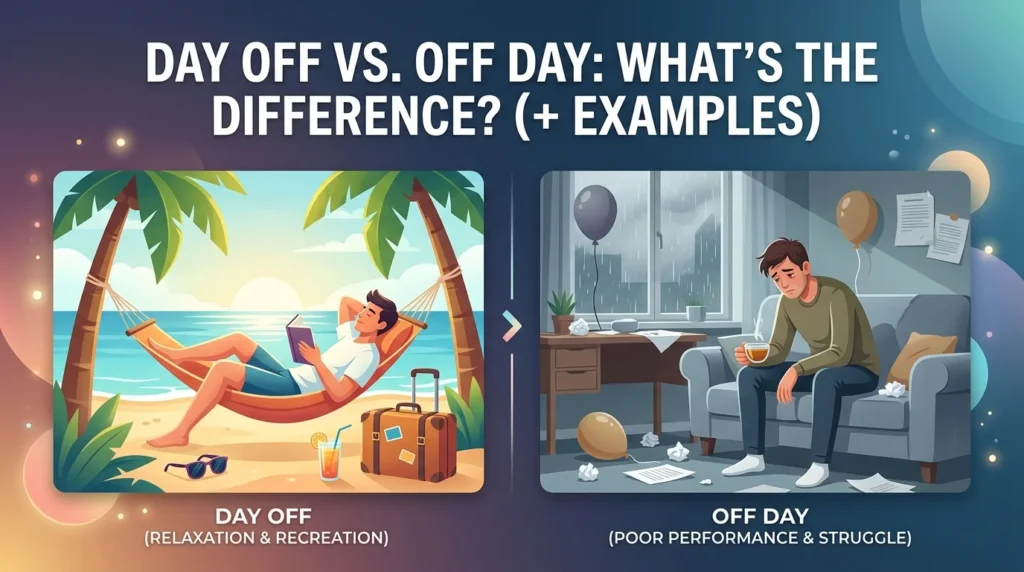
If you’ve ever wondered whether to say “day off” or “off day,” you’re not alone. These two expressions contain the same words, yet their meanings can change when the word order changes. That small difference matters in everyday American English, especially when you’re talking about work schedules, school, sports, performance, or how you feel.
A day off usually means a day when you don’t have to work or perform something you normally do. Cambridge Dictionary defines it as a day when you don’t have to work or do something that you normally do.
In another sense, an off day means a day when you don’t perform as well as usual. Oxford gives the same basic meaning, while Cambridge labels this use as informal.
There’s one important wrinkle, though. In US English, off day can also mean a scheduled day away from work, particularly in workplace or shift-based contexts. Cambridge specifically records this US usage.
That means context matters. Still, when you want to say that you aren’t working, day off remains the clearest and most widely useful choice.
Day Off & Off Day: The Quick Answer
The easiest way to understand the difference is to ask what you’re describing.
If you’re talking about your schedule, use day off:
“Friday is my day off.”
This means you don’t have to work on Friday.
If you’re talking about your performance or condition, use off day:
“I’m having an off day.”
This suggests that you aren’t performing, thinking, feeling, or functioning as well as you normally do.
The distinction becomes even clearer in these examples:
| Expression | Meaning | Example |
| day off | A break from normal duties | “I have a day off tomorrow.” |
| off day | A day of unusually poor performance or condition | “I’m having an off day.” |
| off day in some US workplace contexts | A scheduled non-work day | “Tuesday is an off day for our team.” |
So, day off focuses on being free from an obligation. Off day usually focuses on something being below your normal standard.
A simple memory rule
Think of the position of off.
With day off, the word off tells you what you are doing: you are off your normal schedule.
With off day, the word off describes the day itself: the day feels off, or your performance is off.
That gives you a practical shortcut:
Day off = no regular duty.
Off day = not your usual form.
The rule isn’t absolute because American English also uses off day for scheduled non-work days. However, this distinction works extremely well for everyday communication.
Understanding “Day Off” in American English
A day off is a day when you don’t have to work or carry out something you normally do. It can describe a scheduled break, a day you deliberately take away from work, or a regular period without your usual responsibilities. Cambridge also lists day off as workplace vocabulary and gives the plural form days off.
The phrase appears constantly in ordinary conversations.
You might say:
- “I have a day off tomorrow.”
- “She took a day off to visit her family.”
- “We get two days off each week.”
- “I’m taking Friday off.”
- “Saturday is my day off.”
- “I finally have a day off after a busy week.”
Notice the central idea in every example. The speaker is talking about freedom from a normal responsibility.
That responsibility might involve a job, school, training, or another regular activity.
What “day off” does not necessarily mean
A day off doesn’t automatically mean a vacation.
You could have one afternoon away from work, a single scheduled day without a shift, or several consecutive days away from your normal routine. The phrase simply tells the listener that you aren’t expected to perform your regular duty on that day.
For example:
“I have a day off on Wednesday, but I’m not going anywhere.”
That sentence makes perfect sense. The speaker has free time without taking a vacation.
Likewise:
“I took a day off to handle some paperwork.”
The person still has responsibilities. They simply stepped away from their usual work for that day.
Merriam-Webster describes taking a/the day off as deciding not to work on a particular day.
Common ways to use “day off”
Several verb combinations occur naturally with day off.
| Expression | Meaning | Example |
| have a day off | Your schedule gives you free time | “I have a day off Friday.” |
| take a day off | You choose not to work | “I’m taking a day off tomorrow.” |
| get a day off | You receive or are given free time | “We get a day off after the event.” |
| have the day off | You aren’t working that particular day | “I have the day off today.” |
| request a day off | You formally ask not to work | “She requested a day off.” |
| enjoy a day off | You spend free time pleasantly | “He’s enjoying a day off with his family.” |
There’s a subtle difference between have and take.
If your schedule already says you aren’t working, you can say:
“I have Friday off.”
If you decide not to work and arrange that absence, you can say:
“I’m taking Friday off.”
The second sentence emphasizes the decision or action.
“Day off” at work
Workplace English provides some of the clearest examples.
Imagine a nurse works Monday through Thursday and has Friday free. Friday is her day off.
She might tell a coworker:
“I won’t be here Friday. It’s my day off.”
Now imagine an employee normally works Friday but asks the manager for that day off.
The employee could say:
“Could I take Friday off?”
Here, take a day off communicates the decision to stay away from work.
Shift workers use the phrase frequently because their schedules may not follow the traditional Monday-through-Friday pattern. A day off could fall on Tuesday, Thursday, Sunday, or any other day.
That’s why day off refers to a schedule rather than a particular weekday.
“Day off” at school
The same idea works outside employment.
A student might say:
“We have a day off from school tomorrow.”
This means classes or normal school attendance aren’t required.
A parent might say:
“The kids have a day off on Monday.”
Again, the phrase describes the schedule.
You can also use it for other regular activities:
“The gym gives us a day off between training sessions.”
Here, the person isn’t necessarily avoiding work. They’re simply taking a break from a normal activity.
“Day off” and “days off”
The singular form refers to one day:
“I need a day off.”
The plural form refers to two or more:
“I need a few days off.”
Cambridge lists days off as the plural form in its Business English entry.
Compare these:
- “I have a day off tomorrow.”
- “I have three days off next week.”
- “She took a day off last month.”
- “They’re enjoying several days off.”
The grammar stays straightforward. The meaning remains centered on time away from normal duties.
Understanding “Off Day” and Its Two Meanings
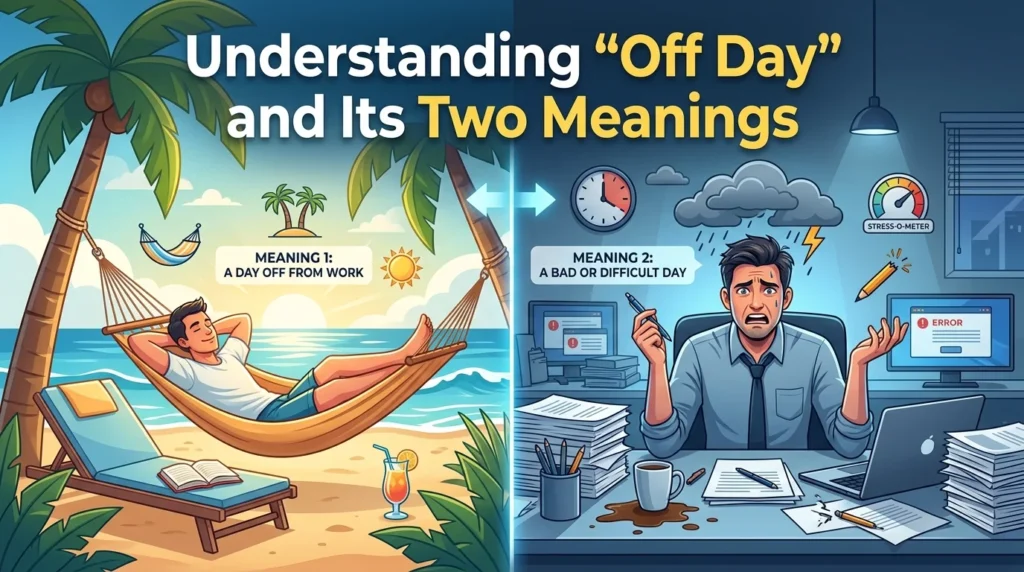
The phrase off day deserves more attention because it can carry two related meanings.
The first is the one most learners encounter when discussing performance:
“I’m having an off day.”
Here, the speaker means that they aren’t doing things as well as usual.
Cambridge defines this sense as an informal expression for a day when you perform below your usual standard.
Oxford similarly defines an off day as a day when someone doesn’t do things as well as usual.
The second meaning appears especially in US English:
“Tuesday is an off day for the team.”
Here, off day can mean a day when people aren’t scheduled to work.
Cambridge explicitly records this US usage as a day when someone isn’t at work.
That distinction explains why you may see both day off and off day used for schedules. English usage isn’t always a neat mathematical system. Context, region, and workplace conventions influence which expression sounds most natural.
The performance meaning of “off day”
The performance meaning is especially common.
Someone might normally write excellent reports but make several mistakes today. They could say:
“I’m having an off day.”
A professional athlete might usually play brilliantly but struggle during one match:
“She had an off day.”
A student who normally understands math quickly might stare at a simple equation and think:
“My brain isn’t working today. I’m having an off day.”
The phrase doesn’t necessarily mean the person lacks ability. In fact, it often implies the opposite.
An off day usually contrasts with a person’s normal standard.
That contrast is important.
If someone always performs poorly, calling one particular day an off day may not communicate the intended idea. The expression works especially well when the person normally does better.
Oxford’s example uses strong performers to illustrate this point, noting that even the best players can have an off day.
An off day can involve more than performance
Although oan ff day often describes performance, it can also suggest that something about the person’s overall condition feels unusual.
For example:
- “I’m tired today.”
- “I can’t concentrate.”
- “Everything feels harder than usual.”
- “I keep making silly mistakes.”
- “I’m not in my usual rhythm.”
- “I just don’t feel like myself today.”
In those situations, an off day can summarize the whole experience.
It’s a useful phrase because you don’t need to explain every little problem.
Instead of saying:
“I forgot three things, made two mistakes, and couldn’t concentrate during the meeting.”
You might simply say:
“I’m having an off day.”
The listener understands that today isn’t going particularly well.
“Off day” in sports
Sports provide one of the clearest contexts for this expression.
Suppose a basketball player normally shoots accurately but misses several easy shots. A commentator might describe the performance as an off day.
Similarly:
- A baseball player can have an off day at the plate.
- A soccer player can have an off day with passing.
- A tennis player can have an off day with serving.
- A runner can have an off day with pacing.
- A golfer can have an off day with putting.
The phrase emphasizes the gap between normal ability and today’s result.
That’s why an off day doesn’t necessarily insult someone. It can actually acknowledge that the person normally performs much better.
“Off day” at work
Imagine a highly reliable employee arrives at work and struggles to concentrate.
They send an email with several typos, forget a meeting detail, and need extra time to complete routine tasks.
A coworker might say:
“She’s just having an off day.”
That statement doesn’t mean she’s a bad employee. It suggests that today’s performance differs from her normal standard.
This distinction matters in professional communication.
Calling someone incompetent makes a broad judgment about their ability.
Calling someone’s performance an off day describes a temporary situation.
That makes the expression softer and more conversational.
Day Off & Off Day: Context Makes the Meaning Clear
Word order matters, but context often does even more work.
Consider this sentence:
“Friday is my day off.”
There’s little ambiguity. The speaker is talking about a schedule.
Now consider:
“I’m having an off day.”
The listener expects a description of performance, mood, energy, or general condition.
The surrounding words act like signposts.
Words such as work, schedule, shift, leave, and vacation often point toward the schedule meaning.
Words such as mistakes, performance, tired, focus, game, and mood often point toward the performance meaning.
| Context clue | Likely expression | Example |
| Work schedule | day off | “Tomorrow is my day off.” |
| Requesting leave | day off | “Can I take Friday off?” |
| School closure | day off | “We have a day off from school.” |
| Poor performance | off day | “He had an off day.” |
| Sports | off day | “The striker had an off day.” |
| Low concentration | off day | “I’m having an off day.” |
| Shift schedule in US English | off day can occur | “Monday is an off day.” |
This is why memorizing definitions alone isn’t enough. You should also learn the phrases in realistic sentences.
Day Off & Off Day in Real-Life Situations
At work
Work is probably the most common setting for confusion.
Suppose Maria works at a restaurant. Her manager schedules her for Monday through Thursday and Saturday. Friday is free.
Maria can say:
“Friday is my day off.”
That tells us about her schedule.
Now imagine Maria works Friday but struggles throughout the shift. She makes unusual mistakes and forgets routine steps.
A coworker could say:
“Maria’s having an off day.”
Now the phrase describes her performance.
The calendar hasn’t changed. The meaning has.
This gives us a useful comparison:
| Situation | Natural phrase |
| Maria isn’t scheduled | “Maria has a day off.” |
| Maria works but struggles | “Maria is having an off day.” |
| Maria asks not to work | “Maria wants to take a day off.” |
| Maria normally performs well but struggles today | “Maria is having an off day.” |
At school
The same distinction applies to students.
A school may close for a teacher-training day. A student could say:
“We have a day off tomorrow.”
That’s a schedule issue.
But suppose the student attends school and struggles with a subject they normally understand.
They might say:
“I’m having an off day in math.”
That’s a performance issue.
The distinction becomes even clearer with tests.
“I had a day off, so I didn’t study.”
This means the speaker had free time.
“I had an off day, so I made several mistakes on the test.”
This means the speaker’s performance was unusually weak.
In sports
Sports make the difference almost impossible to miss.
A team might have a scheduled rest day:
“The players have a day off from training.”
But if the players participate in a game and perform poorly:
“The team had an off day.”
Those sentences describe completely different circumstances.
One concerns the schedule.
The other concerns performance.
Interestingly, Cambridge also gives a US example of an off day referring to a day without organized training.
So sports can contain both meanings:
“The team has an off day from training.”
“The team had an off day during the game.”
The surrounding words make the intended meaning clear.
In everyday conversation
Casual conversation often uses off day to describe how someone feels.
For example:
“Sorry I’m quiet today. I’m having an off day.”
Or:
“Don’t worry about the mistake. Everyone has an off day.”
The expression can soften criticism because it frames a problem as temporary.
Meanwhile, day off works naturally when discussing personal plans:
“I’m meeting my sister because I have a day off.”
“I’m going hiking on my day off.”
“I finally have two days off.”
The distinction becomes almost instinctive once you associate the phrases with their core ideas.
“Off Day” & “Bad Day”
Another phrase learners often compare with off day is bad day.
They overlap, but they aren’t identical.
A bad day usually means the day contains unpleasant experiences, problems, stress, disappointment, or emotional difficulty.
An off day usually highlights a person’s condition or performance.
Compare these:
“I had a bad day at work.”
This could mean the manager criticized you, your computer crashed, you argued with a coworker, and you missed your train.
Now compare:
“I had an off day at work.”
This suggests that your work performance wasn’t as strong as usual.
The difference is subtle but useful.
| Phrase | Main focus | Example |
| bad day | Negative experiences or circumstances | “I had a bad day because everything went wrong.” |
| off day | Below-normal performance or condition | “I had an off day and made several mistakes.” |
| day off | Freedom from regular duties | “I had a day off and stayed home.” |
Of course, one day can be all three.
You could have a day off and still have a bad day.
You could have a day off and still have an off day.
For example:
“It was my day off, but I had an off day and felt miserable.”
Here, each phrase contributes a different meaning.
That’s a perfect example of why these expressions shouldn’t be treated as interchangeable.
Common Mistakes English Learners Make
Using “off day” to mean time away from work
A learner might say:
“Tomorrow is my off day.”
This sentence can be understood, and in some US workplace contexts, off day is genuinely used for a scheduled non-work day.
However, if you’re speaking general everyday American English and simply mean that you don’t work tomorrow, this is clearer:
“Tomorrow is my day off.”
The second version removes unnecessary ambiguity.
Using “day off” to describe poor performance
Another common mistake is:
“I had a day off during the game.”
If you mean that the player performed poorly, that sentence doesn’t communicate the intended idea.
Better:
“I had an off day during the game.”
Now the listener understands that performance was below normal.
Assuming word order doesn’t matter
English contains many expressions where word order affects meaning.
Day off and off day provide a simple example.
The words remain the same, but their relationship changes.
Compare:
“I need a day off.”
with:
“I’m having an off day.”
The first expresses a need for time away.
The second describes a current condition.
Translating directly from another language
Literal translation can cause problems because languages organize fixed expressions differently.
A phrase that means “free day” in one language might not map naturally onto off day in English.
Instead of translating each word, identify the meaning first.
Ask yourself:
Am I talking about being free from a responsibility?
Use day off.
Am I talking about performing or feeling below normal?
Use off day.
That approach is much more reliable than translating word for word.
How to Choose the Right Phrase
When you’re unsure, use a simple two-question test.
Question one: Is the issue your schedule?
If yes, choose day off in most everyday situations.
Examples:
- “I have a day off tomorrow.”
- “I’m taking a day off.”
- “Friday is my day off.”
- “She has two days off this week.”
Question two: Is the issue your performance or condition?
If yes, an off day is usually the better choice.
Examples:
- “I’m having an off day.”
- “He had an off day at work.”
- “The team had an off day.”
- “She’s having a bit of an off day.”
A practical decision table
| What you want to say | Best choice |
| You aren’t scheduled to work | day off |
| You want to stop working for a day | take a day off |
| You don’t have school | day off |
| You performed poorly today | off day |
| You made unusual mistakes | off day |
| You feel out of rhythm | off day |
| Your team performed below normal | off day |
| Your US workplace calls a non-work day an “off day” | off day may be acceptable |
The safest general rule remains simple:
Use “day off” for time away from normal duties. Use “off day” for below-normal performance or condition.
That rule handles the vast majority of everyday situations.
Why “Day Off” and “Off Day” Are Easy to Confuse
The confusion makes sense.
English also uses off in several connected ways.
Merriam-Webster lists senses of off related to being away from regular work and being below a usual standard.
That helps explain the semantic connection.
When someone is off duty, they aren’t performing their normal work.
When someone is off their game, their performance is below their normal level.
The same broad word can therefore contribute different meanings depending on its grammatical relationship to the noun.
That’s what happens in these expressions.
The grammar behind the meaning
In day off, the phrase works as a noun phrase describing a day away from normal obligations.
In:
“Friday is my day off.”
The whole phrase identifies Friday as the person’s non-working day.
In:
“I’m having an off day.”
The word off functions as an adjective modifying day. It characterizes the day as unusual or below normal in the relevant sense.
That grammatical difference is useful, but you don’t need to memorize technical grammar terms to use the expressions correctly.
You only need to remember what the phrase is describing.
Day off: the person’s schedule.
Off day: the person’s condition or performance.
A Useful Case Study: One Friday, Two Meanings
Imagine Daniel normally works Monday through Friday.
This Friday, he uses vacation time.
He says:
“I’m taking Friday off.”
That’s a day off.
Now imagine Daniel still goes to work on Friday but makes several unusual mistakes. His manager notices that he seems distracted.
A coworker says:
“Daniel’s having an off day.”
That’s an off day.
Now imagine Daniel doesn’t work Friday at all, but he spends the morning trying to repair his car. Nothing goes smoothly. He strips a bolt, loses a tool, and accidentally breaks a cable.
Daniel might jokingly say:
“I’m having an off day.”
Notice what happened.
Friday can be his day off because he isn’t working.
At the same time, Friday can feel like an off day because things aren’t going well.
The two expressions don’t compete. They describe different dimensions of the same date.
That’s one of the most useful ways to understand the distinction.
The Nuance of “Off Day” in US English
There’s an important usage point that deserves attention.
The phrase off day isn’t limited to the “poor performance” meaning in American English. Dictionaries recognize a separate US usage for a day when someone isn’t at work. Cambridge explicitly labels this meaning as US and gives examples involving workers and training schedules.
Collins also distinguishes the performance meaning from a US sense involving a day when people don’t go to work.
That means saying “off day” is always wrong for a non-working day would be too strong.
It isn’t always wrong.
Instead, the better advice is this:
If you want the clearest general phrase for a non-working day, use “day off.”
If your workplace, team, schedule, or regional variety commonly uses off day, the expression may be completely natural.
For example:
“Tuesday is an off day for the crew.”
In a specific workplace, that may sound perfectly normal.
However:
“Tuesday is my day off.”
is broadly clear and unlikely to confuse the listener.
This is a good example of why strong grammar advice should account for actual usage rather than pretending every expression has only one possible meaning.
“Day Off” & “Off Day”: Common Collocations
Learning collocations can make these phrases much easier to use naturally.
Common “day off” collocations
- have a day off
- take a day off
- get a day off
- have the day off
- request a day off
- need a day off
- enjoy a day off
- take Friday off
- have two days off
- get the day off
Examples:
“I need a day off after this busy week.”
“She took Monday off for an appointment.”
“We have two days off next month.”
Common “off day” collocations
- have an off day
- be having an off day
- have a really off day
- have a bit of an off day
- experience an off day
- a rare off day
- an occasional off day
Examples:
“I’m having a really off day.”
“Even experienced professionals have an occasional off day.”
“The pitcher had a rare off day.”
These patterns sound natural because English speakers commonly pair these nouns with specific verbs.
Instead of inventing a sentence from scratch, learning the whole phrase gives you a ready-made building block.
More Examples: Day Off & Off Day
Here are paired examples that show the difference without complicated explanations.
| Day Off | Off Day |
| “Monday is my day off.” | “I’m having an off day.” |
| “I’m taking Friday off.” | “I’m having an off day at work.” |
| “She has three days off.” | “She had an off day during the presentation.” |
| “We get a day off after the event.” | “The team had an off day.” |
| “I spent my day off at home.” | “I couldn’t concentrate because I was having an off day.” |
| “He requested a day off.” | “He made several unusual mistakes because he was having an off day.” |
| “The students have a day off.” | “The student had an off day during the exam.” |
| “I’m enjoying my day off.” | “I’m not feeling sharp today. It’s an off day.” |
The left column answers “Why aren’t you doing your normal duties?”
The right column answers “Why aren’t you performing or feeling normally?”
That mental distinction can help you choose the correct expression quickly.
A Final Practical Guide to “Day Off” & “Off Day”
If you remember only one thing, remember this:
A day off is about being free. An off day is usually about being below normal.
Use day off when discussing:
- work schedules
- school schedules
- time away
- leave
- rest days
- personal plans
- regular duties
Use off day when discussing:
- poor performance
- unusual mistakes
- low concentration
- weak athletic performance
- low energy
- feeling out of rhythm
- a temporary dip from someone’s normal standard
There is also a US usage of off day for a scheduled non-work day, particularly in workplace and team contexts.
Still, day off is usually the safest choice when you simply mean that you aren’t working.
The easiest memory trick
Think:
Day off → You are off.
Off day → The day is off.
For example:
“Tomorrow is my day off.”
You aren’t working.
“Today is an off day.”
Something about your performance or condition isn’t normal.
That tiny distinction can prevent a surprisingly common English mistake.
Once you start noticing the context around each expression, the difference becomes much easier to recognize. You’ll hear day off when people discuss schedules and responsibilities. You’ll hear off day when people talk about performance, form, or an unusual day. And when a US workplace uses off day for a scheduled break, the surrounding context usually makes that meaning clear.
The expressions may share the same two words, but they don’t always share the same job. Day off gives you freedom from a normal duty. Off day usually describes a day when something isn’t quite clicking. Learn that distinction, and choosing between them becomes far less of a guessing game.
“Day Off” Meaning, Grammar, and Usage
A day off describes a day when you’re free from work, school, or another regular responsibility. Cambridge defines it as a day when you don’t have to work or do something you normally do. This makes day off the clearest choice when you’re talking about a schedule rather than your performance. For example, “Friday is my day off” tells someone that you aren’t expected to work that day.
Likewise, “I’m taking Monday off” means you’ve arranged to stay away from your normal duties. The phrase doesn’t require a formal vacation, either. You might take a day off for an appointment, family event, rest, errands, or simply because you need a break. In workplace English, common patterns include have a day off, take a day off, get a day off, and request a day off. Cambridge specifically lists book/have/take a day off as common workplace patterns and gives days off as the plural form.
Definition of “Day Off”
The basic meaning is straightforward: day off refers to time away from something you normally do. Most often, that activity is work, but the phrase can extend to school, training, caregiving, or another regular commitment. You can say, “I have a day off tomorrow,” “She took a day off to attend a wedding,” or “We have two days off next week.” The phrase focuses on the person’s schedule. It doesn’t tell us whether the person will relax, travel, run errands, or spend the entire day catching up on chores. In fact, someone can have a day off and still have a packed schedule. The important point is that their usual duty has been removed for that day. Oxford’s American English dictionary also illustrates day off in relation to taking time away from a working day.
Common “Day Off” Expressions
English speakers frequently use day off with certain verbs. Learning these combinations helps your sentences sound natural rather than translated.
| Expression | What it means | Example |
| have a day off | Your schedule gives you free time | “I have a day off tomorrow.” |
| take a day off | You arrange or choose not to work | “I’m taking a day off Friday.” |
| get a day off | You receive a free day | “We get a day off after the event.” |
| have the day off | You aren’t working that specific day | “I have the day off today.” |
| request a day off | You formally ask for time away | “She requested a day off.” |
| need a day off | You feel you need time away | “I really need a day off.” |
| enjoy a day off | You spend your free day pleasantly | “He’s enjoying a day off with his family.” |
There’s a useful distinction between have and take. If your schedule already gives you Friday free, you might say, “I have Friday off.” If you actively arrange not to work Friday, take Friday off emphasizes your decision. Compare “I have Monday off” with “I’m taking Monday off.” Both can describe a non-working Monday, but the second focuses more strongly on the action of taking leave.
“Day Off” at Work
Workplace schedules make the meaning especially clear. Imagine an employee works Tuesday through Saturday and normally rests on Sunday and Monday. The employee could say, “Monday is my day off.” Nothing about the person’s performance is being evaluated. The sentence simply identifies a non-working day.
The phrase also works for irregular schedules. A nurse, firefighter, restaurant worker, retail employee, or other shift worker might have a day off in the middle of the week. There’s no requirement for a day off to fall on Saturday or Sunday.
For example:
- “My day off is Wednesday.”
- “I have two days off this week.”
- “Can I take Thursday off?”
- “She requested a day off for her appointment.”
- “I’ll catch up on errands during my day off.”
The phrase can even describe a day that doesn’t go as planned:
“It was supposed to be my day off, but I ended up working.”
That sentence still centers on the schedule. The speaker expected freedom from work, but circumstances changed. Cambridge gives a similar example in which someone’s planned day off is interrupted by work.
“Day Off” Beyond Employment
Although day off often appears in workplace conversations, its meaning isn’t restricted to paid employment. You can use it whenever someone normally performs a particular activity and takes a break from it.
For example:
- “The students have a day off from school.”
- “The athletes have a day off from training.”
- “I’m taking a day off from studying.”
- “She finally got a day off from her usual responsibilities.”
The key idea remains the same: a normal activity isn’t required on that day.
This is why context matters so much. If someone says, “I have a day off,” listeners generally understand that the person has a break from some regular responsibility. The exact responsibility may come from the surrounding conversation.
“Day Off” & Vacation
A day off and a vacation aren’t necessarily the same thing. A vacation usually involves a longer period away from work or normal responsibilities, while a day off can be just one day.
Compare:
“I’m taking a day off next Friday.”
with:
“I’m going on vacation next month.”
The first statement identifies a single free day. The second describes a broader period away.
Someone could also take several days off without calling the period a vacation:
“I’m taking three days off to move into my new apartment.”
The person is away from work, but the purpose is practical rather than recreational.
Singular and Plural Forms
The singular form is day off. The plural form is days off.
Correct:
- “I need a day off.”
- “She has two days off.”
- “We get several days off each year.”
- “He took three days off.”
The word off doesn’t become plural. Only day changes:
day off → days off
This pattern is worth remembering because learners sometimes try to create unusual forms such as “day offs.” That isn’t the standard plural.
Natural Examples With “Day Off”
Here are several examples covering different situations:
“Friday is my day off, so I’m going to visit my parents.”
“I’m taking a day off to handle some paperwork.”
“She has two days off after working the holiday.”
“The students have a day off tomorrow.”
“Can I request a day off next Monday?”
“I usually catch up on errands during my day off.”
Each example has the same underlying meaning. The person has time away from a normal responsibility.
That’s the central idea to keep in mind whenever you see day off.
“Off Day” Meaning, Grammar, and Usage
Off day is more complicated because it has more than one established meaning. In the most familiar sense, it describes a day when someone performs below their usual standard. Cambridge labels this use informal and gives examples involving people who make unusual mistakes or fail to perform normally. American English also uses off day to describe a day when someone isn’t scheduled to work.
That second meaning is important because it prevents an overly strict rule such as “off day is always wrong when you mean a day away from work.” Actual English usage is more flexible than that.
Still, if you’re speaking generally and want to communicate clearly, day off is usually the safest expression for scheduled time away from work. When off day means poor performance, the intended meaning is quite different.
Definition of “Off Day” for Performance
When someone says:
“I’m having an off day.”
They usually mean they aren’t performing or functioning as well as they normally do.
Maybe they’re tired. Maybe they’re distracted. Perhaps they’re making simple mistakes that they normally wouldn’t make. The phrase doesn’t necessarily indicate a serious problem. Often, it simply describes a temporary dip in performance or form.
Cambridge gives examples of a champion making unusual errors and of even skilled people having occasional off days.
That contrast with normal ability is important.
If a person normally writes excellent reports but makes several mistakes one afternoon, you could say:
“She’s having an off day.”
The sentence suggests that today’s performance is unusual for her.
“Off Day” and Normal Performance
The word off carries the idea of something being different from its normal state. American Heritage defines off in one adjectival sense as being below a normal or satisfactory level.
That explains expressions such as:
- an off day
- an off week
- off form
- off your game
- your timing is off
- your calculations are off
They all involve some kind of departure from the expected standard.
For example:
“My timing was off today.”
means the timing wasn’t as accurate as usual.
Likewise:
“I’m having an off day.”
can summarize several small problems without listing every mistake individually.
“Off Day” Can Describe More Than Work
You can have an off day in many areas of life.
A student might struggle with a familiar subject.
“I’m having an off day in math.”
A musician might miss notes that are normally easy.
“The pianist had an off day.”
An athlete might perform below expectations.
“The striker had an off day.”
A writer might struggle to produce clear sentences.
“I’m having an off day with this article.”
A person might simply feel mentally out of rhythm.
“I don’t know what’s wrong. I’m just having an off day.”
The expression works because the listener compares the current condition with the person’s normal standard.
“Off Day” in Sports
Sports provide one of the clearest uses of an off day.
Suppose a professional basketball player usually shoots accurately but misses several easy shots during one game. A commentator might describe the performance as an off day.
The same idea works across sports:
- A pitcher can have an off day.
- A goalkeeper can have an off day.
- A tennis player can have an off day.
- A golfer can have an off day.
- A runner can have an off day.
- A soccer team can have an off day.
The phrase doesn’t necessarily mean the athlete lacks skill. In many cases, it implies the opposite. The athlete normally performs at a higher level.
That’s why an off day can soften criticism.
Instead of saying:
“He’s a terrible player.”
you might say:
“He had an off day.”
The second statement describes a temporary performance problem rather than making a broad judgment about the person’s ability.
“Off Day” at Work
The performance meaning also appears naturally in professional settings.
Imagine an experienced employee who normally handles customer complaints smoothly. One afternoon, the employee loses track of details, makes several small errors, and struggles to concentrate.
A coworker might say:
“She’s having an off day.”
That description focuses on what happened today. It doesn’t suggest that the employee is generally incompetent.
This distinction can make off day useful in friendly conversation because it frames mistakes as temporary.
For example:
“Don’t worry about that typo. You’re probably just having an off day.”
The speaker recognizes the mistake without turning it into a judgment about the person’s overall ability.
The US Meaning of “Off Day” for Work Schedules
Here’s where the topic gets more interesting.
Cambridge records a US meaning of off day as a day when someone isn’t at work. It gives examples involving shift workers and organized training schedules. American Heritage similarly lists off day as a day spent away from work or duty and gives “My off day is Saturday” as an example.
So this sentence can be natural in the right American context:
“Saturday is my off day.”
Here, the speaker may simply mean that Saturday is their scheduled non-working day.
However, day off remains a very clear general-purpose choice:
“Saturday is my day off.”
If you’re learning English, this distinction is valuable because it separates standard clarity from context-specific usage.
You don’t need to avoid off day completely. Instead, recognize its two meanings and pay attention to context.
When “Off Day” Means a Scheduled Break
The scheduled meaning often becomes obvious from nearby words.
For example:
“The team has an off day from organized training.”
Here, from organized training tells us that the team isn’t training that day. Cambridge specifically gives a similar US example involving NFL training schedules.
Compare that with:
“The team had an off day during the game.”
Now the phrase describes performance.
The words around off day act as the deciding clue.
from training → scheduled break.
during the game → performance problem.
That’s why you should never analyze the two words in isolation. Read the whole sentence.
“Off Day” Examples
Consider these examples:
“I’m having an off day today. Nothing seems to be going right.”
“The champion had an off day and made several unusual errors.”
“The team has an off day from training tomorrow.”
“Tuesday is my off day, so I don’t work.”
“She’s normally excellent at presentations, but she had an off day.”
“Everyone has an occasional off day.”
The first, second, fifth, and sixth examples focus on performance or condition. The third and fourth use the US schedule-related meaning.
That’s why the phrase deserves more than a one-line definition.
Day Off & Off Day: The Core Grammar Difference
The easiest way to understand the contrast is to examine what the phrase identifies.
Compare:
“I have a day off.”
The focus is on the speaker’s schedule.
“I’m having an off day.”
The focus is on the speaker’s condition.
This difference becomes even clearer when you change the surrounding verbs.
Common “Day Off” patterns
Have + a day off
“I have a day off tomorrow.”
Take + a day off
“I’m taking a day off tomorrow.”
Get + a day off
“We get a day off after the holiday.”
Request + a day off
“She requested a day off.”
These combinations naturally point toward absence from regular duties.
Common “Off Day” patterns
Have + an off day
“I’m having an off day.”
Had + an off day
“He had an off day yesterday.”
Have + an occasional off day
“Even experts have an occasional off day.”
Be + an off day
“Today has been an off day.”
These structures commonly point toward performance, mood, or condition.
A Practical Comparison Table
| Point of comparison | Day Off | Off Day |
| Main idea | Freedom from normal duties | Below-normal performance or condition |
| Typical focus | Schedule | Performance, mood, ability, or form |
| Common workplace use | Very common | Also used in US scheduling contexts |
| Common verb | Have, take, get | Have, be having |
| Example | “I have a day off.” | “I’m having an off day.” |
| Sports meaning | Rest from training | Poor performance |
| School meaning | No regular school duties | Poor concentration or performance |
| Plural | days off | off days |
| Safest general choice for work-free time | Yes | Depends on context |
The biggest takeaway is simple: the phrases overlap in some contexts, but they aren’t interchangeable in every sentence.
If you’re talking about whether you’re required to work, day off usually gives the clearest message.
If you’re talking about whether you’re performing normally, off day is the natural choice.
And if you’re in a US workplace where off day means a scheduled non-working day, context will usually make that meaning obvious.
Day Off & Off Day in Real-Life Situations
The difference between day off and off day becomes much easier when you see how Americans use these expressions in real situations. The phrases can appear in similar conversations, especially around work, school, sports, and personal routines. Yet the intended meaning usually depends on whether you’re discussing a schedule or someone’s performance and condition. A useful way to think about it is this: a day off removes a responsibility from your calendar, while an off day usually describes a person who isn’t functioning at their usual level. However, American English has a recognized workplace use of off day for a scheduled non-working day.
At Work: Scheduled Time Away
Workplace conversations provide the clearest examples of day off. If your employer doesn’t schedule you for Friday, you can say, “Friday is my day off.” The sentence tells your coworker something about your work schedule. You aren’t expected to perform your regular duties that day. You might spend the morning sleeping, run errands, visit family, or simply enjoy some quiet time. The activity you choose doesn’t change the meaning of a day off. The important detail is that you’re free from your normal work obligations.
You can also use a day off when you arrange time away from work. For example, “I’m taking a day off next Monday to attend an appointment.” Here, the phrase focuses on your absence from your normal schedule. Similarly, “Could I take Friday off?” is a natural way to ask for permission to miss work for one day. The expression works particularly well because it clearly separates the time away from the reason for taking it.
Common workplace patterns include:
- have a day off
- take a day off
- get a day off
- request a day off
- have the day off
- take Friday off
- have two days off
- enjoy a day off
Consider these examples:
“I have Wednesday off.”
“Wednesday is my day off.”
“I’m taking Wednesday off.”
All three sentences communicate that the speaker won’t work Wednesday. The first and third emphasize the schedule or action, while the second names the free day directly.
When an Employee Has an Off Day
Now change the situation.
Suppose an employee arrives at work as usual.
A coworker might say:
“She’s having an off day.”
Here, off day has nothing to do with whether she came to work. She is physically present. The expression describes her performance.
This distinction matters because saying “She has a day off” would communicate something entirely different. It would suggest that she isn’t working that day.
Compare the two: “Sarah has a day off today.”Sarah isn’t scheduled to work.“Sarah is having an off day today.Sarah may be working, but she isn’t performing normally.
That small change in word order creates a major difference in meaning.
A Workplace Example
Imagine an editor who normally catches every typo in a report. One afternoon, several obvious errors slip through. The editor rereads the document but still misses mistakes.
A colleague could say:
“You’re having an off day.”
That statement doesn’t mean the editor is bad at the job. It suggests today’s performance falls below the person’s normal standard.
This is one reason an off day can sound less harsh than direct criticism. Instead of labeling someone as careless or incompetent, the speaker describes the situation as temporary.
At School
The same distinction applies to students.
If a school doesn’t hold classes on Friday, a student can say:
“We have a day off on Friday.”
That describes the school calendar.
If the student attends class but struggles with a subject they normally understand, they might say:
“I’m having an off day.”
Now the phrase describes the student’s condition or performance.
Consider these paired examples:
| School situation | Natural expression |
| No classes are scheduled | “We have a day off.” |
| Student isn’t attending school | “I have a day off from school.” |
| Student struggles with math | “I’m having an off day in math.” |
| Student makes unusual mistakes | “I’m having an off day.” |
| Student performs below normal | “She had an off day on the test.” |
The same principle works with studying outside school. If you decide not to study for one day, you might say:
“I’m taking a day off from studying.”
If you study but can’t focus, you might say:
“I’m having an off day.”
The first sentence concerns your decision to stop studying. The second describes how your mind is functioning while you study.
In Sports
Sports make an off day especially useful because athletes regularly experience fluctuations in performance.
A basketball player may usually shoot accurately but miss several open shots during one game. A commentator could describe it as an off day.
A baseball pitcher may struggle with control. A tennis player may lose timing. A soccer player may misplace routine passes. A golfer may miss putts they normally make.
In each case, an off day highlights a temporary decline from the athlete’s usual standard.
For example:
“The pitcher had an off day.”
“She had an off day with her serve.”
“The team had an off day.”
These sentences don’t necessarily suggest that the athletes lack skill. Instead, they imply that their performance wasn’t typical.
Scheduled Rest in Sports
Sports also demonstrate the other meaning of an off day.
A team might not practice on Tuesday. In American English, someone could describe Tuesday as the team’s off day, particularly when the surrounding context clearly concerns the training schedule. Cambridge records this US usage and gives examples involving organized training.
For maximum clarity, though, you can say:
“The team has a day off from training.”
That sentence leaves little room for confusion.
Compare:
“The team has an off day from training.”
with:
“The team had an off day during the game.”
The first concerns the schedule. The second concerns performance.
The words surrounding the phrase provide the clue.
In Everyday Conversation
Outside work, school, and sports, an off day often describes a general feeling that something isn’t quite right.
You might wake up tired, struggle to concentrate, forget small things, and feel less energetic than usual. You don’t necessarily have one specific problem. Everything simply feels slightly out of rhythm.
You could say:
“I’m having an off day.”
That short sentence can summarize a surprisingly complicated experience.
It might mean:
- You feel unusually tired.
- You can’t concentrate.
- You’re making simple mistakes.
- Your energy is low.
- You aren’t as productive as usual.
- You’re feeling mentally distracted.
- Your normal routine feels difficult.
- You aren’t quite yourself.
By contrast, day off refers to the calendar or schedule:
“I have a day off, so I’m staying home.”
That person may feel fantastic or terrible. The phrase doesn’t tell us.
One Day Can Be Both
Here’s an important point that many learners miss: a day can be both a day off and an off day.
Suppose Friday is your scheduled day away from work. You could correctly say:
“Friday is my day off.”
Now imagine you spend Friday trying to relax, but everything goes wrong. You forget your wallet, lose your keys, and accidentally spill coffee on your shirt.
You could also say:
“Friday has been an off day.”
The two expressions don’t contradict each other because they describe different things.
Day off describes your schedule.
Off day describes your experience.
This is a powerful way to remember the distinction.
“Off Day” & “Bad Day”
Although off day and bad day can overlap, they don’t communicate the same idea.
A bad day usually focuses on unpleasant experiences. Something went wrong, you encountered problems, or you felt unhappy or stressed.
An off day usually focuses on performance, condition, or a departure from your normal rhythm.
Compare these sentences:
“I had a bad day at work.”
This could mean your boss criticized you, a customer complained, your computer stopped working, and you missed an important deadline.
Now consider:
“I had an off day at work.”
This more strongly suggests that your performance wasn’t up to its usual standard.
When “Bad Day” Is Better
Use bad day when the overall experience was negative.
For example:
“I had a bad day because my car broke down.”
“It was a bad day from start to finish.”
“She had a bad day after receiving the disappointing news.”
These sentences focus on events and emotions.
When “Off Day” Is Better
Use off day when the person’s normal performance or condition is the main issue.
For example:
“I had an off day at the office.”
“The goalkeeper had an off day.”
“I’m having an off day with my writing.”
“He was having an off day and kept forgetting simple details.”
The phrase often suggests that the problem is temporary.
Can “Off Day” Mean Feeling Bad?
Yes, depending on context.
If someone says:
“I’m having an off day.”
they might mean poor performance, low energy, an unusual mood, or a general sense that things aren’t going smoothly.
However, if they specifically mean that they feel emotionally unhappy, bad day may communicate the idea more directly.
For example:
“I’m having a bad day.”
sounds more clearly negative.
“I’m having an off day.”
sounds more like something is unusual or below normal.
The difference isn’t always sharp. Native speakers use context and tone to fill in the details.
How Context Changes the Meaning
Context acts like a traffic signal for these expressions.
Words about schedules tend to point toward a day off.
Words about performance tend to point toward an off day.
Consider the following clues.
Schedule-related clues
If you see words such as:
- work
- shift
- schedule
- leave
- vacation
- holiday
- training
- school
- appointment
- weekend
- tomorrow
- Friday
the conversation may concern a scheduled break.
For example:
“I’m not scheduled to work Friday. It’s my day off.”
Performance-related clues
If the sentence includes words such as:
- mistakes
- performance
- focus
- energy
- concentration
- timing
- accuracy
- form
- productivity
- errors
- game
- mood
then an off day may be the intended expression.
For example:
“I kept making mistakes during the presentation. I was having an off day.”
These clues aren’t rigid grammar rules. They’re simply useful signals that help you interpret the sentence quickly.
Common Mistakes With Day Off and Off Day
Mistake: Saying “Off Day” When You Mean a Work-Free Day
A learner may say:
“I have an off day tomorrow.”
This isn’t automatically wrong in American English. Some workplaces use off day to mean a scheduled day away from work. However, day off is generally clearer when you’re simply telling someone that you aren’t working.
Better:
“I have a day off tomorrow.”
This version communicates your meaning immediately.
Mistake: Saying “Day Off” for Poor Performance
Suppose you played badly in a tennis match.
You wouldn’t normally say:
“I had a day off during the match.”
That sounds as though you weren’t participating.
Instead:
“I had an off day during the match.”
Now the listener understands that your performance was below normal.
Mistake: Treating the Expressions as Synonyms
The two expressions aren’t interchangeable.
“I need a day off.”
means you want time away from your normal responsibilities.
“I’m having an off day.”
means you’re currently not functioning or performing normally.
Replacing one with the other can completely alter the message.
Mistake: Ignoring Regional or Workplace Usage
English isn’t spoken identically in every region or workplace.
American English recognizes off day as a term for a non-working day in certain contexts.
Therefore, it would be inaccurate to claim that off day can never mean a scheduled day away from work.
The better learner strategy is to understand both meanings while using day off when you want maximum clarity.
Day Off & Off Day: A Real-World Decision Guide
When you’re speaking quickly, you don’t need to analyze grammar terminology. Ask yourself one simple question:
Am I describing the schedule or the condition?
If you’re describing the schedule, choose day off in most general situations.
If you’re describing the condition or performance, choose off day.
| Meaning | Recommended phrase | Example |
| No work scheduled | day off | “Tomorrow is my day off.” |
| Taking leave | day off | “I’m taking a day off.” |
| No school | day off | “We have a day off tomorrow.” |
| Poor performance | off day | “I’m having an off day.” |
| Poor sports form | off day | “He had an off day.” |
| Low concentration | off day | “I’m having an off day today.” |
| Unusual mistakes | off day | “She had an off day at work.” |
| US workplace schedule | off day may be used | “Tuesday is my off day.” |
The safest general rule is therefore:
Day off = freedom from normal duties. Off day = performance or condition below normal.
There is one additional US usage to remember: off day can describe a scheduled non-working day in certain workplace and team contexts.
Why the Difference Matters in Everyday English
At first glance, day off and off day look like a tiny vocabulary puzzle. In practice, the distinction can affect how your listener understands the entire situation.
Imagine telling your manager:
“I’m having an off day tomorrow.”
Depending on context, your manager might wonder whether you mean you’re not scheduled to work or that you expect poor performance.
Now say:
“I have a day off tomorrow.”
The meaning is immediately clear.
Likewise, imagine telling a teammate:
“I had a day off during today’s game.”
That sounds strange if you’re describing poor performance.
But:
“I had an off day during today’s game.”
makes perfect sense.
Clear word choice prevents unnecessary confusion.
A Simple Way to Remember the Difference
Think of off as answering two different questions.
Day off: What are you away from?
You’re away from your normal work or duties.
Off day: What is off?
Your performance, mood, energy, timing, or overall condition may be off.
So remember:
Day off = off your normal schedule.
Off day = the day feels off, or your performance is off.
Once that pattern becomes familiar, the expressions become much easier to choose naturally.
Which Phrase Should You Use?
Choosing between day off and off day becomes simple once you identify what you’re describing. If you mean a scheduled break from work, school, training, or another regular responsibility, day off is usually the clearest choice. If you mean that someone isn’t performing normally, feels out of rhythm, or isn’t having their usual level of success, off day fits better. American English also uses off day for a scheduled non-working day in some contexts, especially when the surrounding words make the meaning obvious.
Quick Reference
| What you mean | Best choice | Example |
| Free from work | day off | “Friday is my day off.” |
| Taking leave | day off | “I’m taking a day off.” |
| Free from school | day off | “We have a day off tomorrow.” |
| Poor performance | off day | “The player had an off day.” |
| Poor concentration | off day | “I’m having an off day.” |
| Feeling out of rhythm | off day | “Today feels like an off day.” |
| Scheduled non-working day in some US contexts | off day | “Tuesday is my off day.” |
The most reliable everyday rule is day off = scheduled freedom and off day = something isn’t going normally. That distinction works across most conversations and helps you avoid accidental ambiguity.
How to Use “Day Off” Correctly
Use day off when someone doesn’t have to perform a normal duty on a particular day. The duty might involve employment, education, training, caregiving, or another regular commitment. The phrase describes the schedule, not the person’s mood or performance.
You can use it with several common verbs:
- have a day off
- take a day off
- get a day off
- request a day off
- need a day off
- enjoy a day off
- have the day off
- take Friday off
For example, an employee might say:
“I have a day off tomorrow.”
Someone who has arranged leave could say:
“I’m taking a day off next Friday.”
A worker who receives an additional break might say:
“We get a day off after the holiday.”
The expression also works naturally in the plural:
“I have two days off next week.”
Notice that day becomes plural while off stays unchanged. The correct form is days off, not “day offs.”
Common Situations
Work: “I have a day off on Monday.”
School: “The students have a day off tomorrow.”
Training: “The athletes have a day off from practice.”
Personal responsibilities: “I’m taking a day off from studying.”
Appointments: “She took a day off for her medical appointment.”
Family events: “He requested a day off for his sister’s wedding.”
The purpose doesn’t determine whether the expression is correct. The central idea remains the same: the person is stepping away from something they normally do.
Workplace Examples
“My day off is Wednesday.”
“Can I take Thursday off?”
“I have the day off, so I won’t be checking email.”
“She requested a day off for a family event.”
“We have two days off after the busy season.”
These sentences all focus on work schedules. They don’t describe poor performance.
School Examples
Students can also have a day off when classes aren’t required.
“We have a day off on Friday.”
“I’m taking a day off from studying.”
“The school gave students a day off after the event.”
However, if a student attends class but performs poorly, an off day becomes more appropriate:
“I had an off day during the math test.”
The distinction remains consistent. One phrase concerns absence from a routine, while the other concerns performance within that routine.
Everyday Conversation
In casual conversation, day off often appears when people discuss plans.
“What are you doing on your day off?”
“I’m going hiking on my day off.”
“I finally have a day off this weekend.”
“I spent my day off catching up on chores.”
These examples show something important: having a day off doesn’t necessarily mean doing nothing. You can be extremely busy during your day off. What matters is that you’re away from your usual obligation.
How to Use “Off Day” Correctly
Use off day when something isn’t happening at its normal level. The expression commonly describes performance, concentration, energy, timing, mood, or general condition.
For example:
“I’m having an off day.”
This could mean you’re tired, distracted, unusually forgetful, or simply not functioning at your normal level.
The phrase often carries an unstated comparison with your usual performance. If someone normally performs well, calling one poor performance an off day suggests that the poor result isn’t typical.
Common Situations
Work performance: “I had an off day at work.”
Studying: “I’m having an off day with math.”
Sports: “The goalkeeper had an off day.”
Creative work: “I’m having an off day with writing.”
Concentration: “My focus is terrible today. I’m having an off day.”
General mood: “I don’t know why, but today feels like an off day.”
The phrase can therefore cover several kinds of temporary difficulty.
Workplace Examples
Imagine an experienced employee who normally completes reports accurately. Today, however, they make several small errors and struggle to concentrate.
A coworker might say:
“You’re having an off day.”
That comment doesn’t necessarily criticize the employee’s overall ability. Instead, it suggests that today’s performance differs from the person’s normal standard.
Compare that with:
“You need a day off.”
Now the speaker is suggesting time away from work.
The two expressions can even appear together:
“You’re having an off day. Maybe you need a day off.”
Here, the first describes the current condition. The second suggests a possible solution.
Sports Examples
Sports make the performance meaning particularly clear.
A skilled player can have an off day without suddenly becoming a poor athlete. One game may involve missed shots, poor timing, weak decisions, or unusual mistakes.
For example:
“The striker had an off day and missed several chances.”
“The pitcher was clearly having an off day.”
“Even the best players have an off day.”
This usage emphasizes temporary performance rather than permanent ability.
A scheduled rest period has a different meaning:
“The team has a day off from training.”
In some American contexts, you may also hear:
“The team has an off day tomorrow.”
Both can refer to a break from scheduled activity when the context clearly concerns the schedule.
Everyday Conversation
Off day is especially natural when you’re describing how you feel or function.
“I’m having an off day today.”
“Everything feels slightly off.”
“I keep making silly mistakes. I must be having an off day.”
“Don’t worry about the mistake. Everyone has an off day.”
The expression can sound reassuring because it often suggests that the problem is temporary.
A Simple Memory Trick
There’s an easy mental shortcut for remembering the difference.
Day Off = Off From Your Normal Duty
Think about your schedule.
If you’re not working, studying, or performing another regular responsibility, you have a day off.
Day off → away from the usual duty
Off Day = The Day Feels Off
Think about your performance or condition.
If you aren’t functioning at your normal level, you’re having an off day.
Off day → something isn’t quite right
This distinction becomes especially useful when you imagine two coworkers.
One says:
“Tomorrow is my day off.”
The other says:
“Today is an off day for me.”
The first person isn’t working tomorrow. The second person is probably working today but isn’t performing normally.
Another Easy Way to Remember
Ask yourself:
“Am I talking about my schedule?”
If yes, day off is usually the right choice.
“Am I talking about how well I’m doing?”
If yes, an off day is usually the right choice.
There is a recognized US scheduling use of off day, so context still matters.
Final Quick Recap
The distinction can be reduced to two ideas:
| Expression | Core meaning | Example |
| Day off | A scheduled break from normal duties | “I have a day off tomorrow.” |
| Off day | A day when performance or condition is below normal | “I’m having an off day.” |
| Off day in some US contexts | A scheduled non-working day | “Tuesday is my off day.” |
If you’re unsure, day off is the safer choice when discussing time away from work. Choose off day when you’re describing poor performance, unusual difficulty, or feeling out of rhythm. Once you connect each phrase with its core idea, the difference becomes much easier to remember and use naturally.
Conclusion
Understanding day off & off day becomes much easier when you focus on the meaning behind each phrase. A day off refers to time away from work, school, training, or another regular responsibility. An off day, on the other hand, usually describes a time when your performance, mood, energy, or concentration isn’t at its usual level. For example, “I have a day off tomorrow” talks about your schedule, while “I’m having an off day” describes how you’re doing. American English also uses off day for a scheduled non-working day in some contexts, so the surrounding words can matter. When you’re talking about planned time away, day off is generally the clearest choice. When something feels unusual or below normal, off day usually fits best. Once you connect each phrase with its core meaning, choosing the right expression becomes natural and straightforward.
FAQs
Is “day off” or “off day” correct?
Both day off and off day are correct, but they usually have different meanings. Day off commonly means a scheduled break from work, school, or another regular responsibility. Off day usually describes poor performance, low energy, unusual difficulty, or feeling out of rhythm. In some US contexts, off day can also mean a scheduled non-working day.
What does “day off” mean?
A day off means a day when you don’t have to perform your usual duties. Most commonly, it refers to a break from work, but it can also describe time away from school, training, or other regular activities. For example, “Friday is my day off” means the speaker isn’t scheduled to work on Friday.
What does “off day” mean?
An off day usually means a day when someone isn’t performing or functioning as well as usual. A person might feel tired, distracted, unproductive, or unusually prone to mistakes. For example, “I’m having an off day” suggests that something feels different from normal. The phrase can describe work, school, sports, mood, or everyday activities.
Can “off day” mean a day off from work?
Yes. In American English, off day can refer to a scheduled non-working day in certain contexts. However, day off is generally clearer when you simply mean that you’re not working. For example, “I have a day off tomorrow” leaves little room for confusion. Context determines whether off day refers to scheduling or performance.
Is “I have an off day” grammatically correct?
Yes, I have an off day can be grammatically correct, although the intended meaning depends on context. It may describe a scheduled non-working day in American usage, or it can describe a day when you’re not performing normally. “I’m having an off day” more strongly suggests unusual performance, mood, energy, or concentration.
Is “I have a day off” correct?
Yes, I have a day off is completely natural and commonly used. It means you aren’t expected to work or perform another regular duty on that day. You can add a specific time or date, such as “I have a day off Friday.” The phrase works naturally in the workplace, school, and everyday conversations.
What is the difference between “day off” and “off day”?
A day off focuses on your schedule, while an off day usually focuses on your performance or condition. “I have a day off” means you aren’t working. “I’m having an off day” means you’re not performing or feeling like yourself. In some American contexts, off day can also describe scheduled time away from work.
Can someone have both a day off and an off day?
Yes. The two expressions describe different things, so they can apply to the same date. For example, Friday could be your day off because you aren’t working. If everything goes badly during that free day, you could also call it an off day. One phrase describes your schedule, while the other describes your experience.
Is “off day” the same as “bad day”?
Not always. An off day often suggests that your performance, concentration, energy, or condition isn’t normal. A bad day usually emphasizes unpleasant events, emotions, or experiences. For example, you might have a bad day because your car breaks down. You might have an off day because you keep making mistakes despite normally performing well.
Which phrase should English learners use?
When you mean time away from work or another regular responsibility, day off is usually the safest and clearest choice. Use off day when you mean that performance, mood, energy, or concentration isn’t normal. Learning this simple distinction helps prevent confusion while still allowing you to understand the different ways native speakers use off day.