
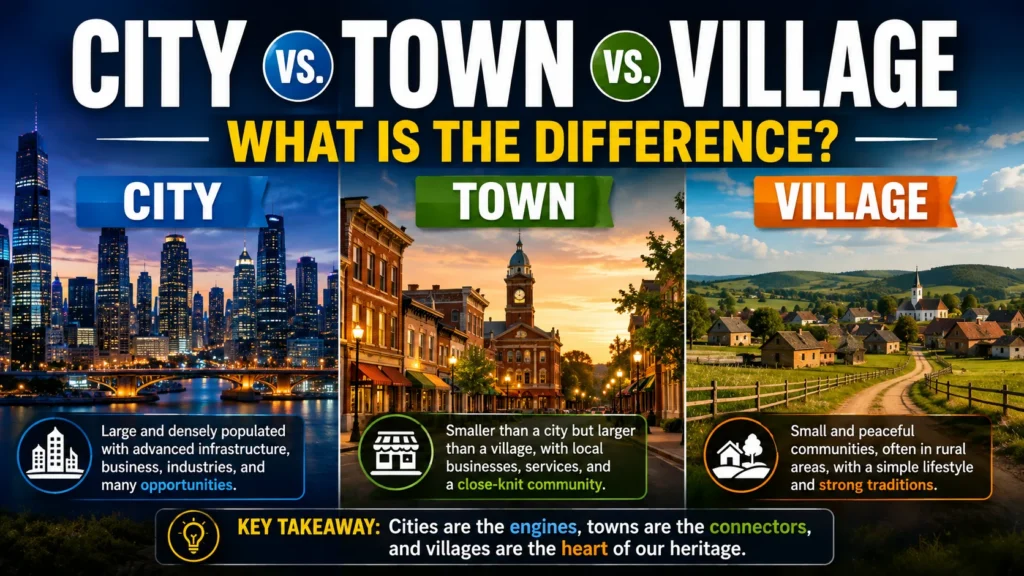
When people compare a city, town, and village, they often assume the difference is simply population: a city is large, a town is smaller, and a village is smaller still. While that is a useful starting point, it is not the complete picture.
The real differences involve population, density, infrastructure, public services, transportation, economic activity, employment, government, and the role a settlement plays within its surrounding region.
A village may have only a few thousand residents but modern electricity, internet, paved roads, schools, and local businesses. A town can sometimes have the population and infrastructure of a small city. Meanwhile, a legally recognized city may be surprisingly small.
This is why there is no single worldwide rule that perfectly separates a city from a town or a town from a village.
A better approach is to look at how a settlement functions, not just what it is called.
At a Glance
| Characteristic | Village | Town | City |
| Typical population | Smaller | Moderate | Larger |
| Population density | Usually lower | Moderate | Often higher |
| Services | Mostly basic/local | Wider range | Broad and specialized |
| Economic role | Mainly local | Regional | Regional, national, or international |
| Employment | More limited | Moderate variety | Broad and specialized |
| Transportation | Mostly local | Regional connections | Extensive networks |
| Healthcare | Basic/local | Hospitals and clinics | Specialized medical facilities |
| Education | Local schools | Schools and some colleges | Universities and specialized institutions |
| Cultural variety | Varies | Moderate | Often high |
| Government complexity | Lower | Moderate | Higher |
| Regional influence | Limited | Significant | Often extensive |
These are general patterns rather than universal definitions. The exact meaning of city, town, and village depends on the country, region, and legal system.
What Is a Village?
A village is generally a relatively small settlement where most services and economic activity are focused on the local community.
Villages are often associated with rural areas, agriculture, open land, and lower population density. However, not every village is purely agricultural, and not every village is completely rural. Some villages can have modern infrastructure and may even be located close to large metropolitan areas.
A typical village may contain:
- Homes and small residential areas
- Grocery and convenience stores
- A primary or secondary school
- A small clinic or health center
- Local markets
- Religious or community buildings
- Small restaurants
- Agricultural businesses
- Repair shops
- Local transportation services
The important feature is usually the scale and range of services.
Residents can often meet their everyday needs locally, but they may need to travel to a nearby town or city for specialized healthcare, higher education, major shopping, government services, or certain types of employment.
Village Life and Community
Village life can offer a strong sense of community because residents may repeatedly interact with the same people.
Neighbors may know one another, local businesses may have long-standing relationships with customers, and community events can play an important role in social life.
This can create a more familiar and personal environment.
However, greater familiarity can also mean less anonymity. Someone who values close community relationships may appreciate village life, while someone who strongly values privacy may prefer a larger settlement.
What Is a Town?
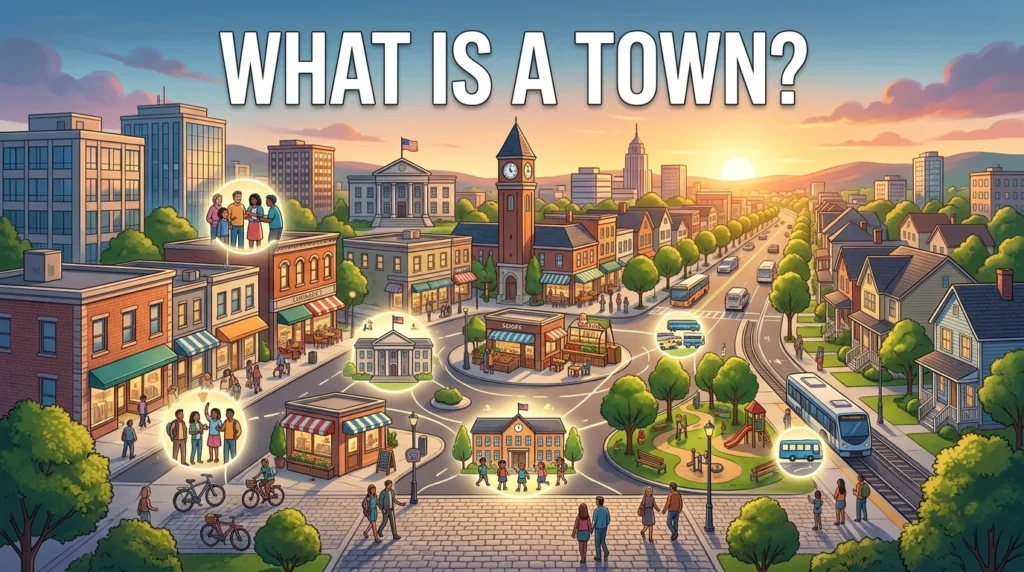
A town generally occupies a middle position between a village and a city, although this is not a universal legal rule.
Towns usually have a larger population and broader range of services than villages. More importantly, a town often serves not only its own residents but also people living in nearby villages and rural communities.
This gives towns an important regional role.
A typical town may provide:
- Schools
- Hospitals and clinics
- Banks
- Supermarkets
- Restaurants
- Government offices
- Local markets
- Pharmacies
- Repair businesses
- Professional services
- Public transportation
- Community and recreational facilities
Someone living in a nearby village might travel to town to buy household goods, visit a doctor, attend school, use a bank, sell agricultural products, or deal with government offices.
For this reason, a town can be economically important even when its population is much smaller than that of a major city.
Towns as Regional Service Centers
One of the easiest ways to understand the role of a town is to ask:
Who does this settlement serve?
A village generally serves its own residents and perhaps a small surrounding area.
A town often serves its own population plus nearby settlements.
A city can serve a much larger region and may attract people from distant parts of a country or even from other countries.
This creates a rough hierarchy:
Village → Town → City
This should not be treated as a strict development ladder. A village does not automatically become a town, and a town does not automatically become a city. Instead, the hierarchy helps explain the different levels of services and regional influence that settlements often develop.
What Is a City?
A city is generally a larger and more complex settlement with a high concentration of people, infrastructure, services, businesses, and institutions.
Cities can support activities that require large populations and specialized markets.
A major city may contain:
- Universities
- Teaching hospitals
- Specialized medical centers
- Shopping districts
- Industrial areas
- Business districts
- Government institutions
- Transportation hubs
- Cultural venues
- Large residential developments
- Professional services
- Corporate headquarters
- Entertainment facilities
Cities also tend to have more diverse economies.
Depending on their location and history, cities can support industries such as:
- Finance
- Technology
- Manufacturing
- Healthcare
- Education
- Tourism
- Media
- Logistics
- Construction
- Real estate
- Professional services
The important difference is not simply that a city has more people. A city often has a greater concentration and specialization of functions.
Population Size Does Not Tell the Whole Story
Population is one of the most obvious ways to compare settlements, but it can be misleading if considered by itself.
Imagine two settlements that both contain 50,000 people.
Settlement A is spread across a large area, with detached houses, open land, farms, and relatively few commercial centers.
Settlement B contains apartment buildings, closely packed neighborhoods, offices, shops, schools, and public transportation concentrated within a smaller area.
Both have the same population, but Settlement B will usually feel much more urban.
This is why population density matters.
Population vs. Population Density
Population tells us:
How many people live there?
Density tells us:
How closely are those people living together?
A settlement with a large population but very low density can have a completely different physical environment from a smaller but highly concentrated settlement.
| Factor | Village | Town | City |
| Population | Generally smaller | Generally moderate | Often larger |
| Density | Often low | Moderate | Often higher |
| Development | Limited or dispersed | More concentrated | Dense or extensive |
| Services | Mostly local | Wider range | Broad and specialized |
| Regional influence | Usually limited | Often significant | Often extensive |
Again, these are broad patterns rather than fixed rules.
Why Population Density Matters
Population density influences how easily services and infrastructure can be provided.
When many people live close together, businesses have access to a larger customer base within a relatively small area. Public transportation can also become more practical because many potential passengers live and work near the same routes.
Higher-density areas can therefore support:
- Frequent bus services
- Rail and metro systems
- Apartment buildings
- Large schools
- Specialized hospitals
- Shopping centers
- Restaurants
- Offices
- Cultural institutions
Lower-density areas face a different challenge.
If homes are spread far apart, a road, water pipeline, electricity network, or public transportation route may serve relatively few people. Providing and maintaining these services across a large area can therefore be more expensive per resident.
This does not mean low density is bad. It simply creates a different set of infrastructure and service requirements.
Physical Size Can Be Misleading
The geographical size of a settlement doesn’t automatically tell you whether it is a village, town, or city.
Administrative boundaries can include residential neighborhoods, farmland, forests, industrial areas, parks, or undeveloped land.
As a result, a place can have a large official area while having a relatively small built-up population.
The opposite can also happen.
A settlement covering a relatively small area can contain a very large population if homes and buildings are densely concentrated.
Consider this simplified example:
| Measure | Settlement A | Settlement B |
| Population | 60,000 | 60,000 |
| Land area | 120 km² | 25 km² |
| Approx. density | 500/km² | 2,400/km² |
| Development pattern | Spread out | Compact |
| Likely urban feel | Lower | Higher |
Both settlements have exactly the same population. Yet Settlement B would generally have a more concentrated urban environment.
So when comparing a, don’t confuse land area, population, and population density.
The Built Environment Also Matters
The physical environment around you provides another clue about the type and function of a settlement.
Villages often contain clusters of homes, local shops, community buildings, agricultural structures, and open land.
Towns generally have more continuous development, with residential neighborhoods connected to commercial streets, schools, healthcare facilities, markets, and government buildings.
Cities can contain several different built environments within the same administrative area, including:
- High-rise residential districts
- Older neighborhoods
- Business centers
- Industrial zones
- Suburban communities
- Shopping districts
- Universities
- Hospitals
- Transportation hubs
- Parks and recreational areas
This variety is one reason cities can sometimes feel like several different communities combined into one.
However, development is not uniform. A city can contain quiet residential streets, while a town can have a busy commercial center that feels highly urban.
Transportation Differences
Transportation is another practical difference between villages, towns, and cities.
In a village, residents may depend heavily on:
- Walking
- Bicycles
- Motorcycles
- Private cars
- Informal local transportation
Because fewer people travel through the settlement every day, a relatively small road network may be sufficient for local needs.
A town usually needs stronger regional transportation connections.
People from surrounding villages may travel into town for work, shopping, education, healthcare, banking, or government services. As a result, roads and transportation systems need to accommodate both local residents and people arriving from nearby communities.
Cities face a much larger transportation challenge.
Large urban areas can generate thousands or millions of daily trips involving:
- Cars
- Buses
- Trains
- Metro systems
- Taxis
- Ride-hailing services
- Motorcycles
- Bicycles
- Walking
- Intercity transportation
The scale changes the entire planning process.
A city road is not simply a wider version of a village road. Urban transportation requires traffic management, intersections, parking systems, public transit planning, pedestrian infrastructure, road maintenance, and coordination with land-use planning.
Public Transportation and Urban Density
Public transportation tends to work most efficiently when enough people live and work close to transport routes.
This is one reason dense cities can justify extensive bus, rail, or metro networks.
A village with a small population spread across a wide area may not have enough passengers to support frequent public transportation. A dense urban district with tens of thousands of residents within a relatively small area can generate much greater demand.
However, density isn’t the only factor.
Public transportation also depends on:
- Geography
- Government investment
- Income
- Urban planning
- Travel patterns
- Road design
- Population distribution
A poorly planned city can have millions of residents and still struggle with public transportation, while a smaller town can operate an effective transit system if its population is concentrated along practical routes.
Airports and Regional Connectivity
Transportation infrastructure also includes airports and other major transport hubs.
Villages generally do not have major airports because the population and travel demand are usually insufficient to support such infrastructure. Residents may instead travel to a nearby town or city to access an airport.
Towns can sometimes be located close to regional airports or important transport terminals, particularly when they serve as centers for surrounding communities.
Cities are much more likely to have direct access to major transportation hubs, including:
- International airports
- Railway stations
- Intercity bus terminals
- Major highways
- Ports
- Metro systems
This creates a practical difference that population figures alone don’t capture.
Someone living in a city may be able to reach several hospitals, universities, shopping districts, workplaces, and transportation hubs without leaving the metropolitan area.
Someone living in a village may need to travel much farther for the same services.
However, greater transportation infrastructure does not always mean shorter travel times. Traffic congestion can make a city journey surprisingly slow, especially during peak commuting periods.
Public Services Become More Specialized
As a settlement grows, the range and specialization of public and private services usually increase.
A village may provide basic services close to home. A town can support a broader collection of everyday services. A city can sustain highly specialized institutions because it has a larger population and a wider regional customer base.
Healthcare provides a clear example.
A village might have:
- A small clinic
- A pharmacy
- Basic healthcare services
- Visiting medical professionals
A town might support:
- Larger clinics
- General hospitals
- Dental practices
- Diagnostic centers
- Pharmacies
- Emergency services
A city may add:
- Teaching hospitals
- Specialized surgery
- Cancer treatment centers
- Cardiology departments
- Neurology services
- Medical universities
- Specialist laboratories
This does not mean every city has excellent healthcare or every village has poor healthcare.
Service availability depends on investment, geography, income, staffing, government policy, and local management, as well as settlement size.
The same principle applies to education.
A village may have a primary or secondary school. A town can support several schools and vocational institutions. A major city can sustain universities, research centers, professional colleges, and highly specialized training programs.
The Key Idea: Function Matters More Than the Label
At this point, the most useful principle is clear:
A settlement’s function often tells you more than its name.
Instead of asking only whether a place is called a city, town, or village, ask:
- How many people live there?
- How densely do they live?
- What services are available locally?
- How far do residents travel for specialized services?
- What kinds of jobs are available?
- Does the settlement serve surrounding communities?
- What transportation links connect it to other places?
- How developed is its infrastructure?
- How complex is its administration?
- What does local law officially call it?
These questions provide a much more accurate picture.
A village can have modern infrastructure. A town can function like a small city. A city can contain quiet, low-density neighborhoods.
So the simplest definition—
“A city is bigger than a town, and a town is bigger than a village”
—is useful as an introduction, but it is not enough to explain the real-world differences.
To understand a settlement properly, you need to consider population, density, infrastructure, services, transportation, economy, government, and regional role together.
Population, Infrastructure, and Public Services
Population is one of the most obvious ways to compare a city, town, and village, but it is not enough by itself. Two settlements can have similar populations while offering completely different living conditions. Population density, transportation, utilities, healthcare, education, shopping, and public infrastructure all influence how a settlement functions.
This is why a useful comparison should look beyond the number of residents. A small settlement with reliable roads, internet, electricity, schools, and healthcare can function very differently from a larger settlement where infrastructure has not kept pace with population growth
For example, imagine two settlements, each with 50,000 residents. One covers a large area with detached houses, farmland, and open spaces. The other has most of its population concentrated in apartment buildings and closely connected neighborhoods.
Although both have the same population, the second settlement will usually feel much more urban.
| Factor | Village | Town | City |
| Population | Generally smaller | Generally moderate | Often larger |
| Density | Usually lower | Moderate | Often higher |
| Development | More dispersed | More concentrated | Dense or extensive |
| Services | Mostly local | Wider range | Broad and specialized |
| Regional influence | Limited | Often significant | Often extensive |
These are general patterns rather than universal rules. Local laws and geography can create many exceptions.
Why Density Matters
Population density affects the way services and infrastructure are provided.
When many people live close together, businesses can serve more customers within a smaller area. Public transportation can also become more practical because many potential passengers live and work near the same routes.
Higher-density areas can therefore support:
- Frequent bus services
- Rail and metro systems
- Apartment buildings
- Larger schools
- Specialized hospitals
- Shopping centers
- Restaurants
- Offices
- Cultural institutions
Lower-density settlements face a different challenge. Roads, water lines, electricity networks, waste collection, and public transportation may have to cover larger distances while serving fewer people.
This does not mean low density is necessarily better or worse. It simply creates different infrastructure requirements.
Physical Size Can Be Misleading
The physical area of a settlement does not automatically tell you whether it is a city, town, or village.
Administrative boundaries can include residential neighborhoods, farmland, forests, industrial areas, and undeveloped land. As a result, a place can have a large official area while still having a relatively small built-up population.
The opposite can also happen. A relatively small area can contain a very large population if homes and buildings are densely concentrated.
Consider this simplified example:
| Measure | Settlement A | Settlement B |
| Population | 60,000 | 60,000 |
| Land area | 120 km² | 25 km² |
| Approx. density | 500/km² | 2,400/km² |
| Development | Spread out | Compact |
| Urban feel | Lower | Higher |
Both settlements have exactly the same number of residents, but Settlement B would generally feel much more urban.
So when comparing settlements, avoid confusing land area, population, and density. They measure different things.
The Built Environment
The buildings and spaces around you provide another useful clue.
Villages often contain smaller groups of homes, local shops, community buildings, agricultural structures, and open land. Towns usually have more continuous development, with residential areas connected to commercial streets and public facilities.
Cities can contain several different environments within the same administrative boundary, including:
- High-rise residential districts
- Older neighborhoods
- Business centers
- Industrial zones
- Universities
- Hospitals
- Shopping districts
- Parks
- Suburban neighborhoods
- Transportation hubs
This variety is one reason a large city can feel like several different communities combined into one.
However, urban development is not uniform. A city can contain quiet residential streets, while a town can have a crowded and highly active commercial center.
Roads and Transportation
Transportation is one of the most noticeable practical differences between settlement types.
In a village, residents may rely mainly on walking, bicycles, motorcycles, private vehicles, or informal transportation. The road network can remain relatively simple because fewer people travel through the settlement each day.
A town normally needs stronger regional connections. People from surrounding villages may travel into town for:
- Work
- Shopping
- Education
- Healthcare
- Banking
- Government services
- Markets
As a result, roads may need to handle both local traffic and people arriving from surrounding areas.
Cities face a much larger transportation challenge. A major urban area can generate thousands or even millions of daily journeys involving:
- Cars
- Buses
- Trains
- Metro systems
- Taxis
- Ride-hailing services
- Motorcycles
- Bicycles
- Walking
- Intercity transportation
The important difference is not simply that city roads are wider.
Urban transportation requires traffic management, intersections, parking systems, public transit planning, pedestrian infrastructure, road maintenance, and coordination with land-use planning.
Traffic Congestion
Greater transportation infrastructure does not automatically mean shorter travel times.
A city may have multiple roads, buses, trains, and highways but still suffer from severe congestion during peak hours. Someone living in a compact city may have many services nearby but spend considerable time travelling because of traffic.
A person living in a smaller town may have fewer services but reach their destination faster because roads are less congested.
This creates an important distinction:
Access to transportation is not the same as speed of transportation.
Public Transportation and Density
Public transportation tends to work most efficiently when enough people live and work close to transit routes.
A dense urban neighborhood may have enough passengers to support frequent buses, trains, or metro services. A village with homes spread over a large area may not have enough demand to support the same system.
However, density is not the only factor.
Public transportation also depends on:
- Government investment
- Geography
- Income levels
- Travel patterns
- Urban planning
- Road design
- Population distribution
Therefore, a smaller town can sometimes have effective public transportation, while a much larger city can still struggle with unreliable or overcrowded services.
Water, Electricity, Waste, and Other Utilities
Infrastructure goes far beyond roads.
Every settlement requires systems that support daily life and economic activity. These can include:
- Electricity
- Drinking water
- Drainage
- Wastewater systems
- Solid-waste collection
- Telecommunications
- Street lighting
- Roads
- Public buildings
As settlements grow, these systems generally become larger and more complex.
A major city may require large water-treatment facilities, extensive sewer networks, pumping stations, waste-management facilities, and complicated electricity distribution systems.
A village may use much smaller systems.
But settlement size does not automatically determine infrastructure quality.
A village can have reliable electricity, clean water, paved roads, high-speed internet, and modern housing. At the same time, some urban neighborhoods may experience unreliable utilities or inadequate public infrastructure.
Infrastructure quality depends on factors such as:
- Government investment
- Local income
- Geography
- Management
- Technology
- Maintenance
- Planning
Education
Education is another area where settlement size can influence local opportunities.
A village may have a primary or secondary school serving local children. Students seeking advanced education may need to travel to a nearby town or city.
A town can support several schools and may also have:
- Vocational institutes
- Training centers
- Colleges
- Libraries
- Technical institutions
A large city can support a much broader educational ecosystem, including:
- Public and private schools
- Universities
- Medical schools
- Engineering institutions
- Business schools
- Research centers
- Vocational institutes
- Specialized training facilities
Larger populations create larger pools of students, teachers, researchers, and specialists. Cities can also benefit from connections between universities and employers, hospitals, government agencies, and research organizations.
Healthcare
Healthcare provides another clear example of how settlement size can affect service availability.
A village may have a small clinic, pharmacy, or primary-care provider. Residents can receive basic treatment locally but may need to travel for surgery, advanced diagnostic testing, specialist consultations, or complex emergencies.
A town can provide a broader healthcare network, potentially including:
- Clinics
- Pharmacies
- Dental practices
- Diagnostic centers
- General hospitals
- Ambulance services
Cities can support highly specialized medical institutions because they have larger patient populations and larger pools of healthcare professionals.
Large urban centers may offer:
- Teaching hospitals
- Specialized surgery
- Cancer treatment
- Cardiology
- Neurology
- Intensive-care units
- Medical research
- Specialist laboratories
However, being located in a city does not automatically guarantee better healthcare. Quality depends on funding, staffing, management, equipment, and accessibility.
Emergency Services
Emergency response also becomes more complex as settlements grow.
A small village may depend on emergency services located locally or in a nearby town. A town may have dedicated ambulance, fire, or police facilities.
A large city may require numerous strategically located facilities because response time becomes critical when thousands of people live within densely developed neighborhoods.
Urban emergency systems can include:
- Fire stations
- Ambulance networks
- Police stations
- Emergency communication centers
- Disaster-response teams
- Specialized rescue units
- Traffic management systems
The goal is not simply to have more emergency workers. It is to position resources where they can reach people quickly.
Shopping and Commercial Services
The range of shopping and commercial services generally increases as the customer base becomes larger.
A village might have small grocery stores, repair shops, pharmacies, and local markets.
A town can support a wider range of businesses, including:
- Supermarkets
- Clothing stores
- Hardware shops
- Banks
- Restaurants
- Furniture stores
- Auto-repair businesses
- Professional offices
A city can support highly specialized commercial districts and large-scale retail, such as:
- Shopping malls
- Wholesale markets
- Department stores
- Specialty stores
- Large supermarkets
- Entertainment venues
- Corporate retail centers
The underlying principle is market size.
A specialized business needs enough customers to remain profitable. A small village may not generate enough demand, while a city can provide thousands or millions of potential customers.
Public Facilities and Recreation
Settlement size can also influence recreational opportunities.
Villages may have:
- Playgrounds
- Sports grounds
- Community centers
- Local parks
- Open spaces
Towns can support larger:
- Sports facilities
- Libraries
- Parks
- Cultural centers
- Community halls
Cities can sustain major attractions such as:
- Museums
- Stadiums
- Theaters
- Concert venues
- Art galleries
- Zoos
- Large parks
- Convention centers
- Cultural institutions
Again, these are patterns rather than rules. A small town can have a world-famous cultural institution, while a large city can have poorly maintained public spaces.
Local investment and history matter.
Internet and Digital Infrastructure
Technology has changed the traditional difference between rural and urban settlements.
Reliable internet can give residents of smaller settlements access to:
- Online education
- Remote employment
- Digital banking
- E-commerce
- Government services
- Telemedicine
- International customers
- Professional networks
A person living in a village can therefore work for a company located hundreds or thousands of kilometres away.
Remote workers may include:
- Software developers
- Graphic designers
- Writers
- Online teachers
- Consultants
- Accountants
- Marketing professionals
- Data analysts
Digital connectivity has reduced some geographic disadvantages, but it has not eliminated them.
High-speed internet cannot completely replace a nearby hospital, university, railway station, major employer, or airport.
Infrastructure Comparison
| Infrastructure/Service | Village | Town | City |
| Local roads | Basic to developed | Extensive locally | Extensive and complex |
| Highways | Usually nearby | Often connected | Multiple connections possible |
| Public transport | Limited | Moderate | Often extensive |
| Water systems | Small-scale | Developed | Large-scale |
| Sewer systems | Varies | More common | Extensive in developed areas |
| Schools | Basic/local | Several levels | Broad and specialized |
| Healthcare | Basic care | Hospitals and clinics | Specialized network |
| Shopping | Local stores | Markets and stores | Extensive retail |
| Entertainment | Limited | Moderate | Broad |
| Emergency services | Local/regional | More developed | Extensive and specialized |
| Internet | Increasingly available | Usually broad | Usually extensive |
This comparison shows why infrastructure is often a more useful practical indicator than the settlement’s name alone.
When Infrastructure Cannot Keep Up
Population growth does not always happen at the same speed as infrastructure development.
A rapidly growing settlement can experience:
- Traffic congestion
- Overcrowded schools
- Water shortages
- Waste-management problems
- Housing pressure
- Longer commutes
- Overloaded hospitals
- Electricity shortages
This is particularly important in areas experiencing rapid urbanization.
New residents can arrive within months or years, while building roads, hospitals, schools, water systems, and public transportation can take much longer.
This creates a gap between population growth and infrastructure capacity.
How Settlements Grow
A settlement can gradually become larger and more economically important.
A simplified process might look like:
Population growth → new housing → more businesses → better infrastructure → expanded services → more employment → further population growth
But growth does not automatically change legal status.
A village can physically expand while remaining legally classified as a village. A town can grow into a major urban center while keeping its official designation.
Another important process occurs when neighboring settlements expand toward one another.
A town may grow toward a nearby village. New housing and businesses fill the space between them. Eventually, their built-up areas can become physically connected even though they retain separate legal names.
This is one reason modern metropolitan areas are much more complicated than the simple:
Village → Town → City
model suggests.
The Key Point
The strongest way to understand the difference between a city, town, and village is to see population, density, infrastructure, and public services as interconnected.
Population creates demand.
Density affects how efficiently that demand can be served.
Infrastructure moves people, water, energy, goods, and information.
Public services provide healthcare, education, safety, and administration.
Economic activity creates jobs and attracts people.
These factors work together to determine how a settlement actually functions.
A settlement with 50,000 residents, excellent roads, specialized healthcare, a college, busy markets, reliable utilities, and strong regional connections may function very differently from another settlement with the same population but dispersed housing and limited services.
The numbers may be identical.
The settlement systems are not.
Local Government, Economy, and Employment in Cities, Towns, and Villages
A city, town, or village is not defined only by buildings and population. The way a settlement is governed, financed, planned, and connected to the local economy also shapes everyday life.
Government determines how public resources are managed, while businesses and workers create much of the economic activity. A village may depend heavily on agriculture and small businesses. A town can become a regional marketplace and service center. A city can support a much broader economic ecosystem involving manufacturing, technology, finance, education, healthcare, transportation, and professional services.
However, these are broad patterns rather than universal rules. Legal definitions and government structures vary from one country to another, so the word “city” does not always represent the same administrative system.
How Local Government Differs
Local governments exist to manage the needs of residents, but their structure depends on the country’s laws and the settlement’s legal status.
A local authority may be responsible for:
- Roads and transportation
- Waste collection
- Water and sanitation
- Land-use planning
- Public parks
- Local regulations
- Building approvals
- Emergency services
- Community facilities
- Local economic development
As settlements become larger and more complex, the number of responsibilities usually increases.
A village authority may manage a relatively small number of roads, public buildings, and community services. A city government may need to coordinate transportation networks, multiple districts, large public facilities, zoning systems, utilities, parks, and services for hundreds of thousands or millions of residents.
The important point is that population size and administrative complexity are related, but they are not exactly the same thing.
How Villages Are Governed
Village administration is often closely connected to the local community.
Depending on the country, a village may have:
- A village council
- Local administrative officers
- Community representatives
- Development committees
- Traditional leadership structures
However, not every place called a village has a completely independent government.
A village may instead be administered by a larger:
- Municipality
- District
- County
- Local authority
- Regional government
This distinction is important because a settlement’s name does not necessarily tell you which government provides its services.
Residents may live in a village but receive water, waste management, road maintenance, education, or other public services from a larger administrative authority.
How Town Governments Operate
Town governments generally have more administrative responsibilities because towns serve not only their own residents but often people from surrounding communities.
A town government may oversee:
- Local roads
- Zoning
- Markets
- Public buildings
- Waste management
- Water services
- Community facilities
- Local business regulations
- Public safety
- Development projects
Towns can also function as regional service hubs.
People living outside the town may travel there for:
- Government services
- Healthcare
- Shopping
- Education
- Banking
- Employment
- Transportation
This creates an important relationship between the town and surrounding villages.
The town does not operate in isolation. Its economy and public services often depend partly on people who live outside its official boundaries.
How City Governments Manage Larger Populations
City governments face a much more complicated management environment.
A large city may contain neighborhoods with completely different characteristics. One district might contain high-rise apartments, another might contain industrial facilities, while another may consist mainly of low-density residential areas.
City administrations may therefore need specialized departments responsible for:
- Transportation
- Urban planning
- Housing
- Public health
- Waste management
- Water systems
- Parks
- Public safety
- Economic development
- Environmental management
- Building regulation
The challenge isn’t simply having more residents.
Large populations create interconnected problems.
For example, a new housing development can increase traffic. More traffic can require road improvements. Additional residents can increase demand for schools, water, waste collection, healthcare, and public transportation.
These services then require additional planning and spending.
Urban government therefore involves considerable long-term coordination.
Why Legal Definitions Differ Around the World
There is no universal population number that automatically turns a village into a town or a town into a city.
This is one of the most important points in understanding settlement classification.
In one country, city status might depend partly on population. In another, it may depend on:
- Legislation
- Historical recognition
- Administrative importance
- A formal charter
- Government recognition
- Other legal requirements
This means two settlements with similar populations can have completely different legal classifications.
For international comparisons, statistical systems such as the United Nations’ Degree of Urbanisation framework use measurable characteristics including population density, population size, and spatial continuity rather than relying entirely on traditional legal labels.
That makes comparisons more consistent across countries.
Local Taxes and Public Spending
Government services require funding.
Depending on the country, local authorities may receive money through:
- Property taxes
- Local taxes
- Business taxes
- Government transfers
- Service fees
- Licenses
- Fines
- Development charges
- Grants
The exact system varies significantly between jurisdictions.
Cities often have larger tax bases because they contain more:
- Businesses
- Properties
- Workers
- Commercial activity
- Higher-value development
However, cities also have much larger expenses.
A major city may need to maintain:
- Thousands of kilometres of roads
- Large water systems
- Wastewater infrastructure
- Public transportation
- Parks
- Public buildings
- Emergency services
- Waste-management systems
Therefore, more total revenue does not automatically mean more money per resident.
A city can have a very large budget while still facing serious financial pressure.
The Village Economy
The economy of a village often reflects its surrounding geography and natural resources.
In agricultural regions, farming may remain an important source of income and employment. But modern village economies can be much more diverse than the traditional image of farming alone.
Village businesses can include:
- Crop production
- Livestock
- Dairy farming
- Fishing
- Forestry
- Agricultural equipment
- Food processing
- Small retail
- Construction
- Local transportation
- Handicrafts
- Tourism
- Remote-work services
Agriculture does not automatically mean that a village is poor or economically isolated.
Modern rural economies can be connected to national and international markets through transportation, banking, digital platforms, improved technology, and modern supply chains.
Some villages may also benefit from:
- Tourism
- Renewable energy
- Manufacturing
- Food processing
- Online businesses
- Remote employment
Agriculture and Village Employment
Agriculture can create far more jobs than farming alone.
A productive agricultural area may support an entire network of businesses.
For example:
Farmers → equipment suppliers → transport companies → storage facilities → food processors → wholesalers → retailers
This creates an economic chain extending beyond the farm.
A village located within an important agricultural region can therefore play a significant economic role even if its own population is relatively small.
Seasonal employment can also be important.
During planting or harvesting seasons, demand may increase for:
- Temporary workers
- Transportation
- Storage
- Equipment
- Processing
- Agricultural services
This means employment patterns in rural areas can sometimes change significantly throughout the year.
Small Businesses in Towns
Towns often depend heavily on small and medium-sized businesses.
Because towns serve both their own residents and surrounding communities, businesses can attract a larger customer base than they would in a typical village.
A town marketplace may contain:
- Grocery stores
- Clothing shops
- Hardware stores
- Restaurants
- Pharmacies
- Banks
- Auto-repair shops
- Furniture stores
- Construction suppliers
- Professional offices
The town becomes a place where people from surrounding villages can perform activities that may not be available locally.
For example, a farmer might:
- Live in a village
- Produce agricultural goods
- Sell them through a town market
- Use a town bank
- Purchase equipment from a town supplier
- Visit a town hospital
- Send children to a town school
The village and town are therefore not separate economic worlds.
They form part of the same regional system.
Towns as Regional Market Centers
One of the most important economic roles of a town is connecting smaller settlements with larger economic networks.
A town may develop around:
- A major road
- A railway station
- A river crossing
- A market
- A port
- An administrative center
- An industrial facility
Once a settlement becomes an important meeting point, additional businesses often follow.
Over time, this can create a cycle:
More customers → more businesses → more jobs → more residents → more services → greater regional importance
This explains why some towns appear surprisingly busy even though their permanent population is relatively modest.
Their economic activity includes people who live elsewhere but work, shop, study, receive services, or conduct business there.
City Economies Are More Diverse
Cities generally support a much wider range of industries and professions.
A major urban economy can include:
- Manufacturing
- Technology
- Finance
- Healthcare
- Education
- Construction
- Tourism
- Logistics
- Media
- Entertainment
- Retail
- Real estate
- Professional services
- Government
- Research
This diversity creates an important advantage.
Workers can often find many different career paths within the same metropolitan area.
If one company closes, other employers may be available. If one industry slows down, another industry may continue expanding.
However, cities can still become dependent on particular sectors.
A city heavily dependent on manufacturing, for example, can experience major economic problems if factories close or production moves elsewhere.
So economic diversity provides resilience, but it does not eliminate economic risk.
Industry and Manufacturing
Manufacturing has historically played a major role in the development of many towns and cities.
Factories need:
- Workers
- Transportation
- Electricity
- Raw materials
- Suppliers
- Warehouses
- Markets
When these factors cluster together, industrial districts can develop.
A town may grow around a single large factory or industrial complex. A city can develop an entire network of manufacturing, logistics, engineering, finance, and professional services.
Industrial growth can transform a settlement dramatically.
A previously small community may attract workers from other areas. Housing expands. Roads improve. Shops open. Schools grow. Local government receives additional revenue.
This can create a self-reinforcing cycle of economic and population growth.
Technology and the Modern City
Technology has changed the traditional urban economy.
A modern city does not have to depend entirely on factories and physical goods. It can also specialize in information-intensive industries such as:
- Software
- Finance
- Research
- Digital services
- Media
- Consulting
- Data analysis
- Professional services
Technology companies often benefit from being close to:
- Universities
- Skilled workers
- Investors
- Customers
- Research institutions
- Professional networks
- Transportation hubs
This concentration creates what economists call agglomeration economies.
When businesses and skilled workers locate near one another, they can share knowledge, access specialized services, find employees more easily, and connect with customers and suppliers.
This is one reason large cities can become powerful economic centers.
Remote Work Changes the Traditional Pattern
Remote work has challenged the assumption that high-skilled employment must always take place inside major cities.
A person can live in a village or small town while working for a company headquartered hundreds or thousands of kilometres away.
Remote employment can include:
- Software development
- Graphic design
- Writing
- Online teaching
- Consulting
- Marketing
- Customer support
- Accounting
- Data analysis
This gives smaller settlements access to economic opportunities that previously might have required relocation.
However, remote work does not completely eliminate the advantages of cities.
Major urban areas still provide:
- Universities
- Professional networks
- Specialized healthcare
- Research institutions
- Cultural activities
- Business connections
- Face-to-face opportunities
So technology has reduced some geographic disadvantages without making cities unnecessary.
Employment Opportunities
Employment variety generally increases with settlement size.
| Employment Factor | Village | Town | City |
| Agriculture | Often important | May support surrounding agriculture | Usually smaller share |
| Local retail | Small | Broad | Extensive |
| Manufacturing | Possible | Common in some towns | Often significant |
| Professional services | Limited | Moderate | Extensive |
| Technology | Increasing | Increasing | Usually broader |
| Specialized healthcare | Limited | Moderate | Extensive |
| Higher education | Limited | Some | Extensive |
| Corporate employment | Limited | Some | Often substantial |
| Remote work | Possible | Possible | Common |
| Career variety | Narrower | Moderate | Broad |
These are general trends rather than strict rules.
A rural technology company can create highly specialized jobs in a village. A small town can host a major manufacturing plant. A city can also contain neighborhoods where informal employment dominates.
Economic Opportunity vs. Competition
Cities provide more employment opportunities, but that does not mean finding a job is automatically easier.
Large labor markets create more opportunities and more competition at the same time.
A village might offer only a few major career categories. A city might offer dozens of professions and industries, but each position may attract many applicants.
Cities can also experience significant income inequality.
Highly paid professionals may live and work near people employed in lower-wage service occupations. Therefore, a city can provide enormous economic opportunity while also containing substantial differences in income and living standards.
Smaller towns and villages may have fewer career choices, but some local labor markets can have stronger connections between employers and residents.
Cost of Living and Employment
Employment and living costs are closely connected.
Cities often offer higher salaries in specialized industries, but they may also have higher costs for:
- Housing
- Transportation
- Childcare
- Food
- Services
A town may provide a lower-cost lifestyle while offering fewer highly specialized jobs.
A village can sometimes provide cheaper housing but require longer travel for specialized employment.
This creates a common trade-off:
More employment opportunities ↔ potentially higher living costs
The right balance depends on your profession, income, family situation, transportation, and personal priorities.
How Economic Growth Changes a Settlement
Economic growth can change the physical identity of a settlement.
A growing village may attract:
- New homes
- Shops
- Roads
- Schools
- Clinics
- Small industries
A growing town may develop:
- Commercial districts
- Industrial parks
- Large residential areas
- Colleges
- Hospitals
- Transportation terminals
A rapidly expanding city may experience:
- High-rise construction
- Suburban expansion
- New business districts
- Industrial development
- Transit expansion
- Housing shortages
- Traffic congestion
Growth creates opportunities, but it also creates pressure.If employment grows faster than housing, housing costs can increase.If population grows faster than roads, congestion can worsen.If businesses expand without adequate environmental management, pollution can increase.
Therefore, economic growth needs infrastructure and planning to remain sustainable.
A Simple Regional Economic Example
Consider a rural region containing three settlement levels.
Village
Farmers produce:
- Wheat
- Vegetables
- Milk
- Livestock
Local stores provide everyday necessities.
Town
Businesses:
- Purchase agricultural products
- Provide machinery
- Offer banking
- Provide healthcare
- Operate schools
- Store goods
- Provide transportation
City
Larger organizations:
- Process agricultural products
- Finance businesses
- Distribute goods
- Export products
- Provide specialized services
- Connect the region to national and international markets
The three settlements depend on one another.
The village provides resources and labor.
The town provides regional services and markets.
The city provides specialized industries, larger markets, finance, and high-level services.
This is not the exact structure of every region, but it illustrates how settlements can form interconnected economic systems.
Economic Reach
A useful way to compare settlement types is to consider their economic reach.
A village generally has a local economic reach.
A town often has a regional economic reach.
A major city can have a national or international economic reach.
This is why population alone cannot measure economic importance.
A relatively small city can be economically powerful if it contains:
- A major port
- Financial institutions
- A university
- An industrial cluster
- A government center
- A transportation hub
Similarly, a large settlement can have relatively limited influence outside its immediate region.
Government and Economy Work Together
Local government and economic activity constantly influence one another.
Businesses need:
- Roads
- Electricity
- Water
- Communications
- Security
- Predictable regulations
- Skilled workers
Governments need economic activity to generate:
- Employment
- Investment
- Tax revenue
- Business activity
- Population stability
This creates a basic relationship:
Infrastructure → Businesses → Jobs → Population growth → Greater demand for services → Further infrastructure investment
When this cycle works well, settlements can grow steadily.
When it fails, growth can produce:
- Congestion
- Housing shortages
- Unemployment
- Infrastructure pressure
- Environmental problems
- Inadequate public services
This is why economic development cannot be separated from infrastructure and government planning.
What Really Separates a City, Town, and Village?
The biggest difference is not one magic population number.
It is the combination of administrative role, economic function, employment diversity, infrastructure, and regional influence.
A village generally focuses on local needs and may rely heavily on agriculture, natural resources, tourism, or small businesses.
A town often becomes a service and market center for surrounding communities.
A city typically supports a more complex economy with specialized employment, larger institutions, extensive infrastructure, and broader regional influence.
But legal status varies by jurisdiction.
A place called a town may function much like a city. A legally recognized city may remain relatively small. A village can become economically sophisticated without losing its traditional designation.
The label tells you something.
The settlement’s government, economy, infrastructure, and regional role tell you much more.
Key Takeaway
When comparing a city, town, and village, don’t ask only:
“How many people live there?”
Also ask:
- What jobs are available?
- What industries operate there?
- Who does the settlement serve?
- How much economic activity happens there?
- What government manages it?
- How much infrastructure does it have?
- How far do surrounding communities depend on it?
These questions provide a much more accurate picture of the settlement’s actual importance.
Lifestyle, Community, Culture, and Choosing Between a City, Town, or Village
The difference between a city, town, and village becomes much more personal when we look at everyday life. Population, infrastructure, government, and the economy explain how settlements function, but they do not fully explain what it feels like to live in one.
Community, culture, housing, career opportunities, access to nature, transportation, education, healthcare, privacy, and personal priorities can make one settlement much more suitable for someone than another.
There is no universally “best” choice. A young professional may prioritize career opportunities and transportation. A family may care more about schools, housing, and safety. Someone seeking peace and open space may prefer a village. Another person may enjoy the energy, diversity, and convenience of a major city.
The right choice depends on the kind of life you want to live.
Daily Life in a Village
Village life often revolves around a relatively small and familiar community.
People may regularly interact with the same:
- Neighbors
- Shopkeepers
- Teachers
- Farmers
- Community leaders
- Relatives
- Local business owners
Because fewer people live in the settlement, social relationships can feel more personal.
Daily life may include:
- Shopping at local stores
- Walking through nearby neighborhoods
- Working in agriculture or local businesses
- Attending community events
- Visiting relatives and neighbors
- Spending time outdoors
- Travelling to a nearby town for specialized services
Villages can also provide easier access to open land and natural surroundings.
However, quieter living comes with trade-offs.
Residents may have fewer nearby:
- Restaurants
- Entertainment venues
- Specialist doctors
- Colleges
- Large retailers
- Career opportunities
- Public transportation options
As a result, private vehicles or regular transportation to a nearby town or city can become important.
Community Life in Villages
Community connections can be especially visible in smaller settlements.
People see familiar faces repeatedly, which can encourage stronger informal networks. Neighbors may help one another during:
- Celebrations
- Emergencies
- Construction projects
- Agricultural work
- Community activities
- Family events
This can create a strong sense of belonging.
But small-community life does not always mean perfect social relationships.
Smaller communities can also provide less anonymity. When many people know one another, personal decisions or family matters may become more visible to others.
Therefore, village life can provide both connection and reduced privacy.
Someone who enjoys close relationships may find this comforting. Someone who strongly values anonymity may prefer a larger town or city.
Life in a Town
A town often provides a middle ground between village and city life.
Residents can have access to more services while avoiding some of the intensity of a major urban center.
A typical town may provide:
- Schools
- Clinics and hospitals
- Grocery stores
- Restaurants
- Banks
- Government offices
- Local markets
- Sports facilities
- Community institutions
- Small businesses
- Public transportation
Residential neighborhoods may still be relatively quiet compared with central city districts.
This balance is one reason towns can appeal to people who want convenience without constant urban pressure.
A person may be able to reach most everyday services within a short journey while still having more space and less congestion than in a major city.
Community Life in Towns
Towns often maintain a strong sense of local identity.
Residents may recognize many people around the community while still having access to a larger variety of social groups, workplaces, businesses, schools, and activities than a typical village.
Town life can therefore combine two characteristics:
Familiarity + variety
A person may know their neighbors and local business owners while also meeting people from surrounding villages who come into town for work, shopping, education, or healthcare.
This creates a broader social environment than a village without necessarily producing the anonymity associated with a large city.
Fast-Paced City Life
City life can feel very different.
A large urban center may operate almost around the clock. Roads remain busy, businesses may stay open late, public transportation moves continuously, and people from different backgrounds interact every day.
Cities can provide exceptional access to:
- Career opportunities
- Universities
- Specialized healthcare
- Entertainment
- Restaurants
- Cultural events
- Professional networks
- Public transportation
- International travel
- Specialized shopping
But urban convenience comes with costs.
Large cities can also bring:
- Traffic
- Noise
- Crowding
- Higher housing costs
- Longer commutes
- Air pollution
- Competition for jobs
- Limited private outdoor space
The experience also varies enormously between neighborhoods.
A quiet residential neighborhood can feel completely different from a crowded commercial district, even though both belong to the same city.
Community and Cultural Diversity
Cities usually provide the greatest cultural variety.
Large urban areas attract people from different regions and countries because of:
- Employment
- Education
- Migration
- Business
- Tourism
- Government
- International connections
As a result, residents may encounter different:
- Languages
- Foods
- Traditions
- Music
- Clothing
- Festivals
- Religious practices
- Professional backgrounds
This diversity can expose people to ideas and experiences they might rarely encounter in a smaller settlement.
Towns can also be culturally diverse, especially when they are located along major transportation routes or attract migrants and workers.
Villages may have smaller populations and stronger shared traditions, although rural communities can also be highly diverse.
The key point is:
Settlement size influences cultural interaction, but it does not completely determine it.
Community Events in Towns
Towns often have a strong local-event culture.
Because towns serve a larger population than villages while remaining relatively manageable communities, they can support events such as:
- Local festivals
- Sports competitions
- Farmers’ markets
- Cultural celebrations
- School events
- Community fairs
- Public meetings
- Seasonal gatherings
These activities can become important social anchors.
A town’s central market or public square may function as more than a commercial location. It can become a place where people:
- Meet friends
- Exchange information
- Celebrate events
- Conduct business
- Maintain traditions
- Build community relationships
This gives towns a social character that can be different from both villages and large cities.
Historical Development of Settlements
The differences between cities, towns, and villages also have a historical dimension.
Human settlements did not appear in their modern forms overnight.
Early permanent communities often developed where people could obtain reliable:
- Food
- Water
- Shelter
- Agricultural land
- Transportation
- Natural resources
Agricultural settlements expanded as farming became more established.
Some communities later grew because they were located near:
- Rivers
- Trade routes
- Coastlines
- Ports
- Crossroads
- Mines
- Religious centers
- Government institutions
Over time, successful settlements attracted more people and economic activity.
A simplified development pattern might look like:
Small settlement → growing village → market center → town → major urban center
But history does not follow one universal path.
Some villages remain small for centuries.Some towns grow rapidly.Some cities decline after losing an important industry or transportation role.
Therefore, settlement size at any particular moment is only one part of the story.
How Villages Developed
Many early villages developed around agriculture.
Farmers benefited from living relatively close to:
- Fields
- Water sources
- Grazing areas
- Storage facilities
- Other households
Living together could provide practical advantages such as:
- Shared labor
- Protection
- Trade
- Access to water
- Social cooperation
- Religious activities
- Cultural traditions
Geography played a major role.
Villages often developed near rivers, fertile valleys, coastlines, forests, crossroads, and other useful resources.
Over generations, these settlements could develop distinctive local traditions, architecture, community structures, and patterns of land use.
How Towns Expanded
Towns often developed when a settlement gained a broader economic or administrative function.
A:
- Marketplace
- Road junction
- Railway station
- Port
- Administrative center
- Mine
- Factory
- Religious institution
could attract people from surrounding communities.
Once a settlement became an important meeting point, additional businesses followed.
The process could create a chain reaction:
More customers → more businesses → more jobs → more residents → more services → greater regional importance
Transportation has historically been especially important.
A town located beside a major railway line or highway can grow much faster than a similar settlement located far from important transportation networks.
How Cities Became Urban Centers
Cities usually emerge when several economic and geographic advantages combine.
A settlement may grow because of:
- Trade
- Government
- Manufacturing
- Agriculture
- Ports
- Mining
- Education
- Finance
- Transportation
- Military importance
- Technology
As population and economic activity increase, additional institutions can develop.
Businesses attract workers.
Workers need housing.
Housing attracts schools and shops.
Schools attract teachers and professionals.
Businesses then benefit from a larger market.
This creates a powerful urban growth cycle.
Modern cities can continue expanding beyond their original boundaries and eventually become part of metropolitan regions containing multiple municipalities, towns, villages, and rural areas.
City, Town, and Village Definitions Vary
One of the biggest misconceptions is that every country uses the same definitions.
It does not.
The legal meaning of city, town, and village can depend on:
- National law
- Regional government
- Historical tradition
- Administrative structure
- Population criteria
- Formal legal recognition
International statistical systems therefore use standardized approaches to make comparisons more meaningful.
The United Nations’ Degree of Urbanisation methodology considers measurable characteristics such as population density, population size, and spatial contiguity rather than depending entirely on traditional national labels.
This distinction becomes especially important when comparing settlements across different countries.
Is Every Large Town a City?
No.
A large town does not automatically become a city everywhere.
Legal status depends on the rules of the relevant jurisdiction.
A town can grow substantially while retaining its official designation.
Likewise, some places legally classified as cities can have surprisingly small populations.
This is why population should be treated as an important indicator rather than a universal legal test.
A statement such as:
“Any settlement with more than X people is a city.”
is incomplete unless the country and classification system are specified.
Can a Village Become a Town?
Yes, in some places.
A village may grow economically and demographically until its administrative status changes.
Growth can bring:
- More housing
- More businesses
- Better roads
- Larger schools
- Healthcare facilities
- New government services
- Greater employment
- Increased population
However, physical growth does not automatically change legal status.
The relevant government authority must follow whatever legal process applies in that jurisdiction.
Some settlements may remain officially classified as villages despite significant development.
Can a Town Become a City?
Yes.
In some legal systems, a town can become a city after meeting specific requirements or receiving formal government recognition.
Possible factors can include:
- Population
- Economic importance
- Infrastructure
- Administrative capacity
- Historical significance
- Government legislation
- Formal incorporation
But there is no worldwide process.
The rules depend on the country and sometimes on the region within that country.
Does the Population Automatically Create a City?
No.
Population can influence classification, but it does not universally determine it.
A settlement’s legal status may depend on:
- Legislation
- A charter
- Administrative recognition
- Historical status
- Government decisions
- Other legal criteria
Therefore, saying that a city “must” have a particular population without specifying the jurisdiction can be misleading.
Are Villages Always Rural?
Not necessarily.
Villages are often associated with rural areas, but the word can also have a legal or historical meaning.
Urban expansion can eventually surround an older village with:
- Housing developments
- Roads
- Shopping areas
- Offices
- Industrial facilities
The village may retain its original name and legal identity even though its surroundings have become highly urbanized.
This creates an important distinction between:
What a place is legally called
and
how its surrounding landscape actually functions.
A settlement can therefore remain a village in name while becoming part of a much larger metropolitan system.
Why Definitions Vary Around the World
Countries classify settlements for different purposes.
Governments may need categories for:
- Elections
- Local administration
- Census reporting
- Infrastructure planning
- Taxation
- Public services
- Land-use regulation
These purposes do not always produce identical definitions.
International statistical frameworks therefore provide standardized ways to compare settlements.
The Degree of Urbanisation approach is useful because it focuses on measurable geographic characteristics rather than assuming that every country’s definition of “city” or “town” means the same thing.
Traditional names remain important for legal and cultural reasons, but statistical classifications can provide more consistent international comparisons.
Which Is Better: City, Town, or Village?
There is no universal winner.
The best settlement depends on:
- Lifestyle
- Career
- Family situation
- Budget
- Transportation needs
- Education
- Healthcare
- Personal priorities
Instead of asking:
“Which is better?”
ask:
“Which environment fits the life I want to live?”
That question produces a much more useful answer.
Which Is Best for Families?
A town can be attractive to families because it may combine:
- Schools
- Healthcare
- Shopping
- Recreation
- Quiet neighborhoods
- Reasonable access to larger cities
A village can provide more space and easier access to nature, but families may need to travel farther for specialized healthcare or advanced education.
A city can offer:
- Universities
- Specialized hospitals
- Parks
- Museums
- Schools
- Activities
- Public transportation
However, housing and transportation can be more expensive.
Therefore, the best choice depends heavily on the specific location, not simply whether the place is officially called a city, town, or village.
Which Is Best for Career Opportunities?
Cities generally offer the widest range of careers.
Large labor markets can support specialized industries such as:
- Technology
- Finance
- Medicine
- Research
- Media
- Engineering
- Corporate management
- Professional services
However, remote work has weakened this traditional advantage for some professions.
Someone who can work entirely online may be able to live in a town or village while working for an employer located in another region or country.
Therefore, career choice matters as much as settlement size.
Which Is Best for Retirement?
A town can provide an attractive balance for retirement.
It may offer:
- Healthcare
- Pharmacies
- Grocery stores
- Restaurants
- Community facilities
- Relatively quiet neighborhoods
A village may be preferable for someone who values:
- Peace
- Nature
- Open space
- Low density
A city may be better for someone who values:
- Specialized medical care
- Public transportation
- Cultural activities
- Restaurants
- Family services
- Entertainment
Healthcare access should receive particular attention when evaluating a retirement location.
Which Is Best for Education?
Cities usually provide the broadest educational opportunities.
A large urban area may contain:
- Universities
- Colleges
- Technical institutions
- Libraries
- Research centers
- Specialized schools
- Professional training programs
Towns can provide strong primary and secondary education and may also contain colleges or vocational institutions.
Villages may provide basic education locally while students travel to towns or cities for advanced programs.
However, quality depends on the specific institutions, not simply on settlement size.
Which Is Best for Peace and Nature?
Villages generally have the strongest advantage in this area.
Lower density, open land, agricultural landscapes, forests, rivers, and quieter roads can create a more relaxed environment.
Some towns offer a similar lifestyle while providing easier access to everyday services.
Cities can also contain significant natural spaces, including:
- Large parks
- Waterfronts
- Botanical gardens
- Green belts
- Protected areas
So the real question is:
How close do you want nature to be in your everyday life?
Cost of Living
Cost of living does not follow a simple:
City = expensive
and
Village = cheap
formula.
A more accurate comparison considers:
- Rent or mortgage
- Utilities
- Food
- Transportation
- Healthcare
- Childcare
- Taxes
- Internet
- Education
- Commuting costs
A village may offer cheaper housing but require more spending on transportation.
A city may have expensive rent but allow residents to walk or use public transportation instead of owning a car.
A town may fall somewhere between these extremes.
Therefore:
Compare the total cost of your lifestyle, not housing alone.
Safety, Convenience, and Work-Life Balance
These factors depend heavily on the specific location.
Smaller settlements can feel calmer because they have fewer people and less traffic.
Cities can provide extensive emergency services and public infrastructure, but they can also experience:
- Congestion
- Noise
- Crowding
- Pollution
- Housing pressure
Work-life balance also depends on distance.
Someone living in a village may spend two hours commuting every day.
Another person living in a city may walk fifteen minutes to work.
The first person may have more space but less free time.
The second person may have less space but more time.
This demonstrates an important principle:
Distance and accessibility can matter more than the settlement label.
Choosing the Right Place
Before choosing between a city, town, or village, it helps to create a practical checklist.
| Priority | Village | Town | City |
| Quiet environment | Excellent | Very good | Variable |
| Access to nature | Often excellent | Usually good | Variable |
| Career variety | Limited | Moderate | Excellent |
| Specialized healthcare | Limited nearby | Moderate | Excellent |
| Higher education | Limited | Moderate | Excellent |
| Shopping | Basic | Good | Excellent |
| Cultural diversity | Variable | Moderate | Often high |
| Public transportation | Limited | Moderate | Often extensive |
| Social familiarity | Often high | Moderate | Often lower |
| Housing space | Often greater | Moderate | Often limited in central areas |
Use this table as a starting point rather than a rulebook.
The quality of a specific neighborhood can matter much more than the broad category of the settlement.
Real-World Settlements Are Complicated
Real settlements demonstrate why simple labels can be misleading.
A village may remain small while developing modern infrastructure, tourism, reliable internet, and high-quality housing.
A town may become a major regional commercial center containing hospitals, colleges, factories, shopping districts, and transportation terminals.
A city may contain quiet neighborhoods that feel almost suburban while its central districts operate at an intense urban pace.
The name does not tell the whole story.
When evaluating a real place, examine:
- Population
- Density
- Legal status
- Built environment
- Economy
- Transportation
- Public services
- Housing
- Community
- Relationship with surrounding settlements
When Classification Becomes Confusing
Consider a settlement located near a major metropolitan area.
It might legally remain a village.
Over time:
- New housing developments appear
- A railway connects it to the city
- Residents commute into the urban center
- Supermarkets open
- Businesses expand
- High-speed internet becomes widespread
Is it still a village?
Legally, perhaps. Functionally, it may be part of a larger urban system.
This distinction is extremely important.
The same situation can happen with towns.
A town may remain legally independent while functioning as part of the same metropolitan economy as a nearby major city.
This is why modern geography often separates a settlement’s legal identity from its functional role.
A Simple Way to Remember the Difference
If you want an easy mental model, think about scale and function.
Village
Primarily local
It mainly serves its residents and a small surrounding area.
Town
Local + regional
It serves its own residents as well as nearby villages and communities.
City
Regional + national/international
It can provide specialized services and economic functions to a much larger area.
Then ask four additional questions:
- How many people live there?
- How densely do they live?
- What services are available?
- What role does the settlement play in the surrounding region?
Together, these questions provide a much stronger understanding than memorizing arbitrary population limits.
The Complete Picture
The difference between a city, town, and village is not based on population alone.
A village is generally smaller and less densely developed, with services focused primarily on local needs.
A town usually has a broader commercial, administrative, and service role that extends into surrounding communities.
A city typically supports a larger or denser population, more complex infrastructure, specialized institutions, and a more diverse economy.
But real life is not that tidy.
A legally recognized town can be larger than a city elsewhere.
A village can exist inside a highly developed metropolitan region.
A small city can have limited urban characteristics.
A large city can contain neighborhoods that feel surprisingly quiet and residential.
That is why the best comparison considers:
Population + Density + Infrastructure + Government + Economy + Employment + Community + Culture + History + Legal Status
rather than relying on one characteristic.
The Three Settlement Types at a Glance
| Characteristic | Village | Town | City |
| Typical scale | Small | Medium | Large or highly influential |
| Population density | Usually lower | Moderate | Often higher |
| Economic role | Local | Regional | Regional to international |
| Employment variety | Limited | Moderate | Broad |
| Infrastructure | Basic to modern | Developed | Extensive and complex |
| Healthcare | Basic/local | Broader | Specialized |
| Education | Local schools | Schools and some higher education | Extensive higher education |
| Transportation | Limited | Regional | Extensive |
| Cultural variety | Variable | Moderate | Often high |
| Natural space | Often nearby | Usually accessible | Highly location-dependent |
| Government complexity | Lower | Moderate | Higher |
| Regional influence | Limited | Significant | Often extensive |
Again, these are general patterns.
Local laws, geography, history, and economic development can create exceptions.
Final Takeaway
A village, town, and city are best understood as different types of human settlements rather than three perfectly fixed stages of development.
Population helps explain scale.
Density explains how concentrated people are.
Infrastructure reveals the physical capacity of the settlement.
Public services show what residents can access locally.
The economy reveals the jobs and markets the settlement supports.
Government determines how the settlement is administered.
History explains why it developed in the first place.
Most importantly:
The label does not tell the whole story.
If you are comparing two real places, do not stop at their names.
Look at:
- How many people live there
- How closely they live
- What services are available
- Where people work
- How people travel
- What infrastructure exists
- How the settlement is governed
- How it connects with surrounding communities
That broader view makes the difference between a city, town, and village much easier to understand and explains why real-world settlements do not always fit neatly into three simple boxes.
Conclusion
The difference between a city, town, and village is not determined by population alone. Population, density, infrastructure, public services, transportation, economic activity, employment, government, and regional importance all contribute to how a settlement functions.
A village generally has a smaller population and a more limited range of local services. A town usually serves a wider surrounding area through its businesses, schools, healthcare, markets, government services, and employment opportunities. A city typically has greater infrastructure, more specialized services, a broader economy, and stronger regional or national influence.
However, these are general patterns rather than universal rules. Legal definitions vary between countries and regions, meaning that a settlement called a city in one place may resemble a town somewhere else.
FAQs
What is the main difference between a city, town, and village?
A city, town, and village generally differ in population, density, infrastructure, services, economic activity, and administrative role. Villages usually serve local communities, towns often serve surrounding areas, and cities generally provide more extensive and specialized services.
Is a town bigger than a village?
Generally, yes. Towns usually have larger populations, more businesses, and a wider range of services than villages. However, there is no universal population limit that separates a town from a village.
Is a city always bigger than a town?
No. In many places cities are larger, but legal classification does not always depend on population. Historical and administrative rules can allow a relatively small settlement to have city status.
Can a village become a town?
Yes. A village can grow through population increase, economic development, new infrastructure, and expanded services. However, whether it officially becomes a town depends on the laws and administrative system of that area.
Can a town become a city?
Yes, in some jurisdictions. A town may receive city status through a formal legal or administrative process. The requirements vary between countries and regions.
Are villages always rural?
No. Villages are often associated with rural areas, but some villages can become surrounded by urban development as nearby cities expand. A settlement may retain its historical or legal village status even when its surroundings become highly developed.
Which is better: a city, town, or village?
There is no universally better option. Cities generally provide more career opportunities and specialized services, towns can offer a balance between convenience and quieter living, while villages may provide more space, nature, and a slower pace of life.
Which has more job opportunities, a city or a town?
Cities generally offer more diverse employment opportunities because they support larger and more specialized economies. Towns can still provide strong employment through healthcare, education, manufacturing, retail, government, agriculture, and regional businesses.
Do cities always have better infrastructure than villages?
Not necessarily. Cities usually have more extensive infrastructure, but infrastructure quality depends on investment, planning, governance, geography, and maintenance. A small village can have excellent infrastructure, while some cities can experience serious infrastructure problems.
Why do city, town, and village definitions vary?
Definitions vary because countries and local governments use different legal and administrative systems. Some classifications consider population, while others consider government status, history, density, economic importance, or other criteria.