
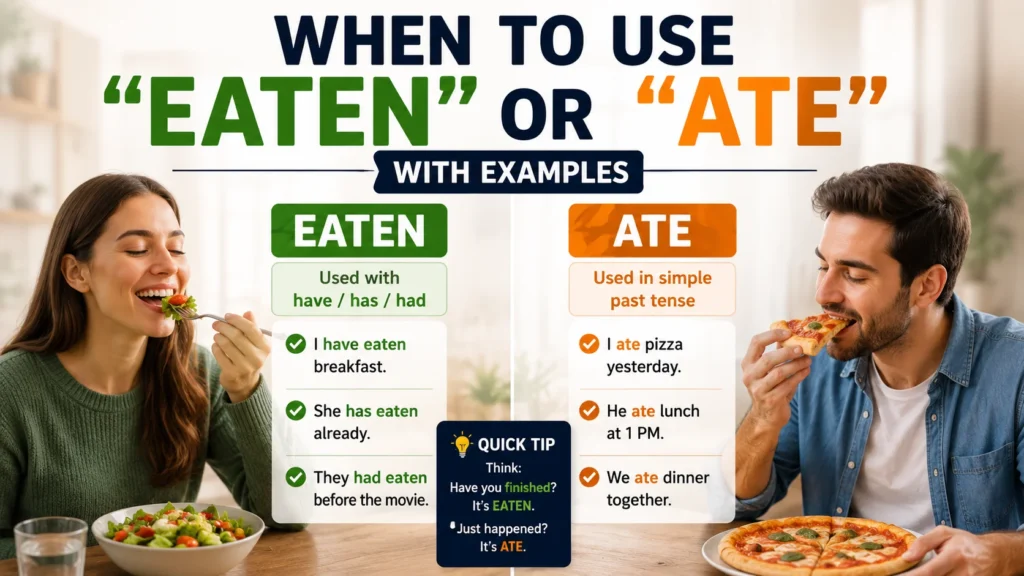
Choosing between ate and eaten looks simple until a sentence includes words such as have, has, had, or did. Both forms come from the same irregular verb, eat, but they do different grammatical jobs. The basic pattern is eat → ate → eaten. Cambridge Dictionary lists ate as the past-tense form and eaten as the past participle.
The easiest way to remember the difference is this: ate normally works as the simple past form, while eaten normally appears after a helping verb in perfect constructions. So, you can say “I ate breakfast,” but you cannot normally say “I have ate breakfast.” The correct sentence is “I have eaten breakfast.” Once this basic pattern becomes familiar, even longer sentences become much easier to handle.
Eaten vs. Ate: What’s the Difference?
The most important difference between ate and eaten is their grammatical role. Ate is the simple past form of eat. Eaten is the past participle. They aren’t interchangeable, even though both describe eating that happened in the past.
Think of the three forms as a small verb family:
| Verb form | Name | Main use | Example |
| eat | Base form | Present, infinitive, and after auxiliaries such as do | I eat breakfast early. |
| ate | Simple past | A completed past action | I ate breakfast at 8 a.m. |
| eaten | Past participle | Perfect constructions and some other grammatical structures | I have eaten breakfast. |
The key point is that past participle does not simply mean “past tense.” A past participle is a particular verb form that works with auxiliary verbs to build certain grammatical structures. Cambridge specifically identifies eaten as the past participle of eat.
That explains why these sentences behave differently:
- I ate the sandwich. — Correct.
- I have eaten the sandwich. — Correct.
- I had eaten the sandwich before class. — Correct.
- I will have eaten the sandwich by noon. — Correct.
- I have ate the sandwich. — Incorrect in standard English.
- I had ate the sandwich. — Incorrect in standard English.
The difference becomes even clearer when you look at the helper verb. In “I have eaten,” the word have carries the tense and grammatical information associated with the perfect construction. Eaten supplies the past participle. In “I ate,” no helping verb is needed because ate itself is the simple past form.
The Short Rule
If you need only one rule, use this:
Ate = simple past. Eaten = past participle, usually used with a helping verb.
For example:
Yesterday, I ate pizza.
Here, yesterday points to a finished past time, so ate fits naturally.
I have eaten pizza before.
Here, have + eaten forms the present perfect. The sentence focuses on experience rather than naming a specific finished time.
This distinction is more useful than trying to memorize dozens of isolated examples.
Why These Forms Cause Confusion
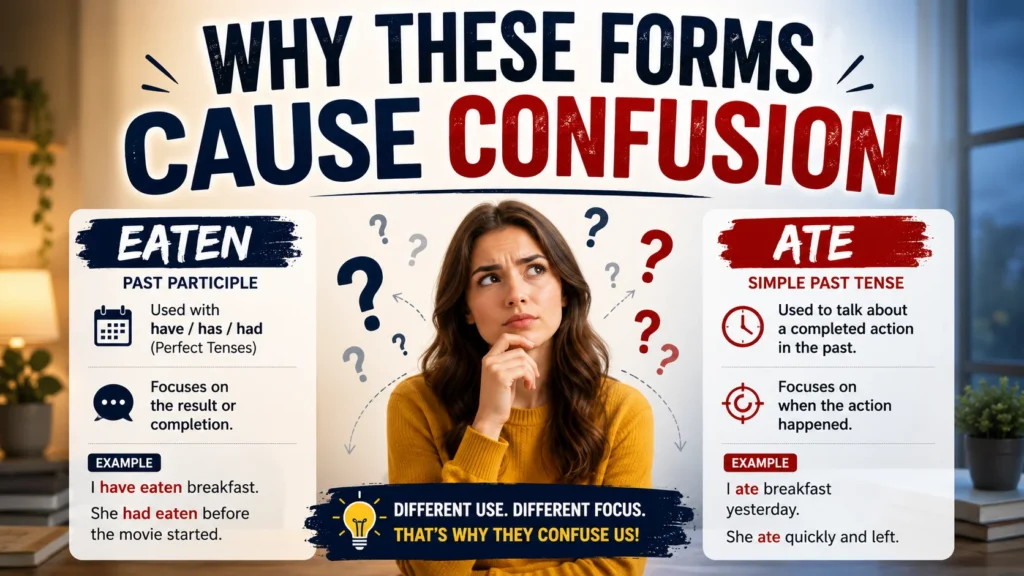
The confusion usually comes from the fact that both forms refer to an action that occurred before the present moment. A learner may think, “If the action happened in the past, why can’t I use ate everywhere?”
English doesn’t choose verb forms based only on whether something happened in the past. It also considers how the speaker connects that action to another time or event.
Compare these sentences:
I ate at noon.
This presents eating as a completed past event.
I have eaten already.
This connects the earlier eating to the present situation. Perhaps someone is offering lunch, and the speaker explains that they don’t need another meal.
The action happened earlier in both sentences. The grammar differs because the speaker frames the action differently.
The British Council describes the past simple as a form used to talk about past events, while English also uses perfect forms to establish relationships between past events and other reference points.
A Useful Mental Picture
Imagine a timeline.
For “I ate breakfast at 8 a.m.”, you are pointing backward to a specific completed event.For “I have eaten breakfast,” you are looking at the present and saying that the earlier event matters now.For “I had eaten breakfast before the meeting started,” you are standing at the past meeting and looking even farther backward.
That timeline gives you a practical way to choose the form without memorizing complicated terminology.
When to Use “Ate”
Use ate when you are describing a completed action in the simple past.
The simple past often works especially well when the sentence identifies a finished time. Common examples include:
- yesterday
- last night
- last week
- two hours ago
- three days ago
- in 2024
- when I was a child
- this morning, when the morning is treated as finished
- earlier today, depending on the context
For example:
I ate breakfast at 7 a.m. yesterday.
The sentence gives you a definite past time. The event is presented as complete, so ate is the natural choice.
Other examples include:
- She ate an apple after school.
- We ate dinner at a small restaurant.
- They ate lunch before the game.
- He ate the last cookie.
- I ate too much at the party.
- You ate breakfast before leaving.
- The children ate everything on their plates.
Notice that the subject doesn’t change the form. You say I ate, you ate, he ate, she ate, we ate, and they ate.
That’s different from the present tense, where third-person singular uses eats:
- I eat breakfast early.
- She eats breakfast early.
- They eat breakfast early.
In the simple past, everyone uses ate:
- I ate breakfast early.
- She ate breakfast early.
- They ate breakfast early.
“Ate” With Finished Time Expressions
A finished-time expression often gives you a strong clue that the simple past may be appropriate.
Consider:
I ate lunch yesterday.
The word yesterday identifies a completed period.
Now compare:
I have eaten lunch.
There is no specific finished past time. The speaker is more interested in the current result: lunch has already happened.
This doesn’t mean that every sentence containing today must use have eaten, or that every sentence without a time expression must use ate. Context still matters. Time expressions are clues, not mechanical switches.
For example:
I ate breakfast today.
This can be perfectly natural when the speaker treats breakfast as a completed event and refers to a particular event earlier today.
In many varieties of English, especially American English, speakers commonly use the simple past in situations where other varieties may favor the present perfect. That’s one reason learners shouldn’t rely on a single “magic word.” Instead, consider the intended time relationship.
“Ate” in Questions
One common mistake appears in questions.
A learner may write:
Did you ate breakfast?
The standard form is:
Did you eat breakfast?
Why?
Because did already marks the past. After the auxiliary did, the main verb returns to its base form.
The pattern is:
Did + subject + eat + …?
Examples:
- Did you eat breakfast?
- Did she eat the cake?
- Did they eat before the movie?
- Did he eat all the rice?
- What did you eat for lunch?
The same principle applies to negative statements:
I didn’t eat breakfast.
Not:
I didn’t ate breakfast.
The British Council gives the same general rule for irregular past forms: after didn’t, the verb remains in its base form. Its examples include patterns such as didn’t go, rather than using the past form after didn’t.
“Ate” for Emphasis
There is another useful structure:
I did eat breakfast.
This is grammatical because did acts as an auxiliary and adds emphasis. The main verb remains eat, not ate.
For example:
“You didn’t eat anything this morning.”
“I did eat breakfast. I just ate earlier than you.”
This structure can be useful in conversation when someone doubts or challenges a past action.
The rule remains consistent:
did + eat
Never:
did + ate
Examples of “Ate” in Real Situations
Imagine a friend asks what happened during lunch.
“We ate at a new café near the office. I ate a chicken sandwich, and Maria ate pasta.”
The simple past works because the speakers are describing a completed event.
At school:
“Yesterday, our class ate lunch outside because the weather was nice.”
At home:
“I ate dinner before you called.”
At a restaurant:
“We ate there last Saturday.”
In each case, the speaker presents eating as a completed past event.
When to Use “Eaten”
Now consider eaten. This form does not normally function as the simple past tense.
You don’t normally say:
I eaten breakfast.
Instead, you need a suitable grammatical structure:
I have eaten breakfast.
The most common pattern is:
have/has/had + eaten
Examples:
- I have eaten.
- You have eaten.
- She has eaten.
- We have eaten.
- They have eaten.
- He had eaten before I arrived.
The helping verb changes according to the tense and subject, while eaten stays the same.
Have Eaten
Use have eaten with I, you, we, and they in the present perfect:
- I have eaten.
- You have eaten.
- We have eaten.
- They have eaten.
The present perfect can connect a past action with the present or describe experience without focusing on a specific finished past time.
For example:
I have eaten sushi before.
This tells us about experience. The speaker doesn’t identify a particular date or meal.
Compare:
I ate sushi in Tokyo in 2023.
Now the speaker gives a specific past setting. The simple past fits naturally.
Another example:
I have eaten already.
This can answer someone who is offering food now. The earlier action matters because of the present situation.
Has Eaten
Use has eaten with he, she, and it:
- She has eaten breakfast.
- He has eaten already.
- The baby has eaten enough.
- The dog has eaten its food.
The important structure is:
has + eaten
Not:
has + ate
So:
She has eaten lunch. ✅
She has ate lunch. ❌
This is one of the most common errors involving these two forms.
Had Eaten
Use had eaten when you want to show that one past action happened before another past event.
For example:
I had eaten breakfast before the meeting started.
There are two past events:
- I ate breakfast.
- The meeting started.
The breakfast happened first.
A simple timeline looks like this:
Breakfast → Meeting started → Later events
The past perfect had eaten makes the earlier relationship clear.
Another example:
When Sarah arrived, we had already eaten.
The arrival happened in the past. The eating happened before that arrival.
The British Council identifies had + past participle as the basic structure of the past perfect.
Will Have Eaten
The form will have eaten moves the reference point into the future.
For example:
By noon, I will have eaten breakfast.
This means the eating will be complete before noon.
Another example:
By the time you arrive, we will have eaten dinner.
The timeline is:
Now → Dinner → Your arrival
The future perfect lets the speaker look ahead from the present and describe an action that will already be complete by a future point.
This form isn’t simply another version of ate or eaten. It combines the future auxiliary will, the perfect auxiliary have, and the past participle eaten.
Why “Eaten” Needs a Helping Verb
For learners, the phrase “helping verb” can sound more complicated than it really is.
A helping verb is an auxiliary verb that works with another verb to create a grammatical structure.
With eaten, common auxiliaries include:
| Structure | Example | Function |
| have + eaten | I have eaten. | Present perfect |
| has + eaten | She has eaten. | Present perfect |
| had + eaten | They had eaten. | Past perfect |
| will have + eaten | We will have eaten. | Future perfect |
The important point is that eaten itself doesn’t carry the same simple-past function as ate.
Compare:
I ate.
This is already a complete simple-past verb phrase.
I eaten.
This is not a standard complete simple-past construction.
Add the auxiliary:
I have eaten.
Now the construction works.
Why “I Have Ate” Is Wrong
The sentence “I have ate” combines the present-perfect auxiliary have with the wrong verb form.
The present perfect needs:
have/has + past participle
The past participle of eat is eaten.
Therefore:
I have eaten. ✅
Not:
I have ate. ❌
The same principle applies to had:
I had eaten. ✅
I had ate. ❌
And to the future perfect:
I will have eaten. ✅
I will have ate. ❌
The mistake becomes easier to avoid when you stop thinking of ate and eaten as interchangeable “past versions” of eat. They have different grammatical roles.
Ate vs. Eaten in Perfect and Simple Tenses
A useful way to master the difference is to compare the forms across several tenses.
| Tense | Correct structure | Example | Main idea |
| Simple present | eat/eats | I eat lunch at noon. | Habit or general situation |
| Simple past | ate | I ate lunch at noon. | Completed past action |
| Present perfect | have/has + eaten | I have eaten lunch. | Past action connected to now |
| Past perfect | had + eaten | I had eaten lunch before class. | Earlier past action |
| Future perfect | will have + eaten | I will have eaten by noon. | Action completed before a future point |
This table exposes an important pattern: ate belongs to the simple past, while eaten appears in perfect constructions.
Present Perfect: Have or Has Eaten
The present perfect is especially important because it causes many ate vs. eaten mistakes.
Use:
have + eaten
with:
- I
- you
- we
- they
Use:
has + eaten
with:
- he
- she
- it
Examples:
- I have eaten breakfast.
- You have eaten enough.
- We have eaten there before.
- They have eaten already.
- She has eaten lunch.
- He has eaten the whole sandwich.
The exact meaning depends on context. Present perfect can describe experience, a recent or relevant past event, or an action within a time period that remains connected to the present.
For example:
I have eaten at that restaurant before.
The focus is experience.
I have eaten already.
The focus is the current situation.
She has eaten three times today.
The time period, today, may still be ongoing, so the action can remain connected to the present.
Past Perfect: Had Eaten
The past perfect gives you a useful “past before past” relationship.
Consider:
The movie started at 8, but I had eaten dinner at 6.
The two actions are both in the past, but had eaten identifies the earlier one.
Another example:
When we arrived at the restaurant, the guests had already eaten.
The guests’ meal came first. The arrival came later.
This is one reason had eaten cannot simply be replaced with ate without potentially changing the way the sequence is understood.
Compare:
We ate before the movie.
This is clear and simple.
We had eaten before the movie started.
This puts more grammatical emphasis on the earlier action in relation to another past event.
Both can be correct. The difference lies in how the speaker organizes the timeline.
The Most Common Mistakes With Ate and Eaten
These errors are predictable, which means they’re also easy to fix once you understand the pattern.
| Incorrect | Correct | Why |
| I have ate. | I have eaten. | Have takes the past participle. |
| She has ate. | She has eaten. | Has takes the past participle. |
| We had ate. | We had eaten. | Had takes the past participle. |
| Did you ate? | Did you eat? | Did takes the past-tense meaning. |
| I didn’t ate. | I didn’t eat. | The main verb returns to its base form. |
| I eaten breakfast. | I have eaten breakfast. | The perfect construction needs an auxiliary. |
Mistake: “Have Ate”
This is probably the clearest example of confusing the past and past participle.
Remember:
have + eaten
not:
have + ate
The same rule applies regardless of whether the sentence is affirmative, negative, or interrogative:
- I have eaten.
- I haven’t eaten.
- Have you eaten?
Mistake: “Did Ate”
The word did already carries the past marking.
Therefore:
Did you eat?
not:
Did you ate?
The same thing happens in negative sentences:
I didn’t eat.
not:
I didn’t ate.
This rule isn’t unique to eat. The same pattern applies to many irregular verbs:
- Did you go? not Did you went?
- Did she see it? not Did she saw it?
- Did they take it? not Did they took it?
The auxiliary did changes the grammatical structure.
Mistake: “I Eaten”
When eaten serves as the past participle in an ordinary active perfect construction, it needs an appropriate auxiliary.
So:
I have eaten.
works.
I eaten.
doesn’t work as a standard finite verb phrase.
There are other grammatical environments in which past participles can appear, including passive constructions, so the broader statement “eaten can never appear without a helping verb” is too absolute. For ordinary learner sentences comparing ate and eaten, however, the practical rule is extremely useful: don’t use eaten as though it were the simple past form.
Ate vs. Eaten in Everyday Situations
Grammar becomes easier when you connect it to situations you actually encounter.
Talking About Yesterday
“What did you eat yesterday?”
“I ate rice and chicken.”
The question uses did + eat. The answer uses the simple past ate.
Talking About Experience
“Have you ever eaten Korean food?”
“Yes, I have eaten it several times.”
The question uses have + eaten because it asks about experience.
Talking About Lunch Right Now
“Do you want some lunch?”
“No, thanks. I have eaten already.”
The earlier meal matters because of the current situation.
Talking About a Specific Past Meal
“Where did you eat last night?”
“I ate at my friend’s house.”
The question asks about a particular completed event, so ate fits naturally.
Talking About Two Past Events
“Why weren’t you hungry at dinner?”
“I had eaten before I came here.”
The eating happened before the speaker arrived.
These small conversations show something important: context often makes the correct form obvious.
A Practical Decision Method
When you’re unsure whether to use ate or eaten, don’t guess. Run through these questions.
Ask Whether You Are Talking About a Finished Past Event
If yes, ate may be the correct form.
I ate breakfast at 8.
Look for “Have,” “Has,” or “Had”
If the sentence contains one of these as a perfect auxiliary, eaten is normally the form you need.
I have eaten.
She has eaten.
They had eaten.
Look for “Did”
If did forms the question or negative, use the base form eat.
Did you eat?
I didn’t eat.
Not ate.
Check the Timeline
Ask yourself:
Is this one completed past event?
Use ate when the simple past expresses it.
Does the action connect to the present?
A present-perfect form such as have eaten or has eaten may be appropriate.
Did one past action happen before another past event?
Consider had eaten.
Will the action be complete before a future point?
Consider will have eaten.
This method is more reliable than memorizing isolated sentences because it helps you build the sentence from its meaning.
A Quick Reference Chart
| If you mean… | Use | Example |
| A completed past event | ate | I ate at noon. |
| Experience | have/has eaten | I have eaten there before. |
| A past action connected to now | have/has eaten | She has eaten already. |
| An earlier action before another past event | had eaten | We had eaten before they arrived. |
| An action completed before a future point | will have eaten | We will have eaten by 8. |
| A question with did | eat | Did you eat? |
| A negative with didn’t | eat | I didn’t eat. |
A Simple Way to Remember Eat, Ate, and Eaten
The three forms are worth learning together:
eat → ate → eaten
Now attach a simple idea to each:
Eat → base form
Ate → simple past
Eaten → past participle
Then remember the helper pattern:
Have, has, or had → eaten
And the question pattern:
Did → eat
This gives you three useful anchors:
- I eat.
- I ate.
- I have eaten.
From there, the other forms become much easier.
The British Council also treats eat → ate as an example of an irregular verb in the past simple.
The biggest mistake is trying to make English follow a regular pattern such as walk → walked. Eat doesn’t work that way. Its forms have to be learned as an irregular set.
Why Context Matters More Than Memorization
Suppose someone asks:
“Did you eat lunch?”
You might answer:
“Yes, I ate lunch at noon.”
That’s a specific past event.
But if someone asks:
“Have you eaten lunch?”
you might answer:
“Yes, I have eaten.”
The second conversation is about whether lunch has happened by the relevant point in the present situation.
The food could even be the same. The grammatical difference comes from the speaker’s time perspective.
That’s the deeper lesson behind eaten vs. ate. You aren’t simply choosing between two words that mean “ate food.” You’re choosing a verb form that matches the structure and time relationship of the sentence.
Once you see that, the distinction stops feeling arbitrary.
The Core Pattern to Keep
| Situation | Correct form |
| “Yesterday, I ___ breakfast.” | ate |
| “I have ___ breakfast.” | eaten |
| “She has ___ breakfast.” | eaten |
| “They had ___ before we arrived.” | eaten |
| “Did you ___ breakfast?” | eat |
| “I didn’t ___ breakfast.” | eat |
| “By noon, I will have ___.” | eaten |
If one sentence deserves to stay in your memory, make it this:
I ate yesterday, but I have eaten today.
It neatly shows the difference between a completed past event and a present-connected perfect construction. The verb forms are different because the grammar and time perspective are different—not because the meaning of eat itself has changed.
When to Use “Eaten” or “Ate”: Perfect Tenses and Helping Verbs
The biggest clue for choosing eaten is often the word sitting right before it. When you see have, has, or had followed by a verb, you’re often looking at a perfect construction. English uses have + past participle to form the perfect aspect, so eat changes to eaten in these structures.
How “Eaten” Works With Helping Verbs
Eaten is the past participle of eat, not its simple past form. The three principal forms are eat, ate, eaten. Cambridge Dictionary lists exactly this pattern: eat as the base form, ate as the past tense, and eaten as the past participle.
A helpful verb works alongside the main verb to create a particular grammatical structure. With eaten, the most important helpers for this topic are have, has, and had.
| Helping verb | Structure | Example |
| have | have + eaten | I have eaten. |
| has | has + eaten | She has eaten. |
| had | had + eaten | They had eaten. |
| will have | will have + eaten | We will have eaten. |
Notice what stays the same: eaten.
The helping verb changes because the tense, subject, or time relationship changes. The participle doesn’t become ate.
That’s why these sentences are correct:
- I have eaten breakfast.
- She has eaten breakfast.
- We had eaten breakfast.
- They will have eaten breakfast.
And these are not standard English:
- I have ate breakfast.
- She has ate breakfast.
- We had ate breakfast.
- They will have ate breakfast.
The mistake comes from treating ate and eaten as interchangeable past forms. They aren’t. Ate is the simple past form, while eaten is the past participle.
“Have Eaten” in the Present Perfect
The structure have eaten belongs to the present perfect when have functions as the auxiliary.
Use have eaten with:
- I
- you
- we
- they
Examples:
I have eaten breakfast.
You have eaten enough.
We have eaten at that restaurant before.
They have eaten already.
The present perfect doesn’t simply mean “something happened in the past.” It presents a past event in a way that connects it with the present or with experience up to now. The British Council describes the present perfect as have + past participle and notes its use for experiences and past events that remain important in the present.
Talking About Experience
One common use of have eaten is to talk about experience.
I have eaten sushi before.
The speaker isn’t saying exactly when the experience happened. The important information is that the experience exists.
Compare that with:
I ate sushi in Tokyo last summer.
Now the speaker identifies a specific past setting. The simple past ate works naturally because the sentence places the action at a particular completed time.
This difference can be summarized like this:
| Sentence | Focus |
| I have eaten sushi before. | Experience |
| I ate sushi in Tokyo last summer. | Specific past event |
The food is the same. The grammar changes because the speaker presents the experience differently.
Talking About Something That Matters Now
Consider this conversation:
“Would you like some lunch?”
“No, thanks. I have eaten already.”
The eating happened before the conversation, but the important point is the current situation. The speaker doesn’t need another meal now.
Compare:
“What did you eat yesterday?”
“I ate pasta.”
Here, the speaker answers a question about a particular completed past event.
This is why simply translating both forms as “past eating” doesn’t capture the whole distinction. Ate can place the action firmly in a finished past event, while have eaten can bring the earlier action into the current conversation.
“Have Eaten” With “Already”
Already frequently appears with present perfect constructions:
- I have already eaten.
- We have already eaten.
- They have already eaten.
The word already tells the listener that something happened before the expected or relevant time.
For example:
“Should I order you something?”
“No, I’ve already eaten.”
The contraction I’ve is simply I have. In everyday American English, contractions often make the sentence sound more natural:
I’ve eaten already.
That’s much more conversational than:
I have eaten already.
Both are grammatical. The shorter version is often what you’ll hear in ordinary speech.
“Has Eaten” With He, She, and It
The present perfect changes from have to has with third-person singular subjects.
Use:
he/she/it + has + eaten
Examples:
- She has eaten breakfast.
- He has eaten the sandwich.
- The baby has eaten enough.
- The dog has eaten its food.
- The machine has already eaten the paper.
The last example shows that eat can also have meanings beyond literally consuming food. English uses eat in expressions such as a machine “eating” paper or a process “eating into” something. Cambridge Dictionary records several meanings and phrasal uses of eat.
For the ordinary food-related meaning, however, the same grammatical pattern remains:
has + eaten
A Common Error
A learner might write:
She has ate lunch.
The standard form is:
She has eaten lunch.
Why? Because has is the perfect auxiliary, and the verb following it must be in the past participle form.
The sequence is:
eat → ate → eaten
So: She ate lunch. ✅She has eaten lunch. ✅She has ate lunch. ❌
The important thing is not to memorize the corrected sentence alone. Memorize the structure:
has + past participle
Then apply the structure to eat:
has + eaten
“Had Eaten” in the Past Perfect
The structure had eaten uses the past perfect.
Its basic pattern is:
subject + had + eaten
Unlike have and has, had works with all subjects:
- I had eaten
- you had eaten
- he had eaten
- she had eaten
- we had eaten
- they had eaten
The past perfect helps establish that one past action happened before another past reference point. British Council grammar guidance describes had + past participle as the structure used for the past perfect.
Consider:
I had eaten breakfast before the meeting started.
There are two events:
First: I ate breakfast.
Second: The meeting started.
The phrase had eaten marks the earlier event.
Why the Past Perfect Can Be Useful
You don’t always need the past perfect.
For example:
I ate breakfast before work.
This is perfectly natural.
The listener can understand the sequence from before work.
But when two past events need a clearer relationship, the past perfect can make the order unmistakable:
When John arrived, we had already eaten.
The structure tells the reader or listener that the eating occurred before John’s arrival.
This is especially useful in longer narratives.
For example:
Sarah arrived at the restaurant at 7:30, but we had already eaten because the children were hungry.
Without had eaten, the timeline could require more attention from the reader. The past perfect neatly places the meal earlier than Sarah’s arrival.
A Simple Timeline for “Had Eaten”
Think of the sentence this way:
Eating → Sarah arrives → Conversation
The past perfect points to the first event from the viewpoint of the second past event.
That’s the central idea.
You don’t need to memorize a complicated definition. Ask:
Did one past event happen before another past event?
If yes, had eaten may be the right choice.
“Will Have Eaten” in the Future Perfect
The future perfect moves the reference point forward.
The structure is:
will + have + eaten
For example:
By noon, I will have eaten breakfast.
The eating will happen before a future point, which is noon.
Another example:
By the time you arrive, we will have eaten dinner.
The expected order is:
Now → Dinner → Your arrival
The future perfect lets the speaker look ahead and describe something that will already be complete by a particular future time.
Why “Will Have Ate” Is Wrong
The phrase will have ate contains the wrong form after have.
The correct sequence is:
will + have + past participle
The past participle of eat is eaten.
Therefore:
We will have eaten by then. ✅
Not:
We will have ate by then. ❌
This is another example of why recognizing the helping verb is so powerful. Once you see have in the perfect construction, you should expect a past participle.
The “Helping Verb” Shortcut
If grammar terminology feels overwhelming, use a practical shortcut.
When you see:
have + ___
ask:
What is the past participle?
For eat, the answer is:
eaten
So:
have eaten
When you see:
has + ___
use:
has eaten
When you see:
had + ___
use:
had eaten
When you see:
will have + ___
use:
will have eaten
This shortcut works because it focuses on the actual words in the sentence rather than forcing you to remember a long grammar definition.
Compare “Ate” and “Eaten” in the Same Situation
The clearest way to understand the difference is to place the forms side by side.
Specific Past Event
I ate breakfast at 7:00.
The speaker identifies a completed event at a particular past time.
Present-Connected Result
I have eaten breakfast.
The speaker is explaining the current situation: breakfast has already happened.
Earlier Past Event
I had eaten breakfast before the bus arrived.
The breakfast happened before another past event.
Future Completion
I will have eaten breakfast by 8:00.
The breakfast will be complete before a future point.
The action itself is still eating. What changes is the time relationship.
| Sentence | Reference point |
| I ate breakfast. | Past |
| I have eaten breakfast. | Present |
| I had eaten breakfast. | Past reference point |
| I will have eaten breakfast. | Future reference point |
This is the heart of perfect-tense grammar.
“Ate” Does Not Need “Have”
One reason learners make mistakes is that have can also mean “possess” or function as an ordinary verb.
For example:
I have breakfast at 8.
Here, have means something like “eat” or “take” a meal. It isn’t necessarily acting as the perfect auxiliary.
But:
I have eaten breakfast.
Here, have is the auxiliary that forms the present perfect.
The two uses look similar but perform different jobs.
Compare:
I have breakfast at 8.
This can describe a routine.
I have eaten breakfast.
This uses the present perfect.
That distinction matters because grammar depends on the function of the words, not simply their appearance.
How “Did” Changes the Verb Form
There is another important contrast between ate and eaten.
When did appears as the auxiliary in a simple-past question or negative sentence, use the base form eat.
Questions
Correct:
Did you eat breakfast?
Incorrect:
Did you ate breakfast?
Negatives
Correct:
I didn’t eat breakfast.
Incorrect:
I didn’t ate breakfast.
Emphasis
Correct:
I did eat breakfast.
Incorrect:
I did ate breakfast.
The reason is that did carries the past-tense marking in these structures. The main verb returns to the base form.
This creates a useful three-way contrast:
| Structure | Correct form |
| Simple past statement | I ate. |
| Past question | Did you eat? |
| Present perfect | I have eaten. |
If you remember those three patterns, many common errors disappear.
“Have You Eaten?” vs. “Did You Eat?”
These two questions are both grammatical, but they don’t always ask the same thing.
“Did You Eat?”
This usually points toward a particular past event or occasion.
Did you eat breakfast this morning?
Did you eat at the restaurant last night?
What did you eat for lunch?
The simple past is especially natural when the question concerns a specific completed time or event.
“Have You Eaten?”
This can focus on whether the person has eaten by the relevant time or on their experience.
Have you eaten yet?
This often means something like:
Has eating happened by now?
The question is highly useful in everyday conversation because the answer affects what happens next.
For example:
“Have you eaten yet?”
“No, not yet.”
“Okay. Let’s get some food.”
Or:
“Have you eaten yet?”
“Yes, I’ve eaten.”
The question isn’t necessarily asking for the exact time of the meal. It is asking about the person’s current status.
A Real-Life Case Study: Choosing the Right Form
Imagine three friends meeting at different times.
Situation One: A Specific Lunch
At 2 p.m., Alex says:
“I ate lunch at noon.”
The speaker gives a specific past time: noon.
Situation Two: Current Hunger
A friend asks:
“Do you want lunch?”
Alex responds:
“No, I’ve eaten already.”
Now the earlier meal matters because of the current offer.
Situation Three: Earlier Than Another Event
Later, Alex explains:
“I had eaten before the meeting began.”
The speaker is now talking about two past events:
meal → meeting
The verb form changes because the timeline changes.
Situation Four: Looking Ahead
Alex says:
“By the time the meeting ends, I will have eaten dinner.”
Now the reference point is in the future.
The same basic action appears in four grammatical frames:
| Situation | Sentence |
| Finished past event | I ate lunch at noon. |
| Current relevance | I have eaten already. |
| Earlier past event | I had eaten before the meeting. |
| Future completion | I will have eaten by then. |
This is why learning the verb as a complete system is more effective than memorizing one form at a time.
A Fast Test for Choosing the Correct Form
When you’re writing a sentence, try this quick test.
Step one: Look for did.
If you see it, use eat:
Did you eat?
Step two: Look for have, has, had, or will have.
If these form a perfect construction, use eaten:
Have you eaten?
She has eaten.
They had eaten.
We will have eaten.
Step three: If neither pattern appears and you’re describing a completed past action, ate may be appropriate:
We ate at 6.
Step four: Check the timeline.
Ask whether the sentence describes:
- one finished past event,
- an experience or present-connected result,
- an earlier event before another past event, or
- a completed action before a future point.
That final check prevents many errors.
The Core Patterns Worth Memorizing
| Pattern | Example |
| eat | I eat breakfast every day. |
| ate | I ate breakfast yesterday. |
| have eaten | I have eaten breakfast already. |
| has eaten | She has eaten breakfast. |
| had eaten | She had eaten before school. |
| will have eaten | She will have eaten by 9. |
| did eat | I did eat breakfast. |
| didn’t eat | I didn’t eat breakfast. |
The pattern becomes much easier once you stop treating ate and eaten as competing words. They are different forms designed for different grammatical jobs.
Ate handles the simple past.
Eaten handles the past-participle role in constructions such as have eaten, has eaten, and had eaten.
And when did appears, the verb returns to eat.
That three-part distinction—eat, ate, eaten—is the foundation for using these forms accurately in everyday American English.
Ate vs. Eaten in Real-Life Sentences and Common Mistakes
The difference between ate and eaten becomes much easier when you see how people actually use these forms in conversation, school, work, and everyday writing. The basic verb pattern remains eat → ate → eaten, but the surrounding words tell you which form belongs in the sentence. Cambridge Dictionary confirms that ate is the past tense and eaten is the past participle of eat.
Ate vs. Eaten in Everyday Conversations
In normal conversation, people don’t usually stop to think about grammar labels. They simply choose a form based on what they want to say. That makes real-life examples especially useful.
Consider this short exchange:
“Did you eat breakfast?”
“Yes, I ate around seven.”
The question uses eat, not ate, because did already marks the past. The answer uses ate because it is a simple past statement.
Now change the question:
“Have you eaten breakfast?”
“Yes, I’ve eaten already.”
Here, have + eaten creates the present perfect. The question focuses on whether breakfast has happened by the relevant time rather than simply asking about a particular completed past event.
Talking About a Specific Past Event
Use ate when you’re describing a particular event in the past.
For example:
- I ate breakfast at 7 a.m.
- She ate lunch at school.
- We ate dinner at my sister’s house.
- They ate pizza last night.
- He ate the last piece of cake.
- I ate there two weeks ago.
These sentences present eating as a completed event. If you add a definite past-time expression such as yesterday, last week, or two hours ago, the simple past is often the natural choice. Cambridge Grammar notes that the past simple is normally used with definite past times.
Talking About Experience
Use have eaten or has eaten when the point is experience up to the present.
For example:
I have eaten Indian food before.
This doesn’t tell us exactly when the experience happened. The important information is that the experience has occurred.
Compare it with:
I ate Indian food in Chicago last summer.
Now the speaker identifies a specific past situation.
| Sentence | Main focus |
| I have eaten there before. | Experience |
| I ate there last Friday. | Specific past event |
| She has eaten sushi before. | Experience |
| She ate sushi yesterday. | Finished past event |
The distinction isn’t really about whether eating happened in the past. Both sentences describe something that happened before now. The difference is how the speaker connects that event to the present or places it in a finished past period.
“Did You Eat?” vs. “Have You Eaten?”
These two questions cause a lot of confusion because both can relate to food you’ve already consumed.
When “Did You Eat?” Works
Use did + eat when asking about a past event.
Did you eat breakfast?
Did you eat at the restaurant last night?
What did you eat for lunch?
Did Sarah eat before she left?
Notice that eat stays in its base form after did.
The structure is:
Did + subject + eat + object?
Not:
Did + subject + ate + object?
So:
Did you eat? ✅
Did you ate? ❌
The same rule applies to negative sentences:
I didn’t eat. ✅
I didn’t ate. ❌
This is a general English pattern. The auxiliary did carries the past marking, so the main verb uses its base form.
When “Have You Eaten?” Works
Use have/has + eaten when the question focuses on whether the person has eaten by now or on experience.
Have you eaten yet?
This is extremely common in everyday conversation.
For example:
“Have you eaten yet?”
“No, I haven’t.”
“Let’s get something to eat.”
The question matters because the answer affects the current situation.
Compare:
Did you eat at noon?
This asks about a particular past time.
Have you eaten yet?
This asks whether eating has happened by the current relevant point.
The British Council explains that present perfect constructions connect past events with the present and can describe experiences up to now.
How Time Expressions Help You Choose
Time expressions can provide strong clues, although they don’t replace understanding the whole sentence.
Common Expressions With “Ate”
The simple past commonly works with finished past-time expressions such as:
- yesterday
- last night
- last week
- last month
- two hours ago
- three days ago
- in 2024
- when I was younger
- on Monday
Examples:
I ate breakfast yesterday.
We ate there last week.
She ate lunch two hours ago.
They ate at that restaurant in 2024.
Cambridge Grammar specifically notes that the past simple commonly appears with definite past expressions such as yesterday, two weeks ago, last year, and specific years.
Common Expressions With “Have Eaten”
The present perfect can work with expressions that connect the action to a period continuing up to the present.
Examples include:
- already
- yet
- ever
- never
- before
- today
- this week
- this year
- so far
For example:
I have eaten already.
Have you eaten yet?
I have never eaten octopus.
Have you ever eaten Korean food?
She has eaten there before.
We have eaten out twice this week.
The British Council notes that the present perfect commonly works with periods that have not finished, such as today, this week, and this year.
However, don’t turn this into a rigid word-matching exercise. Today doesn’t automatically force one verb form in every context.
For example:
I ate breakfast at 7 today.
This can be perfectly natural in American English because the speaker is reporting a completed event at a specific time.
The important question is not simply, “What time word do I see?” Instead ask, “How is the speaker framing the event?”
A Closer Look at “Today”
This is one area where learners often receive oversimplified rules.
Consider:
I have eaten breakfast today.
The speaker views today as a period that is still relevant or unfinished.
Now consider:
I ate breakfast at 7 today.
The speaker focuses on a specific completed event.
Both sentences can communicate that breakfast happened. The grammatical viewpoint differs.
That’s why grammar should not be reduced to a list of trigger words. Time expressions provide clues, but meaning and context determine the final choice.
Ate vs. Eaten in School and Academic Writing
In school writing, students often make errors such as:
I have ate the food.
We had eaten lunch before class.
Did you eat breakfast?
The corrections are straightforward:
I have eaten the food.
We had eaten lunch before class.
Did you eat breakfast?
These mistakes usually happen because the writer knows that the action is in the past but hasn’t learned which verb form belongs after each auxiliary.
A Useful School-Writing Check
Before submitting an assignment, check every sentence containing have, has, had, or did.
| If you see… | Check for… |
| have | eaten |
| has | eaten |
| had | eaten |
| did | eat |
| didn’t | eat |
| No auxiliary in a simple past statement | ate |
For example:
Yesterday, I ate breakfast before school.
I have eaten breakfast already.
I had eaten before the exam started.
Did you eat before the exam?
The same principle works whether you’re writing a short answer, an essay, an email, or a formal report.
Ate vs. Eaten in Workplace Communication
Workplace English often involves short messages where the difference becomes obvious from context.
Imagine a coworker asks:
“Have you eaten lunch?”
You could answer:
“Yes, I’ve eaten already.”
The present situation is important.
But if someone asks what happened during yesterday’s meeting:
“Where did everyone go for lunch?”
You might answer:
“We ate at the café across the street.”
The distinction remains the same even when the setting becomes professional.
Workplace Examples
Specific past event:
We ate lunch together after the meeting yesterday.
Current status:
I’ve eaten already, so I’ll just have coffee.
Earlier past event:
We had eaten before the client arrived.
Future completion:
By the time the meeting ends, we’ll have eaten lunch.
The context changes, but the underlying grammar doesn’t.
Common Mistakes You Should Catch Immediately
Some errors appear so often that they’re worth learning as fixed contrasts.
“I Have Ate” vs. “I Have Eaten”
Incorrect:
I have ate lunch.
Correct:
I have eaten lunch.
The reason is simple: have + past participle.
The past participle is eaten.
“She Has Ate” vs. “She Has Eaten”
Incorrect:
She has ate already.
Correct:
She has eaten already.
Again:
has + eaten
“We Had Ate” vs. “We Had Eaten”
Incorrect:
We had ate before they arrived.
Correct:
We had eaten before they arrived.
The past perfect requires had + past participle.
“Did You Ate?” vs. “Did You Eat?”
Incorrect:
Did you ate lunch?
Correct:
Did you eat lunch?
After did, use eat.
“I Didn’t Ate” vs. “I Didn’t Eat”
Incorrect:
I didn’t ate anything.
Correct:
I didn’t eat anything.
Again, didn’t already carries the past-tense marking.
Why “Eaten” Isn’t Simply Another Past Tense
This is a subtle point, but understanding it can improve your grammar significantly.
The word eaten is called a past participle, but “past participle” does not mean “past tense.” A participle is a verb form that can work in several grammatical constructions.
For example:
I have eaten.
Here, eaten works with have to form the present perfect.
I had eaten.
Here, eaten works with had to form the past perfect.
The cake was eaten quickly.
Here, eaten appears in a passive construction.
So, eaten doesn’t independently tell you the tense. The surrounding structure matters.
Cambridge specifically defines eaten as the past participle of eat.
This is why saying “eaten is the past tense of eat” creates confusion. The standard simple past is ate.
A Real-Life Case Study: One Meal, Four Different Structures
Imagine someone named Daniel has a busy day.
At 8 a.m., he finishes breakfast.
Later That Morning
Someone asks:
“What did you eat for breakfast?”
Daniel answers:
“I ate eggs and toast.”
The question asks about a specific completed event.
At 10 a.m.
A coworker offers him a pastry.
“No thanks. I’ve eaten already.”
The earlier breakfast matters to the current situation.
At 11 a.m.
Daniel tells a friend about his morning:
“I had eaten before I left home.”
Now he is describing an earlier event before another past event—leaving home.
Planning for Tomorrow
Daniel says:
“By 9 a.m. tomorrow, I’ll have eaten breakfast.”
The reference point has moved into the future.
One action—eating breakfast—appears in four different grammatical structures:
| Context | Correct form |
| Specific past event | I ate breakfast. |
| Present relevance | I have eaten breakfast. |
| Earlier past event | I had eaten breakfast. |
| Future completion | I will have eaten breakfast. |
This is a powerful way to understand the difference because the vocabulary stays almost identical while the time relationship changes.
A Simple “Ate or Eaten?” Decision Tree
When you’re unsure, work through these questions.
Does the Sentence Have “Did” or “Didn’t”?
Use eat.
Did you eat?
I didn’t eat.
Does the Sentence Have “Have” or “Has” as a Perfect Auxiliary?
Use eaten.
I have eaten.
She has eaten.
Does the Sentence Have “Had” as a Perfect Auxiliary?
Use eaten.
They had eaten.
Does It Have “Will Have”?
Use eaten.
We will have eaten.
Is It a Simple Past Statement?
Use ate.
We ate at 7.
This quick test solves a large share of everyday errors.
Quick Comparison Table
| Sentence | Correct? | Reason |
| I ate lunch. | ✅ | Simple past |
| I have eaten lunch. | ✅ | Present perfect |
| I had eaten lunch. | ✅ | Past perfect |
| I will have eaten lunch. | ✅ | Future perfect |
| I have ate lunch. | ❌ | Wrong form after have |
| I had ate lunch. | ❌ | Wrong form after had |
| Did you eat lunch? | ✅ | Base form after did |
| Did you ate lunch? | ❌ | Past form incorrectly follows did |
| I didn’t eat lunch. | ✅ | Base form after didn’t |
| I didn’t ate lunch. | ❌ | Past form incorrectly follows didn’t |
A Note About Natural American English
Real conversation doesn’t always follow the neat examples found in grammar exercises word for word. Speakers shorten sentences, leave information understood, and choose between forms based on context.
For example, someone might casually ask:
“You eat yet?”
That’s informal conversational English. In standard written English, especially in careful writing, “Have you eaten yet?” or “Did you eat yet?” may be preferred depending on the intended time perspective.
This matters because grammar learning should prepare you for both correct structures and real communication.
The safest approach is to learn the standard forms first:
Did you eat?
Have you eaten?
I ate.
I have eaten.
Once these patterns become automatic, informal variations become much easier to understand without confusing them with formal written grammar.
The Three Forms of “Eat” at a Glance
The entire topic can be reduced to this table:
| Form | Grammatical name | Typical use | Example |
| eat | Base form | Present, infinitive, after did | Did you eat? |
| ate | Simple past | Completed past action | I ate earlier. |
| eaten | Past participle | Perfect and passive constructions | I have eaten already. |
Cambridge confirms the exact sequence eat, ate, eaten in its dictionary entry.
If you can identify which of these three forms a sentence needs, the rest becomes much easier.
The Most Useful Rules to Keep
Keep these rules close when writing or speaking:
- Ate is the simple past of eat.
- Eaten is the past participle of eat.
- Have + eaten forms the present perfect.
- Has + eaten forms the present perfect with third-person singular subjects.
- Had + eaten forms the past perfect.
- Will have + eaten forms the future perfect.
- Did + eat forms a simple past question or emphatic statement.
- Didn’t + eat forms a simple past negative.
- A definite completed past time often favors ate.
- Present-connected experience or relevance often favors have/has eaten.
The most useful habit is to look at the whole verb phrase, not just the word that refers to eating. Ate, eat, and eaten each have a specific grammatical role. Once the surrounding auxiliary or time reference is clear, the correct choice usually follows naturally.
Quick Rules, Comparisons, and Memory Tricks for “Ate” vs. “Eaten”
When ate and eaten still seem easy to mix up, the best approach is to stop memorizing long grammar explanations and focus on the structure around each form. The core verb remains eat → ate → eaten: Cambridge Dictionary identifies ate as the past tense and eaten as the past participle.
The Three Forms of “Eat”
| Verb form | Grammatical role | Example |
| eat | Base form | I eat breakfast at home. |
| ate | Simple past | I ate breakfast earlier. |
| eaten | Past participle | I have eaten breakfast. |
These three forms shouldn’t be treated as interchangeable. Ate can stand as the main verb in a simple past statement, while eaten usually needs an auxiliary in the perfect constructions discussed here.
A useful memory chain is:
eat → ate → eaten
Then connect each form to its job:
- eat → base form
- ate → simple past
- eaten → past participle
Once this sequence becomes automatic, many grammar mistakes disappear before they reach the page.
The Fastest Rule for “Ate”
Use ate when you’re making a straightforward statement about a completed past action.
I ate breakfast at 8.
She ate pizza last night.
We ate at the restaurant yesterday.
They ate before the movie.
The sentence can contain a specific past-time expression, but it doesn’t have to. The important point is that ate is the simple past form.
Cambridge’s dictionary entry for ate explicitly labels it as the past simple of eat.
The Fastest Rule for “Eaten”
Use eaten when the grammar calls for the past participle.
The most useful pattern is:
have/has/had + eaten
Examples:
I have eaten.
She has eaten.
They had eaten.
We will have eaten by then.
The British Council describes the present perfect as have or has + past participle, while the past perfect uses had + past participle.
So if you see have, has, or had functioning as an auxiliary in one of these perfect constructions, eaten should immediately come to mind.
A Simple “Ate or Eaten?” Decision Method
When you’re writing quickly, use this short check.
Look for “Did” or “Didn’t”
If you see did or didn’t, use eat, not ate.
Did you eat?
Did she eat lunch?
I didn’t eat breakfast.
We didn’t eat there.
Why? Did already marks the past in these structures, so the main verb uses its base form.
Look for “Have,” “Has,” or “Had”
If the auxiliary forms a perfect construction, use eaten.
I have eaten.
She has eaten.
They had eaten.
This is one of the most reliable shortcuts for learners.
If Neither Appears, Check the Time
If you’re describing a completed past event without a perfect auxiliary, ate may be the correct form.
I ate at noon.
We ate there last Saturday.
He ate before work.
The key is to consider the entire sentence rather than searching for one isolated “trigger word.”
Ate vs. Eaten: Side-by-Side Examples
A direct comparison often makes the distinction click.
| Meaning | Correct sentence | Why |
| Completed past action | I ate lunch. | Simple past |
| Specific past time | I ate at noon. | Finished past event |
| Present experience | I have eaten there before. | Present perfect |
| Current relevance | I have eaten already. | Past action matters now |
| Earlier past action | I had eaten before they arrived. | Past perfect |
| Future completion | I will have eaten by noon. | Future perfect |
| Past question | Did you eat? | Base form after did |
| Past negative | I didn’t eat. | Base form after didn’t |
Notice that eaten doesn’t replace ate simply because both refer to something that happened earlier. The grammar surrounding the verb determines which form works.
Why “I Ate” and “I Have Eaten” Aren’t Always the Same
This distinction deserves special attention because both sentences can refer to an action that happened before now.
I ate.
This presents eating as a completed past event.
I have eaten.
This uses the present perfect and presents the earlier action in connection with the present. The British Council explains that the present perfect can describe past actions that remain connected to the present and experiences up to the present.
Imagine someone offers you food:
“Would you like some pizza?”
“No, thanks. I have eaten.”
The point isn’t when you ate. The point is that you don’t need food now.
Now imagine someone asks about yesterday:
“What did you have for dinner last night?”
“I ate pizza.”
The focus is the completed meal at a past time.
The difference is subtle but important: ate often looks backward at a finished event, while have eaten can connect the earlier event to the present.
Time Expressions: Useful Clues, Not Automatic Rules
Time expressions can help you choose between forms, but they shouldn’t become rigid grammar formulas.
Expressions Commonly Used With “Ate”
Examples include:
- yesterday
- last night
- last week
- last month
- two hours ago
- three days ago
- in 2024
- last Sunday
- when I was younger
Examples:
I ate breakfast yesterday.
She ate there last week.
We ate dinner two hours ago.
These expressions point toward completed past periods.
Expressions Commonly Used With “Have Eaten”
Present perfect commonly works with expressions connected to the present or an unfinished period, including:
- already
- yet
- ever
- never
- before
- so far
- until now
- today
- this week
- this year
The British Council specifically notes that the present perfect can describe actions within unfinished periods such as today, this week, and this year, as well as experiences using words such as ever and never.
For example:
I have eaten already.
Have you eaten yet?
I have never eaten octopus.
Have you ever eaten Thai food?
We have eaten out twice this week.
However, don’t assume that one time expression always forces one verb form. Context matters.
For example:
I ate breakfast at 7 today.
This can be natural because the speaker is reporting a particular completed event.
The better question is:
What time relationship does the speaker want to show?
That question is much more useful than memorizing lists of words.
The “H” Memory Trick
A simple memory trick can help you remember eaten.
Think:
H = Have, Has, Had → Eaten
When one of these auxiliary forms creates a perfect construction, think of eaten.
Have eaten
Has eaten
Had eaten
You can extend the trick to:
Will have eaten
The word have still appears in the perfect construction.
This isn’t a complete grammar rule for every possible use of have, because have can also be an ordinary main verb. But for choosing between ate and eaten, it works as a quick practical reminder.
The “D” Rule for Eat
Now use the opposite shortcut with did.
D = Did → Eat
Examples:Did you eat? Did she eat? Did they eat? I didn’t eat.
She didn’t eat.
This gives you a memorable contrast:
H → eaten
D → eat
And for a straightforward past statement:
Ate
So the quick mental map becomes:
Did → eat
Past statement → ate
Have/has/had → eaten
Common Incorrect Sentences and Their Fixes
These mistakes are worth learning as pairs.
| ❌ Incorrect | ✅ Correct | Rule |
| I have ate. | I have eaten. | Have + past participle |
| She has ate. | She has eaten. | Has + past participle |
| We had eaten. | We had eaten. | Had + past participle |
| Did you ate? | Did you eat? | Did + base form |
| I didn’t eat. | I didn’t eat. | Didn’t + base form |
| I have already eaten. | I have eaten already. | Perfect construction needs an auxiliary |
| He had eaten before lunch. | He had eaten before lunch. | Had + past participle |
| Did she ate dinner? | Did she eat dinner? | Did + base form |
The fastest way to correct these isn’t to memorize every individual mistake. Learn the two structures:
auxiliary + past participle
and
did + base form
Then apply them consistently.
What About “Ate” After “Did”?
This is one of the most common errors in English learners’ writing.
Consider:
Did you ate breakfast?
The sentence looks tempting because the event happened in the past. But the auxiliary did already carries the past marking.
The correct version is:
Did you eat breakfast?
Compare these:
I ate breakfast.
Did you eat breakfast?
I didn’t eat breakfast.
The verb changes from ate back to eat because the auxiliary takes over the past-tense role.
The same pattern applies to many irregular verbs:
- I went → Did you go?
- She saw → Did she see?
- They took → Did they take?
- He came → Did he come?
So eat → ate isn’t an isolated rule. It follows a broader English pattern.
What About “Ate” After “Have”?
The opposite mistake occurs here:
I have ate breakfast.
The correct sentence is:
I have eaten breakfast.
Why doesn’t ate work?
Because have is functioning as the auxiliary for the present perfect, which requires the past participle.
The pattern is:
have + past participle
And for eat:
have + eaten
The same applies to:
has + eaten
and:
had + eaten
The British Council confirms that the present perfect is built with have/has + past participle, while the past perfect uses had + past participle.
A Visual Timeline for “Ate” and “Eaten”
Timelines can make the difference easier to understand.
Simple Past
Past event
PAST ──── ★ ───────── NOW
I ate breakfast.
The star represents the completed event.
Present Perfect
Past action connected to now
PAST ──── ★ ═════════ NOW
I have eaten breakfast.
The line emphasizes that the earlier action has relevance to the present situation.
Past Perfect
Earlier past action + later past event
EARLIER PAST ★ ───── LATER PAST ★ ───── NOW
I had eaten before the meeting started.
The first event happened before the second past event. The British Council describes this as one of the main uses of the past perfect.
Future Perfect
Past/future reference toward completed future action
NOW ───── ★ FUTURE ACTION ───── ★ FUTURE POINT
I will have eaten by noon.
The eating is expected to be complete before the future reference point.
A Practical Editing Checklist
Before you publish or submit a sentence containing eat, ate, or eaten, check these points:
- Is the sentence describing a simple past statement? Use ate.
- Does did appear? Use eat.
- Does didn’t appear? Use eat.
- Does have form the present perfect? Use eaten.
- Does has form the present perfect? Use eaten.
- Does had form the past perfect? Use eaten.
- Does will have form the future perfect? Use eaten.
- Is the time period finished or specifically located in the past? Ate may be appropriate.
- Is the action connected to the present or part of an experience up to now? Have/has eaten may fit.
- Is one past event earlier than another? Had eaten may clarify the sequence.
This checklist is short enough to use while proofreading without slowing down your writing.
A Mini Case Study: Fixing a Realistic Paragraph
Consider this paragraph:
Yesterday, I ate breakfast early. Then my brother asked whether I had eaten anything. I told him that I had eaten before he woke up. Later, he asked, “Did you eat lunch?”
Several forms need correction.
The improved version is:
Yesterday, I ate breakfast early. Then my brother asked whether I had eaten anything. I told him that I had eaten before he woke up. Later, he asked, “Did you eat lunch?”
Here’s why:
- ate → simple past statement
- had eaten → earlier action before another past event
- had eaten → same past-perfect relationship
- did eat → base form after did
This example shows why looking at the whole sentence is more effective than choosing a form based solely on the fact that the action happened in the past.
The Most Important Comparison
If only one table is saved from this article, make it this one:
| You want to say… | Use | Example |
| A finished past action | ate | I ate lunch. |
| A finished action at a stated past time | ate | I ate lunch at noon. |
| Experience | have/has eaten | I have eaten there before. |
| Something already done with present relevance | have/has eaten | I have eaten already. |
| An action before another past event | had eaten | I had eaten before they arrived. |
| An action completed before a future point | will have eaten | I will have eaten by noon. |
| Question with did | eat | Did you eat? |
| Negative with didn’t | eat | I didn’t eat. |
One-Minute Review
If you’re in a hurry, remember these examples:
Simple past
I ate breakfast.
Present perfect
I have eaten breakfast.
Past perfect
I had eaten breakfast before work.
Future perfect
I will have eaten breakfast by 9.
Past question
Did you eat breakfast?
Past negative
I didn’t eat breakfast.
These six examples cover most of the structures that confuse.
The grammar becomes much less mysterious once you notice the pattern. Ate belongs to the simple past. Eaten is the past participle used in structures such as have eaten, has eaten, and had eaten. When did or didn’t appear, return to the base form eat. Cambridge and the British Council both support these underlying verb-form and tense patterns.
Quick Grammar Rules for “Eaten” vs. “Ate”
By this point, the difference between ate and eaten should be much easier to see. Still, when you’re writing quickly, a few simple rules can prevent the most common mistakes. The key is to look at the words around the verb rather than deciding based only on the fact that the action happened in the past.
Rule 1: Use “Ate” for Simple Past
Use ate when you describe a completed action in the past without a perfect-tense auxiliary.
I ate breakfast at 8 a.m.
She ate pizza last night.
We ate at the new restaurant yesterday.
They ate before the movie.
The important point is that ate can work as the main verb in a simple past sentence.
A useful pattern is:
Subject + ate + object
For example:
James ate lunch.
Maria ate an apple.
We ate dinner together.
If you can describe the event as a straightforward finished past action, ate is often the form you need.
Rule 2: Use “Eaten” After Have, Has, or Had
Use eaten as the past participle when it follows an auxiliary in a perfect construction.
I have eaten already.
She has eaten breakfast.
They had eaten before we arrived.
The basic patterns are:
have + eaten
has + eaten
had + eaten
This is why these sentences are incorrect:
I have ate breakfast. ❌
She has eaten already. ❌
They had eaten before us. ❌
The correct versions are:
I have eaten breakfast. ✅
She has eaten already. ✅
They had eaten before us. ✅
Don’t think of eaten as simply another word for ate. Its grammatical role is different.
Rule 3: After “Did,” Use “Eat”
This rule is especially important because did already marks the past.
Did you eat breakfast?
What did you eat?
Did she eat lunch?
I didn’t eat anything.
Don’t write:
Did you eat breakfast? ❌
What did you ate? ❌
I didn’t eat anything. ❌
The correct pattern is:
did + eat
didn’t + eat
Compare these two sentences:
I ate breakfast.
Did you eat breakfast?
The first sentence uses ate because it’s a simple past statement. The second uses eat because did carries the past marking.
Rule 4: Look for the Time Relationship
Time clues can help you choose between ate and eaten, but context matters more than memorizing a list of words.
Use ate when you’re talking about a completed event in a finished past context:
I ate lunch yesterday.
We ate there last Saturday.
She ate breakfast two hours ago.
Use have eaten when the past action connects with the present:
I have eaten already.
Have you eaten yet?
I’ve eaten there before.
Use had eaten when one past action happened before another past event:
I had eaten before the guests arrived.
The timeline determines the form.
The “H” Memory Trick
Here’s an easy way to remember eaten.
Think of the letter H:
Have → eaten
Has → eaten
Had → eaten
For example:
I have eaten.
She has eaten.
We had eaten.
You can even remember:
H = Eaten
This isn’t a complete grammar rule for every use of have, but it’s a useful shortcut when you’re deciding between ate and eaten.
Now use another shortcut for did:
Did → eat
Did you eat?
Didn’t you eat?
This gives you a simple mental map:
| Word before the verb | Form to use | Example |
| No perfect auxiliary, simple past | ate | I ate lunch. |
| Have | eaten | I have eaten lunch. |
| Has | eaten | She has eaten lunch. |
| Had | eaten | They had eaten lunch. |
| Did | eat | Did you eat lunch? |
| Didn’t | eat | I didn’t eat lunch. |
A Final Practice Set
Try choosing eat, ate, or eaten before checking the answers.
- I have ___ breakfast already.
- We ___ dinner at 7 p.m. yesterday.
- Did you ___ anything this morning?
- She has never ___ sushi.
- They ___ lunch before the meeting.
- I didn’t ___ breakfast.
- He had ___ before the guests arrived.
- What did you ___ for dinner?
- I ___ pizza last night.
- Have you ___ yet?
Answers
- eaten
- ate
- eat
- eaten
- ate
- eat
- eaten
- eat
- ate
- eaten
The pattern should now be clear. Ate works as the simple past form. Eaten works as the past participle in perfect constructions. After did or didn’t, use the base form eat.
Ate vs. Eaten: Quick Reference
Keep this three-part pattern in mind whenever you’re unsure:
Eat → base form
Ate → simple past
Eaten → past participle
Then remember these sentence patterns:
I eat breakfast every morning.I ate breakfast this morning.I have eaten breakfast already.I had eaten breakfast before work.Did you eat breakfast?
These examples show why the surrounding grammar matters. The action is still eating, but English changes the verb form depending on the tense and sentence structure.
Once you recognize did, have, has, or had, the correct choice becomes much easier. When none of those auxiliaries is creating a perfect or question structure, look at the timeline and decide whether you’re describing a simple present action or a completed past event.
When to Use “Eaten” or “Ate” (With Examples): Final Takeaway
Knowing when to use eaten or ate becomes much easier once you understand the job each verb form performs. Use ate for a completed action in the simple past, such as “I ate lunch yesterday.” Use eaten as the past participle with helping verbs such as have, has, and had, as in “I have eaten” or “She had eaten.” When did or didn’t appear, use the base form eat, not ate. These simple patterns can help you avoid common mistakes such as “I have ate” or “Did you ate?” Pay attention to the tense, helping verbs, and time relationship in the sentence. With a little practice, choosing between eat, ate, and eaten will feel natural. Keep the basic sequence in mind—eat → ate → eaten—and you’ll have a reliable guide whenever you’re unsure.
FAQs
What is the difference between ate and eaten?
Ate is the simple past form of eat, while eaten is the past participle. Use ate for a completed past action, such as “I ate breakfast.” Use eaten with helping verbs in perfect constructions, such as “I have eaten breakfast.” They refer to the same basic action but perform different grammatical roles.
Is “I have ate” grammatically correct?
No, “I have ate” is not correct in standard English. The word have requires the past participle in this perfect construction, so the correct sentence is “I have eaten.” Similarly, use has eaten and had eaten rather than “has ate” or “had ate.”
Should I say “I ate” or “I have eaten”?
Both can be correct, but they express different ideas. Use “I ate” when describing a completed past action, especially when the past time is clear. Use “I have eaten” when the action connects to the present or describes an experience. Context determines which form sounds natural and accurate.
Can I say “Did you ate?”
No. The correct sentence is “Did you eat?” The auxiliary did already marks the sentence as past tense, so the main verb returns to its base form, eat. The same rule applies to negatives: say “I didn’t eat,” not “I didn’t ate.”
What is the past tense of eat?
The simple past tense of eat is ate. For example, “I eat breakfast every morning” becomes “I ate breakfast yesterday.” The verb is irregular because it doesn’t form its past tense by simply adding -ed. Its main forms are eat, ate, and eaten.
What is the past participle of eat?
The past participle of eat is eaten. It commonly appears with helping verbs in perfect constructions. Examples include have eaten, has eaten, and had eaten. You can also see eaten in passive constructions, such as “The cake was eaten before dinner.”
When should I use “had eaten”?
Use had eaten for the past perfect when one past action happened before another past event. For example, “I had eaten before the meeting started.” Eating happened first, while the meeting happened afterward. This tense helps readers understand the order of two events in the past.
Is “I had ate” correct?
No. The correct form is “I had eaten.” The word had forms the past perfect with a past participle, and the past participle of eat is eaten. Therefore, the correct pattern is had + eaten, not had + ate.
Is “Have you eaten?” different from “Did you eat?”
Yes. “Have you eaten?” uses the present perfect and often asks whether eating has happened by now or recently. “Did you eat?” uses the simple past and can focus on a particular completed event. Neither question is automatically more polite; the surrounding context determines the most natural choice.
How can I remember when to use ate or eaten?
Remember three simple forms: eat → ate → eaten. Use ate for simple past statements, eaten after have, has, or had in perfect constructions, and eat after did or didn’t. For example: “I ate,” “I have eaten,” and “Did you eat?”