

Learning whether to use “she has” or “she have” can seem like a small grammar detail, but it affects how natural and accurate your English sounds. A single word can change the quality of a sentence. Many learners understand the meaning they want to express but struggle with choosing the correct verb form.
The correct phrase is “she has.” The phrase “she have” is incorrect in standard English because the subject she requires the verb form has in the present tense.
This rule comes from one of the most important ideas in English grammar: subject-verb agreement. The verb must match the person or thing acting. Once you understand this pattern, choosing between has and have becomes much easier.
The Quick Answer: Is It “She Has” or “She Have”?
The correct answer is:
| Phrase | Correct or Incorrect | Example |
| She has | ✅ Correct | She has a new computer. |
| She have | ❌ Incorrect | She have a new computer. |
Use “she has” whenever you are talking about one female person in the present tense.
Examples:
- She has a beautiful garden.
- She has a meeting today.
- She has many skills.
- She has completed her assignment.
The phrase “she have” sounds wrong because she is a third-person singular subject. In English, third-person singular subjects usually change the verb form by adding -s or using a special form.
For the verb have, that special change becomes has.
The basic pattern looks like this:
| Subject | Correct Verb |
| I | have |
| You | have |
| We | have |
| They | have |
| He | has |
| She | has |
| It | has |
A simple way to remember it:
He, She, and It = Has
I, You, We, and They = Have
Why “She Have” Sounds Wrong
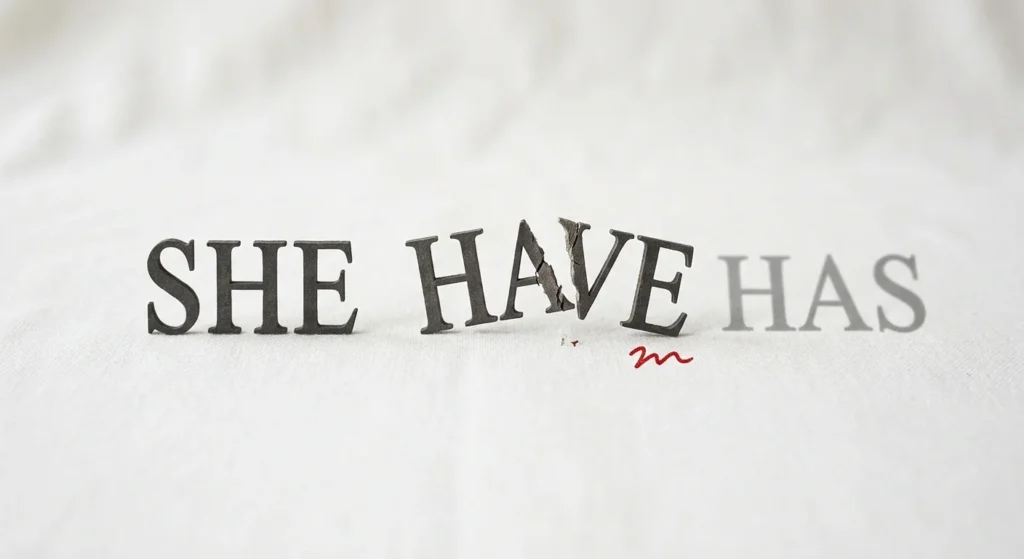
The reason “she have” sounds incorrect is because the subject and verb do not match. English listeners expect the verb to change when the subject is a single person or thing.
Think about grammar like a matching pair of shoes. The subject and verb need to fit together. If they do not match, the sentence feels uncomfortable.
Compare these sentences:
✅ She has a new phone.
❌ She have a new phone.
The first sentence sounds natural because she and has belong together.
The second sentence creates a mismatch because have usually connects with subjects like I, you, we, and they.
Why Do Learners Say “She Have”?
Many English learners make this mistake for several reasons:
- They learn have as the main dictionary form.
- They hear have used frequently in conversations.
- Their first language may not change verbs based on the subject.
- They focus on the meaning instead of the grammatical structure.
For example, a learner may think:
“The meaning is about owning something, so I should use have.”
However, English does not depend only on meaning. It also depends on the relationship between the subject and the verb.
The sentence:
She has a car.
and:
They have a car.
express a similar idea, but the verb changes because the subjects are different.
Understanding the Difference Between “Has” and “Have”
The words has and have come from the same verb. Both describe ownership, experiences, relationships, conditions, and actions connected with perfect tenses.
The main difference is not the meaning. The difference is the subject.
“Have” Is the Base Form
The verb have is used with:
- I
- You
- We
- They
- Plural nouns
Examples:
- I have a question.
- You have a great idea.
- We have enough time.
- They have a new project.
- The students have homework.
“Has” Is Used With Third-Person Singular Subjects
The verb has is used with:
- He
- She
- It
- One person’s name
- Singular nouns
Examples:
- He has a bicycle.
- She has a bicycle.
- It has four wheels.
- Maria has a bicycle.
- The company has a new website.
The meaning stays almost the same. Only the grammar form changes.
What Does “Have” Mean?
The verb have is one of the most common verbs in English. It appears in everyday conversations, professional writing, and academic communication.
It can express different ideas depending on the context.
The main uses of have include:
- Possession
- Relationships
- Experiences
- Conditions
- Helping verb functions
Understanding these uses helps you know when has is simply a changed form of have.
Possession: Using “Have” to Talk About Ownership
One of the most common uses of have is describing something that someone owns or keeps.
Examples:
- I have a laptop.
- You have a nice house.
- They have a large garden.
When the subject becomes she, the verb changes:
- She has a laptop.
- She has a nice house.
- She has a large garden.
The meaning remains the same, but the verb follows the subject.
Comparison Table: Possession Examples
| Subject | Correct Sentence |
| I | I have a car. |
| You | You have a car. |
| He | He has a car. |
| She | She has a car. |
| We | We have a car. |
| They | They have a car. |
A common mistake is focusing only on the object.
For example:
“She ___ a laptop.”
Some learners focus on laptop and choose have because the sentence is about ownership. However, the important word is she, not laptop.
The subject controls the verb.
Relationships: Using “Have” to Describe Connections
English also uses have to talk about relationships with people.
Examples:
- I have two sisters.
- They have many friends.
- We have supportive neighbors.
With she, use has:
- She has two sisters.
- She has many friends.
- She has supportive neighbors.
This pattern appears often in daily conversations.
Examples:
- She has a husband.
- She has three children.
- She has a close relationship with her family.
The verb does not change because of the relationship itself. It changes because the subject is she.
Experiences: Using “Have” for Events and Situations
The verb have can describe things people experience.
Examples:
- I have a busy day.
- You have an important meeting.
- They have an exciting trip planned.
For a singular female subject:
- She has a busy day.
- She has an important meeting.
- She has an exciting trip planned.
You will hear this structure constantly in real conversations.
Examples:
- She has a lot of experience in marketing.
- She has a difficult decision to make.
- She has a chance to improve her skills.
These sentences do not mean she physically owns something. Instead, they describe situations connected to her.
“Have” as a Helping Verb
Another important use of have is as a helping verb in perfect tenses.
A helping verb works with another verb to show time, completion, or connection between events.
Examples:
- I have finished my work.
- They have arrived.
- We have learned the lesson.
When the subject changes to she, use has:
- She has finished her work.
- She has arrived.
- She has learned the lesson.
Present Perfect Pattern
| Subject | Helping Verb | Example |
| I | have | I have completed the task. |
| You | have | You have completed the task. |
| She | has | She has completed the task. |
| They | have | They have completed the task. |
This is one of the most important areas where learners confuse has and have.
What Does “Has” Mean?
The word has is the third-person singular form of have.
It does not have a completely different meaning. It simply follows a different grammar rule.
Use has when the subject is:
- A single person
- A single object
- He, she, or it
Examples:
- She has a new job.
- He has a problem.
- The computer has a virus.
- The company has a plan.
Examples of “Has” in Daily English
Possession
- She has a new dress.
Experience
- She has experience in teaching.
Condition
- She has a cold.
Relationship
- She has many close friends.
Responsibility
- She has an important role.
The Simple Rule Behind “She Has” and “She Have”
The easiest rule to remember is:
If the subject is he, she, or it, use has.
If the subject is I, you, we, or they, use have.
Examples:
✅ She has a book.
✅ They have books.
✅ He has a meeting.
✅ We have meetings.
❌ She have a book.
❌ He have a meeting.
Once this pattern becomes familiar, the difference between she has and she have becomes automatic in everyday writing and speaking.
She Has, or She Have: How Subject-Verb Agreement Decides the Correct Choice
Understanding she has or she have becomes much easier when you learn the grammar rule behind it. English verbs do not always stay the same. They change depending on who or what acts.
This change is called subject-verb agreement. It means the subject and verb must work together correctly. When they match, the sentence sounds natural. When they do not, the sentence immediately feels incorrect to fluent English speakers.
For example:
- She has a new idea. ✅
- She have a new idea. ❌
The subject she requires has because it refers to one person.
How Subject-Verb Agreement Determines the Correct Choice
Every complete sentence has two important parts:
- Subject — who or what the sentence is about
- Verb — what the subject does or has
The verb must follow the grammar pattern of the subject.
Consider these examples:
| Subject | Correct Form | Example |
| I | have | I have a question. |
| You | have | You have a good point. |
| He | has | He has a new job. |
| She | has | She has a new job. |
| It | has | It has a strange sound. |
| We | have | We have enough time. |
| They | have | They have many options. |
The important thing to notice is that only third-person singular subjects use has.
These include:
- She
- He
- It
- Sarah
- The teacher
- My friend
- The company
Examples:
- Sarah has a meeting.
- The teacher has an important announcement.
- My friend has a new apartment.
Why Third-Person Singular Subjects Use “Has”
The phrase third-person singular sounds complicated, but the idea is simple.
Third Person
Third person means you are talking about someone or something else.
Examples:
- She
- He
- It
- John
- The dog
- The computer
You are not talking directly to them. You are talking about them.
Singular
Singular means one person, animal, place, or thing.
Examples:
- One woman → she
- One man → he
- One object → it
When you combine these ideas, you get:
Third-person singular = one person or thing being discussed
That is why English uses:
- She has
- He has
- It has
but:
- They have
- We have
- You have
Why “Has” Changes With He, She, and It
English often adds changes to verbs when the subject is singular.
For many regular verbs, the change is simply adding -s.
Examples:
- She runs.
- He works.
- It looks.
The verb have is irregular, so instead of becoming haves, it changes to has.
This is why we say:
- She has a car.
- He has a question.
- It has a purpose.
We do not say:
- She haves a car. ❌
- He has a question. ❌
The word has is the special third-person form of have.
The Grammar Rule Behind “Has” and “Have”
The basic grammar rule is:
Use has with singular third-person subjects and use have with all other subjects.
This rule applies in normal present tense sentences.
Use “Has” With:
| Subject Type | Examples |
| Female person | She has |
| Male person | He has |
| Object or animal | It has |
| One named person | Emma has |
| One organization | The company has |
Use “Have” With:
| Subject Type | Examples |
| First person | I have |
| Second person | You have |
| Plural people | They have |
| Groups | We have |
| Multiple things | Cars have |
When to Use “Has”
The word has appears in many everyday situations. It can describe things someone owns, feels, experiences, or needs.
Knowing these categories helps you naturally recognize when she has is the correct choice.
Talking About Possession With “She Has”
Possession means something belongs to someone or is available to them.
Examples:
- She has a new phone.
- She has a beautiful house.
- She has a collection of books.
- She has a ticket for the concert.
The object does not matter. The subject decides the verb.
Compare:
- She has a bicycle.
- She has two bicycles.
- She has expensive bicycles.
The noun changes, but has remains the same because the subject is still she.
Talking About Relationships With “She Has”
The verb has can describe connections between people.
Examples:
- She has a brother.
- She has many friends.
- She has a supportive family.
- She has a close relationship with her teacher.
These sentences do not describe ownership. They describe a connection or personal situation.
More examples:
- She has three children.
- She has a helpful coworker.
- She has good relationships with her neighbors.
Talking About Characteristics With “She Has”
English uses has when describing physical features, personality traits, or qualities.
Examples:
- She has blue eyes.
- She has long hair.
- She has a creative mind.
- She has a strong personality.
This pattern is common when describing people.
A useful structure is:
She has + noun phrase
Examples:
- She has confidence.
- She has patience.
- She has a positive attitude.
Talking About Feelings With “She Has”
The verb has can describe emotions, concerns, or mental states.
Examples:
- She has confidence.
- She has doubts.
- She has concerns about the project.
- She has a fear of heights.
In these examples, has connects the person with an emotional or mental condition.
This usage appears frequently in conversations:
- She has a lot of energy today.
- She has a good feeling about the future.
- She has some worries about the decision.
Talking About Responsibilities With “She Has”
We also use has to talk about duties, tasks, and obligations.
Examples:
- She has a meeting at noon.
- She has an important responsibility.
- She has several tasks to complete.
- She has a deadline tomorrow.
These sentences are common in workplace and academic communication.
For example:
“She has a presentation tomorrow, so she needs to prepare tonight.”
The subject controls the verb, so has is required.
Everyday Sentence Examples Using “She Has”
Learning grammar rules is useful, but seeing real examples helps you remember them.
Here are examples from common situations.
At Home
Examples:
- She has a large kitchen.
- She has two pets.
- She has a comfortable bedroom.
- She has a family tradition.
Daily conversations often use she has when discussing someone’s home life.
Example:
“Maria has a beautiful garden behind her house.”
The name Maria is a singular third-person subject, so has is correct.
At School
Students and teachers use has in many situations.
Examples:
- She has a difficult assignment.
- She has a math test tomorrow.
- She has a new teacher.
- She has excellent grades.
Example:
“The student has completed the homework.”
The subject is one student, so the correct form is has.
At Work
Professional conversations often include has.
Examples:
- She has a leadership role.
- She has a meeting with the manager.
- She has experience in marketing.
- She has several projects.
Example:
“She has five years of experience in customer service.”
The sentence describes her experience and states the subject.
While Traveling
Travel situations also use this structure.
Examples:
- She has a passport.
- She has a flight ticket.
- She has a hotel reservation.
- She has travel experience.
Example:
“She has everything ready for her trip.”
The phrase sounds natural because she correctly matches has.
Health Examples
Health-related sentences often use has.
Examples:
- She has a headache.
- She has a fever.
- She has a healthy lifestyle.
- She has strong habits.
Example:
“She has a cold, so she is staying home.”
Again, she has is the correct structure because the subject is singular.
A Simple Memory Trick You’ll Remember Forever
A quick way to remember the difference:
The “S” Rule
When the subject is:
- He
- She
- It
the verb usually receives an s sound.
Examples:
- She runs.
- She works.
- She likes.
- She has.
The verb have does not normally add an ” s “. It changes completely:
- Have → Has
Remember:
She has, not she have.
Another Easy Trick: Replace the Subject
If you are unsure, replace she with they.
Example:
“She ___ a car.”
Change it:
“They have a car.”
Because they use have, you may think the answer is have. Now switch back:
“She has a car.”
The subject changed, so the verb changed.
This method works because it focuses your attention on the subject instead of the object.
Reading the Sentence Aloud
Sometimes your ears catch grammar mistakes faster than your eyes.
Say these sentences:
- She has a beautiful voice.
- She have a beautiful voice.
Most learners immediately notice that the second sentence sounds unnatural.
Reading aloud can help build grammar awareness because correct English patterns become familiar through repetition.
Quick Rule Summary
| If the Subject Is… | Use… | Example |
| She | has | She has a book. |
| He | has | He has a car. |
| It | has | It has a problem. |
| I | have | I have a question. |
| You | have | You have a choice. |
| We | have | We have time. |
| They | have | They have plans. |
The key idea is simple: “She has” is correct because English changes the verb form for third-person singular subjects. Once this pattern becomes familiar, choosing between she has and she have becomes automatic.
She Has, or She Have: Everyday Examples, Questions, Negative Sentences, and When to Use Have
The difference between she has and she have becomes much clearer when you see how people use these words in real conversations. Grammar rules are important, but practical examples help you recognize the correct pattern naturally.
The phrase she has appears in daily life when talking about someone’s possessions, experiences, responsibilities, health, relationships, and actions. On the other hand, have belongs with subjects like I, you, we, and they.
A simple sentence can show the difference:
- She has a new job. ✅
- They have a new job. ✅
- She have a new job. ❌
The subject decides the verb form every time.
Everyday Sentence Examples Using “She Has”
The phrase she has is used constantly in spoken and written English. Whether you are talking about family, education, work, travel, or health, the grammar pattern stays the same.
The structure is:
She has + noun or past participle
Examples:
- She has a new phone.
- She has a meeting today.
- She has finished her homework.
- She has many friends.
The word after has can change, but has remains correct because the subject is she.
Using “She Has” at Home
Home conversations often include sentences about belongings, family members, and daily routines.
Examples:
- She has a comfortable bedroom.
- She has a small garden.
- She has two children.
- She has a pet dog.
- She has a busy morning routine.
Imagine someone describing a neighbor:
“She has a lovely home, a friendly family, and a beautiful garden.”
Every use of has works because the sentence talks about one person.
Common home-related uses include:
| Situation | Example |
| Belongings | She has a new sofa. |
| Family | She has three sisters. |
| Pets | She has a cat. |
| Daily life | She has a busy schedule. |
Using “She Has” at School
School and learning situations use she has frequently.
Examples:
- She has a difficult exam tomorrow.
- She has a science project.
- She has a helpful teacher.
- She has excellent writing skills.
- She has completed her assignment.
Teachers often use this structure when discussing students:
“She has improved her reading skills this year.”
The sentence talks about one student, so has is required.
School Examples
| Incorrect | Correct |
| She have homework. | She has homework. |
| She have a test tomorrow. | She has a test tomorrow. |
| She have good grades. | She has good grades. |
Using “She Has” at Work
Professional English uses she has when describing someone’s experience, duties, skills, or workplace responsibilities.
Examples:
- She has five years of experience.
- She has a leadership position.
- She has an important presentation.
- She has a meeting with the client.
- She has strong communication skills.
A workplace example:
“Sarah has experience managing international projects.”
Here, Sarah is a singular person, so has is the correct verb.
Common Work Situations Using “She Has”
| Topic | Example |
| Experience | She has experience in sales. |
| Skills | She has excellent technical skills. |
| Meetings | She has a meeting at 3 PM. |
| Responsibilities | She has several tasks today. |
Using “She Has” While Traveling
Travel conversations often include has when discussing plans, documents, and experiences.
Examples:
- She has a passport.
- She has a flight ticket.
- She has a hotel reservation.
- She has visited many countries.
- She has planned her trip carefully.
Travel example:
“She has everything ready before leaving for the airport.”
The subject is still she, so the verb remains has.
Using “She Has” for Health
Health-related sentences commonly use has to describe conditions, symptoms, or habits.
Examples:
- She has a headache.
- She has a fever.
- She has a healthy lifestyle.
- She has strong exercise habits.
- She has recovered from an illness.
Medical conversations often follow this pattern:
Person + has + health condition
Examples:
- She has allergies.
- She has diabetes.
- She has a sore throat.
Important note: In everyday English, has does not mean something positive or negative by itself. It simply connects the subject with the condition or experience.
Questions That Use “Has”
Many learners understand she has in statements but become confused when forming questions.
In questions, English changes the sentence structure.
A statement:
She has a car.
A question:
Does she have a car?
Notice something important:
The question uses have, not has.
Why?
Because the helping verb does already carries the third-person singular grammar.
The pattern is:
Does + she + have + object?
Examples:
- Does she have a job?
- Does she have any questions?
- Does she have a passport?
- Does she have experience?
When to Use “Has” Directly in Questions
You use has directly when it works as a helping verb in perfect tenses.
Examples:
- Has she finished her work?
- Has she arrived yet?
- Has she completed the project?
The difference:
| Sentence Type | Example |
| Possession question | Does she have a car? |
| Present perfect question | Has she bought a car? |
Many learners confuse these two patterns.
Examples of Questions Using “Has”
Here are common questions you might hear:
Daily Life Questions
- Has she called you?
- Has she arrived home?
- Has she eaten dinner?
Work Questions
- Has she completed the report?
- Has she joined the meeting?
- Has she contacted the customer?
School Questions
- Has she submitted the assignment?
- Has she studied for the exam?
- Has she understood the lesson?
These questions use has because the verb is helping create the perfect tense.
Negative Sentences Using “Has”
Negative sentences show that something did not happen or is not true.
The common forms are:
- She has not…
- She hasn’t…
Examples:
- She has not finished her work.
- She hasn’t called me.
- She hasn’t arrived yet.
The short form hasn’t is very common in conversations.
Examples:
- She hasn’t completed the project.
- She hasn’t answered the email.
- She hasn’t visited that place.
Negative Sentences With Possession
When talking about possession, negative sentences often use:
She does not have…
not:
She does not have…
Examples:
✅ She does not have a car.
❌ She does not has a car.
Why?
Because does already controls the grammar. The main verb returns to its base form:
- Does she have?
- She does not have.
This is the same reason we say:
- She does like music.
- She does not like music.
Not:
- She does not likes music.
Common Expressions That Use “Has”
Many everyday English expressions use has naturally.
“She Has Got”
In informal English, especially British English, people often say:
- She has got a new phone.
- She has got a great personality.
The meaning is similar to:
- She has a new phone.
- She has a great personality.
Both are correct.
“She Has Been”
This structure describes an action or situation connected to the past and present.
Examples:
- She has been busy.
- She has been working all day.
- She has been learning English for years.
Pattern:
She has been + verb-ing/adjective
Examples:
- She has been studying.
- She has been helpful.
- She has been successful.
“She Has Had”
This structure may look strange because it uses has twice, but it is completely correct.
Examples:
- She has had many opportunities.
- She has had a difficult experience.
- She has had that car for five years.
The first has works as a helping verb, and the second had is the past participle form.
When to Use “Have”
While she has is correct for one female person, have is used with many other subjects.
The verb have appears with:
- I
- You
- We
- They
- Plural nouns
First-Person and Second-Person Subjects
Using “Have” With I
The pronoun I always uses have.
Examples:
- I have a question.
- I have a meeting.
- I have experience in this field.
Incorrect:
- I has a question. ❌
Correct:
- I have a question. ✅
Using “Have” With You
The pronoun you always uses have, whether you mean one person or multiple people.
Examples:
- You have a great idea.
- You have many options.
- You have enough time.
Incorrect:
- You has a great idea. ❌
Correct:
- You have a great idea. ✅
Plural Subjects and “Have”
Plural subjects use have because they refer to more than one person or thing.
Examples:
- We have a plan.
- They have a problem.
- The students have homework.
- The employees have questions.
Compare:
- She has a book.
- They have books.
The number of people changes the verb.
Everyday Examples of Correct Usage
Here are examples showing how has and have work in real sentences:
| Subject | Correct Sentence |
| She | She has a new laptop. |
| He | He has a meeting. |
| I | I have a suggestion. |
| You | You have a choice. |
| We | We have a solution. |
| They | They have experience. |
The rule is simple:
One person with he, she, or it → has
Everyone else → have
Understanding this pattern removes one of the most common English grammar mistakes and helps you use she has confidently in everyday communication.
She Has, or She Have: Side-by-Side Comparisons, Different Subjects, and Tense Rules
The difference between she has and she have becomes even clearer when you compare it with other subjects and sentence structures. Many grammar mistakes happen because learners remember one sentence but do not understand the larger pattern behind it.
English does not choose has or have randomly. The subject controls the verb form. Once you understand how this works with different pronouns, you can apply the same rule to almost any sentence.
A quick reminder:
- She has a book. ✅
- They have a book. ✅
- She have a book. ❌
The verb changes because the subject changes.
Side-by-Side Comparison: “She Has” vs. “She Have”
The most common mistake is using have after she. The sentence may still be understandable, but it does not follow standard English grammar.
Compare these examples:
| Incorrect Sentence | Correct Sentence | Reason |
| She have a car. | She has a car. | She is third-person singular. |
| She have two brothers. | She has two brothers. | One person uses has. |
| She has a meeting today. | She has a meeting today. | The subject controls the verb. |
| She has completed the task. | She has completed the task. | Has works as a helping verb. |
The mistake usually happens because have is the basic form of the verb. However, English changes some verbs when the subject is singular.
For example:
- She works.
- She likes.
- She plays.
- She has.
The same pattern appears with have.
Has vs. Have With Different Subjects
The best way to master she has, or she have,e is to see how the verb changes with every common subject.
He Has, or He Have?
The correct form is:
✅ He has
Incorrect:
❌ He have
Examples:
- He has a new car.
- He has a lot of experience.
- He has completed the project.
The reason is the same as with she. The subject he is third-person singular.
Compare:
- He has a dog.
- They have a dog.
One person uses has. Multiple people use have.
It, Has or It Have?
The correct form is:
✅ It has
Incorrect:
❌ It have
We use it for objects, animals, weather conditions, and situations.
Examples:
- It has four wheels.
- It has a strange sound.
- It has many features.
Examples with objects:
- The phone has a large screen.
- The computer has a fast processor.
- The machine has a safety system.
Because each object is singular, we use has.
I Have, or I Has?
The correct form is:
✅ I have
Incorrect:
❌ I has
Unlike he, she, and it, the pronoun I does not use has.
Examples:
- I have a question.
- I have a meeting tomorrow.
- I have learned a new skill.
This is one area where learners often overapply the “singular means has” rule.
However, English has a special pattern:
- I = have
- You = have
- He/She/It = has
You Have, or You Has?
The correct form is:
✅ You have
Incorrect:
❌ You has
The pronoun you always uses have, even when you are speaking to one person.
Examples:
- You have a great opportunity.
- You have a beautiful voice.
- You have enough time.
Whether you refer to one person or many people, the verb remains the same.
We Have, or We Has?
The correct form is:
✅ We have
Incorrect:
❌ We has
Examples:
- We have a plan.
- We have enough information.
- We have finished our work.
The word we represents more than one person, so it uses have.
They Have, or They Has?
The correct form is:
✅ They have
Incorrect:
❌ They has
Examples:
- They have a new house.
- They have different opinions.
- They have completed the assignment.
Because they refers to multiple people or things, it uses have.
Complete Has vs. Have Subject Chart
| Subject | Correct Form | Example |
| I | have | I have a pen. |
| You | have | You have a choice. |
| He | has | He has a job. |
| She | has | She has a plan. |
| It | has | It has a problem. |
| We | have | We have time. |
| They | have | They have experience. |
A useful memory shortcut:
HAS = He, She, It
HAVE = I, You, We, They
Using “Has” and “Have” in Different Tenses
The choice between has and have does not only appear in simple present sentences. It also affects several important English tenses.
One of the most common examples is the present perfect tense.
The present perfect connects a past action with the present moment.
The structure is:
Subject + has/have + past participle
Examples:
- She has finished.
- They have finished.
The past participle stays the same. Only the helping verb changes.
Present Perfect With “Has”
Use has when the subject is:
- He
- She
- It
- A singular person or thing
Examples:
- She has completed her homework.
- He has arrived at the airport.
- It has stopped raining.
- Maria has started a new job.
The pattern:
She has + past participle
Examples:
- She has written a letter.
- She has studied English.
- She has visited Canada.
- She has learned the rule.
Present Perfect With “Have”
Use have with:
- I
- You
- We
- They
Examples:
- I have finished my work.
- You have improved your English.
- We have reached our goal.
- They have moved to a new city.
The pattern:
Subject + have + past participle
Examples:
- They have completed the project.
- We have seen that movie.
- You have made progress.
Has Been vs. Have Been
Many learners confuse has been and have been, but the difference follows the same subject rule.
Use “Has Been” With:
- He
- She
- It
Examples:
- She has been busy.
- He has been working.
- It has been difficult.
Sentence examples:
She has been studying English for three years.
The subject is she, so has been is correct.
Use “Have Been” With:
- I
- You
- We
- They
Examples:
- I have been waiting.
- You have been helpful.
- We have been practicing.
- They have been traveling.
Sentence example:
They have been working on the project since Monday.
The subject is they, so have been is correct.
Has Had vs. Have Had
The structure has had may look unusual because the word has appears twice in the same phrase. However, it follows a clear grammar pattern.
The first word is the helping verb. The second word is the past participle of have.
Use “Has Had” With:
- He
- She
- It
Examples:
- She has had many opportunities.
- He has had a difficult year.
- It has had several problems.
Example:
She has had this phone for five years.
This means she got the phone in the past and still has it now.
Use “Have Had” With:
- I
- You
- We
- They
Examples:
- I have had enough time.
- You have had many chances.
- We have had a great experience.
- They have had several meetings.
Quick Comparison: Has and Have in Different Forms
| Grammar Form | She | They |
| Present | She has | They have |
| Present Perfect | She has finished | They have finished |
| Perfect Continuous | She has been working | They have been working |
| Perfect With Had | She has had | They have had |
A Real-Life Example: Choosing the Correct Form
Imagine you are writing an email about a coworker:
Incorrect:
She has completed the report, and she has sent it to the manager.
Correct:
She has completed the report, and she has sent it to the manager.
Why?
Because both sentences describe one person: she.
Now compare:
They have completed the report,t and they have sent it to the manager.
The subject changed from one person to multiple people, so have becomes correct.
The Main Rule to Remember
When deciding between she has or she have, ask one question:
Who is the subject?
If the answer is:
- She → has
- He → has
- It → has
If the answer is:
- I → have
- You → have
- We → have
- They → have
This simple check prevents most mistakes and makes your English sound more natural in conversations, writing, and professional communication.
She Has, or She Have: Modal Verbs, Common Mistakes, Memory Tricks, and Practice
The rule behind she has or she have becomes more interesting when you move beyond simple sentences. Many learners understand that she has is correct, but they still make mistakes when other verbs appear in the sentence.
The biggest confusion often happens with modal verbs, helping verbs, and longer sentence structures. The good news is that the same grammar idea still applies: the words around the subject determine the correct verb form.
Understanding these patterns will help you avoid common errors and use English more confidently in writing and conversations.
Modal Verbs: Why We Say “She Should Have” Instead of “She Should Has”
Modal verbs are special helping verbs that express ideas like ability, possibility, advice, permission, or necessity.
Common modal verbs include:
- Should
- Could
- Would
- Might
- May
- Must
- Can
One important rule:
After a modal verb, always use the base form of the main verb.
This means we say:
✅ She should have
❌ She should has
The modal verb should already controls the grammar, so the main verb stays in its original form.
What Are Modal Verbs?
Modal verbs help explain the speaker’s meaning.
They can show:
| Meaning | Modal Example |
| Advice | She should study. |
| Ability | She can help. |
| Possibility | She might come. |
| Permission | She may leave. |
| Necessity | She must work. |
Notice that the verb after the modal does not change.
Examples:
- She should go.
- She can drive.
- She might have time.
- She must complete the task.
Not:
- She should goes. ❌
- She can drives. ❌
- She might has time. ❌
Examples of Correct Usage With “Have”
Here are common examples where have remains correct after a modal verb:
Should Have
- She should have called earlier.
- She should have studied more.
- She should have checked the information.
Could Have
- She could have won the competition.
- She could have helped us.
- She could have finished the project.
Would Have
- She would have accepted the offer.
- She would have arrived sooner.
Might Have
- She might have forgotten the appointment.
- She might have taken another route.
In every example, have stays the same because it follows a modal verb.
Why “She Should Has” Is Incorrect
The sentence:
❌ She should has completed the work.
is incorrect because should already acts as the helping verb.
The correct sentence is:
✅ She should have completed the work.
The grammar structure is:
Subject + modal verb + base verb
Examples:
- She should have.
- He could have.
- They might have.
Not:
- She should has.
- He could have.
- They might has.
A useful comparison:
| Incorrect | Correct |
| She should have a car. | She should have a car. |
| She could have helped. | She could have helped. |
| She might have forgotten. | She might have forgotten. |
More Examples With Modal Verbs
Using “Can Have”
Examples:
- She can have another chance.
- She can have the opportunity.
Using “Must Have”
Examples:
- She must have missed the train.
- She must have completed the assignment.
Using “May Have”
Examples:
- She may have a reason.
- She may have forgotten.
These structures appear often in natural conversations.
Common Mistakes Learners Make With “She Has” and “She Have”
Even advanced learners sometimes confuse has and have because English sentences can become longer and more complicated.
Understanding common mistakes makes it easier to recognize and fix them.
Mistake 1: Using “Have” After “She”
This is the most common mistake.
Incorrect:
❌ She have a new laptop.
Correct:
✅ She has a new laptop.
Why?
Because she is a third-person singular subject.
More examples:
❌ She have two brothers.
✅ She has two brothers.
❌ She have a meeting today.
✅ She has a meeting today.
Mistake 2: Using “Has” After Modal Verbs
Many learners remember that she uses has, then apply the rule everywhere.
Incorrect:
❌ She should have more time.
Correct:
✅ She should have more time.
The reason is simple:
Modal verb + base verb
Examples:
- She should have.
- She could have.
- She might have.
The modal verb changes the grammar structure.
Mistake 3: Confusing Singular and Plural Subjects
Sometimes the subject is separated from the verb by other words.
Example:
❌ She and her friends has a plan.
Correct:
✅ She and her friends have a plan.
Why?
The subject is not only she. It is:
She and her friends
This represents multiple people, so use have.
More examples:
❌ The students has homework.
✅ The students have homework.
❌ My parents has a house.
✅ My parents have a house.
Mistake 4: Letting Nearby Words Cause Confusion
A common grammar trap is choosing the verb based on the closest noun instead of the actual subject.
Example:
❌ The box of books have a label.
Correct:
✅ The box of books has a label.
Why?
The subject is box, not books.
“Box” is singular, so use has.
More examples:
❌ The group of students has completed their project.
✅ The group of students has completed their project.
The main subject controls the verb.
Mistake 5: Forgetting Helping Verbs
Helping verbs can change the sentence structure.
Example:
Statement:
✅ She has finished the work.
Question:
✅ Does she have the work?
Negative:
✅ She does not have the work.
Notice:
- She has
- Does she have
- She does not have
The helping verb does changes the structure.
Quick Grammar Check for “She Has” and “She Have”
Before writing a sentence, ask yourself these questions:
| Question | Check |
| Who is the subject? | Identify the person or thing. |
| Is the subject he, she, or it? | Use has. |
| Is the subject I, you, we, or they? | Use have. |
| Is there a modal verb? | Use have after it. |
| Is there a helping verb like does? | Use the base form have. |
Example:
Sentence:
“Does she ___ a car?”
Check:
- Subject = she
- Helping verb = does
- Main verb = base form
Answer:
✅ Does she have a car?
Easy Memory Tricks to Remember the Rule
Grammar rules become easier when you connect them with simple reminders.
Trick 1: Remember the Three Special Pronouns
The easiest shortcut:
He, She, It = Has
Examples:
- He has.
- She has.
- It has.
Everything else:
I, You, We, They = Have
Examples:
- I have.
- You have.
- We have.
- They have.
Trick 2: The “S” Rule
In the present tense, many English verbs change with third-person singular subjects.
Examples:
- She works.
- She plays.
- She likes.
- She has.
Think of she as a signal that often creates an “s” sound.
The verb have is unusual because it changes completely:
Have → Has
Trick 3: Replace the Subject
If you are unsure, replace she with another pronoun.
Example:
“She ___ a new phone.”
Try:
“They have a new phone.”
Now switch back:
“She has a new phone.”
The subject tells you the answer.
Trick 4: Read the Sentence Aloud
Your ears can often catch grammar mistakes.
Compare:
- She has a beautiful voice.
- She have a beautiful voice.
The first sentence sounds natural because you have heard this pattern many times.
Reading aloud helps train your brain to recognize correct English structures.
A Pronoun Chart You Can Save
| Pronoun | Correct Verb | Example |
| I | have | I have a book. |
| You | have | You have a choice. |
| He | has | He has a car. |
| She | has | She has a job. |
| It | has | It has a purpose. |
| We | have | We have time. |
| They | have | They have plans. |
This chart covers most everyday situations.
A Quick Self-Check Before You Write
Before submitting an email, assignment, or message, check:
- Did I use she has instead of she have?
- Did I use have after modal verbs?
- Did I check the real subject?
- Did I avoid changing the verb because of nearby words?
- Did I use the correct helping verb structure?
A few seconds of checking can prevent common grammar mistakes.
Practice Sentences: Test Your Understanding of “She Has” vs. “She Have”
Fill in the Blank
Choose has or have.
- She ___ a new computer.
- They ___ completed the assignment.
- She ___ been working all day.
- We ___ a meeting tomorrow.
- He ___ a difficult decision to make.
Answers
- She has a new computer.
- They have completed the assignment.
- She has been working all day.
- We have a meeting tomorrow.
- He has a difficult decision to make.
Correct or Incorrect?
Sentence 1
❌ She have a beautiful house.
Correct:
✅ She has a beautiful house.
Sentence 2
✅ She has finished her homework.
Correct.
Sentence 3
❌ She should have called earlier.
Correct:
✅ She should have called earlier.
Sentence 4
✅ They have a new project.
Correct.
Rewrite These Sentences Correctly
Incorrect
She has many responsibilities.
Correct
She has many responsibilities.
Incorrect
She should has more confidence.
Correct
She should have more confidence.
Incorrect
The group of students hhasa meeting.
Correct
The group of students has a meeting.
Real-World Case Study: A Small Grammar Mistake With a Big Impact
Small grammar mistakes may seem harmless in casual conversations, but they can affect how people view written communication.
Imagine a job applicant writes:
“She have experience managing customers.”
A reader will probably understand the meaning, but the mistake may create doubt about the writer’s attention to detail.
The corrected version:
“She has experience managing customers.”
Sounds professional and polished.
This matters in situations like:
- Job applications
- Business emails
- Academic writing
- Professional profiles
- Customer communication
Good grammar does not replace good ideas, but it helps your ideas come across clearly.
Why Accuracy Matters When Using “She Has” or “She Have”
Correct grammar improves communication because it removes distractions.
When readers see:
✅ She has completed the task.
they focus on the information.
When they see:
❌ She have completed the task.
they may pause and notice the error instead.
The goal of grammar is not just following rules. It is making your message clear, natural, and easy to understand.
Mastering the difference between she has and she have gives you a foundation for many other English grammar patterns because it teaches one of the most important ideas in the language: the subject controls the verb.
Conclusion About She Has or She Have – Which Is Correct?
Understanding she has or she have is a small grammar lesson that can make a big difference in your English accuracy. The correct form is always she has when talking about one female person because she is a third-person singular subject. The word have works with subjects like I, you, we, and they.
Once you remember the simple rule — he, she, and it use has — choosing the right verb becomes much easier. Whether you are writing an email, speaking in a conversation, or learning English step by step, this grammar pattern will help your sentences sound more natural. Keep practicing with real examples and soon the difference between has and have will feel automatic.
FAQs About She Has, or She Have – Which Is Correct?
Is “She Has” grammatically correct?
Yes, she has is grammatically correct in standard English. The subject she is a third-person singular pronoun, so it uses has instead of have in present tense sentences. Examples include “She has a book” and “She has a new idea.”
Can “She Have” ever be correct?
In standard English, she have is incorrect when used as a normal present tense statement. However, some dialects or informal speech patterns may use different grammar rules. For formal writing, education, and professional communication, always use she has.
Why does “She” take “Has” instead of “Have”?
The pronoun she takes has because English changes certain verbs for third-person singular subjects. This rule applies to he, she, and it. These subjects use special verb forms, while I, you, we, and they use the base form have.
Is “Has” singular or plural?
Has is generally used with singular third-person subjects such as he, she, and it. It does not mean singular by itself, but it appears with singular subjects in present tense grammar. For example, “She has a car” is correct.
When do I use “Have” instead of “Has”?
Use have with I, you, we, and they. It is also used after modal verbs like should, could, and might. Examples include “I have a question,” “They have arrived,” and “She should have called.”
Is “She Has Been” correct?
Yes, ” She has been is completely correct. It is commonly used in present perfect and present perfect continuous structures. Examples include “She has been working” and “She has been studying English for two years.”
Is “She Has Had” correct?
Yes, ” She has had is correct. The first has works as a helping verb, while had is the past participle form of have. Example: “She has had many opportunities throughout her career.”
What is the difference between “She Has” and “She Have”?
The difference is based on subject-verb agreement. She has matches a singular female subject, while have matches subjects like I, you, we, and they. Both words come from the same verb, but the subject determines which form is correct.
How can I remember “She Has” instead of “She Have”?
A simple memory trick is to remember He, She, It = Has. All other common pronouns use Have. Repeating examples like “She has a job” and “They have jobs” can help build the correct grammar pattern.
Is “She Has” used in questions?
Yes, but the structure changes depending on the sentence. For possession questions, use “Does she have…?” For perfect tense questions, use “Has she…?” Examples are “Does she have a car?” and “Has she finished her work?”
SEO Meta Description
Learn whether She Has or She Have is correct with simple grammar rules, examples, and tips to use has and have naturally in English now.