

Have you ever stopped while writing and wondered whether you should say “a hilarious joke” or “an hilarious joke”? You’re not alone. This question confuses many English learners and even native speakers because the answer isn’t based on the first letter of the word. Instead, it depends on the first sound you hear when you pronounce it. Once you understand this simple principle, choosing between a and an becomes much easier. In this guide, you’ll learn the grammar rule, understand why a hilarious is correct, and discover practical examples you can use with confidence in everyday conversations and professional writing.
Quick Answer: Is It “An Hilarious” or “A Hilarious”?
The correct expression is “a hilarious.” Since hilarious begins with a clearly pronounced H sound (/hɪˈleriəs/), it starts with a consonant sound, which means the correct indefinite article is a.
Correct examples:
- A hilarious movie kept everyone laughing.
- We heard a hilarious story at dinner.
- She made a hilarious comment during the meeting.
- It was a hilarious performance from beginning to end.
- They shared a hilarious video with the class.
Incorrect examples:
- ❌ A hilarious movie
- ❌ An hilarious joke
- ❌ An hilarious experience
In modern English, hilarious is considered the standard and correct form. Although you may occasionally see an hilarious in older books or historical writing, it isn’t the preferred choice today.
| Expression | Correct? | Reason |
| A hilarious joke | ✅ Yes | Begins with a pronounced H sound. |
| An hilarious joke | ❌ No | H isn’t silent in hilarious. |
Why People Get Confused About “A” and “An”
At first glance, hilarious starts with the letter H, which sometimes leads people to believe an should come before it. That confusion becomes even stronger because English has several words beginning with H that actually use an, such as an hour and an honest person.
The problem is that many people remember the rule incorrectly. They think:
“Use an before vowels.”
That statement is only partly true.
The complete rule is:
Use “an” before a vowel sound, not simply before a vowel letter.
This small difference explains why so many article mistakes happen in English.
The Common Misunderstanding
Many learners memorize grammar by looking at spelling instead of pronunciation. As a result, they assume every word beginning with a vowel letter needs an, while every word beginning with a consonant letter needs a.
English doesn’t always work that way.
For example:
| Word | First Letter | First Sound | Correct Article |
| Hilarious | H | /h/ | A |
| Hour | H | /aʊ/ | An |
| Honest | H | /ɒ/ | An |
| Hero | H | /h/ | A |
| Hotel | H | /h/ | A |
Notice how the letter stays the same, but the sound changes. The sound determines which article is correct.
Why Spelling Can Be Misleading
English has borrowed words from many different languages over hundreds of years. Because of that history, spelling and pronunciation don’t always match.
Think about these examples:
- Knife begins with a K, but you don’t pronounce it.
- Psychology starts with P, but the first sound is S.
- Hour starts with H, but the first sound is ow.
These exceptions show why relying only on spelling can lead to mistakes.
Sound Matters More Than Letters
When native speakers choose a or an, they usually don’t think about grammar rules. They simply follow what sounds natural.
Say these phrases aloud:
- a hilarious comedian
- an hour later
The first phrase flows naturally because hilarious begins with the clear H sound.
The second phrase flows naturally because hour begins with a vowel sound after the silent H.
Listening to the pronunciation often gives you the correct answer immediately.
The Rule for Using “A” and “An” in English
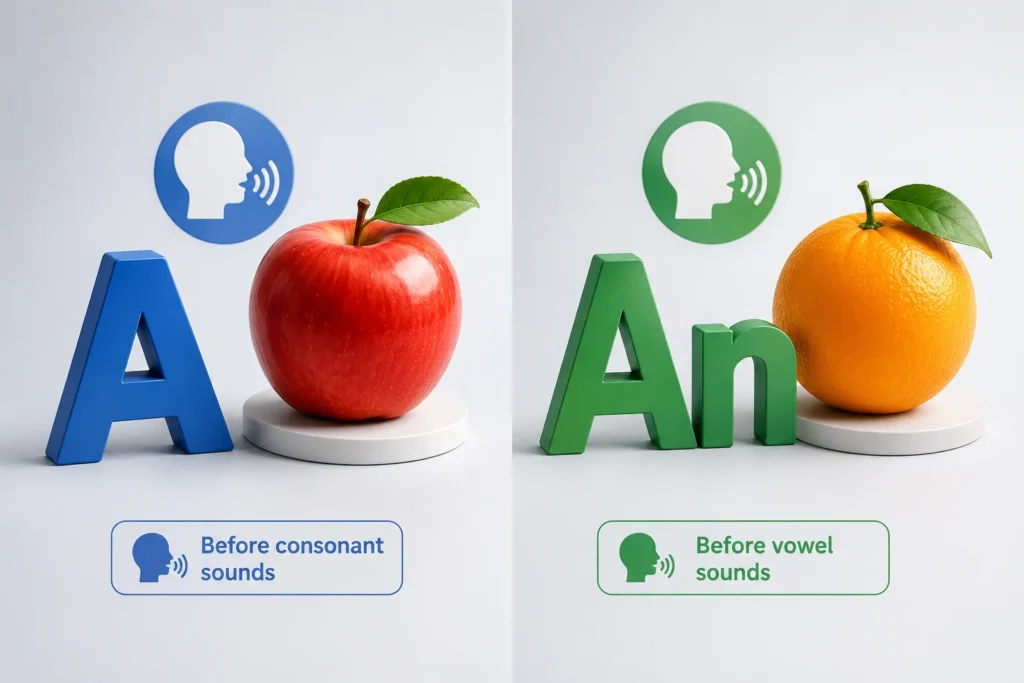
Although English grammar contains many exceptions, this rule is surprisingly consistent.
Use “A” Before Consonant Sounds
Choose a whenever the next word begins with a consonant sound.
Examples include:
- a hilarious movie
- a happy child
- a helpful teacher
- a historic building
- a hotel room
- a hero
- a horse
- a house
Notice that each word starts with a clearly pronounced H, making a the correct article.
Use “An” Before Vowel Sounds
Choose an whenever the following word begins with a vowel sound.
Examples include:
- an apple
- an elephant
- an umbrella
- an engineer
- an hour
- an honest mistake
- an heir
- an honor
In each example, the word begins with a vowel sound, even if the spelling begins with H.
Pronunciation vs. Spelling
One of the biggest lessons in English grammar is that pronunciation often matters more than spelling.
Here are several examples that surprise many learners.
| Phrase | Why It’s Correct |
| A university | Starts with the “yoo” sound. |
| A European country | Begins with the “yoo” sound. |
| An MBA graduate | The letter M is pronounced “em.” |
| An FBI agent | The letter F is pronounced “ef.” |
| A one-time event | One begins with the “w” sound. |
This pattern works the same way with hilarious.
Because you pronounce the H, the correct phrase is always hilarious in standard modern English.
Key Facts to Remember
| Rule | Example |
| Use a before consonant sounds. | a hilarious story |
| Use an before vowel sounds. | an honest person |
| Ignore the first letter. Listen to the first sound. | a university, an MBA |
| Hilarious has a pronounced H. | a hilarious joke |
Quick Tip: If you’re unsure which article to use, say the phrase aloud. Your ears usually recognize the correct choice faster than your eyes.
Understanding this simple sound-based rule eliminates most article mistakes. Once you focus on pronunciation instead of spelling, choosing between a and an becomes almost automatic, whether you’re writing an email, preparing an essay, or having a conversation.
Why We Say “A Hilarious” Instead of “An Hilarious”
Many people know the basic rule for a and an, yet they still hesitate before writing a hilarious story. The reason is simple: the word hilarious begins with the letter H, and English has a handful of H words that use an. The key difference lies in pronunciation. Once you understand how hilarious is spoken, the correct article becomes obvious.
Instead of memorizing dozens of exceptions, learn to trust the sound you hear. This approach works for almost every English word and makes article choice much easier.
The Pronunciation of “Hilarious”
The word hilarious is pronounced:
/hɪˈleriəs/
The very first sound is a clear /h/ sound. Since you can hear that consonant sound immediately, English grammar requires the article a.
Try saying these phrases aloud:
- A hilarious movie
- A hilarious moment
- A hilarious mistake
- A hilarious conversation
Each one sounds smooth because the transition from a to the pronounced H feels natural.
Now compare them with:
- An hilarious movie
- An hilarious joke
Most modern English speakers notice these sound awkward because the rhythm doesn’t match today’s pronunciation.
The Strong H Sound Explained
Not every H in English behaves the same way.
Some words pronounce the H clearly:
- happy
- history
- hero
- hotel
- house
- horrible
- hilarious
Others have a silent H:
- hour
- honest
- honor
- heir
That difference changes which article you should use.
| Word | H Pronounced? | Correct Article |
| hilarious | Yes | a |
| happy | Yes | a |
| hero | Yes | a |
| hotel | Yes | a |
| hour | No | an |
| honest | No | an |
| honor | No | an |
| heir | No | an |
This table highlights the real rule: listen to the sound, not the spelling.
Breaking the Word Into Spoken Sounds
Breaking a word into smaller sounds can make pronunciation easier to understand.
Hilarious can be divided like this:
Hi – lair – ee – us
The very first sound is “Hi.” That opening H is strong and unmistakable.
Compare it with hour:
Hour → ow-er
Notice that the H disappears completely. The word starts directly with the vowel sound “ow.”
That single pronunciation difference explains why we say:
- A hilarious comedian
- An hour later
Although both words begin with the same letter, they begin with different sounds.
A Practical Speaking Test
If you’re ever unsure whether to use a or an, try a simple speaking test.
For example:
| Word | First Sound | Correct Choice |
| hilarious | /h/ | a |
| hour | /aʊ/ | an |
| university | /y/ | a |
| umbrella | /ʌ/ | an |
| European | /y/ | a |
| MBA | /e/ | an |
This quick test works because English articles are designed for smooth pronunciation rather than spelling patterns.
Pronunciation vs. Spelling
One of the biggest challenges in English is that spelling doesn’t always tell you how a word sounds. If it did, article choice would be much easier.
English has borrowed words from French, Latin, Greek, German, and many other languages. As pronunciation evolved over centuries, spelling often stayed the same. That’s why some words no longer sound the way they look.
For article usage, pronunciation always wins.
Words That Begin With Vowel Letters but Use “A”
Some words start with vowel letters yet use a because they begin with a consonant sound.
| Correct Phrase | Reason |
| a university | Starts with the “yoo” sound |
| a European country | Starts with the “yoo” sound |
| a uniform | Pronounced “yoo” |
| a unicorn | Begins with a consonant sound |
| a one-time offer | Starts with the “w” sound |
Many learners find these examples surprising, but they follow the same sound-based rule as hilarious.
Words That Begin With Consonant Letters but Use “An”
Other words begin with consonant letters yet use an because the first spoken sound is a vowel.
| Correct Phrase | Reason |
| an hour | Silent H |
| an honest answer | Silent H |
| an honor | Silent H |
| an heir | Silent H |
| an FBI agent | “F” is pronounced “ef” |
| an MBA student | “M” is pronounced “em” |
Again, pronunciation—not spelling—determines the article.
Why English Articles Depend on Sound
Articles make spoken English easier to pronounce.
Imagine saying:
- a apple
- an university
- an hilarious joke
Each phrase interrupts the natural flow of speech.
Now compare them with:
- an apple
- a university
- a hilarious joke
These phrases move smoothly from one word to the next. That smooth transition is one reason English developed separate articles in the first place.
Common Pronunciation Patterns to Know
Once you recognize a few pronunciation patterns, choosing the correct article becomes much easier.
| Pattern | Article | Example |
| Pronounced H | a | a hilarious story |
| Silent H | an | an honest person |
| “Yoo” sound | a | a university |
| Vowel sound | an | an orange |
| Letter pronounced with a vowel sound | an | an SOS call |
| Letter pronounced with a consonant sound | a | a UFO sighting |
Instead of memorizing individual words, focus on the sound pattern they follow.
What Modern Style Guides Recommend
Modern grammar references agree that a hilarious is the preferred form in contemporary English. While older books occasionally use an hilarious, today’s dictionaries, editors, teachers, and publishers overwhelmingly recommend a hilarious because the H is clearly pronounced.
This recommendation reflects the way English is spoken today rather than the way it was spoken centuries ago.
Modern Grammar Rules
Current grammar teaching emphasizes one simple principle:
Choose the article based on pronunciation, not spelling.
This guideline appears consistently in English language courses, educational materials, and writing resources.
What Major Dictionaries Recommend
Leading dictionaries pronounce hilarious with an audible H sound. Because of that pronunciation, examples consistently pair the word with a.
You will commonly find examples such as:
- a hilarious comedy
- a hilarious performance
- a hilarious misunderstanding
- a hilarious scene
Finding a hilarious in current dictionary examples is extremely rare.
Guidance From Professional Style Manuals
Professional editors favor consistency and modern usage. Most publishing standards recommend writing the way educated speakers naturally communicate.
That means:
- A hilarious story ✔️
- A hilarious speech ✔️
- A hilarious interview ✔️
Using an hilarious in modern writing can appear outdated unless you’re intentionally quoting historical material or preserving an older style.
Why Current English Favors “A Hilarious”
Language changes over time. Centuries ago, some speakers pronounced certain H words differently, making forms like an historical or an heroic more common in formal writing.
Today, however, most English speakers pronounce the H clearly in words like hilarious, historic, heroic, and hotel. As pronunciation evolved, article usage evolved with it.
Key Takeaways So Far
Before moving to more advanced examples, remember these essential points:
| Rule | Result |
| Hilarious begins with a pronounced H sound. | Use a. |
| Articles follow pronunciation. | Sound matters more than spelling. |
| Silent H words use an. | an hour, an honest person |
| Modern English strongly prefers a hilarious. | Standard usage today |
Once you rely on pronunciation instead of the first letter, choosing between a and an becomes quick, accurate, and almost effortless. This simple habit will improve both your writing and your spoken English.
Examples of “A Hilarious” Used Correctly
Learning a grammar rule is helpful, but seeing it in real sentences makes it much easier to remember. The examples below show how a hilarious fits naturally into different types of writing and conversation.
You’ll notice one thing in every example: the word hilarious always keeps its clearly pronounced H sound, so the article a remains correct.
Everyday Conversation Examples
These are the kinds of sentences you’ll hear in daily life.
- We watched a hilarious movie after dinner.
- She told a hilarious story about her first job.
- That was a hilarious joke.
- My brother shared a hilarious video yesterday.
- They had a hilarious conversation on the way home.
- It turned into a hilarious misunderstanding.
- I read a hilarious comment online.
- The kids invented a hilarious game.
- He gave us a hilarious impression of his teacher.
- Everyone remembered it as a hilarious moment.
Notice how natural each sentence sounds. Replacing a with an would make every example sound unusual to most modern English speakers.
Academic and Professional Writing Examples
Formal writing follows the same grammar rules.
Examples include:
- The researcher opened the presentation with a hilarious anecdote that immediately captured the audience’s attention.
- The speaker shared a hilarious example to explain a difficult concept.
- The professor included a hilarious illustration to help students remember the lesson.
- The article described a hilarious incident that later became a popular case study.
- The training session began with a hilarious icebreaker activity.
Even in professional settings, a hilarious is the accepted form because pronunciation—not formality—determines article choice.
Business and Workplace Examples
Grammar rules don’t change in business communication.
Examples:
- The manager shared a hilarious story during the team meeting.
- The newsletter included a hilarious employee spotlight.
- We received a hilarious customer review that made everyone smile.
- The presenter used a hilarious example to explain the new policy.
- It became a hilarious office memory.
Creative Writing Examples
Authors often use humor to make scenes memorable.
Examples:
- A hilarious stranger appeared at exactly the wrong moment.
- She remembered a hilarious summer afternoon with her cousins.
- The novel opened with a hilarious misunderstanding between neighbors.
- They found themselves in a hilarious situation that no one expected.
- Every chapter contained a hilarious surprise.
These examples demonstrate that the article remains the same regardless of writing style.
Common Collocations With “Hilarious”
Certain word combinations appear frequently in English.
| Common Phrase | Example |
| a hilarious joke | He told a hilarious joke. |
| a hilarious story | She shared a hilarious story. |
| a hilarious movie | We watched a hilarious movie. |
| a hilarious moment | It became a hilarious moment. |
| a hilarious comment | Someone posted a hilarious comment. |
| a hilarious video | They uploaded a hilarious video. |
| a hilarious performance | The audience loved a hilarious performance. |
| a hilarious experience | It turned into a hilarious experience. |
| a hilarious misunderstanding | It started with a hilarious misunderstanding. |
| a hilarious scene | The director filmed a hilarious scene. |
Learning these common phrases helps you sound more natural because they’re frequently used by native speakers.
Mini Case Study: Why Native Speakers Rarely Say “An Hilarious”
Imagine two people having a conversation.
Speaker A: “Did you watch that comedy last night?”
Speaker B: “Yes! It was a hilarious movie.”
Now imagine Speaker B saying:
“It was a hilarious movie.”
To many native speakers, the second sentence sounds outdated or unnatural. That isn’t because they consciously remember a grammar rule. Instead, they instinctively follow the pronunciation pattern they’ve heard throughout their lives.
This is an important point.
Native speakers rarely stop to think about a versus an. They naturally choose the article that creates the smoothest pronunciation.
The more English you hear and speak, the more automatic this choice becomes.
Why Fluency Depends on Sound
Fluent speakers don’t process article rules one by one.
Instead, they recognize entire phrases such as:
- a hilarious joke
- a happy ending
- a horrible mistake
- a historic event
- an honest answer
- an hour later
Learning these word groups instead of isolated grammar rules helps improve both speaking and writing.
Is “An Hilarious” Ever Correct?
This question appears surprisingly often.
The short answer is:
Rarely in modern English.
However, there is an interesting historical explanation worth understanding.
Historical Usage and Older Grammar Rules
If you read books from the eighteenth or nineteenth century, you may occasionally encounter phrases like:
- an historical event
- an heroic act
- an humble servant
- an hotel
Older writers sometimes treated the H as weak or nearly silent. Because of that pronunciation, an sounded acceptable in certain regions and social groups.
This wasn’t necessarily incorrect for that period. It reflected how many educated speakers pronounced those words at the time.
Language evolves, and pronunciation evolves with it.
Why Some Older Style Guides Accepted It
Earlier grammar books often encouraged forms such as:
- an historical
- an heroic
- an habitual
These recommendations were influenced by pronunciation patterns inherited from French and older varieties of British English.
Over time, however, the pronunciation changed.
As speakers began pronouncing the H more clearly, article usage changed as well.
Modern English gradually shifted toward:
- a historical event
- a heroic act
- a habitual practice
The same change applies to hilarious.
Modern English Usage Today
Today, nearly all standard English writing uses:
- a hilarious story
- a hilarious comedian
- a hilarious performance
Seeing a hilarious in contemporary books, newspapers, magazines, or educational materials is uncommon.
Unless you’re quoting an older document or preserving historical language, a hilarious is the expected form.
What Major Grammar Authorities Recommend
Modern grammar references consistently emphasize the same principle:
Choose the article that matches the first spoken sound.
Because hilarious starts with the pronounced /h/ sound, today’s grammar authorities recommend hilarious.
This recommendation aligns with current pronunciation in both American English and most varieties of modern British English.
Quick Comparison
Sometimes seeing two forms side by side makes the rule easier to remember.
| Phrase | Correct Today? | Explanation |
| a hilarious joke | ✅ Yes | Pronounced H sound |
| an hilarious joke | ❌ Generally no | Outdated in modern usage |
| a happy child | ✅ Yes | Pronounced H sound |
| an honest person | ✅ Yes | Silent H |
| a hotel room | ✅ Yes | Pronounced H sound |
| an hour later | ✅ Yes | Silent H |
| a heroic rescue | ✅ Yes | Pronounced H sound |
| an heir to the throne | ✅ Yes | Silent H |
The comparison reveals a consistent pattern.
Whenever the H is pronounced, use a.
Whenever the H is silent, use an.
Keeping this single rule in mind will help you avoid one of the most common article mistakes in English while making your writing sound clear, natural, and grammatically correct.
The Special Case of Silent H Words
The word hilarious follows a straightforward grammar rule because its H is clearly pronounced. However, not every English word beginning with H behaves the same way. A small group of words has a silent H, which changes the article from a to an.
These exceptions are one reason many learners hesitate before writing a hilarious. Once you understand why silent H words are different, you’ll find it much easier to choose the correct article every time.
Why “An Hour” Is Correct
The word hour begins with the letter H, but the H isn’t pronounced.
Instead of saying:
H-our
You actually say:
our
Because the first sound is the vowel sound /aʊ/, the correct article is an.
Correct examples:
- We waited an hour for the bus.
- The meeting lasted an hour.
- It took an hour to finish the project.
- She arrived an hour early.
Using an hour sounds incorrect because it creates an awkward transition between the words.
Why “An Honest Person” Is Correct
The same rule applies to honest.
Although the word starts with H, the pronunciation begins with the vowel sound /ɒ/.
Correct examples:
- He’s an honest person.
- She gave an honest answer.
- We appreciate an honest opinion.
- It was an honest mistake.
The article an fits naturally because the H remains silent.
Why “An Heir” Is Correct
The word heir also has a silent H.
It is pronounced almost exactly like air.
Examples:
- She became an heir to the estate.
- He is an heir to the family business.
- The king named an heir before retiring.
Again, pronunciation—not spelling—determines the correct article.
Why “An Honor” Is Also Correct
Another common silent H word is honor.
Examples include:
- It was an honor to meet you.
- Receiving the award was an honor.
- It’s an honor to serve the community.
Although honor begins with H, the word starts with the vowel sound “o.”
Other Common Silent H Words
English contains only a small number of everyday silent H words.
| Word | Correct Article | Example |
| hour | an | an hour ago |
| honest | an | an honest reply |
| honor | an | an honor |
| heir | an | an heir |
| honorary | an | an honorary degree |
| herb* | an (American English) | an herb garden |
Note: In American English, herb is usually pronounced without the H, so an herb is standard. In many British English accents, the H is pronounced, making a herb more common.
Why “Hilarious” Doesn’t Belong in This Group
Unlike hour, honest, or heir, the word hilarious always begins with a clearly pronounced H in modern English.
Compare the pronunciation:
| Word | Pronunciation Starts With | Correct Article |
| hilarious | H sound | a |
| happy | H sound | a |
| hero | H sound | a |
| hotel | H sound | a |
| hour | vowel sound | an |
| honest | vowel sound | an |
| heir | vowel sound | an |
This comparison shows that hilarious belongs with words like happy, hero, and hotel, not with silent H words.
Silent H vs. Pronounced H: Side-by-Side Comparison
A direct comparison makes the grammar rule much easier to remember.
| Pronounced H (Use A) | Silent H (Use An) |
| a hilarious joke | an hour |
| a happy family | an honest person |
| a hero | an heir |
| a hotel | an honor |
| a history lesson | an honorary title |
| a horse | an herb (US English) |
| a horrible accident | an honorable decision |
| a healthy meal | an honor student |
One simple observation stands out:
- Pronounced H = A
- Silent H = An
This pattern works in almost every situation you’ll encounter.
Understanding the Difference
Instead of asking:
“What letter does the word begin with?”
Ask yourself:
“What sound do I hear first?”
That small shift completely changes how you think about articles.
For example:
- Hero starts with H, so use a.
- Hour starts with a vowel sound, so use an.
- Hilarious starts with H, so use a.
- Honor starts with a vowel sound, so use an.
Your ears are often more reliable than your eyes.
A Simple Memory Shortcut
If you’re still unsure, remember this phrase:
“Listen first. Write second.”
Before choosing a or an, quickly say the word aloud.
If you clearly hear the H:
- a hilarious joke
- a happy ending
- a heroic rescue
- a historic building
If the H disappears:
- an hour
- an honest answer
- an heir
- an honor
This habit takes only a second and prevents almost every article mistake.
Does Accent Affect Article Choice?
One question often surprises English learners:
Can different accents change whether we use “a” or “an”?
The answer is yes—but only in a few situations.
Most English speakers today pronounce hilarious with a strong H sound, regardless of whether they speak American English, British English, Australian English, or Canadian English. That means hilarious is the standard choice almost everywhere.
However, a few other H words have a more interesting history.
British English vs. American English
In modern American English, speakers usually pronounce the H in words such as:
- historic
- hotel
- heroic
- horrific
As a result, Americans almost always write:
- a historic event
- a hotel room
- a heroic effort
Modern British English generally follows the same pattern, although you may occasionally hear an historic in formal speeches or older publications.
Historical Pronunciation Differences
Centuries ago, pronunciation varied much more than it does today.
Some educated speakers treated certain H sounds as weak or almost silent, especially in formal British English. That pronunciation made expressions like these sound natural:
- an historical event
- an heroic deed
- an hotel
As pronunciation changed over time, these forms became less common.
Today, a historical event and a heroic act are widely accepted in standard English.
Modern Usage Trends
Current English strongly favors pronunciation-based article choice.
Here’s what you’ll usually see:
| Modern Usage | Preferred Form |
| historical | a historical event |
| heroic | a heroic act |
| hotel | a hotel room |
| hilarious | a hilarious story |
| happy | a happy ending |
Older alternatives still appear occasionally, but they’re no longer the standard choice for most writers and editors.
Real-World Observation
If you read today’s newspapers, academic journals, business reports, novels, or online publications, you’ll notice a clear pattern.
Expressions such as:
- a hilarious video
- a historic victory
- a heroic rescue
- a hotel reservation
appear far more frequently than versions beginning with an.
That’s because modern English has largely settled on pronunciation as the deciding factor.
For everyday writing, school assignments, professional communication, and online content, following this pronunciation-based rule will keep your grammar accurate and your writing natural.
Other H Words That Commonly Cause Confusion
Once you understand why hilarious is correct, you’ll notice that several other H words create the same uncertainty. Most of these words follow the same pronunciation rule, while a few have historical exceptions that still appear occasionally.
Learning these examples will help you apply the rule confidently to many other words.
A Historic or An Historic?
This is probably the most debated example after a hilarious.
In modern English, the preferred form is:
- ✅ a historic event
- ✅ a historic victory
- ✅ a historic decision
You may still see an historic in older books, legal writing, or some British publications. That usage reflects an older pronunciation tradition rather than current standard English.
For most readers today, a historic sounds more natural.
A Hotel or An Hotel?
The correct choice in modern English is:
- ✅ a hotel
- ✅ a hotel room
- ✅ a hotel reservation
Because hotel begins with a clearly pronounced H, it follows the same rule as hilarious.
Although a hotel appeared in older English, it is now considered outdated in everyday usage.
A Heroic Act or An Heroic Act?
Modern English uses:
- ✅ a heroic act
- ✅ a heroic rescue
- ✅ a heroic effort
Since heroic starts with the pronounced H sound, an is the correct article.
A Horrible Mistake or An Horrible Mistake?
The correct expression is:
- ✅ a horrible mistake
Just like happy, hero, and hilarious, the word horrible begins with a strong H sound.
Using a horrible sounds unnatural to most English speakers today.
Quick Reference Table
| Word | Modern Usage | Older Variant |
| hilarious | ✅ a hilarious | an hilarious (rare) |
| historic | ✅ a historic | an historic |
| hotel | ✅ a hotel | an hotel |
| heroic | ✅ a heroic | an heroic |
| horrible | ✅ a horrible | an horrible |
| happy | ✅ a happy | — |
A simple pattern appears again and again:
If you pronounce the H, use “a.”
Similar Article Mistakes You Should Know
The same pronunciation rule applies beyond H words. Some words confuse learners because their spelling suggests one article, while their pronunciation requires another.
A University or An University?
Although university begins with the vowel letter U, it starts with the “yoo” sound.
Correct examples:
- ✅ a university
- ✅ a university student
- ✅ a university campus
A Unique Idea or An Unique Idea?
The word unique also begins with the “yoo” sound.
Correct examples:
- ✅ a unique idea
- ✅ a unique opportunity
- ✅ a unique design
An MBA but A Master’s Degree
Abbreviations follow pronunciation too.
Examples:
- ✅ an MBA
- ✅ an FBI agent
- ✅ an HR manager
- ✅ an LCD screen
The letters M, F, H, and L begin with vowel sounds when spoken.
However:
- ✅ a master’s degree
- ✅ a police officer
- ✅ a university professor
Quick Comparison
| Correct Phrase | Reason |
| a hilarious story | Pronounced H |
| a university | “Yoo” sound |
| a unique idea | “Yoo” sound |
| an MBA | “Em” sound |
| an FBI agent | “Ef” sound |
| an hour | Silent H |
| an honest answer | Silent H |
Instead of memorizing individual words, train yourself to recognize the first spoken sound.
Common Mistakes to Avoid
Many article mistakes happen because writers rely on spelling instead of pronunciation. Avoiding these common errors will make your English sound much more natural.
Choosing Articles Based Only on Spelling
One of the biggest mistakes is looking only at the first letter.
For example:
❌ an hilarious movie
✅ a hilarious movie
The written letter H doesn’t determine the article. The spoken sound does.
Ignoring Pronunciation
Always pronounce the word in your head before writing it.
This quick habit prevents mistakes like:
- ❌ an hotel
- ❌ an hero
- ❌ an historic event (in most modern contexts)
Instead write:
- ✅ a hotel
- ✅ a hero
- ✅ a historic event
Overapplying Silent H Rules
Many learners remember:
- an hour
- an honest person
Then they incorrectly assume every H word uses an.
It doesn’t.
Only words with a silent H follow that pattern.
Memorizing Exceptions Instead of the Rule
Rather than trying to remember dozens of individual words, remember one principle:
Articles follow pronunciation—not spelling.
Once you understand that, most confusing examples become easy.
Simple Ways to Remember the Rule Forever
Grammar becomes easier when you have practical techniques instead of long lists of rules.
Listen Before You Write
Before choosing a or an, say the word aloud.
If the phrase sounds natural, you’ve probably chosen the correct article.
Examples:
- a hilarious joke
- an hour later
- a university course
- an umbrella
Test the Word Out Loud
Reading the complete phrase aloud often reveals the correct answer immediately.
Compare these:
- a hilarious story ✔️
- an hilarious story ❌
The correct version flows naturally.
The One-Second Pronunciation Check
Ask yourself one question:
What sound do I hear first?
If the answer is:
- Consonant sound → Use a
- Vowel sound → Use an
It really is that simple.
Three Easy Memory Tricks
- Remember the sound, not the spelling.
- Your ears are a better guide than your eyes.
- If you hear the H, choose “a.” If you don’t, choose “an.”
These shortcuts work for hilarious, historic, hotel, hero, hour, honest, heir, and hundreds of other English words.
Final Thoughts: Remember the Sound, Not the Letter
Choosing between a hilarious and an hilarious isn’t about the first letter of the word—it’s about the first sound. Since hilarious begins with a clearly pronounced H sound, the correct form in modern English is a hilarious.
This same pronunciation-based rule explains why we say a hotel, a hero, and a historic event, but an hour, an honest person, and an heir. Once you focus on how a word sounds instead of how it’s spelled, you’ll make fewer grammar mistakes and your writing will feel more natural.
Whenever you’re uncertain, pause for a second and say the phrase aloud. That quick pronunciation check is often all you need to choose the correct article with confidence.
Conclusion About a Hilarious or a Hilarious? Which Is Correct?
Knowing whether to use a hilarious or an hilarious is easier once you remember the most important rule: English articles depend on pronunciation, not spelling. Because hilarious begins with a clearly pronounced H sound, a hilarious is the correct choice in modern English. While you may occasionally come across an hilarious in older books or historical texts, it isn’t the standard form used in contemporary American or British English. By focusing on the first sound you hear rather than the first letter you see, you can confidently choose the correct article in similar situations, including words like hotel, hero, and historic. This simple habit will improve your grammar, make your writing sound more natural, and help you communicate with greater confidence. Whenever you’re unsure, say the phrase aloud—the correct article usually becomes obvious. Mastering this small grammar rule can make a big difference in both everyday conversations and professional writing.
FAQs
Is it correct to say “a hilarious” or “an hilarious”?
The correct expression in modern English is a hilarious because hilarious begins with a pronounced H sound. English articles are chosen based on pronunciation rather than spelling, making a hilarious the standard and widely accepted form.
Why isn’t “an hilarious” correct?
An hilarious isn’t considered standard in modern English because the H in hilarious is pronounced. The article an is only used before words that begin with a vowel sound, not simply a vowel letter or the letter H.
Does pronunciation matter more than spelling when choosing articles?
Yes. The choice between a and an depends on the first sound of the following word. If the word begins with a consonant sound, use a. If it begins with a vowel sound, use an, regardless of its spelling.
Why do some H words use “an”?
Some English words have a silent H, such as hour, honest, honor, and heir. Since these words begin with a vowel sound when spoken, they correctly use an instead of a.
Is “an hilarious” ever acceptable?
You may find an hilarious in older books or historical writing because pronunciation and grammar conventions were different. However, modern English strongly prefers a hilarious, and that’s the form recommended for everyday writing and speaking.
Do American and British English use the same rule?
Yes. Both American English and modern British English generally follow the pronunciation rule. Although some older British texts use forms like an historic, a hilarious is the standard choice in contemporary English.
How can I quickly remember the correct rule?
A simple trick is to say the phrase aloud before writing it. If you hear a consonant sound first, use a. If you hear a vowel sound first, use an. This method works for most English words.
What are some examples similar to “a hilarious”?
Similar examples include a hotel, a hero, a historic event, a happy child, and a helpful guide. Each word begins with a clearly pronounced H sound, so a is the correct article.
Why do learners often confuse “a” and “an”?
Many learners focus on the first letter instead of the first sound. Since English spelling and pronunciation don’t always match, relying only on spelling can lead to mistakes. Listening to pronunciation helps avoid this confusion.
Can using the wrong article change the meaning?
Using the wrong article usually doesn’t change the meaning, but it can make your writing or speech sound unnatural or grammatically incorrect. Choosing the correct article helps your English sound fluent, polished, and more professional.
Meta Description
A hilarious or a Hilarious? Which Is Correct? Learn the simple grammar rule with clear examples to write naturally every time.